By Adrienne Evans
TERLINGUA, September 4 - I arrived late for the August 24-28, 2008 Peace and Unity March against the border wall. I got there on Sunday, the last day.
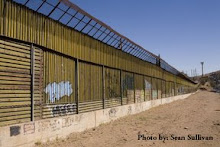
The march that had started on Wednesday and gone 57 miles along the future route of the border wall in far west Texas. Being that late, and having not been that close to the actual border wall before, I was feeling almost like a "fly on the wall," having almost an out-of-body experience and getting a physical, psychological, and spiritual shock at the sight of the ugly wall. It's one thing to see a picture of it; it's another to see it up close, to touch it.
I parked hurriedly, spotting the rally in progress a hundred yards up the mountain in Sunland Park at the border wall there. I started up the hill, joining a journalist as we walked to join the group of 200 people present on both sides of the wall, most kneeling in the dust of the Border Patrol's road alongside the American side of the wall, in the shadow of the camera towers. It was a somber scene, full of the intensity of those who had marched, and the silent recognition by the rest of us of their effort.
Smudge pots by Native American elders burning, most heads bowed, blue, yellow and white butterflies flying up and hitting the wall and falling back over and over, the tired marchers standing a bit apart from the rest of us, the Mexican people gazing through the heavy mesh of the fence as the prayer ended at our sad faces and our signs that proclaimed our friendship and the injustice of a border wall, the indigenous drum beat THRUM-THRUM-THRUM, the sudden, loud call of the Native American woman as the priest said Amen, the Farm Workers Union leader then speaking of the travesty of this wall, hearts heavy on both sides, the priest asking us all to come up to the wall and touch a "brother and a sister's hand." Which we did, tears flowing on both sides.
Some brave few crested the steep hill where the border wall disappeared into the sky. They waved and shouted before heading back down; an elderly Hispanic man picked up tiny pieces of litter off the ground offering the tired marchers a ride to the parking lot in his truck; others trudging back down, arm in arm, to listen to more speeches as marchers on the U.S. side handed food, clothing and camping equipment over the top of the wall to a small crowd of children. Children as young as four were easily able to reach the top of the wall by standing on each other's shoulders.
We hugged and waved goodbye to our sisters and brothers on both sides of the wall.
That day, the wall was a bridge, not a divider. You could touch someone's fingertips through the mesh. You could look into their eyes. You could walk alongside them and speak. You could pray together. The road alongside the border wall was not a military road Sunday -- it was a church, a holy place; it was a place to kneel and pray. It was a place that the indigenous people could call from to the Great Spirit. The wall became a bridge for those few moments -- but as we looked back, its hideous shape reasserted, a physical reminder of our nation's insecurity, its hatreds, its racism, in the form of a wall that was easily breached, even by children.
Yet the butterflies reminded us how solid the wall was, how impenetrable to the helpless animals. The children, not helpless, calling to us, reminded us that our fancy cars and clothes meant we had something to give that they needed. The march’s leaders and activists on both sides of the wall reminded us of the social injustice of border walls, and that the "March had just begun." The priests reminded us that our brethren on the Mexican side of the wall were no different than we were in the sight of God. Indeed.
The sight of the border wall reminded us of the reality of a wall, how grotesque it really is. How useless, really. While the wall stands, we have a chance to wake up to our own fears and the horrible result of these fears. So go see the wall, and symbolically write your own fears, your own hatred, your own racism, upon its surface, as I did last Sunday. Release your fears and be done with them. Lay flowers there. Pray. Watch the butterflies smack against it. Watch the children, laughingly, climb it in five seconds.
The day the wall comes down, we will recognize those fears fully as being exposed and dealt with. We will have overcome them.
Adrienne Evans is a mother, health practitioner and community volunteer who lives in Terlingua, Texas. She is the co-founder of No Wall – Big Bend coalition. For more info, visit http://www.nowallbigbend.blogspot.com/.
Showing posts with label Big Bend. Show all posts
Showing posts with label Big Bend. Show all posts
Tuesday, September 9, 2008


Thursday, August 28, 2008
No Border Wall Endorses the People’s March to Stop the Wall
The No Border Wall Coalition strongly endorses the Border People’s March to Stop the Wall, currently underway on the Texas – Mexico border. Marchers will follow the route of the 57-mile segment of border wall that is being built from Ft. Hancock, Texas, to El Paso, Texas. Led by No Wall – Big Bend and the Border Ambassadors, they plan to highlight the tremendous human and environmental costs of the wall in west Texas and along the entire U.S. – Mexico border.
Marchers will set off from Fort Hancock today, and arrive in El Paso on Sunday, August 31. More information about the march and its route is available at the Border Ambassadors website - www.borderambassadors.com .
Of special concern along the marchers’ route is the impact of the border wall on Native American communities. Like the Tohono O’Odham farther west, the lands that the Ysleta del Sur Pueblo of the Tigua Nation calls home lie on both sides of what is now the international border. The Rio Grande is crucial not only for providing water in a harsh, dry environment, it is also integral to their religious practices. As the Rio Grande is walled off, the Tiguas have stated that they will be cut off from graves and sacred sites.
There are laws on the books, most notably the American Indian Religious Freedom Act and the Native American Graves Protection and Repatriation Act, that should prevent this assault on the Tiguas religion and culture. But section 102 of the Real ID Act allows Department of Homeland Security Secretary Chertoff to brush aside any law that might slow construction of the border wall. On April 1, 2008 he did just that, “waiving in their entirety” 36 federal laws including the American Indian Religious Freedom Act and the Native American Graves Protection and Repatriation Act.
The Tiguas are party to a challenge to the constitutionality of the Real ID Act’s waiver provision, alleging that giving an unelected administration appointee the power to waive laws passed by Congress and signed by the President for the express purpose of subverting the judiciary is a violation of the separation of powers enshrined in the U.S. Constitution. They are joined by El Paso County, the El Paso County Water Improvement District No. 1, the Hudspeth County Conservation and Reclamation District No. 1, Galeria 409, The Frontera Audubon Society, the Friends of the Wildlife Corridor, and the Friends of Laguna Atascosa National Wildlife Refuge. The wide spectrum of plaintiffs challenging the Department of Homeland Security’s suspension of laws points to the broad range of negative impacts that the wall will have in Texas, as well as the rest of our nation’s borderlands.
The same river that provides a focal point for the Tiguas’ religious ceremonies is equally important for the survival of plant, animal, and human communities. The Rio Bosque Wetlands Park has also spoken out against the wall, stating that, “A fence would limit the ability of native terrestrial species to move between such areas and the floodway. It would limit genetic exchange and would fragment populations that are currently connected.” As habitat is fragmented and access to the river is denied, animals, particularly those that are listed as federally threatened or endangered, may not survive.
With border wall construction currently under way near El Paso and elsewhere, it is critically important that we remind members of Congress that the elections that they are currently obsessed with are just the entrance exam for their jobs. Elections are meant to bring in public servants, and it is their job to serve the best interests of the American people. Building walls that will cut off the Rio Grande, that will disrupt Native American religious practices and disturb graves, that will destroy natural areas such as the Rio Bosque Wetlands Park, and will cost U.S. taxpayers billions of dollars, is unconscionable. As our public servants once again come before the American people, asking for our votes, it is important that they know that we will hold them accountable for their actions.
Marchers will set off from Fort Hancock today, and arrive in El Paso on Sunday, August 31. More information about the march and its route is available at the Border Ambassadors website - www.borderambassadors.com .
Of special concern along the marchers’ route is the impact of the border wall on Native American communities. Like the Tohono O’Odham farther west, the lands that the Ysleta del Sur Pueblo of the Tigua Nation calls home lie on both sides of what is now the international border. The Rio Grande is crucial not only for providing water in a harsh, dry environment, it is also integral to their religious practices. As the Rio Grande is walled off, the Tiguas have stated that they will be cut off from graves and sacred sites.
There are laws on the books, most notably the American Indian Religious Freedom Act and the Native American Graves Protection and Repatriation Act, that should prevent this assault on the Tiguas religion and culture. But section 102 of the Real ID Act allows Department of Homeland Security Secretary Chertoff to brush aside any law that might slow construction of the border wall. On April 1, 2008 he did just that, “waiving in their entirety” 36 federal laws including the American Indian Religious Freedom Act and the Native American Graves Protection and Repatriation Act.
The Tiguas are party to a challenge to the constitutionality of the Real ID Act’s waiver provision, alleging that giving an unelected administration appointee the power to waive laws passed by Congress and signed by the President for the express purpose of subverting the judiciary is a violation of the separation of powers enshrined in the U.S. Constitution. They are joined by El Paso County, the El Paso County Water Improvement District No. 1, the Hudspeth County Conservation and Reclamation District No. 1, Galeria 409, The Frontera Audubon Society, the Friends of the Wildlife Corridor, and the Friends of Laguna Atascosa National Wildlife Refuge. The wide spectrum of plaintiffs challenging the Department of Homeland Security’s suspension of laws points to the broad range of negative impacts that the wall will have in Texas, as well as the rest of our nation’s borderlands.
The same river that provides a focal point for the Tiguas’ religious ceremonies is equally important for the survival of plant, animal, and human communities. The Rio Bosque Wetlands Park has also spoken out against the wall, stating that, “A fence would limit the ability of native terrestrial species to move between such areas and the floodway. It would limit genetic exchange and would fragment populations that are currently connected.” As habitat is fragmented and access to the river is denied, animals, particularly those that are listed as federally threatened or endangered, may not survive.
With border wall construction currently under way near El Paso and elsewhere, it is critically important that we remind members of Congress that the elections that they are currently obsessed with are just the entrance exam for their jobs. Elections are meant to bring in public servants, and it is their job to serve the best interests of the American people. Building walls that will cut off the Rio Grande, that will disrupt Native American religious practices and disturb graves, that will destroy natural areas such as the Rio Bosque Wetlands Park, and will cost U.S. taxpayers billions of dollars, is unconscionable. As our public servants once again come before the American people, asking for our votes, it is important that they know that we will hold them accountable for their actions.
Saturday, May 24, 2008
Presidio does the right thing in joining the Texas Border Coalition border wall lawsuit
by Adrienne Evans
On Tuesday, May 20, after input from citizens and discussion among the mayor and council, the Presidio City Council voted to join the Texas Border Coalition (TBC), a coalition of Texas border cities, counties, chambers of commerce, and economic development corporations, representing over two million border residents from El Paso to Brownsville. Presidio is scheduled by DHS for levee-wall construction this year, along with Cameron and Hidalgo Counties.
On February 19, the Presidio City Council passed a resolution that stated that they opposed “the building of a wall along the Texas/Mexico border that extends over 135 miles of border,” as well as “a wall specifically in the Big Bend Area of Texas,” in that “the building of the border wall will impact our region, through trade, tourism, and unfriendly relations within border alliances”. The Presidio County Commissioners, the City of Marfa, the City of Alpine, and the City of El Paso passed similar resolutions.
At the Border Wall Conference in Alpine on May 17, U.S. Border Patrol Deputy Chief Carry Huffman stated in reference to a border wall in Presidio, “As I mentioned earlier, Presidio is not a place that is out of control. Apprehensions in Presidio are relatively low.” After delineating examples of the existing problems in the Marfa Sector, Huffman said, “We anticipate that traffic will be moving through the Ojinaga area,” as the rationale for the border wall.
During a presentation at the Tuesday City Council meeting, Redford resident and border activist April Cotte stated, “I have spoken with five landowners who are very against this, whose land will be affected.”
Mayor Lorenzo Hernandez said, “The thing that really bothers me is those big, old lines that we have to wait in [at the port of entry]. Two Sundays ago, people were complaining about waiting three hours to pass. So if this coalition could help us out that and help the businesses in Presidio, I don’t see why we shouldn’t join. … About the relationship between Presidio and Ojinaga … how is [the border wall] going to affect the relationship with those people? And they know they need Presidio just as much as we need them. And I don’t think this wall is going to help that relationship.”
Before the council voted to join the TBC, there was a discussion about alternatives to the border wall, such as restoring the Rio Grande to its historical levels. The vote was unanimous.
During the city council meeting, Presidio City Attorney Steve Spurgin indicated that he would be in contact with the attorneys involved regarding legal action.
The TBC has recently filed a class action lawsuit against the government asserting, among other issues, that there was a lack of consultation with property owners and border communities about the construction of a border wall. The lawsuit is being brought pro bono by a team that includes lead attorney Peter Schey of the Center for Human Rights and Constitutional Law in Los Angeles.
In the legal complaint filed on May 16, 2008, it states that Secretary of Homeland Security Michael Chertoff has "failed to comply with the consultation requirement of the Consolidated Appropriations Act, 2008 … which requires consultation with private property owners and cities and other stake-holders to minimize the impact on the environment, culture, commerce, and quality of life for the communities and residents located near the sites at which activities relating to border fencing may occur.”
The chair of the TBC is Chad Foster, the mayor of Eagle Pass. In the complaint filed last week, which names as the plaintiff, TBC, and as defendants, Secretary Chertoff as well as Robert F. Janson of U.S. Customs and Border Protection, Mayor Foster is quoted about never receiving “any logical answers from defendants as to why certain areas in his city have been targeted for fencing over other areas: ‘I puzzled a while over why the fence would bypass the industrial park and go through the city park.’”
After the Presidio city council's vote, lifelong Redford resident Enrique Madrid, who attended the meeting with his wife Ruby, said, “Today, May 20, is the eleventh anniversary of the killing of Esequiel Hernandez Jr. Instead of a human form of militarization like the Marines killing Esequiel, this border wall is an engineering form of militarization, which is just as inhumane and brutal as deploying the Marines on U.S. soil in Redford was, eleven years ago."
On May 20, 1997, Esequiel Hernandez, Jr., an 18-year-old high school student, was killed by U.S. Marines near his home in Redford, Texas, which is 12 miles from Presidio. He was the first U.S. citizen to be killed by members of the U.S. Armed Forces since an incident where student demonstrators were massacred at Kent State University by members of the Ohio National Guard in 1970. The documentary, The Ballad of Esequiel Hernandez, will air on PBS on July 8. It is narrated by Tommy Lee Jones and directed by Kieran Fitzgerald.
Mr. Madrid went on to say that “it was appropriate that the City of Presidio, in its own way, commemorated the death of Esequiel Hernandez by rejecting this new manifestation of militarization on this day. It’s like there’s a light at the end of the tunnel, that there is hope, that justice will be permitted, finally. Justice is a natural right that should be freely flowing, and the City of Presidio is supporting that.”
###########
Adrienne Evans is a mother, health practitioner and community volunteer who lives in Terlingua, Texas. She is the co-founder of No Wall – Big Bend coalition. For more info, visit www.NoWallBigBend.blogspot.com.
This op-ed first appeared in the Big Bend Sentinel, the Presidio International, and the Rio Grande Guardian.
On Tuesday, May 20, after input from citizens and discussion among the mayor and council, the Presidio City Council voted to join the Texas Border Coalition (TBC), a coalition of Texas border cities, counties, chambers of commerce, and economic development corporations, representing over two million border residents from El Paso to Brownsville. Presidio is scheduled by DHS for levee-wall construction this year, along with Cameron and Hidalgo Counties.
On February 19, the Presidio City Council passed a resolution that stated that they opposed “the building of a wall along the Texas/Mexico border that extends over 135 miles of border,” as well as “a wall specifically in the Big Bend Area of Texas,” in that “the building of the border wall will impact our region, through trade, tourism, and unfriendly relations within border alliances”. The Presidio County Commissioners, the City of Marfa, the City of Alpine, and the City of El Paso passed similar resolutions.
At the Border Wall Conference in Alpine on May 17, U.S. Border Patrol Deputy Chief Carry Huffman stated in reference to a border wall in Presidio, “As I mentioned earlier, Presidio is not a place that is out of control. Apprehensions in Presidio are relatively low.” After delineating examples of the existing problems in the Marfa Sector, Huffman said, “We anticipate that traffic will be moving through the Ojinaga area,” as the rationale for the border wall.
During a presentation at the Tuesday City Council meeting, Redford resident and border activist April Cotte stated, “I have spoken with five landowners who are very against this, whose land will be affected.”
Mayor Lorenzo Hernandez said, “The thing that really bothers me is those big, old lines that we have to wait in [at the port of entry]. Two Sundays ago, people were complaining about waiting three hours to pass. So if this coalition could help us out that and help the businesses in Presidio, I don’t see why we shouldn’t join. … About the relationship between Presidio and Ojinaga … how is [the border wall] going to affect the relationship with those people? And they know they need Presidio just as much as we need them. And I don’t think this wall is going to help that relationship.”
Before the council voted to join the TBC, there was a discussion about alternatives to the border wall, such as restoring the Rio Grande to its historical levels. The vote was unanimous.
During the city council meeting, Presidio City Attorney Steve Spurgin indicated that he would be in contact with the attorneys involved regarding legal action.
The TBC has recently filed a class action lawsuit against the government asserting, among other issues, that there was a lack of consultation with property owners and border communities about the construction of a border wall. The lawsuit is being brought pro bono by a team that includes lead attorney Peter Schey of the Center for Human Rights and Constitutional Law in Los Angeles.
In the legal complaint filed on May 16, 2008, it states that Secretary of Homeland Security Michael Chertoff has "failed to comply with the consultation requirement of the Consolidated Appropriations Act, 2008 … which requires consultation with private property owners and cities and other stake-holders to minimize the impact on the environment, culture, commerce, and quality of life for the communities and residents located near the sites at which activities relating to border fencing may occur.”
The chair of the TBC is Chad Foster, the mayor of Eagle Pass. In the complaint filed last week, which names as the plaintiff, TBC, and as defendants, Secretary Chertoff as well as Robert F. Janson of U.S. Customs and Border Protection, Mayor Foster is quoted about never receiving “any logical answers from defendants as to why certain areas in his city have been targeted for fencing over other areas: ‘I puzzled a while over why the fence would bypass the industrial park and go through the city park.’”
After the Presidio city council's vote, lifelong Redford resident Enrique Madrid, who attended the meeting with his wife Ruby, said, “Today, May 20, is the eleventh anniversary of the killing of Esequiel Hernandez Jr. Instead of a human form of militarization like the Marines killing Esequiel, this border wall is an engineering form of militarization, which is just as inhumane and brutal as deploying the Marines on U.S. soil in Redford was, eleven years ago."
On May 20, 1997, Esequiel Hernandez, Jr., an 18-year-old high school student, was killed by U.S. Marines near his home in Redford, Texas, which is 12 miles from Presidio. He was the first U.S. citizen to be killed by members of the U.S. Armed Forces since an incident where student demonstrators were massacred at Kent State University by members of the Ohio National Guard in 1970. The documentary, The Ballad of Esequiel Hernandez, will air on PBS on July 8. It is narrated by Tommy Lee Jones and directed by Kieran Fitzgerald.
Mr. Madrid went on to say that “it was appropriate that the City of Presidio, in its own way, commemorated the death of Esequiel Hernandez by rejecting this new manifestation of militarization on this day. It’s like there’s a light at the end of the tunnel, that there is hope, that justice will be permitted, finally. Justice is a natural right that should be freely flowing, and the City of Presidio is supporting that.”
###########
Adrienne Evans is a mother, health practitioner and community volunteer who lives in Terlingua, Texas. She is the co-founder of No Wall – Big Bend coalition. For more info, visit www.NoWallBigBend.blogspot.com.
This op-ed first appeared in the Big Bend Sentinel, the Presidio International, and the Rio Grande Guardian.
Subscribe to:
Posts (Atom)