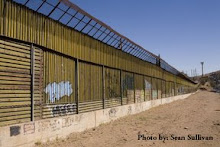
Showing posts with label Eagle Pass. Show all posts

Sunday, August 23, 2009

Will Ciro Rodriguez Stop a New Round of Border Walls?

By Scott Nicol

U.S. Representative Ciro Rodriguez, whose district stretches from San Antonio to the border communities of Eagle Pass, Del Rio, and Presidio, will play a key role in determining whether or not more border walls are built in Texas. After Congress returns from its August recess, Rodriguez will serve on the Conference Committee responsible for reconciling the House and Senate versions of the Department of Homeland Security’s 2010 Appropriations Bill. The Senate’s version contains an amendment requiring the construction of up to 369 miles of new border walls, while the House version makes no mention of walls.

Ignoring the destructive impacts on municipalities, private property, and wildlife refuges that Texas has already suffered, Senators Hutchison and Cornyn both voted for more border walls.

Based on his record, there is hope that, in contrast to Texas’ Senators, Representative Rodriguez will stand up for his constituents and work to strip the border wall amendment from the bill. But a recent action also gives reason for concern.


Standing up for Texas border communities would certainly be welcomed by those in Representative Rodriguez’ district who live along the Rio Grande. Eagle Pass was the first such municipality that the Department of Homeland Security (DHS) sued to condemn land for the border wall.


Representative Rodriguez has made efforts to lessen the border wall’s impact and give the Secretary of Homeland Security the latitude to spare Eagle Pass and other border communities. He inserted an amendment into the 2008 supplemental appropriations bill which changed the Secure Fence Act to read,

“nothing in this paragraph shall require the Secretary of Homeland Security to install fencing, physical barriers, roads, lighting, cameras, and sensors in a particular location along an international border of the United States, if the Secretary determines that the use or placement of such resources is not the most appropriate means to achieve and maintain operational control over the international border at such location.''

Since the Congressional Research Service had already determined that border walls have “no discernible impact” on the number of undocumented immigrants and smugglers who cross the border each year, it should have been easy for then-Secretary Chertoff to decide that walls were not the most appropriate means to control the border. Unfortunately, neither he nor current DHS Secretary Napolitano has been willing to take the political heat and halt the construction of more “expensive and useless” walls.


Rep. Rodriguez also joined the rest of Texas’ border representatives in asking President Obama to “suspend construction of border fencing” until a cost-benefit analysis could be conducted and consultation with local stakeholders could be initiated. He also signed on to a letter calling on DHS to monitor the damage caused by the wall and establish a mitigation fund.

So clearly, Rodriguez can be counted on to remove the border wall building amendment from the DHS appropriations bill, right?

Maybe not. In July, Rep. Rodriguez co-sponsored the Secure America with Verification and Enforcement (SAVE) Act. One provision of the SAVE Act states,

“[T]he Secretary shall construct or purchase […] additional fencing (and aesthetic fencing in business districts) in urban areas of the border; and vehicle barriers, to support, not replace, manpower, in rural and remote areas of the border necessary to achieve operational control of the international borders of the United States.”

So despite his prior record of opposing the border wall, Representative Rodriguez is now co-sponsoring a bill that calls for more wall construction, which may cut through the communities he serves.

This earned Representative Rodriguez and the rest of the SAVE Act’s co-sponsors a congratulatory letter from Roy Beck, president of the anti-immigration group NumbersUSA, who said, “It is with highest enthusiasm and expectation that NumbersUSA endorses your re-introduction of the SAVE Act.”

NumbersUSA has been denounced by the Southern Poverty Law Center for its ties to nativist and racist organizations. Roy Beck himself was a longtime editor of the white nationalist publication The Social Contract, and NumbersUSA shares a Washington, DC office with the anti-immigrant group ProEnglish. One would expect that their enthusiastic endorsement would be as welcome as that of the Ku Klux Klan.

Representative Rodriguez’s support for the SAVE Act muddies his record as an advocate for the border communities in his district and begs the question: what will he do in Conference Committee? Will he work to strip border walls from the DHS bill, or allow them to tear through his constituents’ communities? Will he side with Chad Foster, or Roy Beck?

It is possible that Representative Rodriguez’ support for the walls in the SAVE Act is a response to the right wing’s howls that he and Senator Hutchison “gutted” the Secure Fence Act when they gave DHS the flexibility to decide whether or not to wall off a given refuge, community, or family farm. Senator Hutchison has been unable to stand up to the right’s criticism, and has given the border wall unwavering support ever since.

Ultimately, Representative Rodriguez was not elected to serve Roy Beck. Ciro Rodriguez is in Washington DC to represent the interests of Eagle Pass, Del Rio, Presidio, and other communities that are threatened with border wall construction. If he fails to act on their behalf by removing the border wall amendment from the DHS bill, more of his constituents will see border walls tear through their communities.

Tuesday, November 18, 2008

DHS Ignoring the Rights of Private Property Owners to Build the Border Wall

Texas RioGrande Legal Aid’s Communications Director Cynthia Martinez was invited to testify on TRLA’s work with border landowners at a hearing held by the Mexican American Legislative Caucus on November 13th. Below is the text of her statement before the committee. A copy is also available in pdf format.

*****
Mr. Chairman and members of the Mexican American Legislative Caucus-

Thank you for the opportunity to speak here today. My name is Cynthia Martinez and I am the Communications Director for Texas RioGrande Legal Aid, also known as TRLA. TRLA is a non-profit organization that provides free legal services to low-income clients in 68 counties in Texas. We are the largest provider of legal aid in Texas and the third largest in the United States.

For more than a year now, TRLA has worked in Texas border communities where the wall is going to be constructed to educate landowners on their legal rights and fight on behalf of low-income landowners who are at risk of losing their livelihoods. Our work has focused primarily on the Rio Grande Valley and in Eagle Pass.

TRLA does not take a policy position on whether the wall should be constructed. Our focus is solely on the legal rights of border landowners and residents as the wall is being built and once it is complete.

Throughout our efforts, our work has focused on one primary belief - in the process to construct the border wall the federal government has chosen to sacrifice the basic legal rights of border landowners in the interest of meeting an arbitrary deadline.

Almost eighteen months ago it became clear that the Department of Homeland Security was developing plans for the border wall that would require private landowners to give up their land in the name of homeland security. To date, DHS has sued approximately 100 landowners in the Rio Grande Valley alone to survey their property or begin the eminent domain process.

According to their own public statement, Homeland Security anticipates suing more than 250 landowners to construct the border wall.

About a year ago, in an effort to make sure that landowners were aware of their legal rights before the process began, TRLA attorneys organized community meetings throughout the Rio Grande Valley to bring landowners together and inform them of their legal rights.

At these meetings, landowners were clear that they had several concerns. They wanted to know:

- Where the wall was going to be built
- If they could keep the government from taking their land
- If they would be compensated for losing their land or any inconveniences that occur as a result of the wall’s construction
- What a wall meant for their community and their daily life

They had questions and the government was not doing anything to give them answers. So we did our best to help. In fact, many times we brought maps and information to these meetings that the residents had never seen before.

As early as June 2007 federal officials began approaching landowners for permission to survey their land so that they could begin to plan where the wall would be constructed. They would approach these landowners with documents - only available in English - and tell them that the government would sue them if they did not agree to the survey.

Many of these landowners are Spanish - dominant and all of them have a sincere respect for our government and its laws. To be approached by a federal agent, with legal documents only available in English, and to be told that the government will sue you if you don’t sign the forms left many landowners feeling as though they had no choice.

So many of them signed these documents and did so not knowing what they were signing or what their rights were. Other landowners took the request and refused to sign or sought help from an attorney. Many of these families turned to Texas RioGrande Legal Aid for help.

At this point, TRLA has represented nine families in their border wall litigation and provided legal advice to a countless number of border landowners on their legal rights throughout this process.

While all of our clients are determined to keep fighting for their land, you’d be hard pressed to find a couple more willing to fight than Baldomero and Hilaria Muniz.

Baldomero and Hilaria Muniz are an elderly couple who live in Los Ebanos. They spent their entire lives working as migrant workers to save up enough money to buy a small plot of land, build a house, and raise their children. In their old age, they use their land to raise goats which they sell to have a source of income. Their land is literally their livelihood - and the government wants to take it.

Both the Muniz family and the family of Pamela Rivas were approached around June 2007 to sign waivers that would allow the government to survey their land. But both families decided to put up a fight. Neither family wanted to let the government survey their land and certainly neither family wanted to be forced into giving up their land for the wall’s construction. The government never even had a conversation with these families about the issue. So both families refused to sign the waiver - and they were sued.

From the beginning, their defense was simple - the government failed to negotiate a reasonable price for having access to their land - a process it is required to go through by law. Instead, without consulting with these families, the government set its own price - zero dollars. Zero dollars for the inconvenience of having to let federal officials have access to their land and possibly damage it in the surveying process.

The offer was disingenuous and disrespectful. So TRLA represented both families in appeals that took us all the way to the Fifth Circuit Court of Appeals in New Orleans. The Muniz family, with few resources, was unable to afford the trip to see our attorneys fight on their behalf.
Unfortunately, our efforts were not successful in stopping the condemnation process and both families are currently being sued by the government for possession of their land. At this time, the future of their property is unclear.

Five of our families in the Eagle Pass area have taken a proactive approach and sued DHS for failing to consult or negotiate with them before taking their property and beginning construction on the border wall. In their lawsuit, the families also pointed out that DHS did consult with wealthy, Caucasian landowners in the area and has avoided using their properties in its final construction plans. This is an allegation that many landowners and even the media have made - but that the government has not addressed.

One of our families, the family of Oscar Ceballos, fought the government’s attempt to take his land, which is located approximately two miles from the border in the Rio Grande Valley, by arguing that Congress intended the wall to be built along the border - not in the border area. We were not successful, but in his decision United States District Judge Andrew Hanen did state that “once again, the nation has placed a burden on the citizens of south Texas that is clearly disproportional to that being borne by other locales.” That statement is the only consolation Mr. Ceballos has as the government proceeds with the condemnation process. It should be noted that originally the government intended to offer Mr. Ceballos $1600 for his property. Because of his determination to exercise his legal rights, a federal appraisal has valued his property at more than $30,000.

Currently many of our families and border residents live in a cloud of uncertainty. Late last week, Homeland Security announced that it would temporarily be halting the construction of the wall in certain border communities. If media reports are true, this could leave room for a new Congress and administration to alter or even eliminate construction plans. However, at this point, this is all speculation. All we know for sure is that the federal government is continuing with its lawsuits against border landowners to condemn their land.

Other border residents have a handful of questions, but no answers. Once the wall is constructed, life for border residents will change in ways that have yet to be explored. Will their land be damaged during the wall’s construction? Will they have to travel several miles to have access to their land if their property is cut in half by the wall? Will they have to become accustomed to border patrol agents asking them if they are U.S. citizens when they are on their own property? If their neighbor’s property is protected by a wall but theirs is not, will they get help to protect their own security? If their land is taken, will they be compensated appropriately?

In a speech in February 2008 at the Kennedy School of Government, Homeland Security Secretary Michael Chertoff characterized border landowners as fighting the wall’s construction because they are concerned that the wall will spoil their view or inhibit their cattle’s ability to get to the river.

Such a characterization is wrong, naïve, and dangerous. And it is important that policymakers understand that this isn’t about being able to see sunsets or a cow’s freedom.

These families are fighting for their livelihoods and, in doing so, they are only exercising the legal rights that have been guaranteed to them by the laws of this country.

Homeland Security officials have not been silent on the issue - in the press they have made it very clear that the wall will not be finished by the end of the year as planned and that’s largely due to the fight that landowners such as our clients have waged.

As you can imagine, we have not apologized for this.

At TRLA we take our commitment to these communities very seriously and we remain dedicated to fighting alongside them as the construction of the wall proceeds.

If there is one decisive legal victory we have had in this fight it is that all the courts have agreed on one thing - these landowners have the right to question their government and fight for their property. And that’s what they’re going to continue to do, even if it comes as an inconvenience to the federal government.

Tuesday, July 29, 2008

Hurricanes and Border Walls Don’t Mix

The Texas Border Coalition, which describes itself as a collective voice of border mayors, county judges, and economic development commissions along Texas' border with Mexico, released the following statement regarding the border wall in South Texas:

EAGLE PASS, Texas – (July 25, 2008) – As South Texans continue to repair roofs, roads and lives damaged by Hurricane Dolly, the chairman of the Texas Border Coalition (TBC) repeated his protest today that hurricanes and the border wall don’t mix.

TBC Chairman and Eagle Pass Mayor Chad Foster objected to a new plan by the Department of Homeland Security (DHS) to build 14 miles of movable wall in the U.S.-Mexico border floodplain that would have to be torn down within 24 hours of the next hurricane or other flood event.

“Hurricane season is not over with the downgrading of Dolly,” Foster said. “Not only does DHS plan to continue its piecemeal approach to protecting the lives of South Texans, now they plan a total absurdity: a movable wall.”

“If a movable wall were in place today, over 1,000 workers would be needed to tear it down within 24 hours, load it on to hundreds of trucks to take it north,” said Foster. “They would be doing so instead of battening down their homes for the storm or evacuating their families from its wrath.”

According to the latest information available about the movable wall, it would be constructed of steel bollards 18 feet above ground, filled to the 10-foot level with concrete. By TBC’s back-of-the-envelope estimations, the 14-mile movable wall would be made of nearly 90,000 steel bollards, each weighing about 1,700 pounds.

To achieve its goal of removing the wall, the DHS would have to haul away 151 million pounds of unwieldy pipe filled with concrete. Who will move it and with what equipment is unclear.

“The people of the Rio Grande Valley, having just experienced the rapid emergency work necessary to protect the people in advance of a hurricane, know that DHS’ movable wall is simply ridiculous,” Foster said.

“It is an outrage that that DHS is so arrogant, out of control and headstrong to build a wall that even Homeland Security Secretary Michael Chertoff admits won’t work – that illegal crossers will go around, over, through and under it,” Foster said. “In doing so, they are wasting $50 billion of the taxpayers’ money for a wall that everyone knows won’t work.”

Foster added, “This is the result of Secretary Chertoff’s waiver of 34 laws to build the wall. By repealing these laws, DHS has avoided scrutiny from the public and government agencies, essentially voiding our system of checks and balances. It would have made more sense, and saved taxpayers hundreds of millions of dollars, if DHS had simply consulted with border residents and border officials first. We certainly would not have suggested a 151-million-pound movable wall.”

The Texas wall is being built more than 1 mile from the border, trapping workers, families, farmers, ranchers, and retirees on the Mexican side. The wall will cede thousands of acres of U.S. land to Mexico and endanger the lives of people when they need assistance from emergency or law enforcement personnel who won’t be able to reach them.

“Illegal border crossing won’t be controlled until the U.S. has a well-run immigration system that expands avenues for legal workers and cracks down on illegal hiring,” Foster said.

When immigration is reformed, the U.S. won’t need a border wall, although the nation will continue to require beefed up Border Patrol and Customs forces to halt illegal drug smuggling. The border wall will be torn down, he added.

“We thank goodness that Hurricane Dolly jogged north of the Rio Grande river just before hitting Texas. As my friends and neighbors give thanks for being spared from what could have been the worst catastrophe of their lives, Congress and President Bush should stop the construction of an absurd movable border wall that they’ll have to tear down,” Foster said.

# # #

The Texas Border Coalition (TBC) is a collective voice of border mayors, county judges, economic development commissions focused on issues that affect more than 6 million people along the Texas-Mexico border region and economically disadvantaged counties from El Paso to Brownsville. TBC is working closely with the state and federal government to educate, advocate, and secure funding for transportation, immigration and ports of entry, workforce and education and health care. For more information, visit the coalition Web site at www.texasbordercoaltion.org.

Wednesday, January 16, 2008

Homeland Security is suing landowners to build the border wall

Texas Rio Grande Legal Aid issued the following press release:

WESLACO, Texas – Texas RioGrande Legal Aid (TRLA), the leading provider of legal aid in Texas, is making itself available to border landowners facing lawsuits from the Department of Homeland Security (DHS) for access to their land to build a wall along the Texas-Mexico border.
The lawsuits come after DHS requested access to landowners’ property to plan the location of a wall along the United States – Mexico border. Approximately 600 landowners received requests and an estimated 70 Texas landowners who refused to comply are expected to be sued by Homeland Security as a result.

DHS’s first lawsuit was filed against the City of Eagle Pass on Monday. That same day United States District Judge Alia M. Ludlum ruled on the matter and ordered Eagle Pass to allow government surveyors to access 233 acres of city land for 180 days. In exchange, the federal government paid $100. The orders came without any opportunity for the City of Eagle Pass to voice an objection.

According to TRLA attorney Rebecca Webber, “The fact that the Department of Homeland Security would resort to these fly-by-night tactics in Eagle Pass signals that a tough legal battle lies ahead. We’re preparing for it.”

Border landowners throughout Texas have been anticipating the federal government’s actions for several months. Members of GLOW (Granjeno Landowners Opposed to the Wall) have spent the last two weeks waiting for any sign that the government will be taking legal action against them.

“Many of these landowners are afraid that the government is going to take away land that has been in their families for hundreds of years. They may not have much, but they’re willing to fight to keep it,” added Webber. “For many of them, the anxiety of not knowing what is going to happen has been stressful enough.”

TRLA has partnered with the South Texas Civil Rights Project to provide free legal services to landowners needing representation, regardless of their income level. The groups are available to make referrals to private attorneys, provide general legal advice, and represent landowners in government lawsuits.

“Texas RioGrande Legal Aid is available to provide free legal advice at every step of this process,” added Executive Director David Hall. “If landowners don’t want the wall built on their land or want to make sure that they get the best possible price for their property, we can help.”
TRLA encourages landowners needing legal assistance regarding the border wall to call 1-866-757-1570.

Established in 1970, Texas RioGrande Legal Aid, Inc. (TRLA) is a nonprofit organization that provides free civil legal services to low-income and disadvantaged clients in a 68-county service area. TRLA’s mission is to promote the dignity, self-sufficiency, safety and stability of low-income Texas residents by providing high-quality civil legal assistance and related educational services.

Contact:
Rebecca Webber, Attorney
956.447.4844 rwebber@trla.org

Cynthia Martinez, Communications Director
512.374.2764 cmartinez@trla.org