Showing posts with label University of Texas. Show all posts

Sunday, September 28, 2008

Art Against the Wall

By Scott Nicol

International borders are abstract concepts, little more than lines on maps that we imagine upon the earth. Existing outside of the real world of rivers, mountains, or deserts, political boundaries have no bearing on ecosystems. Ephemeral, the lines shift from decade to decade, century to century, making old maps obsolete. Still, the map and the concept that it represents are privileged over the actual landscape. The wall under construction along the U.S.-Mexico border is an attempt to impose a political fantasy upon living ecosystems, to transform a line on a map into a permanent line of concrete and steel on the land.

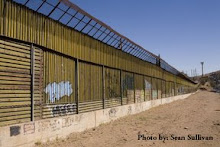
The border wall is meant to enforce division, to block the migration of humans based on the national boundary that encircled them at birth. Near San Diego it consists of parallel 18 foot tall steel walls with stadium lights, cameras, and a road in between. In Arizona rusted steel landing mats left over from the Vietnam War have been welded together and driven into the earth. Three hundred and thirteen miles of pedestrian walls and vehicle barriers had been built by March 31, 2008; another six hundred and seventy miles are to be built by January. Walls will slice through parks and National Wildlife Refuges, communities and businesses, farms and homes. They will stop the movement of endangered species such as the Sonoran pronghorn and ocelot, but according to the Border Patrol human migrants will only be slowed by a few minutes.

In the face of something so destructive and absurd, what role can art play?

Migrating from the campuses of South Texas College and the University of Texas at Brownsville to the McA2 Creative Incubator in McAllen, and scheduled to travel on to Monterrey, Mexico, the Art Against the Wall exhibition allows artists living along the border to address this question. Much of the work is didactic, like Monica Ramirez’ painting “International Friendship”, depicting a golden Statue of Liberty obscured by a crude stone wall with the words, “Give me your tired, your poor, your huddled masses yearning to breathe free…” written on its impasto surface. Oscar Martinez flirts with abstraction, using bands of paint and scraps of plywood to overwhelm a photograph of a concertina wire-topped prison fence in “Crossing the Dividing Line”. In “Anatomy of a Border Wall” Victor Alvarez and Rachael Brown digitally impose fencing onto landscapes that will soon be scarred by actual walls. These and other works in the show express a mix of fear and outrage at what the artists see as a tremendous injustice, an assault on border communities and American ideals. Political in its inception, this show and these artists want to stop the border wall.

The border wall is actually a series of walls with wide gaps in between, the first of which were built near San Diego, California in 1995. As more walls have been constructed near cities, immigrants have traveled deeper into the desert to get around them. This has lead to hundreds of deaths due to dehydration and exposure, a tragic situation that artists in Tijuana, Mexico wanted to bring to light. In 2003 they bolted coffins to the Mexican side of the border wall. Each was decorated and inscribed with a year and the number of crossers who had died that year. For 1995 the number of confirmed dead was 61; in 2000 there were 499. The artists sought to transform the border wall into a graveyard, a memorial to the dead that its construction had caused.

Like the graffiti that covered the West German face of the Berlin wall, the placement of the coffins both undermines the border wall’s authority and protests the authoritarianism that brought it into being. Removed from the art world of galleries and museums, they occupy the real world where people risk their lives to enter the United States, and where military means are marshaled to stop them. They are both a warning to crossers and a reproach to the United States. Affixed to the border wall the coffins become part of the reality of the wall, mediating the perception of the wall of those who encounter it. But they have not stopped further construction. Three years after their installation, and two weeks before the U.S. midterm elections, Congress passed the Secure Fence Act of 2006, calling for more than 700 miles of border wall modeled on the barrier from which the coffins hang.

The transformation of the map’s depiction to the reality of miles of walls is currently underway. Can more art reverse this conjuring trick? During the Spanish Civil War, with Franciso Franco attempting to overthrow Spain’s Republic and install himself as dictator, artists were commissioned to make work that would rally world opinion behind the Republican government to stop Franco’s advance. Pablo Picasso’s epic “Guernica”, with its chaotic disfigurement of humans and animals, was a reaction to the bombing of the Basque village of the same name in which 1,600 civilians died. The chaos of Picasso’s composition was meant to capture the raw terror felt by Franco’s victims as they desperately sought shelter. It has shaped our perception of the event and of Franco’s brutality, but it did not prevent him from taking Spain from democracy to fascist dictatorship.

A reproduction of “Guernica” hangs in the United Nations beside the door to the Security Council chamber. In 2003, when Colin Powell made his now infamous presentation to the UN Security Council laying out evidence for the invasion of Iraq, “Guernica” was covered with a blue banner. The United States did not want the backdrop for the call to war to be a depiction of the horrors of aerial bombardment. Picasso’s painting was viewed as a threat to the control of the message. In the intervening years support for the invasion of Iraq has plummeted, from 90% of Americans in favor of the war to 70% opposed. This dramatic shift was not the result of a single news report, act of protest, or work of art. It is the accumulation of all of these that has inexorably pushed the national debate.

The artists of the borderlands who seek to stop the walls hope for a similar result. Whether images on gallery walls or coffins on the border wall itself, the goal is to shape the conversation, moving it from the xenophobia and “broken borders” rhetoric of CNN’s Lou Dobbs to the lives and landscape that the border walls destroy. It is the art of engagement, addressing the world and addressed to the communities that these artists live in. Their hope is that the rest of the nation will engage in this dialogue and perceive the border walls as they do before more is lost.

This article originally appeared in Voices of Art magazine.

Monday, September 1, 2008

Rapoport Center Alleges that the Border Wall Violates Human Rights

A multi-disciplinary working group of faculty and students affiliated with the Rapoport Center for Human Rights and Justice at The University of Texas at Austin alleges that human rights are being violated by the United States through construction of the border wall. The working group submitted a series of briefing papers to the Inter-American Commission on Human Rights, an inter-governmental body of the Organization of American States composed of seven independent experts. The Commission’s mandate is to examine and monitor compliance by member States of the OAS, including the United States, with human rights obligations established in international law. Below is the full text of their letter. Their report on the human rights violations associated with the border wall is available at: http://www.utexas.edu/law/academics/centers/humanrights/publications/

August 27, 2008

Santiago A. Canton
Executive Secretary
Inter-American Commission on Human Rights
1889 "F" Street, N.W.
Washington, DC 20006
VIA FACSIMILE: (202) 458-3992

RE: Request for General Hearing on the Texas/Mexico Border Wall

Dear Secretary Canton:

I am writing to respectfully request that you schedule, during the 133rd period of sessions of the Inter-American Commission on Human Rights (the "Commission"), a general hearing on the human rights violations implicated in the construction by the United States of a border wall on the Texas/Mexico border. I am making this request in the name of the University of Texas Working Group on Human Rights and the Border Wall, a multi-disciplinary collective of faculty and students at the University of Texas at Austin, which has collaborated with individuals and communities affected by the border wall and Environmental Sciences faculty at the University of Texas at Brownsville, to highlight the human rights violations committed by the United States through planned construction of the wall. A list of working group members is attached to this request. The working group submitted a series of briefing papers to the Inter-American Commission on Human Rights in June 2008. Those papers can also be found at:
http://www.utexas.edu/law/academics/centers/humanrights/publications/

The working group now requests that the Commission urgently consider the matter of the Texas/Mexico border wall in a general hearing. Violations of human rights are already occurring as preparations are made for construction of the wall, and further serious violations are imminent as construction moves forward.

The United States Congress mandated construction of 670 miles of wall along the border between the United States and Mexico in the Secure Fence Act of 2006 and the Consolidated Appropriations Act for FY 2008 and further mandated that 370 miles of that wall be constructed by December 31, 2008. The Department of Homeland Security plans to fulfill this mandate by constructing hundreds of miles of wall along the Texas/Mexico border before the end of 2008.

The United States' plans for the wall have generated significant opposition and clamor for further consultation and deliberation, coming from within the United States and internationally. Many small landowners living along the river, who would see their properties divided in two by the wall, have struggled to defend themselves against the United States government's condemnation proceedings. A number of municipalities along the Texas/Mexico border have joined a class action suit against the United States government asserting that the United States failed to properly consult with individuals and communities affected by the wall or to negotiate fairly regarding the taking of land. Mexico has adopted a formal position against the wall as an affront to the climate of cooperation and joint responsibility that it believes should exist with the United States and has received support for this position from other Latin American countries. In 2006, the Mexican government presented a declaration against the wall at the Organization of American States that received the support of 27 other countries. Mexico also obtained a resolution at the Summit of the Americas urging the United States to reconsider its decision to build a wall. Other State entities, such as the Senate of Chile, have condemned the wall as well. Yet, the United States has not modified its plans to move forward with the wall, making this situation urgent.

The violations of human rights resulting from the border wall plans, which will be presented at the general hearing if granted, include:

Articles II and XXIII of the American Declaration on the Rights and Duties of Man ("American Declaration") guaranteeing equality before the law without distinction as to race, sex, language, creed or any other factor and guaranteeing the right to private property.

To build the wall, the United States is taking property that has been held by families for generations, in some cases dating back to Spanish and Mexican land grants from the 1700s and 1800s. Yet, the State is taking this property in an arbitrary and unjustified manner without properly considering other alternatives for controlling the border. The United States government has not explained why it is necessary to take property to build a border wall to meet the goals of impeding immigration and protecting national security. U.S. officials agree that the border wall will stop intending immigrants only for a matter of minutes and cannot point to national security breaches on the southern border of the United States. Nor has the U. S. government explained the rationale behind the placement of an intermittent fence in particular areas and not in others. The United States therefore cannot assert that the border wall, which violates property rights, is proportional and necessary to the goals it is said to meet.

In addition, the United States is treating property owners on the border unequally. Numerous small landowners will lose property to the wall while more lucrative developed properties and resorts are not included in the wall's path. A statistical analysis conducted by Professor Jeff Wilson of the working group demonstrates that the property owners impacted by the wall are poorer, more often Latino and less educated than those not impacted who also live along the border.

The wall will also negatively impact Native American communities, including individual landowners who are Lipan Apache and the federally recognized Kickapoo and Ysleta del Sur tribes that live and practice their traditional cultures and religions along the Texas/Mexico border. The InterAmerican system has repeatedly recognized the unique and vitally important rights to property and equal protection guaranteed to members of indigenous communities. Yet, the United States has not adequately considered the impact of the wall on indigenous communities in its construction plans.

Article IV of the American Declaration guaranteeing the right to freedom of investigation, opinion, expression and dissemination.

The United States has not acted with transparency regarding its plans to build the border wall. The United States has failed to provide specific information regarding the exact locations for the wall or to explain the rationale for those locations. It has been extremely difficult for anybody outside the United States government to determine even how much and what type ofwall is planned in which regions. In April 2008, the working group at the University of Texas filed requests under the Freedom of Information Act for documents and maps that would show the planned locations for the border wall and for records that might explain why the United States had decided to place the wall in certain areas rather than others as well as any information reflecting consideration given to the impact ofthe wall on Native American communities. As of this date, the United States government has failed to provide a single document or record, although federal law requires U.S. agencies to release information in response to a request under the Freedom of Information Act in a period of 20 days. The lack of transparency violates the right to freedom of investigation and dissemination. The paucity of information also makes it much more difficult to define the exact contours of other violations of rights, such as the right to property, since it is not even possible to identify all victims and impacts of the wall.

The lack of information also negatively affects the right of impacted individuals to be consulted and to express an opinion about the border wall. The "consultations" carried out by the United States have been characterized by this lack of transparency regarding critical information as well as by a lack of possibility for discussion of the relevant issues. Attendees at the handful of public meetings organized by United States government officials have consistently reported that private citizens had no opportunity to enter into any sort of dialogue or question-and-answer discussion with government officials regarding the border wall. Rather, participants listened to prepared statements by officials, which lacked detail, and then were told to record their comments in writing or online.

The lack of transparency and dialogue violates Article IV and has also made it impossible for the United States to comply with its obligation under the American Convention to ensure that no less restrictive alternatives to the wall exist and its obligation under International Labor Organization Convention No. 169 to consult with affected indigenous communities.

Articles V and XIII of the American Declaration protecting the right to private and family life and to culture.

The construction of a wall will irreparably damage a centuries-old culture in which families live and work on both sides of the Rio Grande River, which now constitutes the border between Texas and Mexico. The wall necessarily makes a powerful statement of separation of a community that has traditionally treated the border as a meeting point rather than a dividing line. The communities along the border have also always treated the Rio Grande River dividing Mexico and Texas and its wildlife as an important part of their culture. According to experts, the wall will cause severe environmental degradation of these cultural treasures.

In addition, the wall impacts indigenous culture in violation of the norms guaranteeing special protections to the traditions of Native Americans. For example, the United States government's own analyses recognize that the wall will impinge upon traditional ceremonies conducted by the Ysleta del Sur tribe along the banks of the Rio Grande River.

Article XVIII of the American Declaration guaranteeing the right to
judicial protection.

The possibilities for a court challenge to the taking of property and construction of the border wall are extremely limited. For example, federal law gives the Secretary of the Department of Homeland Security ("DHS") the authority to invoke the importance of border wall construction to overlook a long list of federal statutes that would normally apply to protect indigenous rights and the environment. DHS Secretary Michael Chertoff has exercised this authority and has waived all applicable environmental laws and several laws guaranteeing indigenous rights, such as the Native American Graves Protection and Repatriation Act (NAGPRA). Thus far, the Supreme Court of the United States has declined requests to analyze the constitutionality of the broad grant of authority to the Secretary of DHS to issue these waivers. The United States has thus stripped away, in relation to the border wall, judicial protection that it otherwise provides.

Similarly, the Consolidated Appropriations Act for FY 2008 requires consultation with property owners, Indian tribes and local governments regarding the impact of the wall. However, the same provision clarifies that the consultation mandate creates no enforceable rights. Property owners and members of indigenous communities affected by the wall face a blatant lack of judicial protection against actions of the United States affecting their land and culture. In addition, through its waivers of environmental laws, the United States has failed in its obligation to consider environmental harm and to take measures to limit likely damage. See IIA Comm. H.R., Report N° 40104, Case 12.053, Maya Indigenous Community (Belize), Annual Report of the Inter-American Commission on Human Rights 2004, para. 147.

Finally, the U.S. government is violating the right of indigenous communities to enforce treaties and agreements, as supported by Article 37 of the United Nations Declaration of the Rights of Indigenous Peoples.

The Native American tribes of Texas affected by the border wall are parties to various treaties, which guarantee protection of their civil and human rights. Yet, these rights have not been respected. In addition, by agreement with the United States government, at least one indigenous tribe in Texas -the Kickapoo-has been guaranteed the right to cross freely back and forth from Texas to Mexico, a right which will almost certainly be derogated or limited by the construction of a border wall.

If this hearing is granted, a member of the working group at the University of Texas will testify regarding our findings on the human rights impacts of the Texas/Mexico border wall as well as the difficulties the group has faced in obtaining information from the United States. In addition, we will present a detailed analysis of the equal protection violations revealed in the statistical study of the properties to be affected by the wall. We also expect to present to the Commission the testimony of an affected property owner of indigenous Lipan Apache heritage whose land along the Texas/Mexico border has been held in the family for several hundred years. If possible, we will present testimony from additional impacted individuals. Finally, we hope to also provide information regarding human rights analyses conducted from within Mexico regarding the effects of the border wall. We respectfully request that the Commission invite the United States to be represented at the hearing.

Thank you for your kind attention to this request for a hearing on the Texas/Mexico
border wall during the 133rd period of sessions of the Commission. Please do not hesitate to contact me if I may provide you with any further information regarding this request for a hearing or any other matter.

Friday, June 27, 2008

Assaults on Private Property to Build the Border Wall Challenged in Court

Texas RioGrande Legal Aid has been working to defend the rights of landowners who live in the path of the border wall. Their legal defense of private property rights in south Texas comes as the Department of Homeland Security, led by Secretary Chertoff, is accused of repeatedly violating laws and court orders in their aggressive attmempts to condemn land to build the wall. DHS even went so far as to initiate condemnation proceedings against one of the few south Texas landowners who wanted the border wall, and who had already agreed to sell his land. The Texas Border Coalition continues to challenge the coercive tactics that DHS has employed as it attempts to take over private and municipal property. The University of Texas at Brownsville has announced that they will bring suit to force DHS to comply with a court order requiring that they explore others alternatives to a wall that would slice through their campus. And altough the Supreme Court refused to hear the constitutional challenge to the Real ID Act's waiver privision brought by the Sierra Club and Defenders of Wildlife, there is another constitutional challenge pending, brought by El Paso County, the El Paso County Water Improvement District No. 1, the Hudspeth County Conservation and Reclamation District No. 1, the Ysleta Del Sur Pueblo of the Tigua Nation, Frontera Audubon Society, the Friends of the Wildlife Corridor, and the Friends of Laguna Atascosa National Wildlife Refuge, and Brownsville’s Galeria 409.

The following press release was sent out by Texas RioGrande Legal Aid regarding their ongoing efforts on behalf of private landowners threatened by the border wall:

LOS EBANOS, Texas – Two Rio Grande Valley families will be taking their legal fight against the federal government regarding the construction of the border wall to New Orleans, Louisiana.

Represented by Texas RioGrande Legal Aid (TRLA), the largest provider of legal aid in Texas, the families of Hilaria and Baldomero Muniz and Pamela Rivas are fighting the government’s efforts to take their land to build a wall along the Texas – Mexico border. The legal battle will continue in the Fifth Circuit Court of Appeals in New Orleans on July 8th. The Court will convene at 9 am.

The legal battle began when the Department of Homeland Security (DHS) filed lawsuits against the families to gain access to their land to begin planning the border wall. The families have argued that DHS did not follow the legal steps required before initiating the condemnation proceedings. DHS has sued more than fifty Rio Grande Valley landowners in the border wall process.

According to TRLA attorney Jerome Wesevich,“The government is required to negotiate a reasonable price for the property with these families before they use the court system. The government’s reasonable price was nothing.”

Both the Muniz and Rivas families have owned property in Los Ebanos for several decades. Baldomero and Hilaria Muniz worked as migrant farmworkers to save the money to build their house along the Rio Grande River. They have raised five children in that house and currently use the land to raise goats that they depend on to survive.

“Zero dollars is not a reasonable price for these families’ livelihoods,” added Wesevich. “The government needs to comply with its own laws. Right now, its failure to do so is at the expense of hardworking border landowners.”

Established in 1970, Texas RioGrande Legal Aid, Inc. (TRLA) is a nonprofit organization that provides free civil legal services to low-income and disadvantaged clients in a 68-county service area. TRLA’s mission is to promote the dignity, self-sufficiency, safety and stability of low-income Texas residents by providing high-quality legal assistance and related educational services.

Contact: Jerome Wesevich, Attorney
915.241.0534
jwesevich@trla.org

Cynthia Martinez, Communications Director
512.374.2764
cmartinez@trla.org

Thursday, September 20, 2007

Brownsville NO BORDER WALL Pachanga in the Park

Everyone is invited to the Brownsville No Border Wall Pachanga in the Park on Saturday, September 29. This is the latest in a series of community rallies to oppose the building of a wall along the Texas-Mexico border sponsored by the No Border Wall coalition. It will begin at 5:00 pm at Dean Porter Park in Brownsville, Texas.

Participants hope to show the nation just what is at risk if a wall is built through the city of Brownsville and along the rest of the border. Bishop Raymundo J. Peña of the Diocese of Brownsville will be the keynote speaker. The Bishop, whose diocese operates 107 parishes and missions for the almost 800,000 Catholics who live in the Rio Grande Valley, has been outspoken against the construction of a wall along the U.S.-Mexico border. The Bishop’s opposition echoes the sentiment of the Vatican, where a top official has called the U.S. plan to build a border wall “inhuman.” Community leaders, including state representatives Eddie Lucio III and Juan Escobar, will voice the concerns of their constituents, and local experts will discuss the negative impact a wall could have on our communities, historical landmarks, farms, and natural areas. While the children fly specially-made kites and smash a wall-shaped piñata, adults can listen and dance to live South Texas music into the evening.


Building a border wall along the Rio Grande will cut a wide swath through the city of Brownsville. Maps to date have shown the proposed wall following the flood control levee that runs through the city, rather than the river itself. Parts of the downtown area, with its rich history and charming old buildings, are at risk for demolition because they lie so close to this levee. The University of Texas at Brownsville’s International Technology, Education and Commerce Campus could be cut off entirely by the wall, since it lies to the south of the levee. A border wall could also threaten the close economic and social ties between Brownsville and its sister city Matamoros. Outside the city, landowners and farmers could lose land and critical access to river water for irrigation. A double-layered wall and Border Patrol road could also cut through nearby natural areas such as the Sabal Palm Audubon Sanctuary and the Nature Conservancy’s Lennox Foundation Southmost Preserve. University of Texas at Brownsville Vice President of External Affairs Dr. Tony Zavaleta said, “In my forty odd years of studying the U.S.-Mexico border I have never seen anything suggested by either government that is so wrong headed and destructive to our communities and our people as this border wall.”

To get to Dean Porter Park, exit 6th Street from Expressway 77/83. Turn right on 6th and take another right at the first light, Ringgold Street. Turn right again onto Dean Porter Park Street. The park entrance will be on the left.