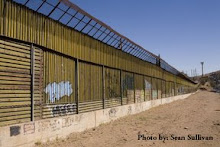
It is a safe bet that he did not take his colleagues to the spot, a few hundred yards from where they posed for the press, where last October a Border Patrol agent reached through the wall to shoot an unarmed teenager in Mexico 11 times in the back. He probably also failed to point out the high water mark left on Mexican buildings when, in 2008, the Nogales border wall dammed floodwaters, causing millions of dollars in property damage and the drowning of two men.
Monday, April 8, 2013
Border Residents Kept in the Dark about New Border Walls
It is a safe bet that he did not take his colleagues to the spot, a few hundred yards from where they posed for the press, where last October a Border Patrol agent reached through the wall to shoot an unarmed teenager in Mexico 11 times in the back. He probably also failed to point out the high water mark left on Mexican buildings when, in 2008, the Nogales border wall dammed floodwaters, causing millions of dollars in property damage and the drowning of two men.
Friday, December 14, 2012
Border Wall Imperils Southern Arizona Pronghorn Herds
www.sierraclub.org/borderlands
Wednesday, September 14, 2011
Congressional Push Continues to Gut Environmental Protections Along U.S. Borders
TUCSON, Ariz.— Under the guise of border security, Sen. John McCain (R-Ariz.) offered an amendment to the Department of Homeland Security appropriations bill today that would grant border-enforcement agencies free rein on federal lands within 300 miles of the U.S.-Mexico border. After criticism from colleagues in his own party that the 300-mile limit went far beyond the scope of border-enforcement activities, McCain scaled it back to 100 miles, and the amendment was added to the bill.
“Politicians are playing games with important border-security legislation at the expense of laws that protect clean air, water and endangered species,” said Randy Serraglio, a conservation advocate at the Center for Biological Diversity. “This amendment is unnecessary, unwanted and threatens significant harm to the wildlife, natural landscapes and people of the border region.”
The McCain amendment introduced today, similar to a bill proposed earlier this year by McCain and Sen. Jon Kyl (R-Ariz.), does not specifically name any laws, but its guarantee of unfettered access for border-enforcement agencies on federal lands effectively neutralizes protections afforded by the Endangered Species Act, Clean Air Act and Clean Water Act. Existing law permits essential border-security activities even in designated wilderness areas, and an existing memorandum of understanding between Homeland Security and the Department of the Interior provides for cooperation between land managers and border agencies.
“Despite repeated statements and congressional testimony from border-security agencies that they neither want nor need the authority granted in this amendment, radical anti-environment forces in Congress continue to push this hoax on the American people,” said Serraglio. “The losers in this game will be jaguars, ocelots, Sonoran pronghorn and residents of border communities that will no longer benefit from fundamental protections that allow them to live and thrive in a healthy environment.”
The nonpartisan Government Accountability Office concluded in a recent report that access to federal lands has not been limited in 22 of 26 sectors along the border, and that the only problems that have occurred in other sectors have been “minor delays.” Meanwhile, between 8,000 and 20,000 miles of wildcat roads have been blazed through a wilderness area in southern Arizona’s Cabeza Prieta National Wildlife Refuge, a majority of which, in recent years, has been caused by enforcement activities, according to a July report by the U.S. Fish and Wildlife Service.
“This amendment pretends to address a problem that does not exist,” said Serraglio. “Clearly, access to federal lands for border-security personnel is not a significant issue in achieving operational control of the border. At best, the McCain amendment is a case of political grandstanding.”
“The false premise inherent in this proposal is that border security and a healthy environment are somehow mutually exclusive,” said Serraglio. “The truth is just the opposite. It has been shown time and again that collaboration between land managers and security agencies enhances both border security and protection of the diverse and vibrant landscapes of the borderlands.”
http://www.biologicaldiversity.org/news/press_releases/2011/border-security-09-14-2011.html
Monday, August 15, 2011
Our Worst Fears about the Border Wall Come True
More human beings would die alone in remote deserts. Endangered species would be pushed to the brink. These were the fears that led humanitarians, environmentalists, and border residents to object to the walls along the U.S.-Mexico border called for by the Secure Fence Act of 2006. With 650 miles built, this summer has brought news that these fears are tragically coming true.
The journey taken by migrant men, women and children who set out across the U.S.-Mexico border has always been risky. But border walls have rerouted migrants away from the safety of urban areas and forced them to walk for greater distances over treacherous mountains and through searing deserts. All too easily they can become fatigued, dehydrated, and unable to go on. In too many cases, they die alone in remote areas.
This month an Arizona Daily Star analysis found that migrants today are almost three times more likely to die on their journey than people who crossed in 2006, the year before the walls began to go up. In fact, the rate of death—the number of deaths per 100,000 Border Patrol apprehensions—continues to increase even as fewer people are making the trek across the border.
Before the walls, in 2006, there were just 46 known deaths per 100,000 Border Patrol apprehensions. By 2010 the number had jumped to 118 known deaths per 100,000 apprehensions, and so far 2011 already has a death rate of 129 per 100,000.
These human beings are also dying deeper in the desert and much further from roads than ever before. Because of the remoteness of the areas in which they die, many of the bodies discovered are just skeletal remains. Such are the real and tragic consequences of border walls.
The same walls that are pushing crossers deeper into deadly terrain slice though nature preserves that were established to protect endangered species. The Otay Mountain Wilderness Area, Organ Pipe Cactus National Monument, and Lower Rio Grande Valley National Wildlife Refuge have seen critical wildlife habitat divided by walls. Environmentalists have argued that vulnerable species like the ocelot, whose U.S. population is less than 100 individuals in South Texas, would be walled off and trapped in small fragments of habitat. Without sufficient food, water, and potential mates, the population would dwindle.
Now scientists are beginning to uncover just how extensive the wall’s impacts are likely to be on endangered species. A recent article published in the journal Diversity and Distributions found that border walls impact 23 endangered species border-wide. Some species in California are blocked from as much as 75 percent of their ranges, a circumstance that makes the isolated populations extremely vulnerable to disease or natural disasters. The study also found that in South Texas border walls impact between 60 percent and 70 percent of the habitat set aside for endangered ocelots in the Lower Rio Grande Valley National Wildlife Refuge.
In 2008 the Department of Homeland Security (DHS) recognized that the border wall had damaged wildlife refuges along the border, and Congress appropriated $50 million to mitigate the effects of the wall border-wide. Money was promised to the Lower Rio Grande Valley National Wildlife Refuge to purchase land to replace the ocelot habitat that the border walls fragmented. But after DHS withheld the money for years, Congress took back the funds. DHS has no further plans to fix any of the environmental damage that its border walls have caused.
As predicted, the border wall has exacerbated the ongoing humanitarian crisis of migrant deaths and has devastated the environment. Nevertheless, some in Congress are calling for more walls and looking to strip border communities of their environmental protections under the pretense of border security.
Dan Millis has witnessed first-hand the human tragedy and environmental devastation unfolding daily along the U.S.-Mexico border. Shortly after finding the lifeless body of a young girl along a migrant trail in Arizona, Dan was convicted of littering for leaving bottles of clean water along trails in the same area. He now works for the Sierra Club in Tucson fighting on behalf of the people and places victimized by border walls and enforcement-only politics.
Dan will visit Texas' Rio Grande Valley to share his experiences, and discuss the impacts of flawed U.S. border policy and how you can make a difference on Monday evening, August 22nd at 7:00 pm at Galeria 409 in Brownsville and on Tuesday August 23rd at 7:00 pm at St. John the Baptist Parish Hall in San Juan. For more information and directions, visit valleygreenspace.wordpress.com.
As border residents we need to educate ourselves about the terrible consequences of border walls and enforcement-only policies all along the border, and then inform our elected leaders.
Stefanie Herweck is chair of the Lower Rio Grande Valley Sierra Club.
Friday, July 29, 2011
New Amendments Threaten Protected Lands
What federal lands would be put at risk?
• All of them. This amendment decimates environmental and other protections on every single acre of federally owned lands, from areas in the southwest already at risk from Border Patrol Activities, like the Cabeza Prieta National Wildlife Refuge in Arizona, to places far from the border, including the Grand Canyon, Yellowstone National Park, and the Cape Hatteras National Seashore.
• This amendment is NOT restricted to areas near the southwest border or even to areas near all borders, as past legislation has proposed.
What laws would be overturned?
• All of them. This amendment is even more overreaching in its impact on federal lands than the controversial H.R. 1505 because it is not restricted to a long list of environmental regulations, but prevents the enforcement of any regulation, even those put in place for safety and other reasons.
• Other regulations that could be completely ignored are those that support economic development, allowing Border Patrol to interfere with grazing, mining, and drilling for oil and gas on public lands.
What Border Patrol activities would be exempted from any oversight?
• All of them. The amendment does not clearly define what “impede or obstruct” means or who would decide whether a law or regulation meets this standard and could therefore be ignored.
• The amendment is even more overreaching than past bills on the Border Patrol because it does not limit exempted activities to “operational control” – or activities specifically intended to prevent illegal entry into the country. Instead it exempts all “patrol activities” which, without definition, could mean any activity undertaken by the Border Patrol.
• This will create conflict between agencies that have begun to work very effectively together to resolve issues surrounding Border Patrol activities.
Is the amendment even needed by the Border Patrol?
• No. The amendment would override multiagency coordination that has been occurring on Federal lands since a 2006 Memorandum of Agreement between the Departments of Homeland Security, Interior, and Agriculture that has led to increased cooperation and leveraged resources.
• 22 out of 26 Border Patrol stations on the southern border with Mexico report that the border security of their area of operation has not been affected by land management laws beyond some minor delays. Instead, factors like rugged terrain—and not access delays or restrictions—have the highest impact on operational control.
• Exemptions already exist that allow Border Patrol Officers in pursuit to continue onto any federal land regardless of regulations or laws. Other exemptions have also been established administratively to ensure the Border Patrol has the access necessary to secure the border.
In addition, Rep. Gosar has also introduced amendment No. 55, another extreme attack on federal lands. Similar to amendment No. 20, this amendment would exempt the Border Patrol from any environmental review, from protecting clean air and water, from honoring and respecting the history and culture of native people, from preserving biodiversity, and more.
Who isn’t hurt by this amendment?
Representative Gosar’s friends in industries like oil and gas drilling, grazing, mining, and logging are taken off the hook in this updated version of amendment No. 20. Amendment No. 20 exempts the Border Patrol from “any regulation” meaning that rules allowing for development and resources extraction could also be trampled by any Border Patrol activities. Amendment No. 55, however, spares these special interests and instead focuses its attack on the environment, biodiversity, and native people.
What environmental and cultural laws would be overturned?
A similar list of laws to that found in H.R. 1505 is included in the amendment. These laws represent a century of bipartisan efforts to protect the environment, intelligently manage public lands, and demonstrate respect for historical and cultural sites.
The exempted laws include:
The National Environmental Policy Act of 1969 (42 U.S.C. 4321 et seq.)
The Endangered Species Act of 1973 (16 U.S.C. 1531 et seq.)
The Clean Water Act (33 U.S.C. 1251 et seq.)
The National Historic Preservation Act (16 U.S.C. 470 et seq.).
The Migratory Bird Treaty Act (16 U.S.C. 703 et seq.)
The Clean Air Act (42 U.S.C. 7401 et seq.).
The Archeological Resources Protection Act of 1979 (16 U.S.C. 18 470aa et seq.).
The Safe Drinking Water Act (42 U.S.C. 300f et seq.).
The Noise Control Act of 1972 (42 U.S.C. 4901 et seq.).
The Solid Waste Disposal Act (42 U.S.C. 6901 et seq.).
The Comprehensive Environmental Response, Compensation, and Liability Act of 1980 (42 U.S.C. 9601 et seq.)
The Archaeological and Historic Preservation Act' and the Archaeological Recovery Act (16 U.S.C. 469 et seq.).
The Antiquities Act (16 U.S.C. 431 et seq.).
The Historic Sites, Buildings, and Antiquities Act (16 U.S.C. 461 et seq.)
The Farmland Protection Policy Act (7 U.S.C. 4201 et seq.).
The Coastal Zone Management Act of 1972 (16 U.S.C. 1451 et seq.).
The Federal Land Policy and Management Act of 1976 (43 U.S.C. 1701 et seq.).
The Wilderness Act (16 U.S.C. 1131 et seq.).
The Bald Eagle Protection Act of 1940 (16 U.S.C. 668 et seq.).
The Native American Graves Protection and Repatriation Act (25 U.S.C. 3001 et seq.).
The American Indian Religious Freedom Act (42 U.S.C. 1996 et seq.).
The Religious Freedom Restoration Act of 1993 (42 U.S.C. 2000bb et seq.).
The Federal Grant and Cooperative Agreement Act of 1977 (31 U.S.C. 6303 et seq.)
What Species would be impacted?
The bill waives compliance with all provisions of the ESA on federal lands. Species throughout the nation that would be impacted include
In the Southwest
• Mexican spotted owl
• Desert tortoise
• Jaguar
• Ocelot
• Sonoran pronghorn
• Chiricahua leopard frog
Elsewhere in the country
• Florida Panther
• Canada lynx
• Polar bear
• Hawaii akepa (honeycreeper)
• Leatherback sea turtle
• West Indian manatee
Friday, May 20, 2011
Congressional Nightmares Fuel a New Assault on our Borderlands
In his recent speech in El Paso President Obama pointed to the buildup of border security personnel and infrastructure, and declining crime rates in border communities, to justify a renewed effort to enact immigration reform. This will be a tough sell in the current Congress.
Just three weeks earlier the difficulty of his task was on display in Washington DC when Representative Jason Chaffetz (R-UT) displayed photos of headless corpses while shouting at Ron Vitiello, Deputy Chief of the US Border Patrol, during a committee hearing. Vitiello had enraged Representative Chaffetz by calmly asserting that, “While there is still work to be done, every key measure shows we are making significant progress along the Southwest border.”
The horrific pictures were not taken within U.S. borders, and so were outside of the Border Patrol’s jurisdiction, despite Chaffetz’ cries that “This is the kind of thing that we’re sending our agents to deal with on a daily basis!”
Chaffetz’ anger boiled over because Deputy Chief Vitiello was not following the Congressman’s script. The facts, that border communities are safe and apprehensions are down, were not welcome.
The Congressional hearing was intended to paint a picture of the U.S. southern border as a war zone, awash in blood and the mutilated bodies of innocents. In this telling, the Border Patrol fights valiantly to achieve “operational control” and quell the violence, but it is hamstrung by environmental laws and federal land managers who care more about endangered species than human life.
It was meant to promote HR 1505, the misnamed “National Security and Federal Lands Protection Act.” Starting with the premise that the Border Patrol has been prevented from entering federal wildlife refuges, wilderness areas, and national monuments along the southern border, it gives the Border Patrol carte blanche on federal lands.
Like the photos of headless bodies, this provision is based on a false impression of our southern border. The Border Patrol and federal land management agencies signed a cooperative agreement in 2006 allowing access to protected lands that Vitiello said works well. Rugged terrain and remote locations are the real problems reported by agents in the field, not restrictions imposed by land managers.
The bill goes on to exempt the Border Patrol from obeying dozens of environmental laws.
Its precursor, the Real ID Act, was used in 2008 to waive 36 laws along the southern border to erect border walls. The Endangered Species Act, Clean Water Act, and National Environmental Policy Act were among those brushed aside to allow for construction that otherwise would have violated them. This resulted in severe environmental damage.
HR 1505 extends the 2008 waivers to cover all of the U.S. – Mexico border, the Canadian border, all maritime borders, and every square inch of terrain within 100 miles of them.
The waiver covers some of our nation’s most important protected areas, from Glacier National Park and the Boundary Waters to Redwood National Park and the Cape Cod National Seashore. Two-thirds of the population of the United States would also fall under the waiver.
Instead of thanking the Congressmen for freeing the Border Patrol from these legal burdens, Deputy Chief Vitiello undermined HR 1505’s premise. He confirmed the Government Accountability Office finding that “Most agents reported that land management laws have had no effect on Border Patrol’s overall measure of border security.”
The photos of headless bodies were displayed in an effort to discredit the Border Patrol’s testimony, and to burn a brutal image into viewers’ minds that would overwhelm the facts that Vitiello presented.
The angry tirades aimed at the Border Patrol made it clear that the “National Security and Federal Lands Protection Act” really has nothing to do with national security. It does not help the Border Patrol, and they did not ask for it. It is nothing more than an assault on our nation’s public lands and environmental laws.
Speaking within sight of the border, President Obama said that “despite a lot of breathless reports that have tagged places like El Paso as dangerous… El Paso and other cities and towns along this border are consistently among the safest in the nation.”
America cannot develop rational policies that protect border residents and ecosystems by picking and choosing facts any more than we can support the rule of law by cherry picking which laws to obey and waiving the rest. With members of congress choosing fear over facts, ungrounded nightmares instead of FBI statistics, the reform that the president spoke of remains a distant dream.
Here is part one of the April 15 hearing on HR 1505
Here is part two. Rep. Chaffetz brandishes the photos of corpses around a half-hour into this clip.
Thursday, May 5, 2011
Congressional Proposals Aim to Eviscerate Environmental Laws Along U.S. Borders, Coasts
Randy Serraglio, Center for Biological Diversity
Scott Nicol, Sierra Club Borderlands Team
Jenny Neeley, Sky Island Alliance
Matt Clark, Defenders of Wildlife
Mike Quigley, The Wilderness Society
Nathan Newcomer, New Mexico Wilderness Alliance
Matt Skroch, Arizona Wilderness Coalition
Under Guise of Border Security, Bills Would Eliminate Measures
Protecting Air, Water, Endangered Species
TUCSON, Ariz.— Two bills pending in Congress would eliminate environmental laws along U.S. borderlands — including those that protect endangered species and safeguard clean air and water — under the guise of improving border security. The “National Security and Federal Lands Protection Act” (H.R. 1505), introduced by Utah Rep. Rob Bishop, would permanently exempt border-enforcement activities from 31 environmental and cultural resource laws within 100 miles of all U.S. borders and coasts.
The “Border Security Enforcement Act of 2011” (S. 803), introduced by Arizona Sens. John McCain and Jon Kyl, would effectively give the Department of Homeland Security veto power over environmental protections on public lands within 150 miles of the southwestern border. Land managers in the border region would be prevented from acting to protect the resources they manage if their actions were perceived to conflict with Department of Homeland Security activities.
“These bedrock environmental laws were put in place for a reason: to protect the air we breathe, the water we drink and the natural resources and wildlife we value,” said Randy Serraglio, a conservation advocate with the Center for Biological Diversity. “It makes no sense to turn our back on these laws to satisfy the narrow agenda of a few politicians looking to score points with their most extreme constituents.”
The authority included in these bills has not been requested. In fact, it has been deemed unnecessary by border-enforcement agencies. During an April 15 congressional hearing on border security, U.S. Border Patrol Deputy Chief Ronald Vitiello testified that his agency “enjoys a close working relationship” with public lands agencies that “allows it to fulfill its border enforcement responsibilities.” Vitiello said his agency “is fully committed to continuing our cooperative relationships with the Department of the Interior and the Department of Agriculture.”
“These bills have been introduced solely to satisfy the radical whims of a small minority of anti-environment extremists in Congress,” said Jenny Neeley, conservation policy director for Sky Island Alliance. “These proposals threaten the entire Sky Islands region we work to protect by establishing a dangerous legal precedent of permanently erasing environmental and cultural resource protections across huge swaths of the United States.”
Barrier and road construction, off-road driving, stadium lighting and other border-enforcement activities already threaten parks, refuges and other protected areas as well as many species in the border region, including endangered jaguars and ocelots in Arizona, New Mexico and Texas.
“Too much damage has been done to our borderlands already,” said Scott Nicol, Sierra Club Borderlands Team co-chair. “From massive blasting and erosion in California wilderness areas to devastating floods in Arizona and fragmented habitat for endangered species in Texas, the implementation of border enforcement with callous disregard for our nation’s environmental laws has caused one disaster after another.”
“Protections for endangered wildlife, water and clean air are not standing in the way of border security,” said Matt Clark with Defenders of Wildlife in Tucson. “All Congress has to do is look at the facts: Apprehensions of immigrants illegally crossing the border have fallen by two-thirds over the past decade. Border Patrol and land-management agencies have been effectively working together, and it’s clear that it takes teamwork to secure the border and protect the environment.”
“These efforts to discard the rule of law rest on the false premise that we can have border security or we can have functioning borderlands ecosystems, but not both. That's wrong. We can — and we should — have both,” said Mike Quigley, Arizona representative of The Wilderness Society.
“Protected areas such as wilderness and national parks along our borders provide us with essential environmental services, premier recreation opportunities and important habitat for our wildlife heritage,” said Matt Skroch, executive director of the Arizona Wilderness Coalition. “These shortsighted efforts to waive laws are penny wise and pound foolish. Border enforcement and natural resource management are not and should not be mutually exclusive.”
http://www.biologicaldiversity.org/news/press_releases/2011/border-05-04-2011.html
Thursday, February 3, 2011
Border Walls versus Environmental Justice
In 1994 President Clinton issued Executive Order 12898 to address the issue of Environmental Justice. It instructs federal agencies to identify and address actions that might have “disproportionately high and adverse human health or environmental effects… on minority populations and low-income populations.” EO 12898 remains in effect today, but in building border walls the Department of Homeland Security (DHS) has chosen to ignore it.
Since the passage of the Secure Fence Act around 650 miles of border wall have been built, slicing though towns, farms, and natural areas. Southern border states have rates of poverty that are significantly higher than the national average. In 2009 Arizona had the second highest poverty rate in the nation, New Mexico had the third highest, and Texas came in seventh. Within these states communities along the border tend to be the poorest. The 2007 list of 10 counties with the lowest median incomes in the nation included the Texas border counties of El Paso, Hidalgo, and Cameron, all three of which now have border walls.
Rather than act to minimize the border wall’s impacts on these communities, DHS used the Real ID Act to waive 36 federal laws. The Safe Drinking Water Act, Farmland Protection Policy Act, Native American Graves Protection and Repatriation Act, and other laws that protect the rest of the nation no longer protect border communities. Equal protection under the law does not apply to those who live along the border.
This has led to a host of negative impacts on border communities. The economic impacts of land condemnation and damage to family farms have hit economically disadvantaged communities. Walls have cause severe flooding in Lukeville, Arizona, and across the border in Nogales, Sonora, Mexico, where two people drowned. In Texas wetlands have been destroyed, and construction has caused serious erosion, further degrading the Rio Grande, which is the source of drinking and irrigation water for border residents.
In documents released before wall construction began, DHS stated that each of the Texas communities living in the path of the wall, “meets these two criteria [high percentages of minority and low-income residents] as a potential environmental justice population.” DHS went on to claim, however, that “the Secretary’s waiver means that CBP no longer has any specific obligation under Executive Order (EO) 12898.” While the first statement is backed by census data, the claim that DHS is not bound by the executive order is false, because the executive order was not listed among the 36 laws that DHS waived. But the assertion has meant that little effort has gone into lessening the impacts of border walls on border communities, or including them in decision-making.
South Texas Communities
To build border walls the federal government filed condemnation lawsuits against more than 400 Texas landowners, in communities that are 85 – 90% Hispanic and have rates of poverty that are more than twice the state average.
In Hidalgo and Cameron counties, where border walls were built along existing levees, homes, businesses, farms, and privately-owned nature preserves have been cut in two, or even walled off entirely, trapped between the border wall and the Rio Grande.
DHS has only to paid for the exact footprint of the border wall (typically, a 60-foot wide strip) as it passes through a parcel of land. The agency has completely discounted the hardships that the border wall will bring to landowners, such as the devaluation of contiguous property, access to farm land and homes, and impacts on livelihood.
In south Texas there are 21 separate border walls, totaling 70 linear miles, with wide gaps between sections. Border residents noticed that walls tended to be built through the lands of low-income families, but stopped abruptly at the property line of landowners such as the Hunt family, who, coincidentally, donated millions for the construction of the Bush Presidential Library.
Researchers from the University of Texas who examined this determined, “Our comparison of the areas planned to be fenced along the border with those areas where ‘gaps’ in the fence are planned suggests disproportionate impact on individuals with lower income and education, Hispanic ethnicity and non-U.S. citizenship status.”
Tohono O’odham Nation
The Tohono O’odham nation in Southern Arizona is split by 75 miles of the U.S.-Mexico border, with 1,500 out of 20,000 tribal members living south of the line. As in many Native American nations poverty is widespread. According to the 2000 census the average income on the reservation was $8,137, compared to a national average of $26,940. Life expectancy was eight years less than the national average.
Speaking before a U.S. House of Representatives hearing on the border wall, O’odham Chairman Ned Norris Jr. said, “We are older than the international boundary with Mexico and had no role in creating the border. But our land is now cut in half, with O’odham communities, sacred sites, salt pilgrimage routes, and families divided.”
Chairman Norris went on to state that, with the waiving of the Native American Graves Protection and Repatriation Act, “… fragments of human remains were observed in the tire tracks of heavy construction equipment. Barriers and the border road now cross the site.”
“Imagine a bulldozer parking in your family graveyard, turning up bones. This is our reality.”
Chairman Norris concluded, “We know from our own experience living on the border that security can be improved while respecting the rights of tribes and border communities, while fulfilling our duty to the environment and to our ancestors, and without granting any person the power to ignore the law.”
Tuesday, January 18, 2011
Climbing the Border Wall
Here is the clip:
Most of the responses have been a mix of surprise and amusement that a federal project that has soaked up over $3 billion, and has involved more than 400 condemnation suits against landowners and the waiving of 36 federal laws would be so easy to overcome.
It should not surprise anyone.

Climbing the San Diego "triple fence." Photo by Laura Garcia.
Bush administration Secretary of Homeland Security Michael Chertoff said in 2007, "I think the fence has come to assume a certain kind of symbolic significance which should not obscure the fact that it is a much more complicated problem than putting up a fence which someone can climb over with a ladder or tunnel under with a shovel."
Clip from the documentary The Wall.
Climbing the border wall in the Otay Mountain Wilderness Area while Border Patrol agents look on. Photo by Italia Milan.Border Patrol spokesperson Mike Scioli said, "The border fence is a speed bump in the desert."
But that is likely giving it too much credit. In this clip former President Bush is giving an interview in front of the border wall, discussing the efficacy of his border security measures. Just over his shoulder a group of immigrants jump the wall:Before the border walls that President Bush touted were built, Del Rio, Texas, Border Patrol Chief Randy Hill predicted, "We're going to see steel barriers erected on the borders where U.S. and Mexican cities adjoin. These will slow down illegal crossers by minutes." He made no claim that they would stop anyone.
Photo from a Time Magazine article titled "The Great Wall of America."
The border wall has been a farce since its inception. Forget the "danged fence." It is time to admit that the emperor has no clothes, and address immigration reform and substance abuse in a rational manner.
Friday, November 19, 2010
Homeland Security may Squander $40 million on Environmental Lip Service
In 2010 Congress allocated $40 million to the Department of Homeland Security (DHS) for the purpose of "minimizing adverse environmental and other negative impacts" of border wall construction. Environmental mitigation and monitoring work is best done by agencies such as the U.S. Fish and Wildlife Service, part of the Department of the Interior (DOI). In fact, the allocation language made it very clear that congress "expects CBP to use these funds to work in coordination with the Department of Interior and other government agencies with responsibilities for environmental policy on the border."
However, it is feared that DHS could instead decide to keep the money, and use it to fund ill-advised and half-hearted attempts to address some of the environmental havoc wreaked by their walls, roads, and infrastructure.
Take Arizona's San Pedro Riparian National Conservation Area, a U.N. World Heritage Natural Area known for its huge diversity of migratory bird species. Ostensibly to address flooding issues that arise from walls recently built across washes and riverbeds, DHS has been busily constructing and installing "flood gates" such as the one seen below.
Local rancher Bill Odle shows off DHS's "flood gates" and debris piles
What about these huge gates?!?! They are massive. Locals report that Border Patrol vehicles attempting to open them instead end up winching their own front ends off the ground! Once open, the holes are large enough to drive a pick-up truck through them, which begs the question, why build the wall in the first place?! Of course, predicting the weather in the Southwest is a crapshoot at best, and once the storms begin, access to many areas is often cut off by flash flooding. Debris piled high against the gates indicate to us that these things haven't been opened during recent stroms, which locals say have been relatively mild. It's an example of a half-hatched scheme launched by an agency whose expertise is in security, not environmental planning. The funds sunk in this scheme would have been put to much better use by the experts within the DOI.
Notre Dame students frolic atop a DHS jungle gym
The "flood gates" are one example of mitigation gone wrong. Another is the "cat hole" project in Texas. Concern over the blockage of wildlife migration corridors prompted DHS to retrofit a section of border wall near the Lower Rio Grande National Wildlife Refuge with a series of doggy doors, each about the size of an 8.5 by 11 inch sheet of notebook paper. For more info on the "cat holes," download our flier:
http://dl.getdropbox.com/u/369702/cathole.pdf
Mitigation and monitoring needs to be done by the professionals at DOI, which is why DHS needs to give them the funds which have already been appropriated.
Dan Millis is an organizer for the Sierra Club's Borderlands campaign. To read more about the border wall's environmental impacts, and to view the Club's 20-minute documentary Wild vs. Wall, go to http://sierraclub.org/borderlands/
Following flooding in Nogales and the Organ Pipe Cactus National Monument the Border Patrol commissioned a report on the walls that cross washes and rivers from El Paso to San Diego. It found that the poorly designed walls were not only damming them, but in many instances their foundations were being undermined. The report is available here: http://www.scribd.com/doc/41500057/Customs-and-Border-Protection-report-on-border-walls-crossing-washes-and-streams
Tuesday, July 20, 2010
Be Careful What You Wish For
Jan Brewer, the Governor of Arizona, says the funniest things. Especially about immigrants. Ok, I’ll admit that SB 1070, the state’s vicious anti-immigrant legislation, is nothing to laugh about. But when Brewer went on local television in early July she cracked me up.
Why? Because she told astonished viewers that Arizona police have begun to stumble on bodies buried in the desert that have been beheaded. Beheaded by those nasty immigrants she has been warning us about. Really, she said that.
Of course there is no truth to this preposterous allegation. Nor is there any basis for her claims that the “terrible border security crisis…has gotten worse.” Quite the reverse: the U. S. Borderlands are among the safest places in the United States, and getting more so. Then there is Brewer’s remarkable assertion that the majority of immigrants crossing into Arizona are drug dealers, mules or addicts. Investigations by journalists, Border Patrol officials, and county medical examiners have produced not a shred of evidence to support this and other of her bizarre rants.
Just as baseless is Senator John McCain’s frenzied claims that the state he represents is the “No. 2 kidnapping capital in the world.” Arizona has experienced nothing like the wave of kidnappings that mar social life in Africa, Asia and Central America; indeed, its figures are dropping, which suggests that the once-principled presidential candidate has gone off the deep end.
In this he has good company in the wacky State Senator Sylvia Allen. She has been blustering of late that "in the last few years 80 percent of our law enforcement that have been killed or wounded have been by an illegal." Arizona police departments have been quick to denounce her false charges.
All these lies have a purpose: the GOP in Arizona and across the nation has been flogging anti-immigrant horror stories to terrorize voters. The party wants to whip up its political base and drive independent voters into its ranks. Its fearmongering tactics and eagerness to incite racial prejudice, aided and abetted by right-wing talk radio and television, are also designed to cut into President Obama’s popular support and the Democratic Party’s congressional majority. This summer’s GOP craziness is all about the November 2010 elections.
Yet in so operating Republicans are proving to be certifiably crazy. They swear they want to include Latinos in their “Big Tent” coalition; they recognize--or at least the savviest of them do--that being inclusive is the only way that the GOP can remain a national party; it cannot otherwise survive in our twenty-first nation of immigrants. Perhaps it does not wish to: how else explain its sanctioning of repeated and vicious assaults on Hispanics, the very voters with whom they claim such great affinity?
The political impact of GOP anger and hostility is captured in the latest LatinoMetrics poll. It shows that the economy is no longer Latinos key worry--immigration is. And this change in focus came about in just six months, the exact period of time when Arizona politicians and others began to lambast immigrants. Latinos have taken notice. As one commentator told the Los Angeles Times: “Latinos are feeling less optimistic and more under siege.” Embattled, they are ready to fight back. They “have taken offense to the way immigrants have been demonized by politicians and political interest groups,” said Brent Wilkes, LULAC Executive Director, “and are prepared to vote accordingly.”
Come November, a crazed Jan Brewer may be just what the Democrats needed to maintain power. How funny is that?
Char Miller is W. M. Keck Professor and Director of the Environmental Analysis Program at Pomona College, Claremont CA. He is author of Deep in the Heart of San Antonio: Land and Life in South Texas and a columnist for the Rio Grande Guardian, where this essay originally appeared.
Thursday, June 3, 2010
Trading on Fear in an Election Year: Using the Spillover Myth to Build Border Walls and Score Votes
On May 25, President Obama announced that he would deploy up to 1,200 National Guard troops to the US-Mexico border. This followed a White House meeting with Congressional Republicans aimed at attracting support for, or at least blunting opposition to, comprehensive immigration reform legislation. With mid-term elections on the horizon, conservative members of Congress have turned their attention to the border. Or, more precisely, to walling it off. In May two bills and one amendment aimed at building more border walls were introduced. One failed, but the other two are still pending.
On Cinco de Mayo Senator Jim DeMint announced that he would reintroduce his “Finish the Fence” amendment. It would change the Secure Fence Act to say that, “Fencing that does not effectively restrain pedestrian traffic (such as vehicle barriers and virtual fencing) may not be used to meet the 700-mile fence requirement.” As of April 2010, DHS reports that it has completed 347 miles of “pedestrian fence”, meant to stop people on foot, and 299 miles of “vehicle barriers.” If DeMint’s amendment makes it into law an additional 353 miles of “pedestrian fence” will be built along the border.

"Pedestrian fence" south of San Diego, California. Photo courtesy Jay Johnson Castro.
When DeMint proposed this amendment last July, the Senate voted 54 to 44 to include it in the Department of Homeland Security’s annual appropriations bill. The House version of the bill did not contain a matching provision, and Representative Ciro Rodriguez, who, unlike DeMint, represents a district encompassing part of the border, was able to remove it during the House/Senate conference committee.
This time around DeMint attempted to attach his amendment to Financial Reform legislation. Seeing that this had nothing to do with financial reform (in fact, at roughly $7.5 million per mile DeMint’s new walls would cost taxpayers $2,647,500,000) DeMint’s amendment was not adopted. Following this failure DeMint tried to attach it to a bill funding the wars in Iraq and Afghanistan. That attempt also fell short (though just barely), but he will almost certainly try again between now and the November elections.
Even more extreme than DeMint’s amendment is Representative Todd Tiahrt’s Secure the Border Act, which requires continuous double-layered border walls along the entire 2,000 mile long border, from the Pacific Ocean to the Gulf of Mexico. Tiahrt made no attempt to explain how the monumental expense of his legislation would benefit his Kansas constituents, who already have Oklahoma and Texas acting as buffers between them and Mexico.
Instead, Tiahrt proudly proclaimed that the Federation for American Immigration Reform (FAIR) and NumbersUSA support his bill. FAIR has earned a place on the Southern Poverty Law Center’s list of hate groups. They received $1.2 million from the Pioneer Fund, an organization founded to promote eugenics and foster policies of “racial betterment.” NumbersUSA has also been denounced by the Southern Poverty Law Center for its ties to nativist and racist organizations. FAIR president Dan Stein and NumbersUSA president Roy Beck both formerly edited the white nationalist publication The Social Contract. One would expect Congressman Tiahrt to avoid their endorsements, not embrace them.

Border Wall construction in El Paso, Texas. Customs and Border Protection photo.
When he announced his bill Tiahrt neglected to mention that before his election to the House of Representatives he was employed by Boeing, where he worked on a number of government contracts. His old boss has not forgotten him; in 2009-2010 Boeing was Tiahrt’s biggest campaign contributor. Boeing is in turn one of the largest recipients of contracts for the Secure Border Initiative (SBI), which includes both solid border walls and virtual fences. To date, Boeing has received 13 task orders for SBI, totaling $1.2 billion.
Representative Tiahrt is currently running for the U.S. Senate. Senate races are expensive, and a successful candidate needs publicity to energize voters. Boeing has consistently provided him with campaign cash, and NumbersUSA and FAIR make regular appearances on FOX news, where they defend anti-immigrant legislation and promote favorite legislators such as Tiahrt.
Not to be left out, Senators John McCain and Jon Kyl rolled out a “10-Point Border Security Plan”, along with accompanying legislation. Their bill would “construct double- and triple-layer fencing” throughout Arizona. McCain also released a campaign commercial in which he and Pinal County Sheriff Paul Babeu walk alongside the border wall and discuss McCain’s border scheme.
“The plan is perfect,” Sheriff Babeu intones.
“Then complete the danged fence,” McCain responds, with the domain CompleteTheDangedFence.com on the screen below him.
Those who try to visit the website are redirected to JohnMcCain.com, where they can purchase McCain t-shirts or donate to his reelection campaign.
McCain is in a tough primary fight with JD Hayworth, who has been attacking McCain for his prior willingness to support immigration reform. Before Hayworth threatened to unseat him, McCain told Vanity Fair, "I think the fence is least effective. But I'll build the g--damned fence if they want it." The possibility of losing the election has caused the Senator to embrace the border wall that he once dismissed.
Sheriff Babeu seems like an odd choice to accompany McCain alongside the Nogales border wall. Babeu’s jurisdiction is 115 miles north of Nogales, and does not include any of the border that McCain advocates walling off. Why not consult an actual border sheriff about his border security plan?
Because those who work on the border might give an honest answer, instead of reading McCain’s cue cards. If he were to ask Nogales Assistant Police Chief Roy Bermudez, for example, the response might mirror Bermudez’ statement earlier this month, when he said, "We have not, thank God, witnessed any spillover violence from Mexico.”
Clarence Dupnik, Sheriff of neighboring Pima County, which also includes a long stretch of the US-Mexico border, said at that time, "This is a media-created event. I hear politicians on TV saying the border has gotten worse. Well, the fact of the matter is that the border has never been more secure."
In fact, according to FBI statistics, crime rates in Arizona border towns, including Nogales, have remained flat for the past decade. There has been no increase in violence as a result of “spillover” from Mexico. There was also no decrease in crime following the erection of border walls and the hiring of thousands of Border Patrol agents. FBI statistics show that the same is true for U.S. cities all along the border, from San Diego to El Paso to Brownsville.
Contrast what the FBI says with statements by DeMint, who said, “Drug trafficking, human trafficking, gang activity and other crimes are raging in American cities near the border.” Or McCain, who opens his campaign spot by listing, “Drug and human smuggling, home invasions, murder…” as justifications for sending in the National Guard and building more “danged fence.”
Politicians and law enforcement seem to be looking at two completely different borders.
In fact, they are looking at completely different numbers. The numbers that DeMint, Tiahrt, and McCain are interested in are votes, not FBI crime statistics. Facts about the border do not matter; voters’ beliefs, no matter how divorced from reality, do. As Senator McCain indicated during his earlier, pre-campaign Vanity Fair interview, building walls and sending troops to the border are political gestures meant to get votes, not solutions to any real problem.
Just as in McCain’s commercial, for politicians the border wall is simply a prop, a stage set upon which they can project an illusion of strength and security for an audience of voters who will never see the actual border. They are looking at voters who live far from the border, who can be told that “spillover” violence poses an existential threat to the United States, and only they (certainly not their election opponents!) can protect the nation. Those of us who live on the actual border, and live with the land condemnations, the suspension of laws, and the environmental damage that accompany actual border walls, see it very differently.
Thursday, June 4, 2009
No More Deaths Volunteer Convicted of Littering for Leaving Water in the Desert
Humanitarian Who Left "Life-Sustaining Water" for Migrants Convicted of “Littering”
Walt Staton, a volunteer with the Tucson-based humanitarian aid group No More Deaths, was convicted today of "knowingly littering garbage or other debris" after he left clean drinking water for undocumented migrants crossing the desert on the Buenos Aires National Wildlife Refuge.
In response to this verdict, No More Deaths released the following statement:
“This is a sad day for human rights and for all of us in southern Arizona. By penalizing life-saving work, the United States is showing callous disregard for the lives of our neighbors to the south, whose only crime is to seek a better life. No More Deaths will continue to provide life-saving aid to those in need, and to do our part to clean up the desert. The era of border enforcement that uses death and human rights abuses as a deterrent must come to an end.”
After more than four hours of deliberation on Tuesday afternoon and Wednesday morning, the 12-member jury first stated to the court that they were not able to agree upon a verdict. Magistrate judge Jennifer Guerin then ordered the jury to go back and attempt again to reach a unanimous verdict. Staton's attorney, William Walker, objected to the order, stating that it was coercive to the jury. The jury reconvened and met for less than an hour before returning a guilty verdict.
On December 4, 2008, U.S. Fish and Wildlife officer James Casey cited Staton and three other humanitarians for littering after being contacted by Border Patrol agents who were following the volunteers. The US Attorney’s office later dropped the charges against the other three. Staton refused to accept guilt and pay the original $175 fine. He now faces the punishment of this criminal misdemeanor that could include up to one year of prison time and a large fine. Sentencing is set for August 11.
In Staton's court testimony, he said that he was compelled by his personal experiences of encountering severely dehydrated migrants in distress. He also explained how the organization uses a strategic system of maps and GPS equipment to place the water in strategic locations. "We try to be conscious as an organization to be the most effective in order to save lives," stated Staton during examination.
During closing arguments, defense lawyer Bill Walker held a full gallon jug of water in the air and declared: "When the government tells you this case isn't about water or this isn't about saving lives, they're wrong! This is valuable, life-sustaining water."
During jury selection nearly one third of the original 31 potential jurors were dismissed after stating they had strong emotions about providing humanitarian aid to migrants and would be unwilling to convict someone who was engaged in humanitarian aid. Public support was also evident during the two full days of the trial as the courtroom remained full with 40-50 humanitarian supporters from local groups such as The Samaritans, Humane Borders, American Friends Service Committee and the Unitarian Universalist Church of Tucson, among others.
Dan Millis, a fellow No More Deaths volunteer, received a similar ticket in February, 2008, for leaving water jugs on the Buenos Aires National Wildlife Refuge. Millis was found guilty last September after a bench trial before magistrate judge Bernie Velasco in Tucson. Dan appealed the case to the US District Court, where the original ruling was upheld. It is currently under appeal at the 9th Circuit Court. Staton also plans to appeal his case to the 9th Circuit.
“The Buenos Aires leadership needs to realize that we’re on the same team here,” Millis said. Millis works full-time for the Sierra Club’s Borderlands Protection Campaign. “They need to issue more permits allowing humanitarian groups to provide water and pick up trash on the refuge,” he said.
Letters of support for Walt Staton, Dan Millis and No More Deaths can be sent to media@nomoredeaths. org; they will be posted on our web site.
* Background on No More Deaths:
According to Pima County medical examiner's data, approximately 20 bodies of deceased migrants have been recovered from Buenos Aires National Wildlife Refuge since 2002. Dehydration is a factor that leads to many of these deaths. More than 5,000 bodies have been recovered from the US/Mexico border as a result of the U.S. Border Patrol’s strategy of deterrence, beginning in 1994 with Operation Gatekeeper.
Since 2004 No More Deaths has provided life-saving aid to migrants in distress along the Arizona/Mexico border. Thousands of volunteers have participated in these efforts, which include providing water, food and medical assistance. No More Deaths is a ministry of the Unitarian Universalist Church of Tucson and seeks to work with other religious groups, government, community partners, and individuals willing to work toward an end to the humanitarian crisis occurring in the Arizona desert.
No More Deaths is currently gearing up for its sixth summer of humanitarian action during the hottest, deadliest months of the year. We are accepting volunteer applications for the summer, and welcome any and all donations to support our work!
For an updated list of migrant deaths in Arizona, visit DerechosHumanosAZ. net.
Please take a moment to sign the following e-letter to participate in an international campaign declaring that "Humanitarian Aid Is Never A Crime!” This letter speaks to a case in which the Italian government is prosecuting two Germans for "smuggling" after they rescued a sinking raft in the Mediterranean Sea with 37 African refugees on board. Such prosecutions resonate with the efforts by the United States government, described above, to criminalize life-saving humanitarian work.Saturday, December 13, 2008
Border Wall Harms Wildlife
The border wall is a classic example of habitat fragmentation – one of the leading causes of species extinction. As human-created barriers such as highways and walls bisect the land, once intact wildlife habitat patches become fragmented, and less permeable to wildlife movements. One of the insidious consequences of habitat fragmentation is that it creates smaller, more isolated habitat patches and wildlife populations – the negative effects of which may not become apparent for decades. Isolated wildlife populations are prone to more dramatic fluctuations from year to year, are less resilient to natural disturbances, have a higher probability of local extinction, and are robbed of the crucial genetic interchange that keeps wildlife populations healthy. Fragmentation may also preclude access to water sources, seasonally-available food resources, and new territories. The importance of maintaining and/or restoring habitat connectivity is a fundamental principle that has emerged from wildlife conservation sciences in the past two decades.
The border wall is causing habitat destruction, degradation and fragmentation at a regional scale for a wide array of wildlife – creatures that do not recognize arbitrary political boundaries. Numerous cross-border wildlife linkages have already been severed by the wall, and the wall itself is redirecting traffic into adjacent habitats. Clearly, more scientific research is needed to quantify these impacts.
On-the-ground examples:
· 1.9 million tons of dirt is being used to fill Smuggler’s Gulch in southern California in order to construct a wall across this steep canyon. This threatens to increase sediment flows into the ecologically-sensitive Tijuana River Estuary, which provides habitat for four federally-listed endangered birds: the light-footed clapper rail, the California least tern, the least Bell's vireo and the California brown pelican.
· Both deer and javelina have been documented along the wall in the vicinity of the San Pedro Riparian National Conservation Area, apparently unable to cross the border because of the wall.
· A Compatiblility Determination for the then-proposed border wall on the Buenos Aires National Wildlife Refuge concluded the wall was not compatible with the refuge’s mission and regulations, stating: “The barrier would fragment habitat on the refuge, thereby adversely affecting the ecological integrity of the refuge's natural resources…The barrier would adversely affect endangered species (jaguar), migratory birds (pygmy-owls), and important habitats (Arivaca Creek) on the refuge, thereby conflicting with stated management goals for the refuge...” A controversial land swap was orchestrated and the wall was built anyway. Border Patrol recently documented an aggravated mountain lion on the refuge unsuccessfully attempting to get through the border wall to the Mexican side of its habitat.
Buenos Aires National Wildlife Refuge and the Border Wall. Photo courtesy Matt Clark.· A recent Biological Opinion from the U.S. Fish and Wildlife Service states, “Shifting IA [illegal alien] activity has already occurred in Arizona and California as a result of fence construction or increased CBP [Customs and Border Protection] staffing”. The wall continues to funnel traffic and disturbance into remote, rugged, and ecologically sensitive areas. The Biological Opinion provides 8 documented examples of this phenomenon, some of which are anticipated to negatively impact threatened and endangered species such as the Sonoran pronghorn, jaguar, Mexican spotted owl and Chiricahua leopard frog.
Matt Clark is the Southwest Representative for Defenders of Wildlife.
Monday, November 3, 2008
Walkers Remember Migrants on Tohono O'odham Land

Walkers called out "Presente!" during the reading of the names at San Xavier, remembering those who died walking to a better life. The walk, organized by Derechos Humanos, was an 8-mile walk from Tucson, during temperatures that reached the mid 90s.
Although the elected leaders on the main section of the Tohono O'odham Nation, located to the west of here, have not welcomed humanitarian aid for migrants, the San Xavier District cohosted the Indigenous Peoples Border Summit of the Americas in 2006 and 2007. The border summits were cohosted by the International Indian Treaty Council and organized by Tohono O'odham Mike Flores.

Photos: Walkers arrive at San Xavier. Crosses carry the names of the migrants who died this past year. Photos Brenda Norrell. Please e-mail for reprint permission: brendanorrell@gmail.com