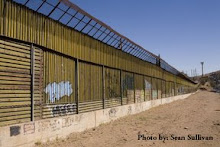
Wednesday, April 24, 2013
Another Round of South Texas Border Wall Condemnations is about to Begin
Friday, December 14, 2012
Border Wall Imperils Southern Arizona Pronghorn Herds
www.sierraclub.org/borderlands
Monday, August 29, 2011
New Study: Border Hysteria Imperils Wildlife
by Dan Millis
In a Congress plagued by immigration hysteria, none is more gravely afflicted than South Carolina’s Republican Senator Jim DeMint. Twice in two weeks he added border pork to Senate bills, both times calling for 300-plus miles of walls to be imposed between the U.S. and Mexico. These are the fourth and fifth times in less than two years that he has made such attempts.
Delirious and angry lawmakers like DeMint seem oblivious to the 650 miles of barriers and walls that already occupy the Southwest’s borderlands, exacting high costs on taxpayers and public lands. Another side effect these lawmakers suffer is an acute indifference to the impacts caused by their border madness.
A new study in the Diversity and Distributions journal identifies 49 species put most at risk by border walls and areas of intensive human land use along the U.S.-Mexico border. The study only considers amphibian, reptile, and non-volant (don't fly) mammal species, and identifies California, the Sky Islands, the Gulf Coast as the three regions most heavily impacted.
One unique aspect of this study is that it doesn’t just look at current impacts wrought by existing border walls and areas with a heavy human footprint. Potential future impacts from border wall expansions such as those proposed by DeMint are also taken into consideration, and the results are sobering:
This graph from the study shows a horizontal base line representing our 2,000 mile border with Mexico. The three faint vertical lines in the left half of the graph represent the state borders between California, Arizona, New Mexico, and Texas. The fatter horizontal line sitting atop the baseline shows where the taller “pedestrian” (10-25 feet tall) border walls are located along the border.
Then there is the vertical ‘species’ scale, which includes only species from the sample set that have already been listed as threatened, either binationally or by the International Union for the Conservation of Nature. The dashed line represents how many of these already-threatened species are put in grave danger by existing “pedestrian” border walls in each geographic location along the border. You’ll notice that there are few such species, which may be expected when working with such a small sample set of species to begin with.
However, the solid line is much less benign, with the number of vulnerable species spiking most dramatically here in Arizona (to the right [East] of first faint vertical line [CA-AZ border]). This line represents the number of already threatened species that would be pushed to the brink if proposals like DeMint’s were passed and border walls came to occupy even more precious habitat.
A key finding of the study states, "The REAL ID Act should be amended to reinstate environmental regulation of border security efforts." The REAL ID waiver of more than 30 vital federal protection laws along the border allowed walls to be built in violation of the Wilderness Act, the Endangered Species Act, and more.
Dan Millis is a Sierra Club Borderlands campaign organizer. To learn more about the Sierra Club's Borderlands Campaign visit http://sierraclub.org/borderlands/
Friday, November 19, 2010
Homeland Security may Squander $40 million on Environmental Lip Service
In 2010 Congress allocated $40 million to the Department of Homeland Security (DHS) for the purpose of "minimizing adverse environmental and other negative impacts" of border wall construction. Environmental mitigation and monitoring work is best done by agencies such as the U.S. Fish and Wildlife Service, part of the Department of the Interior (DOI). In fact, the allocation language made it very clear that congress "expects CBP to use these funds to work in coordination with the Department of Interior and other government agencies with responsibilities for environmental policy on the border."
However, it is feared that DHS could instead decide to keep the money, and use it to fund ill-advised and half-hearted attempts to address some of the environmental havoc wreaked by their walls, roads, and infrastructure.
Take Arizona's San Pedro Riparian National Conservation Area, a U.N. World Heritage Natural Area known for its huge diversity of migratory bird species. Ostensibly to address flooding issues that arise from walls recently built across washes and riverbeds, DHS has been busily constructing and installing "flood gates" such as the one seen below.
Local rancher Bill Odle shows off DHS's "flood gates" and debris piles
What about these huge gates?!?! They are massive. Locals report that Border Patrol vehicles attempting to open them instead end up winching their own front ends off the ground! Once open, the holes are large enough to drive a pick-up truck through them, which begs the question, why build the wall in the first place?! Of course, predicting the weather in the Southwest is a crapshoot at best, and once the storms begin, access to many areas is often cut off by flash flooding. Debris piled high against the gates indicate to us that these things haven't been opened during recent stroms, which locals say have been relatively mild. It's an example of a half-hatched scheme launched by an agency whose expertise is in security, not environmental planning. The funds sunk in this scheme would have been put to much better use by the experts within the DOI.
Notre Dame students frolic atop a DHS jungle gym
The "flood gates" are one example of mitigation gone wrong. Another is the "cat hole" project in Texas. Concern over the blockage of wildlife migration corridors prompted DHS to retrofit a section of border wall near the Lower Rio Grande National Wildlife Refuge with a series of doggy doors, each about the size of an 8.5 by 11 inch sheet of notebook paper. For more info on the "cat holes," download our flier:
http://dl.getdropbox.com/u/369702/cathole.pdf
Mitigation and monitoring needs to be done by the professionals at DOI, which is why DHS needs to give them the funds which have already been appropriated.
Dan Millis is an organizer for the Sierra Club's Borderlands campaign. To read more about the border wall's environmental impacts, and to view the Club's 20-minute documentary Wild vs. Wall, go to http://sierraclub.org/borderlands/
Following flooding in Nogales and the Organ Pipe Cactus National Monument the Border Patrol commissioned a report on the walls that cross washes and rivers from El Paso to San Diego. It found that the poorly designed walls were not only damming them, but in many instances their foundations were being undermined. The report is available here: http://www.scribd.com/doc/41500057/Customs-and-Border-Protection-report-on-border-walls-crossing-washes-and-streams
Thursday, August 5, 2010
Destroying the Borderlands to Secure the Border
Time to call in the troops and wall off the border.
The first 14 miles of border wall, extending from the Pacific Ocean inland, were built of rusting steel helicopter landing mats left over from the Vietnam War crudely welded together. A second layer, 15-feet tall and made of steel mesh, was later added north of the first wall. In the no-man’s-land between these two walls was a graded road for Border Patrol vehicles, with towers for surveillance cameras and stadium lights.
The landing mat border wall entering the ocean between San Diego and Tijuana.
In 2004 the California Coastal Commission and environmental groups, including the Sierra Club, sued to stop the Border Patrol’s plan to plug several canyons in order to create a level path for the border wall. The court found that the Border Patrol was in violation of federal environmental laws and that such a fill project would have a devastating impact on the Tijuana Estuary. The judge ordered that construction be halted.
In order to override the court’s decision, a provision was inserted into the Real ID Act of 2005 giving the unprecedented power to the US Attorney General (later transferred to the Secretary of Homeland Security) to waive all federal, state, and local laws, environmental and otherwise, to build border walls. Former Secretary of Homeland Security Michael Chertoff used the Real ID Act to brush aside the laws that had stopped the border wall, and resumed construction. In waiving those laws he was admitting that border wall construction would violate them.
A few hundred feet from the border wall’s starting point in the Pacific, the Tijuana River Estuary spills into the sea. It is the largest of Southern California’s remaining salt marshes, where over 90% of wetland habitat has been lost to development. The combined Tijuana River Slough National Wildlife Refuge, Tijuana River National Estuarine Research Reserve and Border Field State Park protect sand dunes and beaches, vernal pools, tidal channels, mudflats and coastal sage scrub. During the wet winter season, water drains into the marsh from the Tijuana River and surrounding creeks and canyons, infusing the marsh with fresh water and creating a delicate balance on which its many highly sensitive habitats depend. The site is a key stopover point on the Pacific Flyway, and provides over 370 species of migratory and native birds, including six endangered species, with essential breeding, feeding and nesting grounds.
Following the passage of the Real ID Act the canyon known as Smuggler’s Gulch, south of San Diego, was filled in with over 2 million cubic yards of earth that had been ripped from adjacent mountaintops. A border wall was then perched on top. With no regulations in place and no oversight by other agencies, the Department of Homeland Security (DHS) put little effort into erosion control, and the still bare slopes of the earthen dam threaten to wash tremendous amounts of dirt into the Tijuana River National Estuarine Research Reserve, which is only 600 feet away. In addition to smothering vegetation, burying the estuary in sediment may raise its surface level enough to disrupt the twice-daily inundation of sea water upon which its fragile ecosystem depends.
A few miles up the Tijuana River, the Otay Mountain region is home to the last surviving stands of Tecate cypress, an ice age tree that survives by absorbing coastal moisture from the air. This tree in turn is the host plant for the rare Thorne’s hairstreak butterfly. In an attempt to protect these and other rare and endangered species that inhabit this unique ecosystem, 18,500 acres of the Otay Mountain region were designated a National Wilderness Area.

Border wall in the Otay Mountain Wilderness Area, California
When the Environmental Protection Agency reviewed the plan to build this section of border wall, they expressed concern that plans to fill in canyons and waterways that feed into the Tijuana River would violate the Clean Water Act. The Department of the Interior warned that 6 endangered species would also be harmed by the wall.San Diego Sector Border Patrol spokesman Richard Kite said in 2006, "At the mountain range, you simply don't need a fence. It's such harsh terrain it's difficult to walk, let alone drive. There's no reason to disrupt the land when the land itself is a physical barrier."
Ignoring his observation, DHS decided to “disrupt the land” of the Otay Mountain Wilderness Area with a border wall and an access road. The rugged terrain of the Wilderness Area necessitated the blasting and removal of 530,000 cubic yards of rock and extensive grading and leveling. The Otay Mountain Wilderness Area is so steep that the goal of blasting was to achieve an elevation grade of 15%, even though the Secure Fence Act states that if the elevation grade of an area exceeds 10% walls do not need to be constructed there. Border wall construction caused tremendous erosion, and involved cutting down more than 100 Tecate cypress trees.
Because this is clearly incompatible with a wilderness designation, the goal of which was to limit human activity and protect fragile ecosystems, the Otay Mountain Wilderness Act was among the 36 laws that former Homeland Security Secretary Chertoff suspended using the Real ID Act. He also swept aside the Clean Water Act and the Endangered Species Act, rather than listen to the concerns of the Environmental Protection Agency and the Department of the Interior. With the wilderness no longer protected by law, DHS blasted through it and built the border wall. The Otay Mountain Wilderness Area now suffers from a barren scar and erosion that will bleed sediment into the Tijuana River for years to come.
Unchecked by environmental protections, the walls that began in California’s borderlands now extend over 600 miles, inflicting tremendous damage upon many sensitive ecosystems. In Arizona the border walls that cross washes and streams in the Organ Pipe Cactus National Monument have caused severe erosion and flooding. Border walls built in New Mexico’s Playas Valley block the movement of one of the last wild herds of bison, whose range straddles the U.S. – Mexico border. In Texas the walls that slice through the Lower Rio Grande Valley National Wildlife Refuge have fragmented habitat that is critical for the survival of endangered ocelots.
Border wall in the Lower Rio Grande Valley National Wildlife Refuge in Texas.
Environmental organizations, including the Sierra Club, Defenders of Wildlife, and many others, have attempted to protect fragile border ecosystems from DHS’ lawless actions. They have challenged the constitutionality for the Real ID Act’s waiver provision in court, and have worked to educate Congress and the public about the wall’s environmental impacts. The Sierra Club has also produced a short documentary, Wild vs. Wall, that gives an overview of the border wall’s environmental impacts from the Pacific to the Gulf of Mexico.
Even the Department of Homeland Security admits that border walls have negative impacts on border ecosystems, though they consistently underestimate the extent of the damage. In Environmental Stewardship Plans prepared ahead of construction, DHS identified the purchase of equivalent replacement lands as the most practical way to make up for the many thousands of acres of land that walls would tear through. Setting aside the question of where one would find replacement land comparable to a mountainous wilderness area, Congress allocated some of the necessary funds in 2008 and 2009. The Department of Homeland Security has yet to provide the Department of the Interior with those funds, and not a single acre of replacement land has been bought.
The Department of Homeland Security’s dismissive attitude towards environmental laws and border ecosystems is a direct reflection of that of some politicians, who whip up hysteria about “broken borders” and are openly hostile towards environmental protections. Chief among them has been Utah Representative Rob Bishop, who has repeatedly called the idea that DHS should pay to fix some small portion of the damage that it has done “extortion”, and has worked to keep mitigation funds from reaching the Department of the Interior.
Bishop recently said, "If wilderness designation gets in the way of a secure southern border, I want the designation changed. If it means you lose a couple of acres of wilderness, I don't think God will blame us at the judgment bar for doing that."
In 1968 an unnamed Army major justified the bombing of the Vietnamese provincial capital of Ben Tre by stating coldly, “It became necessary to destroy the town to save it.” The same Orwellian logic seems to animate Representative Bishop, and some of his colleagues, when they look at the U.S.-Mexico border. Blinded by the myth that the border is a war zone, they ignore inconvenient facts like the low crime rates in the border cities of San Diego, El Paso, and Brownsville, and call for a scorched earth campaign to stop the imagined invasion. They fail to see the hypocrisy in setting aside all of our nation’s laws to stop those whom they call “illegals”. They are destroying the borderlands to “secure” the border.
The Sierra Club documentary Wild vs. Wall can be viewed at sierraclub.org/borderlands .
Tuesday, December 15, 2009
Environmental Groups Support Provisions of Comprehensive Immigration Reform Bill
Comprehensive Immigration Reform Bill Gets it Right at the Border
Bill Would Help Protect Wildlife from Damage of Border Walls
Washington, D.C, - A new immigration bill introduced today includes important provisions that will help protect wildlife, communities, and natural resources from damage wrought by border walls between the U.S. and Mexico.
The Comprehensive Immigration Reform for America's Security and Prosperity Act of 2009, introduced by Representative Luis Gutierrez, includes critical components of the Border Security and Responsibility Act of 2009 (HR 2076), introduced by Rep. Raul Grijalva in April 2009.
To date, at least 633 miles of border walls and barriers have been constructed along the U.S. – Mexico border, and the construction has proceeded quickly and almost entirely without proper consultation or compliance laws.Three dozen environmental, archaeological, religious freedom, historic preservation, cultural, and other laws were waived by former Secretary of Homeland Security Michael Chertoff for border wall construction.
The legislation would replace the border wall’s one-size-fits-all approach to border security with a strategy based on comprehensive analyses of the effectiveness and costs of various security measures. To address negative impacts from existing border infrastructure, the legislation would establish comprehensive monitoring and mitigation programs. The bill would also ensure full compliance with landmark laws like the Safe Drinking Water Act and the Endangered Species Act that were enacted to promote public health and protect our country’s wildlife and natural heritage.
“ Rep. Gutierrez and Rep. Grijalva deserve praise for recognizing the need for a responsible border security policy that minimizes harm to our precious borderlands, wildlife, and border communities,” said Sierra Club representative Michael Degnan.
“Much of this country’s rarest and most spectacular wildlife--including jaguar, ocelot, Sonoran pronghorn, and many other species--depend upon the borderlands for survival. This bill would restore crucial protections to such wildlife and help mitigate the widespread damage that has already been done to important habitat and migration corridors,” said Randy Serraglio, conservation advocate at the Center for Biological Diversity.
"Laws that protect our wildlife, our water, our air, and our right to a healthful environment should never have been circumvented by the Bush administration," said Bob Irvin, Senior Vice President for Conservation Programs at Defenders of Wildlife. "This bill will restore the rule of law along America's border."
Sunday, September 20, 2009
Environmental Organizations Call Upon Congress to Strip Border Walls from the DHS Appropriations Bill
Dear Conferees,
On behalf of our millions of members and supporters across the entire country, the undersigned organizations are writing to ask that you remove Sen. DeMint’s amendment #1399 from the Homeland Security Appropriations Act and continue to support efforts to monitor and mitigate negative impacts of border wall construction.
Senate amendment #1399 is the latest attempt to extend the failed policy of building more border walls along our southwest border. In addition to negatively impacting the wildlife and natural resources of the borderlands, the provision would come at great expense to our nation’s border security programs and the American taxpayer. While tying the hands of border security experts by requiring an arbitrary number of miles of wall construction, this language would drain funding from other border security programs in order to cover the growing cost of border wall construction. Taxpayers have paid approximately $2.4 billion for border wall construction to date, and according to the Government Accountability Office, one mile of border wall now costs nearly $8 million.
Nearly one-third of the 1,950 mile U.S.-Mexico border lies within military, tribal, and public lands, including Wilderness areas, National Wildlife Refuges, National Forests, National Monuments, State Parks and hundreds of miles within the National Park system. Much of this country’s most spectacular and imperiled wildlife, including two of America’s most endangered big cats, jaguars and ocelot, bighorn sheep, Sonoran pronghorn, and bison, depend upon protected public lands along the border for intact habitat and survival.
Numerous studies have highlighted the damage that border infrastructure has caused to the borderlands’ ecology and wildlife. The National Park Service issued a report in August, 2008 confirming that the border wall along the Lukeville Port of Entry has exacerbated seasonal flooding and has caused accelerated scouring and erosion on the Organ Pipe Cactus National Monument. A recent study in Conservation Biology showed that the border wall fractures the habitat connectivity that wildlife like the pygmy owl and bighorn sheep need for survival. As climate change shifts habitats and alters migration routes, establishing wildlife corridors and protecting habitat connectivity becomes even more critical.
The damage that border walls have caused to the unique natural values of the borderlands has been exacerbated by the Secretary of Homeland Security’s authority to waive any applicable laws to expedite border wall construction. This unprecedented authority has prompted the waiving of 37 environmental, historic preservation, tribal protection and other federal laws along with related state and local laws across 563 miles of the border.
In order to help address the negative impacts of border walls that have already been constructed, the House Homeland Security Appropriations bill included $40 million for border monitoring and mitigation. We strongly support keeping this language in the final bill and believe that its inclusion would mark one more step towards repairing the damage done to communities and natural resources along the border.
Again, we support the House version of the Homeland Security Appropriations Act, and as you move to conference we specifically ask that you remove Senate amendment #1399 from the final bill and continue to advance border monitoring and mitigation efforts.
Sincerely,
The Arizona Zoological Society
Center for Biological Diversity
Defenders of Wildlife
Earthjustice
Frontera Audubon
International League of Conservation Photographers
League of Conservation Voters
National Audubon Society
National Wildlife Federation
Natural Resources Defense Council
Rio Grande International Study Center
Sierra Club
Southwest Environmental Center
Valley Nature Center
Western Lands Project
The Wilderness Society
Wildlands CPR
Wildlands Network
Friday, January 9, 2009
A Border Wall in the Otay Mountain Wilderness Area Will Be an Environmental Disaster

Road-Building in Borderlands Wilderness Area
Project is first use of Real ID Act waiver allowing
construction in designated wilderness
Otay Mesa, CA –With little advance notice, the Department of Homeland Security (DHS) has begun bulldozing a road inside a federally-designated wilderness area on the U.S.-Mexico border. Apparently not wishing to attract national attention to the controversial project, DHS made the construction start-up announcement through its contractor on Christmas Eve. According to DHS, the road-building project is necessary to build a border wall within and immediately to the south of the 18,500-acre Otay Mountain Wilderness Area on the U.S.-Mexico border east of San Diego.
The rugged terrain of the wilderness area will require blasting and removal of 530,000 cubic yards of rock, and extensive grading and leveling in order to build the wall and the accompanying road, says Sukut Construction, the contractor doing the work. Plans for the project note that much of the five-mile patrol road and approximately 1,300 feet of the primary pedestrian fence would extend into the Otay Mountain Wilderness.
Because motorized equipment, new roads and permanent human structures are not permitted within a federally-designated wilderness area, the Wilderness Act was among the 36 laws waived by Homeland Security Secretary Chertoff in April 2008 in order to expedite border wall construction. The controversial waiver was authorized under the Real ID Act, which allows the Secretary to exempt DHS from any and all laws that might interfere with construction of the border wall and associated access roads.
“Wilderness areas are designated by Congress specifically to protect sensitive places from projects like this road construction,” said Carl Pope, Executive Director of the Sierra Club. “This road sets terrible precedent and clearly demonstrates the dangers of granting the Secretary of Homeland Security authority to waive any law in order to build walls along our international borders.”
The project now moves forward despite DHS documentation that “Construction of the fence, staging areas, and patrol road…will result in a barrier to movement for large non-flying animals and general loss of wildlife habitat.” According to Matt Clark, Southwest representative for Defenders of Wildlife, “Such harmful impacts to wilderness characteristics and values are clearly inconsistent with the Congressional intent of the law that established the Otay Mountain Wilderness Area in 1999. The waiver and the wall are an affront to our nation’s laws and natural heritage.”
When Congress passed the Secure Fence Act (SFA) in 2006, mandating that 670 miles of border fence be constructed by the end of 2008, San Diego Sector Border Patrol spokesman, Richard Kite, said, "…at the (Otay) mountain range, you simply don't need a fence. It's such harsh terrain it's difficult to walk, let alone drive. There's no reason to disrupt the land when the land itself is a physical barrier." Kite’s experience and reasoning, along with the language of the SFA itself, which does not require walls on slopes with more than a 10% grade (such as most of those in the project area), has apparently been ignored by DHS as it now attempts to speed up border wall construction.
“The frantic pace of wall building along the U.S.-Mexico border completely ignores the project’s serious environmental consequences to wildlife, wildlands and the general ecology of the borderlands region,” says Kim Vacariu, Western Director for the Wildlands Network, a conservation group working to protect cross-border wildlife corridors. “The waiving of the bedrock environmental laws that protect our nation’s natural resources is unconscionable. Construction in the Otay Mountain Wilderness should cease pending immediate and thorough environmental review,” he notes.
William H. Meadows, president of The Wilderness Society, agreed. “We are very concerned about the impacts this wall will cause to wilderness values at Otay,” Meadows said. “Wilderness areas are among the last places in the United States that are untrammeled by humans, and we believe they should stay that way.”
Contacts: Kim Vacariu, Wildlands Network 575-557-0155
Matt Clark, Defenders of Wildlife 520-623-9653
Oliver Bernstein, Sierra Club 512-477-2152
Paul Spitler, The Wilderness Society 202-429-2672
Wednesday, July 2, 2008
The Border Wall's Environmental Impacts were Largely Ignored According to the Environmental Protection Agency
The Environmental Protection Agency is tasked with evaluating Environmental Impact Statements and Environmental Assessments, and determining whether the have been properly prepared. In the case of the documents prepared by the Department of Homeland Security's contractor, they found in every case that the reports were inadequate.
Today the Lone Star Chapter of the Sierra Club issued the following press release about the EPA's findings:
(Austin) -- The Environmental Protection Agency (EPA) expressed serious concerns about the impacts of the border wall that were ignored, according to newly disclosed public comments from late 2007.
The EPA's environmental and economic concerns echoed those raised by hundreds of residents, environmental organizations, and local institutions and public officials, all of which were negated by the Bush Administration's April 1 waiver of 36 federal laws to expedite construction of the border wall.
The ignored comments were submitted by EPA to the Department of Homeland Security (DHS) as part of the draft Environmental Impact Study (DEIS) on the planned border fences in the Lower Rio Grande Valley, as well as similar plans in the Presidio and El Paso areas of the Texas-Mexico border.
"These comments show that the EPA felt that the border wall represents a major threat to the habitat and endangered species found along the Texas-Mexico border," said Cyrus Reed, Conservation Director of the Lone Star Chapter of the Sierra Club. "Rather than trying to rewrite or reconsider the hastily drawn plans of a massive border wall, the Bush Administration felt it was above the law and chose to waive dozens of environmental and other federal laws."
The EPA comments characterized the proposed border walls and fences to be environmentally and economically disruptive due to their size and location, often slated for construction in natural wildlife areas or cutting through agriculturally productive land. For example, in its comments submitted on the proposed fences in the Lower Rio Grande Valley, John Blevins, Director of Compliance Assurance and Enforcement Definitions rates the project as "EC-2, Environmental Concerns-Insufficient Information," and explains: "The DEIS contains insufficient information for an adequate review. Of particular concern to EPA is the potential for long-term adverse environmental and ecological habitat impacts in the study area."
Among the chief concerns and insufficiencies highlighted by the agency are:
There is no text, studies, etc. that provide support for the purpose and need.
It does not appear that the alternatives are equally analyzed. There is also text that implies that the "No Action Alternative" is not a viable alternative.
There is no mention of how the wall would impact water quality.
The majority of this section uses relative terms like "minor, major, perceptible, short-term, and long-term." There are qualitative descriptions of these terms, but there is no quantitative description or attempt to quantify these impacts.
There is also no mention of US-Mexico treaties and whether they will be impacted.
There is no discussion of the fence's potential impact on migratory species or impact to their home range, in particular, large mammal species (e.g., deer or carnivores) or birds.
There is no discussion of the U. S. Fish and Wildlife Service (FWS) initiative to purchase land to connect units of the Lower Rio Grande Valley National Wildlife Refuge (LRGVNWR) (p. 3-30 line 4-10) or the potential impacts of the fence to this large scale effort to increase connectivity and reduce habitat fragmentation.
Related to the location of the fence and property of individuals, the maps created by DHS show that the fence could run straight through houses and backyards. Many families have lived at these locations for decades, some even centuries, and have strong emotional ties to the family land and homes.
The fence could also cut off farmers from prime farmland close to the water.
"These comments show the DHS never conducted a proper assessment of the sites, and also show that they would have a hard time convincing EPA to give a thumbs up to the proposed border wall," Reed stated. "Rather than getting a black eye from their fellow agency, they chose to waive environmental laws and ignore the comments of EPA and the public."
Several civil lawsuits that could impact the construction of the border wall are ongoing.
Find more information on the Lone Star Chapter Sierra Club's website at http://www.texas.sierraclub.org/press/newsreleases/20080702.asp.
Contact: Donna Hoffman, Lone Star Chapter, Sierra Club, 512-477-1729 or 512-299-5776
Monday, April 7, 2008
Members of Congress Support the Constitutional Challenge to Chertoff's Border Wall Waivers
It is extremely heartening to see members of Congress defending the Constitution and the rule of law. Many members of Congress appear to be too frightened of the lobbying power of xenophobic extremists, or of the likely negative press spewed by pundits such as Lou Dobbs and Sean Hannnity. Rather than stand up for what they know is right, they crouch down and hope that they won't be noticed and the whole issue will go away. Any member of Congress who has not signed on to the Amicus Curiae brief in support of the Constitutional challenge to Chertoff's unchecked power should be contacted and asked to explain their inaction. Members of the House of Representatives should also be urged to cosponsor the Borderlands Conservation and Security Act (HR 2593) which would repeal section 102 of the Real ID Act, restoring the rule of law to our borderlands.
The following is the press release issued by the members of Congress who will sign the Amicus Curiae brief:
April 7, 2008 – Today, Congressman Bennie G. Thompson (D-MS), Chairman of the Committee on Homeland Security led a group of 14 Members of Congress, including eight Committee Chairmen, in submitting a notice of intent to file an Amicus Curiae brief in the Defenders of Wildlife case (No. 07-1180). The brief, which will be filed by the end of the month, pertains to Homeland Security Secretary Michael Chertoff’s use of questionable waiver authority to skirt numerous federal laws in order to construct fencing along the southwest border.
The Amici will urge the Supreme Court to grant certiorari in the case. The petitioners, the Defenders of Wildlife and Sierra Club, allege that the Department of Homeland Security’s use of the waiver is unconstitutional.
Today’s notice of intent is being submitted by:
· Homeland Security Committee Chairman Bennie G. Thompson (D-MS);
· Energy & Commerce Committee Chairman John Dingell (D-MI);
· Judiciary Committee Chairman John Conyers (D-MI);
· Transportation & Infrastructure Committee Chairman James Oberstar (D-MN);
· Education and Labor Committee Chairman George Miller (D-CA);
· Rules Committee Chairwoman Louise Slaughter (D-NY)
· Veterans Affairs Chairman Bob Filner (D-CA);
· Intelligence Committee Chairman Silvestre Reyes (D-TX);
· Congressman Solomon Ortiz (D-TX);
· Congresswoman Zoe Lofgren (D-CA);
· Congresswoman Sheila Jackson Lee (D-CA);
· Congresswoman Susan Davis (D-CA);
· Congressman Raul M. Grijalva (D-AZ); and
· Congresswoman Yvette D. Clarke (D-NY).
Speaking to today’s filing, Chairman Thompson noted that “this waiver by the Secretary of Homeland Security is a direct challenge to Congress’s Constitutional role. The American people entrust Congress to ensure that the laws of this land are faithfully executed not excused by the Executive Branch.” Congressman Thompson added that “while the protection of our nation is a paramount concern to all of us, DHS must act prudently and respect the laws that Congress has written. The far-reaching effects that this waiver will have on the institution of Congress, as well as the border, demands that we act swiftly.”
House Judiciary Committee Chairman John Conyers, Jr. (D-MI) added that "our responsibility to be stewards of the earth cannot be thrown aside for the sake of an ill-conceived border fence. The Administration exempts itself from a duty to protect the environment, sacred burial sites, and centuries-old farms, but conveniently spares wealthy landowners from the bulldozers."
“This blanket waiver of laws like the Clean Air Act and the Safe Drinking Water Act is a clear and disturbing abuse of the Secretary’s discretion,” added Rep. John D. Dingell, Chairman of the House Committee on Energy and Commerce. “Congress’ efforts to seek justification for this waiver from DHS have been stonewalled, which leads me to believe none exists.”
“The Department of Homeland Security’s decision to issue waivers to expedite the construction of a wasteful fence along the Southwest border is disappointing at best. As a former Border Patrol Sector Chief and current Chair of the House Intelligence Committee, I know the importance of securing our borders and fully support providing our agents with strong tools to carry out their jobs. I do not, however, support DHS’s continued disregard for border communities. This recent attempt to bypass more than 30 laws and regulations to pursue an already ill-advised idea should not move forward,” added Intelligence Committee Chairman Silvestre Reyes.
The Members are represented by Alan E. Untereiner, Max Huffman, and Alan D. Strasser of Robbins, Russell, Englert, Orseck, Untereiner & Sauber LLP in Washington, DC.
Tuesday, March 18, 2008
Chertoff's Real ID Act Power to Waive U.S. Law Challenged
Defenders of Wildlife and the Sierra Club are challenging the authority to waive all of our nation's laws before the Supreme Court. They have issued the following press release:
WASHINGTON – Today, Defenders of Wildlife and The Sierra Club filed a petition asking the U.S. Supreme Court to hear its argument that the REAL ID Act, which grants Department of Homeland Security (DHS) Secretary Michael Chertoff unprecedented and sweeping authority to waive any and all laws to expedite the construction of a wall along the U.S.-Mexico border, is unconstitutional besides being harmful to the environment and border communities. The two conservation groups charge that such unbounded authority to the executive branch is a violation of the Constitution’s separation of powers provisions.
“By granting one government official the absolute power to pick and choose which laws apply to border wall construction, the REAL ID Act proves itself to be both inherently dangerous and profoundly un-American. The issue here is not security vs. wildlife, but whether wildlife, sensitive environmental values and communities along the border will be given fair consideration in the decisions the government makes,” said Rodger Schlickeisen, president of Defenders of Wildlife. “We are hopeful that the Supreme Court will take up this case in order to protect the fundamental separation of powers principles enshrined in the United States Constitution”
“Laws such as the National Environmental Policy Act and the National Historic Preservation Act are part of America's enduring legal framework, and no agency or public official should be allowed to ignore them,” said Carl Pope, executive director of Sierra Club. “Our laws have provided Americans a voice in the decision-making process that affects their lives, their human rights and the protection of wildlife; our government must not exempt itself from obeying those laws.”
The groups’ petition is the latest chapter in their legal efforts dating back to October, 2007 to safeguard the borderlands in the face of aggressive border wall construction. At that time, Defenders and The Sierra Club filed a lawsuit challenging DHS and Bureau of Land Management’s (BLM) approval of border wall construction within the San Pedro Riparian National Conservation Area in Arizona. After a federal judge in the U.S. District Court for District of Columbia found that the groups would likely prevail on their claims and issued an injunction blocking further construction of the wall, Secretary Chertoff waived 19 laws intended to protect public health, wildlife and endangered species, clean air and water, and historic and archeological sites to move forward with construction.
In their petition to the U.S. Supreme Court, Defenders and The Sierra Club contend that the REAL ID Act’s waiver provision unconstitutionally allows the DHS secretary unilaterally to repeal laws, threatening the system of checks and balances assured in the Constitution.
Since passage of the REAL ID Act in 2005, Secretary Chertoff has used this power to waive laws on three occasions:
to complete a wall near San Diego, California
to remove vehicle barriers and replace them with a wall in the Barry M. Goldwater Range in Arizona
to build a border wall within the San Pedro Riparian National Conservation Area.
In addition, Secretary Chertoff appears poised to again waive laws in relation to proposed border wall construction in Texas, in order to bypass extensive opposition from local residents, elected leaders, business owners, and conservationists.
“It isn’t too much to ask that DHS and other government agencies comply with our nation’s environmental laws along the border, particularly where international treasures like the San Pedro River are at stake,” said Schlickeisen. “We can not afford to let this keep happening all across the border or we will be left with nothing but a 700-mile testament to our own short-sightedness.”
Defenders and Sierra Club are represented by the Yale Law School Supreme Court Clinic, led by Professor Dan Kahan. Defenders is also represented by Andrew J. Pincus and Charles Rothfeld of Mayer Brown, LLP.
Tuesday, February 12, 2008
Members of Congress Urged to Support the Borderlands Conservation and Security Act
Dear Representative:
We urge you to cosponsor H.R. 2593, the Borderlands Conservation and Security Act. The
legislation amends existing border security laws which hinder strategic border security efforts and needlessly ignore environmental impacts and local communities.
The status quo mandates a weak border security mechanism and limits the Department of
Homeland Security (DHS): Currently, the Secure Fence Act requires DHS to construct a wall along non-continuous sections of the border between the U.S. and Mexico. Past experiences clearly show, border walls do not stop undocumented immigrants and drug smugglers. They just go around, climb over or dig under the wall. In addition, a rigidly mandated, one-size-fits-all border wall is inefficient and is an enormous waste of taxpayer dollars. Border security can and should be more strategic. H.R. 2593 would provide experts at DHS the ability to decide whether fences, vehicle barriers, or virtual fences would be most effective way to secure the border.
The status quo results in uninformed construction to the detriment of wildlife, citizens and border security: At present, section 102(c) of the Real ID Act grants the DHS Secretary broad and unparalleled authority to waive any and all federal, state and local laws when constructing barriers along the U.S. Border. As a result important considerations, such as blocking vital cross-border wildlife movement, are dismissed in the rush to waive laws and push forward with construction. Citizens, border security experts and land management agencies are all but cut out of the border security decisions. Citizens are denied the right to establish how border walls may devastate local economies dependant on ecotourism, legal international trade and good relations. Indeed, in the most recent waiver case in San Pedro Riparian National Conservation Area, citizens were denied the right to participate or inform the decision at all. HR. 2593 would give land management agencies, Native American tribes, and local communities a voice in border construction and decisionmaking.
The status quo threatens the nation’s commitment to the rule of law: DHS has invoked the Real ID Act waiver three times, waiving more laws with each successive use. Recently, in response to a court determination that DHS border wall construction violated the National Environmental Policy Act (NEPA), the Secretary waived not just NEPA but eighteen other laws as well, each of which was passed by Congress to protect public health, imperiled wildlife, or to guarantee citizens the right and a process to address arbitrary and capricious decisions of their government. And yet, each was waived without congressional oversight, a means of recourse for the public impacted, or any explanation. A notice was filed in the Federal Register and automatically nineteen laws were dismissed. Authorizing DHS to ignore all laws is no way to signal that the rule of law is to be respected. The president does not have the authority to waive laws at will, neither should an unelected official. We need an urgent and strategic solution to border security, not a reckless one which threatens the rule of law. H.R. 2593 would require compliance with laws meant to protect the air, water, wildlife, culture, and the health and safety of people in borderland communities.
We all support national security, and we can have intelligent security without harm to our precious borderlands, wildlife, and border communities. Again, we strongly urge you to Cosponsor H.R. 2593, and support its passage by the U.S. House of Representatives.
Thursday, November 1, 2007
Defenders of Wildlife and the Sierra Club challenge the constitutionality of the Real ID Act
On October 10, U.S. District Court Judge Ellen S. Huvelle issued a temporary restraining order stopping border wall and road construction within the San Pedro Riparian National Conservation Area, saying that the Department of Homeland Security (DHS) and the Bureau of Land Management, which oversees the San Pedro area, hadn’t properly analyzed the impacts of the construction on wildlife and other natural resources, and that the agencies had failed to include the public in their decision-making process. DHS Secretary Michael Chertoff responded by invoking the REAL ID Act to waive 19 laws in order to resume construction of this particular wall segment.
“Instead of fixing these shortcomings and incorporating environmental protection into national security efforts, Secretary Chertoff took it upon himself to waive 19 laws. These laws were put in place to provide all of us with clean air and water and ensure our treasured places and wildlife are protected,” said Rodger Schlickeisen, president of Defenders of Wildlife. “The Secretary’s action was a clear and unprecedented abuse of authority and demonstrated a profound disregard for the system of checks and balances assured in our constitution. The Secretary left us no choice but to address the unconstitutional nature of the REAL ID Act.”
“The Bush administration should know that we have the ability to protect our nation while at the same time preserving the unique wildlife and treasured lands along the border,” said Carl Pope, Sierra Club Executive Director. “Arbitrarily waiving environmental protections is an extreme path to tread.”
Under the REAL ID Act, Congress gave the DHS Secretary unrestricted power to waive any law—federal, state or local—that would otherwise apply to border wall and road construction. The groups’ amended complaint alleges that this unprecedented authority violates the fundamental separation of powers principles enshrined in the United States Constitution. They argue that by delegating the power to pick and choose which laws will apply to border wall construction, Congress has unconstitutionally given away its lawmaking responsibilities to a politically-appointed Executive branch official who is not accountable to the American public.
Despite the fact that the groups’ lawsuit was based on violations of only three laws, Sec. Chertoff responded by waiving 19 laws intended to protect wildlife and endangered species, clean water and air, safe drinking water, and cultural, historic and archeologically significant resources.
Monday, October 15, 2007
Will the Last Free-Flowing River in Arizona Survive the Border Wall?
One of the last undammed, free-flowing rivers in the American southwest, the San Pedro River and its surrounding watershed is one of the most biologically diverse areas in the United States. As it runs from Mexico through Arizona before joining the Gila River it passes through the confluence of four major ecosystems: the Sierra Madre and Rocky Mountains, and the Sonoran and Chihuahan Deserts. The river’s course is home to 84 species of mammals, 14 species of fish, 41 species of reptiles and amphibians, more than 100 species of breeding birds and an additional 250 species of migrant and wintering birds. It also contains archaeological sites representing the remains of human occupation from 11,200 years ago. This led Congress to designate the San Pedro Riparian National Conservation Area in 1988. The San Pedro was recognized by the National Audubon Society as its first Globally Important Bird Area, and designated as a world heritage natural area by the United Nations World Heritage Program.

Unfortunately for the San Pedro and the wildlife that depend upon it, it crosses the southern border of the United States. The Secure Fence Act of 2006 requires, “[at] least 2 layers of reinforced fencing, the installation of additional physical barriers, roads, lighting, cameras, and sensors” covering over 700 miles of the U.S. – Mexico border, including a span “extending from 10 miles west of the Calexico, California, port of entry to 5 miles east of the Douglas, Arizona, port of entry.” This section alone would be approximately 370 miles long, directly impacting the Cabeza Prieta National Wildlife Refuge, Buenos Aires National Wildlife Refuge, Organ Pipe Cactus National Monument, Coronado National Forest, and the San Pedro Riparian National Conservation Area.
The Department of Homeland Security prefers the term “pedestrian fencing” rather than border wall, as it is less apt to evoke images of Berlin in the soviet era. To date they have favored two wall designs, “Sandia” and “Bollard”. Under the Bollard design, offsetting double rows of 14’ to 17’ high steel pipe, approximately 6” in diameter, are set in 8.5” centers, and then filled with concrete. This construction requires trenching 5’ deep and 2’ wide along the entire length of the wall. Under the Sandia design, metal mesh panels are attached vertically to 16’ steel poles, and then 6’ panels are secured to the top of these at an angle of 45 degrees. The poles are anchored by a 12” wide by 4’ deep concrete footing along the length of the fence. In the San Pedro Riparian National Conservation Area, the Army Corps intends to utilize a “modified” Sandia design with steel pipes arranged horizontally to a height of 3’, and the remaining height consisting of mesh. Vehicle barriers constructed of scrap railroad ties will be placed in the riverbed and removed using cranes during seasonal flooding. How cranes will reach the riverbed each year during the monsoon season without causing tremendous damage and erosion has not been explained.

In its rush to add more miles to the border wall (and mollify certain Presidential hopefuls), the Department of Homeland Security has largely ignored federal environmental regulations. DHS Secretary Chertoff used the power granted to him under the Real ID Act to “waive in their entirety” the National Environmental Policy Act, Endangered Species Act, National Migratory Bird Treaty Act, Clean Water Act, and other laws to build walls near San Diego and in Arizona’s Barry M. Goldwater Range. In other parts of Arizona rushed Environmental Assessments have been produced with no public comment period that invariably find that building walls through the habitat of endangered species such as the Sonoran pronghorn will have “no significant impact”.
When this was attempted in the San Pedro Riparian NCA the Defenders of Wildlife and Sierra Club requested a stay in construction so that an Environmental Impact Statement, as required by the National Environmental Policy Act, could be conducted. Instead the Army Corps began bulldozing the next day. In response Defenders of Wildlife and Sierra Club filed suit, asking a federal court to halt construction until the Army Corps of Engineers fully complied with the law. Specifically, they argued that a regional Environmental Impact Statement is required for the entire length of the Arizona border wall, rather than limited Environmental Assessments for individual sections. In addition, a full Environmental Impact Statement must be carried out for the San Pedro River. Finally, to comply with NEPA there should be public participation in the EIS process. Until Chertoff signs a waiver DHS and the Border Patrol must obey the laws of the land.