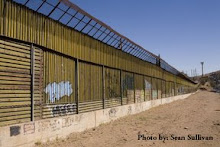
The Sierra Club, Defenders of Wildlife, and the Center for Biological Diversity have issued the following press release in support of the Comprehensive Immigration Reform for America's Security and Prosperity Act of 2009, introduced by Representative Luis Gutierrez. The bill contains key provisions intended to ensure that the Department of Homeland Security obeys all of our nation's laws when building infrastructure on the border.
Comprehensive Immigration Reform Bill Gets it Right at the Border
Bill Would Help Protect Wildlife from Damage of Border Walls
Washington, D.C, - A new immigration bill introduced today includes important provisions that will help protect wildlife, communities, and natural resources from damage wrought by border walls between the U.S. and Mexico.
The Comprehensive Immigration Reform for America's Security and Prosperity Act of 2009, introduced by Representative Luis Gutierrez, includes critical components of the Border Security and Responsibility Act of 2009 (HR 2076), introduced by Rep. Raul Grijalva in April 2009.
To date, at least 633 miles of border walls and barriers have been constructed along the U.S. – Mexico border, and the construction has proceeded quickly and almost entirely without proper consultation or compliance laws.Three dozen environmental, archaeological, religious freedom, historic preservation, cultural, and other laws were waived by former Secretary of Homeland Security Michael Chertoff for border wall construction.
The legislation would replace the border wall’s one-size-fits-all approach to border security with a strategy based on comprehensive analyses of the effectiveness and costs of various security measures. To address negative impacts from existing border infrastructure, the legislation would establish comprehensive monitoring and mitigation programs. The bill would also ensure full compliance with landmark laws like the Safe Drinking Water Act and the Endangered Species Act that were enacted to promote public health and protect our country’s wildlife and natural heritage.
“ Rep. Gutierrez and Rep. Grijalva deserve praise for recognizing the need for a responsible border security policy that minimizes harm to our precious borderlands, wildlife, and border communities,” said Sierra Club representative Michael Degnan.
“Much of this country’s rarest and most spectacular wildlife--including jaguar, ocelot, Sonoran pronghorn, and many other species--depend upon the borderlands for survival. This bill would restore crucial protections to such wildlife and help mitigate the widespread damage that has already been done to important habitat and migration corridors,” said Randy Serraglio, conservation advocate at the Center for Biological Diversity.
"Laws that protect our wildlife, our water, our air, and our right to a healthful environment should never have been circumvented by the Bush administration," said Bob Irvin, Senior Vice President for Conservation Programs at Defenders of Wildlife. "This bill will restore the rule of law along America's border."
Showing posts with label Defenders of Wildlife. Show all posts
Showing posts with label Defenders of Wildlife. Show all posts
Tuesday, December 15, 2009


Friday, January 9, 2009
A Border Wall in the Otay Mountain Wilderness Area Will Be an Environmental Disaster
Four prominent national environmental organizations - the Sierra Club, Defenders of Wildlife, Wilderness Society, and Wildlands Network - issued the following press release in response to recently announced plans to punch the border wall and its associated roads through the Otay Mountain Wilderness Area. The Secure Fence Act itself states that if the elevation grade of an area exceeds 10%, walls do not need to be constructed there. Otay Mountain is so steep and rugged that the goal of blasting is to achieve an elevation grade of 15%, greater than the 10% limit in the Secure Fence Act. When the Environmental Protection Agency reviewed the plan to build this section of border wall, they expressed concern that plans to fill in canyons and waterways that feed into the Tijuana River would violate the Clean Water Act. The Department of the Interior expressed concern for 6 endangered species that would be impacted by the wall. Secretary Chertoff's response was to waive the Clean Water Act, Endangered Species Act, National Environmental Policy Act, the Otay Mountain Wildeerness Act, and 32 other federal laws, and now their contractor, Sukut, is quite literally breaking ground.

Contacts: Kim Vacariu, Wildlands Network 575-557-0155
Matt Clark, Defenders of Wildlife 520-623-9653
Oliver Bernstein, Sierra Club 512-477-2152
Paul Spitler, The Wilderness Society 202-429-2672
Conservation Groups call for Halt to
Road-Building in Borderlands Wilderness Area
Project is first use of Real ID Act waiver allowing
construction in designated wilderness
Otay Mesa, CA –With little advance notice, the Department of Homeland Security (DHS) has begun bulldozing a road inside a federally-designated wilderness area on the U.S.-Mexico border. Apparently not wishing to attract national attention to the controversial project, DHS made the construction start-up announcement through its contractor on Christmas Eve. According to DHS, the road-building project is necessary to build a border wall within and immediately to the south of the 18,500-acre Otay Mountain Wilderness Area on the U.S.-Mexico border east of San Diego.
The rugged terrain of the wilderness area will require blasting and removal of 530,000 cubic yards of rock, and extensive grading and leveling in order to build the wall and the accompanying road, says Sukut Construction, the contractor doing the work. Plans for the project note that much of the five-mile patrol road and approximately 1,300 feet of the primary pedestrian fence would extend into the Otay Mountain Wilderness.
Because motorized equipment, new roads and permanent human structures are not permitted within a federally-designated wilderness area, the Wilderness Act was among the 36 laws waived by Homeland Security Secretary Chertoff in April 2008 in order to expedite border wall construction. The controversial waiver was authorized under the Real ID Act, which allows the Secretary to exempt DHS from any and all laws that might interfere with construction of the border wall and associated access roads.
“Wilderness areas are designated by Congress specifically to protect sensitive places from projects like this road construction,” said Carl Pope, Executive Director of the Sierra Club. “This road sets terrible precedent and clearly demonstrates the dangers of granting the Secretary of Homeland Security authority to waive any law in order to build walls along our international borders.”
The project now moves forward despite DHS documentation that “Construction of the fence, staging areas, and patrol road…will result in a barrier to movement for large non-flying animals and general loss of wildlife habitat.” According to Matt Clark, Southwest representative for Defenders of Wildlife, “Such harmful impacts to wilderness characteristics and values are clearly inconsistent with the Congressional intent of the law that established the Otay Mountain Wilderness Area in 1999. The waiver and the wall are an affront to our nation’s laws and natural heritage.”
When Congress passed the Secure Fence Act (SFA) in 2006, mandating that 670 miles of border fence be constructed by the end of 2008, San Diego Sector Border Patrol spokesman, Richard Kite, said, "…at the (Otay) mountain range, you simply don't need a fence. It's such harsh terrain it's difficult to walk, let alone drive. There's no reason to disrupt the land when the land itself is a physical barrier." Kite’s experience and reasoning, along with the language of the SFA itself, which does not require walls on slopes with more than a 10% grade (such as most of those in the project area), has apparently been ignored by DHS as it now attempts to speed up border wall construction.
“The frantic pace of wall building along the U.S.-Mexico border completely ignores the project’s serious environmental consequences to wildlife, wildlands and the general ecology of the borderlands region,” says Kim Vacariu, Western Director for the Wildlands Network, a conservation group working to protect cross-border wildlife corridors. “The waiving of the bedrock environmental laws that protect our nation’s natural resources is unconscionable. Construction in the Otay Mountain Wilderness should cease pending immediate and thorough environmental review,” he notes.
William H. Meadows, president of The Wilderness Society, agreed. “We are very concerned about the impacts this wall will cause to wilderness values at Otay,” Meadows said. “Wilderness areas are among the last places in the United States that are untrammeled by humans, and we believe they should stay that way.”
Road-Building in Borderlands Wilderness Area
Project is first use of Real ID Act waiver allowing
construction in designated wilderness
Otay Mesa, CA –With little advance notice, the Department of Homeland Security (DHS) has begun bulldozing a road inside a federally-designated wilderness area on the U.S.-Mexico border. Apparently not wishing to attract national attention to the controversial project, DHS made the construction start-up announcement through its contractor on Christmas Eve. According to DHS, the road-building project is necessary to build a border wall within and immediately to the south of the 18,500-acre Otay Mountain Wilderness Area on the U.S.-Mexico border east of San Diego.
The rugged terrain of the wilderness area will require blasting and removal of 530,000 cubic yards of rock, and extensive grading and leveling in order to build the wall and the accompanying road, says Sukut Construction, the contractor doing the work. Plans for the project note that much of the five-mile patrol road and approximately 1,300 feet of the primary pedestrian fence would extend into the Otay Mountain Wilderness.
Because motorized equipment, new roads and permanent human structures are not permitted within a federally-designated wilderness area, the Wilderness Act was among the 36 laws waived by Homeland Security Secretary Chertoff in April 2008 in order to expedite border wall construction. The controversial waiver was authorized under the Real ID Act, which allows the Secretary to exempt DHS from any and all laws that might interfere with construction of the border wall and associated access roads.
“Wilderness areas are designated by Congress specifically to protect sensitive places from projects like this road construction,” said Carl Pope, Executive Director of the Sierra Club. “This road sets terrible precedent and clearly demonstrates the dangers of granting the Secretary of Homeland Security authority to waive any law in order to build walls along our international borders.”
The project now moves forward despite DHS documentation that “Construction of the fence, staging areas, and patrol road…will result in a barrier to movement for large non-flying animals and general loss of wildlife habitat.” According to Matt Clark, Southwest representative for Defenders of Wildlife, “Such harmful impacts to wilderness characteristics and values are clearly inconsistent with the Congressional intent of the law that established the Otay Mountain Wilderness Area in 1999. The waiver and the wall are an affront to our nation’s laws and natural heritage.”
When Congress passed the Secure Fence Act (SFA) in 2006, mandating that 670 miles of border fence be constructed by the end of 2008, San Diego Sector Border Patrol spokesman, Richard Kite, said, "…at the (Otay) mountain range, you simply don't need a fence. It's such harsh terrain it's difficult to walk, let alone drive. There's no reason to disrupt the land when the land itself is a physical barrier." Kite’s experience and reasoning, along with the language of the SFA itself, which does not require walls on slopes with more than a 10% grade (such as most of those in the project area), has apparently been ignored by DHS as it now attempts to speed up border wall construction.
“The frantic pace of wall building along the U.S.-Mexico border completely ignores the project’s serious environmental consequences to wildlife, wildlands and the general ecology of the borderlands region,” says Kim Vacariu, Western Director for the Wildlands Network, a conservation group working to protect cross-border wildlife corridors. “The waiving of the bedrock environmental laws that protect our nation’s natural resources is unconscionable. Construction in the Otay Mountain Wilderness should cease pending immediate and thorough environmental review,” he notes.
William H. Meadows, president of The Wilderness Society, agreed. “We are very concerned about the impacts this wall will cause to wilderness values at Otay,” Meadows said. “Wilderness areas are among the last places in the United States that are untrammeled by humans, and we believe they should stay that way.”
Contacts: Kim Vacariu, Wildlands Network 575-557-0155
Matt Clark, Defenders of Wildlife 520-623-9653
Oliver Bernstein, Sierra Club 512-477-2152
Paul Spitler, The Wilderness Society 202-429-2672
Saturday, December 13, 2008
Border Wall Harms Wildlife
By Matt Clark
The border wall is a classic example of habitat fragmentation – one of the leading causes of species extinction. As human-created barriers such as highways and walls bisect the land, once intact wildlife habitat patches become fragmented, and less permeable to wildlife movements. One of the insidious consequences of habitat fragmentation is that it creates smaller, more isolated habitat patches and wildlife populations – the negative effects of which may not become apparent for decades. Isolated wildlife populations are prone to more dramatic fluctuations from year to year, are less resilient to natural disturbances, have a higher probability of local extinction, and are robbed of the crucial genetic interchange that keeps wildlife populations healthy. Fragmentation may also preclude access to water sources, seasonally-available food resources, and new territories. The importance of maintaining and/or restoring habitat connectivity is a fundamental principle that has emerged from wildlife conservation sciences in the past two decades.
The border wall is causing habitat destruction, degradation and fragmentation at a regional scale for a wide array of wildlife – creatures that do not recognize arbitrary political boundaries. Numerous cross-border wildlife linkages have already been severed by the wall, and the wall itself is redirecting traffic into adjacent habitats. Clearly, more scientific research is needed to quantify these impacts.
On-the-ground examples:
· 1.9 million tons of dirt is being used to fill Smuggler’s Gulch in southern California in order to construct a wall across this steep canyon. This threatens to increase sediment flows into the ecologically-sensitive Tijuana River Estuary, which provides habitat for four federally-listed endangered birds: the light-footed clapper rail, the California least tern, the least Bell's vireo and the California brown pelican.

· Both deer and javelina have been documented along the wall in the vicinity of the San Pedro Riparian National Conservation Area, apparently unable to cross the border because of the wall.
· A Compatiblility Determination for the then-proposed border wall on the Buenos Aires National Wildlife Refuge concluded the wall was not compatible with the refuge’s mission and regulations, stating: “The barrier would fragment habitat on the refuge, thereby adversely affecting the ecological integrity of the refuge's natural resources…The barrier would adversely affect endangered species (jaguar), migratory birds (pygmy-owls), and important habitats (Arivaca Creek) on the refuge, thereby conflicting with stated management goals for the refuge...” A controversial land swap was orchestrated and the wall was built anyway. Border Patrol recently documented an aggravated mountain lion on the refuge unsuccessfully attempting to get through the border wall to the Mexican side of its habitat.
 Buenos Aires National Wildlife Refuge and the Border Wall. Photo courtesy Matt Clark.
· A recent Biological Opinion from the U.S. Fish and Wildlife Service states, “Shifting IA [illegal alien] activity has already occurred in Arizona and California as a result of fence construction or increased CBP [Customs and Border Protection] staffing”. The wall continues to funnel traffic and disturbance into remote, rugged, and ecologically sensitive areas. The Biological Opinion provides 8 documented examples of this phenomenon, some of which are anticipated to negatively impact threatened and endangered species such as the Sonoran pronghorn, jaguar, Mexican spotted owl and Chiricahua leopard frog.
Matt Clark is the Southwest Representative for Defenders of Wildlife.
The border wall is a classic example of habitat fragmentation – one of the leading causes of species extinction. As human-created barriers such as highways and walls bisect the land, once intact wildlife habitat patches become fragmented, and less permeable to wildlife movements. One of the insidious consequences of habitat fragmentation is that it creates smaller, more isolated habitat patches and wildlife populations – the negative effects of which may not become apparent for decades. Isolated wildlife populations are prone to more dramatic fluctuations from year to year, are less resilient to natural disturbances, have a higher probability of local extinction, and are robbed of the crucial genetic interchange that keeps wildlife populations healthy. Fragmentation may also preclude access to water sources, seasonally-available food resources, and new territories. The importance of maintaining and/or restoring habitat connectivity is a fundamental principle that has emerged from wildlife conservation sciences in the past two decades.
The border wall is causing habitat destruction, degradation and fragmentation at a regional scale for a wide array of wildlife – creatures that do not recognize arbitrary political boundaries. Numerous cross-border wildlife linkages have already been severed by the wall, and the wall itself is redirecting traffic into adjacent habitats. Clearly, more scientific research is needed to quantify these impacts.
On-the-ground examples:
· 1.9 million tons of dirt is being used to fill Smuggler’s Gulch in southern California in order to construct a wall across this steep canyon. This threatens to increase sediment flows into the ecologically-sensitive Tijuana River Estuary, which provides habitat for four federally-listed endangered birds: the light-footed clapper rail, the California least tern, the least Bell's vireo and the California brown pelican.
· Both deer and javelina have been documented along the wall in the vicinity of the San Pedro Riparian National Conservation Area, apparently unable to cross the border because of the wall.
· A Compatiblility Determination for the then-proposed border wall on the Buenos Aires National Wildlife Refuge concluded the wall was not compatible with the refuge’s mission and regulations, stating: “The barrier would fragment habitat on the refuge, thereby adversely affecting the ecological integrity of the refuge's natural resources…The barrier would adversely affect endangered species (jaguar), migratory birds (pygmy-owls), and important habitats (Arivaca Creek) on the refuge, thereby conflicting with stated management goals for the refuge...” A controversial land swap was orchestrated and the wall was built anyway. Border Patrol recently documented an aggravated mountain lion on the refuge unsuccessfully attempting to get through the border wall to the Mexican side of its habitat.
Buenos Aires National Wildlife Refuge and the Border Wall. Photo courtesy Matt Clark.· A recent Biological Opinion from the U.S. Fish and Wildlife Service states, “Shifting IA [illegal alien] activity has already occurred in Arizona and California as a result of fence construction or increased CBP [Customs and Border Protection] staffing”. The wall continues to funnel traffic and disturbance into remote, rugged, and ecologically sensitive areas. The Biological Opinion provides 8 documented examples of this phenomenon, some of which are anticipated to negatively impact threatened and endangered species such as the Sonoran pronghorn, jaguar, Mexican spotted owl and Chiricahua leopard frog.
Matt Clark is the Southwest Representative for Defenders of Wildlife.
Monday, April 7, 2008
Members of Congress Support the Constitutional Challenge to Chertoff's Border Wall Waivers
Today 14 members of Congress announced that they will file an Amicus Curiae brief in support of the constitutional challenge to the Real ID Act filed by the Sierra Club and Defenders of Wildlife. Section 102 of the Real ID Act gives Secretary Chertoff and Secretary Chertoff alone the power to waive any local, state, or federal law that he decides will slow construction of the border wall. The Real ID Act failed when it was introduced as a stand alone bill, and only passed when it was attached as a rider on a bill funding the wars in Iraq and Afghanistan, along with tsunami relief. The power given to the Secretary of Homeland Security to sweep away laws passed by Congress and signed by the President for the express purpose of avoiding judicial review is clearly a violation of the separation of powers provided for in the US Constitution.
It is extremely heartening to see members of Congress defending the Constitution and the rule of law. Many members of Congress appear to be too frightened of the lobbying power of xenophobic extremists, or of the likely negative press spewed by pundits such as Lou Dobbs and Sean Hannnity. Rather than stand up for what they know is right, they crouch down and hope that they won't be noticed and the whole issue will go away. Any member of Congress who has not signed on to the Amicus Curiae brief in support of the Constitutional challenge to Chertoff's unchecked power should be contacted and asked to explain their inaction. Members of the House of Representatives should also be urged to cosponsor the Borderlands Conservation and Security Act (HR 2593) which would repeal section 102 of the Real ID Act, restoring the rule of law to our borderlands.
The following is the press release issued by the members of Congress who will sign the Amicus Curiae brief:
It is extremely heartening to see members of Congress defending the Constitution and the rule of law. Many members of Congress appear to be too frightened of the lobbying power of xenophobic extremists, or of the likely negative press spewed by pundits such as Lou Dobbs and Sean Hannnity. Rather than stand up for what they know is right, they crouch down and hope that they won't be noticed and the whole issue will go away. Any member of Congress who has not signed on to the Amicus Curiae brief in support of the Constitutional challenge to Chertoff's unchecked power should be contacted and asked to explain their inaction. Members of the House of Representatives should also be urged to cosponsor the Borderlands Conservation and Security Act (HR 2593) which would repeal section 102 of the Real ID Act, restoring the rule of law to our borderlands.
The following is the press release issued by the members of Congress who will sign the Amicus Curiae brief:
April 7, 2008 – Today, Congressman Bennie G. Thompson (D-MS), Chairman of the Committee on Homeland Security led a group of 14 Members of Congress, including eight Committee Chairmen, in submitting a notice of intent to file an Amicus Curiae brief in the Defenders of Wildlife case (No. 07-1180). The brief, which will be filed by the end of the month, pertains to Homeland Security Secretary Michael Chertoff’s use of questionable waiver authority to skirt numerous federal laws in order to construct fencing along the southwest border.
The Amici will urge the Supreme Court to grant certiorari in the case. The petitioners, the Defenders of Wildlife and Sierra Club, allege that the Department of Homeland Security’s use of the waiver is unconstitutional.
Today’s notice of intent is being submitted by:
· Homeland Security Committee Chairman Bennie G. Thompson (D-MS);
· Energy & Commerce Committee Chairman John Dingell (D-MI);
· Judiciary Committee Chairman John Conyers (D-MI);
· Transportation & Infrastructure Committee Chairman James Oberstar (D-MN);
· Education and Labor Committee Chairman George Miller (D-CA);
· Rules Committee Chairwoman Louise Slaughter (D-NY)
· Veterans Affairs Chairman Bob Filner (D-CA);
· Intelligence Committee Chairman Silvestre Reyes (D-TX);
· Congressman Solomon Ortiz (D-TX);
· Congresswoman Zoe Lofgren (D-CA);
· Congresswoman Sheila Jackson Lee (D-CA);
· Congresswoman Susan Davis (D-CA);
· Congressman Raul M. Grijalva (D-AZ); and
· Congresswoman Yvette D. Clarke (D-NY).
Speaking to today’s filing, Chairman Thompson noted that “this waiver by the Secretary of Homeland Security is a direct challenge to Congress’s Constitutional role. The American people entrust Congress to ensure that the laws of this land are faithfully executed not excused by the Executive Branch.” Congressman Thompson added that “while the protection of our nation is a paramount concern to all of us, DHS must act prudently and respect the laws that Congress has written. The far-reaching effects that this waiver will have on the institution of Congress, as well as the border, demands that we act swiftly.”
House Judiciary Committee Chairman John Conyers, Jr. (D-MI) added that "our responsibility to be stewards of the earth cannot be thrown aside for the sake of an ill-conceived border fence. The Administration exempts itself from a duty to protect the environment, sacred burial sites, and centuries-old farms, but conveniently spares wealthy landowners from the bulldozers."
“This blanket waiver of laws like the Clean Air Act and the Safe Drinking Water Act is a clear and disturbing abuse of the Secretary’s discretion,” added Rep. John D. Dingell, Chairman of the House Committee on Energy and Commerce. “Congress’ efforts to seek justification for this waiver from DHS have been stonewalled, which leads me to believe none exists.”
“The Department of Homeland Security’s decision to issue waivers to expedite the construction of a wasteful fence along the Southwest border is disappointing at best. As a former Border Patrol Sector Chief and current Chair of the House Intelligence Committee, I know the importance of securing our borders and fully support providing our agents with strong tools to carry out their jobs. I do not, however, support DHS’s continued disregard for border communities. This recent attempt to bypass more than 30 laws and regulations to pursue an already ill-advised idea should not move forward,” added Intelligence Committee Chairman Silvestre Reyes.
The Members are represented by Alan E. Untereiner, Max Huffman, and Alan D. Strasser of Robbins, Russell, Englert, Orseck, Untereiner & Sauber LLP in Washington, DC.
Tuesday, March 18, 2008
Chertoff's Real ID Act Power to Waive U.S. Law Challenged
In 2005 the Real ID Act was attached as a rider on an appropriations bill funding the wars in Iraq and Afghanistan after it failed to pass on its own merits. It contained a provision intended to overrule the objections of the California Coastal Commission and anyone else who might oppose the construction of border barriers. “Notwithstanding any other provision of law, the Secretary of Homeland Security shall have the authority to waive all legal requirements such Secretary, in such Secretary’s sole discretion, determines necessary to ensure expeditious construction of the barriers and roads under this section.” Secretary of Homeland Security Michael Chertoff used his unprecedented new power to “waive in their entirety” the Endangered Species Act, the Migratory Bird Treaty Act, the National Environmental Policy Act, the Coastal Zone Management Act, the Clean Water Act, the Clean Air Act, and the National Historic Preservation Act, and a host of other federal laws to override court challenges to the construction of walls in California and Arizona. There is of course no reason for DHS to waive a law unless they know that their actions will violate it.
Defenders of Wildlife and the Sierra Club are challenging the authority to waive all of our nation's laws before the Supreme Court. They have issued the following press release:
WASHINGTON – Today, Defenders of Wildlife and The Sierra Club filed a petition asking the U.S. Supreme Court to hear its argument that the REAL ID Act, which grants Department of Homeland Security (DHS) Secretary Michael Chertoff unprecedented and sweeping authority to waive any and all laws to expedite the construction of a wall along the U.S.-Mexico border, is unconstitutional besides being harmful to the environment and border communities. The two conservation groups charge that such unbounded authority to the executive branch is a violation of the Constitution’s separation of powers provisions.
“By granting one government official the absolute power to pick and choose which laws apply to border wall construction, the REAL ID Act proves itself to be both inherently dangerous and profoundly un-American. The issue here is not security vs. wildlife, but whether wildlife, sensitive environmental values and communities along the border will be given fair consideration in the decisions the government makes,” said Rodger Schlickeisen, president of Defenders of Wildlife. “We are hopeful that the Supreme Court will take up this case in order to protect the fundamental separation of powers principles enshrined in the United States Constitution”
“Laws such as the National Environmental Policy Act and the National Historic Preservation Act are part of America's enduring legal framework, and no agency or public official should be allowed to ignore them,” said Carl Pope, executive director of Sierra Club. “Our laws have provided Americans a voice in the decision-making process that affects their lives, their human rights and the protection of wildlife; our government must not exempt itself from obeying those laws.”
The groups’ petition is the latest chapter in their legal efforts dating back to October, 2007 to safeguard the borderlands in the face of aggressive border wall construction. At that time, Defenders and The Sierra Club filed a lawsuit challenging DHS and Bureau of Land Management’s (BLM) approval of border wall construction within the San Pedro Riparian National Conservation Area in Arizona. After a federal judge in the U.S. District Court for District of Columbia found that the groups would likely prevail on their claims and issued an injunction blocking further construction of the wall, Secretary Chertoff waived 19 laws intended to protect public health, wildlife and endangered species, clean air and water, and historic and archeological sites to move forward with construction.
In their petition to the U.S. Supreme Court, Defenders and The Sierra Club contend that the REAL ID Act’s waiver provision unconstitutionally allows the DHS secretary unilaterally to repeal laws, threatening the system of checks and balances assured in the Constitution.
Since passage of the REAL ID Act in 2005, Secretary Chertoff has used this power to waive laws on three occasions:
to complete a wall near San Diego, California
to remove vehicle barriers and replace them with a wall in the Barry M. Goldwater Range in Arizona
to build a border wall within the San Pedro Riparian National Conservation Area.
In addition, Secretary Chertoff appears poised to again waive laws in relation to proposed border wall construction in Texas, in order to bypass extensive opposition from local residents, elected leaders, business owners, and conservationists.
“It isn’t too much to ask that DHS and other government agencies comply with our nation’s environmental laws along the border, particularly where international treasures like the San Pedro River are at stake,” said Schlickeisen. “We can not afford to let this keep happening all across the border or we will be left with nothing but a 700-mile testament to our own short-sightedness.”
Defenders and Sierra Club are represented by the Yale Law School Supreme Court Clinic, led by Professor Dan Kahan. Defenders is also represented by Andrew J. Pincus and Charles Rothfeld of Mayer Brown, LLP.
Defenders of Wildlife and the Sierra Club are challenging the authority to waive all of our nation's laws before the Supreme Court. They have issued the following press release:
WASHINGTON – Today, Defenders of Wildlife and The Sierra Club filed a petition asking the U.S. Supreme Court to hear its argument that the REAL ID Act, which grants Department of Homeland Security (DHS) Secretary Michael Chertoff unprecedented and sweeping authority to waive any and all laws to expedite the construction of a wall along the U.S.-Mexico border, is unconstitutional besides being harmful to the environment and border communities. The two conservation groups charge that such unbounded authority to the executive branch is a violation of the Constitution’s separation of powers provisions.
“By granting one government official the absolute power to pick and choose which laws apply to border wall construction, the REAL ID Act proves itself to be both inherently dangerous and profoundly un-American. The issue here is not security vs. wildlife, but whether wildlife, sensitive environmental values and communities along the border will be given fair consideration in the decisions the government makes,” said Rodger Schlickeisen, president of Defenders of Wildlife. “We are hopeful that the Supreme Court will take up this case in order to protect the fundamental separation of powers principles enshrined in the United States Constitution”
“Laws such as the National Environmental Policy Act and the National Historic Preservation Act are part of America's enduring legal framework, and no agency or public official should be allowed to ignore them,” said Carl Pope, executive director of Sierra Club. “Our laws have provided Americans a voice in the decision-making process that affects their lives, their human rights and the protection of wildlife; our government must not exempt itself from obeying those laws.”
The groups’ petition is the latest chapter in their legal efforts dating back to October, 2007 to safeguard the borderlands in the face of aggressive border wall construction. At that time, Defenders and The Sierra Club filed a lawsuit challenging DHS and Bureau of Land Management’s (BLM) approval of border wall construction within the San Pedro Riparian National Conservation Area in Arizona. After a federal judge in the U.S. District Court for District of Columbia found that the groups would likely prevail on their claims and issued an injunction blocking further construction of the wall, Secretary Chertoff waived 19 laws intended to protect public health, wildlife and endangered species, clean air and water, and historic and archeological sites to move forward with construction.
In their petition to the U.S. Supreme Court, Defenders and The Sierra Club contend that the REAL ID Act’s waiver provision unconstitutionally allows the DHS secretary unilaterally to repeal laws, threatening the system of checks and balances assured in the Constitution.
Since passage of the REAL ID Act in 2005, Secretary Chertoff has used this power to waive laws on three occasions:
to complete a wall near San Diego, California
to remove vehicle barriers and replace them with a wall in the Barry M. Goldwater Range in Arizona
to build a border wall within the San Pedro Riparian National Conservation Area.
In addition, Secretary Chertoff appears poised to again waive laws in relation to proposed border wall construction in Texas, in order to bypass extensive opposition from local residents, elected leaders, business owners, and conservationists.
“It isn’t too much to ask that DHS and other government agencies comply with our nation’s environmental laws along the border, particularly where international treasures like the San Pedro River are at stake,” said Schlickeisen. “We can not afford to let this keep happening all across the border or we will be left with nothing but a 700-mile testament to our own short-sightedness.”
Defenders and Sierra Club are represented by the Yale Law School Supreme Court Clinic, led by Professor Dan Kahan. Defenders is also represented by Andrew J. Pincus and Charles Rothfeld of Mayer Brown, LLP.
Tuesday, February 12, 2008
Members of Congress Urged to Support the Borderlands Conservation and Security Act
The No Border Wall Coalition has signed on to the following letter urging members of the U.S. House of Representatives to support H.R. 2593, the Borderlands Conservation and Security Act. Signers include the Defenders of Wildlife, Sierra Club, World Wildlife Fund, Earthjustice, and a host of other organizations. While H.R. 2593 does not repeal the Secure Fence Act, it does repeal section 102 of the Real ID Act. This is the law that states, “Notwithstanding any other provision of law, the Secretary of Homeland Security shall have the authority to waive all legal requirements such Secretary, in such Secretary’s sole discretion, determines necessary to ensure expeditious construction of the barriers and roads under this section.” It gives Department of Homeland Security Secretary Chertoff the unchecked power to ignore the laws of our nation, and to waive those laws when homeowners, landowners, and environmentalists try to force DHS to obey them.
Dear Representative:
We urge you to cosponsor H.R. 2593, the Borderlands Conservation and Security Act. The
legislation amends existing border security laws which hinder strategic border security efforts and needlessly ignore environmental impacts and local communities.
The status quo mandates a weak border security mechanism and limits the Department of
Homeland Security (DHS): Currently, the Secure Fence Act requires DHS to construct a wall along non-continuous sections of the border between the U.S. and Mexico. Past experiences clearly show, border walls do not stop undocumented immigrants and drug smugglers. They just go around, climb over or dig under the wall. In addition, a rigidly mandated, one-size-fits-all border wall is inefficient and is an enormous waste of taxpayer dollars. Border security can and should be more strategic. H.R. 2593 would provide experts at DHS the ability to decide whether fences, vehicle barriers, or virtual fences would be most effective way to secure the border.
The status quo results in uninformed construction to the detriment of wildlife, citizens and border security: At present, section 102(c) of the Real ID Act grants the DHS Secretary broad and unparalleled authority to waive any and all federal, state and local laws when constructing barriers along the U.S. Border. As a result important considerations, such as blocking vital cross-border wildlife movement, are dismissed in the rush to waive laws and push forward with construction. Citizens, border security experts and land management agencies are all but cut out of the border security decisions. Citizens are denied the right to establish how border walls may devastate local economies dependant on ecotourism, legal international trade and good relations. Indeed, in the most recent waiver case in San Pedro Riparian National Conservation Area, citizens were denied the right to participate or inform the decision at all. HR. 2593 would give land management agencies, Native American tribes, and local communities a voice in border construction and decisionmaking.
The status quo threatens the nation’s commitment to the rule of law: DHS has invoked the Real ID Act waiver three times, waiving more laws with each successive use. Recently, in response to a court determination that DHS border wall construction violated the National Environmental Policy Act (NEPA), the Secretary waived not just NEPA but eighteen other laws as well, each of which was passed by Congress to protect public health, imperiled wildlife, or to guarantee citizens the right and a process to address arbitrary and capricious decisions of their government. And yet, each was waived without congressional oversight, a means of recourse for the public impacted, or any explanation. A notice was filed in the Federal Register and automatically nineteen laws were dismissed. Authorizing DHS to ignore all laws is no way to signal that the rule of law is to be respected. The president does not have the authority to waive laws at will, neither should an unelected official. We need an urgent and strategic solution to border security, not a reckless one which threatens the rule of law. H.R. 2593 would require compliance with laws meant to protect the air, water, wildlife, culture, and the health and safety of people in borderland communities.
We all support national security, and we can have intelligent security without harm to our precious borderlands, wildlife, and border communities. Again, we strongly urge you to Cosponsor H.R. 2593, and support its passage by the U.S. House of Representatives.
Dear Representative:
We urge you to cosponsor H.R. 2593, the Borderlands Conservation and Security Act. The
legislation amends existing border security laws which hinder strategic border security efforts and needlessly ignore environmental impacts and local communities.
The status quo mandates a weak border security mechanism and limits the Department of
Homeland Security (DHS): Currently, the Secure Fence Act requires DHS to construct a wall along non-continuous sections of the border between the U.S. and Mexico. Past experiences clearly show, border walls do not stop undocumented immigrants and drug smugglers. They just go around, climb over or dig under the wall. In addition, a rigidly mandated, one-size-fits-all border wall is inefficient and is an enormous waste of taxpayer dollars. Border security can and should be more strategic. H.R. 2593 would provide experts at DHS the ability to decide whether fences, vehicle barriers, or virtual fences would be most effective way to secure the border.
The status quo results in uninformed construction to the detriment of wildlife, citizens and border security: At present, section 102(c) of the Real ID Act grants the DHS Secretary broad and unparalleled authority to waive any and all federal, state and local laws when constructing barriers along the U.S. Border. As a result important considerations, such as blocking vital cross-border wildlife movement, are dismissed in the rush to waive laws and push forward with construction. Citizens, border security experts and land management agencies are all but cut out of the border security decisions. Citizens are denied the right to establish how border walls may devastate local economies dependant on ecotourism, legal international trade and good relations. Indeed, in the most recent waiver case in San Pedro Riparian National Conservation Area, citizens were denied the right to participate or inform the decision at all. HR. 2593 would give land management agencies, Native American tribes, and local communities a voice in border construction and decisionmaking.
The status quo threatens the nation’s commitment to the rule of law: DHS has invoked the Real ID Act waiver three times, waiving more laws with each successive use. Recently, in response to a court determination that DHS border wall construction violated the National Environmental Policy Act (NEPA), the Secretary waived not just NEPA but eighteen other laws as well, each of which was passed by Congress to protect public health, imperiled wildlife, or to guarantee citizens the right and a process to address arbitrary and capricious decisions of their government. And yet, each was waived without congressional oversight, a means of recourse for the public impacted, or any explanation. A notice was filed in the Federal Register and automatically nineteen laws were dismissed. Authorizing DHS to ignore all laws is no way to signal that the rule of law is to be respected. The president does not have the authority to waive laws at will, neither should an unelected official. We need an urgent and strategic solution to border security, not a reckless one which threatens the rule of law. H.R. 2593 would require compliance with laws meant to protect the air, water, wildlife, culture, and the health and safety of people in borderland communities.
We all support national security, and we can have intelligent security without harm to our precious borderlands, wildlife, and border communities. Again, we strongly urge you to Cosponsor H.R. 2593, and support its passage by the U.S. House of Representatives.
Thursday, November 1, 2007
Defenders of Wildlife and the Sierra Club challenge the constitutionality of the Real ID Act
Today, Defenders of Wildlife and the Sierra Club stepped up their efforts to save crucial environmental protections as well as unique wildlife and lands along the U.S.-Mexico border. The groups have filed an amended complaint in U.S. district court which challenges as unconstitutional the Bush administration’s power to single-handedly waive any and all United States laws to continue construction of border wall segments in environmentally sensitive areas.
On October 10, U.S. District Court Judge Ellen S. Huvelle issued a temporary restraining order stopping border wall and road construction within the San Pedro Riparian National Conservation Area, saying that the Department of Homeland Security (DHS) and the Bureau of Land Management, which oversees the San Pedro area, hadn’t properly analyzed the impacts of the construction on wildlife and other natural resources, and that the agencies had failed to include the public in their decision-making process. DHS Secretary Michael Chertoff responded by invoking the REAL ID Act to waive 19 laws in order to resume construction of this particular wall segment.
“Instead of fixing these shortcomings and incorporating environmental protection into national security efforts, Secretary Chertoff took it upon himself to waive 19 laws. These laws were put in place to provide all of us with clean air and water and ensure our treasured places and wildlife are protected,” said Rodger Schlickeisen, president of Defenders of Wildlife. “The Secretary’s action was a clear and unprecedented abuse of authority and demonstrated a profound disregard for the system of checks and balances assured in our constitution. The Secretary left us no choice but to address the unconstitutional nature of the REAL ID Act.”
“The Bush administration should know that we have the ability to protect our nation while at the same time preserving the unique wildlife and treasured lands along the border,” said Carl Pope, Sierra Club Executive Director. “Arbitrarily waiving environmental protections is an extreme path to tread.”
Under the REAL ID Act, Congress gave the DHS Secretary unrestricted power to waive any law—federal, state or local—that would otherwise apply to border wall and road construction. The groups’ amended complaint alleges that this unprecedented authority violates the fundamental separation of powers principles enshrined in the United States Constitution. They argue that by delegating the power to pick and choose which laws will apply to border wall construction, Congress has unconstitutionally given away its lawmaking responsibilities to a politically-appointed Executive branch official who is not accountable to the American public.
Despite the fact that the groups’ lawsuit was based on violations of only three laws, Sec. Chertoff responded by waiving 19 laws intended to protect wildlife and endangered species, clean water and air, safe drinking water, and cultural, historic and archeologically significant resources.
On October 10, U.S. District Court Judge Ellen S. Huvelle issued a temporary restraining order stopping border wall and road construction within the San Pedro Riparian National Conservation Area, saying that the Department of Homeland Security (DHS) and the Bureau of Land Management, which oversees the San Pedro area, hadn’t properly analyzed the impacts of the construction on wildlife and other natural resources, and that the agencies had failed to include the public in their decision-making process. DHS Secretary Michael Chertoff responded by invoking the REAL ID Act to waive 19 laws in order to resume construction of this particular wall segment.
“Instead of fixing these shortcomings and incorporating environmental protection into national security efforts, Secretary Chertoff took it upon himself to waive 19 laws. These laws were put in place to provide all of us with clean air and water and ensure our treasured places and wildlife are protected,” said Rodger Schlickeisen, president of Defenders of Wildlife. “The Secretary’s action was a clear and unprecedented abuse of authority and demonstrated a profound disregard for the system of checks and balances assured in our constitution. The Secretary left us no choice but to address the unconstitutional nature of the REAL ID Act.”
“The Bush administration should know that we have the ability to protect our nation while at the same time preserving the unique wildlife and treasured lands along the border,” said Carl Pope, Sierra Club Executive Director. “Arbitrarily waiving environmental protections is an extreme path to tread.”
Under the REAL ID Act, Congress gave the DHS Secretary unrestricted power to waive any law—federal, state or local—that would otherwise apply to border wall and road construction. The groups’ amended complaint alleges that this unprecedented authority violates the fundamental separation of powers principles enshrined in the United States Constitution. They argue that by delegating the power to pick and choose which laws will apply to border wall construction, Congress has unconstitutionally given away its lawmaking responsibilities to a politically-appointed Executive branch official who is not accountable to the American public.
Despite the fact that the groups’ lawsuit was based on violations of only three laws, Sec. Chertoff responded by waiving 19 laws intended to protect wildlife and endangered species, clean water and air, safe drinking water, and cultural, historic and archeologically significant resources.
Monday, October 15, 2007
Will the Last Free-Flowing River in Arizona Survive the Border Wall?
By Scott Nicol
One of the last undammed, free-flowing rivers in the American southwest, the San Pedro River and its surrounding watershed is one of the most biologically diverse areas in the United States. As it runs from Mexico through Arizona before joining the Gila River it passes through the confluence of four major ecosystems: the Sierra Madre and Rocky Mountains, and the Sonoran and Chihuahan Deserts. The river’s course is home to 84 species of mammals, 14 species of fish, 41 species of reptiles and amphibians, more than 100 species of breeding birds and an additional 250 species of migrant and wintering birds. It also contains archaeological sites representing the remains of human occupation from 11,200 years ago. This led Congress to designate the San Pedro Riparian National Conservation Area in 1988. The San Pedro was recognized by the National Audubon Society as its first Globally Important Bird Area, and designated as a world heritage natural area by the United Nations World Heritage Program.

Unfortunately for the San Pedro and the wildlife that depend upon it, it crosses the southern border of the United States. The Secure Fence Act of 2006 requires, “[at] least 2 layers of reinforced fencing, the installation of additional physical barriers, roads, lighting, cameras, and sensors” covering over 700 miles of the U.S. – Mexico border, including a span “extending from 10 miles west of the Calexico, California, port of entry to 5 miles east of the Douglas, Arizona, port of entry.” This section alone would be approximately 370 miles long, directly impacting the Cabeza Prieta National Wildlife Refuge, Buenos Aires National Wildlife Refuge, Organ Pipe Cactus National Monument, Coronado National Forest, and the San Pedro Riparian National Conservation Area.
The Department of Homeland Security prefers the term “pedestrian fencing” rather than border wall, as it is less apt to evoke images of Berlin in the soviet era. To date they have favored two wall designs, “Sandia” and “Bollard”. Under the Bollard design, offsetting double rows of 14’ to 17’ high steel pipe, approximately 6” in diameter, are set in 8.5” centers, and then filled with concrete. This construction requires trenching 5’ deep and 2’ wide along the entire length of the wall. Under the Sandia design, metal mesh panels are attached vertically to 16’ steel poles, and then 6’ panels are secured to the top of these at an angle of 45 degrees. The poles are anchored by a 12” wide by 4’ deep concrete footing along the length of the fence. In the San Pedro Riparian National Conservation Area, the Army Corps intends to utilize a “modified” Sandia design with steel pipes arranged horizontally to a height of 3’, and the remaining height consisting of mesh. Vehicle barriers constructed of scrap railroad ties will be placed in the riverbed and removed using cranes during seasonal flooding. How cranes will reach the riverbed each year during the monsoon season without causing tremendous damage and erosion has not been explained.

In its rush to add more miles to the border wall (and mollify certain Presidential hopefuls), the Department of Homeland Security has largely ignored federal environmental regulations. DHS Secretary Chertoff used the power granted to him under the Real ID Act to “waive in their entirety” the National Environmental Policy Act, Endangered Species Act, National Migratory Bird Treaty Act, Clean Water Act, and other laws to build walls near San Diego and in Arizona’s Barry M. Goldwater Range. In other parts of Arizona rushed Environmental Assessments have been produced with no public comment period that invariably find that building walls through the habitat of endangered species such as the Sonoran pronghorn will have “no significant impact”.
When this was attempted in the San Pedro Riparian NCA the Defenders of Wildlife and Sierra Club requested a stay in construction so that an Environmental Impact Statement, as required by the National Environmental Policy Act, could be conducted. Instead the Army Corps began bulldozing the next day. In response Defenders of Wildlife and Sierra Club filed suit, asking a federal court to halt construction until the Army Corps of Engineers fully complied with the law. Specifically, they argued that a regional Environmental Impact Statement is required for the entire length of the Arizona border wall, rather than limited Environmental Assessments for individual sections. In addition, a full Environmental Impact Statement must be carried out for the San Pedro River. Finally, to comply with NEPA there should be public participation in the EIS process. Until Chertoff signs a waiver DHS and the Border Patrol must obey the laws of the land.

One of the last undammed, free-flowing rivers in the American southwest, the San Pedro River and its surrounding watershed is one of the most biologically diverse areas in the United States. As it runs from Mexico through Arizona before joining the Gila River it passes through the confluence of four major ecosystems: the Sierra Madre and Rocky Mountains, and the Sonoran and Chihuahan Deserts. The river’s course is home to 84 species of mammals, 14 species of fish, 41 species of reptiles and amphibians, more than 100 species of breeding birds and an additional 250 species of migrant and wintering birds. It also contains archaeological sites representing the remains of human occupation from 11,200 years ago. This led Congress to designate the San Pedro Riparian National Conservation Area in 1988. The San Pedro was recognized by the National Audubon Society as its first Globally Important Bird Area, and designated as a world heritage natural area by the United Nations World Heritage Program.
Unfortunately for the San Pedro and the wildlife that depend upon it, it crosses the southern border of the United States. The Secure Fence Act of 2006 requires, “[at] least 2 layers of reinforced fencing, the installation of additional physical barriers, roads, lighting, cameras, and sensors” covering over 700 miles of the U.S. – Mexico border, including a span “extending from 10 miles west of the Calexico, California, port of entry to 5 miles east of the Douglas, Arizona, port of entry.” This section alone would be approximately 370 miles long, directly impacting the Cabeza Prieta National Wildlife Refuge, Buenos Aires National Wildlife Refuge, Organ Pipe Cactus National Monument, Coronado National Forest, and the San Pedro Riparian National Conservation Area.
The Department of Homeland Security prefers the term “pedestrian fencing” rather than border wall, as it is less apt to evoke images of Berlin in the soviet era. To date they have favored two wall designs, “Sandia” and “Bollard”. Under the Bollard design, offsetting double rows of 14’ to 17’ high steel pipe, approximately 6” in diameter, are set in 8.5” centers, and then filled with concrete. This construction requires trenching 5’ deep and 2’ wide along the entire length of the wall. Under the Sandia design, metal mesh panels are attached vertically to 16’ steel poles, and then 6’ panels are secured to the top of these at an angle of 45 degrees. The poles are anchored by a 12” wide by 4’ deep concrete footing along the length of the fence. In the San Pedro Riparian National Conservation Area, the Army Corps intends to utilize a “modified” Sandia design with steel pipes arranged horizontally to a height of 3’, and the remaining height consisting of mesh. Vehicle barriers constructed of scrap railroad ties will be placed in the riverbed and removed using cranes during seasonal flooding. How cranes will reach the riverbed each year during the monsoon season without causing tremendous damage and erosion has not been explained.
In its rush to add more miles to the border wall (and mollify certain Presidential hopefuls), the Department of Homeland Security has largely ignored federal environmental regulations. DHS Secretary Chertoff used the power granted to him under the Real ID Act to “waive in their entirety” the National Environmental Policy Act, Endangered Species Act, National Migratory Bird Treaty Act, Clean Water Act, and other laws to build walls near San Diego and in Arizona’s Barry M. Goldwater Range. In other parts of Arizona rushed Environmental Assessments have been produced with no public comment period that invariably find that building walls through the habitat of endangered species such as the Sonoran pronghorn will have “no significant impact”.
When this was attempted in the San Pedro Riparian NCA the Defenders of Wildlife and Sierra Club requested a stay in construction so that an Environmental Impact Statement, as required by the National Environmental Policy Act, could be conducted. Instead the Army Corps began bulldozing the next day. In response Defenders of Wildlife and Sierra Club filed suit, asking a federal court to halt construction until the Army Corps of Engineers fully complied with the law. Specifically, they argued that a regional Environmental Impact Statement is required for the entire length of the Arizona border wall, rather than limited Environmental Assessments for individual sections. In addition, a full Environmental Impact Statement must be carried out for the San Pedro River. Finally, to comply with NEPA there should be public participation in the EIS process. Until Chertoff signs a waiver DHS and the Border Patrol must obey the laws of the land.
On October 10 U.S. District Court Judge Ellen Segal Huvelle temporarily delayed construction of the border wall in San Pedro Riparian NCA. She accepted the argument that the government had failed to look at the cumulative effects of the sections of border wall that have been built or proposed. The failure of the government to acknowledge the potential impact of walls on other parts of the border “renders this environmental assessment inadequate,” she said. This victory in the fight to save our nation’s public lands from being ripped apart by the border wall was tempered by the fact that Secretary Chertoff has the ability to waive the laws that formed the basis for the lawsuit, effectively nullifying it. As Judge Huvelle said, “The law allows you to trump it. You have all the power,”
Secretray Chertoff was quoted as saying, ““Illegal migrants really degrade the environment. I’ve seen pictures of human waste, garbage, discarded bottles and other human artifact in pristine areas. And believe me, that is the worst thing you can do to the environment.” Apparently the secretary confuses a litter-free parking lot with viable habitat. Litter can be a problem for wildlife, but litter in an ecosystem is still far better than the bulldozing of that ecosystem. Animals can sidestep discarded bottles, but if their habitat is cleared of vegetation and bisected by an impermeable wall they cannot survive. If walls are built in the San Pedro watershed erosion and damming will permanently alter the riparian habitat. When asked about the likelihood of issuing a waiver for the San Pedro Riparian National Conservation Area to nullify DHS’ loss in court, Chertoff said, “I certainly reserve the right to use it again.” If building the border wall were beneficial to the environment Chertoff would not need to waive environmental statutes. The only reason to waive these important laws is because he knows that DHS’ actions will violate them.
Monday, October 1, 2007
Conservation Groups Appeal Construction of Arizona Border Wall
The Sierra Club and Defenders of Wildlife issued the following statement today regarding the construction of the border wall in sensitive habitat along Arizona's southern border.
Conservation Groups Ask Federal Government to Consider
Border Fence’s Overall Impact to Wildlife, Public Lands in Arizona
Border Fence’s Overall Impact to Wildlife, Public Lands in Arizona
WASHINGTON – The government needs to look at the overall impacts of building walls along Arizona’s border before constructing additional segments, according to a formal appeal filed today by two national conservation groups. The joint appeal to the Bureau of Land Management (BLM) and Department of the Interior asks that the government prohibit construction of a border wall within the San Pedro Riparian National Conservation Area (NCA) until it can comprehensively assess the environmental impacts on wildlife and protected federal lands in Arizona.
“The San Pedro National Conservation Area is an irreplaceable national treasure. Putting a fence right through the middle of it will rob America of one of its most important wildlife areas, but it won’t make America any safer,” said Jamie Rappaport Clark, executive vice president of Defenders of Wildlife. “The decision to build a wall in this unique area points out the absurdity of the government’s ill-conceived approach to securing America’s borders. Meanwhile, the government isn't even considering the cumulative impacts of these wall segments on wildlife and habitat. They haven’t taken a step back to look at the whole picture—and right now that picture looks bleak.”
The appeal by Defenders of Wildlife and the Sierra Club challenges the short-sighted decision to build a wall through the San Pedro NCA, which is one of the American Southwest’s most unique and biologically diverse areas. The San Pedro region has been designated as a World Heritage Natural Area by the United Nations World Heritage program. Some 250 species of migratory birds have been recorded in the area, which led to its designation as a Globally Important Bird Area by the National Audubon Society, American Bird Conservancy, and the international Commission for Environmental Cooperation. The San Pedro River is one of the last free-flowing rivers in the United States, and its natural beauty and diverse wildlife attract visitors from around the globe.
The appeal specifically challenges a BLM decision that permits construction of a wall and a new road within the San Pedro Riparian NCA. According to the BLM, the proposed fencing across the desert arroyos that feed the San Pedro River would cause erosion, sediment build-up and possibly even shift the entire riverbed. These changes could be disastrous for the cottonwood-willow woodlands and the wildlife that depend on this habitat. Construction of the wall could also physically isolate numerous wildlife species in Arizona that have populations in Mexico, including jaguar, ocelot, coati, gray and kit fox, badger, black bear, ringtail cat and unique subspecies of deer and squirrel.
The San Pedro wall is just one of six wall segments proposed since the beginning of the year along Arizona’s border with Mexico, including the San Pedro River, Organ Pipe Cactus National Monument and Buenos Aires National Monument. At least two of these segments are already under construction. Under the National Environmental Policy Act, federal agencies are required to consider alternatives and review the cumulative environmental impacts of different federal actions that are occurring at the same time in the same area. Such comprehensive assessments are necessary to determine how best to minimize the impacts of border security measures on wildlife, wildlands and border communities.
On September 24, the Department of Homeland Security announced that it would complete comprehensive Environmental Impact Statements concerning the cumulative impacts of planned border fence construction along much of the Texas border with Mexico. In Arizona, however, where construction on some segments of the fence has already begun, no such effort has been made.
“It’s an encouraging step in the right direction that the government has agreed to do a comprehensive assessment in Texas, but Arizona is the place where bulldozers are tearing up the borderland as we speak,” said Sean Sullivan, executive committee member for the Sierra Club Rincon (Southern Arizona) group. “Arizona’s border wall is already under construction in certain places, and the government has a responsibility to make sure its actions are thoroughly examined before it starts any new projects, especially in areas as sensitive as the San Pedro.”
“The San Pedro National Conservation Area is an irreplaceable national treasure. Putting a fence right through the middle of it will rob America of one of its most important wildlife areas, but it won’t make America any safer,” said Jamie Rappaport Clark, executive vice president of Defenders of Wildlife. “The decision to build a wall in this unique area points out the absurdity of the government’s ill-conceived approach to securing America’s borders. Meanwhile, the government isn't even considering the cumulative impacts of these wall segments on wildlife and habitat. They haven’t taken a step back to look at the whole picture—and right now that picture looks bleak.”
The appeal by Defenders of Wildlife and the Sierra Club challenges the short-sighted decision to build a wall through the San Pedro NCA, which is one of the American Southwest’s most unique and biologically diverse areas. The San Pedro region has been designated as a World Heritage Natural Area by the United Nations World Heritage program. Some 250 species of migratory birds have been recorded in the area, which led to its designation as a Globally Important Bird Area by the National Audubon Society, American Bird Conservancy, and the international Commission for Environmental Cooperation. The San Pedro River is one of the last free-flowing rivers in the United States, and its natural beauty and diverse wildlife attract visitors from around the globe.
The appeal specifically challenges a BLM decision that permits construction of a wall and a new road within the San Pedro Riparian NCA. According to the BLM, the proposed fencing across the desert arroyos that feed the San Pedro River would cause erosion, sediment build-up and possibly even shift the entire riverbed. These changes could be disastrous for the cottonwood-willow woodlands and the wildlife that depend on this habitat. Construction of the wall could also physically isolate numerous wildlife species in Arizona that have populations in Mexico, including jaguar, ocelot, coati, gray and kit fox, badger, black bear, ringtail cat and unique subspecies of deer and squirrel.
The San Pedro wall is just one of six wall segments proposed since the beginning of the year along Arizona’s border with Mexico, including the San Pedro River, Organ Pipe Cactus National Monument and Buenos Aires National Monument. At least two of these segments are already under construction. Under the National Environmental Policy Act, federal agencies are required to consider alternatives and review the cumulative environmental impacts of different federal actions that are occurring at the same time in the same area. Such comprehensive assessments are necessary to determine how best to minimize the impacts of border security measures on wildlife, wildlands and border communities.
On September 24, the Department of Homeland Security announced that it would complete comprehensive Environmental Impact Statements concerning the cumulative impacts of planned border fence construction along much of the Texas border with Mexico. In Arizona, however, where construction on some segments of the fence has already begun, no such effort has been made.
“It’s an encouraging step in the right direction that the government has agreed to do a comprehensive assessment in Texas, but Arizona is the place where bulldozers are tearing up the borderland as we speak,” said Sean Sullivan, executive committee member for the Sierra Club Rincon (Southern Arizona) group. “Arizona’s border wall is already under construction in certain places, and the government has a responsibility to make sure its actions are thoroughly examined before it starts any new projects, especially in areas as sensitive as the San Pedro.”
.jpg)
Subscribe to:
Posts (Atom)