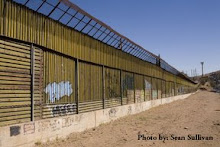
Texas RioGrande Legal Aid has been providing legal advice and representation to private property owners threatened by the border wall who could not otherwise afford a lawyer. The Department of Homeland Security has been trying to browbeat landowners into signing over access to their lands. Even in cases in which a farm or ranch will be sliced in half, and a lack of access to the Rio Grande for irrigation will make farming more expensive or completely untenable, DHS has only offered to pay for the slice of property that the wall sits on. Property owners whose land is entirely behind the wall will receive no compensation, even though the liklihood that anyone will want to buy their property in the future is next to nothing. TRLA has done commendable work on behalf of border residents, and the No Border Wall Coalition commends their efforts.
TRLA released the following press release regarding their efforts to defend private property owners on May 8, 2008:
NEW ORLEANS, Louisiana – Today the United States Court of Appeals for the Fifth Circuit ordered that oral arguments on a series of border wall lawsuits will begin the week of July 7.
The issue to be addressed by the Court is whether the Department of Homeland Security (DHS) violated federal law by condemning land for the border wall before negotiating a price for the property. Represented by Texas RioGrande Legal Aid (TRLA), the largest provider of legal aid in Texas, the landowners are arguing that the government is not following the legal steps required in the condemnation process.
Landowners in the cases on appeal claim that, because the Government failed to offer any money, it cannot sue them for land access. DHS is arguing that it did not offer the landowners any money because it “deemed $0.00 to be a reasonable price” and the courts do not have the power to question the government’s determination of the price’s reasonability.
“If the government’s condemnation power is really that broad, then nobody has the power to make them comply with their own laws,” said TRLA attorney Jerome Wesevich, “The government asserts absolute power in this case and that power can’t be questioned by anyone.”
Landowners involved in the litigation include Baldomero and Hilaria Muñiz of Los Ebanos, Texas. The elderly couple worked as migrant farmworkers and used their earnings to build a house on the border. They raised their five children in the house and now tend goats on their small piece of land to survive. In June 2007 DHS approached Mr. Muñiz and told him that he had to give the Department access to his property or be sued by the federal government.
“This land is their livelihood,” added Wesevich. “Saying that it isn’t worth a penny is insulting.”
The U.S. Court of Appeals for the Fifth Circuit case number is 08-40372.
###
Established in 1970, Texas RioGrande Legal Aid, Inc. (TRLA) is a nonprofit organization that provides free civil legal services to low-income and disadvantaged clients in a 68-county service area. TRLA’s mission is to promote the dignity, self-sufficiency, safety and stability of low-income Texas residents by providing high-quality legal assistance and related educational services.
Contact: Jerome Wesevich, Attorney
915.241.0534
jwesevich@trla.org
Cynthia Martinez, Communications Director
512.374.2764
cmartinez@trla.org
Thursday, May 8, 2008


Thursday, May 1, 2008
The border wall will drive jaguars to extinction in the United States
The Center for Biological Diversity is bringing suit to force the U.S. Fish and Wildlife Service to develop a recovery plan for jaguars in southern Arizona. Listed under the Endangered Species Act, the jaguar is one of the first species that will be driven to extinction by the border wall. If the walls that are on the books for 2008 are built, the Sonoran pronghorn, cactus ferruginous pygmy owl, ocelot, jaguarundi, and a number of other species will follow the jauar into oblivion. While the border-wide waiver of laws that DHS Secretary Chertoff issued on April 1 exempts the activities of the Department of Homeland Security from 36 federal laws, including the Endangered Species Act and National Environmental Policy Act, U.S. Fish and Wildlife is still required to obey the law and develop recovery plans for critically endnagered species. The No Border Wall Coalition applauds the Center for Biological Diversity's efforts to compel the federal government to uphold federal environmental laws.
The finding was signed January 7, 2008, four months after the Fish and Wildlife Service issued a biological opinion that served as a green light — by stating that there would be no jeopardy to the survival of the jaguar — for construction of a border wall that is now rising along the Arizona border with Sonora, Mexico in regions where jaguars roam.
Construction of the wall will end the ongoing jaguar recolonization of former habitats in the United States. Four male jaguars, identifiable by the individual pattern of their rosettes, have been photographed in the United States since 1996, including one photographed repeatedly in southern Arizona over the past 12 years. Other unconfirmed jaguars have also been reported.

Fish and Wildlife’s finding, which was not subject to public review, relies on regulatory loopholes allowing the Service to forgo development of recovery plans in extraordinary circumstances, such as when “the species’ historic and current ranges occur entirely under the jurisdiction of other countries.” However, both the jaguar’s historic U.S. range from California through the Carolinas and its current U.S. range in southeastern Arizona and southwestern New Mexico disqualify it from this exemption.
The finding directly contradicts the assessments of independent biologists that a science-based recovery plan is imperative for the jaguar. In September 2006, Dr. Brian Miller and Dr. Howard Quigley, both members of the interagency Jaguar Conservation Team’s Scientific Advisory Group, wrote the Fish and Wildlife Service to request appointment of a jaguar recovery team. The primary role of a recovery team is to craft a recovery plan.
Dr. Miller has studied wild jaguars in Jalisco, Mexico. Today Dr. Miller stated: “A recovery team and the recovery plan its members produce would reduce conflict because it would force people to consider evidence for an issue rather than rely on political beliefs. Science-based planning puts biological sideboards within which people can negotiate and solve problems.”
In June 2007, over 500 members of the American Society of Mammalogists met in Albuquerque and unanimously passed a resolution calling on the Fish and Wildlife Service to develop a recovery plan for the jaguar. The resolution concluded that “habitats for the jaguar in the United States, including Arizona and New Mexico, are vital to the long-term resilience and survival of the species, especially in response to ongoing climate change.”
In its finding, the Fish and Wildlife Service states that “the existing voluntary approach” of the Jaguar Conservation Team suffices instead of a recovery plan. In 1997 the team pledged to “coordinate protection of jaguar habitat,” but it has not done so, not even taking a stand against the ongoing construction of the border wall.

The Endangered Species Act is intended to recover species and conserve their ecosystems. The presence of jaguars in the Southwest contributed to the evolution of alertness in deer and the tendency of the pig-like javelina to travel in herds for protection. Because jaguars roam widely, protection for their habitat can also protect the habitats for many other species – an example of the link between conservation of species and their habitats that is contemplated in the Act.
The jaguar was listed as an endangered species south of the border in 1972 but was not afforded protection in the United States until July 1997, which only occurred as a result of a previous Center for Biological Diversity lawsuit against the Fish and Wildlife Service.
Background
The last female jaguar confirmed in the United States was shot by a U.S. Fish and Wildlife Service predator control agent in the Apache National Forest (where Mexican gray wolves have since been reintroduced) in 1963.
When the jaguar was listed as an endangered species throughout its range in 1997, the U.S. Fish and Wildlife Service was then required to develop a recovery plan and designate critical habitat for it.
For Immediate Release, April 30, 2008
Silver City, N.M.— The Center for Biological Diversity filed suit today against the U.S. Fish and Wildlife Service to compel development of a recovery plan and critical habitat for the endangered jaguar. The suit challenges a “finding,” signed by Fish and Wildlife Service Director Dale Hall, that a recovery plan would not promote the conservation of the jaguar.
The finding was signed January 7, 2008, four months after the Fish and Wildlife Service issued a biological opinion that served as a green light — by stating that there would be no jeopardy to the survival of the jaguar — for construction of a border wall that is now rising along the Arizona border with Sonora, Mexico in regions where jaguars roam.
Construction of the wall will end the ongoing jaguar recolonization of former habitats in the United States. Four male jaguars, identifiable by the individual pattern of their rosettes, have been photographed in the United States since 1996, including one photographed repeatedly in southern Arizona over the past 12 years. Other unconfirmed jaguars have also been reported.

Fish and Wildlife’s finding, which was not subject to public review, relies on regulatory loopholes allowing the Service to forgo development of recovery plans in extraordinary circumstances, such as when “the species’ historic and current ranges occur entirely under the jurisdiction of other countries.” However, both the jaguar’s historic U.S. range from California through the Carolinas and its current U.S. range in southeastern Arizona and southwestern New Mexico disqualify it from this exemption.
“The American jaguar has been exterminated from all but a tiny sliver of its vast historic range in the United States,” said Michael Robinson of the Center for Biological Diversity. “A recovery plan is a science-based document that would help the jaguar reclaim and eventually be secure in more of its native ecosystems.”
Robinson added: “We will not let the Bush administration, now walling off the border, doom the jaguar to extinction in its northern range.”
The finding directly contradicts the assessments of independent biologists that a science-based recovery plan is imperative for the jaguar. In September 2006, Dr. Brian Miller and Dr. Howard Quigley, both members of the interagency Jaguar Conservation Team’s Scientific Advisory Group, wrote the Fish and Wildlife Service to request appointment of a jaguar recovery team. The primary role of a recovery team is to craft a recovery plan.
Dr. Miller has studied wild jaguars in Jalisco, Mexico. Today Dr. Miller stated: “A recovery team and the recovery plan its members produce would reduce conflict because it would force people to consider evidence for an issue rather than rely on political beliefs. Science-based planning puts biological sideboards within which people can negotiate and solve problems.”
In June 2007, over 500 members of the American Society of Mammalogists met in Albuquerque and unanimously passed a resolution calling on the Fish and Wildlife Service to develop a recovery plan for the jaguar. The resolution concluded that “habitats for the jaguar in the United States, including Arizona and New Mexico, are vital to the long-term resilience and survival of the species, especially in response to ongoing climate change.”
In its finding, the Fish and Wildlife Service states that “the existing voluntary approach” of the Jaguar Conservation Team suffices instead of a recovery plan. In 1997 the team pledged to “coordinate protection of jaguar habitat,” but it has not done so, not even taking a stand against the ongoing construction of the border wall.

The Fish and Wildlife Service has developed international recovery plans for the Mexican gray wolf (1982) and the whooping crane (2007), among others, indicating the practicality of working across borders to recover endangered wildlife.
The Endangered Species Act is intended to recover species and conserve their ecosystems. The presence of jaguars in the Southwest contributed to the evolution of alertness in deer and the tendency of the pig-like javelina to travel in herds for protection. Because jaguars roam widely, protection for their habitat can also protect the habitats for many other species – an example of the link between conservation of species and their habitats that is contemplated in the Act.
The jaguar was listed as an endangered species south of the border in 1972 but was not afforded protection in the United States until July 1997, which only occurred as a result of a previous Center for Biological Diversity lawsuit against the Fish and Wildlife Service.
Background
The jaguar is the largest New World cat. It historically occurred from the southern United States through Mexico and Central America to South America. In the United States it once roamed the southern states from Monterey Bay, California through the Appalachian Mountains. It was exterminated by the same federal predator extermination program that wiped out wolves in the western United States, along with persecution by the livestock industry and habitat loss.
The last female jaguar confirmed in the United States was shot by a U.S. Fish and Wildlife Service predator control agent in the Apache National Forest (where Mexican gray wolves have since been reintroduced) in 1963.
When the jaguar was listed as an endangered species throughout its range in 1997, the U.S. Fish and Wildlife Service was then required to develop a recovery plan and designate critical habitat for it.
Monday, April 7, 2008
Members of Congress Support the Constitutional Challenge to Chertoff's Border Wall Waivers
Today 14 members of Congress announced that they will file an Amicus Curiae brief in support of the constitutional challenge to the Real ID Act filed by the Sierra Club and Defenders of Wildlife. Section 102 of the Real ID Act gives Secretary Chertoff and Secretary Chertoff alone the power to waive any local, state, or federal law that he decides will slow construction of the border wall. The Real ID Act failed when it was introduced as a stand alone bill, and only passed when it was attached as a rider on a bill funding the wars in Iraq and Afghanistan, along with tsunami relief. The power given to the Secretary of Homeland Security to sweep away laws passed by Congress and signed by the President for the express purpose of avoiding judicial review is clearly a violation of the separation of powers provided for in the US Constitution.
It is extremely heartening to see members of Congress defending the Constitution and the rule of law. Many members of Congress appear to be too frightened of the lobbying power of xenophobic extremists, or of the likely negative press spewed by pundits such as Lou Dobbs and Sean Hannnity. Rather than stand up for what they know is right, they crouch down and hope that they won't be noticed and the whole issue will go away. Any member of Congress who has not signed on to the Amicus Curiae brief in support of the Constitutional challenge to Chertoff's unchecked power should be contacted and asked to explain their inaction. Members of the House of Representatives should also be urged to cosponsor the Borderlands Conservation and Security Act (HR 2593) which would repeal section 102 of the Real ID Act, restoring the rule of law to our borderlands.
The following is the press release issued by the members of Congress who will sign the Amicus Curiae brief:
It is extremely heartening to see members of Congress defending the Constitution and the rule of law. Many members of Congress appear to be too frightened of the lobbying power of xenophobic extremists, or of the likely negative press spewed by pundits such as Lou Dobbs and Sean Hannnity. Rather than stand up for what they know is right, they crouch down and hope that they won't be noticed and the whole issue will go away. Any member of Congress who has not signed on to the Amicus Curiae brief in support of the Constitutional challenge to Chertoff's unchecked power should be contacted and asked to explain their inaction. Members of the House of Representatives should also be urged to cosponsor the Borderlands Conservation and Security Act (HR 2593) which would repeal section 102 of the Real ID Act, restoring the rule of law to our borderlands.
The following is the press release issued by the members of Congress who will sign the Amicus Curiae brief:
April 7, 2008 – Today, Congressman Bennie G. Thompson (D-MS), Chairman of the Committee on Homeland Security led a group of 14 Members of Congress, including eight Committee Chairmen, in submitting a notice of intent to file an Amicus Curiae brief in the Defenders of Wildlife case (No. 07-1180). The brief, which will be filed by the end of the month, pertains to Homeland Security Secretary Michael Chertoff’s use of questionable waiver authority to skirt numerous federal laws in order to construct fencing along the southwest border.
The Amici will urge the Supreme Court to grant certiorari in the case. The petitioners, the Defenders of Wildlife and Sierra Club, allege that the Department of Homeland Security’s use of the waiver is unconstitutional.
Today’s notice of intent is being submitted by:
· Homeland Security Committee Chairman Bennie G. Thompson (D-MS);
· Energy & Commerce Committee Chairman John Dingell (D-MI);
· Judiciary Committee Chairman John Conyers (D-MI);
· Transportation & Infrastructure Committee Chairman James Oberstar (D-MN);
· Education and Labor Committee Chairman George Miller (D-CA);
· Rules Committee Chairwoman Louise Slaughter (D-NY)
· Veterans Affairs Chairman Bob Filner (D-CA);
· Intelligence Committee Chairman Silvestre Reyes (D-TX);
· Congressman Solomon Ortiz (D-TX);
· Congresswoman Zoe Lofgren (D-CA);
· Congresswoman Sheila Jackson Lee (D-CA);
· Congresswoman Susan Davis (D-CA);
· Congressman Raul M. Grijalva (D-AZ); and
· Congresswoman Yvette D. Clarke (D-NY).
Speaking to today’s filing, Chairman Thompson noted that “this waiver by the Secretary of Homeland Security is a direct challenge to Congress’s Constitutional role. The American people entrust Congress to ensure that the laws of this land are faithfully executed not excused by the Executive Branch.” Congressman Thompson added that “while the protection of our nation is a paramount concern to all of us, DHS must act prudently and respect the laws that Congress has written. The far-reaching effects that this waiver will have on the institution of Congress, as well as the border, demands that we act swiftly.”
House Judiciary Committee Chairman John Conyers, Jr. (D-MI) added that "our responsibility to be stewards of the earth cannot be thrown aside for the sake of an ill-conceived border fence. The Administration exempts itself from a duty to protect the environment, sacred burial sites, and centuries-old farms, but conveniently spares wealthy landowners from the bulldozers."
“This blanket waiver of laws like the Clean Air Act and the Safe Drinking Water Act is a clear and disturbing abuse of the Secretary’s discretion,” added Rep. John D. Dingell, Chairman of the House Committee on Energy and Commerce. “Congress’ efforts to seek justification for this waiver from DHS have been stonewalled, which leads me to believe none exists.”
“The Department of Homeland Security’s decision to issue waivers to expedite the construction of a wasteful fence along the Southwest border is disappointing at best. As a former Border Patrol Sector Chief and current Chair of the House Intelligence Committee, I know the importance of securing our borders and fully support providing our agents with strong tools to carry out their jobs. I do not, however, support DHS’s continued disregard for border communities. This recent attempt to bypass more than 30 laws and regulations to pursue an already ill-advised idea should not move forward,” added Intelligence Committee Chairman Silvestre Reyes.
The Members are represented by Alan E. Untereiner, Max Huffman, and Alan D. Strasser of Robbins, Russell, Englert, Orseck, Untereiner & Sauber LLP in Washington, DC.
Tuesday, April 1, 2008
Chertoff’s Border Wall Waiver is an Assault on the Rule of Law
The No Border Wall Coalition is deeply disturbed by the announcement that Department of Homeland Security Secretary Michael Chertoff has decided to “waive in their entirety” 36 federal laws to build walls along the entire United States’ southern border. This represents an unprecedented abuse of authority on Secretary Chertoff’s part, and clearly demonstrates the need for an immediate repeal of section 102 of the Real ID Act. Obeying the law is not voluntary, it is mandatory, and Secretary Chertoff cannot claim that he is sweeping aside a host of laws on the border in defense of immigration laws. In a nation of laws all laws must be respected, not just those that are convenient.
Equal protection under the law is meant to be a fundamental right shared by every American, but the Real ID Act makes the legal rights of citizens who live near the border conditional on Secretary Chertoff’s whims. Section 102 of the Real ID Act of 2005 states, “Notwithstanding any other provision of law, the Secretary of Homeland Security shall have the authority to waive all legal requirements such Secretary, in such Secretary’s sole discretion, determines necessary to ensure expeditious construction of the barriers and roads under this section.” No one else is granted this extreme power under any circumstance. The president cannot waive our nation’s laws even in times of national crisis, and Secretary Chertoff cannot waive the laws that protect citizens who live away from the border. Only border residents may have their legal protections waived.
Secretary Chertoff claims that the Secure Fence Act mandates walls along the border, and he therefore has no choice but to build border walls no matter the cost. The walls that are scheduled for construction in 2008 will destroy homes, businesses, and farms, will slice through communities, parks, and wildlife refuges, and will cost tens of billions of dollars. Border walls will not stop anyone from entering the United States, and in July 2007 the Congressional Research Service concluded that the California border wall “did not have a discernible impact on the influx of unauthorized aliens coming across the border in San Diego.” Recognizing this fact language was inserted into the 2007 Omnibus Spending bill that allowed Secretary Chertoff to decide whether or not walls would be built in a given area based on tactical considerations, and required that he consult with local stakeholders. Despite the fact that his hands are no longer tied, Secretary Chertoff prefers to act as though the Secure Fence Act is still the law of the land, and it is apparently the only law that he continues to respect.
In announcing the Real ID waivers Secretary Chertoff said, "Criminal activity at the border does not stop for endless debate or protracted litigation." The waivers are essentially an admission that the border wall will itself violate up to 36 federal laws, making construction of the wall a criminal act. If Chertoff is genuinely concerned with criminal activity he should ensure that the agency that he oversees complies with the law.
The only reason for Secretary Chertoff to waive these laws is because he knows that the border wall will violate them. In setting these 36 federal laws aside Secretary Chertoff sets himself above the law. If congress allows unchecked power to remain in the hands of an unelected administration appointee they are complicit in fundamentally undermining the rule of law. Leaving the Real ID Act on the books and allowing Chertoff’s waivers to stand sets a precedent that should outrage the American people. If our nation’s laws can be set aside to build a border wall today, they may be similarly set aside for whatever crisis politicians discover in the next election cycle.
The No Border Wall coalition calls on congress to repeal section 102 of the Real ID Act and restore the rule of law. We also urge the Supreme Court to take up the constitutional challenge brought by the Defenders of Wildlife and Sierra Club to Secretary Chertoff’s earlier waiver of 19 federal laws to force the border wall through the San Pedro Riparian National Conservation Area in Arizona. Allowing one man to overrule laws passed by Congress and signed by the President for the express intent of circumventing judicial oversight is fundamentally un-American.
Equal protection under the law is meant to be a fundamental right shared by every American, but the Real ID Act makes the legal rights of citizens who live near the border conditional on Secretary Chertoff’s whims. Section 102 of the Real ID Act of 2005 states, “Notwithstanding any other provision of law, the Secretary of Homeland Security shall have the authority to waive all legal requirements such Secretary, in such Secretary’s sole discretion, determines necessary to ensure expeditious construction of the barriers and roads under this section.” No one else is granted this extreme power under any circumstance. The president cannot waive our nation’s laws even in times of national crisis, and Secretary Chertoff cannot waive the laws that protect citizens who live away from the border. Only border residents may have their legal protections waived.
Secretary Chertoff claims that the Secure Fence Act mandates walls along the border, and he therefore has no choice but to build border walls no matter the cost. The walls that are scheduled for construction in 2008 will destroy homes, businesses, and farms, will slice through communities, parks, and wildlife refuges, and will cost tens of billions of dollars. Border walls will not stop anyone from entering the United States, and in July 2007 the Congressional Research Service concluded that the California border wall “did not have a discernible impact on the influx of unauthorized aliens coming across the border in San Diego.” Recognizing this fact language was inserted into the 2007 Omnibus Spending bill that allowed Secretary Chertoff to decide whether or not walls would be built in a given area based on tactical considerations, and required that he consult with local stakeholders. Despite the fact that his hands are no longer tied, Secretary Chertoff prefers to act as though the Secure Fence Act is still the law of the land, and it is apparently the only law that he continues to respect.
In announcing the Real ID waivers Secretary Chertoff said, "Criminal activity at the border does not stop for endless debate or protracted litigation." The waivers are essentially an admission that the border wall will itself violate up to 36 federal laws, making construction of the wall a criminal act. If Chertoff is genuinely concerned with criminal activity he should ensure that the agency that he oversees complies with the law.
The only reason for Secretary Chertoff to waive these laws is because he knows that the border wall will violate them. In setting these 36 federal laws aside Secretary Chertoff sets himself above the law. If congress allows unchecked power to remain in the hands of an unelected administration appointee they are complicit in fundamentally undermining the rule of law. Leaving the Real ID Act on the books and allowing Chertoff’s waivers to stand sets a precedent that should outrage the American people. If our nation’s laws can be set aside to build a border wall today, they may be similarly set aside for whatever crisis politicians discover in the next election cycle.
The No Border Wall coalition calls on congress to repeal section 102 of the Real ID Act and restore the rule of law. We also urge the Supreme Court to take up the constitutional challenge brought by the Defenders of Wildlife and Sierra Club to Secretary Chertoff’s earlier waiver of 19 federal laws to force the border wall through the San Pedro Riparian National Conservation Area in Arizona. Allowing one man to overrule laws passed by Congress and signed by the President for the express intent of circumventing judicial oversight is fundamentally un-American.
Friday, March 28, 2008
Riding the Border Wall to Reelection
By Scott Nicol
Representative Duncan Hunter (R-CA) likes to brag about the wall that he built on the border. It took a decade and $39 million to build the first 9 miles of border wall south of San Diego, and its impact was minimal at best, but it made Rep. Hunter proud. In the weeks just before the 2006 mid-term elections, politicians desperate to look tough on national security and hang on to their seats jumped on Hunter’s bandwagon and rushed through the Secure Fence Act, which mandated “[at] least 2 layers of reinforced fencing, the installation of additional physical barriers, roads, lighting, cameras, and sensors” along 700-plus miles of the U.S. - Mexico border. Though no walls would be built along the Canadian border and the coasts would likewise be unaffected, the Act’s pie-in-the-sky goal was “to achieve and maintain operational control over the entire international land and maritime borders of the United States."
The politicians who voted for the Secure Fence Act were primarily interested in the symbolism of a wall, not its substance, otherwise they would have checked to see if the original San Diego border wall had worked. In fact, it hadn’t. The Congressional Research Service concluded that the border wall “did not have a discernible impact on the influx of unauthorized aliens coming across the border in San Diego.” Recent Border Patrol statistics bear this conclusion out. Fiscal year 2007 saw a 7% increase in illegal crossings in the San Diego sector. In contrast, during the same year crossings border-wide dropped by 20%. The Del Rio sector, which like the rest of Texas east of El Paso has never had a wall, saw a 46% drop. The unwalled Rio Grande Valley saw a 34% drop, bringing illegal entries in that sector to a 15 year low. Even Department of Homeland Security Secretary Michael Chertoff recognized the border wall’s ineffectiveness, saying, “I think the fence has come to assume a certain kind of symbolic significance which should not obscure the fact that it is a much more complicated problem than putting up a fence which someone can climb over with a ladder or tunnel under with a shovel.”

Unfortunately, the border wall is not just a symbol or a line drawn on a map. It is a physical structure that will tear through private homes and property, municipalities, parks and wildlife refuges, and a college campus. While its benefits may be illusory, the damage that it causes will be real. Recognizing this fact, in December Representative Ciro Rodriguez (D-TX) and Senator Kay Bailey Hutchison (R-TX) inserted language into the Omnibus Spending Bill that gave DHS Secretary Chertoff the flexibility to determine where walls would be built, as well as how many miles of wall would be built, based on his determination of the Border Patrol’s operational needs. The bill also requires Chertoff to consult with property owners, local governments, Indian tribes, and the Secretaries of Agriculture and the Interior to “minimize the impact on the environment, culture, commerce, and quality of life for the communities and residents located near the sites at which such fencing is to be constructed.”
While this would seem like the first small step towards a rational border policy, it enraged right wing politicians who screamed that the border wall had been “gutted.” Representative Hunter, whose failed bid for the White House had been based on little more than his claim to have built the California border wall, quickly introduced the Reinstatement of the Secure Fence Act. It repeals the Omnibus Spending Bill’s flexibility language, and requires that 700 miles of double layered border wall be built within 6 months. The nearly 300 miles of border walls and vehicle barriers that have already been built would not count towards that number, and the funds necessary to build the new walls would be immediately appropriated. The bill currently has 19 cosponsors. Clearly, Representative Hunter realized that the border wall is his only claim to fame, and that during his presidential bid the media ignored him if he talked about anything else. Howling that our national security is being put at risk gets him media attention and brings in donations to his reelection campaign and his Peace Through Strength Political Action Committee.

Duncan Hunter is not alone in exploiting fears of an immigrant invasion and terrorists crossing our southern border to fill his campaign coffers. Senator Jim DeMint (R-SC) introduced the Complete the Fence Act, which does much the same things as Hunter’s bill. In a letter announcing the bill DeMint also heralded “the launch of a new grassroots website called Completethefencenow.com”. Of course, the “grassroots” website has a link to JimDeMint.com on its banner, a video clip of Jim DeMint on the home page, and declares at the bottom of the home page “Paid for by Jim DeMint For Senate, Inc.” It is little more than a campaign ad. In fact, the letter announcing the Complete the Fence Act ends with a heartfelt P.S., “I will continue to lead the charge for conservative reforms, but I need your help. Please consider making a contribution to my campaign.”
Not to be left out, Representative Walter Jones (R-NC) has introduced the Fence by Date Certain Act, which contains the same provisions as the Reinstatement of the Secure Fence Act. Congressman Jones is best known for his efforts to change the names of French Fries and French Toast to Freedom Fries and Freedom Toast in the congressional cafeteria to punish France for refusing to support the invasion of Iraq. His latest valiant effort to defend our national honor already has 42 cosponsors, including 14 of the 19 cosponsors of Hunter’s nearly identical bill. Why introduce a third bill that mimics two existing bills? Because actually building a wall is not the point. Getting credit for demanding its construction is.
Politics is a game that exists outside of the real world. In the real world the border wall is an expensive failure, but it sure looks great behind the candidate in a campaign ad. If demolished homes and bulldozed wildlife refuges clash with the rhetoric of protecting the homeland, they are simply ignored. When the Border Patrol says it only takes 5 minutes to get past the border wall, Representative Jones calls it “a foolproof barrier on the border.” While the General Accounting Office says that the wall has caused the number of crossers who die in the desert to double, Representative Hunter says “the fence works” in his ads. Reality is irrelevant. The only real-world consequences that matter to Hunter, DeMint, and Jones are campaign contributions in their pockets and votes in the next election.
Representative Duncan Hunter (R-CA) likes to brag about the wall that he built on the border. It took a decade and $39 million to build the first 9 miles of border wall south of San Diego, and its impact was minimal at best, but it made Rep. Hunter proud. In the weeks just before the 2006 mid-term elections, politicians desperate to look tough on national security and hang on to their seats jumped on Hunter’s bandwagon and rushed through the Secure Fence Act, which mandated “[at] least 2 layers of reinforced fencing, the installation of additional physical barriers, roads, lighting, cameras, and sensors” along 700-plus miles of the U.S. - Mexico border. Though no walls would be built along the Canadian border and the coasts would likewise be unaffected, the Act’s pie-in-the-sky goal was “to achieve and maintain operational control over the entire international land and maritime borders of the United States."
The politicians who voted for the Secure Fence Act were primarily interested in the symbolism of a wall, not its substance, otherwise they would have checked to see if the original San Diego border wall had worked. In fact, it hadn’t. The Congressional Research Service concluded that the border wall “did not have a discernible impact on the influx of unauthorized aliens coming across the border in San Diego.” Recent Border Patrol statistics bear this conclusion out. Fiscal year 2007 saw a 7% increase in illegal crossings in the San Diego sector. In contrast, during the same year crossings border-wide dropped by 20%. The Del Rio sector, which like the rest of Texas east of El Paso has never had a wall, saw a 46% drop. The unwalled Rio Grande Valley saw a 34% drop, bringing illegal entries in that sector to a 15 year low. Even Department of Homeland Security Secretary Michael Chertoff recognized the border wall’s ineffectiveness, saying, “I think the fence has come to assume a certain kind of symbolic significance which should not obscure the fact that it is a much more complicated problem than putting up a fence which someone can climb over with a ladder or tunnel under with a shovel.”

Unfortunately, the border wall is not just a symbol or a line drawn on a map. It is a physical structure that will tear through private homes and property, municipalities, parks and wildlife refuges, and a college campus. While its benefits may be illusory, the damage that it causes will be real. Recognizing this fact, in December Representative Ciro Rodriguez (D-TX) and Senator Kay Bailey Hutchison (R-TX) inserted language into the Omnibus Spending Bill that gave DHS Secretary Chertoff the flexibility to determine where walls would be built, as well as how many miles of wall would be built, based on his determination of the Border Patrol’s operational needs. The bill also requires Chertoff to consult with property owners, local governments, Indian tribes, and the Secretaries of Agriculture and the Interior to “minimize the impact on the environment, culture, commerce, and quality of life for the communities and residents located near the sites at which such fencing is to be constructed.”
While this would seem like the first small step towards a rational border policy, it enraged right wing politicians who screamed that the border wall had been “gutted.” Representative Hunter, whose failed bid for the White House had been based on little more than his claim to have built the California border wall, quickly introduced the Reinstatement of the Secure Fence Act. It repeals the Omnibus Spending Bill’s flexibility language, and requires that 700 miles of double layered border wall be built within 6 months. The nearly 300 miles of border walls and vehicle barriers that have already been built would not count towards that number, and the funds necessary to build the new walls would be immediately appropriated. The bill currently has 19 cosponsors. Clearly, Representative Hunter realized that the border wall is his only claim to fame, and that during his presidential bid the media ignored him if he talked about anything else. Howling that our national security is being put at risk gets him media attention and brings in donations to his reelection campaign and his Peace Through Strength Political Action Committee.

Duncan Hunter is not alone in exploiting fears of an immigrant invasion and terrorists crossing our southern border to fill his campaign coffers. Senator Jim DeMint (R-SC) introduced the Complete the Fence Act, which does much the same things as Hunter’s bill. In a letter announcing the bill DeMint also heralded “the launch of a new grassroots website called Completethefencenow.com”. Of course, the “grassroots” website has a link to JimDeMint.com on its banner, a video clip of Jim DeMint on the home page, and declares at the bottom of the home page “Paid for by Jim DeMint For Senate, Inc.” It is little more than a campaign ad. In fact, the letter announcing the Complete the Fence Act ends with a heartfelt P.S., “I will continue to lead the charge for conservative reforms, but I need your help. Please consider making a contribution to my campaign.”
Not to be left out, Representative Walter Jones (R-NC) has introduced the Fence by Date Certain Act, which contains the same provisions as the Reinstatement of the Secure Fence Act. Congressman Jones is best known for his efforts to change the names of French Fries and French Toast to Freedom Fries and Freedom Toast in the congressional cafeteria to punish France for refusing to support the invasion of Iraq. His latest valiant effort to defend our national honor already has 42 cosponsors, including 14 of the 19 cosponsors of Hunter’s nearly identical bill. Why introduce a third bill that mimics two existing bills? Because actually building a wall is not the point. Getting credit for demanding its construction is.
Politics is a game that exists outside of the real world. In the real world the border wall is an expensive failure, but it sure looks great behind the candidate in a campaign ad. If demolished homes and bulldozed wildlife refuges clash with the rhetoric of protecting the homeland, they are simply ignored. When the Border Patrol says it only takes 5 minutes to get past the border wall, Representative Jones calls it “a foolproof barrier on the border.” While the General Accounting Office says that the wall has caused the number of crossers who die in the desert to double, Representative Hunter says “the fence works” in his ads. Reality is irrelevant. The only real-world consequences that matter to Hunter, DeMint, and Jones are campaign contributions in their pockets and votes in the next election.
Tuesday, March 18, 2008
Chertoff's Real ID Act Power to Waive U.S. Law Challenged
In 2005 the Real ID Act was attached as a rider on an appropriations bill funding the wars in Iraq and Afghanistan after it failed to pass on its own merits. It contained a provision intended to overrule the objections of the California Coastal Commission and anyone else who might oppose the construction of border barriers. “Notwithstanding any other provision of law, the Secretary of Homeland Security shall have the authority to waive all legal requirements such Secretary, in such Secretary’s sole discretion, determines necessary to ensure expeditious construction of the barriers and roads under this section.” Secretary of Homeland Security Michael Chertoff used his unprecedented new power to “waive in their entirety” the Endangered Species Act, the Migratory Bird Treaty Act, the National Environmental Policy Act, the Coastal Zone Management Act, the Clean Water Act, the Clean Air Act, and the National Historic Preservation Act, and a host of other federal laws to override court challenges to the construction of walls in California and Arizona. There is of course no reason for DHS to waive a law unless they know that their actions will violate it.
Defenders of Wildlife and the Sierra Club are challenging the authority to waive all of our nation's laws before the Supreme Court. They have issued the following press release:
WASHINGTON – Today, Defenders of Wildlife and The Sierra Club filed a petition asking the U.S. Supreme Court to hear its argument that the REAL ID Act, which grants Department of Homeland Security (DHS) Secretary Michael Chertoff unprecedented and sweeping authority to waive any and all laws to expedite the construction of a wall along the U.S.-Mexico border, is unconstitutional besides being harmful to the environment and border communities. The two conservation groups charge that such unbounded authority to the executive branch is a violation of the Constitution’s separation of powers provisions.
“By granting one government official the absolute power to pick and choose which laws apply to border wall construction, the REAL ID Act proves itself to be both inherently dangerous and profoundly un-American. The issue here is not security vs. wildlife, but whether wildlife, sensitive environmental values and communities along the border will be given fair consideration in the decisions the government makes,” said Rodger Schlickeisen, president of Defenders of Wildlife. “We are hopeful that the Supreme Court will take up this case in order to protect the fundamental separation of powers principles enshrined in the United States Constitution”
“Laws such as the National Environmental Policy Act and the National Historic Preservation Act are part of America's enduring legal framework, and no agency or public official should be allowed to ignore them,” said Carl Pope, executive director of Sierra Club. “Our laws have provided Americans a voice in the decision-making process that affects their lives, their human rights and the protection of wildlife; our government must not exempt itself from obeying those laws.”
The groups’ petition is the latest chapter in their legal efforts dating back to October, 2007 to safeguard the borderlands in the face of aggressive border wall construction. At that time, Defenders and The Sierra Club filed a lawsuit challenging DHS and Bureau of Land Management’s (BLM) approval of border wall construction within the San Pedro Riparian National Conservation Area in Arizona. After a federal judge in the U.S. District Court for District of Columbia found that the groups would likely prevail on their claims and issued an injunction blocking further construction of the wall, Secretary Chertoff waived 19 laws intended to protect public health, wildlife and endangered species, clean air and water, and historic and archeological sites to move forward with construction.
In their petition to the U.S. Supreme Court, Defenders and The Sierra Club contend that the REAL ID Act’s waiver provision unconstitutionally allows the DHS secretary unilaterally to repeal laws, threatening the system of checks and balances assured in the Constitution.
Since passage of the REAL ID Act in 2005, Secretary Chertoff has used this power to waive laws on three occasions:
to complete a wall near San Diego, California
to remove vehicle barriers and replace them with a wall in the Barry M. Goldwater Range in Arizona
to build a border wall within the San Pedro Riparian National Conservation Area.
In addition, Secretary Chertoff appears poised to again waive laws in relation to proposed border wall construction in Texas, in order to bypass extensive opposition from local residents, elected leaders, business owners, and conservationists.
“It isn’t too much to ask that DHS and other government agencies comply with our nation’s environmental laws along the border, particularly where international treasures like the San Pedro River are at stake,” said Schlickeisen. “We can not afford to let this keep happening all across the border or we will be left with nothing but a 700-mile testament to our own short-sightedness.”
Defenders and Sierra Club are represented by the Yale Law School Supreme Court Clinic, led by Professor Dan Kahan. Defenders is also represented by Andrew J. Pincus and Charles Rothfeld of Mayer Brown, LLP.
Defenders of Wildlife and the Sierra Club are challenging the authority to waive all of our nation's laws before the Supreme Court. They have issued the following press release:
WASHINGTON – Today, Defenders of Wildlife and The Sierra Club filed a petition asking the U.S. Supreme Court to hear its argument that the REAL ID Act, which grants Department of Homeland Security (DHS) Secretary Michael Chertoff unprecedented and sweeping authority to waive any and all laws to expedite the construction of a wall along the U.S.-Mexico border, is unconstitutional besides being harmful to the environment and border communities. The two conservation groups charge that such unbounded authority to the executive branch is a violation of the Constitution’s separation of powers provisions.
“By granting one government official the absolute power to pick and choose which laws apply to border wall construction, the REAL ID Act proves itself to be both inherently dangerous and profoundly un-American. The issue here is not security vs. wildlife, but whether wildlife, sensitive environmental values and communities along the border will be given fair consideration in the decisions the government makes,” said Rodger Schlickeisen, president of Defenders of Wildlife. “We are hopeful that the Supreme Court will take up this case in order to protect the fundamental separation of powers principles enshrined in the United States Constitution”
“Laws such as the National Environmental Policy Act and the National Historic Preservation Act are part of America's enduring legal framework, and no agency or public official should be allowed to ignore them,” said Carl Pope, executive director of Sierra Club. “Our laws have provided Americans a voice in the decision-making process that affects their lives, their human rights and the protection of wildlife; our government must not exempt itself from obeying those laws.”
The groups’ petition is the latest chapter in their legal efforts dating back to October, 2007 to safeguard the borderlands in the face of aggressive border wall construction. At that time, Defenders and The Sierra Club filed a lawsuit challenging DHS and Bureau of Land Management’s (BLM) approval of border wall construction within the San Pedro Riparian National Conservation Area in Arizona. After a federal judge in the U.S. District Court for District of Columbia found that the groups would likely prevail on their claims and issued an injunction blocking further construction of the wall, Secretary Chertoff waived 19 laws intended to protect public health, wildlife and endangered species, clean air and water, and historic and archeological sites to move forward with construction.
In their petition to the U.S. Supreme Court, Defenders and The Sierra Club contend that the REAL ID Act’s waiver provision unconstitutionally allows the DHS secretary unilaterally to repeal laws, threatening the system of checks and balances assured in the Constitution.
Since passage of the REAL ID Act in 2005, Secretary Chertoff has used this power to waive laws on three occasions:
to complete a wall near San Diego, California
to remove vehicle barriers and replace them with a wall in the Barry M. Goldwater Range in Arizona
to build a border wall within the San Pedro Riparian National Conservation Area.
In addition, Secretary Chertoff appears poised to again waive laws in relation to proposed border wall construction in Texas, in order to bypass extensive opposition from local residents, elected leaders, business owners, and conservationists.
“It isn’t too much to ask that DHS and other government agencies comply with our nation’s environmental laws along the border, particularly where international treasures like the San Pedro River are at stake,” said Schlickeisen. “We can not afford to let this keep happening all across the border or we will be left with nothing but a 700-mile testament to our own short-sightedness.”
Defenders and Sierra Club are represented by the Yale Law School Supreme Court Clinic, led by Professor Dan Kahan. Defenders is also represented by Andrew J. Pincus and Charles Rothfeld of Mayer Brown, LLP.
Sunday, March 9, 2008
COURT RULES SECRETARY CHERTOFF VIOLATING THE LAW IN BUILDING BORDER WALL
The Center for Human Rights and Constitutional Law released the following statement regarding their lawsuit defending the private property rights of border resident Eloisa Tamez:
In a 32-page decision issued today, a federal judge in Brownsville ruled that Secretary of Homeland Security Michael Chertoff violated federal law in his rush to build several hundred miles of border fencing in Southern Texas.
In a lawsuit filed by Secretary Chertoff in January against Dr. Eloisa Tamez, the Department of Homeland Security requested an expedited court order condemning Dr. Tamez's land so it could immediately commence a survey for the planned border fence. Dr. Tamez is an indigenous land-grant property owner in South Texas who refused to voluntarily give the U.S. Government a six month right to enter her land to survey for the border wall.
About twenty cases filed by Secretary Chertoff to condemn land along the border have been consolidated before federal judge Andrew Hanen in Brownsville, Texas, and delayed pending the outcome of Dr. Tamez's case.
In response to the government's suit, the court held a lengthy hearing on February 7 at which Dr. Tamez's lawyers with the Los Angeles-based Center for Human Rights and Constitutional Law argued that Secretary Chertoff had violated federal law by failing to negotiate with Dr. Tamez to arrive at a "fixed price" for the six month access it sought before suing to condemn the land to allow the survey to proceed.
In the decision issued today, judge Hanen ruled that "Dr. Tamez correctly asserts that negotiations are a prerequisite to the exercise of the power of eminent domain" under federal law. The court further concluded that Secretary Chertoff had presented "insufficient evidence ... as to whether there has been bona fide efforts to negotiate with Dr. Tamez." As it has done for over a month now, the court refused to sign an expedited order condemning Dr. Tamez's land so that the Department of Homeland Security can start a survey for its planned border wall.
The court also decided that a clause in the 2008 Appropriations Act for the Department of Homeland Security enacted in December 2007 that requires the Secretary of Homeland Security to consult with property owners to minimize the adverse impacts of any border activity is not a defense to the temporary access the Department seeks to conduct a survey, "but that it still may be a defense to later activity by the Government" when it seeks to enter her property: "Given the mandatory language of the consultation clause, that 'the Secretary of Homeland Security shall consult . . .,' this Court may find it proper to require compliance with the consultation clause, when appropriate, as a condition prior to entry onto the property after the taking has been completed ... Dr. Tamez's objections concerning the failure of the Government to abide by the consultation clause are denied without prejudice to her ability to reassert those objections at a later point in time" if the Government actually seeks to enter her property.
The court rejected Dr. Tamez's argument that if she and the Department of Homeland Security are unable after negotiations to agree on a fixed price for the right of temporary access to her land, that the government may only proceed to condemn her land under a federal law that grants her a right to a jury trial. The decision states that if the parties are unable to negotiate a fixed price for the interest the Government seeks in Dr. Tamez's land, then the Department of Homeland Security may seek to condemn the land under an expedited procedure known as the Declaration of Taking Act.
The court ordered the Government agents "to either partake in negotiations and/or provide this Court with any relevant evidence they may have concerning the existence of bona fide efforts to negotiate" by March 21.
In a statement issued through her lawyers, Dr. Tamez stated: "The court's order issued today vindicates my position that Secretary Chertoff has proceeded to seize my land and the land of other property owners in violation of federal law. On the other hand I am disappointed that the court ruled that Secretary Chertoff may use the expedited condemnation procedures after he negotiates with property owners to arrive at a fixed price for the use he seeks of our property. I am also pleased that the court appears to agree that property owners have the right to be consulted before Government agents actually enter our land. Under federal law the consultation we will insist upon must seek to minimize the adverse impact of any entry onto our lands on the environment and our cultural and economic rights. I intend to continue fighting this case to insure that Secretary Chertoff does not violate the law while rushing forward to build an ill-conceived border fence that will in many ways destroy border communities."
Peter Schey, President of the Center for Human Rights and Constitutional Law, and Dr. Tamez's lead counsel, responded to the ruling: "We will carefully study this decision to see how it may be used by other border property owners to protect their rights to the fullest extent permitted by law. Like border property owners, Secretary Chertoff is also bound by applicable laws and may not run roughshod over property owners' rights in his rush to complete an ill-conceived border wall. The proposed border wall will do little to stop undocumented migration but it will significantly increase deaths and injuries by diverting migrants to more dangerous border crossings. Regardless of how ill-advised the proposed border wall is, it certainly may not be built on a foundation of illegal and lawless conduct by the Department of Homeland Security. We welcome the court-ordered negotiations with the Government to explore a fair price for the property access that Secretary Chertoff seeks in Dr. Tamez's land. Once those discussions are concluded, we will demand that consultation take place with Dr. Tamez before any federal agents enter her land. By law these consultations must be aimed at minimizing any adverse impact of entry onto her land on the environment and on her economic and cultural rights. We will certainly also seek the same protections for all similarly situated property owners along the US-Mexico border."
Arnoldo Garcia, Senior Policy Associate with the National Network for Immigrant and Refugee Rights that has been supporting Dr. Tamez's lawsuit said: "It is time for Congress to reconsider building a Berlin-type militarized wall along the US-Mexico border. The more the border area is militarized and criminalized, the more migrants die trying to come to the US in search of little more than a better life and the ability to join or support their families. This country urgently needs rational and humane immigration reform, not walls that kill people. When Congress musters the courage to enact immigration reform, the need for a border wall will all but disappear. What good does it do to spend hundreds of millions of dollars on a border wall when half the undocumented immigrants enter the United States with non-immigrant visas, not through the US-Mexico border. Virtually all migration experts agree that we need to promptly legalize the undocumented population, issue a sufficient number of visas in the future to meet the known demand, and invest in sustainable development in the major sending communities abroad, not turn the United States into a fort surrounded by another Berlin wall."
The court's Order is available at http://www.nnirr. org/resources/ docs/EloisaTamez Case3-7-08- Order.pdf
Contacts:Peter Schey, Center for Human Rights and Constitutional Law, lead attorney for Dr. Tamez 323 251-3223Arnoldo Garcia, National Network for Immigrant and Refugee Rights, 510 928-0685Margo Tamez, daughter of Dr. Eloisa Tamez, Co-Founder, Lipan Apache (El Calaboz) Women Community Defense 509-595-4445
In a 32-page decision issued today, a federal judge in Brownsville ruled that Secretary of Homeland Security Michael Chertoff violated federal law in his rush to build several hundred miles of border fencing in Southern Texas.
In a lawsuit filed by Secretary Chertoff in January against Dr. Eloisa Tamez, the Department of Homeland Security requested an expedited court order condemning Dr. Tamez's land so it could immediately commence a survey for the planned border fence. Dr. Tamez is an indigenous land-grant property owner in South Texas who refused to voluntarily give the U.S. Government a six month right to enter her land to survey for the border wall.
About twenty cases filed by Secretary Chertoff to condemn land along the border have been consolidated before federal judge Andrew Hanen in Brownsville, Texas, and delayed pending the outcome of Dr. Tamez's case.
In response to the government's suit, the court held a lengthy hearing on February 7 at which Dr. Tamez's lawyers with the Los Angeles-based Center for Human Rights and Constitutional Law argued that Secretary Chertoff had violated federal law by failing to negotiate with Dr. Tamez to arrive at a "fixed price" for the six month access it sought before suing to condemn the land to allow the survey to proceed.
In the decision issued today, judge Hanen ruled that "Dr. Tamez correctly asserts that negotiations are a prerequisite to the exercise of the power of eminent domain" under federal law. The court further concluded that Secretary Chertoff had presented "insufficient evidence ... as to whether there has been bona fide efforts to negotiate with Dr. Tamez." As it has done for over a month now, the court refused to sign an expedited order condemning Dr. Tamez's land so that the Department of Homeland Security can start a survey for its planned border wall.
The court also decided that a clause in the 2008 Appropriations Act for the Department of Homeland Security enacted in December 2007 that requires the Secretary of Homeland Security to consult with property owners to minimize the adverse impacts of any border activity is not a defense to the temporary access the Department seeks to conduct a survey, "but that it still may be a defense to later activity by the Government" when it seeks to enter her property: "Given the mandatory language of the consultation clause, that 'the Secretary of Homeland Security shall consult . . .,' this Court may find it proper to require compliance with the consultation clause, when appropriate, as a condition prior to entry onto the property after the taking has been completed ... Dr. Tamez's objections concerning the failure of the Government to abide by the consultation clause are denied without prejudice to her ability to reassert those objections at a later point in time" if the Government actually seeks to enter her property.
The court rejected Dr. Tamez's argument that if she and the Department of Homeland Security are unable after negotiations to agree on a fixed price for the right of temporary access to her land, that the government may only proceed to condemn her land under a federal law that grants her a right to a jury trial. The decision states that if the parties are unable to negotiate a fixed price for the interest the Government seeks in Dr. Tamez's land, then the Department of Homeland Security may seek to condemn the land under an expedited procedure known as the Declaration of Taking Act.
The court ordered the Government agents "to either partake in negotiations and/or provide this Court with any relevant evidence they may have concerning the existence of bona fide efforts to negotiate" by March 21.
In a statement issued through her lawyers, Dr. Tamez stated: "The court's order issued today vindicates my position that Secretary Chertoff has proceeded to seize my land and the land of other property owners in violation of federal law. On the other hand I am disappointed that the court ruled that Secretary Chertoff may use the expedited condemnation procedures after he negotiates with property owners to arrive at a fixed price for the use he seeks of our property. I am also pleased that the court appears to agree that property owners have the right to be consulted before Government agents actually enter our land. Under federal law the consultation we will insist upon must seek to minimize the adverse impact of any entry onto our lands on the environment and our cultural and economic rights. I intend to continue fighting this case to insure that Secretary Chertoff does not violate the law while rushing forward to build an ill-conceived border fence that will in many ways destroy border communities."
Peter Schey, President of the Center for Human Rights and Constitutional Law, and Dr. Tamez's lead counsel, responded to the ruling: "We will carefully study this decision to see how it may be used by other border property owners to protect their rights to the fullest extent permitted by law. Like border property owners, Secretary Chertoff is also bound by applicable laws and may not run roughshod over property owners' rights in his rush to complete an ill-conceived border wall. The proposed border wall will do little to stop undocumented migration but it will significantly increase deaths and injuries by diverting migrants to more dangerous border crossings. Regardless of how ill-advised the proposed border wall is, it certainly may not be built on a foundation of illegal and lawless conduct by the Department of Homeland Security. We welcome the court-ordered negotiations with the Government to explore a fair price for the property access that Secretary Chertoff seeks in Dr. Tamez's land. Once those discussions are concluded, we will demand that consultation take place with Dr. Tamez before any federal agents enter her land. By law these consultations must be aimed at minimizing any adverse impact of entry onto her land on the environment and on her economic and cultural rights. We will certainly also seek the same protections for all similarly situated property owners along the US-Mexico border."
Arnoldo Garcia, Senior Policy Associate with the National Network for Immigrant and Refugee Rights that has been supporting Dr. Tamez's lawsuit said: "It is time for Congress to reconsider building a Berlin-type militarized wall along the US-Mexico border. The more the border area is militarized and criminalized, the more migrants die trying to come to the US in search of little more than a better life and the ability to join or support their families. This country urgently needs rational and humane immigration reform, not walls that kill people. When Congress musters the courage to enact immigration reform, the need for a border wall will all but disappear. What good does it do to spend hundreds of millions of dollars on a border wall when half the undocumented immigrants enter the United States with non-immigrant visas, not through the US-Mexico border. Virtually all migration experts agree that we need to promptly legalize the undocumented population, issue a sufficient number of visas in the future to meet the known demand, and invest in sustainable development in the major sending communities abroad, not turn the United States into a fort surrounded by another Berlin wall."
The court's Order is available at http://www.nnirr. org/resources/ docs/EloisaTamez Case3-7-08- Order.pdf
Contacts:Peter Schey, Center for Human Rights and Constitutional Law, lead attorney for Dr. Tamez 323 251-3223Arnoldo Garcia, National Network for Immigrant and Refugee Rights, 510 928-0685Margo Tamez, daughter of Dr. Eloisa Tamez, Co-Founder, Lipan Apache (El Calaboz) Women Community Defense 509-595-4445
Subscribe to:
Posts (Atom)