By Stefanie Herweck
Over the past two years, the Department of Homeland Security (DHS) and the organizations that it manages, Customs and Border Protection (CBP) and the Border Patrol, have shown a deep-seated indifference to the welfare of those of us living on the Texas-Mexico border. These agencies have treated our elected leaders with disrespect, they have assumed an adversarial relationship with the public, and they have shown disdain for border communities, culture, and the environment. These actions have seriously undermined DHS’s credibility along the Texas border and have fostered a great deal of antagonism.
The border wall is the clearest example of this. The border wall project has been propelled by a blind determination to build as many miles of wall as possible regardless of cost, safety, effectiveness, and environmental damage. It has been shrouded in secrecy, and DHS has purposely obfuscated time and time again, as though border residents have no right to know what is happening in their communities and even on their own property.

Levee-border wall in Hidalgo County, Texas February 22, 2009
In June 2007, they started with a lie to the Texas Border Coalition. Texas border mayors and other community leaders were assembled to hear details about the border walls that would run through their cities. Border Patrol Chief David Aguilar told them that he could give them few details because even though he had attended the signing ceremony for the Secure Fence Act nine months earlier, the border wall plans were still sketched on “the backs of napkins.” At the exact same time in another location, the Border Patrol held a private meeting with landowners, during which detailed maps of the proposed route of the wall were displayed.
DHS lied again in order to comply with legislation that requires local consultation. When ask to submit proof of the “18 town hall meetings” that they claimed to have held, they listed random phone calls and lunch meetings with single individuals, but no actual town hall meetings.
Then, in the ultimate act of negligence, DHS decided that border residents should not be protected by the laws that govern the rest of the country, and Bush Administration Secretary Chertoff waived 36 federal laws in order to slam the border wall through the Texas borderlands regardless of its impact on public safety and the environment. The Safe Drinking Water Act, National Environmental Policy Act, and others that protect the rest of the nation no longer apply where the wall is being built.
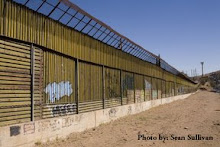
Border wall "pickets" in front of the wall in El Calaboz, Texas March 14, 2009
Yet another DHS policy revealed this same disregard for public safety. Shortly before hurricane season last year, the news broke that in the event of a hurricane making landfall in the Rio Grande Valley, the Border Patrol intended to check documents of every Valley resident seeking to evacuate or seeking entrance into a shelter. According to Border Patrol’s plans, anyone without the proper documentation would be immediately arrested and placed in a detention facility.
Worried that this policy would cause a bottleneck at the checkpoints and the unjustified arrests of citizens fleeing in haste without documents, border leaders and residents decried the practice. Advocates for colonias complained that it unfairly risked the safety of the poor, elderly, and those with limited English who would be afraid to evacuate. Since many people would be unwilling to leave their undocumented family members, this policy could mean many thousands of people left in the path of a deadly storm.
In the face of criticism that DHS was willing to put so many human lives in jeopardy, and the perception that they might even be taking advantage of a natural disaster to make more arrests, Secretary Chertoff downplayed the policy and said that the Border Patrol would not impede evacuations. However, when Hurricane Dolly bore down on the Rio Grande Valley in July 2008, the Border Patrol continued to arrest undocumented immigrants who tried to pass through the checkpoints.
Although there has been a change in administration, the agency is still primarily staffed by the same officials that crafted and implemented DHS's stance during the last administration. Among them is the CBP employee who in February gave the Brownsville City Commissioners an arbitrary deadline to accept a border wall deal. The deadline was later repudiated by Secretary Napolitano, who had not been informed of it, after U.S. Representative Ortiz intervened on Brownsville’s behalf.
Under the Obama administration, DHS has also maintained its indifference toward the landowners whose properties are being directly affected by the construction of the border wall. Having long refused to provide landowners and their elected officials with a detailed border wall plans, they sabotaged yet another opportunity to explain where and how the wall will be built when they refused to “walk the line” with the Texas Border Coalition in February. DHS said that they were willing to visit a very few of the properties where the border wall would be built with TBC, but the property owners must be kept away.
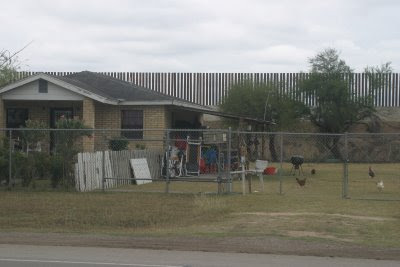
Border wall behind a home in Cameron County, Texas March 14, 2009
In perhaps the ultimate act of disrespect to landowners, as well as evidence of sheer incompetence and unprofessionalism, last week brought news that DHS usurped one Cameron County resident’s property for the border wall without a contract and without offering compensation. Eva Lambert woke up one morning to find the border wall being constructed across her backyard. It wasn’t until after the wall on her property was finished that she was visited by a DHS official.
Given this track record, it is no surprise that Texas border residents are suspicious of DHS’s latest scheme to eradicate Carrizo cane by aerially spraying an herbicide in Laredo. This proposed spraying project is certainly following the modus operandi of DHS under the Bush Administration. There was a mere one-day public comment period on the Environmental Assessment for the project last summer, and that assessment itself was not made available online until last month, 2 days after the Laredo City Council had granted Customs and Border Protection an easement to spray. CBP attempted to move up the timeline for spraying from June 2009, as stated in the Environmental Assessment, to immediately. And they did not bother to consult with the City of Nuevo Laredo across the border in Mexico, whose drinking water intake is immediately downstream from the spraying area. The rejection of meaningful public input, the headlong push to implement a controversial project as quickly as possible, and the apparent disregard for the health and safety of Texas and Mexico border residents are all hallmarks of DHS’s operations along the border.
This behavior reinforces the widespread notion in Texas border communities that the Department of Homeland Security is an agency motivated by politics and ideology rather than the facts on the ground and the welfare of citizens. Unless and until DHS, CBP and Border Patrol transform the way that they operate on the border, unless and until they show real sensitivity to border communities and real stewardship to border natural areas, their operations and projects will continue to be regarded with a high degree of suspicion and even hostility on the Texas border. This will certainly undermine their ability to fulfill their mission to protect the United States.
Secretary Napolitano must begin immediately to mend the broken relationship between DHS and border residents. This will require an attitude shift across the entire agency: DHS must recognize that for millions of people, the borderlands are the homeland. Instead of viewing the border as the frontline in a war zone, Secretary Napolitano needs to instill in her agency the understanding that the people who live on the border are entitled to the same rights and privileges, and due the same protections, as those who live in any other part of the United States. Proximity to the Rio Grande does not dissolve our constitutional guarantees to private property or equal protection under the law.
Secretary Napolitano will have little success in reversing the Department’s abusive practices until she replaces the ideologues that her predecessor hired. Even as she speaks to Congress and in the press about bringing change to DHS, holdovers from the last administration tell Congress and the press that there will be no change. So long as they are willing to go so far as to issue ultimatums on behalf of the Department of Homeland Security without bothering to inform its new leadership, any positive changes that she wishes to make will dissipate before they make it from Washington, D.C. to border communities.
Tremendous damage to the Texas borderlands has already been done by former Secretary Chertoff, but in a few places it is not too late to stop border wall construction and thereby signal that change is real and profound, rather than just a campaign slogan. Where the wall has not yet been built because condemnation lawsuits are still in court, DHS should drop its court case and enter into meaningful negotiations.
Finally, if Secretary Napolitano truly sees the defense of our nation’s laws as a fundamental part of her new job she should rescind former Secretary Chertoff’s Real ID Act waivers and restore the rule of law to the Texas border. It is absurd to claim that immigration rules supersede every other law that has been passed by Congress or the states. It is offensive to claim that living near the border strips U.S. citizens of legal protections that are enjoyed by the rest of the nation. Secretary Napolitano must defend all U.S. citizens and all U.S. laws, and repudiate Secretary Chertoff’s practice of picking and choosing which to prioritize and which to ignore.
The new Administration has a tremendous opportunity to reverse the Bush administration’s abuses, and to begin to repair the damage that was done. But they must act immediately. Right now, landowners are facing condemnation proceedings. Right now, construction crews from South Texas to San Diego are erecting border walls. Right now, laws that should protect border residents are suspended. We have yet to see the change that we have been promised, and that we so desperately need.


 A child plays in the shadow of the border wall behind her house.
  Looking North into the neighborhood from behind the wall.
 A border patrol surveillance tower and the border wall visible at the end of a Brownsville cul-de-sac.
  Construction on the wall is quickly approaching Hope Park, a city park that was established on the banks of the Rio Grande in part to commemorate the strong ties between the U.S. and Mexico.