by Char Miller
The Department of Homeland Security (DHS) has a nasty habit of rubbing salt into wounds, fresh and old.
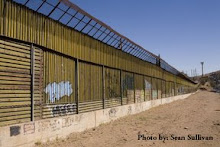
Just ask anyone who lives along the Rio Grande Valley, makes their home in the Sonoran Desert covering large sections of northwest Mexico and southwest Arizona, or inhabits the dense sprawl of those entwined cities, San Diego and Tijuana. Since 2006, wherever DHS has pounded down its infamous Border Wall, it has chopped up habitats human and natural, severing longstanding cultural links and environmental connections between the U.S. and Mexico. It is a haunting reminder that the post-9/11 hunt for national security has generated its own insecurities.
The most recent (and stinging) example of this painful paradox came in late November. That's when DHS began construction of the latest segment of the wall, dubbed the Surf Fence Project. This 18-foot-high barrier, hung on six-inch rust-proof steel piping, is being pile-driven out 300 feet into the Pacific Ocean. The goal is fortify Imperial Beach, making it impregnable redoubt, the first line of defense for San Diego.
"There is a clear operational need for this development," Michael Hance, field operation supervisor with the U.S. Border Patrol, told the BBC. "The southern side of the border is densely populated and in the past many people found an easy way into the US through these beaches. We need physical infrastructure as well as border agents in the area."
As for the urgency to thrust this wall so deep into the pounding surf, local border patrol agents point to the capture in November of several undocumented migrants attempting to swim around the current fencing.
At a cost of $4.3 million, this new wall will be a very expensive form of deterrent. But Assistant Chief Patrol Agent Bruce Parks assured the LA Times that the exorbitant price tag (amounting to $143,333.33 per foot!) is worth every penny, for this stretch of beach "still has the potential to be very dangerous, as beautiful as it is."
I'd like to think that Parks is just being silly: do we really spend this much money building a wall because of the potential that this stretch of seaside can be a dangerous gateway into the U.S.? But he's not being flippant. After five years of listening to the Border Patrol and its parent department, DHS, say similar things every time they have announced the launch of yet another segment to the 670-mile border wall, it is clear that there is a pattern to their patter.
If, as DHS asserts, the land and sea are so threatening; if the people who would cross these stretches of our sovereign territory are judged to be so unsafe, then we must militarize the first while demonizing the second. Every mile of steel pole and three-ply fencing, every searchlight, movement sensor, high-flying drone, and armed guard is a reflection of this American war on nature and the Other. A terrorism that may be as malevolent as the threat this thick bulwark is supposed to repel.
This deliberate violence against land and people is underscored in the title of a new and insightful collection of essays on the geopolitics of the borderlands: Wounded Border/Frontera-Herida. The injuries that its ten chapters probe cover a wide range: the deeply flawed law enforcement and judicial systems on both sides of the border; the inequities and humiliations that migrants face in U.S. labor markets desperate for low-wage, expendable workers (pressure that women disproportionately bear); the environmental despoliation that comes from a globalized economy that created maquiladoras in Mexico, industries whose toxic effluent damages ground and surface waters, pollutes the air, and poisons adjacent neighborhoods. The border is a fraught landscape.
No shock, this contested physical space is also a social construct. As co-editor Justin Akers Chacón argues: "Since its inception as a boundary imposed by war of expansion, the U.S.-Mexico border has functioned in a dualistic manner. It has served both as a gateway to economic opportunity and as a barrier that creates and maintains unequal power relationships." Out of this duality, he writes, flows "the identities of both people in relationship to each other," becoming a "signifier of status that sustains each population in its own form of isolation." Although the proponents of globalization like to argue that this force is flattening the distinctions between counties and cultures, the U.S. border wall stands in stark refutation, a vertical and visible barrier. Bluntly divisive.
Emblematic of the rending of the social fabric that this enforced divide can produce is Friendship Park. Its name once conveyed its binational significance: First Lady Pat Nixon was on site at its ceremonial opening in 1971, there celebrating the site that memorialized the two nation's close relationship. "There should be no more fences," she declared.
That amity turned into animosity when, as a result of the 2006 Secure Fence Act that the George W. Bush administration promulgated, DHS built a series of fences that turned the park into a penitentiary. "New rules for public access to the gathering place leave families feeling like they have entered a maximum security prison on visiting day," writes Jill Holslin at her blog At the Edges. Any who would like to enter the park today must "wait outside the border wall 150 feet away from Friendship Park, seek permission to enter a locked gate, then be escorted by a border patrol agent in a 'security zone,' a five-foot tall pedestrian barrier that confines the space of the concrete circle of Friendship Park." Detention, surveillance, enforcement: these are the markers of a "containment society."
More egregious still is the latest effort to cordon off the United States, our arrogant ambition to split the Pacific Ocean in two.
Char Miller is the Director and W.M. Keck Professor of Environmental Analysis at Pomona College, and editor of the just-published "Cities and Nature in the American West." This article originally appeared on KCET, and is reproduced with the author's permission.
Showing posts with label Brownsville. Show all posts
Showing posts with label Brownsville. Show all posts
Monday, January 2, 2012


Thursday, June 3, 2010
Trading on Fear in an Election Year: Using the Spillover Myth to Build Border Walls and Score Votes
By Scott Nicol
On May 25, President Obama announced that he would deploy up to 1,200 National Guard troops to the US-Mexico border. This followed a White House meeting with Congressional Republicans aimed at attracting support for, or at least blunting opposition to, comprehensive immigration reform legislation. With mid-term elections on the horizon, conservative members of Congress have turned their attention to the border. Or, more precisely, to walling it off. In May two bills and one amendment aimed at building more border walls were introduced. One failed, but the other two are still pending.
On Cinco de Mayo Senator Jim DeMint announced that he would reintroduce his “Finish the Fence” amendment. It would change the Secure Fence Act to say that, “Fencing that does not effectively restrain pedestrian traffic (such as vehicle barriers and virtual fencing) may not be used to meet the 700-mile fence requirement.” As of April 2010, DHS reports that it has completed 347 miles of “pedestrian fence”, meant to stop people on foot, and 299 miles of “vehicle barriers.” If DeMint’s amendment makes it into law an additional 353 miles of “pedestrian fence” will be built along the border.

On May 25, President Obama announced that he would deploy up to 1,200 National Guard troops to the US-Mexico border. This followed a White House meeting with Congressional Republicans aimed at attracting support for, or at least blunting opposition to, comprehensive immigration reform legislation. With mid-term elections on the horizon, conservative members of Congress have turned their attention to the border. Or, more precisely, to walling it off. In May two bills and one amendment aimed at building more border walls were introduced. One failed, but the other two are still pending.
On Cinco de Mayo Senator Jim DeMint announced that he would reintroduce his “Finish the Fence” amendment. It would change the Secure Fence Act to say that, “Fencing that does not effectively restrain pedestrian traffic (such as vehicle barriers and virtual fencing) may not be used to meet the 700-mile fence requirement.” As of April 2010, DHS reports that it has completed 347 miles of “pedestrian fence”, meant to stop people on foot, and 299 miles of “vehicle barriers.” If DeMint’s amendment makes it into law an additional 353 miles of “pedestrian fence” will be built along the border.
"Pedestrian fence" south of San Diego, California. Photo courtesy Jay Johnson Castro.
When DeMint proposed this amendment last July, the Senate voted 54 to 44 to include it in the Department of Homeland Security’s annual appropriations bill. The House version of the bill did not contain a matching provision, and Representative Ciro Rodriguez, who, unlike DeMint, represents a district encompassing part of the border, was able to remove it during the House/Senate conference committee.
This time around DeMint attempted to attach his amendment to Financial Reform legislation. Seeing that this had nothing to do with financial reform (in fact, at roughly $7.5 million per mile DeMint’s new walls would cost taxpayers $2,647,500,000) DeMint’s amendment was not adopted. Following this failure DeMint tried to attach it to a bill funding the wars in Iraq and Afghanistan. That attempt also fell short (though just barely), but he will almost certainly try again between now and the November elections.
Even more extreme than DeMint’s amendment is Representative Todd Tiahrt’s Secure the Border Act, which requires continuous double-layered border walls along the entire 2,000 mile long border, from the Pacific Ocean to the Gulf of Mexico. Tiahrt made no attempt to explain how the monumental expense of his legislation would benefit his Kansas constituents, who already have Oklahoma and Texas acting as buffers between them and Mexico.
Instead, Tiahrt proudly proclaimed that the Federation for American Immigration Reform (FAIR) and NumbersUSA support his bill. FAIR has earned a place on the Southern Poverty Law Center’s list of hate groups. They received $1.2 million from the Pioneer Fund, an organization founded to promote eugenics and foster policies of “racial betterment.” NumbersUSA has also been denounced by the Southern Poverty Law Center for its ties to nativist and racist organizations. FAIR president Dan Stein and NumbersUSA president Roy Beck both formerly edited the white nationalist publication The Social Contract. One would expect Congressman Tiahrt to avoid their endorsements, not embrace them.

Border Wall construction in El Paso, Texas. Customs and Border Protection photo.
When he announced his bill Tiahrt neglected to mention that before his election to the House of Representatives he was employed by Boeing, where he worked on a number of government contracts. His old boss has not forgotten him; in 2009-2010 Boeing was Tiahrt’s biggest campaign contributor. Boeing is in turn one of the largest recipients of contracts for the Secure Border Initiative (SBI), which includes both solid border walls and virtual fences. To date, Boeing has received 13 task orders for SBI, totaling $1.2 billion.
Representative Tiahrt is currently running for the U.S. Senate. Senate races are expensive, and a successful candidate needs publicity to energize voters. Boeing has consistently provided him with campaign cash, and NumbersUSA and FAIR make regular appearances on FOX news, where they defend anti-immigrant legislation and promote favorite legislators such as Tiahrt.
Not to be left out, Senators John McCain and Jon Kyl rolled out a “10-Point Border Security Plan”, along with accompanying legislation. Their bill would “construct double- and triple-layer fencing” throughout Arizona. McCain also released a campaign commercial in which he and Pinal County Sheriff Paul Babeu walk alongside the border wall and discuss McCain’s border scheme.
“The plan is perfect,” Sheriff Babeu intones.
“Then complete the danged fence,” McCain responds, with the domain CompleteTheDangedFence.com on the screen below him.
Those who try to visit the website are redirected to JohnMcCain.com, where they can purchase McCain t-shirts or donate to his reelection campaign.
McCain is in a tough primary fight with JD Hayworth, who has been attacking McCain for his prior willingness to support immigration reform. Before Hayworth threatened to unseat him, McCain told Vanity Fair, "I think the fence is least effective. But I'll build the g--damned fence if they want it." The possibility of losing the election has caused the Senator to embrace the border wall that he once dismissed.
Sheriff Babeu seems like an odd choice to accompany McCain alongside the Nogales border wall. Babeu’s jurisdiction is 115 miles north of Nogales, and does not include any of the border that McCain advocates walling off. Why not consult an actual border sheriff about his border security plan?
Because those who work on the border might give an honest answer, instead of reading McCain’s cue cards. If he were to ask Nogales Assistant Police Chief Roy Bermudez, for example, the response might mirror Bermudez’ statement earlier this month, when he said, "We have not, thank God, witnessed any spillover violence from Mexico.”
Clarence Dupnik, Sheriff of neighboring Pima County, which also includes a long stretch of the US-Mexico border, said at that time, "This is a media-created event. I hear politicians on TV saying the border has gotten worse. Well, the fact of the matter is that the border has never been more secure."
In fact, according to FBI statistics, crime rates in Arizona border towns, including Nogales, have remained flat for the past decade. There has been no increase in violence as a result of “spillover” from Mexico. There was also no decrease in crime following the erection of border walls and the hiring of thousands of Border Patrol agents. FBI statistics show that the same is true for U.S. cities all along the border, from San Diego to El Paso to Brownsville.
Contrast what the FBI says with statements by DeMint, who said, “Drug trafficking, human trafficking, gang activity and other crimes are raging in American cities near the border.” Or McCain, who opens his campaign spot by listing, “Drug and human smuggling, home invasions, murder…” as justifications for sending in the National Guard and building more “danged fence.”
Politicians and law enforcement seem to be looking at two completely different borders.
In fact, they are looking at completely different numbers. The numbers that DeMint, Tiahrt, and McCain are interested in are votes, not FBI crime statistics. Facts about the border do not matter; voters’ beliefs, no matter how divorced from reality, do. As Senator McCain indicated during his earlier, pre-campaign Vanity Fair interview, building walls and sending troops to the border are political gestures meant to get votes, not solutions to any real problem.
Just as in McCain’s commercial, for politicians the border wall is simply a prop, a stage set upon which they can project an illusion of strength and security for an audience of voters who will never see the actual border. They are looking at voters who live far from the border, who can be told that “spillover” violence poses an existential threat to the United States, and only they (certainly not their election opponents!) can protect the nation. Those of us who live on the actual border, and live with the land condemnations, the suspension of laws, and the environmental damage that accompany actual border walls, see it very differently.
Monday, April 26, 2010
Walling off Texas' Last Sabal Palm Forest
By Scott Nicol
On April 19, Kiewit construction crews began clearing ground for yet another section of border wall just east of Brownsville, Texas on land that was, until the prior week, part of the Nature Conservancy’s Lennox Foundation Southmost Preserve. The 18-foot tall steel wall will cut off 95% of the 1,034 acre preserve. As with the more than 400 other landowners whose property the Department of Homeland Security (DHS) has condemned, the Nature Conservancy was only offered compensation for the exact footprint of the wall – a strip 60 feet wide and 6,000 feet long – not the land that will be behind the wall. In DHS’ limited view, $114,000 is “just compensation” for walling off lands purchased in 1999 for $2.6 million.
 Kiewit construction sign in front of the South Texas border wall
Before the order granting the federal government possession of their land, the Nature Conservancy had attempted to use the courts to force DHS to provide compensation and guarantee access to its property. The Department of Homeland Security has stated that the new border wall will have gates, but they have refused to explain under what circumstances they will be opened to permit access to areas behind the wall. With no way of knowing if staff or eco-tourists will be allowed into the Southmost Preserve, it is hard to see how they can continue to operate. Faced with a similar situation, the neighboring Sabal Palms Audubon Sanctuary simply took down its sign and ceased operations.
The Southmost Preserve contains one of the last of the sabal palm forests that once enveloped the mouth of the river. Before it was called the Rio Grande in the United States and the Rio Bravo in Mexico, the river was known as the Rio de las Palmas to Spanish explorers and conquistadors, who used the palm forest at its mouth as a landmark as they sailed along the Gulf Coast. Then dense groves of sabal palms followed the river up to 80 miles inland, but today the last stands are confined to one tract of the Lower Rio Grande Valley National Wildlife Refuge, the former Sabal Palms Audubon Sanctuary, and the Nature Conservancy’s Southmost Preserve. All three are now behind the border wall.
 Border wall under construction in front of Sabal Palms Audubon Sanctuary
Federally listed endangered species, including the ocelot and jaguarundi, depend upon riparian habitat along the Rio Grande for their continued survival. Naturally solitary animals, they require large territories in which to hunt, find mates, and disperse after they are weaned. But South Texas has lost roughly 95% of its historic vegetative cover to urban development and agriculture.
Habitat fragmentation, in which disconnected “islands” of habitat are separated by large areas cleared of vegetation, split by roads, or divided by other impediments to movement, poses a tremendous threat to these species’ long-term survival. Ocelot and jaguarundi trapped within too-small habitat “islands” may not have sufficient prey or access to water, and often show evidence of inbreeding. Today, the Rio Grande Valley is home to the less than 80 ocelots and 40 jaguarundi that are still believed to survive in the United States.
The Lower Rio Grande Valley National Wildlife Refuge was established to address the threat to the survival of ocelot, jaguarundi, and other wildlife posed by habitat fragmentation. Over the years 113 individual tracts of land, totaling 88,044 acres, have been acquired, with a goal of using the ribbon of riparian habitat along the Rio Grande as a wildlife corridor to link them. Though not operated by US Fish and Wildlife, the Southmost Preserve and Sabal Palms Audubon Sanctuary are critical parts of the corridor. Bound together by the river, it was hoped that they would provide sufficient resources and allow for the necessary mobility to prevent the extirpation of these endangered cats.
Mile after mile of border wall now slice through the LRGV National Wildlife Refuge; along the northern border of the Sabal Palms Audubon Sanctuary; and soon will tear through the Nature Conservancy’s Southmost Preserve, fragmenting habitat that was painstakingly pieced together over the course of many years. The walls that break apart the wildlife corridor may prove to be the final nail in the coffin for ocelots and jaguarundi.

Sabal Palms Audubon Sanctuary closed
Though the border walls called for by the Secure Fence Act are nearly finished, the threat of Congressionally mandated damage to the borderlands continues. With mid-term elections looming, many politicians hope to exploit fears of “spillover violence” and a Mexican “reconquista” in their bids to stay in office. Calling for the erection of more walls and the deployment of troops may not be sound border policy, but it is a sure-fire way to land an interview on Fox news, which is tantamount to a free campaign ad. The border environment is then either used as a scapegoat or ignored.Claiming that federal land managers are “hiding behind the law” and preventing the Border Patrol from doing their job, recently Representative Rob Bishop introduced legislation that would prevent the Department of Interior from “impeding” Homeland Security’s attempts to fulfill the Secure Fence Act’s mandate. Rep. Bishop, whose Utah district lies 800 miles north of the U.S. – Mexico border, failed to ask the Border Patrol if the Department of the Interior’s stewardship of public lands was in fact interfering with their operations. Brandon Judd, vice president of Local 2544 of the National Border Patrol Council, spoke out against Rep. Bishop’s bill, stating that without environmental regulations, “you would destroy the land.”
Last week the Senate held hearings on border security and the failure of Boeing’s multi-million dollar “virtual fence.” The Senators did not discuss the environmental impacts of the border wall, or address the underlying economic factors driving immigration, or even consider whether or not it made sense to continue “enforcement only” immigration policies. Instead Connecticut Senator Joe Lieberman, chairman of the Homeland Security and Governmental Affairs Committee, suggested that, "The best answer to this continuing crisis and continued flow of illegal immigrants into the U.S. is to go back to the old-style fences, double- and triple-tiered, and layered."

"Triple fence" border wall design in San Diego, California
So while we may want to believe that border wall construction, and the accompanying destruction of border ecosystems, is finally coming to an end, the truth is that so long as politicians believe that militarizing the border plays well in their home districts they will continue to draft legislation calling for more border walls. To voters in Utah and Connecticut sabal palm forests along the Rio Grande are no more real than the forests in Avatar. When the palm forests are gone most won’t notice their passing.
This is why it is so important for those of us who can see the damage that is being inflicted upon the borderlands, and who will mourn the loss of sabal palms, ocelots, and the rest of our unique environment, to make certain that when these decisions are made far from the border our voices are heard. We cannot allow ecosystems that predate the founding of the United States and Mexico to be destroyed just to score points in an off-year election. As John Muir said, “God has cared for these trees, saved them from drought, disease, avalanches, and a thousand tempests and floods. But he cannot save them from fools.”
Tuesday, February 23, 2010
Border Walls are Ineffective Speed Bumps in the Desert
By Scott Nicol
All of the imagined benefits of the border wall flow from the assumption that if walls are built they will stop undocumented traffic from coming across. Politicians claim that building 700 miles of wall along our 1,933 mile long southern border, while ignoring the 3,987 mile long northern border and 12,479 miles of coastline will somehow allow the Department of Homeland Security to achieve the Secure Fence Act’s goal, to “achieve and maintain operational control over the entire international land and maritime borders of the United States.”

Crossers climbing the “triple fence” near San Diego, California. Photo by Laura Garcia.
In fact, the Border Patrol’s own statistics show that the border walls have not brought about a decrease in illegal entries. The border patrol uses the number of border crossers apprehended in a given sector to gauge the overall number of attempted crossings. Apprehensions dropped dramatically between 2005, the year before the Secure Fence Act was passed, and 2007, the year after. But the decrease did not occur in areas where border walls had been built. On the contrary, the greatest reductions in apprehensions, which according to the Border Patrol would indicate a successful strategy for stopping undocumented immigration, were seen in sectors that did not have walls. Texas’ Rio Grande Valley sector saw a 45.3% decrease in apprehensions, bringing them to a 15 year low. The Del Rio, Texas, sector saw a 66.5% decrease. Neither sector had an inch of border wall before 2008. In sectors such as Tucson, which saw walls built shortly after passage of the Secure Fence Act, the reduction in apprehensions began before any wall posts were erected. The areas that saw an increase in crossings were California’s San Diego and El Centro sectors, both of which have had border walls for over a decade. At the same time that the unwalled border witnessed dramatic decreases in crossings, heavily fortified San Diego saw a 20.1% increase.
Even before the passage of the Secure Fence Act, it was clear that border walls did not reduce the number of people entering the United States. The Congressional Research Service found that the number of border crossers apprehended nationally in 1992 was the same as the number apprehended in 2004, after walls in San Diego had been erected. They concluded that migrant traffic had simply shifted to more remote areas in Arizona and that “increased enforcement in San Diego sector has had little impact on overall apprehensions.” Migrants were not stopped by border walls; they simply went around them.
Other researchers have studied the effectiveness of the border wall and border enforcement by analyzing how successful migrants are at getting through it. The Migrant Policy Institute found that 97% of undocumented immigrants eventually succeed in entering the United States, a number that has been unchanged since the first border walls went up in 1995. Wayne Cornelius, Director of the Center for Comparative Immigration Studies at the University of California-San Diego told the House Judiciary Committee that according to his research,
Tightened border enforcement since 1993 has not stopped nor even discouraged unauthorized migrants from entering the United States. Even if apprehended, the vast majority (92-97%) keep trying until they succeed. Neither the higher probability of being apprehended by the Border Patrol, nor the sharply increased danger of clandestine entry through deserts and mountainous terrain, has discouraged potential migrants from leaving home.
Assertions by pundits and politicians that walls will allow the U.S. to “secure” its southern border are patently false. Spokespersons for the Border Patrol tend to describe it much more modestly. Del Rio, Texas, Border Patrol Chief Randy Hill said, “We're going to see steel barriers erected on the borders where U.S. and Mexican cities adjoin. These will slow down illegal crossers by minutes.” Not stop crossers, or allow the Border Patrol to “achieve and maintain operational control” of the border, but slow them down by “minutes.” As Border Patrol spokesperson Mike Scioli said, “The border fence is a speed bump in the desert.”
Even Bush administration Secretary of Homeland Security Michael Chertoff said in 2007, “I think the fence has come to assume a certain kind of symbolic significance which should not obscure the fact that it is a much more complicated problem than putting up a fence which someone can climb over with a ladder or tunnel under with a shovel.”
Mile upon mile of border wall have been built, with no apparent thought given to efficacy, because the Secure Fence Act only mandated a mile count. There is no requirement that border walls have any measurable impact on immigration or smuggling, and in 2009 the Government Accountability Office found that the Department of Homeland Security had made no effort to determine whether or not walls were having any effect. Even the Border Patrol has questioned whether walls are being built in some locations for political, rather than operational, reasons. In a 2007 email obtained by the Center for Responsibility and Ethics in Washington (CREW) through a Freedom of Information Act request, the Assistant Chief Patrol Agent for the Yuma sector asks, “will we be getting fence where we don’t need it in our sector for the sake of putting up the required mileage?” The miles of unnecessary border wall that he referred to have since been built through the Imperial Sand Dunes of Southern California.

Border Wall in the Imperial Sand Dunes. Border Patrol photo.
Despite its “symbolic significance” and its possibly arbitrary placement, the border wall comes with a real price tag. In 2007 the Congressional Research Service estimated that the border wall could cost as much as $49 billion to build and maintain. Since then the costs of construction have risen dramatically. The Army Corps of Engineers reported that the cost of building “pedestrian fences” has increased from an average of $3.5 million per mile to $7.5 million per mile. The cost of building vehicle barriers on the border is now $2.8 million per mile. Some sections of border wall are particularly expensive: the walls that have been inserted into the levees in south Texas averaged $12 million per mile; in California, a 3.5 mile section that involved filling in canyons cost taxpayers $57 million. In 2008, the Department of Homeland Security asked Congress to allocate an additional $400 million for border wall construction, because the $2.7 billion already spent was not enough to finish out the year.
Why would members of Congress vote to spend billions of taxpayer dollars on border walls that do not work?
Simply put, for members of Congress who do not live beside the border, and do not count on the votes of those who do, the border wall is an abstraction. The reality that the border wall has little or no impact on border crossings is irrelevant. The reality that more than 400 property owners have had their property condemned is irrelevant. The reality that federally designated wilderness areas and wildlife refuges have been severely impacted is irrelevant. The politicians who voted for border walls were voting for a symbol, something that could be used to give voters a false sense of security during election cycles, and nothing more.
All of the imagined benefits of the border wall flow from the assumption that if walls are built they will stop undocumented traffic from coming across. Politicians claim that building 700 miles of wall along our 1,933 mile long southern border, while ignoring the 3,987 mile long northern border and 12,479 miles of coastline will somehow allow the Department of Homeland Security to achieve the Secure Fence Act’s goal, to “achieve and maintain operational control over the entire international land and maritime borders of the United States.”
Crossers climbing the “triple fence” near San Diego, California. Photo by Laura Garcia.
In fact, the Border Patrol’s own statistics show that the border walls have not brought about a decrease in illegal entries. The border patrol uses the number of border crossers apprehended in a given sector to gauge the overall number of attempted crossings. Apprehensions dropped dramatically between 2005, the year before the Secure Fence Act was passed, and 2007, the year after. But the decrease did not occur in areas where border walls had been built. On the contrary, the greatest reductions in apprehensions, which according to the Border Patrol would indicate a successful strategy for stopping undocumented immigration, were seen in sectors that did not have walls. Texas’ Rio Grande Valley sector saw a 45.3% decrease in apprehensions, bringing them to a 15 year low. The Del Rio, Texas, sector saw a 66.5% decrease. Neither sector had an inch of border wall before 2008. In sectors such as Tucson, which saw walls built shortly after passage of the Secure Fence Act, the reduction in apprehensions began before any wall posts were erected. The areas that saw an increase in crossings were California’s San Diego and El Centro sectors, both of which have had border walls for over a decade. At the same time that the unwalled border witnessed dramatic decreases in crossings, heavily fortified San Diego saw a 20.1% increase.
Even before the passage of the Secure Fence Act, it was clear that border walls did not reduce the number of people entering the United States. The Congressional Research Service found that the number of border crossers apprehended nationally in 1992 was the same as the number apprehended in 2004, after walls in San Diego had been erected. They concluded that migrant traffic had simply shifted to more remote areas in Arizona and that “increased enforcement in San Diego sector has had little impact on overall apprehensions.” Migrants were not stopped by border walls; they simply went around them.
Other researchers have studied the effectiveness of the border wall and border enforcement by analyzing how successful migrants are at getting through it. The Migrant Policy Institute found that 97% of undocumented immigrants eventually succeed in entering the United States, a number that has been unchanged since the first border walls went up in 1995. Wayne Cornelius, Director of the Center for Comparative Immigration Studies at the University of California-San Diego told the House Judiciary Committee that according to his research,
Tightened border enforcement since 1993 has not stopped nor even discouraged unauthorized migrants from entering the United States. Even if apprehended, the vast majority (92-97%) keep trying until they succeed. Neither the higher probability of being apprehended by the Border Patrol, nor the sharply increased danger of clandestine entry through deserts and mountainous terrain, has discouraged potential migrants from leaving home.
Assertions by pundits and politicians that walls will allow the U.S. to “secure” its southern border are patently false. Spokespersons for the Border Patrol tend to describe it much more modestly. Del Rio, Texas, Border Patrol Chief Randy Hill said, “We're going to see steel barriers erected on the borders where U.S. and Mexican cities adjoin. These will slow down illegal crossers by minutes.” Not stop crossers, or allow the Border Patrol to “achieve and maintain operational control” of the border, but slow them down by “minutes.” As Border Patrol spokesperson Mike Scioli said, “The border fence is a speed bump in the desert.”
Even Bush administration Secretary of Homeland Security Michael Chertoff said in 2007, “I think the fence has come to assume a certain kind of symbolic significance which should not obscure the fact that it is a much more complicated problem than putting up a fence which someone can climb over with a ladder or tunnel under with a shovel.”
Mile upon mile of border wall have been built, with no apparent thought given to efficacy, because the Secure Fence Act only mandated a mile count. There is no requirement that border walls have any measurable impact on immigration or smuggling, and in 2009 the Government Accountability Office found that the Department of Homeland Security had made no effort to determine whether or not walls were having any effect. Even the Border Patrol has questioned whether walls are being built in some locations for political, rather than operational, reasons. In a 2007 email obtained by the Center for Responsibility and Ethics in Washington (CREW) through a Freedom of Information Act request, the Assistant Chief Patrol Agent for the Yuma sector asks, “will we be getting fence where we don’t need it in our sector for the sake of putting up the required mileage?” The miles of unnecessary border wall that he referred to have since been built through the Imperial Sand Dunes of Southern California.
Border Wall in the Imperial Sand Dunes. Border Patrol photo.
Despite its “symbolic significance” and its possibly arbitrary placement, the border wall comes with a real price tag. In 2007 the Congressional Research Service estimated that the border wall could cost as much as $49 billion to build and maintain. Since then the costs of construction have risen dramatically. The Army Corps of Engineers reported that the cost of building “pedestrian fences” has increased from an average of $3.5 million per mile to $7.5 million per mile. The cost of building vehicle barriers on the border is now $2.8 million per mile. Some sections of border wall are particularly expensive: the walls that have been inserted into the levees in south Texas averaged $12 million per mile; in California, a 3.5 mile section that involved filling in canyons cost taxpayers $57 million. In 2008, the Department of Homeland Security asked Congress to allocate an additional $400 million for border wall construction, because the $2.7 billion already spent was not enough to finish out the year.
Why would members of Congress vote to spend billions of taxpayer dollars on border walls that do not work?
Simply put, for members of Congress who do not live beside the border, and do not count on the votes of those who do, the border wall is an abstraction. The reality that the border wall has little or no impact on border crossings is irrelevant. The reality that more than 400 property owners have had their property condemned is irrelevant. The reality that federally designated wilderness areas and wildlife refuges have been severely impacted is irrelevant. The politicians who voted for border walls were voting for a symbol, something that could be used to give voters a false sense of security during election cycles, and nothing more.
Monday, November 9, 2009
As we celebrate the fall of the Berlin Wall, border walls are built in Brownsville, Texas
While the world celebrates the fall of the Berlin Wall, the United States is continuing construction on its own border wall in the southern tip of Texas. The following photos show the progress of the construction and how the people of Brownsville, Texas are having to learn to live with a wall in their midst.
Construction has been completed through many residential neighborhoods. This one is off Milpa Verde Street in East Brownsville.
 A child plays in the shadow of the border wall behind her house.
 Looking North into the neighborhood from behind the wall.
 A border patrol surveillance tower and the border wall visible at the end of a Brownsville cul-de-sac.
 Construction on the wall is quickly approaching Hope Park, a city park that was established on the banks of the Rio Grande in part to commemorate the strong ties between the U.S. and Mexico.
Inside Hope Park. The marker on the left is where the wall will be built. On the right is a state historical marker for the Chisolm Trail.

East of Brownsville is the Sabal Palms Audubon Sanctuary, home of the largest surviving stand of native Sabal Palms. With the border wall's impending construction, the sanctuary has been closed to the public since last spring. The gate on the left blocks the entrance to the sanctuary, and the sign has been taken down.

The border wall reaching the edge of the Nature Conservancy Southmost Preserve. Construction here is delayed while Nature Conservancy fights DHS in court.

Homeowners living across the street from the border wall draw explicit parallels between the border wall and the Berlin wall.
Sunday, September 27, 2009
Border War Rhetoric Has Real Consequences for the Borderlands
By Stefanie Herweck
This week Texas Lieutenant Governor David Dewhurst addressed an assembly of border residents and community leaders in Harlingen, Texas, less than 15 miles from the Rio Grande, and proclaimed that there was a war going on along the border. His assessment of the border was extreme: “We have two wars everyone talks about going on, one is in Iraq and one is in Afghanistan. We’ve got a third going on and that’s the border.”
Dewhurst made this announcement in the keynote speech for State Senator Eddie Lucio’s State of the District Address. With Senator Lucio looking on, Dewhurst went on to make his case for war on the border, speaking in vague terms about “transnational gangs,” “drug lords killing Americans,” and “border violence,” but providing little in the way of concrete details. He urged that more law enforcement be deployed in order to “close down this border.”
Dewhurst’s comparison of the U.S.-Mexico border region to war-torn Iraq and Afghanistan is offensive and absurd. His characterization of a border at war is based on ignorant hysteria instead of reality. And his portrayal of the border region as the dangerous fount of criminal activity for the rest of the state and the country is categorically false.
When pressed in an interview after the speech to provide the details that would support his claims, Dewhurst said, “We’ve seen incidence of gangs, drive by shootings, in Wichita Falls, which is a long way from the border.” The Lieutenant Governor is right about one thing here: 600 miles between Wichita Falls and the Texas-Mexico border is a long way. But declaring war on the border in order to fight crime in Wichita Falls is ludicrous.
Especially because most Texas border cities are actually safer than Wichita Falls. Although Wichita Falls has 30,000 fewer people than the border city of McAllen, its crime rate in 2008 was higher than McAllen’s. According to FBI statistics, Wichita Falls had 557 incidences of violent crime in 2008, while McAllen only had 371. El Paso was ranked as the third safest large city in the United States in the same year. And all of these cities saw a decrease in violent crime from 2007 to 2008, as did the nation as a whole. Dewhurst’s perverse fantasy of a chaotic crime-ridden border simply does not match the relatively peaceful day-to-day border reality.
In his speech, Dewhurst also cited briefings he has received from the Department of Public Safety and other law enforcement. When asked to elaborate on these briefings after his speech, he cited no official reports or criminological studies, but said “Virtually every city I go into I talk to the DPS and I talk to the local police and they have all seen a pick up of gang activity that they feel is related to drug cartels in Mexico.” While the views of law enforcement officers around the state are valuable, it is irresponsible to make policy recommendations based on their “feelings” rather than hard facts.
Furthermore, Dewhurst has apparently failed to consult with law enforcement officials in the border region. When interviewed by NPR this spring, Brownsville Police Chief Carlos Garcia noted that there had only been 3 homicides in his city in 2008, and that none of them were related to drug cartels. In the same article McAllen Police Chief Victor Rodriguez provided some perceptive analysis that Dewhurst should heed: “The sky is not falling,” he said, refuting unfounded statements by pundits and politicians that cartel violence was spilling over at the border. "What's happening right now is we've got rhetoric that's driving the policy."
When it was pointed out after his speech that his talk of war might not be welcome at the border, Dewhurst quickly wrote it off as just a rhetorical strategy: “I use the word 'war' only in the sense to get people’s attention to understand that there’s a serious problem along our porous southern and northern border.”
Unfortunately, as Chief Rodriguez well understands, rhetoric drives policy. Dewhurst’s declaration of war on the border may be intended as nothing more than a metaphor, but it is likely to have real consequences for the residents of the Texas border.
In his own speech, Dewhurst called for more actual boots on the ground to deal with the war scenario that he later claimed was purely rhetorical. This same border war rhetoric is driving Governor Perry’s call for troops to patrol the border and military predator aircraft to fly up and down the Rio Grande. This month he stationed a specialized team of the Texas Rangers that will reportedly be patrolling the border region carrying automatic weapons, and wearing camouflage, helmets, and bullet-proof vests.
The governor’s action comes despite his own admission that crime along the border has been falling in recent years. And it has been deemed unnecessary by border law enforcement. Hidalgo County Sheriff Lupe Treviño said, “We don't need the Texas Rangers to come to the border to quell any imaginary disturbance.”
Although sending the Texas Rangers or the National Guard to fight an imaginary war at the border might make for good sound bites in the rest of the state, it sends a shiver down the spine of border residents. Community and business leaders fear that their efforts to develop the border region will be undermined by the false perception of a dangerous, militarized border. Residents know that staging a war in their communities, parks, and farmlands only puts them more at risk.
Border war rhetoric like Dewhurst’s drives policy on the national stage as well. Senator Jim DeMint of South Carolina introduced an amendment to the 2010 DHS Appropriations Bill calling for more than 300 miles of new border wall. If the amendment passes, hundreds of those miles could be built in Texas. These walls are being proposed despite the fact that the hundreds of miles of border walls already built have not stopped people from crossing the border. Wayne Cornelius, Director Emeritus of the Center for Comparative Immigration Studies at the University of California at San Diego, say that despite the walls at the border, between 92% and 98% of all those attempting to cross the U.S.-Mexico border illegally eventually get through. This month, a report by the Government Accountability Office faulted the Department of Homeland Security for having no effective way to gauge the impacts that border walls are having on illegal entry.
But the myth of a border war trumps the reality that walls don’t work. In the press release about his amendment, DeMint says that more border walls are urgently needed because “our southern border has become a battleground.”
Too many walls already blight the Texas borderlands. Texas citizens have had their private property stripped away to make way for walls. Texas cities have seen their landscape forever marred by them. Texas natural areas, wildlife refuges and parks have been irreparably damaged by them. All of this destruction is rooted in the myth of the border war.
Dewhurst’s inflammatory war rhetoric may have been intended only to “get people’s attention,” but the consequences for his constituents along the border are very real. When our borderlands are decreed a war zone, politicians in Austin and Washington forget that it is a place that millions of people call home. They jump on the border war bandwagon, hoping to score political points and to burnish their law-and-order credentials. Like Lt. Gov. Dewhurst, they make the border a scapegoat for crime in the rest of the Texas and the United States. Like Gov. Perry and Sen. DeMint, they dream up absurd, and ultimately destructive, schemes to fight an imaginary war.
Border residents desperately need leaders who will reject the border war scenario, who will refuse to bear false witness against the borderlands and who will work tirelessly to represent the reality of border life at the state and national level. We need uncompromising leaders who will not be complicit in the border war myth, who will actively oppose the schemes based on this myth, and who will not sit silently by as the border region that they were elected to represent is mischaracterized, maligned and damaged.
This week Texas Lieutenant Governor David Dewhurst addressed an assembly of border residents and community leaders in Harlingen, Texas, less than 15 miles from the Rio Grande, and proclaimed that there was a war going on along the border. His assessment of the border was extreme: “We have two wars everyone talks about going on, one is in Iraq and one is in Afghanistan. We’ve got a third going on and that’s the border.”
Dewhurst made this announcement in the keynote speech for State Senator Eddie Lucio’s State of the District Address. With Senator Lucio looking on, Dewhurst went on to make his case for war on the border, speaking in vague terms about “transnational gangs,” “drug lords killing Americans,” and “border violence,” but providing little in the way of concrete details. He urged that more law enforcement be deployed in order to “close down this border.”
Dewhurst’s comparison of the U.S.-Mexico border region to war-torn Iraq and Afghanistan is offensive and absurd. His characterization of a border at war is based on ignorant hysteria instead of reality. And his portrayal of the border region as the dangerous fount of criminal activity for the rest of the state and the country is categorically false.
When pressed in an interview after the speech to provide the details that would support his claims, Dewhurst said, “We’ve seen incidence of gangs, drive by shootings, in Wichita Falls, which is a long way from the border.” The Lieutenant Governor is right about one thing here: 600 miles between Wichita Falls and the Texas-Mexico border is a long way. But declaring war on the border in order to fight crime in Wichita Falls is ludicrous.
Especially because most Texas border cities are actually safer than Wichita Falls. Although Wichita Falls has 30,000 fewer people than the border city of McAllen, its crime rate in 2008 was higher than McAllen’s. According to FBI statistics, Wichita Falls had 557 incidences of violent crime in 2008, while McAllen only had 371. El Paso was ranked as the third safest large city in the United States in the same year. And all of these cities saw a decrease in violent crime from 2007 to 2008, as did the nation as a whole. Dewhurst’s perverse fantasy of a chaotic crime-ridden border simply does not match the relatively peaceful day-to-day border reality.
In his speech, Dewhurst also cited briefings he has received from the Department of Public Safety and other law enforcement. When asked to elaborate on these briefings after his speech, he cited no official reports or criminological studies, but said “Virtually every city I go into I talk to the DPS and I talk to the local police and they have all seen a pick up of gang activity that they feel is related to drug cartels in Mexico.” While the views of law enforcement officers around the state are valuable, it is irresponsible to make policy recommendations based on their “feelings” rather than hard facts.
Furthermore, Dewhurst has apparently failed to consult with law enforcement officials in the border region. When interviewed by NPR this spring, Brownsville Police Chief Carlos Garcia noted that there had only been 3 homicides in his city in 2008, and that none of them were related to drug cartels. In the same article McAllen Police Chief Victor Rodriguez provided some perceptive analysis that Dewhurst should heed: “The sky is not falling,” he said, refuting unfounded statements by pundits and politicians that cartel violence was spilling over at the border. "What's happening right now is we've got rhetoric that's driving the policy."
When it was pointed out after his speech that his talk of war might not be welcome at the border, Dewhurst quickly wrote it off as just a rhetorical strategy: “I use the word 'war' only in the sense to get people’s attention to understand that there’s a serious problem along our porous southern and northern border.”
Unfortunately, as Chief Rodriguez well understands, rhetoric drives policy. Dewhurst’s declaration of war on the border may be intended as nothing more than a metaphor, but it is likely to have real consequences for the residents of the Texas border.
In his own speech, Dewhurst called for more actual boots on the ground to deal with the war scenario that he later claimed was purely rhetorical. This same border war rhetoric is driving Governor Perry’s call for troops to patrol the border and military predator aircraft to fly up and down the Rio Grande. This month he stationed a specialized team of the Texas Rangers that will reportedly be patrolling the border region carrying automatic weapons, and wearing camouflage, helmets, and bullet-proof vests.
The governor’s action comes despite his own admission that crime along the border has been falling in recent years. And it has been deemed unnecessary by border law enforcement. Hidalgo County Sheriff Lupe Treviño said, “We don't need the Texas Rangers to come to the border to quell any imaginary disturbance.”
Although sending the Texas Rangers or the National Guard to fight an imaginary war at the border might make for good sound bites in the rest of the state, it sends a shiver down the spine of border residents. Community and business leaders fear that their efforts to develop the border region will be undermined by the false perception of a dangerous, militarized border. Residents know that staging a war in their communities, parks, and farmlands only puts them more at risk.
Border war rhetoric like Dewhurst’s drives policy on the national stage as well. Senator Jim DeMint of South Carolina introduced an amendment to the 2010 DHS Appropriations Bill calling for more than 300 miles of new border wall. If the amendment passes, hundreds of those miles could be built in Texas. These walls are being proposed despite the fact that the hundreds of miles of border walls already built have not stopped people from crossing the border. Wayne Cornelius, Director Emeritus of the Center for Comparative Immigration Studies at the University of California at San Diego, say that despite the walls at the border, between 92% and 98% of all those attempting to cross the U.S.-Mexico border illegally eventually get through. This month, a report by the Government Accountability Office faulted the Department of Homeland Security for having no effective way to gauge the impacts that border walls are having on illegal entry.
But the myth of a border war trumps the reality that walls don’t work. In the press release about his amendment, DeMint says that more border walls are urgently needed because “our southern border has become a battleground.”
Too many walls already blight the Texas borderlands. Texas citizens have had their private property stripped away to make way for walls. Texas cities have seen their landscape forever marred by them. Texas natural areas, wildlife refuges and parks have been irreparably damaged by them. All of this destruction is rooted in the myth of the border war.
Dewhurst’s inflammatory war rhetoric may have been intended only to “get people’s attention,” but the consequences for his constituents along the border are very real. When our borderlands are decreed a war zone, politicians in Austin and Washington forget that it is a place that millions of people call home. They jump on the border war bandwagon, hoping to score political points and to burnish their law-and-order credentials. Like Lt. Gov. Dewhurst, they make the border a scapegoat for crime in the rest of the Texas and the United States. Like Gov. Perry and Sen. DeMint, they dream up absurd, and ultimately destructive, schemes to fight an imaginary war.
Border residents desperately need leaders who will reject the border war scenario, who will refuse to bear false witness against the borderlands and who will work tirelessly to represent the reality of border life at the state and national level. We need uncompromising leaders who will not be complicit in the border war myth, who will actively oppose the schemes based on this myth, and who will not sit silently by as the border region that they were elected to represent is mischaracterized, maligned and damaged.
Sunday, June 21, 2009
City Commissioners Vote to Buy Brownsville a Border Wall
By Scott Nicol
On June 2, the Brownsville City Commission finally capitulated to the Department of Homeland Security’s demand that they give away city property to build the border wall. They had attempted to do this twice before, first last July and again this past February. In both instances the commissioners backed down in the face of widespread opposition from Brownsville residents. This time, however, they stuck with DHS, ignoring the will of the people by voting to give away the city’s land and to commit to build a border wall through Brownsville at the city’s expense. No other city has done so much to help build the border wall.
When the City Commissioners considered this deal last February, they issued a press release praising it, saying that “The City of Brownsville is in the unique position to be the only border city between San Diego, California and the Gulf of Mexico to be offered the ability to remove the federally mandated border fence.” The Commissioners’ spin leaves out the fact that the initial border wall will only be removed after it is replaced with a border wall that will be far more permanent and imposing, and one for which Brownsville taxpayers will foot the entire multi-million dollar bill.
While the contract with DHS has been rewritten, the substance remains the same. The City of Brownsville will give up 15 acres of city property, which DHS valued at $123,100 when it initiated condemnation proceedings last September. The Department of Homeland Security will not pay a dime for the city’s land.
According to the contract, at some indefinite time in the future, the city will pay to build a levee-border wall in another unspecified location to replace the “floating fence.” It stipulates that the city must pay to buy the land for the new levee-border wall, and “construction shall be the responsibility of Brownsville, and shall not be performed by the United States or at any cost to the United States.” The bids for the levee-border walls in Hidalgo County ranged from $12 to $16 million per mile. Placing cost ahead of confidence in the quality of construction of our flood control levees, Hidalgo naturally went with the low bidder. Assuming that Brownsville does the same, the 2-4 miles of levee-border wall that will slice through the city will cost between $24 and $48 million, every dime of which must come from city coffers.

Once Brownsville constructs the new levee-border wall, DHS will pay to take down the “floating fence.” Maybe. Homeland Security’s promise to pay to take down the first border wall is “subject to the availability of funding.” If they do not have the cash in hand, “then DHS shall provide Brownsville with appropriate access and authority to remove such sections and dispose of the removed material” at the city’s expense.
One new provision in the contract that the City Commission approved states that, “Brownsville shall, at its sole expense, preserve and maintain the Replacement Border Barrier.” So not only will Brownsville’s taxpayers have to pay to build a levee-border wall that none of them want, they must also pay to maintain it for decades to come.
Of course, it is unlikely that Brownsville will be able to come up with all of this money, so the “temporary” border wall will in fact be permanent.
But if they do, and private developers come through with millions more to build a riverwalk, we can look forward to long lines of tourists waiting to show their passports to go through the border wall to reach the trendy restaurants on the other side. What could be more appealing than fine dining in a no-man’s land that the Department of Homeland Security has walled off to keep “terrorists and terrorist weapons” from entering the rest of the United States?
Yet, this is the deal that Brownsville City Commissioners Anthony Troiani, Edward Camarillo, Ricardo Longoria, and Leo Garza voted to accept. Charlie Atkinson, who is a Border Patrol employee, abstained. Commissioner Carlos Cisneros and Mayor Pat Ahumada voted to reject it.
When public funds are used to build schools, hospitals, or other structures for the benefit of taxpayers, the politicians who approved the project can be counted on attend a ribbon-cutting ceremony and place a plaque telling future generations of their accomplishment. If the City of Brownsville manages to pull funds from schools, hospitals, or other projects to build the levee-border wall, I trust that the City Commissioners who voted for it will be on hand for the dedication ceremony. They can smile and wave and shake hands with the grateful residents of Brownsville, who will sleep better knowing that the border is no longer broken, that floods of terrorists no longer wash over Brownsville, and that it was their City Commission that brought about this shining moment. Engraved on a bronze plaque that will be bolted to the concrete slab of the border wall will be the names:
Ricardo Longoria
Leo Garza
On June 2, the Brownsville City Commission finally capitulated to the Department of Homeland Security’s demand that they give away city property to build the border wall. They had attempted to do this twice before, first last July and again this past February. In both instances the commissioners backed down in the face of widespread opposition from Brownsville residents. This time, however, they stuck with DHS, ignoring the will of the people by voting to give away the city’s land and to commit to build a border wall through Brownsville at the city’s expense. No other city has done so much to help build the border wall.
When the City Commissioners considered this deal last February, they issued a press release praising it, saying that “The City of Brownsville is in the unique position to be the only border city between San Diego, California and the Gulf of Mexico to be offered the ability to remove the federally mandated border fence.” The Commissioners’ spin leaves out the fact that the initial border wall will only be removed after it is replaced with a border wall that will be far more permanent and imposing, and one for which Brownsville taxpayers will foot the entire multi-million dollar bill.
While the contract with DHS has been rewritten, the substance remains the same. The City of Brownsville will give up 15 acres of city property, which DHS valued at $123,100 when it initiated condemnation proceedings last September. The Department of Homeland Security will not pay a dime for the city’s land.

"Floating fence" border wall design in Cameron County, Texas
According to the contract, at some indefinite time in the future, the city will pay to build a levee-border wall in another unspecified location to replace the “floating fence.” It stipulates that the city must pay to buy the land for the new levee-border wall, and “construction shall be the responsibility of Brownsville, and shall not be performed by the United States or at any cost to the United States.” The bids for the levee-border walls in Hidalgo County ranged from $12 to $16 million per mile. Placing cost ahead of confidence in the quality of construction of our flood control levees, Hidalgo naturally went with the low bidder. Assuming that Brownsville does the same, the 2-4 miles of levee-border wall that will slice through the city will cost between $24 and $48 million, every dime of which must come from city coffers.
Levee-border wall under construction in Hidalgo County
Once Brownsville constructs the new levee-border wall, DHS will pay to take down the “floating fence.” Maybe. Homeland Security’s promise to pay to take down the first border wall is “subject to the availability of funding.” If they do not have the cash in hand, “then DHS shall provide Brownsville with appropriate access and authority to remove such sections and dispose of the removed material” at the city’s expense.
One new provision in the contract that the City Commission approved states that, “Brownsville shall, at its sole expense, preserve and maintain the Replacement Border Barrier.” So not only will Brownsville’s taxpayers have to pay to build a levee-border wall that none of them want, they must also pay to maintain it for decades to come.
Of course, it is unlikely that Brownsville will be able to come up with all of this money, so the “temporary” border wall will in fact be permanent.
But if they do, and private developers come through with millions more to build a riverwalk, we can look forward to long lines of tourists waiting to show their passports to go through the border wall to reach the trendy restaurants on the other side. What could be more appealing than fine dining in a no-man’s land that the Department of Homeland Security has walled off to keep “terrorists and terrorist weapons” from entering the rest of the United States?

Levee-border wall at the Old Hidalgo Pumphouse World Birding Center in Hidalgo County
Even if everything goes as the City Commission hopes, this deal defies all logic. It is as if someone took away your home, and rather than fight in court to either stop them or force them to pay you its market value of $123,100, you offered to buy them new land and build them a new house that would cost anywhere from $24 to $48 million, and you would then pay to maintain it. Accepting such a deal would certainly put you in a “unique position.”Yet, this is the deal that Brownsville City Commissioners Anthony Troiani, Edward Camarillo, Ricardo Longoria, and Leo Garza voted to accept. Charlie Atkinson, who is a Border Patrol employee, abstained. Commissioner Carlos Cisneros and Mayor Pat Ahumada voted to reject it.
When public funds are used to build schools, hospitals, or other structures for the benefit of taxpayers, the politicians who approved the project can be counted on attend a ribbon-cutting ceremony and place a plaque telling future generations of their accomplishment. If the City of Brownsville manages to pull funds from schools, hospitals, or other projects to build the levee-border wall, I trust that the City Commissioners who voted for it will be on hand for the dedication ceremony. They can smile and wave and shake hands with the grateful residents of Brownsville, who will sleep better knowing that the border is no longer broken, that floods of terrorists no longer wash over Brownsville, and that it was their City Commission that brought about this shining moment. Engraved on a bronze plaque that will be bolted to the concrete slab of the border wall will be the names:
Anthony P. Troiani
Edward C. Camarillo
Ricardo Longoria
Leo Garza
Friday, April 3, 2009
Sabal Palms Audubon Sanctuary Will Close to the Public Thanks in part to the Border Wall
The Audubon Society issued the following press release today, announcing that thanks in part to the impending construction of the border wall they will be forced to curtail public access to the Sabal Palms Audubon Sanctuary. The Sanctuary is just downriver from Brownsville, Texas. The entire refuge lies between the Rio Grande and the flood control levee. DHS' current plan is to construct the border wall on the levee, completely cutting off the refuge. Because the wall is in front of the refuge, but does not touch it, Audubon has not been offered any compensation.
FOR IMMEDIATE RELEASE:
Audubon Texas will reduce hours of operation at the Sabal Palm Audubon Center and Sanctuary effective May 15, 2009. Combined impacts of the declining economy and continued uncertainty over the proposed border fence are forcing Audubon to curtail public programs and access at the center outside Brownsville, Texas, in order to continue its primary conservation mission there.
The sanctuary's original mission of preserving one of the nation's last oases of healthy sabal palm habitat had been augmented in recent years by nature education efforts that expanded its role to that of a community nature center. Regrettably, donors buffeted by the recession have significantly cut back support and there is uncertainty about the Homeland Security border fence that threatens to cut off the facility from the community, effectively decimating the sanctuary's operating budget.
"Funding must go first and foremost to maintaining the sanctuary and protecting the habitat, "said Audubon Texas Executive Director, Bob Benson. "Our first priority is to keep the habitat healthy for native wildlife and to ensure that its natural wonders remain intact for the inspiration, sustenance and education of future human generations.
Contact: Bob Benson, Executive Director, 512-469-7891 or bbenson@audubon.org
FOR IMMEDIATE RELEASE:
Audubon Texas will reduce hours of operation at the Sabal Palm Audubon Center and Sanctuary effective May 15, 2009. Combined impacts of the declining economy and continued uncertainty over the proposed border fence are forcing Audubon to curtail public programs and access at the center outside Brownsville, Texas, in order to continue its primary conservation mission there.
The sanctuary's original mission of preserving one of the nation's last oases of healthy sabal palm habitat had been augmented in recent years by nature education efforts that expanded its role to that of a community nature center. Regrettably, donors buffeted by the recession have significantly cut back support and there is uncertainty about the Homeland Security border fence that threatens to cut off the facility from the community, effectively decimating the sanctuary's operating budget.
"Funding must go first and foremost to maintaining the sanctuary and protecting the habitat, "said Audubon Texas Executive Director, Bob Benson. "Our first priority is to keep the habitat healthy for native wildlife and to ensure that its natural wonders remain intact for the inspiration, sustenance and education of future human generations.
The 557-acre property, owned by The National Audubon Society, is home to the last remaining largest stand of native sabal palms in the nation; and is among the most biologically diverse regions in the Lone Star state. Aside from being a birder's paradise, rare plants and animals are seen here in this unique sub-tropical habitat.
Audubon will focus its resources on protecting and managing the sanctuary through a new schedule that includes months with limited access to the public. The following schedule will be in effect until further notice:
May 15 – Oct. 15 CLOSED TO THE PUBLIC
Oct. 15 – Dec. 15 OPEN WEEKENDS ONLY (Saturday & Sunday)
Dec. 15 – May 15 OPEN Tues – Sunday, 9 a.m. to 5 p.m.
The sanctuary will still offer scheduled group tours for $10/person during the closed season; they can be arranged through the sanctuary manager. Individual admission during the open season will be $6.00 per person.
"It's unfortunate that we won't be able to maintain the current operation schedule," added Benson, "but Audubon will continue its vital work with the conservation community to protect the last vestiges of the sabal palm forest for future generations to enjoy. That's the mission that brought Audubon to the area, and it's a mission we will accomplish."
Contact: Bob Benson, Executive Director, 512-469-7891 or bbenson@audubon.
Sunday, September 28, 2008
Art Against the Wall
By Scott Nicol
 In the face of something so destructive and absurd, what role can art play?
Migrating from the campuses of South Texas College and the University of Texas at Brownsville to the McA2 Creative Incubator in McAllen, and scheduled to travel on to Monterrey, Mexico, the Art Against the Wall exhibition allows artists living along the border to address this question. Much of the work is didactic, like Monica Ramirez’ painting “International Friendship”, depicting a golden Statue of Liberty obscured by a crude stone wall with the words, “Give me your tired, your poor, your huddled masses yearning to breathe free…” written on its impasto surface. Oscar Martinez flirts with abstraction, using bands of paint and scraps of plywood to overwhelm a photograph of a concertina wire-topped prison fence in “Crossing the Dividing Line”. In “Anatomy of a Border Wall” Victor Alvarez and Rachael Brown digitally impose fencing onto landscapes that will soon be scarred by actual walls. These and other works in the show express a mix of fear and outrage at what the artists see as a tremendous injustice, an assault on border communities and American ideals. Political in its inception, this show and these artists want to stop the border wall.
.jpg) Like the graffiti that covered the West German face of the Berlin wall, the placement of the coffins both undermines the border wall’s authority and protests the authoritarianism that brought it into being. Removed from the art world of galleries and museums, they occupy the real world where people risk their lives to enter the United States, and where military means are marshaled to stop them. They are both a warning to crossers and a reproach to the United States. Affixed to the border wall the coffins become part of the reality of the wall, mediating the perception of the wall of those who encounter it. But they have not stopped further construction. Three years after their installation, and two weeks before the U.S. midterm elections, Congress passed the Secure Fence Act of 2006, calling for more than 700 miles of border wall modeled on the barrier from which the coffins hang.
Like the graffiti that covered the West German face of the Berlin wall, the placement of the coffins both undermines the border wall’s authority and protests the authoritarianism that brought it into being. Removed from the art world of galleries and museums, they occupy the real world where people risk their lives to enter the United States, and where military means are marshaled to stop them. They are both a warning to crossers and a reproach to the United States. Affixed to the border wall the coffins become part of the reality of the wall, mediating the perception of the wall of those who encounter it. But they have not stopped further construction. Three years after their installation, and two weeks before the U.S. midterm elections, Congress passed the Secure Fence Act of 2006, calling for more than 700 miles of border wall modeled on the barrier from which the coffins hang.
The transformation of the map’s depiction to the reality of miles of walls is currently underway. Can more art reverse this conjuring trick? During the Spanish Civil War, with Franciso Franco attempting to overthrow Spain’s Republic and install himself as dictator, artists were commissioned to make work that would rally world opinion behind the Republican government to stop Franco’s advance. Pablo Picasso’s epic “Guernica”, with its chaotic disfigurement of humans and animals, was a reaction to the bombing of the Basque village of the same name in which 1,600 civilians died. The chaos of Picasso’s composition was meant to capture the raw terror felt by Franco’s victims as they desperately sought shelter. It has shaped our perception of the event and of Franco’s brutality, but it did not prevent him from taking Spain from democracy to fascist dictatorship.
 A reproduction of “Guernica” hangs in the United Nations beside the door to the Security Council chamber. In 2003, when Colin Powell made his now infamous presentation to the UN Security Council laying out evidence for the invasion of Iraq, “Guernica” was covered with a blue banner. The United States did not want the backdrop for the call to war to be a depiction of the horrors of aerial bombardment. Picasso’s painting was viewed as a threat to the control of the message. In the intervening years support for the invasion of Iraq has plummeted, from 90% of Americans in favor of the war to 70% opposed. This dramatic shift was not the result of a single news report, act of protest, or work of art. It is the accumulation of all of these that has inexorably pushed the national debate.
The artists of the borderlands who seek to stop the walls hope for a similar result. Whether images on gallery walls or coffins on the border wall itself, the goal is to shape the conversation, moving it from the xenophobia and “broken borders” rhetoric of CNN’s Lou Dobbs to the lives and landscape that the border walls destroy. It is the art of engagement, addressing the world and addressed to the communities that these artists live in. Their hope is that the rest of the nation will engage in this dialogue and perceive the border walls as they do before more is lost.
International borders are abstract concepts, little more than lines on maps that we imagine upon the earth. Existing outside of the real world of rivers, mountains, or deserts, political boundaries have no bearing on ecosystems. Ephemeral, the lines shift from decade to decade, century to century, making old maps obsolete. Still, the map and the concept that it represents are privileged over the actual landscape. The wall under construction along the U.S.-Mexico border is an attempt to impose a political fantasy upon living ecosystems, to transform a line on a map into a permanent line of concrete and steel on the land.
The border wall is meant to enforce division, to block the migration of humans based on the national boundary that encircled them at birth. Near San Diego it consists of parallel 18 foot tall steel walls with stadium lights, cameras, and a road in between. In Arizona rusted steel landing mats left over from the Vietnam War have been welded together and driven into the earth. Three hundred and thirteen miles of pedestrian walls and vehicle barriers had been built by March 31, 2008; another six hundred and seventy miles are to be built by January. Walls will slice through parks and National Wildlife Refuges, communities and businesses, farms and homes. They will stop the movement of endangered species such as the Sonoran pronghorn and ocelot, but according to the Border Patrol human migrants will only be slowed by a few minutes.
The border wall is meant to enforce division, to block the migration of humans based on the national boundary that encircled them at birth. Near San Diego it consists of parallel 18 foot tall steel walls with stadium lights, cameras, and a road in between. In Arizona rusted steel landing mats left over from the Vietnam War have been welded together and driven into the earth. Three hundred and thirteen miles of pedestrian walls and vehicle barriers had been built by March 31, 2008; another six hundred and seventy miles are to be built by January. Walls will slice through parks and National Wildlife Refuges, communities and businesses, farms and homes. They will stop the movement of endangered species such as the Sonoran pronghorn and ocelot, but according to the Border Patrol human migrants will only be slowed by a few minutes.
 In the face of something so destructive and absurd, what role can art play?
Migrating from the campuses of South Texas College and the University of Texas at Brownsville to the McA2 Creative Incubator in McAllen, and scheduled to travel on to Monterrey, Mexico, the Art Against the Wall exhibition allows artists living along the border to address this question. Much of the work is didactic, like Monica Ramirez’ painting “International Friendship”, depicting a golden Statue of Liberty obscured by a crude stone wall with the words, “Give me your tired, your poor, your huddled masses yearning to breathe free…” written on its impasto surface. Oscar Martinez flirts with abstraction, using bands of paint and scraps of plywood to overwhelm a photograph of a concertina wire-topped prison fence in “Crossing the Dividing Line”. In “Anatomy of a Border Wall” Victor Alvarez and Rachael Brown digitally impose fencing onto landscapes that will soon be scarred by actual walls. These and other works in the show express a mix of fear and outrage at what the artists see as a tremendous injustice, an assault on border communities and American ideals. Political in its inception, this show and these artists want to stop the border wall.
The border wall is actually a series of walls with wide gaps in between, the first of which were built near San Diego, California in 1995. As more walls have been constructed near cities, immigrants have traveled deeper into the desert to get around them. This has lead to hundreds of deaths due to dehydration and exposure, a tragic situation that artists in Tijuana, Mexico wanted to bring to light. In 2003 they bolted coffins to the Mexican side of the border wall. Each was decorated and inscribed with a year and the number of crossers who had died that year. For 1995 the number of confirmed dead was 61; in 2000 there were 499. The artists sought to transform the border wall into a graveyard, a memorial to the dead that its construction had caused.
.jpg) Like the graffiti that covered the West German face of the Berlin wall, the placement of the coffins both undermines the border wall’s authority and protests the authoritarianism that brought it into being. Removed from the art world of galleries and museums, they occupy the real world where people risk their lives to enter the United States, and where military means are marshaled to stop them. They are both a warning to crossers and a reproach to the United States. Affixed to the border wall the coffins become part of the reality of the wall, mediating the perception of the wall of those who encounter it. But they have not stopped further construction. Three years after their installation, and two weeks before the U.S. midterm elections, Congress passed the Secure Fence Act of 2006, calling for more than 700 miles of border wall modeled on the barrier from which the coffins hang.
Like the graffiti that covered the West German face of the Berlin wall, the placement of the coffins both undermines the border wall’s authority and protests the authoritarianism that brought it into being. Removed from the art world of galleries and museums, they occupy the real world where people risk their lives to enter the United States, and where military means are marshaled to stop them. They are both a warning to crossers and a reproach to the United States. Affixed to the border wall the coffins become part of the reality of the wall, mediating the perception of the wall of those who encounter it. But they have not stopped further construction. Three years after their installation, and two weeks before the U.S. midterm elections, Congress passed the Secure Fence Act of 2006, calling for more than 700 miles of border wall modeled on the barrier from which the coffins hang.The transformation of the map’s depiction to the reality of miles of walls is currently underway. Can more art reverse this conjuring trick? During the Spanish Civil War, with Franciso Franco attempting to overthrow Spain’s Republic and install himself as dictator, artists were commissioned to make work that would rally world opinion behind the Republican government to stop Franco’s advance. Pablo Picasso’s epic “Guernica”, with its chaotic disfigurement of humans and animals, was a reaction to the bombing of the Basque village of the same name in which 1,600 civilians died. The chaos of Picasso’s composition was meant to capture the raw terror felt by Franco’s victims as they desperately sought shelter. It has shaped our perception of the event and of Franco’s brutality, but it did not prevent him from taking Spain from democracy to fascist dictatorship.
 A reproduction of “Guernica” hangs in the United Nations beside the door to the Security Council chamber. In 2003, when Colin Powell made his now infamous presentation to the UN Security Council laying out evidence for the invasion of Iraq, “Guernica” was covered with a blue banner. The United States did not want the backdrop for the call to war to be a depiction of the horrors of aerial bombardment. Picasso’s painting was viewed as a threat to the control of the message. In the intervening years support for the invasion of Iraq has plummeted, from 90% of Americans in favor of the war to 70% opposed. This dramatic shift was not the result of a single news report, act of protest, or work of art. It is the accumulation of all of these that has inexorably pushed the national debate.
The artists of the borderlands who seek to stop the walls hope for a similar result. Whether images on gallery walls or coffins on the border wall itself, the goal is to shape the conversation, moving it from the xenophobia and “broken borders” rhetoric of CNN’s Lou Dobbs to the lives and landscape that the border walls destroy. It is the art of engagement, addressing the world and addressed to the communities that these artists live in. Their hope is that the rest of the nation will engage in this dialogue and perceive the border walls as they do before more is lost.
This article originally appeared in Voices of Art magazine.
Friday, June 27, 2008
Assaults on Private Property to Build the Border Wall Challenged in Court
Texas RioGrande Legal Aid has been working to defend the rights of landowners who live in the path of the border wall. Their legal defense of private property rights in south Texas comes as the Department of Homeland Security, led by Secretary Chertoff, is accused of repeatedly violating laws and court orders in their aggressive attmempts to condemn land to build the wall. DHS even went so far as to initiate condemnation proceedings against one of the few south Texas landowners who wanted the border wall, and who had already agreed to sell his land. The Texas Border Coalition continues to challenge the coercive tactics that DHS has employed as it attempts to take over private and municipal property. The University of Texas at Brownsville has announced that they will bring suit to force DHS to comply with a court order requiring that they explore others alternatives to a wall that would slice through their campus. And altough the Supreme Court refused to hear the constitutional challenge to the Real ID Act's waiver privision brought by the Sierra Club and Defenders of Wildlife, there is another constitutional challenge pending, brought by El Paso County, the El Paso County Water Improvement District No. 1, the Hudspeth County Conservation and Reclamation District No. 1, the Ysleta Del Sur Pueblo of the Tigua Nation, Frontera Audubon Society, the Friends of the Wildlife Corridor, and the Friends of Laguna Atascosa National Wildlife Refuge, and Brownsville’s Galeria 409.
The following press release was sent out by Texas RioGrande Legal Aid regarding their ongoing efforts on behalf of private landowners threatened by the border wall:
LOS EBANOS, Texas – Two Rio Grande Valley families will be taking their legal fight against the federal government regarding the construction of the border wall to New Orleans, Louisiana.
Represented by Texas RioGrande Legal Aid (TRLA), the largest provider of legal aid in Texas, the families of Hilaria and Baldomero Muniz and Pamela Rivas are fighting the government’s efforts to take their land to build a wall along the Texas – Mexico border. The legal battle will continue in the Fifth Circuit Court of Appeals in New Orleans on July 8th. The Court will convene at 9 am.
The legal battle began when the Department of Homeland Security (DHS) filed lawsuits against the families to gain access to their land to begin planning the border wall. The families have argued that DHS did not follow the legal steps required before initiating the condemnation proceedings. DHS has sued more than fifty Rio Grande Valley landowners in the border wall process.
According to TRLA attorney Jerome Wesevich,“The government is required to negotiate a reasonable price for the property with these families before they use the court system. The government’s reasonable price was nothing.”
Both the Muniz and Rivas families have owned property in Los Ebanos for several decades. Baldomero and Hilaria Muniz worked as migrant farmworkers to save the money to build their house along the Rio Grande River. They have raised five children in that house and currently use the land to raise goats that they depend on to survive.
“Zero dollars is not a reasonable price for these families’ livelihoods,” added Wesevich. “The government needs to comply with its own laws. Right now, its failure to do so is at the expense of hardworking border landowners.”
Established in 1970, Texas RioGrande Legal Aid, Inc. (TRLA) is a nonprofit organization that provides free civil legal services to low-income and disadvantaged clients in a 68-county service area. TRLA’s mission is to promote the dignity, self-sufficiency, safety and stability of low-income Texas residents by providing high-quality legal assistance and related educational services.
Contact: Jerome Wesevich, Attorney
915.241.0534
jwesevich@trla.org
Cynthia Martinez, Communications Director
512.374.2764
cmartinez@trla.org
The following press release was sent out by Texas RioGrande Legal Aid regarding their ongoing efforts on behalf of private landowners threatened by the border wall:
LOS EBANOS, Texas – Two Rio Grande Valley families will be taking their legal fight against the federal government regarding the construction of the border wall to New Orleans, Louisiana.
Represented by Texas RioGrande Legal Aid (TRLA), the largest provider of legal aid in Texas, the families of Hilaria and Baldomero Muniz and Pamela Rivas are fighting the government’s efforts to take their land to build a wall along the Texas – Mexico border. The legal battle will continue in the Fifth Circuit Court of Appeals in New Orleans on July 8th. The Court will convene at 9 am.
The legal battle began when the Department of Homeland Security (DHS) filed lawsuits against the families to gain access to their land to begin planning the border wall. The families have argued that DHS did not follow the legal steps required before initiating the condemnation proceedings. DHS has sued more than fifty Rio Grande Valley landowners in the border wall process.
According to TRLA attorney Jerome Wesevich,“The government is required to negotiate a reasonable price for the property with these families before they use the court system. The government’s reasonable price was nothing.”
Both the Muniz and Rivas families have owned property in Los Ebanos for several decades. Baldomero and Hilaria Muniz worked as migrant farmworkers to save the money to build their house along the Rio Grande River. They have raised five children in that house and currently use the land to raise goats that they depend on to survive.
“Zero dollars is not a reasonable price for these families’ livelihoods,” added Wesevich. “The government needs to comply with its own laws. Right now, its failure to do so is at the expense of hardworking border landowners.”
Established in 1970, Texas RioGrande Legal Aid, Inc. (TRLA) is a nonprofit organization that provides free civil legal services to low-income and disadvantaged clients in a 68-county service area. TRLA’s mission is to promote the dignity, self-sufficiency, safety and stability of low-income Texas residents by providing high-quality legal assistance and related educational services.
Contact: Jerome Wesevich, Attorney
915.241.0534
jwesevich@trla.org
Cynthia Martinez, Communications Director
512.374.2764
cmartinez@trla.org
Wednesday, June 4, 2008
Building border walls during hurricane season is dangerous
By K. Rod Summy
Most of us who live here in the Lower Rio Grande Valley (LRGV) of Texas were very relieved when the Secretary of Homeland Security recently thwarted a potentially dangerous proposal by the Border Patrol to check the immigration status of all persons leaving this area in the event of an emergency evacuation.
This idea may have sounded good on paper, but it would have very probably placed a lot of people in harm’s way if it were ever implemented during an evacuation. We applaud Mr. Chertoff for recognizing this danger and for making it clear to all that “…the safety of American citizens is and will remain a top priority of the Department of Homeland Security.”
 There is another DHS plan in progress which also sounds good on paper, but is probably more dangerous and potentially destructive than the one mentioned previously. The mandate to begin construction on the border wall in Cameron and Hidalgo Counties in the very near future and to finish it by year’s end essentially guarantees that much or all of our flood-control levee system will be under construction during the height of the 2008 hurricane season, which extends from early-June through mid-October.
 In addition to their highly unpredictable pathways and awesome destructive power, one of the major concerns relating to hurricanes involves the rapidity at which these storms may develop, intensify and move across the Gulf of Mexico. For example, the recent storm which ravaged much of the Gulf Coast area and essentially destroyed the city of New Orleans, Louisiana (Hurricane Katrina) developed as a tropical depression near the Bahamas on August 23, 2005, strengthened into a tropical storm the following day, intensified to a Category 1 hurricane by August 25 (winds greater than 74 mph), further intensified to Category 5 status by August 28 (winds greater than 155 mph), and made landfall as a Category 4 hurricane (winds of 140-150 mph) near Grande Isle, LA, on August 29 – a total of 6 days between the time the storm formed and the date of landfall on the Louisiana coast.
What this means in practical terms is that if a major hurricane destined to hit the Rio Grande Valley develops this year over the Caribbean or Gulf of Mexico, we will have about a week or less to prepare for it. While this short time interval is probably sufficient to organize an orderly evacuation of human residents, it almost certainly does not provide sufficient time to “batten down the hatches” of any flood-control levees under construction at the time a hurricane warning is issued.
 The flood-control levee system of the Rio Grande Valley is our primary defense against such a disaster, and allowing anyone tamper with it during the annual hurricane season is tantamount to giving them a pair of dice and allowing them to play a game of “craps” with our lives and property as the stakes.
The obvious solution to this problem is simply to postpone construction of the border wall project until the 2008 hurricane season ends during mid-October, or to limit construction during the hurricane season per se to levee improvements in areas in dire need of repair.
This common-sense approach might be somewhat inconvenient as it would require extending the completion deadline by a period of several months, although this delay would probably be in the best interests of everyone involved as it would allow sufficient time for DHS contractors do the job right and to avoid the tendency by some to view work on our critical levee system as a “rush job,” which we cannot afford under any circumstance.
The legal precedent for such an extension already exists – the DHS Secretary waived 37 Federal laws in order to expedite construction of the border wall in Texas, and a simple waiver that would delay construction until a safer time of year would not only be perfectly legal, but would also reinforce Mr. Chertoff’s previous commitment that “… the safety of American citizens is and will remain a top priority of the Department of Homeland Security.”
K. Rod Summy is an associate professor of entomology. He lives in Weslaco, Texas.
Most of us who live here in the Lower Rio Grande Valley (LRGV) of Texas were very relieved when the Secretary of Homeland Security recently thwarted a potentially dangerous proposal by the Border Patrol to check the immigration status of all persons leaving this area in the event of an emergency evacuation.
This idea may have sounded good on paper, but it would have very probably placed a lot of people in harm’s way if it were ever implemented during an evacuation. We applaud Mr. Chertoff for recognizing this danger and for making it clear to all that “…the safety of American citizens is and will remain a top priority of the Department of Homeland Security.”
 There is another DHS plan in progress which also sounds good on paper, but is probably more dangerous and potentially destructive than the one mentioned previously. The mandate to begin construction on the border wall in Cameron and Hidalgo Counties in the very near future and to finish it by year’s end essentially guarantees that much or all of our flood-control levee system will be under construction during the height of the 2008 hurricane season, which extends from early-June through mid-October.
The potential danger of this plan should be obvious – the LRGV region is located within a major hurricane zone and, during an average year, our probability of experiencing a major tropical storm or hurricane is about 1 in 7 (14%). Although the majority of these storms develop during the late-summer and early-fall period, some of the most destructive hurricanes on record have made landfall on the Texas coast as early as June – e.g., Hurricane Alice during June, 1954 and Hurricane Audrey during June, 1957.
 In addition to their highly unpredictable pathways and awesome destructive power, one of the major concerns relating to hurricanes involves the rapidity at which these storms may develop, intensify and move across the Gulf of Mexico. For example, the recent storm which ravaged much of the Gulf Coast area and essentially destroyed the city of New Orleans, Louisiana (Hurricane Katrina) developed as a tropical depression near the Bahamas on August 23, 2005, strengthened into a tropical storm the following day, intensified to a Category 1 hurricane by August 25 (winds greater than 74 mph), further intensified to Category 5 status by August 28 (winds greater than 155 mph), and made landfall as a Category 4 hurricane (winds of 140-150 mph) near Grande Isle, LA, on August 29 – a total of 6 days between the time the storm formed and the date of landfall on the Louisiana coast.
What this means in practical terms is that if a major hurricane destined to hit the Rio Grande Valley develops this year over the Caribbean or Gulf of Mexico, we will have about a week or less to prepare for it. While this short time interval is probably sufficient to organize an orderly evacuation of human residents, it almost certainly does not provide sufficient time to “batten down the hatches” of any flood-control levees under construction at the time a hurricane warning is issued.
If a major hurricane associated with torrential rains does indeed impact the Rio Grande Valley region this year, our levee system will have to withstand water currents capable of washing out dams, knocking down bridges and uprooting large trees. Therefore, we need to be very cautious in believing any claims by DHS or their contractors and engineers that initiating major levee construction projects at the beginning of our current hurricane season is okay and will pose no problems.
If we are impacted by a major hurricane and our levee system holds (including those areas under construction), then the experts will indeed be correct and the story will end happily. On the other hand, if they are wrong and the levee system fails, the Rio Grande Valley will very probably be subjected to massive flooding and we may well find ourselves living in the midst of drowned and ruined cities similar to those that are now commonplace in Louisiana and other areas impacted by Hurricane Katrina three years ago.
 The flood-control levee system of the Rio Grande Valley is our primary defense against such a disaster, and allowing anyone tamper with it during the annual hurricane season is tantamount to giving them a pair of dice and allowing them to play a game of “craps” with our lives and property as the stakes.
The obvious solution to this problem is simply to postpone construction of the border wall project until the 2008 hurricane season ends during mid-October, or to limit construction during the hurricane season per se to levee improvements in areas in dire need of repair.
This common-sense approach might be somewhat inconvenient as it would require extending the completion deadline by a period of several months, although this delay would probably be in the best interests of everyone involved as it would allow sufficient time for DHS contractors do the job right and to avoid the tendency by some to view work on our critical levee system as a “rush job,” which we cannot afford under any circumstance.
The legal precedent for such an extension already exists – the DHS Secretary waived 37 Federal laws in order to expedite construction of the border wall in Texas, and a simple waiver that would delay construction until a safer time of year would not only be perfectly legal, but would also reinforce Mr. Chertoff’s previous commitment that “… the safety of American citizens is and will remain a top priority of the Department of Homeland Security.”
K. Rod Summy is an associate professor of entomology. He lives in Weslaco, Texas.
Sunday, March 9, 2008
COURT RULES SECRETARY CHERTOFF VIOLATING THE LAW IN BUILDING BORDER WALL
The Center for Human Rights and Constitutional Law released the following statement regarding their lawsuit defending the private property rights of border resident Eloisa Tamez:
In a 32-page decision issued today, a federal judge in Brownsville ruled that Secretary of Homeland Security Michael Chertoff violated federal law in his rush to build several hundred miles of border fencing in Southern Texas.
In a lawsuit filed by Secretary Chertoff in January against Dr. Eloisa Tamez, the Department of Homeland Security requested an expedited court order condemning Dr. Tamez's land so it could immediately commence a survey for the planned border fence. Dr. Tamez is an indigenous land-grant property owner in South Texas who refused to voluntarily give the U.S. Government a six month right to enter her land to survey for the border wall.
About twenty cases filed by Secretary Chertoff to condemn land along the border have been consolidated before federal judge Andrew Hanen in Brownsville, Texas, and delayed pending the outcome of Dr. Tamez's case.
In response to the government's suit, the court held a lengthy hearing on February 7 at which Dr. Tamez's lawyers with the Los Angeles-based Center for Human Rights and Constitutional Law argued that Secretary Chertoff had violated federal law by failing to negotiate with Dr. Tamez to arrive at a "fixed price" for the six month access it sought before suing to condemn the land to allow the survey to proceed.
In the decision issued today, judge Hanen ruled that "Dr. Tamez correctly asserts that negotiations are a prerequisite to the exercise of the power of eminent domain" under federal law. The court further concluded that Secretary Chertoff had presented "insufficient evidence ... as to whether there has been bona fide efforts to negotiate with Dr. Tamez." As it has done for over a month now, the court refused to sign an expedited order condemning Dr. Tamez's land so that the Department of Homeland Security can start a survey for its planned border wall.
The court also decided that a clause in the 2008 Appropriations Act for the Department of Homeland Security enacted in December 2007 that requires the Secretary of Homeland Security to consult with property owners to minimize the adverse impacts of any border activity is not a defense to the temporary access the Department seeks to conduct a survey, "but that it still may be a defense to later activity by the Government" when it seeks to enter her property: "Given the mandatory language of the consultation clause, that 'the Secretary of Homeland Security shall consult . . .,' this Court may find it proper to require compliance with the consultation clause, when appropriate, as a condition prior to entry onto the property after the taking has been completed ... Dr. Tamez's objections concerning the failure of the Government to abide by the consultation clause are denied without prejudice to her ability to reassert those objections at a later point in time" if the Government actually seeks to enter her property.
The court rejected Dr. Tamez's argument that if she and the Department of Homeland Security are unable after negotiations to agree on a fixed price for the right of temporary access to her land, that the government may only proceed to condemn her land under a federal law that grants her a right to a jury trial. The decision states that if the parties are unable to negotiate a fixed price for the interest the Government seeks in Dr. Tamez's land, then the Department of Homeland Security may seek to condemn the land under an expedited procedure known as the Declaration of Taking Act.
The court ordered the Government agents "to either partake in negotiations and/or provide this Court with any relevant evidence they may have concerning the existence of bona fide efforts to negotiate" by March 21.
In a statement issued through her lawyers, Dr. Tamez stated: "The court's order issued today vindicates my position that Secretary Chertoff has proceeded to seize my land and the land of other property owners in violation of federal law. On the other hand I am disappointed that the court ruled that Secretary Chertoff may use the expedited condemnation procedures after he negotiates with property owners to arrive at a fixed price for the use he seeks of our property. I am also pleased that the court appears to agree that property owners have the right to be consulted before Government agents actually enter our land. Under federal law the consultation we will insist upon must seek to minimize the adverse impact of any entry onto our lands on the environment and our cultural and economic rights. I intend to continue fighting this case to insure that Secretary Chertoff does not violate the law while rushing forward to build an ill-conceived border fence that will in many ways destroy border communities."
Peter Schey, President of the Center for Human Rights and Constitutional Law, and Dr. Tamez's lead counsel, responded to the ruling: "We will carefully study this decision to see how it may be used by other border property owners to protect their rights to the fullest extent permitted by law. Like border property owners, Secretary Chertoff is also bound by applicable laws and may not run roughshod over property owners' rights in his rush to complete an ill-conceived border wall. The proposed border wall will do little to stop undocumented migration but it will significantly increase deaths and injuries by diverting migrants to more dangerous border crossings. Regardless of how ill-advised the proposed border wall is, it certainly may not be built on a foundation of illegal and lawless conduct by the Department of Homeland Security. We welcome the court-ordered negotiations with the Government to explore a fair price for the property access that Secretary Chertoff seeks in Dr. Tamez's land. Once those discussions are concluded, we will demand that consultation take place with Dr. Tamez before any federal agents enter her land. By law these consultations must be aimed at minimizing any adverse impact of entry onto her land on the environment and on her economic and cultural rights. We will certainly also seek the same protections for all similarly situated property owners along the US-Mexico border."
Arnoldo Garcia, Senior Policy Associate with the National Network for Immigrant and Refugee Rights that has been supporting Dr. Tamez's lawsuit said: "It is time for Congress to reconsider building a Berlin-type militarized wall along the US-Mexico border. The more the border area is militarized and criminalized, the more migrants die trying to come to the US in search of little more than a better life and the ability to join or support their families. This country urgently needs rational and humane immigration reform, not walls that kill people. When Congress musters the courage to enact immigration reform, the need for a border wall will all but disappear. What good does it do to spend hundreds of millions of dollars on a border wall when half the undocumented immigrants enter the United States with non-immigrant visas, not through the US-Mexico border. Virtually all migration experts agree that we need to promptly legalize the undocumented population, issue a sufficient number of visas in the future to meet the known demand, and invest in sustainable development in the major sending communities abroad, not turn the United States into a fort surrounded by another Berlin wall."
The court's Order is available at http://www.nnirr. org/resources/ docs/EloisaTamez Case3-7-08- Order.pdf
Contacts:Peter Schey, Center for Human Rights and Constitutional Law, lead attorney for Dr. Tamez 323 251-3223Arnoldo Garcia, National Network for Immigrant and Refugee Rights, 510 928-0685Margo Tamez, daughter of Dr. Eloisa Tamez, Co-Founder, Lipan Apache (El Calaboz) Women Community Defense 509-595-4445
In a 32-page decision issued today, a federal judge in Brownsville ruled that Secretary of Homeland Security Michael Chertoff violated federal law in his rush to build several hundred miles of border fencing in Southern Texas.
In a lawsuit filed by Secretary Chertoff in January against Dr. Eloisa Tamez, the Department of Homeland Security requested an expedited court order condemning Dr. Tamez's land so it could immediately commence a survey for the planned border fence. Dr. Tamez is an indigenous land-grant property owner in South Texas who refused to voluntarily give the U.S. Government a six month right to enter her land to survey for the border wall.
About twenty cases filed by Secretary Chertoff to condemn land along the border have been consolidated before federal judge Andrew Hanen in Brownsville, Texas, and delayed pending the outcome of Dr. Tamez's case.
In response to the government's suit, the court held a lengthy hearing on February 7 at which Dr. Tamez's lawyers with the Los Angeles-based Center for Human Rights and Constitutional Law argued that Secretary Chertoff had violated federal law by failing to negotiate with Dr. Tamez to arrive at a "fixed price" for the six month access it sought before suing to condemn the land to allow the survey to proceed.
In the decision issued today, judge Hanen ruled that "Dr. Tamez correctly asserts that negotiations are a prerequisite to the exercise of the power of eminent domain" under federal law. The court further concluded that Secretary Chertoff had presented "insufficient evidence ... as to whether there has been bona fide efforts to negotiate with Dr. Tamez." As it has done for over a month now, the court refused to sign an expedited order condemning Dr. Tamez's land so that the Department of Homeland Security can start a survey for its planned border wall.
The court also decided that a clause in the 2008 Appropriations Act for the Department of Homeland Security enacted in December 2007 that requires the Secretary of Homeland Security to consult with property owners to minimize the adverse impacts of any border activity is not a defense to the temporary access the Department seeks to conduct a survey, "but that it still may be a defense to later activity by the Government" when it seeks to enter her property: "Given the mandatory language of the consultation clause, that 'the Secretary of Homeland Security shall consult . . .,' this Court may find it proper to require compliance with the consultation clause, when appropriate, as a condition prior to entry onto the property after the taking has been completed ... Dr. Tamez's objections concerning the failure of the Government to abide by the consultation clause are denied without prejudice to her ability to reassert those objections at a later point in time" if the Government actually seeks to enter her property.
The court rejected Dr. Tamez's argument that if she and the Department of Homeland Security are unable after negotiations to agree on a fixed price for the right of temporary access to her land, that the government may only proceed to condemn her land under a federal law that grants her a right to a jury trial. The decision states that if the parties are unable to negotiate a fixed price for the interest the Government seeks in Dr. Tamez's land, then the Department of Homeland Security may seek to condemn the land under an expedited procedure known as the Declaration of Taking Act.
The court ordered the Government agents "to either partake in negotiations and/or provide this Court with any relevant evidence they may have concerning the existence of bona fide efforts to negotiate" by March 21.
In a statement issued through her lawyers, Dr. Tamez stated: "The court's order issued today vindicates my position that Secretary Chertoff has proceeded to seize my land and the land of other property owners in violation of federal law. On the other hand I am disappointed that the court ruled that Secretary Chertoff may use the expedited condemnation procedures after he negotiates with property owners to arrive at a fixed price for the use he seeks of our property. I am also pleased that the court appears to agree that property owners have the right to be consulted before Government agents actually enter our land. Under federal law the consultation we will insist upon must seek to minimize the adverse impact of any entry onto our lands on the environment and our cultural and economic rights. I intend to continue fighting this case to insure that Secretary Chertoff does not violate the law while rushing forward to build an ill-conceived border fence that will in many ways destroy border communities."
Peter Schey, President of the Center for Human Rights and Constitutional Law, and Dr. Tamez's lead counsel, responded to the ruling: "We will carefully study this decision to see how it may be used by other border property owners to protect their rights to the fullest extent permitted by law. Like border property owners, Secretary Chertoff is also bound by applicable laws and may not run roughshod over property owners' rights in his rush to complete an ill-conceived border wall. The proposed border wall will do little to stop undocumented migration but it will significantly increase deaths and injuries by diverting migrants to more dangerous border crossings. Regardless of how ill-advised the proposed border wall is, it certainly may not be built on a foundation of illegal and lawless conduct by the Department of Homeland Security. We welcome the court-ordered negotiations with the Government to explore a fair price for the property access that Secretary Chertoff seeks in Dr. Tamez's land. Once those discussions are concluded, we will demand that consultation take place with Dr. Tamez before any federal agents enter her land. By law these consultations must be aimed at minimizing any adverse impact of entry onto her land on the environment and on her economic and cultural rights. We will certainly also seek the same protections for all similarly situated property owners along the US-Mexico border."
Arnoldo Garcia, Senior Policy Associate with the National Network for Immigrant and Refugee Rights that has been supporting Dr. Tamez's lawsuit said: "It is time for Congress to reconsider building a Berlin-type militarized wall along the US-Mexico border. The more the border area is militarized and criminalized, the more migrants die trying to come to the US in search of little more than a better life and the ability to join or support their families. This country urgently needs rational and humane immigration reform, not walls that kill people. When Congress musters the courage to enact immigration reform, the need for a border wall will all but disappear. What good does it do to spend hundreds of millions of dollars on a border wall when half the undocumented immigrants enter the United States with non-immigrant visas, not through the US-Mexico border. Virtually all migration experts agree that we need to promptly legalize the undocumented population, issue a sufficient number of visas in the future to meet the known demand, and invest in sustainable development in the major sending communities abroad, not turn the United States into a fort surrounded by another Berlin wall."
The court's Order is available at http://www.nnirr. org/resources/ docs/EloisaTamez Case3-7-08- Order.pdf
Contacts:Peter Schey, Center for Human Rights and Constitutional Law, lead attorney for Dr. Tamez 323 251-3223Arnoldo Garcia, National Network for Immigrant and Refugee Rights, 510 928-0685Margo Tamez, daughter of Dr. Eloisa Tamez, Co-Founder, Lipan Apache (El Calaboz) Women Community Defense 509-595-4445
Wednesday, December 19, 2007
Blatant Bias in the Border Wall Environmental Impact Statement
The Department of Homeland Security intends to break ground on the border wall in the Rio Grande Valley of Texas in the spring of 2008. Seventy miles of wall are planned to cut across the Valley from Roma to Brownsville. In preparation for this enormous and expensive project, DHS has prepared a Draft Environmental Impact Statement (EIS). Unfortunately, the document, prepared by the private contractor e²M, is not an objective study as required by environmental regulations, but an enthusiastic endorsement of the border wall. It erroneously claims that a border wall will stop illegal immigration and keep the United States safe from terrorism. And it downplays the damage a wall will cause to the communities, farms and natural areas of the Rio Grande Valley and to our nation as a whole.

Texas State Rep. Kino Flores at the La Lomita No Border Wall Festival
To comply with the National Environmental Policy Act of 1969 (NEPA), Environmental Impact Statements must present an objective, unbiased overview of the impacts that a course of action will have on both the human and natural environments. This information is used by decision makers to evaluate whether the costs of an action outweigh its intended benefits. In the regulations that govern Environmental Impact Statements the Council on Environmental Quality clearly states, “Environmental impact statements shall serve as the means of assessing the environmental impact of proposed agency actions, rather than justifying decisions already made.” (Sec. 1502.2)
The Draft Environmental Impact Statement for the Rio Grande Valley border wall ignores this regulation. Rather than objectively evaluating all of the negative impacts that a wall will have in South Texas, it repeatedly presents Department of Homeland Security justifications for the wall as facts without any corroborating evidence. It assumes that the border wall will be a resounding success, and that Texas and the other 49 states will reap the benefits. One passage in particular promotes this idea:
“The cumulative impacts of USBP activities to reduce the flow of illegal drugs, terrorists, and terrorist weapons into the United States and the concomitant effects upon the Nation’s health and economy, drug-related crimes, community cohesion, property values, and traditional family values would be long-term and beneficial, both nationally and locally. Residents of the border towns would benefit from increased security, a reduction in illegal drug-smuggling activities and the number of violent crimes, less damage to and loss of personal property, and less financial burden for entitlement programs. This would be accompanied by the concomitant benefits of reduced enforcement and insurance costs.” (5.11.17)
This reads like a sales pitch, not an unbiased assessment. No evidence is presented to back up any of these claims. But the words used to frame the first sentence, “The cumulative impacts… would be long-term and beneficial” employ precisely the same language that is used elsewhere to evaluate scientifically quantifiable impacts.
In an effective ad campaign it is important to inflate the positive aspects of the product and minimize or ignore the negative. If you go to a used car lot, you know that the sales person is going to tell you that the car has A/C, but probably won’t mention the rust in the wheel wells. The claims made in the Draft EIS should be viewed with the same level of skepticism. A prime example of this is the repeated use of terrorism as a justification for building the wall. Since no terrorists or terrorist weapons have ever entered the United States by crossing the southern border, the border wall cannot possibly “reduce their flow” into the U.S. How can they go below zero?
 The United States - Canada border at Beebe Vermont / Quebec
Illegal drugs, on the other hand, do cross the southern border into the United States. However, no data is presented in the Draft EIS to support the assertion that building 70 miles of wall in 21 separate sections along our 1,933 mile long southern border, while ignoring the 3,987 mile long northern border and 12,479 miles of coastline, will in any way impact “drug-related crimes… both nationally and locally.” There have been walls along the southern border near San Diego for over a decade, but according to the Border Patrol nearly 33% of the drugs that they confiscated in 2006 came through the San Diego sector, up from 24% the previous year. The border wall has apparently failed to bring about a “reduction in illegal drug-smuggling activities” in southern California.
The statement that the border wall’s impact upon “community cohesion, property values, and traditional family values would be long-term and beneficial” falls somewhere between George Orwell and Alice in Wonderland. How does one objectively measure “community cohesion” or “traditional family values?” This statement sounds more like a presidential candidate’s stump speech than an unbiased evaluation of the facts, and it is directly contradicted by an earlier passage in the same Draft EIS:
“Minor to moderate adverse indirect impacts would be expected from the imminent dislocation of some families due to property acquisition. Some housing properties would either be removed or visually impaired by the pedestrian fence and adjacent patrol roads. The social aspects of dislocation could be disruptive. Many families in the proposed project corridor have lived there for decades, some even centuries, and have strong emotional ties to the family land and homes.” (4.12.55)
How will the “dislocation of some families” and the removal of houses have a beneficial impact on “community cohesion, property values, and traditional family values?” Wouldn’t bulldozing a house lower the property’s value? Is homelessness now a “traditional family value?” At least there is the tepid admission that evicting families from their homes and lands “could be disruptive”, particularly for families that have occupied plots of land for many generations. In some instances ownership stretches back to the Spanish land grants of the 1760’s. Removing families with such deep roots will destroy “community cohesion”, no matter what definition of the term the writers of the Draft EIS want to use. But even in this statement the negative impacts are downplayed. When a family is evicted from their home and the building is knocked down, the impacts are certainly not “indirect”, and they are by no means “minor to moderate.”
 Construction of the Berlin Wall - "community cohesion" in the making
Not only are the claims that those border residents who don’t have their homes bulldozed will see a reduction in violent crime, less damage to private property, and lower entitlement program costs made without any empirical evidence, they run counter to the evidence that does exist. All of the imagined benefits of the border wall flow from the baseless assumption that if sections of border wall are built in the Rio Grande Valley they will stop illegal traffic from coming across. They will not. In its June 5, 2007 report Border Security: Barriers Along the U.S. International Border the Congressional Research Service concluded that the border wall “did not have a discernible impact on the influx of unauthorized aliens coming across the border in San Diego.” The San Diego wall consists of two parallel walls, the first made of steel slabs and the second made of steel mesh, each 16 feet tall. Between them there is a cleared area 100 feet wide with a graded patrol road and light and camera towers. This is much more than is proposed for the Rio Grande Valley by the Draft EIS, yet it is claimed that the Texas border wall will be much more effective than the walls near San Diego.
In searching for justifications for the border wall the private contractor that wrote the Draft Environmental Impact Statement was very selective about what information was included and what was left out. Even the words of their client were excluded when they failed to provide a ringing endorsement of the wall’s effectiveness. Discussing the border wall in July, Department of Homeland Security Secretary Michael Chertoff said,
“Fencing is not the cure-all for the problem at the border. I think the fence has come to assume a certain kind of symbolic significance which should not obscure the fact that it is a much more complicated problem than putting up a fence which someone can climb over with a ladder or tunnel under with a shovel.”
Coming from the man who recently threatened to condemn people’s homes if they refused access to surveyors, this is a telling comment. The fact that it is not reflected anywhere in the Draft EIS shows just how biased it is.
 The Border Wall between San Diego and Tijuana
Border residents and the rest of America deserve more than a sales pitch. There must be a full accounting of the effects of the border wall before construction begins. Rather than issuing a Final Environmental Impact Statement in January, a new Draft EIS that even-handedly evaluates the impacts that the border wall will have should be prepared. Bias and unfounded statements should be replaced with solid facts. Information that was left out of the Draft EIS, such as the exact number of homes that will be bulldozed, what will happen in the event of a hurricane or major flood, and what measures will be taken to ensure that endangered species are not driven to extinction, should be included. Anything less would be a violation of the National Environmental Policy Act, and would represent a tremendous disservice to the American people.

Texas State Rep. Kino Flores at the La Lomita No Border Wall Festival
To comply with the National Environmental Policy Act of 1969 (NEPA), Environmental Impact Statements must present an objective, unbiased overview of the impacts that a course of action will have on both the human and natural environments. This information is used by decision makers to evaluate whether the costs of an action outweigh its intended benefits. In the regulations that govern Environmental Impact Statements the Council on Environmental Quality clearly states, “Environmental impact statements shall serve as the means of assessing the environmental impact of proposed agency actions, rather than justifying decisions already made.” (Sec. 1502.2)
The Draft Environmental Impact Statement for the Rio Grande Valley border wall ignores this regulation. Rather than objectively evaluating all of the negative impacts that a wall will have in South Texas, it repeatedly presents Department of Homeland Security justifications for the wall as facts without any corroborating evidence. It assumes that the border wall will be a resounding success, and that Texas and the other 49 states will reap the benefits. One passage in particular promotes this idea:
“The cumulative impacts of USBP activities to reduce the flow of illegal drugs, terrorists, and terrorist weapons into the United States and the concomitant effects upon the Nation’s health and economy, drug-related crimes, community cohesion, property values, and traditional family values would be long-term and beneficial, both nationally and locally. Residents of the border towns would benefit from increased security, a reduction in illegal drug-smuggling activities and the number of violent crimes, less damage to and loss of personal property, and less financial burden for entitlement programs. This would be accompanied by the concomitant benefits of reduced enforcement and insurance costs.” (5.11.17)
This reads like a sales pitch, not an unbiased assessment. No evidence is presented to back up any of these claims. But the words used to frame the first sentence, “The cumulative impacts… would be long-term and beneficial” employ precisely the same language that is used elsewhere to evaluate scientifically quantifiable impacts.
In an effective ad campaign it is important to inflate the positive aspects of the product and minimize or ignore the negative. If you go to a used car lot, you know that the sales person is going to tell you that the car has A/C, but probably won’t mention the rust in the wheel wells. The claims made in the Draft EIS should be viewed with the same level of skepticism. A prime example of this is the repeated use of terrorism as a justification for building the wall. Since no terrorists or terrorist weapons have ever entered the United States by crossing the southern border, the border wall cannot possibly “reduce their flow” into the U.S. How can they go below zero?
 The United States - Canada border at Beebe Vermont / Quebec
Illegal drugs, on the other hand, do cross the southern border into the United States. However, no data is presented in the Draft EIS to support the assertion that building 70 miles of wall in 21 separate sections along our 1,933 mile long southern border, while ignoring the 3,987 mile long northern border and 12,479 miles of coastline, will in any way impact “drug-related crimes… both nationally and locally.” There have been walls along the southern border near San Diego for over a decade, but according to the Border Patrol nearly 33% of the drugs that they confiscated in 2006 came through the San Diego sector, up from 24% the previous year. The border wall has apparently failed to bring about a “reduction in illegal drug-smuggling activities” in southern California.
The statement that the border wall’s impact upon “community cohesion, property values, and traditional family values would be long-term and beneficial” falls somewhere between George Orwell and Alice in Wonderland. How does one objectively measure “community cohesion” or “traditional family values?” This statement sounds more like a presidential candidate’s stump speech than an unbiased evaluation of the facts, and it is directly contradicted by an earlier passage in the same Draft EIS:
“Minor to moderate adverse indirect impacts would be expected from the imminent dislocation of some families due to property acquisition. Some housing properties would either be removed or visually impaired by the pedestrian fence and adjacent patrol roads. The social aspects of dislocation could be disruptive. Many families in the proposed project corridor have lived there for decades, some even centuries, and have strong emotional ties to the family land and homes.” (4.12.55)
How will the “dislocation of some families” and the removal of houses have a beneficial impact on “community cohesion, property values, and traditional family values?” Wouldn’t bulldozing a house lower the property’s value? Is homelessness now a “traditional family value?” At least there is the tepid admission that evicting families from their homes and lands “could be disruptive”, particularly for families that have occupied plots of land for many generations. In some instances ownership stretches back to the Spanish land grants of the 1760’s. Removing families with such deep roots will destroy “community cohesion”, no matter what definition of the term the writers of the Draft EIS want to use. But even in this statement the negative impacts are downplayed. When a family is evicted from their home and the building is knocked down, the impacts are certainly not “indirect”, and they are by no means “minor to moderate.”
 Construction of the Berlin Wall - "community cohesion" in the making
Not only are the claims that those border residents who don’t have their homes bulldozed will see a reduction in violent crime, less damage to private property, and lower entitlement program costs made without any empirical evidence, they run counter to the evidence that does exist. All of the imagined benefits of the border wall flow from the baseless assumption that if sections of border wall are built in the Rio Grande Valley they will stop illegal traffic from coming across. They will not. In its June 5, 2007 report Border Security: Barriers Along the U.S. International Border the Congressional Research Service concluded that the border wall “did not have a discernible impact on the influx of unauthorized aliens coming across the border in San Diego.” The San Diego wall consists of two parallel walls, the first made of steel slabs and the second made of steel mesh, each 16 feet tall. Between them there is a cleared area 100 feet wide with a graded patrol road and light and camera towers. This is much more than is proposed for the Rio Grande Valley by the Draft EIS, yet it is claimed that the Texas border wall will be much more effective than the walls near San Diego.
In searching for justifications for the border wall the private contractor that wrote the Draft Environmental Impact Statement was very selective about what information was included and what was left out. Even the words of their client were excluded when they failed to provide a ringing endorsement of the wall’s effectiveness. Discussing the border wall in July, Department of Homeland Security Secretary Michael Chertoff said,
“Fencing is not the cure-all for the problem at the border. I think the fence has come to assume a certain kind of symbolic significance which should not obscure the fact that it is a much more complicated problem than putting up a fence which someone can climb over with a ladder or tunnel under with a shovel.”
Coming from the man who recently threatened to condemn people’s homes if they refused access to surveyors, this is a telling comment. The fact that it is not reflected anywhere in the Draft EIS shows just how biased it is.
 The Border Wall between San Diego and Tijuana
Border residents and the rest of America deserve more than a sales pitch. There must be a full accounting of the effects of the border wall before construction begins. Rather than issuing a Final Environmental Impact Statement in January, a new Draft EIS that even-handedly evaluates the impacts that the border wall will have should be prepared. Bias and unfounded statements should be replaced with solid facts. Information that was left out of the Draft EIS, such as the exact number of homes that will be bulldozed, what will happen in the event of a hurricane or major flood, and what measures will be taken to ensure that endangered species are not driven to extinction, should be included. Anything less would be a violation of the National Environmental Policy Act, and would represent a tremendous disservice to the American people.
Subscribe to:
Posts (Atom)