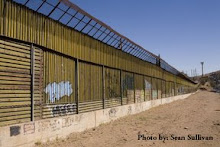
By Scott Nicol
In 1994 President Clinton issued Executive Order 12898 to address the issue of Environmental Justice. It instructs federal agencies to identify and address actions that might have “disproportionately high and adverse human health or environmental effects… on minority populations and low-income populations.” EO 12898 remains in effect today, but in building border walls the Department of Homeland Security (DHS) has chosen to ignore it.
Since the passage of the Secure Fence Act around 650 miles of border wall have been built, slicing though towns, farms, and natural areas. Southern border states have rates of poverty that are significantly higher than the national average. In 2009 Arizona had the second highest poverty rate in the nation, New Mexico had the third highest, and Texas came in seventh. Within these states communities along the border tend to be the poorest. The 2007 list of 10 counties with the lowest median incomes in the nation included the Texas border counties of El Paso, Hidalgo, and Cameron, all three of which now have border walls.
Rather than act to minimize the border wall’s impacts on these communities, DHS used the Real ID Act to waive 36 federal laws. The Safe Drinking Water Act, Farmland Protection Policy Act, Native American Graves Protection and Repatriation Act, and other laws that protect the rest of the nation no longer protect border communities. Equal protection under the law does not apply to those who live along the border.
This has led to a host of negative impacts on border communities. The economic impacts of land condemnation and damage to family farms have hit economically disadvantaged communities. Walls have cause severe flooding in Lukeville, Arizona, and across the border in Nogales, Sonora, Mexico, where two people drowned. In Texas wetlands have been destroyed, and construction has caused serious erosion, further degrading the Rio Grande, which is the source of drinking and irrigation water for border residents.
In documents released before wall construction began, DHS stated that each of the Texas communities living in the path of the wall, “meets these two criteria [high percentages of minority and low-income residents] as a potential environmental justice population.” DHS went on to claim, however, that “the Secretary’s waiver means that CBP no longer has any specific obligation under Executive Order (EO) 12898.” While the first statement is backed by census data, the claim that DHS is not bound by the executive order is false, because the executive order was not listed among the 36 laws that DHS waived. But the assertion has meant that little effort has gone into lessening the impacts of border walls on border communities, or including them in decision-making.
South Texas Communities
To build border walls the federal government filed condemnation lawsuits against more than 400 Texas landowners, in communities that are 85 – 90% Hispanic and have rates of poverty that are more than twice the state average.
In Hidalgo and Cameron counties, where border walls were built along existing levees, homes, businesses, farms, and privately-owned nature preserves have been cut in two, or even walled off entirely, trapped between the border wall and the Rio Grande.
DHS has only to paid for the exact footprint of the border wall (typically, a 60-foot wide strip) as it passes through a parcel of land. The agency has completely discounted the hardships that the border wall will bring to landowners, such as the devaluation of contiguous property, access to farm land and homes, and impacts on livelihood.
In south Texas there are 21 separate border walls, totaling 70 linear miles, with wide gaps between sections. Border residents noticed that walls tended to be built through the lands of low-income families, but stopped abruptly at the property line of landowners such as the Hunt family, who, coincidentally, donated millions for the construction of the Bush Presidential Library.
Researchers from the University of Texas who examined this determined, “Our comparison of the areas planned to be fenced along the border with those areas where ‘gaps’ in the fence are planned suggests disproportionate impact on individuals with lower income and education, Hispanic ethnicity and non-U.S. citizenship status.”
Tohono O’odham Nation
The Tohono O’odham nation in Southern Arizona is split by 75 miles of the U.S.-Mexico border, with 1,500 out of 20,000 tribal members living south of the line. As in many Native American nations poverty is widespread. According to the 2000 census the average income on the reservation was $8,137, compared to a national average of $26,940. Life expectancy was eight years less than the national average.
Speaking before a U.S. House of Representatives hearing on the border wall, O’odham Chairman Ned Norris Jr. said, “We are older than the international boundary with Mexico and had no role in creating the border. But our land is now cut in half, with O’odham communities, sacred sites, salt pilgrimage routes, and families divided.”
Chairman Norris went on to state that, with the waiving of the Native American Graves Protection and Repatriation Act, “… fragments of human remains were observed in the tire tracks of heavy construction equipment. Barriers and the border road now cross the site.”
“Imagine a bulldozer parking in your family graveyard, turning up bones. This is our reality.”
Chairman Norris concluded, “We know from our own experience living on the border that security can be improved while respecting the rights of tribes and border communities, while fulfilling our duty to the environment and to our ancestors, and without granting any person the power to ignore the law.”
Showing posts with label Environmental Justice. Show all posts
Showing posts with label Environmental Justice. Show all posts
Thursday, February 3, 2011


Tuesday, November 18, 2008
DHS Ignoring the Rights of Private Property Owners to Build the Border Wall
Texas RioGrande Legal Aid’s Communications Director Cynthia Martinez was invited to testify on TRLA’s work with border landowners at a hearing held by the Mexican American Legislative Caucus on November 13th. Below is the text of her statement before the committee. A copy is also available in pdf format.
*****
Mr. Chairman and members of the Mexican American Legislative Caucus-
Thank you for the opportunity to speak here today. My name is Cynthia Martinez and I am the Communications Director for Texas RioGrande Legal Aid, also known as TRLA. TRLA is a non-profit organization that provides free legal services to low-income clients in 68 counties in Texas. We are the largest provider of legal aid in Texas and the third largest in the United States.
For more than a year now, TRLA has worked in Texas border communities where the wall is going to be constructed to educate landowners on their legal rights and fight on behalf of low-income landowners who are at risk of losing their livelihoods. Our work has focused primarily on the Rio Grande Valley and in Eagle Pass.
TRLA does not take a policy position on whether the wall should be constructed. Our focus is solely on the legal rights of border landowners and residents as the wall is being built and once it is complete.
Throughout our efforts, our work has focused on one primary belief - in the process to construct the border wall the federal government has chosen to sacrifice the basic legal rights of border landowners in the interest of meeting an arbitrary deadline.
Almost eighteen months ago it became clear that the Department of Homeland Security was developing plans for the border wall that would require private landowners to give up their land in the name of homeland security. To date, DHS has sued approximately 100 landowners in the Rio Grande Valley alone to survey their property or begin the eminent domain process.
According to their own public statement, Homeland Security anticipates suing more than 250 landowners to construct the border wall.
About a year ago, in an effort to make sure that landowners were aware of their legal rights before the process began, TRLA attorneys organized community meetings throughout the Rio Grande Valley to bring landowners together and inform them of their legal rights.
At these meetings, landowners were clear that they had several concerns. They wanted to know:
- Where the wall was going to be built
- If they could keep the government from taking their land
- If they would be compensated for losing their land or any inconveniences that occur as a result of the wall’s construction
- What a wall meant for their community and their daily life
They had questions and the government was not doing anything to give them answers. So we did our best to help. In fact, many times we brought maps and information to these meetings that the residents had never seen before.
As early as June 2007 federal officials began approaching landowners for permission to survey their land so that they could begin to plan where the wall would be constructed. They would approach these landowners with documents - only available in English - and tell them that the government would sue them if they did not agree to the survey.
Many of these landowners are Spanish - dominant and all of them have a sincere respect for our government and its laws. To be approached by a federal agent, with legal documents only available in English, and to be told that the government will sue you if you don’t sign the forms left many landowners feeling as though they had no choice.
So many of them signed these documents and did so not knowing what they were signing or what their rights were. Other landowners took the request and refused to sign or sought help from an attorney. Many of these families turned to Texas RioGrande Legal Aid for help.
At this point, TRLA has represented nine families in their border wall litigation and provided legal advice to a countless number of border landowners on their legal rights throughout this process.
While all of our clients are determined to keep fighting for their land, you’d be hard pressed to find a couple more willing to fight than Baldomero and Hilaria Muniz.
Baldomero and Hilaria Muniz are an elderly couple who live in Los Ebanos. They spent their entire lives working as migrant workers to save up enough money to buy a small plot of land, build a house, and raise their children. In their old age, they use their land to raise goats which they sell to have a source of income. Their land is literally their livelihood - and the government wants to take it.
Both the Muniz family and the family of Pamela Rivas were approached around June 2007 to sign waivers that would allow the government to survey their land. But both families decided to put up a fight. Neither family wanted to let the government survey their land and certainly neither family wanted to be forced into giving up their land for the wall’s construction. The government never even had a conversation with these families about the issue. So both families refused to sign the waiver - and they were sued.
From the beginning, their defense was simple - the government failed to negotiate a reasonable price for having access to their land - a process it is required to go through by law. Instead, without consulting with these families, the government set its own price - zero dollars. Zero dollars for the inconvenience of having to let federal officials have access to their land and possibly damage it in the surveying process.
The offer was disingenuous and disrespectful. So TRLA represented both families in appeals that took us all the way to the Fifth Circuit Court of Appeals in New Orleans. The Muniz family, with few resources, was unable to afford the trip to see our attorneys fight on their behalf.
Unfortunately, our efforts were not successful in stopping the condemnation process and both families are currently being sued by the government for possession of their land. At this time, the future of their property is unclear.
Five of our families in the Eagle Pass area have taken a proactive approach and sued DHS for failing to consult or negotiate with them before taking their property and beginning construction on the border wall. In their lawsuit, the families also pointed out that DHS did consult with wealthy, Caucasian landowners in the area and has avoided using their properties in its final construction plans. This is an allegation that many landowners and even the media have made - but that the government has not addressed.
One of our families, the family of Oscar Ceballos, fought the government’s attempt to take his land, which is located approximately two miles from the border in the Rio Grande Valley, by arguing that Congress intended the wall to be built along the border - not in the border area. We were not successful, but in his decision United States District Judge Andrew Hanen did state that “once again, the nation has placed a burden on the citizens of south Texas that is clearly disproportional to that being borne by other locales.” That statement is the only consolation Mr. Ceballos has as the government proceeds with the condemnation process. It should be noted that originally the government intended to offer Mr. Ceballos $1600 for his property. Because of his determination to exercise his legal rights, a federal appraisal has valued his property at more than $30,000.
Currently many of our families and border residents live in a cloud of uncertainty. Late last week, Homeland Security announced that it would temporarily be halting the construction of the wall in certain border communities. If media reports are true, this could leave room for a new Congress and administration to alter or even eliminate construction plans. However, at this point, this is all speculation. All we know for sure is that the federal government is continuing with its lawsuits against border landowners to condemn their land.
Other border residents have a handful of questions, but no answers. Once the wall is constructed, life for border residents will change in ways that have yet to be explored. Will their land be damaged during the wall’s construction? Will they have to travel several miles to have access to their land if their property is cut in half by the wall? Will they have to become accustomed to border patrol agents asking them if they are U.S. citizens when they are on their own property? If their neighbor’s property is protected by a wall but theirs is not, will they get help to protect their own security? If their land is taken, will they be compensated appropriately?
In a speech in February 2008 at the Kennedy School of Government, Homeland Security Secretary Michael Chertoff characterized border landowners as fighting the wall’s construction because they are concerned that the wall will spoil their view or inhibit their cattle’s ability to get to the river.
Such a characterization is wrong, naïve, and dangerous. And it is important that policymakers understand that this isn’t about being able to see sunsets or a cow’s freedom.
These families are fighting for their livelihoods and, in doing so, they are only exercising the legal rights that have been guaranteed to them by the laws of this country.
Homeland Security officials have not been silent on the issue - in the press they have made it very clear that the wall will not be finished by the end of the year as planned and that’s largely due to the fight that landowners such as our clients have waged.
As you can imagine, we have not apologized for this.
At TRLA we take our commitment to these communities very seriously and we remain dedicated to fighting alongside them as the construction of the wall proceeds.
If there is one decisive legal victory we have had in this fight it is that all the courts have agreed on one thing - these landowners have the right to question their government and fight for their property. And that’s what they’re going to continue to do, even if it comes as an inconvenience to the federal government.
*****
Mr. Chairman and members of the Mexican American Legislative Caucus-
Thank you for the opportunity to speak here today. My name is Cynthia Martinez and I am the Communications Director for Texas RioGrande Legal Aid, also known as TRLA. TRLA is a non-profit organization that provides free legal services to low-income clients in 68 counties in Texas. We are the largest provider of legal aid in Texas and the third largest in the United States.
For more than a year now, TRLA has worked in Texas border communities where the wall is going to be constructed to educate landowners on their legal rights and fight on behalf of low-income landowners who are at risk of losing their livelihoods. Our work has focused primarily on the Rio Grande Valley and in Eagle Pass.
TRLA does not take a policy position on whether the wall should be constructed. Our focus is solely on the legal rights of border landowners and residents as the wall is being built and once it is complete.
Throughout our efforts, our work has focused on one primary belief - in the process to construct the border wall the federal government has chosen to sacrifice the basic legal rights of border landowners in the interest of meeting an arbitrary deadline.
Almost eighteen months ago it became clear that the Department of Homeland Security was developing plans for the border wall that would require private landowners to give up their land in the name of homeland security. To date, DHS has sued approximately 100 landowners in the Rio Grande Valley alone to survey their property or begin the eminent domain process.
According to their own public statement, Homeland Security anticipates suing more than 250 landowners to construct the border wall.
About a year ago, in an effort to make sure that landowners were aware of their legal rights before the process began, TRLA attorneys organized community meetings throughout the Rio Grande Valley to bring landowners together and inform them of their legal rights.
At these meetings, landowners were clear that they had several concerns. They wanted to know:
- Where the wall was going to be built
- If they could keep the government from taking their land
- If they would be compensated for losing their land or any inconveniences that occur as a result of the wall’s construction
- What a wall meant for their community and their daily life
They had questions and the government was not doing anything to give them answers. So we did our best to help. In fact, many times we brought maps and information to these meetings that the residents had never seen before.
As early as June 2007 federal officials began approaching landowners for permission to survey their land so that they could begin to plan where the wall would be constructed. They would approach these landowners with documents - only available in English - and tell them that the government would sue them if they did not agree to the survey.
Many of these landowners are Spanish - dominant and all of them have a sincere respect for our government and its laws. To be approached by a federal agent, with legal documents only available in English, and to be told that the government will sue you if you don’t sign the forms left many landowners feeling as though they had no choice.
So many of them signed these documents and did so not knowing what they were signing or what their rights were. Other landowners took the request and refused to sign or sought help from an attorney. Many of these families turned to Texas RioGrande Legal Aid for help.
At this point, TRLA has represented nine families in their border wall litigation and provided legal advice to a countless number of border landowners on their legal rights throughout this process.
While all of our clients are determined to keep fighting for their land, you’d be hard pressed to find a couple more willing to fight than Baldomero and Hilaria Muniz.
Baldomero and Hilaria Muniz are an elderly couple who live in Los Ebanos. They spent their entire lives working as migrant workers to save up enough money to buy a small plot of land, build a house, and raise their children. In their old age, they use their land to raise goats which they sell to have a source of income. Their land is literally their livelihood - and the government wants to take it.
Both the Muniz family and the family of Pamela Rivas were approached around June 2007 to sign waivers that would allow the government to survey their land. But both families decided to put up a fight. Neither family wanted to let the government survey their land and certainly neither family wanted to be forced into giving up their land for the wall’s construction. The government never even had a conversation with these families about the issue. So both families refused to sign the waiver - and they were sued.
From the beginning, their defense was simple - the government failed to negotiate a reasonable price for having access to their land - a process it is required to go through by law. Instead, without consulting with these families, the government set its own price - zero dollars. Zero dollars for the inconvenience of having to let federal officials have access to their land and possibly damage it in the surveying process.
The offer was disingenuous and disrespectful. So TRLA represented both families in appeals that took us all the way to the Fifth Circuit Court of Appeals in New Orleans. The Muniz family, with few resources, was unable to afford the trip to see our attorneys fight on their behalf.
Unfortunately, our efforts were not successful in stopping the condemnation process and both families are currently being sued by the government for possession of their land. At this time, the future of their property is unclear.
Five of our families in the Eagle Pass area have taken a proactive approach and sued DHS for failing to consult or negotiate with them before taking their property and beginning construction on the border wall. In their lawsuit, the families also pointed out that DHS did consult with wealthy, Caucasian landowners in the area and has avoided using their properties in its final construction plans. This is an allegation that many landowners and even the media have made - but that the government has not addressed.
One of our families, the family of Oscar Ceballos, fought the government’s attempt to take his land, which is located approximately two miles from the border in the Rio Grande Valley, by arguing that Congress intended the wall to be built along the border - not in the border area. We were not successful, but in his decision United States District Judge Andrew Hanen did state that “once again, the nation has placed a burden on the citizens of south Texas that is clearly disproportional to that being borne by other locales.” That statement is the only consolation Mr. Ceballos has as the government proceeds with the condemnation process. It should be noted that originally the government intended to offer Mr. Ceballos $1600 for his property. Because of his determination to exercise his legal rights, a federal appraisal has valued his property at more than $30,000.
Currently many of our families and border residents live in a cloud of uncertainty. Late last week, Homeland Security announced that it would temporarily be halting the construction of the wall in certain border communities. If media reports are true, this could leave room for a new Congress and administration to alter or even eliminate construction plans. However, at this point, this is all speculation. All we know for sure is that the federal government is continuing with its lawsuits against border landowners to condemn their land.
Other border residents have a handful of questions, but no answers. Once the wall is constructed, life for border residents will change in ways that have yet to be explored. Will their land be damaged during the wall’s construction? Will they have to travel several miles to have access to their land if their property is cut in half by the wall? Will they have to become accustomed to border patrol agents asking them if they are U.S. citizens when they are on their own property? If their neighbor’s property is protected by a wall but theirs is not, will they get help to protect their own security? If their land is taken, will they be compensated appropriately?
In a speech in February 2008 at the Kennedy School of Government, Homeland Security Secretary Michael Chertoff characterized border landowners as fighting the wall’s construction because they are concerned that the wall will spoil their view or inhibit their cattle’s ability to get to the river.
Such a characterization is wrong, naïve, and dangerous. And it is important that policymakers understand that this isn’t about being able to see sunsets or a cow’s freedom.
These families are fighting for their livelihoods and, in doing so, they are only exercising the legal rights that have been guaranteed to them by the laws of this country.
Homeland Security officials have not been silent on the issue - in the press they have made it very clear that the wall will not be finished by the end of the year as planned and that’s largely due to the fight that landowners such as our clients have waged.
As you can imagine, we have not apologized for this.
At TRLA we take our commitment to these communities very seriously and we remain dedicated to fighting alongside them as the construction of the wall proceeds.
If there is one decisive legal victory we have had in this fight it is that all the courts have agreed on one thing - these landowners have the right to question their government and fight for their property. And that’s what they’re going to continue to do, even if it comes as an inconvenience to the federal government.
Thursday, May 8, 2008
DHS Violates the Law in Condemning Private Property for the Border Wall
Texas RioGrande Legal Aid has been providing legal advice and representation to private property owners threatened by the border wall who could not otherwise afford a lawyer. The Department of Homeland Security has been trying to browbeat landowners into signing over access to their lands. Even in cases in which a farm or ranch will be sliced in half, and a lack of access to the Rio Grande for irrigation will make farming more expensive or completely untenable, DHS has only offered to pay for the slice of property that the wall sits on. Property owners whose land is entirely behind the wall will receive no compensation, even though the liklihood that anyone will want to buy their property in the future is next to nothing. TRLA has done commendable work on behalf of border residents, and the No Border Wall Coalition commends their efforts.
TRLA released the following press release regarding their efforts to defend private property owners on May 8, 2008:
NEW ORLEANS, Louisiana – Today the United States Court of Appeals for the Fifth Circuit ordered that oral arguments on a series of border wall lawsuits will begin the week of July 7.
The issue to be addressed by the Court is whether the Department of Homeland Security (DHS) violated federal law by condemning land for the border wall before negotiating a price for the property. Represented by Texas RioGrande Legal Aid (TRLA), the largest provider of legal aid in Texas, the landowners are arguing that the government is not following the legal steps required in the condemnation process.
Landowners in the cases on appeal claim that, because the Government failed to offer any money, it cannot sue them for land access. DHS is arguing that it did not offer the landowners any money because it “deemed $0.00 to be a reasonable price” and the courts do not have the power to question the government’s determination of the price’s reasonability.
“If the government’s condemnation power is really that broad, then nobody has the power to make them comply with their own laws,” said TRLA attorney Jerome Wesevich, “The government asserts absolute power in this case and that power can’t be questioned by anyone.”
Landowners involved in the litigation include Baldomero and Hilaria Muñiz of Los Ebanos, Texas. The elderly couple worked as migrant farmworkers and used their earnings to build a house on the border. They raised their five children in the house and now tend goats on their small piece of land to survive. In June 2007 DHS approached Mr. Muñiz and told him that he had to give the Department access to his property or be sued by the federal government.
“This land is their livelihood,” added Wesevich. “Saying that it isn’t worth a penny is insulting.”
The U.S. Court of Appeals for the Fifth Circuit case number is 08-40372.
###
Established in 1970, Texas RioGrande Legal Aid, Inc. (TRLA) is a nonprofit organization that provides free civil legal services to low-income and disadvantaged clients in a 68-county service area. TRLA’s mission is to promote the dignity, self-sufficiency, safety and stability of low-income Texas residents by providing high-quality legal assistance and related educational services.
Contact: Jerome Wesevich, Attorney
915.241.0534
jwesevich@trla.org
Cynthia Martinez, Communications Director
512.374.2764
cmartinez@trla.org
TRLA released the following press release regarding their efforts to defend private property owners on May 8, 2008:
NEW ORLEANS, Louisiana – Today the United States Court of Appeals for the Fifth Circuit ordered that oral arguments on a series of border wall lawsuits will begin the week of July 7.
The issue to be addressed by the Court is whether the Department of Homeland Security (DHS) violated federal law by condemning land for the border wall before negotiating a price for the property. Represented by Texas RioGrande Legal Aid (TRLA), the largest provider of legal aid in Texas, the landowners are arguing that the government is not following the legal steps required in the condemnation process.
Landowners in the cases on appeal claim that, because the Government failed to offer any money, it cannot sue them for land access. DHS is arguing that it did not offer the landowners any money because it “deemed $0.00 to be a reasonable price” and the courts do not have the power to question the government’s determination of the price’s reasonability.
“If the government’s condemnation power is really that broad, then nobody has the power to make them comply with their own laws,” said TRLA attorney Jerome Wesevich, “The government asserts absolute power in this case and that power can’t be questioned by anyone.”
Landowners involved in the litigation include Baldomero and Hilaria Muñiz of Los Ebanos, Texas. The elderly couple worked as migrant farmworkers and used their earnings to build a house on the border. They raised their five children in the house and now tend goats on their small piece of land to survive. In June 2007 DHS approached Mr. Muñiz and told him that he had to give the Department access to his property or be sued by the federal government.
“This land is their livelihood,” added Wesevich. “Saying that it isn’t worth a penny is insulting.”
The U.S. Court of Appeals for the Fifth Circuit case number is 08-40372.
###
Established in 1970, Texas RioGrande Legal Aid, Inc. (TRLA) is a nonprofit organization that provides free civil legal services to low-income and disadvantaged clients in a 68-county service area. TRLA’s mission is to promote the dignity, self-sufficiency, safety and stability of low-income Texas residents by providing high-quality legal assistance and related educational services.
Contact: Jerome Wesevich, Attorney
915.241.0534
jwesevich@trla.org
Cynthia Martinez, Communications Director
512.374.2764
cmartinez@trla.org
Sunday, March 9, 2008
COURT RULES SECRETARY CHERTOFF VIOLATING THE LAW IN BUILDING BORDER WALL
The Center for Human Rights and Constitutional Law released the following statement regarding their lawsuit defending the private property rights of border resident Eloisa Tamez:
In a 32-page decision issued today, a federal judge in Brownsville ruled that Secretary of Homeland Security Michael Chertoff violated federal law in his rush to build several hundred miles of border fencing in Southern Texas.
In a lawsuit filed by Secretary Chertoff in January against Dr. Eloisa Tamez, the Department of Homeland Security requested an expedited court order condemning Dr. Tamez's land so it could immediately commence a survey for the planned border fence. Dr. Tamez is an indigenous land-grant property owner in South Texas who refused to voluntarily give the U.S. Government a six month right to enter her land to survey for the border wall.
About twenty cases filed by Secretary Chertoff to condemn land along the border have been consolidated before federal judge Andrew Hanen in Brownsville, Texas, and delayed pending the outcome of Dr. Tamez's case.
In response to the government's suit, the court held a lengthy hearing on February 7 at which Dr. Tamez's lawyers with the Los Angeles-based Center for Human Rights and Constitutional Law argued that Secretary Chertoff had violated federal law by failing to negotiate with Dr. Tamez to arrive at a "fixed price" for the six month access it sought before suing to condemn the land to allow the survey to proceed.
In the decision issued today, judge Hanen ruled that "Dr. Tamez correctly asserts that negotiations are a prerequisite to the exercise of the power of eminent domain" under federal law. The court further concluded that Secretary Chertoff had presented "insufficient evidence ... as to whether there has been bona fide efforts to negotiate with Dr. Tamez." As it has done for over a month now, the court refused to sign an expedited order condemning Dr. Tamez's land so that the Department of Homeland Security can start a survey for its planned border wall.
The court also decided that a clause in the 2008 Appropriations Act for the Department of Homeland Security enacted in December 2007 that requires the Secretary of Homeland Security to consult with property owners to minimize the adverse impacts of any border activity is not a defense to the temporary access the Department seeks to conduct a survey, "but that it still may be a defense to later activity by the Government" when it seeks to enter her property: "Given the mandatory language of the consultation clause, that 'the Secretary of Homeland Security shall consult . . .,' this Court may find it proper to require compliance with the consultation clause, when appropriate, as a condition prior to entry onto the property after the taking has been completed ... Dr. Tamez's objections concerning the failure of the Government to abide by the consultation clause are denied without prejudice to her ability to reassert those objections at a later point in time" if the Government actually seeks to enter her property.
The court rejected Dr. Tamez's argument that if she and the Department of Homeland Security are unable after negotiations to agree on a fixed price for the right of temporary access to her land, that the government may only proceed to condemn her land under a federal law that grants her a right to a jury trial. The decision states that if the parties are unable to negotiate a fixed price for the interest the Government seeks in Dr. Tamez's land, then the Department of Homeland Security may seek to condemn the land under an expedited procedure known as the Declaration of Taking Act.
The court ordered the Government agents "to either partake in negotiations and/or provide this Court with any relevant evidence they may have concerning the existence of bona fide efforts to negotiate" by March 21.
In a statement issued through her lawyers, Dr. Tamez stated: "The court's order issued today vindicates my position that Secretary Chertoff has proceeded to seize my land and the land of other property owners in violation of federal law. On the other hand I am disappointed that the court ruled that Secretary Chertoff may use the expedited condemnation procedures after he negotiates with property owners to arrive at a fixed price for the use he seeks of our property. I am also pleased that the court appears to agree that property owners have the right to be consulted before Government agents actually enter our land. Under federal law the consultation we will insist upon must seek to minimize the adverse impact of any entry onto our lands on the environment and our cultural and economic rights. I intend to continue fighting this case to insure that Secretary Chertoff does not violate the law while rushing forward to build an ill-conceived border fence that will in many ways destroy border communities."
Peter Schey, President of the Center for Human Rights and Constitutional Law, and Dr. Tamez's lead counsel, responded to the ruling: "We will carefully study this decision to see how it may be used by other border property owners to protect their rights to the fullest extent permitted by law. Like border property owners, Secretary Chertoff is also bound by applicable laws and may not run roughshod over property owners' rights in his rush to complete an ill-conceived border wall. The proposed border wall will do little to stop undocumented migration but it will significantly increase deaths and injuries by diverting migrants to more dangerous border crossings. Regardless of how ill-advised the proposed border wall is, it certainly may not be built on a foundation of illegal and lawless conduct by the Department of Homeland Security. We welcome the court-ordered negotiations with the Government to explore a fair price for the property access that Secretary Chertoff seeks in Dr. Tamez's land. Once those discussions are concluded, we will demand that consultation take place with Dr. Tamez before any federal agents enter her land. By law these consultations must be aimed at minimizing any adverse impact of entry onto her land on the environment and on her economic and cultural rights. We will certainly also seek the same protections for all similarly situated property owners along the US-Mexico border."
Arnoldo Garcia, Senior Policy Associate with the National Network for Immigrant and Refugee Rights that has been supporting Dr. Tamez's lawsuit said: "It is time for Congress to reconsider building a Berlin-type militarized wall along the US-Mexico border. The more the border area is militarized and criminalized, the more migrants die trying to come to the US in search of little more than a better life and the ability to join or support their families. This country urgently needs rational and humane immigration reform, not walls that kill people. When Congress musters the courage to enact immigration reform, the need for a border wall will all but disappear. What good does it do to spend hundreds of millions of dollars on a border wall when half the undocumented immigrants enter the United States with non-immigrant visas, not through the US-Mexico border. Virtually all migration experts agree that we need to promptly legalize the undocumented population, issue a sufficient number of visas in the future to meet the known demand, and invest in sustainable development in the major sending communities abroad, not turn the United States into a fort surrounded by another Berlin wall."
The court's Order is available at http://www.nnirr. org/resources/ docs/EloisaTamez Case3-7-08- Order.pdf
Contacts:Peter Schey, Center for Human Rights and Constitutional Law, lead attorney for Dr. Tamez 323 251-3223Arnoldo Garcia, National Network for Immigrant and Refugee Rights, 510 928-0685Margo Tamez, daughter of Dr. Eloisa Tamez, Co-Founder, Lipan Apache (El Calaboz) Women Community Defense 509-595-4445
In a 32-page decision issued today, a federal judge in Brownsville ruled that Secretary of Homeland Security Michael Chertoff violated federal law in his rush to build several hundred miles of border fencing in Southern Texas.
In a lawsuit filed by Secretary Chertoff in January against Dr. Eloisa Tamez, the Department of Homeland Security requested an expedited court order condemning Dr. Tamez's land so it could immediately commence a survey for the planned border fence. Dr. Tamez is an indigenous land-grant property owner in South Texas who refused to voluntarily give the U.S. Government a six month right to enter her land to survey for the border wall.
About twenty cases filed by Secretary Chertoff to condemn land along the border have been consolidated before federal judge Andrew Hanen in Brownsville, Texas, and delayed pending the outcome of Dr. Tamez's case.
In response to the government's suit, the court held a lengthy hearing on February 7 at which Dr. Tamez's lawyers with the Los Angeles-based Center for Human Rights and Constitutional Law argued that Secretary Chertoff had violated federal law by failing to negotiate with Dr. Tamez to arrive at a "fixed price" for the six month access it sought before suing to condemn the land to allow the survey to proceed.
In the decision issued today, judge Hanen ruled that "Dr. Tamez correctly asserts that negotiations are a prerequisite to the exercise of the power of eminent domain" under federal law. The court further concluded that Secretary Chertoff had presented "insufficient evidence ... as to whether there has been bona fide efforts to negotiate with Dr. Tamez." As it has done for over a month now, the court refused to sign an expedited order condemning Dr. Tamez's land so that the Department of Homeland Security can start a survey for its planned border wall.
The court also decided that a clause in the 2008 Appropriations Act for the Department of Homeland Security enacted in December 2007 that requires the Secretary of Homeland Security to consult with property owners to minimize the adverse impacts of any border activity is not a defense to the temporary access the Department seeks to conduct a survey, "but that it still may be a defense to later activity by the Government" when it seeks to enter her property: "Given the mandatory language of the consultation clause, that 'the Secretary of Homeland Security shall consult . . .,' this Court may find it proper to require compliance with the consultation clause, when appropriate, as a condition prior to entry onto the property after the taking has been completed ... Dr. Tamez's objections concerning the failure of the Government to abide by the consultation clause are denied without prejudice to her ability to reassert those objections at a later point in time" if the Government actually seeks to enter her property.
The court rejected Dr. Tamez's argument that if she and the Department of Homeland Security are unable after negotiations to agree on a fixed price for the right of temporary access to her land, that the government may only proceed to condemn her land under a federal law that grants her a right to a jury trial. The decision states that if the parties are unable to negotiate a fixed price for the interest the Government seeks in Dr. Tamez's land, then the Department of Homeland Security may seek to condemn the land under an expedited procedure known as the Declaration of Taking Act.
The court ordered the Government agents "to either partake in negotiations and/or provide this Court with any relevant evidence they may have concerning the existence of bona fide efforts to negotiate" by March 21.
In a statement issued through her lawyers, Dr. Tamez stated: "The court's order issued today vindicates my position that Secretary Chertoff has proceeded to seize my land and the land of other property owners in violation of federal law. On the other hand I am disappointed that the court ruled that Secretary Chertoff may use the expedited condemnation procedures after he negotiates with property owners to arrive at a fixed price for the use he seeks of our property. I am also pleased that the court appears to agree that property owners have the right to be consulted before Government agents actually enter our land. Under federal law the consultation we will insist upon must seek to minimize the adverse impact of any entry onto our lands on the environment and our cultural and economic rights. I intend to continue fighting this case to insure that Secretary Chertoff does not violate the law while rushing forward to build an ill-conceived border fence that will in many ways destroy border communities."
Peter Schey, President of the Center for Human Rights and Constitutional Law, and Dr. Tamez's lead counsel, responded to the ruling: "We will carefully study this decision to see how it may be used by other border property owners to protect their rights to the fullest extent permitted by law. Like border property owners, Secretary Chertoff is also bound by applicable laws and may not run roughshod over property owners' rights in his rush to complete an ill-conceived border wall. The proposed border wall will do little to stop undocumented migration but it will significantly increase deaths and injuries by diverting migrants to more dangerous border crossings. Regardless of how ill-advised the proposed border wall is, it certainly may not be built on a foundation of illegal and lawless conduct by the Department of Homeland Security. We welcome the court-ordered negotiations with the Government to explore a fair price for the property access that Secretary Chertoff seeks in Dr. Tamez's land. Once those discussions are concluded, we will demand that consultation take place with Dr. Tamez before any federal agents enter her land. By law these consultations must be aimed at minimizing any adverse impact of entry onto her land on the environment and on her economic and cultural rights. We will certainly also seek the same protections for all similarly situated property owners along the US-Mexico border."
Arnoldo Garcia, Senior Policy Associate with the National Network for Immigrant and Refugee Rights that has been supporting Dr. Tamez's lawsuit said: "It is time for Congress to reconsider building a Berlin-type militarized wall along the US-Mexico border. The more the border area is militarized and criminalized, the more migrants die trying to come to the US in search of little more than a better life and the ability to join or support their families. This country urgently needs rational and humane immigration reform, not walls that kill people. When Congress musters the courage to enact immigration reform, the need for a border wall will all but disappear. What good does it do to spend hundreds of millions of dollars on a border wall when half the undocumented immigrants enter the United States with non-immigrant visas, not through the US-Mexico border. Virtually all migration experts agree that we need to promptly legalize the undocumented population, issue a sufficient number of visas in the future to meet the known demand, and invest in sustainable development in the major sending communities abroad, not turn the United States into a fort surrounded by another Berlin wall."
The court's Order is available at http://www.nnirr. org/resources/ docs/EloisaTamez Case3-7-08- Order.pdf
Contacts:Peter Schey, Center for Human Rights and Constitutional Law, lead attorney for Dr. Tamez 323 251-3223Arnoldo Garcia, National Network for Immigrant and Refugee Rights, 510 928-0685Margo Tamez, daughter of Dr. Eloisa Tamez, Co-Founder, Lipan Apache (El Calaboz) Women Community Defense 509-595-4445
Wednesday, January 16, 2008
Homeland Security is suing landowners to build the border wall
Texas Rio Grande Legal Aid issued the following press release:
WESLACO, Texas – Texas RioGrande Legal Aid (TRLA), the leading provider of legal aid in Texas, is making itself available to border landowners facing lawsuits from the Department of Homeland Security (DHS) for access to their land to build a wall along the Texas-Mexico border.
The lawsuits come after DHS requested access to landowners’ property to plan the location of a wall along the United States – Mexico border. Approximately 600 landowners received requests and an estimated 70 Texas landowners who refused to comply are expected to be sued by Homeland Security as a result.
DHS’s first lawsuit was filed against the City of Eagle Pass on Monday. That same day United States District Judge Alia M. Ludlum ruled on the matter and ordered Eagle Pass to allow government surveyors to access 233 acres of city land for 180 days. In exchange, the federal government paid $100. The orders came without any opportunity for the City of Eagle Pass to voice an objection.
According to TRLA attorney Rebecca Webber, “The fact that the Department of Homeland Security would resort to these fly-by-night tactics in Eagle Pass signals that a tough legal battle lies ahead. We’re preparing for it.”
Border landowners throughout Texas have been anticipating the federal government’s actions for several months. Members of GLOW (Granjeno Landowners Opposed to the Wall) have spent the last two weeks waiting for any sign that the government will be taking legal action against them.
“Many of these landowners are afraid that the government is going to take away land that has been in their families for hundreds of years. They may not have much, but they’re willing to fight to keep it,” added Webber. “For many of them, the anxiety of not knowing what is going to happen has been stressful enough.”
TRLA has partnered with the South Texas Civil Rights Project to provide free legal services to landowners needing representation, regardless of their income level. The groups are available to make referrals to private attorneys, provide general legal advice, and represent landowners in government lawsuits.
“Texas RioGrande Legal Aid is available to provide free legal advice at every step of this process,” added Executive Director David Hall. “If landowners don’t want the wall built on their land or want to make sure that they get the best possible price for their property, we can help.”
TRLA encourages landowners needing legal assistance regarding the border wall to call 1-866-757-1570.
Established in 1970, Texas RioGrande Legal Aid, Inc. (TRLA) is a nonprofit organization that provides free civil legal services to low-income and disadvantaged clients in a 68-county service area. TRLA’s mission is to promote the dignity, self-sufficiency, safety and stability of low-income Texas residents by providing high-quality civil legal assistance and related educational services.
Contact:
Rebecca Webber, Attorney
956.447.4844 rwebber@trla.org
Cynthia Martinez, Communications Director
512.374.2764 cmartinez@trla.org
WESLACO, Texas – Texas RioGrande Legal Aid (TRLA), the leading provider of legal aid in Texas, is making itself available to border landowners facing lawsuits from the Department of Homeland Security (DHS) for access to their land to build a wall along the Texas-Mexico border.
The lawsuits come after DHS requested access to landowners’ property to plan the location of a wall along the United States – Mexico border. Approximately 600 landowners received requests and an estimated 70 Texas landowners who refused to comply are expected to be sued by Homeland Security as a result.
DHS’s first lawsuit was filed against the City of Eagle Pass on Monday. That same day United States District Judge Alia M. Ludlum ruled on the matter and ordered Eagle Pass to allow government surveyors to access 233 acres of city land for 180 days. In exchange, the federal government paid $100. The orders came without any opportunity for the City of Eagle Pass to voice an objection.
According to TRLA attorney Rebecca Webber, “The fact that the Department of Homeland Security would resort to these fly-by-night tactics in Eagle Pass signals that a tough legal battle lies ahead. We’re preparing for it.”
Border landowners throughout Texas have been anticipating the federal government’s actions for several months. Members of GLOW (Granjeno Landowners Opposed to the Wall) have spent the last two weeks waiting for any sign that the government will be taking legal action against them.
“Many of these landowners are afraid that the government is going to take away land that has been in their families for hundreds of years. They may not have much, but they’re willing to fight to keep it,” added Webber. “For many of them, the anxiety of not knowing what is going to happen has been stressful enough.”
TRLA has partnered with the South Texas Civil Rights Project to provide free legal services to landowners needing representation, regardless of their income level. The groups are available to make referrals to private attorneys, provide general legal advice, and represent landowners in government lawsuits.
“Texas RioGrande Legal Aid is available to provide free legal advice at every step of this process,” added Executive Director David Hall. “If landowners don’t want the wall built on their land or want to make sure that they get the best possible price for their property, we can help.”
TRLA encourages landowners needing legal assistance regarding the border wall to call 1-866-757-1570.
Established in 1970, Texas RioGrande Legal Aid, Inc. (TRLA) is a nonprofit organization that provides free civil legal services to low-income and disadvantaged clients in a 68-county service area. TRLA’s mission is to promote the dignity, self-sufficiency, safety and stability of low-income Texas residents by providing high-quality civil legal assistance and related educational services.
Contact:
Rebecca Webber, Attorney
956.447.4844 rwebber@trla.org
Cynthia Martinez, Communications Director
512.374.2764 cmartinez@trla.org
Friday, November 30, 2007
The Department of Homeland Security Versus Environmental Justice
In the recently released Rio Grande Valley Tactical Infrastructure Environmental Impact Statement (EIS), the Department of Homeland Security attempts to brush aside issues of environmental justice in its plans to build border walls in south Texas. Although the Rio Grande Valley’s population is over 85% minority, and its border communities are some of the poorest in the nation, the EIS states that the impacts of the proposed border wall “would not fall disproportionately on minority or low-income populations.”
The Environmental Impact Statement is not only of interest to environmentalists. By law, environmental impact statements are required to cover issues of the human environment as well. Unfortunately, the Rio Grande Valley Border Fence EIS (copy available at http://www.borderfencenepa.com/rio-grande-valley-sector-eis/) does not adequately address these issues, and the most vulnerable residents of the Rio Grande Valley are being left unprotected from the damage a border wall is certain to cause.

The Border Wall in Southern California - courtesy J.J. Castro
Environmental justice is defined by the Environmental Protection Agency to mean that “no group of people, including racial, ethnic, or socioeconomic groups, should bear a disproportionate share of the negative environmental consequences resulting from industrial, municipal, and commercial operations or the execution of federal, state, local, and tribal environmental programs and policies” (EPA Fact Sheet). This sentiment was codified by President Clinton in executive order 12898 (Federal Action to Address Environmental Justice [EJ] in Minority Populations and Low-Income Populations), which provides that “each Federal agency must identify and address, as appropriate, disproportionately high and adverse human health or environmental effects of its programs, policies, and activities on minority populations and low-income populations in the U.S.”
In 2004, the Operation Rio Grande Environmental Impact Statement found that environmental justice was indeed an issue for projects in the Rio Grande Valley:
"Approximately 85% of the population in the area can be classified as minority (well above the state average of 39.4%). The median annual household incomes for the counties in the project area (Starr, $10,182; Hidalgo, $16,703; and Cameron, $17,336) are well below the state average of $27,016 and, in the case of Starr County, below the $15,000 established by the EPA for defining the economic status risk group. Therefore, many of the households in the project area doubtless have a high potential EJ index." (Operation Rio Grande EIS, Section 3.12.6)
However, in the 2007 Draft Rio Grande Valley Border Fence EIS, it is claimed that the protections of environmental justice do not apply. This questionable judgment is achieved by sleight of hand and is revealed in the following quote:
"Of the 21 fence sections, 11 are within census bureau tracts in which a portion of the tracts have a higher proportion of minority or low-income residents. Of the proposed 70 miles of tactical infrastructure, substantially less than half is within census bureau tracts that have a higher proportion of minority or low-income residents—therefore the overall impacts of the proposed tactical infrastructure would not fall disproportionately on minority or low-income populations." (Section 5. 5.11)
Rather than stating that the majority of people who will be negatively impacted by the border wall are poor and/or minorities, which is what environmental justice is all about, the EIS counts miles. Miles that fall within US Fish and Wildlife refuge tracts, where no people live, are counted along with the miles that pass through poor communities, allowing them to dilute, at least on paper, the wall’s impact on minority and low-income populations. Mileage is irrelevant to the question of environmental justice. The question is whether a disproportionately high number of the people who will be negatively affected are members of minority and/or low income populations.
The EIS does mention in passing that people will lose their homes, stating that, “Construction of the project would require some acquisition of private property, including the potential dislocation of some property owners and tenants.” “Dislocation” is of course a euphemism for eviction. In communities like Granjeno, where families have passed property down through the generations since the Spanish land grants of the 1760’s, up to a third of the homes will be impacted.
 Residents evicted to build the Berlin Wall
Hard-working people who may not have the money to hire lawyers are going to have their homes bulldozed or family farms sliced in two for a wall that won’t stop anyone. DHS is prepared to perpetrate a terrible injustice against the very U.S. citizens that they are supposed to protect.
The grassroots coalition No Border Wall is concerned that the Department of Homeland Security is papering over the real human hardships that a border wall tearing through Rio Grande Valley communities will cause and that minorities and the poor will bear the brunt of the damage of a misguided and politically-motivated project.
The Environmental Impact Statement is not only of interest to environmentalists. By law, environmental impact statements are required to cover issues of the human environment as well. Unfortunately, the Rio Grande Valley Border Fence EIS (copy available at http://www.borderfencenepa.com/rio-grande-valley-sector-eis/) does not adequately address these issues, and the most vulnerable residents of the Rio Grande Valley are being left unprotected from the damage a border wall is certain to cause.

The Border Wall in Southern California - courtesy J.J. Castro
Environmental justice is defined by the Environmental Protection Agency to mean that “no group of people, including racial, ethnic, or socioeconomic groups, should bear a disproportionate share of the negative environmental consequences resulting from industrial, municipal, and commercial operations or the execution of federal, state, local, and tribal environmental programs and policies” (EPA Fact Sheet). This sentiment was codified by President Clinton in executive order 12898 (Federal Action to Address Environmental Justice [EJ] in Minority Populations and Low-Income Populations), which provides that “each Federal agency must identify and address, as appropriate, disproportionately high and adverse human health or environmental effects of its programs, policies, and activities on minority populations and low-income populations in the U.S.”
In 2004, the Operation Rio Grande Environmental Impact Statement found that environmental justice was indeed an issue for projects in the Rio Grande Valley:
"Approximately 85% of the population in the area can be classified as minority (well above the state average of 39.4%). The median annual household incomes for the counties in the project area (Starr, $10,182; Hidalgo, $16,703; and Cameron, $17,336) are well below the state average of $27,016 and, in the case of Starr County, below the $15,000 established by the EPA for defining the economic status risk group. Therefore, many of the households in the project area doubtless have a high potential EJ index." (Operation Rio Grande EIS, Section 3.12.6)
However, in the 2007 Draft Rio Grande Valley Border Fence EIS, it is claimed that the protections of environmental justice do not apply. This questionable judgment is achieved by sleight of hand and is revealed in the following quote:
"Of the 21 fence sections, 11 are within census bureau tracts in which a portion of the tracts have a higher proportion of minority or low-income residents. Of the proposed 70 miles of tactical infrastructure, substantially less than half is within census bureau tracts that have a higher proportion of minority or low-income residents—therefore the overall impacts of the proposed tactical infrastructure would not fall disproportionately on minority or low-income populations." (Section 5. 5.11)
Rather than stating that the majority of people who will be negatively impacted by the border wall are poor and/or minorities, which is what environmental justice is all about, the EIS counts miles. Miles that fall within US Fish and Wildlife refuge tracts, where no people live, are counted along with the miles that pass through poor communities, allowing them to dilute, at least on paper, the wall’s impact on minority and low-income populations. Mileage is irrelevant to the question of environmental justice. The question is whether a disproportionately high number of the people who will be negatively affected are members of minority and/or low income populations.
The EIS does mention in passing that people will lose their homes, stating that, “Construction of the project would require some acquisition of private property, including the potential dislocation of some property owners and tenants.” “Dislocation” is of course a euphemism for eviction. In communities like Granjeno, where families have passed property down through the generations since the Spanish land grants of the 1760’s, up to a third of the homes will be impacted.
 Residents evicted to build the Berlin Wall
Hard-working people who may not have the money to hire lawyers are going to have their homes bulldozed or family farms sliced in two for a wall that won’t stop anyone. DHS is prepared to perpetrate a terrible injustice against the very U.S. citizens that they are supposed to protect.
The grassroots coalition No Border Wall is concerned that the Department of Homeland Security is papering over the real human hardships that a border wall tearing through Rio Grande Valley communities will cause and that minorities and the poor will bear the brunt of the damage of a misguided and politically-motivated project.
Subscribe to:
Posts (Atom)