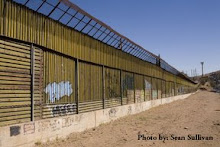
We are pleased to announce that the new No Border Wall website is up and running at
www.No-Border-Wall.com
This site is designed to be a comprehensive guide to the U.S.-Mexico border wall--its history, its ineffectiveness, types of wall designs, and the problems it has caused. There is also a geographical breakdown that details the damage walls have caused in specific regions. With loads of information and citation links to documents and newspaper articles embedded throughout, it is our hope that this site will become a point of entry into the issue for reporters, researchers, policy makers, and the general public.
The updated website comes at a particularly important time, with candidates for office as far from the border as Rhode Island running on border militarization. This often includes calls for more border walls, even double-layered walls from coast to coast, despite the tremendous financial, social, and environmental cost that this would inflict upon the United States. National policies of this magnitude must be based on facts, rather than misleading sound bites. That is why we have made every effort to ensure the accuracy of the information that is presented on the website.
Showing posts with label No Border Wall. Show all posts
Showing posts with label No Border Wall. Show all posts
Sunday, October 10, 2010


Friday, September 18, 2009
Taxpayers for Common Sense Blasts the Border Wall
Taxpayers for Common Sense has voiced their opposition to the border wall, tossing it into their Weekly Wastebasket. They describe themselves in this way,
"Taxpayers for Common Sense is an independent and non-partisan voice for taxpayers working to increase transparency and expose and eliminate wasteful and corrupt subsidies, earmarks, and corporate welfare."
Border Waste Reruns
Volume XIV No. 38: September 18, 2009
Jimmy Buffet could have testified at this week’s hearing about ongoing federal border protection initiatives. As you watched the same old song and dance about Department of Homeland Security (DHS) spending commence before lawmakers, you could almost hear him sing: “Wasting away again on the border wall. Searching for the lost section of fence. Some people say that Boeing’s to blame, but I know – it’s our own damn fault.”
With the benefit of updated numbers and dates, the House Homeland Security Committee learned that seven years and more than $4 billion in, DHS’s Secure Border Initiative (SBI) is (still) broken. SBI is comprised of a system of cameras and sensors known as SBINet and a steel “pedestrian” fence erected on more than 600 miles of the southwestern U.S. border.
Lawmakers heard an all too familiar tale of waste and woe. The average cost of pedestrian fencing has jumped from $3.5 to $6.5 million per mile, and costs for vehicle fencing have doubled. The Government Accountability Office (GAO) testified that the sensors used in the SBINet system still suffer from too many false detections and are vulnerable to bad weather despite the fact that the military has effectively used camera and sensor technology to track enemy movements for years at a much lower cost. But it didn’t stop there, the sad song continued:
· Full deployment of SBINet is now projected for 2016—seven years after the original contract with Boeing was scheduled to end;
· The pedestrian fence has been breached more than 3,000 times so far, with each repair costing at least $1,300;
· A long-overdue DHS study estimates the costs of maintaining the fence over a 20-year period at $6.5 billion— which is likely a low ball.
Sadly, even the new price tag may not tell the whole story. As our analysis of fence costs points out, maintenance estimates by the Congressional Budget Office and U.S. Army Corps of Engineers put that figure at $8 billion years ago, before the same labor and materials price hikes that have bumped up the cost of fence construction.
Problems with SBINet are due in large part to a contract that even a Boeing spokesman admitted was “awkward.” That’s a bit of an understatement: The delays and cost overruns have made the project a poster child for problems with “lead systems integrator” contracting strategy, where one company acts as a “system integrator” that tries to cobble together several different projects completed at different times and with different subcontractors. Incredibly, DHS just renewed Boeing’s contract for another year, despite a string of failures that has dogged the contract almost since its 2006 inception.
The fundamental question, of course, is whether the fence actually works. The unfortunate answers range between “no” and “not sure”. Because the SBINet technology still isn’t functional, border patrol agents are forced to work with outdated and ineffective technology, decreasing the border’s effectiveness. And the border patrol hasn’t yet created a way to quantitatively measure whether or not the pedestrian fence is actually keeping people out. The number of people caught trying to cross the border actually declined in several sectors before the fence went up, showing only that those numbers are influenced by factors other than the existence of a 14-foot steel wall.
Like too many expensive national security projects, Congressional commitments to the border fence were made in a fiscal vacuum. Yet Senators exacerbated irresponsible spending by inserting a requirement that would add another 300 miles of pedestrian fence at a cost of some $40 billion. Even though they’ve seen this one before, maybe lawmakers should review the hearing transcript: When asked whether the American taxpayer had benefitted from spending on SBI, the GAO analyst replied with an unequivocal “No.”
"Taxpayers for Common Sense is an independent and non-partisan voice for taxpayers working to increase transparency and expose and eliminate wasteful and corrupt subsidies, earmarks, and corporate welfare."
Border Waste Reruns
Volume XIV No. 38: September 18, 2009
Jimmy Buffet could have testified at this week’s hearing about ongoing federal border protection initiatives. As you watched the same old song and dance about Department of Homeland Security (DHS) spending commence before lawmakers, you could almost hear him sing: “Wasting away again on the border wall. Searching for the lost section of fence. Some people say that Boeing’s to blame, but I know – it’s our own damn fault.”
With the benefit of updated numbers and dates, the House Homeland Security Committee learned that seven years and more than $4 billion in, DHS’s Secure Border Initiative (SBI) is (still) broken. SBI is comprised of a system of cameras and sensors known as SBINet and a steel “pedestrian” fence erected on more than 600 miles of the southwestern U.S. border.
Lawmakers heard an all too familiar tale of waste and woe. The average cost of pedestrian fencing has jumped from $3.5 to $6.5 million per mile, and costs for vehicle fencing have doubled. The Government Accountability Office (GAO) testified that the sensors used in the SBINet system still suffer from too many false detections and are vulnerable to bad weather despite the fact that the military has effectively used camera and sensor technology to track enemy movements for years at a much lower cost. But it didn’t stop there, the sad song continued:
· Full deployment of SBINet is now projected for 2016—seven years after the original contract with Boeing was scheduled to end;
· The pedestrian fence has been breached more than 3,000 times so far, with each repair costing at least $1,300;
· A long-overdue DHS study estimates the costs of maintaining the fence over a 20-year period at $6.5 billion— which is likely a low ball.
Sadly, even the new price tag may not tell the whole story. As our analysis of fence costs points out, maintenance estimates by the Congressional Budget Office and U.S. Army Corps of Engineers put that figure at $8 billion years ago, before the same labor and materials price hikes that have bumped up the cost of fence construction.
Problems with SBINet are due in large part to a contract that even a Boeing spokesman admitted was “awkward.” That’s a bit of an understatement: The delays and cost overruns have made the project a poster child for problems with “lead systems integrator” contracting strategy, where one company acts as a “system integrator” that tries to cobble together several different projects completed at different times and with different subcontractors. Incredibly, DHS just renewed Boeing’s contract for another year, despite a string of failures that has dogged the contract almost since its 2006 inception.
The fundamental question, of course, is whether the fence actually works. The unfortunate answers range between “no” and “not sure”. Because the SBINet technology still isn’t functional, border patrol agents are forced to work with outdated and ineffective technology, decreasing the border’s effectiveness. And the border patrol hasn’t yet created a way to quantitatively measure whether or not the pedestrian fence is actually keeping people out. The number of people caught trying to cross the border actually declined in several sectors before the fence went up, showing only that those numbers are influenced by factors other than the existence of a 14-foot steel wall.
Like too many expensive national security projects, Congressional commitments to the border fence were made in a fiscal vacuum. Yet Senators exacerbated irresponsible spending by inserting a requirement that would add another 300 miles of pedestrian fence at a cost of some $40 billion. Even though they’ve seen this one before, maybe lawmakers should review the hearing transcript: When asked whether the American taxpayer had benefitted from spending on SBI, the GAO analyst replied with an unequivocal “No.”
Tuesday, September 15, 2009
LULAC Opposes DeMint Amendment in the Senate Version of the Homeland Security Appropriations Bill
LULAC Press Release
September 15, 2009
Washington, DC – The League of United Latin American Citizens, the largest and oldest Hispanic civil rights organization in the country, conveys strong opposition to the DeMint amendment included in the Senate version of the Homeland Security Appropriations bill, H.R. 2892 which would require additional several hundred miles of pedestrian fencing along the southern border costing taxpayers approximately $3 billion.
“Our border security remains a national priority but with our budget constraints we face, I believe we need to go about appropriating our resources where they are most needed," said LULAC National President Rosa Rosales. "The Secretary of Homeland Security Janet Napolitano has indicated that there are more useful ways of using these resources such as in deploying new surveillance assets, sensors, and tactical infrastructure to the southern border.”
We strongly recommend that the Senate recede to the House on the DeMint amendment, eliminating it from the final bill. Should conferees have the funds available for such a proposal as was approved by the Senate, we recommend that the money be used to strengthen border security at the southern ports of entry, where the nation’s needs are most urgent. There is an investment of $720 million in American Recovery and Reinvestment Act (ARRA) funds to improve security at land ports of entry, including $260 million for new technology and equipment.
We look forward to working with the Senate and House to reconcile both appropriations bills.
The League of United Latin American Citizens advances the economic condition, educational attainment, political influence, housing, health and civil rights of Hispanic Americans through community-based programs operating at more than 700 LULAC councils nationwide.
September 15, 2009
Washington, DC – The League of United Latin American Citizens, the largest and oldest Hispanic civil rights organization in the country, conveys strong opposition to the DeMint amendment included in the Senate version of the Homeland Security Appropriations bill, H.R. 2892 which would require additional several hundred miles of pedestrian fencing along the southern border costing taxpayers approximately $3 billion.
“Our border security remains a national priority but with our budget constraints we face, I believe we need to go about appropriating our resources where they are most needed," said LULAC National President Rosa Rosales. "The Secretary of Homeland Security Janet Napolitano has indicated that there are more useful ways of using these resources such as in deploying new surveillance assets, sensors, and tactical infrastructure to the southern border.”
We strongly recommend that the Senate recede to the House on the DeMint amendment, eliminating it from the final bill. Should conferees have the funds available for such a proposal as was approved by the Senate, we recommend that the money be used to strengthen border security at the southern ports of entry, where the nation’s needs are most urgent. There is an investment of $720 million in American Recovery and Reinvestment Act (ARRA) funds to improve security at land ports of entry, including $260 million for new technology and equipment.
We look forward to working with the Senate and House to reconcile both appropriations bills.
The League of United Latin American Citizens advances the economic condition, educational attainment, political influence, housing, health and civil rights of Hispanic Americans through community-based programs operating at more than 700 LULAC councils nationwide.
Tuesday, September 9, 2008
Fly on the Wall
By Adrienne Evans
TERLINGUA, September 4 - I arrived late for the August 24-28, 2008 Peace and Unity March against the border wall. I got there on Sunday, the last day.
The march that had started on Wednesday and gone 57 miles along the future route of the border wall in far west Texas. Being that late, and having not been that close to the actual border wall before, I was feeling almost like a "fly on the wall," having almost an out-of-body experience and getting a physical, psychological, and spiritual shock at the sight of the ugly wall. It's one thing to see a picture of it; it's another to see it up close, to touch it.
I parked hurriedly, spotting the rally in progress a hundred yards up the mountain in Sunland Park at the border wall there. I started up the hill, joining a journalist as we walked to join the group of 200 people present on both sides of the wall, most kneeling in the dust of the Border Patrol's road alongside the American side of the wall, in the shadow of the camera towers. It was a somber scene, full of the intensity of those who had marched, and the silent recognition by the rest of us of their effort.
Smudge pots by Native American elders burning, most heads bowed, blue, yellow and white butterflies flying up and hitting the wall and falling back over and over, the tired marchers standing a bit apart from the rest of us, the Mexican people gazing through the heavy mesh of the fence as the prayer ended at our sad faces and our signs that proclaimed our friendship and the injustice of a border wall, the indigenous drum beat THRUM-THRUM-THRUM, the sudden, loud call of the Native American woman as the priest said Amen, the Farm Workers Union leader then speaking of the travesty of this wall, hearts heavy on both sides, the priest asking us all to come up to the wall and touch a "brother and a sister's hand." Which we did, tears flowing on both sides.
Some brave few crested the steep hill where the border wall disappeared into the sky. They waved and shouted before heading back down; an elderly Hispanic man picked up tiny pieces of litter off the ground offering the tired marchers a ride to the parking lot in his truck; others trudging back down, arm in arm, to listen to more speeches as marchers on the U.S. side handed food, clothing and camping equipment over the top of the wall to a small crowd of children. Children as young as four were easily able to reach the top of the wall by standing on each other's shoulders.
We hugged and waved goodbye to our sisters and brothers on both sides of the wall.
That day, the wall was a bridge, not a divider. You could touch someone's fingertips through the mesh. You could look into their eyes. You could walk alongside them and speak. You could pray together. The road alongside the border wall was not a military road Sunday -- it was a church, a holy place; it was a place to kneel and pray. It was a place that the indigenous people could call from to the Great Spirit. The wall became a bridge for those few moments -- but as we looked back, its hideous shape reasserted, a physical reminder of our nation's insecurity, its hatreds, its racism, in the form of a wall that was easily breached, even by children.
Yet the butterflies reminded us how solid the wall was, how impenetrable to the helpless animals. The children, not helpless, calling to us, reminded us that our fancy cars and clothes meant we had something to give that they needed. The march’s leaders and activists on both sides of the wall reminded us of the social injustice of border walls, and that the "March had just begun." The priests reminded us that our brethren on the Mexican side of the wall were no different than we were in the sight of God. Indeed.
The sight of the border wall reminded us of the reality of a wall, how grotesque it really is. How useless, really. While the wall stands, we have a chance to wake up to our own fears and the horrible result of these fears. So go see the wall, and symbolically write your own fears, your own hatred, your own racism, upon its surface, as I did last Sunday. Release your fears and be done with them. Lay flowers there. Pray. Watch the butterflies smack against it. Watch the children, laughingly, climb it in five seconds.
The day the wall comes down, we will recognize those fears fully as being exposed and dealt with. We will have overcome them.
Adrienne Evans is a mother, health practitioner and community volunteer who lives in Terlingua, Texas. She is the co-founder of No Wall – Big Bend coalition. For more info, visit http://www.nowallbigbend.blogspot.com/.
TERLINGUA, September 4 - I arrived late for the August 24-28, 2008 Peace and Unity March against the border wall. I got there on Sunday, the last day.
The march that had started on Wednesday and gone 57 miles along the future route of the border wall in far west Texas. Being that late, and having not been that close to the actual border wall before, I was feeling almost like a "fly on the wall," having almost an out-of-body experience and getting a physical, psychological, and spiritual shock at the sight of the ugly wall. It's one thing to see a picture of it; it's another to see it up close, to touch it.
I parked hurriedly, spotting the rally in progress a hundred yards up the mountain in Sunland Park at the border wall there. I started up the hill, joining a journalist as we walked to join the group of 200 people present on both sides of the wall, most kneeling in the dust of the Border Patrol's road alongside the American side of the wall, in the shadow of the camera towers. It was a somber scene, full of the intensity of those who had marched, and the silent recognition by the rest of us of their effort.
Smudge pots by Native American elders burning, most heads bowed, blue, yellow and white butterflies flying up and hitting the wall and falling back over and over, the tired marchers standing a bit apart from the rest of us, the Mexican people gazing through the heavy mesh of the fence as the prayer ended at our sad faces and our signs that proclaimed our friendship and the injustice of a border wall, the indigenous drum beat THRUM-THRUM-THRUM, the sudden, loud call of the Native American woman as the priest said Amen, the Farm Workers Union leader then speaking of the travesty of this wall, hearts heavy on both sides, the priest asking us all to come up to the wall and touch a "brother and a sister's hand." Which we did, tears flowing on both sides.
Some brave few crested the steep hill where the border wall disappeared into the sky. They waved and shouted before heading back down; an elderly Hispanic man picked up tiny pieces of litter off the ground offering the tired marchers a ride to the parking lot in his truck; others trudging back down, arm in arm, to listen to more speeches as marchers on the U.S. side handed food, clothing and camping equipment over the top of the wall to a small crowd of children. Children as young as four were easily able to reach the top of the wall by standing on each other's shoulders.
We hugged and waved goodbye to our sisters and brothers on both sides of the wall.
That day, the wall was a bridge, not a divider. You could touch someone's fingertips through the mesh. You could look into their eyes. You could walk alongside them and speak. You could pray together. The road alongside the border wall was not a military road Sunday -- it was a church, a holy place; it was a place to kneel and pray. It was a place that the indigenous people could call from to the Great Spirit. The wall became a bridge for those few moments -- but as we looked back, its hideous shape reasserted, a physical reminder of our nation's insecurity, its hatreds, its racism, in the form of a wall that was easily breached, even by children.
Yet the butterflies reminded us how solid the wall was, how impenetrable to the helpless animals. The children, not helpless, calling to us, reminded us that our fancy cars and clothes meant we had something to give that they needed. The march’s leaders and activists on both sides of the wall reminded us of the social injustice of border walls, and that the "March had just begun." The priests reminded us that our brethren on the Mexican side of the wall were no different than we were in the sight of God. Indeed.
The sight of the border wall reminded us of the reality of a wall, how grotesque it really is. How useless, really. While the wall stands, we have a chance to wake up to our own fears and the horrible result of these fears. So go see the wall, and symbolically write your own fears, your own hatred, your own racism, upon its surface, as I did last Sunday. Release your fears and be done with them. Lay flowers there. Pray. Watch the butterflies smack against it. Watch the children, laughingly, climb it in five seconds.
The day the wall comes down, we will recognize those fears fully as being exposed and dealt with. We will have overcome them.
Adrienne Evans is a mother, health practitioner and community volunteer who lives in Terlingua, Texas. She is the co-founder of No Wall – Big Bend coalition. For more info, visit http://www.nowallbigbend.blogspot.com/.
Thursday, August 28, 2008
No Border Wall Endorses the People’s March to Stop the Wall
The No Border Wall Coalition strongly endorses the Border People’s March to Stop the Wall, currently underway on the Texas – Mexico border. Marchers will follow the route of the 57-mile segment of border wall that is being built from Ft. Hancock, Texas, to El Paso, Texas. Led by No Wall – Big Bend and the Border Ambassadors, they plan to highlight the tremendous human and environmental costs of the wall in west Texas and along the entire U.S. – Mexico border.
Marchers will set off from Fort Hancock today, and arrive in El Paso on Sunday, August 31. More information about the march and its route is available at the Border Ambassadors website - www.borderambassadors.com .
Of special concern along the marchers’ route is the impact of the border wall on Native American communities. Like the Tohono O’Odham farther west, the lands that the Ysleta del Sur Pueblo of the Tigua Nation calls home lie on both sides of what is now the international border. The Rio Grande is crucial not only for providing water in a harsh, dry environment, it is also integral to their religious practices. As the Rio Grande is walled off, the Tiguas have stated that they will be cut off from graves and sacred sites.
There are laws on the books, most notably the American Indian Religious Freedom Act and the Native American Graves Protection and Repatriation Act, that should prevent this assault on the Tiguas religion and culture. But section 102 of the Real ID Act allows Department of Homeland Security Secretary Chertoff to brush aside any law that might slow construction of the border wall. On April 1, 2008 he did just that, “waiving in their entirety” 36 federal laws including the American Indian Religious Freedom Act and the Native American Graves Protection and Repatriation Act.
The Tiguas are party to a challenge to the constitutionality of the Real ID Act’s waiver provision, alleging that giving an unelected administration appointee the power to waive laws passed by Congress and signed by the President for the express purpose of subverting the judiciary is a violation of the separation of powers enshrined in the U.S. Constitution. They are joined by El Paso County, the El Paso County Water Improvement District No. 1, the Hudspeth County Conservation and Reclamation District No. 1, Galeria 409, The Frontera Audubon Society, the Friends of the Wildlife Corridor, and the Friends of Laguna Atascosa National Wildlife Refuge. The wide spectrum of plaintiffs challenging the Department of Homeland Security’s suspension of laws points to the broad range of negative impacts that the wall will have in Texas, as well as the rest of our nation’s borderlands.
The same river that provides a focal point for the Tiguas’ religious ceremonies is equally important for the survival of plant, animal, and human communities. The Rio Bosque Wetlands Park has also spoken out against the wall, stating that, “A fence would limit the ability of native terrestrial species to move between such areas and the floodway. It would limit genetic exchange and would fragment populations that are currently connected.” As habitat is fragmented and access to the river is denied, animals, particularly those that are listed as federally threatened or endangered, may not survive.
With border wall construction currently under way near El Paso and elsewhere, it is critically important that we remind members of Congress that the elections that they are currently obsessed with are just the entrance exam for their jobs. Elections are meant to bring in public servants, and it is their job to serve the best interests of the American people. Building walls that will cut off the Rio Grande, that will disrupt Native American religious practices and disturb graves, that will destroy natural areas such as the Rio Bosque Wetlands Park, and will cost U.S. taxpayers billions of dollars, is unconscionable. As our public servants once again come before the American people, asking for our votes, it is important that they know that we will hold them accountable for their actions.
Marchers will set off from Fort Hancock today, and arrive in El Paso on Sunday, August 31. More information about the march and its route is available at the Border Ambassadors website - www.borderambassadors.com .
Of special concern along the marchers’ route is the impact of the border wall on Native American communities. Like the Tohono O’Odham farther west, the lands that the Ysleta del Sur Pueblo of the Tigua Nation calls home lie on both sides of what is now the international border. The Rio Grande is crucial not only for providing water in a harsh, dry environment, it is also integral to their religious practices. As the Rio Grande is walled off, the Tiguas have stated that they will be cut off from graves and sacred sites.
There are laws on the books, most notably the American Indian Religious Freedom Act and the Native American Graves Protection and Repatriation Act, that should prevent this assault on the Tiguas religion and culture. But section 102 of the Real ID Act allows Department of Homeland Security Secretary Chertoff to brush aside any law that might slow construction of the border wall. On April 1, 2008 he did just that, “waiving in their entirety” 36 federal laws including the American Indian Religious Freedom Act and the Native American Graves Protection and Repatriation Act.
The Tiguas are party to a challenge to the constitutionality of the Real ID Act’s waiver provision, alleging that giving an unelected administration appointee the power to waive laws passed by Congress and signed by the President for the express purpose of subverting the judiciary is a violation of the separation of powers enshrined in the U.S. Constitution. They are joined by El Paso County, the El Paso County Water Improvement District No. 1, the Hudspeth County Conservation and Reclamation District No. 1, Galeria 409, The Frontera Audubon Society, the Friends of the Wildlife Corridor, and the Friends of Laguna Atascosa National Wildlife Refuge. The wide spectrum of plaintiffs challenging the Department of Homeland Security’s suspension of laws points to the broad range of negative impacts that the wall will have in Texas, as well as the rest of our nation’s borderlands.
The same river that provides a focal point for the Tiguas’ religious ceremonies is equally important for the survival of plant, animal, and human communities. The Rio Bosque Wetlands Park has also spoken out against the wall, stating that, “A fence would limit the ability of native terrestrial species to move between such areas and the floodway. It would limit genetic exchange and would fragment populations that are currently connected.” As habitat is fragmented and access to the river is denied, animals, particularly those that are listed as federally threatened or endangered, may not survive.
With border wall construction currently under way near El Paso and elsewhere, it is critically important that we remind members of Congress that the elections that they are currently obsessed with are just the entrance exam for their jobs. Elections are meant to bring in public servants, and it is their job to serve the best interests of the American people. Building walls that will cut off the Rio Grande, that will disrupt Native American religious practices and disturb graves, that will destroy natural areas such as the Rio Bosque Wetlands Park, and will cost U.S. taxpayers billions of dollars, is unconscionable. As our public servants once again come before the American people, asking for our votes, it is important that they know that we will hold them accountable for their actions.
Monday, August 18, 2008
Organ Pipe Cactus National Monument Damaged by Border Wall Flood Obstruction
New Park Service Report Details Environmental, Infrastructure Damage Caused by Predictable Border Wall Flood Problems.
The following press release comes from the Center for Biological Diversity, regarding the impact of the border wall on flooding in Organ Pipe National Monument on July 12. The same storm system that caused flooding in Nogales, Sonora, Mexico, which was dramatically worsened by the presence of the border wall that runs through the sister cities of Nogales as well as an illegally built wall in the storm sewer beneath the cities, was responsible for the flooding of the washes in Organ Pipe. This is a regular occurrence that the Department of Homeland Security had been warned of, but apparently Chertoff did not heed those warnings.
PHOENIX— A newly obtained National Park Service report details ecological and infrastructure damage in Organ Pipe Cactus National Monument caused by flood obstruction and debris accumulation along recently constructed portions of the border wall. Damage includes severe erosion, infrastructure damage, and movement of floodwaters and drainages behind debris obstructions into adjacent deserts and, in one case, through a border-crossing station.
An environmental analysis conducted by the Department of Homeland Security in 2007 concluded that the fence would “…not impede the natural flow of water.” It would be “…designed and constructed to ensure proper conveyance of floodwaters and to eliminate the potential to cause backwater flooding on either side of the U.S.-Mexico border.” Further, Customs and Border Protection would “…remove debris from the fence within washes/arroyos immediately after rain events to ensure that no backwater flooding occurs.” Homeland Security Secretary Michael Chertoff has since exempted the border wall from all environmental laws.
“The callousness displayed by Homeland Security in ignoring warnings to damage a national treasure is mind-boggling,” said Robin Silver of the Center for Biological Diversity. “The border wall does not stop humans, but it will stop jaguars and other wildlife. It is already wreaking havoc on the southern part of Organ Pipe National Monument.”
“The contrast between the report findings and the environmental assessment displays the Bush administration’s wholly meaningless approach to environmental analysis,” said Silver. “The administration essentially did no analysis at all.”
The Park Service report shows several instances in which debris collected in flash floods in south-flowing drainages caused natural resource and infrastructure damage and states that National Monument resources and infrastructure will continue to be impacted, as well as resources and infrastructure on neighboring lands in the United States and Mexico. The report anticipates the following short- and long-term impacts:
Accelerated scour below the pedestrian fence will damage the structural integrity of the vehicle barrier along the U.S./Mexico boundary unless continued maintenance occurs.
Floodwaters will flow laterally along the pedestrian fence and on the patrol road. These flows will result in erosion and scour above and below the foundation wall of the fence, including areas hundreds of feet outside existing drainage channels. As a consequence, the need for routine maintenance and repairs of the patrol road and vehicle barrier will increase.
The patrol road associated with the pedestrian fence will change vegetation in Organ Pipe by changing rainfall retention or runoff along the northern road edge.
Riparian vegetation will change in response to increased sedimentation.
Channel morphology and floodplain function will change over time.
Channelized waters will begin a gullying process that has the potential to transform land surfaces in the affected watersheds.
“While the Bush administration may claim it’s taking environmental impacts of the border wall into consideration, building wire mesh fences across washes prone to debris-laden floods is fundamentally flawed,” said Silver. “It’s time for Homeland Security to lift its embargo on environmental laws. The border fence does not stop humans. Now we have more proof of the wall’s destruction of our national treasures."
www.BiologicalDiversity.org
Contact: Robin Silver, (602) 799-3275
The following press release comes from the Center for Biological Diversity, regarding the impact of the border wall on flooding in Organ Pipe National Monument on July 12. The same storm system that caused flooding in Nogales, Sonora, Mexico, which was dramatically worsened by the presence of the border wall that runs through the sister cities of Nogales as well as an illegally built wall in the storm sewer beneath the cities, was responsible for the flooding of the washes in Organ Pipe. This is a regular occurrence that the Department of Homeland Security had been warned of, but apparently Chertoff did not heed those warnings.
PHOENIX— A newly obtained National Park Service report details ecological and infrastructure damage in Organ Pipe Cactus National Monument caused by flood obstruction and debris accumulation along recently constructed portions of the border wall. Damage includes severe erosion, infrastructure damage, and movement of floodwaters and drainages behind debris obstructions into adjacent deserts and, in one case, through a border-crossing station.
An environmental analysis conducted by the Department of Homeland Security in 2007 concluded that the fence would “…not impede the natural flow of water.” It would be “…designed and constructed to ensure proper conveyance of floodwaters and to eliminate the potential to cause backwater flooding on either side of the U.S.-Mexico border.” Further, Customs and Border Protection would “…remove debris from the fence within washes/arroyos immediately after rain events to ensure that no backwater flooding occurs.” Homeland Security Secretary Michael Chertoff has since exempted the border wall from all environmental laws.
“The callousness displayed by Homeland Security in ignoring warnings to damage a national treasure is mind-boggling,” said Robin Silver of the Center for Biological Diversity. “The border wall does not stop humans, but it will stop jaguars and other wildlife. It is already wreaking havoc on the southern part of Organ Pipe National Monument.”
“The contrast between the report findings and the environmental assessment displays the Bush administration’s wholly meaningless approach to environmental analysis,” said Silver. “The administration essentially did no analysis at all.”
The Park Service report shows several instances in which debris collected in flash floods in south-flowing drainages caused natural resource and infrastructure damage and states that National Monument resources and infrastructure will continue to be impacted, as well as resources and infrastructure on neighboring lands in the United States and Mexico. The report anticipates the following short- and long-term impacts:
Accelerated scour below the pedestrian fence will damage the structural integrity of the vehicle barrier along the U.S./Mexico boundary unless continued maintenance occurs.
Floodwaters will flow laterally along the pedestrian fence and on the patrol road. These flows will result in erosion and scour above and below the foundation wall of the fence, including areas hundreds of feet outside existing drainage channels. As a consequence, the need for routine maintenance and repairs of the patrol road and vehicle barrier will increase.
The patrol road associated with the pedestrian fence will change vegetation in Organ Pipe by changing rainfall retention or runoff along the northern road edge.
Riparian vegetation will change in response to increased sedimentation.
Channel morphology and floodplain function will change over time.
Channelized waters will begin a gullying process that has the potential to transform land surfaces in the affected watersheds.
“While the Bush administration may claim it’s taking environmental impacts of the border wall into consideration, building wire mesh fences across washes prone to debris-laden floods is fundamentally flawed,” said Silver. “It’s time for Homeland Security to lift its embargo on environmental laws. The border fence does not stop humans. Now we have more proof of the wall’s destruction of our national treasures."
www.BiologicalDiversity.org
Contact: Robin Silver, (602) 799-3275
Monday, August 4, 2008
Border Wall Causes Flood in Nogales, Sonora
By Sean Sullivan
On July 12, monsoons washed through the Nogales, Sonora area and caused major flooding on the Mexican side of the border. In some places five feet of water was pooled up along the border wall and there were reports of cars floating away. What caused this flood?
 As reported in the AZ Daily Star, Mexican officials blame an illegally built wall for the devastating flood. The Border Patrol built a 5 foot wall within a drainage tunnel near a port of entry without notifying the International Boundary and Water Commission (IBWC).
The IBWC is comprised of officials from Mexico and the U.S. They are charged with seeking solutions to issues pertaining to sanitation, water quality, and flood control in the border region. The 5 foot wall was built by Border Patrol in January of this year. Traditionally, the IBWC is consulted when projects built on either side of the border will have an impact on stormwater runoff. However, Border Patrol never contacted the IBWC.
Mexican officials with the IBWC have submitted a formal complaint claiming that the wall reduced water flows within the drainage tunnel. As a result, concrete drainage structures failed and released torrents of water into the streets of the Nogales, Sonora. U.S. officials are still investigating the matter.
Complete disregard for the law and respect for other agencies and communities within the border region is now rampant within the Department for Homeland Security (DHS). This year DHS waived over 30 federal laws in order to construct hundreds of miles of border walls. Now the Border Patrol has failed to consult with the organization responsible for bi-national flood control and has endangered the residents of Nogales.
We know that border infrastructure is having devastating impacts on wildlife and ecosystems. The Nogales flood shows us that border communities also face environmental injustices. The flood caused millions of dollars in damages and destroyed many businesses in a low income community. Floods such as this can soil drinking water, spread hazardous materials, and create breeding grounds for various types of mold that can pose a health risk to people.
The infrastructure being utilized by DHS along the U.S./Mexico border continues to result in devastating impacts not only to the natural environment, but to communities as well. The Nogales flood could very well be a portent of what could occur along the lower Rio Grande Valley. There are many communities in the vicinity of the walls being constructed along that stretch of the border. This incident is yet another tarnished example of how U.S. border policy fails and instead places people and the environment at risk.
Sean Sullivan is the Co-Chair for the Sierra Club's Rincon Group in southern Arizona.
On July 12, monsoons washed through the Nogales, Sonora area and caused major flooding on the Mexican side of the border. In some places five feet of water was pooled up along the border wall and there were reports of cars floating away. What caused this flood?
 As reported in the AZ Daily Star, Mexican officials blame an illegally built wall for the devastating flood. The Border Patrol built a 5 foot wall within a drainage tunnel near a port of entry without notifying the International Boundary and Water Commission (IBWC).
The IBWC is comprised of officials from Mexico and the U.S. They are charged with seeking solutions to issues pertaining to sanitation, water quality, and flood control in the border region. The 5 foot wall was built by Border Patrol in January of this year. Traditionally, the IBWC is consulted when projects built on either side of the border will have an impact on stormwater runoff. However, Border Patrol never contacted the IBWC.
Mexican officials with the IBWC have submitted a formal complaint claiming that the wall reduced water flows within the drainage tunnel. As a result, concrete drainage structures failed and released torrents of water into the streets of the Nogales, Sonora. U.S. officials are still investigating the matter.
Complete disregard for the law and respect for other agencies and communities within the border region is now rampant within the Department for Homeland Security (DHS). This year DHS waived over 30 federal laws in order to construct hundreds of miles of border walls. Now the Border Patrol has failed to consult with the organization responsible for bi-national flood control and has endangered the residents of Nogales.
We know that border infrastructure is having devastating impacts on wildlife and ecosystems. The Nogales flood shows us that border communities also face environmental injustices. The flood caused millions of dollars in damages and destroyed many businesses in a low income community. Floods such as this can soil drinking water, spread hazardous materials, and create breeding grounds for various types of mold that can pose a health risk to people.
The infrastructure being utilized by DHS along the U.S./Mexico border continues to result in devastating impacts not only to the natural environment, but to communities as well. The Nogales flood could very well be a portent of what could occur along the lower Rio Grande Valley. There are many communities in the vicinity of the walls being constructed along that stretch of the border. This incident is yet another tarnished example of how U.S. border policy fails and instead places people and the environment at risk.
Sean Sullivan is the Co-Chair for the Sierra Club's Rincon Group in southern Arizona.
Tuesday, July 29, 2008
Hurricanes and Border Walls Don’t Mix
The Texas Border Coalition, which describes itself as a collective voice of border mayors, county judges, and economic development commissions along Texas' border with Mexico, released the following statement regarding the border wall in South Texas:
EAGLE PASS, Texas – (July 25, 2008) – As South Texans continue to repair roofs, roads and lives damaged by Hurricane Dolly, the chairman of the Texas Border Coalition (TBC) repeated his protest today that hurricanes and the border wall don’t mix.
TBC Chairman and Eagle Pass Mayor Chad Foster objected to a new plan by the Department of Homeland Security (DHS) to build 14 miles of movable wall in the U.S.-Mexico border floodplain that would have to be torn down within 24 hours of the next hurricane or other flood event.
“Hurricane season is not over with the downgrading of Dolly,” Foster said. “Not only does DHS plan to continue its piecemeal approach to protecting the lives of South Texans, now they plan a total absurdity: a movable wall.”
“If a movable wall were in place today, over 1,000 workers would be needed to tear it down within 24 hours, load it on to hundreds of trucks to take it north,” said Foster. “They would be doing so instead of battening down their homes for the storm or evacuating their families from its wrath.”
According to the latest information available about the movable wall, it would be constructed of steel bollards 18 feet above ground, filled to the 10-foot level with concrete. By TBC’s back-of-the-envelope estimations, the 14-mile movable wall would be made of nearly 90,000 steel bollards, each weighing about 1,700 pounds.
To achieve its goal of removing the wall, the DHS would have to haul away 151 million pounds of unwieldy pipe filled with concrete. Who will move it and with what equipment is unclear.
“The people of the Rio Grande Valley, having just experienced the rapid emergency work necessary to protect the people in advance of a hurricane, know that DHS’ movable wall is simply ridiculous,” Foster said.
“It is an outrage that that DHS is so arrogant, out of control and headstrong to build a wall that even Homeland Security Secretary Michael Chertoff admits won’t work – that illegal crossers will go around, over, through and under it,” Foster said. “In doing so, they are wasting $50 billion of the taxpayers’ money for a wall that everyone knows won’t work.”
Foster added, “This is the result of Secretary Chertoff’s waiver of 34 laws to build the wall. By repealing these laws, DHS has avoided scrutiny from the public and government agencies, essentially voiding our system of checks and balances. It would have made more sense, and saved taxpayers hundreds of millions of dollars, if DHS had simply consulted with border residents and border officials first. We certainly would not have suggested a 151-million-pound movable wall.”
The Texas wall is being built more than 1 mile from the border, trapping workers, families, farmers, ranchers, and retirees on the Mexican side. The wall will cede thousands of acres of U.S. land to Mexico and endanger the lives of people when they need assistance from emergency or law enforcement personnel who won’t be able to reach them.
“Illegal border crossing won’t be controlled until the U.S. has a well-run immigration system that expands avenues for legal workers and cracks down on illegal hiring,” Foster said.
When immigration is reformed, the U.S. won’t need a border wall, although the nation will continue to require beefed up Border Patrol and Customs forces to halt illegal drug smuggling. The border wall will be torn down, he added.
“We thank goodness that Hurricane Dolly jogged north of the Rio Grande river just before hitting Texas. As my friends and neighbors give thanks for being spared from what could have been the worst catastrophe of their lives, Congress and President Bush should stop the construction of an absurd movable border wall that they’ll have to tear down,” Foster said.
# # #
The Texas Border Coalition (TBC) is a collective voice of border mayors, county judges, economic development commissions focused on issues that affect more than 6 million people along the Texas-Mexico border region and economically disadvantaged counties from El Paso to Brownsville. TBC is working closely with the state and federal government to educate, advocate, and secure funding for transportation, immigration and ports of entry, workforce and education and health care. For more information, visit the coalition Web site at www.texasbordercoaltion.org.
EAGLE PASS, Texas – (July 25, 2008) – As South Texans continue to repair roofs, roads and lives damaged by Hurricane Dolly, the chairman of the Texas Border Coalition (TBC) repeated his protest today that hurricanes and the border wall don’t mix.
TBC Chairman and Eagle Pass Mayor Chad Foster objected to a new plan by the Department of Homeland Security (DHS) to build 14 miles of movable wall in the U.S.-Mexico border floodplain that would have to be torn down within 24 hours of the next hurricane or other flood event.
“Hurricane season is not over with the downgrading of Dolly,” Foster said. “Not only does DHS plan to continue its piecemeal approach to protecting the lives of South Texans, now they plan a total absurdity: a movable wall.”
“If a movable wall were in place today, over 1,000 workers would be needed to tear it down within 24 hours, load it on to hundreds of trucks to take it north,” said Foster. “They would be doing so instead of battening down their homes for the storm or evacuating their families from its wrath.”
According to the latest information available about the movable wall, it would be constructed of steel bollards 18 feet above ground, filled to the 10-foot level with concrete. By TBC’s back-of-the-envelope estimations, the 14-mile movable wall would be made of nearly 90,000 steel bollards, each weighing about 1,700 pounds.
To achieve its goal of removing the wall, the DHS would have to haul away 151 million pounds of unwieldy pipe filled with concrete. Who will move it and with what equipment is unclear.
“The people of the Rio Grande Valley, having just experienced the rapid emergency work necessary to protect the people in advance of a hurricane, know that DHS’ movable wall is simply ridiculous,” Foster said.
“It is an outrage that that DHS is so arrogant, out of control and headstrong to build a wall that even Homeland Security Secretary Michael Chertoff admits won’t work – that illegal crossers will go around, over, through and under it,” Foster said. “In doing so, they are wasting $50 billion of the taxpayers’ money for a wall that everyone knows won’t work.”
Foster added, “This is the result of Secretary Chertoff’s waiver of 34 laws to build the wall. By repealing these laws, DHS has avoided scrutiny from the public and government agencies, essentially voiding our system of checks and balances. It would have made more sense, and saved taxpayers hundreds of millions of dollars, if DHS had simply consulted with border residents and border officials first. We certainly would not have suggested a 151-million-pound movable wall.”
The Texas wall is being built more than 1 mile from the border, trapping workers, families, farmers, ranchers, and retirees on the Mexican side. The wall will cede thousands of acres of U.S. land to Mexico and endanger the lives of people when they need assistance from emergency or law enforcement personnel who won’t be able to reach them.
“Illegal border crossing won’t be controlled until the U.S. has a well-run immigration system that expands avenues for legal workers and cracks down on illegal hiring,” Foster said.
When immigration is reformed, the U.S. won’t need a border wall, although the nation will continue to require beefed up Border Patrol and Customs forces to halt illegal drug smuggling. The border wall will be torn down, he added.
“We thank goodness that Hurricane Dolly jogged north of the Rio Grande river just before hitting Texas. As my friends and neighbors give thanks for being spared from what could have been the worst catastrophe of their lives, Congress and President Bush should stop the construction of an absurd movable border wall that they’ll have to tear down,” Foster said.
# # #
The Texas Border Coalition (TBC) is a collective voice of border mayors, county judges, economic development commissions focused on issues that affect more than 6 million people along the Texas-Mexico border region and economically disadvantaged counties from El Paso to Brownsville. TBC is working closely with the state and federal government to educate, advocate, and secure funding for transportation, immigration and ports of entry, workforce and education and health care. For more information, visit the coalition Web site at www.texasbordercoaltion.org.
Thursday, July 10, 2008
CALL TO ACTION BY THE TOHONO O'ODHAM INDIGENOUS PEOPLE AGAINST THE US-MEXICO BORDER WALL
The Traditional Tohono O'odham Indigenous People Demand a Halt to the Construction of the US-Mexico Border Wall and the Destruction of Indigenous Nations.
The following press release was issued by the O'odham Solidarity Project:
The Tohono O'odham Nation has the second largest reservation recognized by the United States, with territory and members on both sides of the US-Mexico political boundary in the states of Arizona, US and Sonora, Mexico. As original people of the territory, the Tohono O'odham have lived on and cared for that land long before such a boundary even existed; before there was a US or a Mexico. Now, however, the construction of the border wall along the entire US – Mexican border is splitting border communities and Indigenous nations alike, including the Tohono O'odham.
The construction of this wall will destroy the Tohono O'odham way of life (their traditions and religious practices), not to mention the many rights sworn to the O'odham people that are being violated. Tohono O'odham elders and traditionalists maintain their legacy through oral history, conducting natural ceremonies that include offerings to the land and sea. They also use manyplants and environmental resources of the region as a source of food and medicine. But, many of these sacred ceremonies take place in Mexico.
"This Wall and the construction of this Wall has destroyed our communities, our burial sites, and ancient O'odham routes throughout our lands. The entire International border has divided and displaced our people," says Ofelia Rivas, a representative of the traditional Tohono O'odham in Washington D.C. “The Wall is also severely affecting the animals. We now see mountain lions going into areas where people live because of the Wall.”
The right of the O'odham to travel freely and safely via these traditional routes in their territory has previously been guaranteed under United States, Mexican, and International Law. The US government's American Indian Religious Freedom Act of 1978 acknowledges rights for the O'odham people that the construction of the US-Mexico Border Wall directly violates. By restricting the mobility of the O'odham people, the Wall prevents the free practice of their religion and their cultural traditions. Further, rights granted by the United Nations universalDeclaration of Human Rights, the Declaration of Human Rights for Indigenous Peoples, and the American Declaration of the Rights and Duties of Man are also being ignored due to a waiver issued by the US Department of Homeland Security. Under this document, the President claims the power to waive any and all environmental and Federal Indian laws in order to build the Wall in the name of national security.
The US-Mexican border policies and the Wall have also increased the military presence within the O'odham lands, further affecting their lives and communities.
"This Wall has militarized our entire lands," states Ofelia Rivas, "We, as original people, are now required to answer to United States armed forces as to our nationality on our own lands." Ofelia Rivas, herself, was once asked, at gunpoint, to produce identification to establish her right to be on lands that she was born on and her ancestors lived on since before Columbus.
Ironically, the increase in militarization of the US-Mexican Border has coincided with the rise of the North American Free Trade Agreement (NAFTA) that went into effect in 1994. Supporters at the time said NAFTA would decrease immigration and bring good paying jobs to Mexico but the exact opposite has happened.
“Many of the people crossing from Mexico into the United States are indigenous people and families,” says Ofelia Rivas. “They tell me that under these free trade agreements they can no longer farm and make a living.”
Under NAFTA it has become easier for commercial goods to cross the border than people, especially the Tohono O'odham. This is illustrated by a striking example told by Mrs. Rivas:"An O'odham elder and her daughter were interrogated and watched by United States Border Patrol guards as they collected traditional O'odham food in the desert."
Ofelia Rivas is in Washington, D.C. today with members of many different Indigenous nations and allies who have walked from San Francisco, California across the continent to Washington, D.C. This group calls their march “The People’s Walk” not only for the sovereignty of Indigenous nations but also for the protection of sacred sites, plants, and animals.
Thus, ordinary O'odham people and elders and their allies are issuing a call to action against the construction of the US-Mexico Border Wall. "As original peoples of these lands,” says Ofelia Rivas, “we protest the violation of the thirty seven federal laws by the April 1, 2008 Waiver by Secretary Chertoff."
For More Information Contact:
O'odham VOICE Against the Wall and O'odham Rights Cultural and Environmental
Justice Coalition: Ofelia Rivas (520) 471-3398, uyarivas@hotmail.com,
http://www.tiamatpublications.com/odham_solidarity_project.html
The People’s Walk: peoplejune13@yahoo.com
Earthpeoples: Rebecca Sommer: (718) 302-1949, http://www.earthpeoples.org/
The following press release was issued by the O'odham Solidarity Project:
The Tohono O'odham Nation has the second largest reservation recognized by the United States, with territory and members on both sides of the US-Mexico political boundary in the states of Arizona, US and Sonora, Mexico. As original people of the territory, the Tohono O'odham have lived on and cared for that land long before such a boundary even existed; before there was a US or a Mexico. Now, however, the construction of the border wall along the entire US – Mexican border is splitting border communities and Indigenous nations alike, including the Tohono O'odham.
The construction of this wall will destroy the Tohono O'odham way of life (their traditions and religious practices), not to mention the many rights sworn to the O'odham people that are being violated. Tohono O'odham elders and traditionalists maintain their legacy through oral history, conducting natural ceremonies that include offerings to the land and sea. They also use manyplants and environmental resources of the region as a source of food and medicine. But, many of these sacred ceremonies take place in Mexico.
"This Wall and the construction of this Wall has destroyed our communities, our burial sites, and ancient O'odham routes throughout our lands. The entire International border has divided and displaced our people," says Ofelia Rivas, a representative of the traditional Tohono O'odham in Washington D.C. “The Wall is also severely affecting the animals. We now see mountain lions going into areas where people live because of the Wall.”
The right of the O'odham to travel freely and safely via these traditional routes in their territory has previously been guaranteed under United States, Mexican, and International Law. The US government's American Indian Religious Freedom Act of 1978 acknowledges rights for the O'odham people that the construction of the US-Mexico Border Wall directly violates. By restricting the mobility of the O'odham people, the Wall prevents the free practice of their religion and their cultural traditions. Further, rights granted by the United Nations universalDeclaration of Human Rights, the Declaration of Human Rights for Indigenous Peoples, and the American Declaration of the Rights and Duties of Man are also being ignored due to a waiver issued by the US Department of Homeland Security. Under this document, the President claims the power to waive any and all environmental and Federal Indian laws in order to build the Wall in the name of national security.
The US-Mexican border policies and the Wall have also increased the military presence within the O'odham lands, further affecting their lives and communities.
"This Wall has militarized our entire lands," states Ofelia Rivas, "We, as original people, are now required to answer to United States armed forces as to our nationality on our own lands." Ofelia Rivas, herself, was once asked, at gunpoint, to produce identification to establish her right to be on lands that she was born on and her ancestors lived on since before Columbus.
Ironically, the increase in militarization of the US-Mexican Border has coincided with the rise of the North American Free Trade Agreement (NAFTA) that went into effect in 1994. Supporters at the time said NAFTA would decrease immigration and bring good paying jobs to Mexico but the exact opposite has happened.
“Many of the people crossing from Mexico into the United States are indigenous people and families,” says Ofelia Rivas. “They tell me that under these free trade agreements they can no longer farm and make a living.”
Under NAFTA it has become easier for commercial goods to cross the border than people, especially the Tohono O'odham. This is illustrated by a striking example told by Mrs. Rivas:"An O'odham elder and her daughter were interrogated and watched by United States Border Patrol guards as they collected traditional O'odham food in the desert."
Ofelia Rivas is in Washington, D.C. today with members of many different Indigenous nations and allies who have walked from San Francisco, California across the continent to Washington, D.C. This group calls their march “The People’s Walk” not only for the sovereignty of Indigenous nations but also for the protection of sacred sites, plants, and animals.
Thus, ordinary O'odham people and elders and their allies are issuing a call to action against the construction of the US-Mexico Border Wall. "As original peoples of these lands,” says Ofelia Rivas, “we protest the violation of the thirty seven federal laws by the April 1, 2008 Waiver by Secretary Chertoff."
For More Information Contact:
O'odham VOICE Against the Wall and O'odham Rights Cultural and Environmental
Justice Coalition: Ofelia Rivas (520) 471-3398, uyarivas@hotmail.com,
http://www.tiamatpublications.com/odham_solidarity_project.html
The People’s Walk: peoplejune13@yahoo.com
Earthpeoples: Rebecca Sommer: (718) 302-1949, http://www.earthpeoples.org/
Tuesday, July 8, 2008
WAIVED ON THE BORDER: THE ADMINISTRATIVE PROCEDURE ACT OF 1946
By Nat Stone
Wary of New Deal-era government expansion, and after costly brushes with fascism under Nazi Germany and Imperial Japan, in 1946 Congress passed the Administrative Procedure Act to protect United States citizens from abuses by federal agencies.
As President Roosevelt had observed during the decade-long process of negotiating the APA, to entrust federal agencies with legislative, executive, and judicial powers was also to risk corrupting these powers, and "to develop a fourth branch of government for which there is no sanction in the Constitution."
The Administrative Procedure Act authorizes and standardizes the procedures of 55 federal agencies responsible for implementing and enforcing federal laws. A manual for governance, APA requires transparency in agency rulemaking, opportunity for citizen participation, and protection of individual privacy.
Further buttressing the foundation of American civil rights, these among many provisions of the Administrative Procedure Act require that:
Agencies shall "give interested persons an opportunity to participate in the rule making…"
Agencies shall "maintain no record describing how any individual exercises rights guaranteed by the First Amendment unless expressly authorized."
Agencies shall "establish appropriate administrative, technical, and physical safeguards to insure the security and confidentiality of records…"
Whenever any agency fails to comply…in such a way as to have an adverse effect on an individual, the individual may bring a civil action against the agency…"
A person compelled to appear in person before an agency or representative thereof is entitled to be accompanied, represented, and advised by counsel…"
Under authority of Section 102 of the 2005 REAL ID Act, The Administrative Procedure Act is one of 36 federal laws now waived, without explanation, by the Department of Homeland Security for border wall construction.
Left unchecked, the unprecedented vagueness of Section 102 waiver authority, and the unjustified muting of the Administrative Procedure Act, may be repeated for other federal projects elsewhere in the nation.
For true collaboration between DHS and local agencies for appropriate border management, and to check Section 102 waiver authority, please support HR 2593, The Borderlands Conservation and Security Act.
The full text of HR 2593 can be found here:
http://www.govtrack.us/congress/billtext.xpd?bill=h110-2593.
Here is the complete list of laws that Department of Homeland Security Secretary Chertoff waived using his Real ID Act authority on April 1, 2008:
National Environmental Policy Act
Endangered Species Act
Federal Water Pollution Control Act (commonly referred to as the Clean Water Act)
National Historic Preservation Act
Migratory Bird Treaty Act
Clean Air Act
Archeological Resources Protection Act
Safe Drinking Water Act
Noise Control Act
Solid Waste Disposal Act
Comprehensive Environmental Response, Compensation, and Liability Act
Archaeological and Historic Preservation Act
Antiquities Act
Historic Sites, Buildings, and Antiquities Act
Wild and Scenic Rivers Act
Farmland Protection Policy Act
Coastal Zone Management Act
Wilderness Act
Federal Land Policy and Management Act
National Wildlife Refuge System Administration Act
Fish and Wildlife Act of 1956
Fish and Wildlife Coordination Act
Administrative Procedure Act
Otay Mountain Wilderness Act of 1999
Sections 102(29) and 103 of Title I of the California Desert Protection Act
National Park Service Organic Act
National Park Service General Authorities Act
Sections 401(7), 403, and 404 of the National Parks and Recreation Act of 1978
Sections 301(a)-(f) of the Arizona Desert Wilderness Act
Rivers and Harbors Act of 1899
Eagle Protection Act
Native American Graves Protection and Repatriation Act
American Indian Religious Freedom Act
Religious Freedom Restoration Act
National Forest Management Act of 1976
Multiple Use and Sustained Yield Act of 1960
Wary of New Deal-era government expansion, and after costly brushes with fascism under Nazi Germany and Imperial Japan, in 1946 Congress passed the Administrative Procedure Act to protect United States citizens from abuses by federal agencies.
As President Roosevelt had observed during the decade-long process of negotiating the APA, to entrust federal agencies with legislative, executive, and judicial powers was also to risk corrupting these powers, and "to develop a fourth branch of government for which there is no sanction in the Constitution."
The Administrative Procedure Act authorizes and standardizes the procedures of 55 federal agencies responsible for implementing and enforcing federal laws. A manual for governance, APA requires transparency in agency rulemaking, opportunity for citizen participation, and protection of individual privacy.
Further buttressing the foundation of American civil rights, these among many provisions of the Administrative Procedure Act require that:
Agencies shall "give interested persons an opportunity to participate in the rule making…"
Agencies shall "maintain no record describing how any individual exercises rights guaranteed by the First Amendment unless expressly authorized."
Agencies shall "establish appropriate administrative, technical, and physical safeguards to insure the security and confidentiality of records…"
Whenever any agency fails to comply…in such a way as to have an adverse effect on an individual, the individual may bring a civil action against the agency…"
A person compelled to appear in person before an agency or representative thereof is entitled to be accompanied, represented, and advised by counsel…"
Under authority of Section 102 of the 2005 REAL ID Act, The Administrative Procedure Act is one of 36 federal laws now waived, without explanation, by the Department of Homeland Security for border wall construction.
Left unchecked, the unprecedented vagueness of Section 102 waiver authority, and the unjustified muting of the Administrative Procedure Act, may be repeated for other federal projects elsewhere in the nation.
For true collaboration between DHS and local agencies for appropriate border management, and to check Section 102 waiver authority, please support HR 2593, The Borderlands Conservation and Security Act.
The full text of HR 2593 can be found here:
http://www.govtrack.us/congress/billtext.xpd?bill=h110-2593.
Here is the complete list of laws that Department of Homeland Security Secretary Chertoff waived using his Real ID Act authority on April 1, 2008:
National Environmental Policy Act
Endangered Species Act
Federal Water Pollution Control Act (commonly referred to as the Clean Water Act)
National Historic Preservation Act
Migratory Bird Treaty Act
Clean Air Act
Archeological Resources Protection Act
Safe Drinking Water Act
Noise Control Act
Solid Waste Disposal Act
Comprehensive Environmental Response, Compensation, and Liability Act
Archaeological and Historic Preservation Act
Antiquities Act
Historic Sites, Buildings, and Antiquities Act
Wild and Scenic Rivers Act
Farmland Protection Policy Act
Coastal Zone Management Act
Wilderness Act
Federal Land Policy and Management Act
National Wildlife Refuge System Administration Act
Fish and Wildlife Act of 1956
Fish and Wildlife Coordination Act
Administrative Procedure Act
Otay Mountain Wilderness Act of 1999
Sections 102(29) and 103 of Title I of the California Desert Protection Act
National Park Service Organic Act
National Park Service General Authorities Act
Sections 401(7), 403, and 404 of the National Parks and Recreation Act of 1978
Sections 301(a)-(f) of the Arizona Desert Wilderness Act
Rivers and Harbors Act of 1899
Eagle Protection Act
Native American Graves Protection and Repatriation Act
American Indian Religious Freedom Act
Religious Freedom Restoration Act
National Forest Management Act of 1976
Multiple Use and Sustained Yield Act of 1960
Wednesday, July 2, 2008
The Border Wall's Environmental Impacts were Largely Ignored According to the Environmental Protection Agency
Before Chertoff waived 36 federal laws to build the border wall, the Department of Homeland Security went through the motions of preparing Draft Environmental Impact Statements for the Rio Grande Valley of Texas and for a portion of the border wall south of San Diego. Their contractor, E2m, also prepared Draft Environmental Assessments for many of the other Border Patrol sectors which are scheduled to see border wall construction in 2008. DHS claimed that these were in compliance with the National Environmental Policy Act, which requires that when the government goes forward with major projects it first must study the impacts that will be felt by the human and natural environments, so that stakeholders and decisionmakers can decide whether the project justifies the damage that it will do, and if that damage can be lessened in any way. When Secretary Chertoff issued the Real ID Act waiver in April, the National Environmental Policy Act topped the list of suspended laws. Chertoff quickly announced that Final Environmental Impact Statements and Environmetal Assessments would not be issued.
The Environmental Protection Agency is tasked with evaluating Environmental Impact Statements and Environmental Assessments, and determining whether the have been properly prepared. In the case of the documents prepared by the Department of Homeland Security's contractor, they found in every case that the reports were inadequate.
Today the Lone Star Chapter of the Sierra Club issued the following press release about the EPA's findings:
(Austin) -- The Environmental Protection Agency (EPA) expressed serious concerns about the impacts of the border wall that were ignored, according to newly disclosed public comments from late 2007.
The EPA's environmental and economic concerns echoed those raised by hundreds of residents, environmental organizations, and local institutions and public officials, all of which were negated by the Bush Administration's April 1 waiver of 36 federal laws to expedite construction of the border wall.
The ignored comments were submitted by EPA to the Department of Homeland Security (DHS) as part of the draft Environmental Impact Study (DEIS) on the planned border fences in the Lower Rio Grande Valley, as well as similar plans in the Presidio and El Paso areas of the Texas-Mexico border.
"These comments show that the EPA felt that the border wall represents a major threat to the habitat and endangered species found along the Texas-Mexico border," said Cyrus Reed, Conservation Director of the Lone Star Chapter of the Sierra Club. "Rather than trying to rewrite or reconsider the hastily drawn plans of a massive border wall, the Bush Administration felt it was above the law and chose to waive dozens of environmental and other federal laws."
The EPA comments characterized the proposed border walls and fences to be environmentally and economically disruptive due to their size and location, often slated for construction in natural wildlife areas or cutting through agriculturally productive land. For example, in its comments submitted on the proposed fences in the Lower Rio Grande Valley, John Blevins, Director of Compliance Assurance and Enforcement Definitions rates the project as "EC-2, Environmental Concerns-Insufficient Information," and explains: "The DEIS contains insufficient information for an adequate review. Of particular concern to EPA is the potential for long-term adverse environmental and ecological habitat impacts in the study area."
Among the chief concerns and insufficiencies highlighted by the agency are:
There is no text, studies, etc. that provide support for the purpose and need.
It does not appear that the alternatives are equally analyzed. There is also text that implies that the "No Action Alternative" is not a viable alternative.
There is no mention of how the wall would impact water quality.
The majority of this section uses relative terms like "minor, major, perceptible, short-term, and long-term." There are qualitative descriptions of these terms, but there is no quantitative description or attempt to quantify these impacts.
There is also no mention of US-Mexico treaties and whether they will be impacted.
There is no discussion of the fence's potential impact on migratory species or impact to their home range, in particular, large mammal species (e.g., deer or carnivores) or birds.
There is no discussion of the U. S. Fish and Wildlife Service (FWS) initiative to purchase land to connect units of the Lower Rio Grande Valley National Wildlife Refuge (LRGVNWR) (p. 3-30 line 4-10) or the potential impacts of the fence to this large scale effort to increase connectivity and reduce habitat fragmentation.
Related to the location of the fence and property of individuals, the maps created by DHS show that the fence could run straight through houses and backyards. Many families have lived at these locations for decades, some even centuries, and have strong emotional ties to the family land and homes.
The fence could also cut off farmers from prime farmland close to the water.
"These comments show the DHS never conducted a proper assessment of the sites, and also show that they would have a hard time convincing EPA to give a thumbs up to the proposed border wall," Reed stated. "Rather than getting a black eye from their fellow agency, they chose to waive environmental laws and ignore the comments of EPA and the public."
Several civil lawsuits that could impact the construction of the border wall are ongoing.
Find more information on the Lone Star Chapter Sierra Club's website at http://www.texas.sierraclub.org/press/newsreleases/20080702.asp.
Contact: Donna Hoffman, Lone Star Chapter, Sierra Club, 512-477-1729 or 512-299-5776
The Environmental Protection Agency is tasked with evaluating Environmental Impact Statements and Environmental Assessments, and determining whether the have been properly prepared. In the case of the documents prepared by the Department of Homeland Security's contractor, they found in every case that the reports were inadequate.
Today the Lone Star Chapter of the Sierra Club issued the following press release about the EPA's findings:
(Austin) -- The Environmental Protection Agency (EPA) expressed serious concerns about the impacts of the border wall that were ignored, according to newly disclosed public comments from late 2007.
The EPA's environmental and economic concerns echoed those raised by hundreds of residents, environmental organizations, and local institutions and public officials, all of which were negated by the Bush Administration's April 1 waiver of 36 federal laws to expedite construction of the border wall.
The ignored comments were submitted by EPA to the Department of Homeland Security (DHS) as part of the draft Environmental Impact Study (DEIS) on the planned border fences in the Lower Rio Grande Valley, as well as similar plans in the Presidio and El Paso areas of the Texas-Mexico border.
"These comments show that the EPA felt that the border wall represents a major threat to the habitat and endangered species found along the Texas-Mexico border," said Cyrus Reed, Conservation Director of the Lone Star Chapter of the Sierra Club. "Rather than trying to rewrite or reconsider the hastily drawn plans of a massive border wall, the Bush Administration felt it was above the law and chose to waive dozens of environmental and other federal laws."
The EPA comments characterized the proposed border walls and fences to be environmentally and economically disruptive due to their size and location, often slated for construction in natural wildlife areas or cutting through agriculturally productive land. For example, in its comments submitted on the proposed fences in the Lower Rio Grande Valley, John Blevins, Director of Compliance Assurance and Enforcement Definitions rates the project as "EC-2, Environmental Concerns-Insufficient Information," and explains: "The DEIS contains insufficient information for an adequate review. Of particular concern to EPA is the potential for long-term adverse environmental and ecological habitat impacts in the study area."
Among the chief concerns and insufficiencies highlighted by the agency are:
There is no text, studies, etc. that provide support for the purpose and need.
It does not appear that the alternatives are equally analyzed. There is also text that implies that the "No Action Alternative" is not a viable alternative.
There is no mention of how the wall would impact water quality.
The majority of this section uses relative terms like "minor, major, perceptible, short-term, and long-term." There are qualitative descriptions of these terms, but there is no quantitative description or attempt to quantify these impacts.
There is also no mention of US-Mexico treaties and whether they will be impacted.
There is no discussion of the fence's potential impact on migratory species or impact to their home range, in particular, large mammal species (e.g., deer or carnivores) or birds.
There is no discussion of the U. S. Fish and Wildlife Service (FWS) initiative to purchase land to connect units of the Lower Rio Grande Valley National Wildlife Refuge (LRGVNWR) (p. 3-30 line 4-10) or the potential impacts of the fence to this large scale effort to increase connectivity and reduce habitat fragmentation.
Related to the location of the fence and property of individuals, the maps created by DHS show that the fence could run straight through houses and backyards. Many families have lived at these locations for decades, some even centuries, and have strong emotional ties to the family land and homes.
The fence could also cut off farmers from prime farmland close to the water.
"These comments show the DHS never conducted a proper assessment of the sites, and also show that they would have a hard time convincing EPA to give a thumbs up to the proposed border wall," Reed stated. "Rather than getting a black eye from their fellow agency, they chose to waive environmental laws and ignore the comments of EPA and the public."
Several civil lawsuits that could impact the construction of the border wall are ongoing.
Find more information on the Lone Star Chapter Sierra Club's website at http://www.texas.sierraclub.org/press/newsreleases/20080702.asp.
Contact: Donna Hoffman, Lone Star Chapter, Sierra Club, 512-477-1729 or 512-299-5776
Friday, June 27, 2008
Assaults on Private Property to Build the Border Wall Challenged in Court
Texas RioGrande Legal Aid has been working to defend the rights of landowners who live in the path of the border wall. Their legal defense of private property rights in south Texas comes as the Department of Homeland Security, led by Secretary Chertoff, is accused of repeatedly violating laws and court orders in their aggressive attmempts to condemn land to build the wall. DHS even went so far as to initiate condemnation proceedings against one of the few south Texas landowners who wanted the border wall, and who had already agreed to sell his land. The Texas Border Coalition continues to challenge the coercive tactics that DHS has employed as it attempts to take over private and municipal property. The University of Texas at Brownsville has announced that they will bring suit to force DHS to comply with a court order requiring that they explore others alternatives to a wall that would slice through their campus. And altough the Supreme Court refused to hear the constitutional challenge to the Real ID Act's waiver privision brought by the Sierra Club and Defenders of Wildlife, there is another constitutional challenge pending, brought by El Paso County, the El Paso County Water Improvement District No. 1, the Hudspeth County Conservation and Reclamation District No. 1, the Ysleta Del Sur Pueblo of the Tigua Nation, Frontera Audubon Society, the Friends of the Wildlife Corridor, and the Friends of Laguna Atascosa National Wildlife Refuge, and Brownsville’s Galeria 409.
The following press release was sent out by Texas RioGrande Legal Aid regarding their ongoing efforts on behalf of private landowners threatened by the border wall:
LOS EBANOS, Texas – Two Rio Grande Valley families will be taking their legal fight against the federal government regarding the construction of the border wall to New Orleans, Louisiana.
Represented by Texas RioGrande Legal Aid (TRLA), the largest provider of legal aid in Texas, the families of Hilaria and Baldomero Muniz and Pamela Rivas are fighting the government’s efforts to take their land to build a wall along the Texas – Mexico border. The legal battle will continue in the Fifth Circuit Court of Appeals in New Orleans on July 8th. The Court will convene at 9 am.
The legal battle began when the Department of Homeland Security (DHS) filed lawsuits against the families to gain access to their land to begin planning the border wall. The families have argued that DHS did not follow the legal steps required before initiating the condemnation proceedings. DHS has sued more than fifty Rio Grande Valley landowners in the border wall process.
According to TRLA attorney Jerome Wesevich,“The government is required to negotiate a reasonable price for the property with these families before they use the court system. The government’s reasonable price was nothing.”
Both the Muniz and Rivas families have owned property in Los Ebanos for several decades. Baldomero and Hilaria Muniz worked as migrant farmworkers to save the money to build their house along the Rio Grande River. They have raised five children in that house and currently use the land to raise goats that they depend on to survive.
“Zero dollars is not a reasonable price for these families’ livelihoods,” added Wesevich. “The government needs to comply with its own laws. Right now, its failure to do so is at the expense of hardworking border landowners.”
Established in 1970, Texas RioGrande Legal Aid, Inc. (TRLA) is a nonprofit organization that provides free civil legal services to low-income and disadvantaged clients in a 68-county service area. TRLA’s mission is to promote the dignity, self-sufficiency, safety and stability of low-income Texas residents by providing high-quality legal assistance and related educational services.
Contact: Jerome Wesevich, Attorney
915.241.0534
jwesevich@trla.org
Cynthia Martinez, Communications Director
512.374.2764
cmartinez@trla.org
The following press release was sent out by Texas RioGrande Legal Aid regarding their ongoing efforts on behalf of private landowners threatened by the border wall:
LOS EBANOS, Texas – Two Rio Grande Valley families will be taking their legal fight against the federal government regarding the construction of the border wall to New Orleans, Louisiana.
Represented by Texas RioGrande Legal Aid (TRLA), the largest provider of legal aid in Texas, the families of Hilaria and Baldomero Muniz and Pamela Rivas are fighting the government’s efforts to take their land to build a wall along the Texas – Mexico border. The legal battle will continue in the Fifth Circuit Court of Appeals in New Orleans on July 8th. The Court will convene at 9 am.
The legal battle began when the Department of Homeland Security (DHS) filed lawsuits against the families to gain access to their land to begin planning the border wall. The families have argued that DHS did not follow the legal steps required before initiating the condemnation proceedings. DHS has sued more than fifty Rio Grande Valley landowners in the border wall process.
According to TRLA attorney Jerome Wesevich,“The government is required to negotiate a reasonable price for the property with these families before they use the court system. The government’s reasonable price was nothing.”
Both the Muniz and Rivas families have owned property in Los Ebanos for several decades. Baldomero and Hilaria Muniz worked as migrant farmworkers to save the money to build their house along the Rio Grande River. They have raised five children in that house and currently use the land to raise goats that they depend on to survive.
“Zero dollars is not a reasonable price for these families’ livelihoods,” added Wesevich. “The government needs to comply with its own laws. Right now, its failure to do so is at the expense of hardworking border landowners.”
Established in 1970, Texas RioGrande Legal Aid, Inc. (TRLA) is a nonprofit organization that provides free civil legal services to low-income and disadvantaged clients in a 68-county service area. TRLA’s mission is to promote the dignity, self-sufficiency, safety and stability of low-income Texas residents by providing high-quality legal assistance and related educational services.
Contact: Jerome Wesevich, Attorney
915.241.0534
jwesevich@trla.org
Cynthia Martinez, Communications Director
512.374.2764
cmartinez@trla.org
Friday, June 20, 2008
The Border Wall’s Lawless History
By Scott Nicol
The border wall, which has already done tremendous damage to the environment of our borderlands, will in coming weeks plug a canyon south of San Diego. More than 2 million cubic yards of earth will be torn from adjacent hills and dumped into a canyon called Smuggler’s Gulch to create a massive earthen berm. The wall will then be built on top of this berm, rather than following the canyon’s natural contours. The Keiwit Corporation will be paid $48.6 million to fill the canyon and build 3.5 miles of border wall, doing irreparable damage the Tijuana River estuary in the process. In Keiwit’s home state of Nebraska, or any other part of the country, federal laws would limit the destruction that such a reckless project could do, but on the border the Department of Homeland Security is no longer bound by our nation’s laws.
In 1996 Congress passed the Illegal Immigration Reform and Immigrant Responsibility Act, which called for the construction of walls along the U.S.-Mexico border. Beginning in the Pacific Ocean and extending inland for 14 miles, the wall would slice through protected lands, Smuggler’s Gulch, and the Tijuana River. It would consist of parallel concrete and steel walls with a graded road between them, lights, cameras, and sensors, and 50 feet on either side cleared of all vegetation.
California’s Coastal Commission determined that the border wall would violate the federal Coastal Zone Management Act. Of particular concern was the damage that would be done to the Tijuana River National Estuarine Research Reserve and other lands that had been set aside for protection, Smuggler’s Gulch in particular, as well as impacts on threatened and endangered species. The Sierra Club and other environmental groups challenged the border wall in court, alleging that it violated the National Environmental Policy Act. The judge agreed, and construction was halted.In 2005 the Real ID Act was attached as a rider on an appropriations bill funding the wars in Iraq and Afghanistan after it failed to pass on its own merits. It contained a provision intended to overrule the objections of the California Coastal Commission and anyone else who might oppose the construction of border walls. It said, “Notwithstanding any other provision of law, the Secretary of Homeland Security shall have the authority to waive all legal requirements such Secretary, in such Secretary’s sole discretion, determines necessary to ensure expeditious construction of the barriers and roads under this section.”
Department of Homeland Security Secretary Michael Chertoff used his unprecedented new power to “waive in their entirety” the Coastal Zone Management Act, the National Environmental Policy Act, the Endangered Species Act, the Migratory Bird Treaty Act, the Clean Water Act, and other vital federal laws to build the San Diego border wall. The challenges brought by the California Coastal Commission and the Sierra Club were thrown out when the laws that they were based upon were waived.
The Real ID Act amended the Illegal Immigration Reform and Immigrant Responsibility Act, with the phrase “under this section” referring to its 14 miles of California border wall. When the Secure Fence Act was passed two weeks before the 2006 mid-term election, it further amended the Illegal Immigration Reform and Immigrant Responsibility Act, replacing the 14 miles originally called for by the act with over 700 miles of border wall. Because these new walls were now “under this section” Secretary Chertoff had the power under Real ID to “waive all legal requirements” to build them as well.
In 2007 the California pattern was repeated in Arizona. The Sierra Club and Defenders of Wildlife challenged the construction of the border wall in the San Pedro Riparian National Conservation Area. The San Pedro was recognized by the National Audubon Society as its first Globally Important Bird Area, and designated as a world heritage natural area by the United Nations World Heritage Program. The court agreed that the Department of Homeland Security had ignored the requirements of the National Environmental Policy Act when they began building the wall through Arizona’s last free-flowing river, and an injunction temporarily halting construction was handed down. Rather than comply with the law, Secretary Chertoff waived it, once again suspending the laws that were the basis of a successful suit, along with 18 others. Within days of the waiver DHS restarted construction. This case is currently pending before the Supreme Court.
Apparently hoping to head off further court challenges to the border wall, last April Secretary Chertoff issued two waivers. One waived 27 federal laws to allow for the insertion of border walls into the existing flood control levees in Hidalgo County. This followed the determination by the US Fish and Wildlife Service that, “any proposed fence and/or levee segment that bisects lands within the Lower Rio Grande National Wildlife Refuge cannot be found compatible with the purposes for which the refuge was established,” and would therefore be in violation of the National Wildlife Refuge Administration Act. It also brought an abrupt end to the Environmental Impact Statement process mandated by the National Environmental Policy Act.
The second waiver covered every other section of border wall that will be built in 2008 from San Diego, California to Brownsville, Texas. This mega-waiver suspended 36 federal laws. Along with the environmental laws set aside in earlier waivers, Chertoff waived the Farmland Protection Policy Act, the National Historic Preservation Act, the Religious Freedom Restoration Act, the Clean Water Act, the Clean Air Act, the Endangered Species Act, and a host of others. It appears that in his rush to build the border wall, Chertoff was setting aside not only the laws that the wall was certain to violate, but any law that might in any way be relevant.
Predictably, this abuse of power invited court challenge rather than curtailing it. A diverse group of plaintiffs - El Paso County, the El Paso County Water Improvement District No. 1, the Hudspeth County Conservation and Reclamation District No. 1, the Ysleta Del Sur Pueblo of the Tigua Nation, Frontera Audubon Society, the Friends of the Wildlife Corridor, the Friends of Laguna Atascosa National Wildlife Refuge, and Brownsville’s Galeria 409 - have challenged the constitutionality of the Real ID Act’s waiver provision. They allege that giving an Administration appointee the power to overrule acts of Congress that were signed by the President for the express purpose of short-circuiting the functioning of the Judiciary is a violation of the Constitutionally mandated separation of powers.
This is not just an academic question; these plaintiffs will be directly impacted by the suspension of these laws. The waiving of the American Indian Religious Freedom Act means that the wall can be built without consideration of the sites on the Rio Grande that are important to the religious practices of the Tigua Nation. The El Paso and Hudspeth County water districts are charged with providing their counties with drinking and irrigation water. Not only has Chertoff waived the Clean Water Act and the Safe Drinking Water Act, but, “all federal, state, or other laws, regulations and legal requirements of, deriving from, or related to the subject of” the laws listed in the waiver. Apparently, no laws related to water are in force, leaving water districts with no way of knowing what rules still apply.
Long after the remains of the border wall share museum space with the broken concrete of the Berlin Wall, Smuggler’s Gulch will still be filled in, and the Tijuana River estuary that it flows into silted up. Secretary Chertoff, however, is so fixated on building the border wall that he is willing to ignore the consequences of his actions. Serious violations of federal law, resulting in irreparable damage to our nation’s natural and cultural heritage; to homes and farms and businesses; and to the continuation of Native American religious practices that predate the founding of the United States, are all acceptable costs according to this narrow mindset. Chertoff has admitted that, “Yes, you can get over it; yes, you can get under it,” but in his mind an ineffectual border wall is still worth sacrificing the fundamental principles enshrined in the U.S. Constitution.
The border wall, which has already done tremendous damage to the environment of our borderlands, will in coming weeks plug a canyon south of San Diego. More than 2 million cubic yards of earth will be torn from adjacent hills and dumped into a canyon called Smuggler’s Gulch to create a massive earthen berm. The wall will then be built on top of this berm, rather than following the canyon’s natural contours. The Keiwit Corporation will be paid $48.6 million to fill the canyon and build 3.5 miles of border wall, doing irreparable damage the Tijuana River estuary in the process. In Keiwit’s home state of Nebraska, or any other part of the country, federal laws would limit the destruction that such a reckless project could do, but on the border the Department of Homeland Security is no longer bound by our nation’s laws.
In 1996 Congress passed the Illegal Immigration Reform and Immigrant Responsibility Act, which called for the construction of walls along the U.S.-Mexico border. Beginning in the Pacific Ocean and extending inland for 14 miles, the wall would slice through protected lands, Smuggler’s Gulch, and the Tijuana River. It would consist of parallel concrete and steel walls with a graded road between them, lights, cameras, and sensors, and 50 feet on either side cleared of all vegetation.
California’s Coastal Commission determined that the border wall would violate the federal Coastal Zone Management Act. Of particular concern was the damage that would be done to the Tijuana River National Estuarine Research Reserve and other lands that had been set aside for protection, Smuggler’s Gulch in particular, as well as impacts on threatened and endangered species. The Sierra Club and other environmental groups challenged the border wall in court, alleging that it violated the National Environmental Policy Act. The judge agreed, and construction was halted.In 2005 the Real ID Act was attached as a rider on an appropriations bill funding the wars in Iraq and Afghanistan after it failed to pass on its own merits. It contained a provision intended to overrule the objections of the California Coastal Commission and anyone else who might oppose the construction of border walls. It said, “Notwithstanding any other provision of law, the Secretary of Homeland Security shall have the authority to waive all legal requirements such Secretary, in such Secretary’s sole discretion, determines necessary to ensure expeditious construction of the barriers and roads under this section.”
Department of Homeland Security Secretary Michael Chertoff used his unprecedented new power to “waive in their entirety” the Coastal Zone Management Act, the National Environmental Policy Act, the Endangered Species Act, the Migratory Bird Treaty Act, the Clean Water Act, and other vital federal laws to build the San Diego border wall. The challenges brought by the California Coastal Commission and the Sierra Club were thrown out when the laws that they were based upon were waived.
The Real ID Act amended the Illegal Immigration Reform and Immigrant Responsibility Act, with the phrase “under this section” referring to its 14 miles of California border wall. When the Secure Fence Act was passed two weeks before the 2006 mid-term election, it further amended the Illegal Immigration Reform and Immigrant Responsibility Act, replacing the 14 miles originally called for by the act with over 700 miles of border wall. Because these new walls were now “under this section” Secretary Chertoff had the power under Real ID to “waive all legal requirements” to build them as well.
In 2007 the California pattern was repeated in Arizona. The Sierra Club and Defenders of Wildlife challenged the construction of the border wall in the San Pedro Riparian National Conservation Area. The San Pedro was recognized by the National Audubon Society as its first Globally Important Bird Area, and designated as a world heritage natural area by the United Nations World Heritage Program. The court agreed that the Department of Homeland Security had ignored the requirements of the National Environmental Policy Act when they began building the wall through Arizona’s last free-flowing river, and an injunction temporarily halting construction was handed down. Rather than comply with the law, Secretary Chertoff waived it, once again suspending the laws that were the basis of a successful suit, along with 18 others. Within days of the waiver DHS restarted construction. This case is currently pending before the Supreme Court.
Apparently hoping to head off further court challenges to the border wall, last April Secretary Chertoff issued two waivers. One waived 27 federal laws to allow for the insertion of border walls into the existing flood control levees in Hidalgo County. This followed the determination by the US Fish and Wildlife Service that, “any proposed fence and/or levee segment that bisects lands within the Lower Rio Grande National Wildlife Refuge cannot be found compatible with the purposes for which the refuge was established,” and would therefore be in violation of the National Wildlife Refuge Administration Act. It also brought an abrupt end to the Environmental Impact Statement process mandated by the National Environmental Policy Act.
The second waiver covered every other section of border wall that will be built in 2008 from San Diego, California to Brownsville, Texas. This mega-waiver suspended 36 federal laws. Along with the environmental laws set aside in earlier waivers, Chertoff waived the Farmland Protection Policy Act, the National Historic Preservation Act, the Religious Freedom Restoration Act, the Clean Water Act, the Clean Air Act, the Endangered Species Act, and a host of others. It appears that in his rush to build the border wall, Chertoff was setting aside not only the laws that the wall was certain to violate, but any law that might in any way be relevant.
Predictably, this abuse of power invited court challenge rather than curtailing it. A diverse group of plaintiffs - El Paso County, the El Paso County Water Improvement District No. 1, the Hudspeth County Conservation and Reclamation District No. 1, the Ysleta Del Sur Pueblo of the Tigua Nation, Frontera Audubon Society, the Friends of the Wildlife Corridor, the Friends of Laguna Atascosa National Wildlife Refuge, and Brownsville’s Galeria 409 - have challenged the constitutionality of the Real ID Act’s waiver provision. They allege that giving an Administration appointee the power to overrule acts of Congress that were signed by the President for the express purpose of short-circuiting the functioning of the Judiciary is a violation of the Constitutionally mandated separation of powers.
This is not just an academic question; these plaintiffs will be directly impacted by the suspension of these laws. The waiving of the American Indian Religious Freedom Act means that the wall can be built without consideration of the sites on the Rio Grande that are important to the religious practices of the Tigua Nation. The El Paso and Hudspeth County water districts are charged with providing their counties with drinking and irrigation water. Not only has Chertoff waived the Clean Water Act and the Safe Drinking Water Act, but, “all federal, state, or other laws, regulations and legal requirements of, deriving from, or related to the subject of” the laws listed in the waiver. Apparently, no laws related to water are in force, leaving water districts with no way of knowing what rules still apply.
Long after the remains of the border wall share museum space with the broken concrete of the Berlin Wall, Smuggler’s Gulch will still be filled in, and the Tijuana River estuary that it flows into silted up. Secretary Chertoff, however, is so fixated on building the border wall that he is willing to ignore the consequences of his actions. Serious violations of federal law, resulting in irreparable damage to our nation’s natural and cultural heritage; to homes and farms and businesses; and to the continuation of Native American religious practices that predate the founding of the United States, are all acceptable costs according to this narrow mindset. Chertoff has admitted that, “Yes, you can get over it; yes, you can get under it,” but in his mind an ineffectual border wall is still worth sacrificing the fundamental principles enshrined in the U.S. Constitution.
Wednesday, June 4, 2008
Building border walls during hurricane season is dangerous
By K. Rod Summy
Most of us who live here in the Lower Rio Grande Valley (LRGV) of Texas were very relieved when the Secretary of Homeland Security recently thwarted a potentially dangerous proposal by the Border Patrol to check the immigration status of all persons leaving this area in the event of an emergency evacuation.
This idea may have sounded good on paper, but it would have very probably placed a lot of people in harm’s way if it were ever implemented during an evacuation. We applaud Mr. Chertoff for recognizing this danger and for making it clear to all that “…the safety of American citizens is and will remain a top priority of the Department of Homeland Security.”
 There is another DHS plan in progress which also sounds good on paper, but is probably more dangerous and potentially destructive than the one mentioned previously. The mandate to begin construction on the border wall in Cameron and Hidalgo Counties in the very near future and to finish it by year’s end essentially guarantees that much or all of our flood-control levee system will be under construction during the height of the 2008 hurricane season, which extends from early-June through mid-October.
 In addition to their highly unpredictable pathways and awesome destructive power, one of the major concerns relating to hurricanes involves the rapidity at which these storms may develop, intensify and move across the Gulf of Mexico. For example, the recent storm which ravaged much of the Gulf Coast area and essentially destroyed the city of New Orleans, Louisiana (Hurricane Katrina) developed as a tropical depression near the Bahamas on August 23, 2005, strengthened into a tropical storm the following day, intensified to a Category 1 hurricane by August 25 (winds greater than 74 mph), further intensified to Category 5 status by August 28 (winds greater than 155 mph), and made landfall as a Category 4 hurricane (winds of 140-150 mph) near Grande Isle, LA, on August 29 – a total of 6 days between the time the storm formed and the date of landfall on the Louisiana coast.
What this means in practical terms is that if a major hurricane destined to hit the Rio Grande Valley develops this year over the Caribbean or Gulf of Mexico, we will have about a week or less to prepare for it. While this short time interval is probably sufficient to organize an orderly evacuation of human residents, it almost certainly does not provide sufficient time to “batten down the hatches” of any flood-control levees under construction at the time a hurricane warning is issued.
 The flood-control levee system of the Rio Grande Valley is our primary defense against such a disaster, and allowing anyone tamper with it during the annual hurricane season is tantamount to giving them a pair of dice and allowing them to play a game of “craps” with our lives and property as the stakes.
The obvious solution to this problem is simply to postpone construction of the border wall project until the 2008 hurricane season ends during mid-October, or to limit construction during the hurricane season per se to levee improvements in areas in dire need of repair.
This common-sense approach might be somewhat inconvenient as it would require extending the completion deadline by a period of several months, although this delay would probably be in the best interests of everyone involved as it would allow sufficient time for DHS contractors do the job right and to avoid the tendency by some to view work on our critical levee system as a “rush job,” which we cannot afford under any circumstance.
The legal precedent for such an extension already exists – the DHS Secretary waived 37 Federal laws in order to expedite construction of the border wall in Texas, and a simple waiver that would delay construction until a safer time of year would not only be perfectly legal, but would also reinforce Mr. Chertoff’s previous commitment that “… the safety of American citizens is and will remain a top priority of the Department of Homeland Security.”
K. Rod Summy is an associate professor of entomology. He lives in Weslaco, Texas.
Most of us who live here in the Lower Rio Grande Valley (LRGV) of Texas were very relieved when the Secretary of Homeland Security recently thwarted a potentially dangerous proposal by the Border Patrol to check the immigration status of all persons leaving this area in the event of an emergency evacuation.
This idea may have sounded good on paper, but it would have very probably placed a lot of people in harm’s way if it were ever implemented during an evacuation. We applaud Mr. Chertoff for recognizing this danger and for making it clear to all that “…the safety of American citizens is and will remain a top priority of the Department of Homeland Security.”
 There is another DHS plan in progress which also sounds good on paper, but is probably more dangerous and potentially destructive than the one mentioned previously. The mandate to begin construction on the border wall in Cameron and Hidalgo Counties in the very near future and to finish it by year’s end essentially guarantees that much or all of our flood-control levee system will be under construction during the height of the 2008 hurricane season, which extends from early-June through mid-October.
The potential danger of this plan should be obvious – the LRGV region is located within a major hurricane zone and, during an average year, our probability of experiencing a major tropical storm or hurricane is about 1 in 7 (14%). Although the majority of these storms develop during the late-summer and early-fall period, some of the most destructive hurricanes on record have made landfall on the Texas coast as early as June – e.g., Hurricane Alice during June, 1954 and Hurricane Audrey during June, 1957.
 In addition to their highly unpredictable pathways and awesome destructive power, one of the major concerns relating to hurricanes involves the rapidity at which these storms may develop, intensify and move across the Gulf of Mexico. For example, the recent storm which ravaged much of the Gulf Coast area and essentially destroyed the city of New Orleans, Louisiana (Hurricane Katrina) developed as a tropical depression near the Bahamas on August 23, 2005, strengthened into a tropical storm the following day, intensified to a Category 1 hurricane by August 25 (winds greater than 74 mph), further intensified to Category 5 status by August 28 (winds greater than 155 mph), and made landfall as a Category 4 hurricane (winds of 140-150 mph) near Grande Isle, LA, on August 29 – a total of 6 days between the time the storm formed and the date of landfall on the Louisiana coast.
What this means in practical terms is that if a major hurricane destined to hit the Rio Grande Valley develops this year over the Caribbean or Gulf of Mexico, we will have about a week or less to prepare for it. While this short time interval is probably sufficient to organize an orderly evacuation of human residents, it almost certainly does not provide sufficient time to “batten down the hatches” of any flood-control levees under construction at the time a hurricane warning is issued.
If a major hurricane associated with torrential rains does indeed impact the Rio Grande Valley region this year, our levee system will have to withstand water currents capable of washing out dams, knocking down bridges and uprooting large trees. Therefore, we need to be very cautious in believing any claims by DHS or their contractors and engineers that initiating major levee construction projects at the beginning of our current hurricane season is okay and will pose no problems.
If we are impacted by a major hurricane and our levee system holds (including those areas under construction), then the experts will indeed be correct and the story will end happily. On the other hand, if they are wrong and the levee system fails, the Rio Grande Valley will very probably be subjected to massive flooding and we may well find ourselves living in the midst of drowned and ruined cities similar to those that are now commonplace in Louisiana and other areas impacted by Hurricane Katrina three years ago.
 The flood-control levee system of the Rio Grande Valley is our primary defense against such a disaster, and allowing anyone tamper with it during the annual hurricane season is tantamount to giving them a pair of dice and allowing them to play a game of “craps” with our lives and property as the stakes.
The obvious solution to this problem is simply to postpone construction of the border wall project until the 2008 hurricane season ends during mid-October, or to limit construction during the hurricane season per se to levee improvements in areas in dire need of repair.
This common-sense approach might be somewhat inconvenient as it would require extending the completion deadline by a period of several months, although this delay would probably be in the best interests of everyone involved as it would allow sufficient time for DHS contractors do the job right and to avoid the tendency by some to view work on our critical levee system as a “rush job,” which we cannot afford under any circumstance.
The legal precedent for such an extension already exists – the DHS Secretary waived 37 Federal laws in order to expedite construction of the border wall in Texas, and a simple waiver that would delay construction until a safer time of year would not only be perfectly legal, but would also reinforce Mr. Chertoff’s previous commitment that “… the safety of American citizens is and will remain a top priority of the Department of Homeland Security.”
K. Rod Summy is an associate professor of entomology. He lives in Weslaco, Texas.
Thursday, May 29, 2008
Texas Groups Sue to Force the Department of Homeland Security to Obey Our Nation's Laws
The Frontera Audubon Society, the Friends of the Wildlife Corridor, and the Friends of Laguna Atascosa National Wildlife Refuge are suing Homeland Security Secretary Michael Chertoff for waiving 36 federal laws in order to build walls along the U.S.-Mexico border. They are joined in this effort by a diverse group of plaintiffs along the Texas-Mexico border: El Paso County, the El Paso County Water Improvement District No. 1, the Hudspeth County Conservation and Reclamation District No. 1, the Ysleta Del Sur Pueblo of the Tigua Nation, and Brownsville’s Galeria 409. The Texas organizations are challenging the constitutionality of section 102 of the Real ID Act, which gives Secretary Chertoff the power to waive any and all federal, state and local laws in order to facilitate construction of the border wall. The suit claims that by placing the authority to unilaterally suspend all laws in the hands of a single Administration appointee, the Real ID Act violates the Constitution’s separation of powers. As organizations dedicated to the preservation of South Texas’ remaining wildlife habitat, these groups assert that if environmental laws are waived, years of effort to protect species and restore critical habitat will be lost.
 In April DHS Secretary Chertoff announced that he was using his waiver power to ignore 36 federal laws, including the Endangered Species Act, the Migratory Bird Treaty Act, the National Wildlife Refuge System Administration Act, and the National Environmental Policy Act, in order to speed up construction of over 300 miles of border wall. The only reason for Secretary Chertoff to waive these laws is that he knows that the border wall will violate them.
The fate of the Lower Rio Grande Valley National Wildlife Refuge system is of particular concern. Consisting of individual tracts of native habitat linked by the Rio Grande, it creates a wildlife corridor, providing endangered species such as the ocelot and jaguarundi sufficient territory to find food, water, and mates. Migratory birds also rely on it to rest and refuel on their annual journeys, as well as for nesting. Maps released by DHS show the border wall slicing through many refuge tracts, and cutting off others from the river. The wall will fragment habitat, block migratory pathways, deny animals access to fresh water, and isolate breeding populations of endangered ocelot and jagurandi.
"It's taken 30 years, $80 million, and back-breaking effort to create an 80,000 acre wildlife corridor along the last 250 miles of the Rio Grande. To put a fence or wall through that is insanity," said Keith Hackland, President of the Friends of the Wildlife Corridor.
 “Currently, there are only 80 to 100 wild ocelots remaining in the continental U.S., and they cannot hope to survive without the wildlife corridor and the protection of the Endangered Species Act,” said Shane Wilson, President of the Friends of Laguna Atascosa. “The border wall, as proposed, will ensure that future generations will never witness the spectacular beauty of seeing an ocelot in the wild.”
“Further habitat losses in the Valley, which serves as a vital stop over and feeding grounds for hundreds of species of migrating coastal shorebirds, inland waterfowl, and passerines, and nesting habitat for approximately 150 more species, will be catastrophic,” said Wayne Bartholomew, Executive Director of Frontera Audubon.
In their suit, the organizations ask the court to declare section 102 of the Real ID Act unconstitutional and to prevent the Department of Homeland Security from building walls, roads, or other infrastructure on the border that do not fully comply with all of our nation’s environmental laws.
"To instantly dissolve 96 years of environmental laws and protection with a mere wave of the hand is nothing short of monstrous,” said Jim Chapman, Board President of the Frontera Audubon Society. “If laws can be so easily swept aside on the border, the same precedent could be applied anywhere, from the Arctic National Wildlife Refuge to Yellowstone National Park. If our nation’s laws are optional, they aren’t really laws.”
In the April waiver the Department of Homeland Security suspended the following federal laws along the United States' southern border:
The National Environmental Policy Act
The Endangered Species Act
The Federal Water Pollution Control Act (commonly referred to as the Clean Water Act)
The National Historic Preservation Act
The Migratory Bird Treaty Act
The Clean Air Act
The Archeological Resources Protection Act
The Safe Drinking Water Act
The Noise Control Act
The Solid Waste Disposal Act, as amended by the Resource Conservation and Recovery Act
The Comprehensive Environmental Response, Compensation, and Liability Act
The Archaeological and Historic Preservation Act
The Antiquities Act
The Historic Sites, Buildings, and Antiquities Act
The Wild and Scenic Rivers Act
The Farmland Protection Policy Act
The Coastal Zone Management Act
The Wilderness Act
The Federal Land Policy and Management Act
The National Wildlife Refuge System Administration Act
The Fish and Wildlife Act of 1956
The Fish and Wildlife Coordination Act
The Administrative Procedure Act
The Otay Mountain Wilderness Act of 1999
Sections 102(29) and 103 of Title I of the California Desert Protection Act
The National Park Service Organic Act
The National Park Service General Authorities Act
Sections 401(7), 403, and 404 of the National Parks and Recreation Act of 1978
Sections 301(a)-(f) of the Arizona Desert Wilderness Act
The Rivers and Harbors Act of 1899
The Eagle Protection Act
The Native American Graves Protection and Repatriation Act
The American Indian Religious Freedom Act
The Religious Freedom Restoration Act
The National Forest Management Act of 1976
The Multiple Use and Sustained Yield Act of 1960
 In April DHS Secretary Chertoff announced that he was using his waiver power to ignore 36 federal laws, including the Endangered Species Act, the Migratory Bird Treaty Act, the National Wildlife Refuge System Administration Act, and the National Environmental Policy Act, in order to speed up construction of over 300 miles of border wall. The only reason for Secretary Chertoff to waive these laws is that he knows that the border wall will violate them.
The fate of the Lower Rio Grande Valley National Wildlife Refuge system is of particular concern. Consisting of individual tracts of native habitat linked by the Rio Grande, it creates a wildlife corridor, providing endangered species such as the ocelot and jaguarundi sufficient territory to find food, water, and mates. Migratory birds also rely on it to rest and refuel on their annual journeys, as well as for nesting. Maps released by DHS show the border wall slicing through many refuge tracts, and cutting off others from the river. The wall will fragment habitat, block migratory pathways, deny animals access to fresh water, and isolate breeding populations of endangered ocelot and jagurandi.
"It's taken 30 years, $80 million, and back-breaking effort to create an 80,000 acre wildlife corridor along the last 250 miles of the Rio Grande. To put a fence or wall through that is insanity," said Keith Hackland, President of the Friends of the Wildlife Corridor.
 “Currently, there are only 80 to 100 wild ocelots remaining in the continental U.S., and they cannot hope to survive without the wildlife corridor and the protection of the Endangered Species Act,” said Shane Wilson, President of the Friends of Laguna Atascosa. “The border wall, as proposed, will ensure that future generations will never witness the spectacular beauty of seeing an ocelot in the wild.”
“Further habitat losses in the Valley, which serves as a vital stop over and feeding grounds for hundreds of species of migrating coastal shorebirds, inland waterfowl, and passerines, and nesting habitat for approximately 150 more species, will be catastrophic,” said Wayne Bartholomew, Executive Director of Frontera Audubon.
In their suit, the organizations ask the court to declare section 102 of the Real ID Act unconstitutional and to prevent the Department of Homeland Security from building walls, roads, or other infrastructure on the border that do not fully comply with all of our nation’s environmental laws.
"To instantly dissolve 96 years of environmental laws and protection with a mere wave of the hand is nothing short of monstrous,” said Jim Chapman, Board President of the Frontera Audubon Society. “If laws can be so easily swept aside on the border, the same precedent could be applied anywhere, from the Arctic National Wildlife Refuge to Yellowstone National Park. If our nation’s laws are optional, they aren’t really laws.”
In the April waiver the Department of Homeland Security suspended the following federal laws along the United States' southern border:
The National Environmental Policy Act
The Endangered Species Act
The Federal Water Pollution Control Act (commonly referred to as the Clean Water Act)
The National Historic Preservation Act
The Migratory Bird Treaty Act
The Clean Air Act
The Archeological Resources Protection Act
The Safe Drinking Water Act
The Noise Control Act
The Solid Waste Disposal Act, as amended by the Resource Conservation and Recovery Act
The Comprehensive Environmental Response, Compensation, and Liability Act
The Archaeological and Historic Preservation Act
The Antiquities Act
The Historic Sites, Buildings, and Antiquities Act
The Wild and Scenic Rivers Act
The Farmland Protection Policy Act
The Coastal Zone Management Act
The Wilderness Act
The Federal Land Policy and Management Act
The National Wildlife Refuge System Administration Act
The Fish and Wildlife Act of 1956
The Fish and Wildlife Coordination Act
The Administrative Procedure Act
The Otay Mountain Wilderness Act of 1999
Sections 102(29) and 103 of Title I of the California Desert Protection Act
The National Park Service Organic Act
The National Park Service General Authorities Act
Sections 401(7), 403, and 404 of the National Parks and Recreation Act of 1978
Sections 301(a)-(f) of the Arizona Desert Wilderness Act
The Rivers and Harbors Act of 1899
The Eagle Protection Act
The Native American Graves Protection and Repatriation Act
The American Indian Religious Freedom Act
The Religious Freedom Restoration Act
The National Forest Management Act of 1976
The Multiple Use and Sustained Yield Act of 1960
Saturday, May 24, 2008
Presidio does the right thing in joining the Texas Border Coalition border wall lawsuit
by Adrienne Evans
On Tuesday, May 20, after input from citizens and discussion among the mayor and council, the Presidio City Council voted to join the Texas Border Coalition (TBC), a coalition of Texas border cities, counties, chambers of commerce, and economic development corporations, representing over two million border residents from El Paso to Brownsville. Presidio is scheduled by DHS for levee-wall construction this year, along with Cameron and Hidalgo Counties.
On February 19, the Presidio City Council passed a resolution that stated that they opposed “the building of a wall along the Texas/Mexico border that extends over 135 miles of border,” as well as “a wall specifically in the Big Bend Area of Texas,” in that “the building of the border wall will impact our region, through trade, tourism, and unfriendly relations within border alliances”. The Presidio County Commissioners, the City of Marfa, the City of Alpine, and the City of El Paso passed similar resolutions.
At the Border Wall Conference in Alpine on May 17, U.S. Border Patrol Deputy Chief Carry Huffman stated in reference to a border wall in Presidio, “As I mentioned earlier, Presidio is not a place that is out of control. Apprehensions in Presidio are relatively low.” After delineating examples of the existing problems in the Marfa Sector, Huffman said, “We anticipate that traffic will be moving through the Ojinaga area,” as the rationale for the border wall.
During a presentation at the Tuesday City Council meeting, Redford resident and border activist April Cotte stated, “I have spoken with five landowners who are very against this, whose land will be affected.”
Mayor Lorenzo Hernandez said, “The thing that really bothers me is those big, old lines that we have to wait in [at the port of entry]. Two Sundays ago, people were complaining about waiting three hours to pass. So if this coalition could help us out that and help the businesses in Presidio, I don’t see why we shouldn’t join. … About the relationship between Presidio and Ojinaga … how is [the border wall] going to affect the relationship with those people? And they know they need Presidio just as much as we need them. And I don’t think this wall is going to help that relationship.”
Before the council voted to join the TBC, there was a discussion about alternatives to the border wall, such as restoring the Rio Grande to its historical levels. The vote was unanimous.
During the city council meeting, Presidio City Attorney Steve Spurgin indicated that he would be in contact with the attorneys involved regarding legal action.
The TBC has recently filed a class action lawsuit against the government asserting, among other issues, that there was a lack of consultation with property owners and border communities about the construction of a border wall. The lawsuit is being brought pro bono by a team that includes lead attorney Peter Schey of the Center for Human Rights and Constitutional Law in Los Angeles.
In the legal complaint filed on May 16, 2008, it states that Secretary of Homeland Security Michael Chertoff has "failed to comply with the consultation requirement of the Consolidated Appropriations Act, 2008 … which requires consultation with private property owners and cities and other stake-holders to minimize the impact on the environment, culture, commerce, and quality of life for the communities and residents located near the sites at which activities relating to border fencing may occur.”
The chair of the TBC is Chad Foster, the mayor of Eagle Pass. In the complaint filed last week, which names as the plaintiff, TBC, and as defendants, Secretary Chertoff as well as Robert F. Janson of U.S. Customs and Border Protection, Mayor Foster is quoted about never receiving “any logical answers from defendants as to why certain areas in his city have been targeted for fencing over other areas: ‘I puzzled a while over why the fence would bypass the industrial park and go through the city park.’”
After the Presidio city council's vote, lifelong Redford resident Enrique Madrid, who attended the meeting with his wife Ruby, said, “Today, May 20, is the eleventh anniversary of the killing of Esequiel Hernandez Jr. Instead of a human form of militarization like the Marines killing Esequiel, this border wall is an engineering form of militarization, which is just as inhumane and brutal as deploying the Marines on U.S. soil in Redford was, eleven years ago."
On May 20, 1997, Esequiel Hernandez, Jr., an 18-year-old high school student, was killed by U.S. Marines near his home in Redford, Texas, which is 12 miles from Presidio. He was the first U.S. citizen to be killed by members of the U.S. Armed Forces since an incident where student demonstrators were massacred at Kent State University by members of the Ohio National Guard in 1970. The documentary, The Ballad of Esequiel Hernandez, will air on PBS on July 8. It is narrated by Tommy Lee Jones and directed by Kieran Fitzgerald.
Mr. Madrid went on to say that “it was appropriate that the City of Presidio, in its own way, commemorated the death of Esequiel Hernandez by rejecting this new manifestation of militarization on this day. It’s like there’s a light at the end of the tunnel, that there is hope, that justice will be permitted, finally. Justice is a natural right that should be freely flowing, and the City of Presidio is supporting that.”
###########
Adrienne Evans is a mother, health practitioner and community volunteer who lives in Terlingua, Texas. She is the co-founder of No Wall – Big Bend coalition. For more info, visit www.NoWallBigBend.blogspot.com.
This op-ed first appeared in the Big Bend Sentinel, the Presidio International, and the Rio Grande Guardian.
On Tuesday, May 20, after input from citizens and discussion among the mayor and council, the Presidio City Council voted to join the Texas Border Coalition (TBC), a coalition of Texas border cities, counties, chambers of commerce, and economic development corporations, representing over two million border residents from El Paso to Brownsville. Presidio is scheduled by DHS for levee-wall construction this year, along with Cameron and Hidalgo Counties.
On February 19, the Presidio City Council passed a resolution that stated that they opposed “the building of a wall along the Texas/Mexico border that extends over 135 miles of border,” as well as “a wall specifically in the Big Bend Area of Texas,” in that “the building of the border wall will impact our region, through trade, tourism, and unfriendly relations within border alliances”. The Presidio County Commissioners, the City of Marfa, the City of Alpine, and the City of El Paso passed similar resolutions.
At the Border Wall Conference in Alpine on May 17, U.S. Border Patrol Deputy Chief Carry Huffman stated in reference to a border wall in Presidio, “As I mentioned earlier, Presidio is not a place that is out of control. Apprehensions in Presidio are relatively low.” After delineating examples of the existing problems in the Marfa Sector, Huffman said, “We anticipate that traffic will be moving through the Ojinaga area,” as the rationale for the border wall.
During a presentation at the Tuesday City Council meeting, Redford resident and border activist April Cotte stated, “I have spoken with five landowners who are very against this, whose land will be affected.”
Mayor Lorenzo Hernandez said, “The thing that really bothers me is those big, old lines that we have to wait in [at the port of entry]. Two Sundays ago, people were complaining about waiting three hours to pass. So if this coalition could help us out that and help the businesses in Presidio, I don’t see why we shouldn’t join. … About the relationship between Presidio and Ojinaga … how is [the border wall] going to affect the relationship with those people? And they know they need Presidio just as much as we need them. And I don’t think this wall is going to help that relationship.”
Before the council voted to join the TBC, there was a discussion about alternatives to the border wall, such as restoring the Rio Grande to its historical levels. The vote was unanimous.
During the city council meeting, Presidio City Attorney Steve Spurgin indicated that he would be in contact with the attorneys involved regarding legal action.
The TBC has recently filed a class action lawsuit against the government asserting, among other issues, that there was a lack of consultation with property owners and border communities about the construction of a border wall. The lawsuit is being brought pro bono by a team that includes lead attorney Peter Schey of the Center for Human Rights and Constitutional Law in Los Angeles.
In the legal complaint filed on May 16, 2008, it states that Secretary of Homeland Security Michael Chertoff has "failed to comply with the consultation requirement of the Consolidated Appropriations Act, 2008 … which requires consultation with private property owners and cities and other stake-holders to minimize the impact on the environment, culture, commerce, and quality of life for the communities and residents located near the sites at which activities relating to border fencing may occur.”
The chair of the TBC is Chad Foster, the mayor of Eagle Pass. In the complaint filed last week, which names as the plaintiff, TBC, and as defendants, Secretary Chertoff as well as Robert F. Janson of U.S. Customs and Border Protection, Mayor Foster is quoted about never receiving “any logical answers from defendants as to why certain areas in his city have been targeted for fencing over other areas: ‘I puzzled a while over why the fence would bypass the industrial park and go through the city park.’”
After the Presidio city council's vote, lifelong Redford resident Enrique Madrid, who attended the meeting with his wife Ruby, said, “Today, May 20, is the eleventh anniversary of the killing of Esequiel Hernandez Jr. Instead of a human form of militarization like the Marines killing Esequiel, this border wall is an engineering form of militarization, which is just as inhumane and brutal as deploying the Marines on U.S. soil in Redford was, eleven years ago."
On May 20, 1997, Esequiel Hernandez, Jr., an 18-year-old high school student, was killed by U.S. Marines near his home in Redford, Texas, which is 12 miles from Presidio. He was the first U.S. citizen to be killed by members of the U.S. Armed Forces since an incident where student demonstrators were massacred at Kent State University by members of the Ohio National Guard in 1970. The documentary, The Ballad of Esequiel Hernandez, will air on PBS on July 8. It is narrated by Tommy Lee Jones and directed by Kieran Fitzgerald.
Mr. Madrid went on to say that “it was appropriate that the City of Presidio, in its own way, commemorated the death of Esequiel Hernandez by rejecting this new manifestation of militarization on this day. It’s like there’s a light at the end of the tunnel, that there is hope, that justice will be permitted, finally. Justice is a natural right that should be freely flowing, and the City of Presidio is supporting that.”
###########
Adrienne Evans is a mother, health practitioner and community volunteer who lives in Terlingua, Texas. She is the co-founder of No Wall – Big Bend coalition. For more info, visit www.NoWallBigBend.blogspot.com.
This op-ed first appeared in the Big Bend Sentinel, the Presidio International, and the Rio Grande Guardian.
Monday, May 12, 2008
Judge JD Salinas Buys into the Border Wall
By Scott Nicol
On February 8 Department of Homeland Security Secretary Michael Chertoff held a press conference at the Border Patrol station in Hidalgo County, Texas, to announce that a deal had been struck with Hidalgo County Judge JD Salinas to build the border wall. Rather than the 22 miles of “pedestrian fence” that DHS had planned to build along side the flood control levees in the county, which would destroy homes, bisect farms, and ruin wildlife refuges, the wall would be inserted into the levees. The existing levees that parallel the Rio Grande would have their sides torn off and replaced with 18-foot tall slabs of concrete. This was a configuration that had been rejected without study in the Draft Environmental Impact Study for the Rio Grande Valley, but suddenly it was rebranded as the perfect solution for both stopping the flow of immigrants into the United States and holding back floodwaters in a hurricane zone. Judge Salinas and Secretary Chertoff both characterized the border wall/levee combo as a “win-win.”
 This week Hidalgo County Judge JD Salinas told residents of Hidalgo County that we will be paying $48 million to stuff the border wall into our flood control levees. Since brokering the deal for the border wall/levee combo, Judge Salinas has claimed that the border wall is not a wall at all, and that rather than destroying homes, farms, and wildlife refuges it will be a boon to our economy. When Secretary Chertoff announced that he would waive federal laws meant to protect Hidalgo County residents and our environment, Judge Salinas issued a press release stating that, “As it relates to Hidalgo County, the DHS waiver is responsive to the needs of our diverse border community.” Rather than fight for the rights of his constituents, Judge Salinas is paving the way for the border wall.
Salinas has repeatedly claimed that the county will be reimbursed. Relying on Senator Cornyn’s promise of federal funds, he says that the border wall/levee combo will actually bring money into the county rather than draining our funds. However, in order to secure these funds, Senator Cornyn must get a law passed, and his bill repaying Hidalgo County’s contribution to the border wall has no cosponsors and may not go forward. Hidalgo County will then be left with the bill for a wall that the overwhelming majority of its residents do not want.
Salinas claims that the new design is not really a border wall, it is a levee, but for the Department of Homeland Security this is not about flood control. If it were, Chertoff could not issue a waiver. The waiver authority contained in section 102 of the Real ID Act only applies to border wall construction. No wall = no waiver. In response to criticism of his applause for Chertoff’s waiver, Salinas issued a statement saying,
"I agree with you that environmental laws are enacted to protect the environment for humans and that persons are guaranteed by the Constitution equal protection under the law. However, South Texas is hardly as equally protected as the rest of our country and the rest of the border. We live in a unique geographic setting — a flat Delta area prone to intense tropical weather."
We were equally protected by the law before Secretary Chertoff issued the waiver. Now we are not. Laws such as the Safe Drinking Water Act and Clean Water Act, which continue to be in effect for the rest of the nation, no longer ensure that the water that we drink is safe or clean. The Endangered Species Act and the Migratory Bird Treaty Act no longer protect the ocelots and migratory birds that attract $125 million worth of ecotourism to the area. The suspension of our legal protections has nothing to do with “a unique geographic setting.” The fact that we live in a flood prone area does not mean that we should live without protective laws; instead, it makes those laws even more important.
 When Hurricane Katrina devastated New Orleans it was not because there were too many pesky laws. New Orleans drowned because the federal government shirked its duty to maintain the levees. The federal government has also been negligent regarding south Texas’ levees. Now Secretary Chertoff, who oversaw the disaster there, is going to implement a rushed insertion of border walls into our already weak levees. The waiver was issued to speed this up. Now the Final Environmental Impact Statement will not be released, and DHS does not have to carry out the engineering studies and hydrological modeling that would assure us that the wall is structurally sound. They will just build it and hope for the best.
In Arizona border walls constructed just last summer are already leaning over. With construction rushed to meet an artificial deadline, there is no reason to think that similar problems will not plague Hidalgo County. But here the stakes are higher, as the new border wall is also supposed to protect us from floods. The laws that Chertoff waived, and whose suspension Salinas has publicly supported, were there for a reason.
The fact that Judge Salinas is working so hard to sell not only the wall but the waiver, ignoring the threat to the safety of Hidalgo County residents and the suspension of our Constitutional right to equal protection under the law, is extremely disturbing. Judge Salinas has gone from opponent of the border wall to border wall booster, and his words will help Chertoff to build it.
Maybe Hidalgo County will be reimbursed for the $48 million, or maybe we will be forced to pay for a wall that we do not want, that will in no way protect us, and that may actually increase the liklihood of a levee breach. One thing is certain; Judge JD Salinas has become Chertoff’s best ally when it comes to building the border wall.
On February 8 Department of Homeland Security Secretary Michael Chertoff held a press conference at the Border Patrol station in Hidalgo County, Texas, to announce that a deal had been struck with Hidalgo County Judge JD Salinas to build the border wall. Rather than the 22 miles of “pedestrian fence” that DHS had planned to build along side the flood control levees in the county, which would destroy homes, bisect farms, and ruin wildlife refuges, the wall would be inserted into the levees. The existing levees that parallel the Rio Grande would have their sides torn off and replaced with 18-foot tall slabs of concrete. This was a configuration that had been rejected without study in the Draft Environmental Impact Study for the Rio Grande Valley, but suddenly it was rebranded as the perfect solution for both stopping the flow of immigrants into the United States and holding back floodwaters in a hurricane zone. Judge Salinas and Secretary Chertoff both characterized the border wall/levee combo as a “win-win.”
 This week Hidalgo County Judge JD Salinas told residents of Hidalgo County that we will be paying $48 million to stuff the border wall into our flood control levees. Since brokering the deal for the border wall/levee combo, Judge Salinas has claimed that the border wall is not a wall at all, and that rather than destroying homes, farms, and wildlife refuges it will be a boon to our economy. When Secretary Chertoff announced that he would waive federal laws meant to protect Hidalgo County residents and our environment, Judge Salinas issued a press release stating that, “As it relates to Hidalgo County, the DHS waiver is responsive to the needs of our diverse border community.” Rather than fight for the rights of his constituents, Judge Salinas is paving the way for the border wall.
Salinas has repeatedly claimed that the county will be reimbursed. Relying on Senator Cornyn’s promise of federal funds, he says that the border wall/levee combo will actually bring money into the county rather than draining our funds. However, in order to secure these funds, Senator Cornyn must get a law passed, and his bill repaying Hidalgo County’s contribution to the border wall has no cosponsors and may not go forward. Hidalgo County will then be left with the bill for a wall that the overwhelming majority of its residents do not want.
Salinas claims that the new design is not really a border wall, it is a levee, but for the Department of Homeland Security this is not about flood control. If it were, Chertoff could not issue a waiver. The waiver authority contained in section 102 of the Real ID Act only applies to border wall construction. No wall = no waiver.
 In response to criticism of his applause for Chertoff’s waiver, Salinas issued a statement saying,
"I agree with you that environmental laws are enacted to protect the environment for humans and that persons are guaranteed by the Constitution equal protection under the law. However, South Texas is hardly as equally protected as the rest of our country and the rest of the border. We live in a unique geographic setting — a flat Delta area prone to intense tropical weather."
We were equally protected by the law before Secretary Chertoff issued the waiver. Now we are not. Laws such as the Safe Drinking Water Act and Clean Water Act, which continue to be in effect for the rest of the nation, no longer ensure that the water that we drink is safe or clean. The Endangered Species Act and the Migratory Bird Treaty Act no longer protect the ocelots and migratory birds that attract $125 million worth of ecotourism to the area. The suspension of our legal protections has nothing to do with “a unique geographic setting.” The fact that we live in a flood prone area does not mean that we should live without protective laws; instead, it makes those laws even more important.
 When Hurricane Katrina devastated New Orleans it was not because there were too many pesky laws. New Orleans drowned because the federal government shirked its duty to maintain the levees. The federal government has also been negligent regarding south Texas’ levees. Now Secretary Chertoff, who oversaw the disaster there, is going to implement a rushed insertion of border walls into our already weak levees. The waiver was issued to speed this up. Now the Final Environmental Impact Statement will not be released, and DHS does not have to carry out the engineering studies and hydrological modeling that would assure us that the wall is structurally sound. They will just build it and hope for the best.
In Arizona border walls constructed just last summer are already leaning over. With construction rushed to meet an artificial deadline, there is no reason to think that similar problems will not plague Hidalgo County. But here the stakes are higher, as the new border wall is also supposed to protect us from floods. The laws that Chertoff waived, and whose suspension Salinas has publicly supported, were there for a reason.
The fact that Judge Salinas is working so hard to sell not only the wall but the waiver, ignoring the threat to the safety of Hidalgo County residents and the suspension of our Constitutional right to equal protection under the law, is extremely disturbing. Judge Salinas has gone from opponent of the border wall to border wall booster, and his words will help Chertoff to build it.
The 2007 Omnibus Spending Bill says that to get border wall funds Secretary Chertoff must go before the Appropriations Committees and prove that he has worked with local stakeholders. Texas Border Coalition President Chad Foster has repeatedly said that Chertoff’s claims of meaningful consultation are false. Brownsville Mayor Pat Ahumada and numerous other border leaders have said the same. But when Secretary Chertoff goes before those committees he will ignore his critics and instead trot out Judge Salinas. He can say, “Judge Salinas thinks the wall is ‘a win-win’; Judge Salinas says, ‘the DHS waiver is responsive to the needs of our diverse border community.’” Salinas’ statements will help Secretary Chertoff get the funds that he needs to build the border wall.
Maybe Hidalgo County will be reimbursed for the $48 million, or maybe we will be forced to pay for a wall that we do not want, that will in no way protect us, and that may actually increase the liklihood of a levee breach. One thing is certain; Judge JD Salinas has become Chertoff’s best ally when it comes to building the border wall.
Thursday, May 8, 2008
DHS Violates the Law in Condemning Private Property for the Border Wall
Texas RioGrande Legal Aid has been providing legal advice and representation to private property owners threatened by the border wall who could not otherwise afford a lawyer. The Department of Homeland Security has been trying to browbeat landowners into signing over access to their lands. Even in cases in which a farm or ranch will be sliced in half, and a lack of access to the Rio Grande for irrigation will make farming more expensive or completely untenable, DHS has only offered to pay for the slice of property that the wall sits on. Property owners whose land is entirely behind the wall will receive no compensation, even though the liklihood that anyone will want to buy their property in the future is next to nothing. TRLA has done commendable work on behalf of border residents, and the No Border Wall Coalition commends their efforts.
TRLA released the following press release regarding their efforts to defend private property owners on May 8, 2008:
NEW ORLEANS, Louisiana – Today the United States Court of Appeals for the Fifth Circuit ordered that oral arguments on a series of border wall lawsuits will begin the week of July 7.
The issue to be addressed by the Court is whether the Department of Homeland Security (DHS) violated federal law by condemning land for the border wall before negotiating a price for the property. Represented by Texas RioGrande Legal Aid (TRLA), the largest provider of legal aid in Texas, the landowners are arguing that the government is not following the legal steps required in the condemnation process.
Landowners in the cases on appeal claim that, because the Government failed to offer any money, it cannot sue them for land access. DHS is arguing that it did not offer the landowners any money because it “deemed $0.00 to be a reasonable price” and the courts do not have the power to question the government’s determination of the price’s reasonability.
“If the government’s condemnation power is really that broad, then nobody has the power to make them comply with their own laws,” said TRLA attorney Jerome Wesevich, “The government asserts absolute power in this case and that power can’t be questioned by anyone.”
Landowners involved in the litigation include Baldomero and Hilaria Muñiz of Los Ebanos, Texas. The elderly couple worked as migrant farmworkers and used their earnings to build a house on the border. They raised their five children in the house and now tend goats on their small piece of land to survive. In June 2007 DHS approached Mr. Muñiz and told him that he had to give the Department access to his property or be sued by the federal government.
“This land is their livelihood,” added Wesevich. “Saying that it isn’t worth a penny is insulting.”
The U.S. Court of Appeals for the Fifth Circuit case number is 08-40372.
###
Established in 1970, Texas RioGrande Legal Aid, Inc. (TRLA) is a nonprofit organization that provides free civil legal services to low-income and disadvantaged clients in a 68-county service area. TRLA’s mission is to promote the dignity, self-sufficiency, safety and stability of low-income Texas residents by providing high-quality legal assistance and related educational services.
Contact: Jerome Wesevich, Attorney
915.241.0534
jwesevich@trla.org
Cynthia Martinez, Communications Director
512.374.2764
cmartinez@trla.org
TRLA released the following press release regarding their efforts to defend private property owners on May 8, 2008:
NEW ORLEANS, Louisiana – Today the United States Court of Appeals for the Fifth Circuit ordered that oral arguments on a series of border wall lawsuits will begin the week of July 7.
The issue to be addressed by the Court is whether the Department of Homeland Security (DHS) violated federal law by condemning land for the border wall before negotiating a price for the property. Represented by Texas RioGrande Legal Aid (TRLA), the largest provider of legal aid in Texas, the landowners are arguing that the government is not following the legal steps required in the condemnation process.
Landowners in the cases on appeal claim that, because the Government failed to offer any money, it cannot sue them for land access. DHS is arguing that it did not offer the landowners any money because it “deemed $0.00 to be a reasonable price” and the courts do not have the power to question the government’s determination of the price’s reasonability.
“If the government’s condemnation power is really that broad, then nobody has the power to make them comply with their own laws,” said TRLA attorney Jerome Wesevich, “The government asserts absolute power in this case and that power can’t be questioned by anyone.”
Landowners involved in the litigation include Baldomero and Hilaria Muñiz of Los Ebanos, Texas. The elderly couple worked as migrant farmworkers and used their earnings to build a house on the border. They raised their five children in the house and now tend goats on their small piece of land to survive. In June 2007 DHS approached Mr. Muñiz and told him that he had to give the Department access to his property or be sued by the federal government.
“This land is their livelihood,” added Wesevich. “Saying that it isn’t worth a penny is insulting.”
The U.S. Court of Appeals for the Fifth Circuit case number is 08-40372.
###
Established in 1970, Texas RioGrande Legal Aid, Inc. (TRLA) is a nonprofit organization that provides free civil legal services to low-income and disadvantaged clients in a 68-county service area. TRLA’s mission is to promote the dignity, self-sufficiency, safety and stability of low-income Texas residents by providing high-quality legal assistance and related educational services.
Contact: Jerome Wesevich, Attorney
915.241.0534
jwesevich@trla.org
Cynthia Martinez, Communications Director
512.374.2764
cmartinez@trla.org
Thursday, May 1, 2008
The border wall will drive jaguars to extinction in the United States
The Center for Biological Diversity is bringing suit to force the U.S. Fish and Wildlife Service to develop a recovery plan for jaguars in southern Arizona. Listed under the Endangered Species Act, the jaguar is one of the first species that will be driven to extinction by the border wall. If the walls that are on the books for 2008 are built, the Sonoran pronghorn, cactus ferruginous pygmy owl, ocelot, jaguarundi, and a number of other species will follow the jauar into oblivion. While the border-wide waiver of laws that DHS Secretary Chertoff issued on April 1 exempts the activities of the Department of Homeland Security from 36 federal laws, including the Endangered Species Act and National Environmental Policy Act, U.S. Fish and Wildlife is still required to obey the law and develop recovery plans for critically endnagered species. The No Border Wall Coalition applauds the Center for Biological Diversity's efforts to compel the federal government to uphold federal environmental laws.
The finding was signed January 7, 2008, four months after the Fish and Wildlife Service issued a biological opinion that served as a green light — by stating that there would be no jeopardy to the survival of the jaguar — for construction of a border wall that is now rising along the Arizona border with Sonora, Mexico in regions where jaguars roam.
Construction of the wall will end the ongoing jaguar recolonization of former habitats in the United States. Four male jaguars, identifiable by the individual pattern of their rosettes, have been photographed in the United States since 1996, including one photographed repeatedly in southern Arizona over the past 12 years. Other unconfirmed jaguars have also been reported.

Fish and Wildlife’s finding, which was not subject to public review, relies on regulatory loopholes allowing the Service to forgo development of recovery plans in extraordinary circumstances, such as when “the species’ historic and current ranges occur entirely under the jurisdiction of other countries.” However, both the jaguar’s historic U.S. range from California through the Carolinas and its current U.S. range in southeastern Arizona and southwestern New Mexico disqualify it from this exemption.
The finding directly contradicts the assessments of independent biologists that a science-based recovery plan is imperative for the jaguar. In September 2006, Dr. Brian Miller and Dr. Howard Quigley, both members of the interagency Jaguar Conservation Team’s Scientific Advisory Group, wrote the Fish and Wildlife Service to request appointment of a jaguar recovery team. The primary role of a recovery team is to craft a recovery plan.
Dr. Miller has studied wild jaguars in Jalisco, Mexico. Today Dr. Miller stated: “A recovery team and the recovery plan its members produce would reduce conflict because it would force people to consider evidence for an issue rather than rely on political beliefs. Science-based planning puts biological sideboards within which people can negotiate and solve problems.”
In June 2007, over 500 members of the American Society of Mammalogists met in Albuquerque and unanimously passed a resolution calling on the Fish and Wildlife Service to develop a recovery plan for the jaguar. The resolution concluded that “habitats for the jaguar in the United States, including Arizona and New Mexico, are vital to the long-term resilience and survival of the species, especially in response to ongoing climate change.”
In its finding, the Fish and Wildlife Service states that “the existing voluntary approach” of the Jaguar Conservation Team suffices instead of a recovery plan. In 1997 the team pledged to “coordinate protection of jaguar habitat,” but it has not done so, not even taking a stand against the ongoing construction of the border wall.

The Endangered Species Act is intended to recover species and conserve their ecosystems. The presence of jaguars in the Southwest contributed to the evolution of alertness in deer and the tendency of the pig-like javelina to travel in herds for protection. Because jaguars roam widely, protection for their habitat can also protect the habitats for many other species – an example of the link between conservation of species and their habitats that is contemplated in the Act.
The jaguar was listed as an endangered species south of the border in 1972 but was not afforded protection in the United States until July 1997, which only occurred as a result of a previous Center for Biological Diversity lawsuit against the Fish and Wildlife Service.
Background
The last female jaguar confirmed in the United States was shot by a U.S. Fish and Wildlife Service predator control agent in the Apache National Forest (where Mexican gray wolves have since been reintroduced) in 1963.
When the jaguar was listed as an endangered species throughout its range in 1997, the U.S. Fish and Wildlife Service was then required to develop a recovery plan and designate critical habitat for it.
For Immediate Release, April 30, 2008
Silver City, N.M.— The Center for Biological Diversity filed suit today against the U.S. Fish and Wildlife Service to compel development of a recovery plan and critical habitat for the endangered jaguar. The suit challenges a “finding,” signed by Fish and Wildlife Service Director Dale Hall, that a recovery plan would not promote the conservation of the jaguar.
The finding was signed January 7, 2008, four months after the Fish and Wildlife Service issued a biological opinion that served as a green light — by stating that there would be no jeopardy to the survival of the jaguar — for construction of a border wall that is now rising along the Arizona border with Sonora, Mexico in regions where jaguars roam.
Construction of the wall will end the ongoing jaguar recolonization of former habitats in the United States. Four male jaguars, identifiable by the individual pattern of their rosettes, have been photographed in the United States since 1996, including one photographed repeatedly in southern Arizona over the past 12 years. Other unconfirmed jaguars have also been reported.

Fish and Wildlife’s finding, which was not subject to public review, relies on regulatory loopholes allowing the Service to forgo development of recovery plans in extraordinary circumstances, such as when “the species’ historic and current ranges occur entirely under the jurisdiction of other countries.” However, both the jaguar’s historic U.S. range from California through the Carolinas and its current U.S. range in southeastern Arizona and southwestern New Mexico disqualify it from this exemption.
“The American jaguar has been exterminated from all but a tiny sliver of its vast historic range in the United States,” said Michael Robinson of the Center for Biological Diversity. “A recovery plan is a science-based document that would help the jaguar reclaim and eventually be secure in more of its native ecosystems.”
Robinson added: “We will not let the Bush administration, now walling off the border, doom the jaguar to extinction in its northern range.”
The finding directly contradicts the assessments of independent biologists that a science-based recovery plan is imperative for the jaguar. In September 2006, Dr. Brian Miller and Dr. Howard Quigley, both members of the interagency Jaguar Conservation Team’s Scientific Advisory Group, wrote the Fish and Wildlife Service to request appointment of a jaguar recovery team. The primary role of a recovery team is to craft a recovery plan.
Dr. Miller has studied wild jaguars in Jalisco, Mexico. Today Dr. Miller stated: “A recovery team and the recovery plan its members produce would reduce conflict because it would force people to consider evidence for an issue rather than rely on political beliefs. Science-based planning puts biological sideboards within which people can negotiate and solve problems.”
In June 2007, over 500 members of the American Society of Mammalogists met in Albuquerque and unanimously passed a resolution calling on the Fish and Wildlife Service to develop a recovery plan for the jaguar. The resolution concluded that “habitats for the jaguar in the United States, including Arizona and New Mexico, are vital to the long-term resilience and survival of the species, especially in response to ongoing climate change.”
In its finding, the Fish and Wildlife Service states that “the existing voluntary approach” of the Jaguar Conservation Team suffices instead of a recovery plan. In 1997 the team pledged to “coordinate protection of jaguar habitat,” but it has not done so, not even taking a stand against the ongoing construction of the border wall.

The Fish and Wildlife Service has developed international recovery plans for the Mexican gray wolf (1982) and the whooping crane (2007), among others, indicating the practicality of working across borders to recover endangered wildlife.
The Endangered Species Act is intended to recover species and conserve their ecosystems. The presence of jaguars in the Southwest contributed to the evolution of alertness in deer and the tendency of the pig-like javelina to travel in herds for protection. Because jaguars roam widely, protection for their habitat can also protect the habitats for many other species – an example of the link between conservation of species and their habitats that is contemplated in the Act.
The jaguar was listed as an endangered species south of the border in 1972 but was not afforded protection in the United States until July 1997, which only occurred as a result of a previous Center for Biological Diversity lawsuit against the Fish and Wildlife Service.
Background
The jaguar is the largest New World cat. It historically occurred from the southern United States through Mexico and Central America to South America. In the United States it once roamed the southern states from Monterey Bay, California through the Appalachian Mountains. It was exterminated by the same federal predator extermination program that wiped out wolves in the western United States, along with persecution by the livestock industry and habitat loss.
The last female jaguar confirmed in the United States was shot by a U.S. Fish and Wildlife Service predator control agent in the Apache National Forest (where Mexican gray wolves have since been reintroduced) in 1963.
When the jaguar was listed as an endangered species throughout its range in 1997, the U.S. Fish and Wildlife Service was then required to develop a recovery plan and designate critical habitat for it.
Subscribe to:
Posts (Atom)