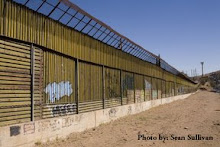
The Center for Biological Diversity has issued the following press release. No Border Wall is in complete agreement, and urges rational members of Congress to reject McCain's amendment to the DHS appropriations bill, along with similar measures in the House, most notably HR 1505.
TUCSON, Ariz.— Under the guise of border security, Sen. John McCain (R-Ariz.) offered an amendment to the Department of Homeland Security appropriations bill today that would grant border-enforcement agencies free rein on federal lands within 300 miles of the U.S.-Mexico border. After criticism from colleagues in his own party that the 300-mile limit went far beyond the scope of border-enforcement activities, McCain scaled it back to 100 miles, and the amendment was added to the bill.
“Politicians are playing games with important border-security legislation at the expense of laws that protect clean air, water and endangered species,” said Randy Serraglio, a conservation advocate at the Center for Biological Diversity. “This amendment is unnecessary, unwanted and threatens significant harm to the wildlife, natural landscapes and people of the border region.”
The McCain amendment introduced today, similar to a bill proposed earlier this year by McCain and Sen. Jon Kyl (R-Ariz.), does not specifically name any laws, but its guarantee of unfettered access for border-enforcement agencies on federal lands effectively neutralizes protections afforded by the Endangered Species Act, Clean Air Act and Clean Water Act. Existing law permits essential border-security activities even in designated wilderness areas, and an existing memorandum of understanding between Homeland Security and the Department of the Interior provides for cooperation between land managers and border agencies.
“Despite repeated statements and congressional testimony from border-security agencies that they neither want nor need the authority granted in this amendment, radical anti-environment forces in Congress continue to push this hoax on the American people,” said Serraglio. “The losers in this game will be jaguars, ocelots, Sonoran pronghorn and residents of border communities that will no longer benefit from fundamental protections that allow them to live and thrive in a healthy environment.”
The nonpartisan Government Accountability Office concluded in a recent report that access to federal lands has not been limited in 22 of 26 sectors along the border, and that the only problems that have occurred in other sectors have been “minor delays.” Meanwhile, between 8,000 and 20,000 miles of wildcat roads have been blazed through a wilderness area in southern Arizona’s Cabeza Prieta National Wildlife Refuge, a majority of which, in recent years, has been caused by enforcement activities, according to a July report by the U.S. Fish and Wildlife Service.
“This amendment pretends to address a problem that does not exist,” said Serraglio. “Clearly, access to federal lands for border-security personnel is not a significant issue in achieving operational control of the border. At best, the McCain amendment is a case of political grandstanding.”
“The false premise inherent in this proposal is that border security and a healthy environment are somehow mutually exclusive,” said Serraglio. “The truth is just the opposite. It has been shown time and again that collaboration between land managers and security agencies enhances both border security and protection of the diverse and vibrant landscapes of the borderlands.”
http://www.biologicaldiversity.org/news/press_releases/2011/border-security-09-14-2011.html
Showing posts with label McCain. Show all posts
Showing posts with label McCain. Show all posts
Wednesday, September 14, 2011


Thursday, June 3, 2010
Trading on Fear in an Election Year: Using the Spillover Myth to Build Border Walls and Score Votes
By Scott Nicol
On May 25, President Obama announced that he would deploy up to 1,200 National Guard troops to the US-Mexico border. This followed a White House meeting with Congressional Republicans aimed at attracting support for, or at least blunting opposition to, comprehensive immigration reform legislation. With mid-term elections on the horizon, conservative members of Congress have turned their attention to the border. Or, more precisely, to walling it off. In May two bills and one amendment aimed at building more border walls were introduced. One failed, but the other two are still pending.
On Cinco de Mayo Senator Jim DeMint announced that he would reintroduce his “Finish the Fence” amendment. It would change the Secure Fence Act to say that, “Fencing that does not effectively restrain pedestrian traffic (such as vehicle barriers and virtual fencing) may not be used to meet the 700-mile fence requirement.” As of April 2010, DHS reports that it has completed 347 miles of “pedestrian fence”, meant to stop people on foot, and 299 miles of “vehicle barriers.” If DeMint’s amendment makes it into law an additional 353 miles of “pedestrian fence” will be built along the border.

On May 25, President Obama announced that he would deploy up to 1,200 National Guard troops to the US-Mexico border. This followed a White House meeting with Congressional Republicans aimed at attracting support for, or at least blunting opposition to, comprehensive immigration reform legislation. With mid-term elections on the horizon, conservative members of Congress have turned their attention to the border. Or, more precisely, to walling it off. In May two bills and one amendment aimed at building more border walls were introduced. One failed, but the other two are still pending.
On Cinco de Mayo Senator Jim DeMint announced that he would reintroduce his “Finish the Fence” amendment. It would change the Secure Fence Act to say that, “Fencing that does not effectively restrain pedestrian traffic (such as vehicle barriers and virtual fencing) may not be used to meet the 700-mile fence requirement.” As of April 2010, DHS reports that it has completed 347 miles of “pedestrian fence”, meant to stop people on foot, and 299 miles of “vehicle barriers.” If DeMint’s amendment makes it into law an additional 353 miles of “pedestrian fence” will be built along the border.
"Pedestrian fence" south of San Diego, California. Photo courtesy Jay Johnson Castro.
When DeMint proposed this amendment last July, the Senate voted 54 to 44 to include it in the Department of Homeland Security’s annual appropriations bill. The House version of the bill did not contain a matching provision, and Representative Ciro Rodriguez, who, unlike DeMint, represents a district encompassing part of the border, was able to remove it during the House/Senate conference committee.
This time around DeMint attempted to attach his amendment to Financial Reform legislation. Seeing that this had nothing to do with financial reform (in fact, at roughly $7.5 million per mile DeMint’s new walls would cost taxpayers $2,647,500,000) DeMint’s amendment was not adopted. Following this failure DeMint tried to attach it to a bill funding the wars in Iraq and Afghanistan. That attempt also fell short (though just barely), but he will almost certainly try again between now and the November elections.
Even more extreme than DeMint’s amendment is Representative Todd Tiahrt’s Secure the Border Act, which requires continuous double-layered border walls along the entire 2,000 mile long border, from the Pacific Ocean to the Gulf of Mexico. Tiahrt made no attempt to explain how the monumental expense of his legislation would benefit his Kansas constituents, who already have Oklahoma and Texas acting as buffers between them and Mexico.
Instead, Tiahrt proudly proclaimed that the Federation for American Immigration Reform (FAIR) and NumbersUSA support his bill. FAIR has earned a place on the Southern Poverty Law Center’s list of hate groups. They received $1.2 million from the Pioneer Fund, an organization founded to promote eugenics and foster policies of “racial betterment.” NumbersUSA has also been denounced by the Southern Poverty Law Center for its ties to nativist and racist organizations. FAIR president Dan Stein and NumbersUSA president Roy Beck both formerly edited the white nationalist publication The Social Contract. One would expect Congressman Tiahrt to avoid their endorsements, not embrace them.

Border Wall construction in El Paso, Texas. Customs and Border Protection photo.
When he announced his bill Tiahrt neglected to mention that before his election to the House of Representatives he was employed by Boeing, where he worked on a number of government contracts. His old boss has not forgotten him; in 2009-2010 Boeing was Tiahrt’s biggest campaign contributor. Boeing is in turn one of the largest recipients of contracts for the Secure Border Initiative (SBI), which includes both solid border walls and virtual fences. To date, Boeing has received 13 task orders for SBI, totaling $1.2 billion.
Representative Tiahrt is currently running for the U.S. Senate. Senate races are expensive, and a successful candidate needs publicity to energize voters. Boeing has consistently provided him with campaign cash, and NumbersUSA and FAIR make regular appearances on FOX news, where they defend anti-immigrant legislation and promote favorite legislators such as Tiahrt.
Not to be left out, Senators John McCain and Jon Kyl rolled out a “10-Point Border Security Plan”, along with accompanying legislation. Their bill would “construct double- and triple-layer fencing” throughout Arizona. McCain also released a campaign commercial in which he and Pinal County Sheriff Paul Babeu walk alongside the border wall and discuss McCain’s border scheme.
“The plan is perfect,” Sheriff Babeu intones.
“Then complete the danged fence,” McCain responds, with the domain CompleteTheDangedFence.com on the screen below him.
Those who try to visit the website are redirected to JohnMcCain.com, where they can purchase McCain t-shirts or donate to his reelection campaign.
McCain is in a tough primary fight with JD Hayworth, who has been attacking McCain for his prior willingness to support immigration reform. Before Hayworth threatened to unseat him, McCain told Vanity Fair, "I think the fence is least effective. But I'll build the g--damned fence if they want it." The possibility of losing the election has caused the Senator to embrace the border wall that he once dismissed.
Sheriff Babeu seems like an odd choice to accompany McCain alongside the Nogales border wall. Babeu’s jurisdiction is 115 miles north of Nogales, and does not include any of the border that McCain advocates walling off. Why not consult an actual border sheriff about his border security plan?
Because those who work on the border might give an honest answer, instead of reading McCain’s cue cards. If he were to ask Nogales Assistant Police Chief Roy Bermudez, for example, the response might mirror Bermudez’ statement earlier this month, when he said, "We have not, thank God, witnessed any spillover violence from Mexico.”
Clarence Dupnik, Sheriff of neighboring Pima County, which also includes a long stretch of the US-Mexico border, said at that time, "This is a media-created event. I hear politicians on TV saying the border has gotten worse. Well, the fact of the matter is that the border has never been more secure."
In fact, according to FBI statistics, crime rates in Arizona border towns, including Nogales, have remained flat for the past decade. There has been no increase in violence as a result of “spillover” from Mexico. There was also no decrease in crime following the erection of border walls and the hiring of thousands of Border Patrol agents. FBI statistics show that the same is true for U.S. cities all along the border, from San Diego to El Paso to Brownsville.
Contrast what the FBI says with statements by DeMint, who said, “Drug trafficking, human trafficking, gang activity and other crimes are raging in American cities near the border.” Or McCain, who opens his campaign spot by listing, “Drug and human smuggling, home invasions, murder…” as justifications for sending in the National Guard and building more “danged fence.”
Politicians and law enforcement seem to be looking at two completely different borders.
In fact, they are looking at completely different numbers. The numbers that DeMint, Tiahrt, and McCain are interested in are votes, not FBI crime statistics. Facts about the border do not matter; voters’ beliefs, no matter how divorced from reality, do. As Senator McCain indicated during his earlier, pre-campaign Vanity Fair interview, building walls and sending troops to the border are political gestures meant to get votes, not solutions to any real problem.
Just as in McCain’s commercial, for politicians the border wall is simply a prop, a stage set upon which they can project an illusion of strength and security for an audience of voters who will never see the actual border. They are looking at voters who live far from the border, who can be told that “spillover” violence poses an existential threat to the United States, and only they (certainly not their election opponents!) can protect the nation. Those of us who live on the actual border, and live with the land condemnations, the suspension of laws, and the environmental damage that accompany actual border walls, see it very differently.
Subscribe to:
Posts (Atom)