Sunday, January 13, 2013
Broken Promises and Border Walls Push Jaguarundi to the Brink
Wednesday, April 18, 2012
National Park Service Retirees Oppose HR 1505
The Coalition of National Park Service Retirees immediately issued a press release, stating their opposition to a bill that would do tremendous harm to national parks and other protected lands:
NPS RETIREES: 54 NATIONAL PARK AREAS JEOPARDIZED UNDER BOGUS “NATIONAL SECURITY” BILL ADVANCING IN U.S. HOUSE
Among National Parks Threatened With Unrestricted Construction and Road Building: Olympic, Glacier, Voyageurs, Isle Royale, Big Bend, Joshua Tree, Acadia and Saguaro; Sites in AK, AZ, CA, ME, MI, MN, MT, NM, ND, OH, TX and WA Seen As At Risk.
WASHINGTON, D.C. – April 18, 2012 -- Legislation pending in the U.S. House of Representatives that is being falsely touted as improving U.S. border security would instead “have the potential to devastate 54 of America’s national parks, historic sites, national monuments and other popular park icons and negatively impact the nation’s economy,” according to a warning issued today by the Coalition of National Park Service Retirees (CNPSR). H.R. 1505, the mistitled “National Security and Federal Lands Protection Act,” would gut a century’s worth of proven federal lands protection, potentially opening up millions of pristine acres of national parks to off-road vehicle use, road construction, air strips and helipads, fencing, base installations, and other disruptions.
This radical legislation introduced by Rep. Rob Bishop (R-UT) would suspend the enforcement of almost all the nation’s environmental laws on all lands under the jurisdiction of the Departments of the Interior and Agriculture within 100 miles of the northern border with Canada and the southern border with Mexico. It would change the targeted national park and other federal areas into security zones and leave priceless resources unprotected. Such dramatic changes to the integrity of our national parks and forests would almost certainly damage local economies, which have evolved to depend on the tourism, jobs, and related economic benefits generated by these national assets. Why would families seeking the natural and cultural wonders and transformative outdoor experiences of our national parks choose to visit such Border Patrol-controlled areas criss-crossed by new roads, penetrated by noisy all-terrain vehicles, and dominated by tactical infrastructure?
Among the National Park Service areas that fall within H.R. 1505’s proposed 100-mile zone of potential devastation are Acadia, Big Bend, Carlsbad Caverns, Cuyahoga Valley, Glacier, Glacier Bay National Park and Preserve, Guadalupe Mountains, Isle Royale, Joshua Tree, North Cascades, Olympic, Saguaro, Theodore Roosevelt, Voyageurs, and Wrangell-St. Elias National Park and Preserve. The combined total acreage of these 15 parks is 21,657,399, nearly 25 percent of the overall footprint U.S. National Park System. They are located within the states of Alaska, Arizona, California, Maine, Michigan, Minnesota, Montana, New Mexico, North Dakota, Ohio, Texas, and Washington.
CNPSR Chair Maureen Finnerty said: “This legislative proposal is perhaps the most direct assault on national parks ever to be advanced at any level in any Congress in U.S. history. It threatens to literally stop all enforcement of several landmark environmental and conservation laws that NPS uses to manage and protect the National Park System and to serve millions of park visitors. The outrage here is that national parks and other U.S. crown jewels could end up being trashed in the name of achieving national security gains that are fictitious.”
Among the 36 laws that would be expressly suspended within 100 miles of the borders with Canada and Mexico are virtually all environmental, historic preservation, wildlife, pollution, and tribal protection laws, including the National Park Service Organic Act, 1916 (the act that requires park areas to be managed for conservation and enjoyment so as to leave them unimpaired); the Wilderness Act, 1964; the National Environmental Policy Act, 1969; the National Historic Preservation Act, 1966; the Endangered Species Act, 1973; the Clean Water and Clean Air Acts; the Archeological Resources Protection Act, 1979. All these laws are critically important to maintaining the integrity of America’s national parks.
H.R. 1505’s remaining provisions are no less extreme. For example, the bill independently provides “immediate access” to U.S. Customs and Border Patrol for road, equipment, and infrastructure construction and motorized vehicle use on national parks and all the other lands under the jurisdiction of both the Secretary of Agriculture, home of the U.S. Forest Service, and the Secretary of the Interior, home of the National Park Service, the U.S. Fish and Wildlife Service, and the Bureau of Land Management. In addition, the bill prohibits these Secretaries from “impeding, prohibiting or restricting activities of the U.S. Customs and Border Patrol” on national parks or any of the other lands. Thus, even without the cynical waiver of virtually all environmental laws within 100 miles of the northern and southern borders, this bill achieves essentially the same result, and applies throughout the entire United States, through its remaining provisions.
Furthermore, in light of the interagency collaboration and achievements made under existing authorities, this harmful legislation is not needed. Homeland Security Secretary Janet Napolitano testified on March 8, 2012, that the bill “is unnecessary, and it’s bad policy.” And officials from the U.S. Border Patrol testified against the bill in Congress on July 8, 2011, explaining that “U.S. Customs and Border Protection (CBP) enjoys a close working relationship with the Department of Interior (DOI) and Department of Agriculture (USDA) that allows us to fulfill our border enforcement responsibilities while respecting and enhancing the environment. We respect the missions of these agencies, and we recognize the importance of preserving the American landscape. Our agencies have formed a number of agreements that allow us to carry out both of these missions. CBP believes that efforts to reduce the number of illegal aliens crossing the border have lessened environmental degradation and have assisted with recovery of damaged resources, and we are fully committed to continuing our cooperative relationships with DOI and USDA to further this good work.” See the testimony online at http://www.dhs.gov/ynews/testimony/20110708-cbp-national-security-federal-lands-protection-act.shtm.
H.R. 1505 is only one of several pending bills that similarly threaten national parks and other park, refuge, and wilderness lands under the jurisdiction of the Secretaries of the Interior and Agriculture in the name of border security. For example, Senators McCain (R-AZ) and Kyl (R-AZ) and Representative Quayle (R-AZ) are sponsoring amendments to the authorization legislation for the Department of Homeland Security that would have also have devastating impacts on national parks and other Federally protected lands and are unwarranted for national security.
CNPSR’s Finnerty pointed out that “while the other bills do not have the express waiver of virtually all environmental laws like H.R. 1505, they accomplish essentially the same result by allowing the Border Patrol to make decisions on activities like motorized patrol and construction of roads and infrastructure in national park and other conservation areas. It may be that these bills are too radical for Congress to pass or the President to sign as stand-alone bills, thus making it the far greater danger that Congress will tack the park-wrecking provisions onto another must-sign piece of legislation, like an appropriations bill. All these bills are terrible policy, unnecessary for national security, and must be stopped.”
ABOUT CNPSR
The more than 800 members of the Coalition of National Park Service Retirees are all former employees of the National Park Service with a combined over 24,000 years of stewardship of America’ most precious natural and cultural resources. In their personal lives, CNPSR members reflect the broad spectrum of political affiliations. CNPSR members now strive to apply their credibility and integrity as they speak out for national park solutions that uphold law and apply sound science. The Coalition counts among its members: former National Park Service leaders at the national, regional, and park levels, park rangers, and other career professionals who devoted an average of nearly 30 years each to protecting and interpreting America’s national parks on behalf of the public. For more information, visit the CNPSR Web site at http://www.npsretirees.org.
Wednesday, September 14, 2011
Congressional Push Continues to Gut Environmental Protections Along U.S. Borders
TUCSON, Ariz.— Under the guise of border security, Sen. John McCain (R-Ariz.) offered an amendment to the Department of Homeland Security appropriations bill today that would grant border-enforcement agencies free rein on federal lands within 300 miles of the U.S.-Mexico border. After criticism from colleagues in his own party that the 300-mile limit went far beyond the scope of border-enforcement activities, McCain scaled it back to 100 miles, and the amendment was added to the bill.
“Politicians are playing games with important border-security legislation at the expense of laws that protect clean air, water and endangered species,” said Randy Serraglio, a conservation advocate at the Center for Biological Diversity. “This amendment is unnecessary, unwanted and threatens significant harm to the wildlife, natural landscapes and people of the border region.”
The McCain amendment introduced today, similar to a bill proposed earlier this year by McCain and Sen. Jon Kyl (R-Ariz.), does not specifically name any laws, but its guarantee of unfettered access for border-enforcement agencies on federal lands effectively neutralizes protections afforded by the Endangered Species Act, Clean Air Act and Clean Water Act. Existing law permits essential border-security activities even in designated wilderness areas, and an existing memorandum of understanding between Homeland Security and the Department of the Interior provides for cooperation between land managers and border agencies.
“Despite repeated statements and congressional testimony from border-security agencies that they neither want nor need the authority granted in this amendment, radical anti-environment forces in Congress continue to push this hoax on the American people,” said Serraglio. “The losers in this game will be jaguars, ocelots, Sonoran pronghorn and residents of border communities that will no longer benefit from fundamental protections that allow them to live and thrive in a healthy environment.”
The nonpartisan Government Accountability Office concluded in a recent report that access to federal lands has not been limited in 22 of 26 sectors along the border, and that the only problems that have occurred in other sectors have been “minor delays.” Meanwhile, between 8,000 and 20,000 miles of wildcat roads have been blazed through a wilderness area in southern Arizona’s Cabeza Prieta National Wildlife Refuge, a majority of which, in recent years, has been caused by enforcement activities, according to a July report by the U.S. Fish and Wildlife Service.
“This amendment pretends to address a problem that does not exist,” said Serraglio. “Clearly, access to federal lands for border-security personnel is not a significant issue in achieving operational control of the border. At best, the McCain amendment is a case of political grandstanding.”
“The false premise inherent in this proposal is that border security and a healthy environment are somehow mutually exclusive,” said Serraglio. “The truth is just the opposite. It has been shown time and again that collaboration between land managers and security agencies enhances both border security and protection of the diverse and vibrant landscapes of the borderlands.”
http://www.biologicaldiversity.org/news/press_releases/2011/border-security-09-14-2011.html
Thursday, August 5, 2010
Destroying the Borderlands to Secure the Border
Time to call in the troops and wall off the border.
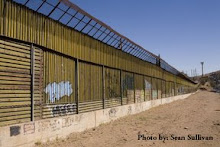
The first 14 miles of border wall, extending from the Pacific Ocean inland, were built of rusting steel helicopter landing mats left over from the Vietnam War crudely welded together. A second layer, 15-feet tall and made of steel mesh, was later added north of the first wall. In the no-man’s-land between these two walls was a graded road for Border Patrol vehicles, with towers for surveillance cameras and stadium lights.
The landing mat border wall entering the ocean between San Diego and Tijuana.
In 2004 the California Coastal Commission and environmental groups, including the Sierra Club, sued to stop the Border Patrol’s plan to plug several canyons in order to create a level path for the border wall. The court found that the Border Patrol was in violation of federal environmental laws and that such a fill project would have a devastating impact on the Tijuana Estuary. The judge ordered that construction be halted.
In order to override the court’s decision, a provision was inserted into the Real ID Act of 2005 giving the unprecedented power to the US Attorney General (later transferred to the Secretary of Homeland Security) to waive all federal, state, and local laws, environmental and otherwise, to build border walls. Former Secretary of Homeland Security Michael Chertoff used the Real ID Act to brush aside the laws that had stopped the border wall, and resumed construction. In waiving those laws he was admitting that border wall construction would violate them.
A few hundred feet from the border wall’s starting point in the Pacific, the Tijuana River Estuary spills into the sea. It is the largest of Southern California’s remaining salt marshes, where over 90% of wetland habitat has been lost to development. The combined Tijuana River Slough National Wildlife Refuge, Tijuana River National Estuarine Research Reserve and Border Field State Park protect sand dunes and beaches, vernal pools, tidal channels, mudflats and coastal sage scrub. During the wet winter season, water drains into the marsh from the Tijuana River and surrounding creeks and canyons, infusing the marsh with fresh water and creating a delicate balance on which its many highly sensitive habitats depend. The site is a key stopover point on the Pacific Flyway, and provides over 370 species of migratory and native birds, including six endangered species, with essential breeding, feeding and nesting grounds.
Following the passage of the Real ID Act the canyon known as Smuggler’s Gulch, south of San Diego, was filled in with over 2 million cubic yards of earth that had been ripped from adjacent mountaintops. A border wall was then perched on top. With no regulations in place and no oversight by other agencies, the Department of Homeland Security (DHS) put little effort into erosion control, and the still bare slopes of the earthen dam threaten to wash tremendous amounts of dirt into the Tijuana River National Estuarine Research Reserve, which is only 600 feet away. In addition to smothering vegetation, burying the estuary in sediment may raise its surface level enough to disrupt the twice-daily inundation of sea water upon which its fragile ecosystem depends.
A few miles up the Tijuana River, the Otay Mountain region is home to the last surviving stands of Tecate cypress, an ice age tree that survives by absorbing coastal moisture from the air. This tree in turn is the host plant for the rare Thorne’s hairstreak butterfly. In an attempt to protect these and other rare and endangered species that inhabit this unique ecosystem, 18,500 acres of the Otay Mountain region were designated a National Wilderness Area.

Border wall in the Otay Mountain Wilderness Area, California
When the Environmental Protection Agency reviewed the plan to build this section of border wall, they expressed concern that plans to fill in canyons and waterways that feed into the Tijuana River would violate the Clean Water Act. The Department of the Interior warned that 6 endangered species would also be harmed by the wall.San Diego Sector Border Patrol spokesman Richard Kite said in 2006, "At the mountain range, you simply don't need a fence. It's such harsh terrain it's difficult to walk, let alone drive. There's no reason to disrupt the land when the land itself is a physical barrier."
Ignoring his observation, DHS decided to “disrupt the land” of the Otay Mountain Wilderness Area with a border wall and an access road. The rugged terrain of the Wilderness Area necessitated the blasting and removal of 530,000 cubic yards of rock and extensive grading and leveling. The Otay Mountain Wilderness Area is so steep that the goal of blasting was to achieve an elevation grade of 15%, even though the Secure Fence Act states that if the elevation grade of an area exceeds 10% walls do not need to be constructed there. Border wall construction caused tremendous erosion, and involved cutting down more than 100 Tecate cypress trees.
Because this is clearly incompatible with a wilderness designation, the goal of which was to limit human activity and protect fragile ecosystems, the Otay Mountain Wilderness Act was among the 36 laws that former Homeland Security Secretary Chertoff suspended using the Real ID Act. He also swept aside the Clean Water Act and the Endangered Species Act, rather than listen to the concerns of the Environmental Protection Agency and the Department of the Interior. With the wilderness no longer protected by law, DHS blasted through it and built the border wall. The Otay Mountain Wilderness Area now suffers from a barren scar and erosion that will bleed sediment into the Tijuana River for years to come.
Unchecked by environmental protections, the walls that began in California’s borderlands now extend over 600 miles, inflicting tremendous damage upon many sensitive ecosystems. In Arizona the border walls that cross washes and streams in the Organ Pipe Cactus National Monument have caused severe erosion and flooding. Border walls built in New Mexico’s Playas Valley block the movement of one of the last wild herds of bison, whose range straddles the U.S. – Mexico border. In Texas the walls that slice through the Lower Rio Grande Valley National Wildlife Refuge have fragmented habitat that is critical for the survival of endangered ocelots.
Border wall in the Lower Rio Grande Valley National Wildlife Refuge in Texas.
Environmental organizations, including the Sierra Club, Defenders of Wildlife, and many others, have attempted to protect fragile border ecosystems from DHS’ lawless actions. They have challenged the constitutionality for the Real ID Act’s waiver provision in court, and have worked to educate Congress and the public about the wall’s environmental impacts. The Sierra Club has also produced a short documentary, Wild vs. Wall, that gives an overview of the border wall’s environmental impacts from the Pacific to the Gulf of Mexico.
Even the Department of Homeland Security admits that border walls have negative impacts on border ecosystems, though they consistently underestimate the extent of the damage. In Environmental Stewardship Plans prepared ahead of construction, DHS identified the purchase of equivalent replacement lands as the most practical way to make up for the many thousands of acres of land that walls would tear through. Setting aside the question of where one would find replacement land comparable to a mountainous wilderness area, Congress allocated some of the necessary funds in 2008 and 2009. The Department of Homeland Security has yet to provide the Department of the Interior with those funds, and not a single acre of replacement land has been bought.
The Department of Homeland Security’s dismissive attitude towards environmental laws and border ecosystems is a direct reflection of that of some politicians, who whip up hysteria about “broken borders” and are openly hostile towards environmental protections. Chief among them has been Utah Representative Rob Bishop, who has repeatedly called the idea that DHS should pay to fix some small portion of the damage that it has done “extortion”, and has worked to keep mitigation funds from reaching the Department of the Interior.
Bishop recently said, "If wilderness designation gets in the way of a secure southern border, I want the designation changed. If it means you lose a couple of acres of wilderness, I don't think God will blame us at the judgment bar for doing that."
In 1968 an unnamed Army major justified the bombing of the Vietnamese provincial capital of Ben Tre by stating coldly, “It became necessary to destroy the town to save it.” The same Orwellian logic seems to animate Representative Bishop, and some of his colleagues, when they look at the U.S.-Mexico border. Blinded by the myth that the border is a war zone, they ignore inconvenient facts like the low crime rates in the border cities of San Diego, El Paso, and Brownsville, and call for a scorched earth campaign to stop the imagined invasion. They fail to see the hypocrisy in setting aside all of our nation’s laws to stop those whom they call “illegals”. They are destroying the borderlands to “secure” the border.
The Sierra Club documentary Wild vs. Wall can be viewed at sierraclub.org/borderlands .
Tuesday, June 16, 2009
Supreme Court Fails to Restore the Rule of Law to the Border
Section 102 of the Real ID Act allows for the suspension of all laws to build the border wall, stating, “Notwithstanding any other provision of law, the Secretary of Homeland Security shall have the authority to waive all legal requirements such Secretary, in such Secretary’s sole discretion, determines necessary to ensure expeditious construction of the barriers and roads under this section.” No other United States citizen is granted this extreme power under any circumstance. Even the president does not have this power to waive our nation’s laws, no matter what crisis may arise.
When former Homeland Security Secretary Chertoff waived 36 federal laws in April 2008, he knew that in building border walls he would be violating those laws. Obeying the law is not voluntary, it is mandatory. In a nation of laws all laws must be respected, not just those that are convenient. Those laws were enacted to prevent the kind of damage that we see everywhere border walls have been built.
For plaintiffs such as the Frontera Audubon Society, the Friends of the Wildlife Corridor, and the Friends of Laguna Atascosa National Wildlife Refuge, the fate of the Lower Rio Grande Valley National Wildlife Refuge is of particular concern. Consisting of individual tracts of native habitat linked by the Rio Grande, it creates a wildlife corridor, providing federally endangered species such as the ocelot and jaguarundi sufficient territory to find food, water, and mates. Migratory birds also rely on it to rest and refuel on their annual journeys, as well as for nesting. The border walls that have been built, and those that are still under construction, slice through many refuge tracts and cut off others from the river. The wall is fragmenting habitat, blocking migratory pathways, denying animals access to fresh water, and isolating breeding populations of endangered ocelot and jagurandi. Because the Endangered Species Act, the Migratory Bird Treaty Act, the National Wildlife Refuge System Administration Act, and the National Environmental Policy Act were among the 36 federal laws that the former Secretary swept aside, none of the usual legal protections for these supposedly protected lands remain.
In addition, Texas border communities depend upon the Rio Grande for irrigation and drinking water. But former Homeland Security Secretary Chertoff waived not only the Safe Drinking Water Act and the Clean Water Act, but also “all federal, state, or other laws, regulations and legal requirements of, deriving from, or related to the subject of” those, and 34 other, laws. So where the wall has been built, in El Paso and Eagle Pass and Hidalgo and Brownsville and other border communities that draw water from the Rio Grande, all laws “related to the subject of” water are no longer in effect. This absurd situation prompted the El Paso County Water Improvement District No. 1 and the Hudspeth County Conservation and Reclamation District No. 1 to take part in the challenge to the constitutionality of the Real ID Act’s waiver authority.
Equal protection under the law is meant to be a fundamental right shared by every American, but the Real ID Act makes the legal rights of citizens who live near the border conditional on the whims of an unelected Administration appointee. The Secretary of Homeland Security cannot waive the laws that protect citizens who live away from the border. Only border residents may have their legal protections waived.
When the Supreme Court decided not to hear these arguments without uttering so much as a word as to why, they shirked their duty as the final arbiters of the United States constitution and the principle of the rule of law that it enshrines. This precedent bodes ill for the rest of the nation, as any manufactured crisis may be used to enact a similar waiver. A “broken” northern border may be the pretext for a new bill waiving laws along the Canadian boundary, or an “energy crisis” may provide a convenient excuse to do away with laws that prevent drilling in the Arctic National Wildlife Refuge. The Supreme Court’s inaction will likely have repercussions beyond the destruction wrought by the border wall.
Wednesday, February 11, 2009
Border Wall Threatens Endangered Ocelot Kitten in South Texas: Future Uncertain as Construction Nears Fragile Habitat
BROWNSVILLE , TEXAS —The first ocelot kitten seen in Texas in more than ten years has been photographed at Laguna Atascosa National Wildlife Refuge in Cameron County, Texas. Ocelots were listed under the Endangered Species Act in 1972, and there are believed to be less than 100 left in the United States .
The birth of an ocelot should be a hopeful sign of recovery, but it is marred by the looming onset of border wall construction along the U.S.-Mexico border in Cameron County , which puts this kitten’s future – and the future of the entire Texas ocelot population – in grave jeopardy.
“As we’ve seen with the border walls in California and Arizona , human beings can easily climb over walls with ladders or tunnel under them with a shovel,” said Jim Chapman, chair of the Lower Rio Grande Valley Sierra Club Group. “Ocelots and other wildlife are stopped dead in their tracks.”
Ocelots once lived in dense brush habitat throughout Mexico and the southern U.S., but farms, roads, fences, and housing developments have destroyed and fragmented their habitat along the Rio Grande, pushing populations in the two nations farther apart, and further isolating the Texas cats. Isolation weakens the gene pool and makes the population susceptible to catastrophic declines due to inbreeding or disease.
In 1979 a collaborative effort to bolster the ocelot population of South Texas began by piecing together and rehabilitating tracts of former farmland to create the Lower Rio Grande Valley National Wildlife Refuge. The ribbon of habitat that lines the Rio Grande acts as a wildlife corridor, connecting these refuge tracts to state lands and privately owned parks like Sabal Palm Audubon Sanctuary and The Nature Conservancy’s Lennox Foundation Southmost Preserve. Individually, none of these tracts would be large enough to support a healthy ocelot population, but with the Rio Grande corridor allowing for movement between tracts, and encouraging cross-border movements, it was hoped that their extirpation in the U.S. could be avoided.
The U.S.-Mexico border wall currently under construction will slice through the wildlife corridor, utterly undermining its purpose and decades of hard work and financial investment. The path of the wall follows the Rio Grande through prime riparian habitat, cutting some refuge tracts in two and severing others from the river, which in many places is the only source of fresh water.
Karen Chapman of the Environmental Defense Fund notes that, although the continued urban development of South Texas poses threats to the ocelot, “no other project so completely isolates habitat patches north and south, so completely renders riparian habitat inaccessible or so thoroughly eliminates the potential for future north-south habitat corridors.”
Concrete border walls topped with metal bars are already tearing through the wildlife corridor in neighboring Hidalgo County , upriver from Cameron County ’s refuge tracts. When the combination levee/border wall was proposed for Hidalgo County last year, Deputy Director Kenneth Stansell of the U.S. Fish and Wildlife Service wrote to the Customs and Border Protection agency that “any proposed fence and/or levee segment that bisects lands within the Lower Rio Grande Valley National Wildlife Refuge cannot be found compatible with the purposed for which the Refuge was established.”
With the levee/border walls nearing completion in Hidalgo County ’s refuge tracts, the preservation of the wildlife corridor that remains in Cameron County is even more critical to the ocelots’ survival.
“The last administration swept away dozens of environmental laws to fast-track the construction of an enormously expensive, ineffective border wall,” said Noah Kahn, wildlife refuge program manager for Defenders of Wildlife. “President Obama has made it very clear that he intends to restore scientific integrity to federal actions. We hope that will include steps to reverse or mitigate the damage that the border wall is inflicting on wildlife, habitat and people along our southern border.”
###
Saturday, November 15, 2008
Testimony on the Environmental Impacts of the Border Wall Given to the Texas State Legislature
A number of members of the No Border Wall Coalition spoke at the hearing, addressing the impacts of the wall on agriculture, border communities, and the waiving of laws under the Real ID Act. Martin Hagne, Executive Director of the Valley Nature Center and a founding member of the Coalition, described to the legislators the effects that the walls currently under construction are likely to have on the environment.
Here is his testimony:
Thank you for allowing us the opportunity to testify and to give you further information about the border wall in Texas as designed by the U.S. Department of Homeland Security. My name is Martin Hagne, and I am the Executive Director of the Valley Nature Center in Weslaco, Texas. Today I am representing the No Border Wall Coalition, which was formed in the Lower Rio Grande Valley in May of 2007. And although the No Border Wall Coalition is greatly concerned with all aspects of the border wall, including human rights, immigration, property rights, and economic issues, today my testimony will focus on the impact of the wall to wildlife and the environment.
The border wall is to date the single most detrimental environmental disaster to take place along the Texas Mexico Border in our lifetime. The environmental effects will be far-reaching, long-lasting, and permanent in many areas. There is simply no way to construct such a barrier in such a place without doing irreparable harm to wildlife and the very sensitive habitats along the Rio Grande.
Today I will focus mostly on the Lower Rio Grande, but all areas in Texas slated for the border wall face similarly destructive challenges. Obviously the habitats along such a long border will vary greatly, but the damage will be equally destructive.
Habitat Loss
The easiest issues to describe will be the obvious habitat loss that will occur when the concrete and steel structure is built. As mandated in the Secure Fence Act of 2006, the wall is not just a single wall but two structures spaced apart to facilitate high speed roads between and outside the walls. This in itself will clear a wide swath of habitat up to 350 feet. Granted that DHS seems to be pursuing a single layer wall at this time, but the Act still stipulates the double layered version and still shows such on the "books." We must, therefore, be aware of this and act accordingly.
The thin layer of riparian forest that still exists along the Rio Grande, is often only 100 feet wide or less. Agricultural land has crept up all the way to the rivers edge in many places. The riparian forest made up of tall woody species such as Anacua, Texas Ebony, Rio Grande Hackberry, and Mexican Ash has been slipping away due to clearing for human use, and much of what little is left has been altered due to the river being dammed in 1957 by Falcon Dam. The dams and reservoirs that make the Valley flood-free and inhabitable for humans have also stopped the seasonal flooding which keeps the riparian forests alive. Each year floods would inundate the lowlands of the Rio Grande and keep such ecosystems thriving. Flood control is altering these precious forests into drier thorn forests.
For over 30 years efforts have been made to reclaim some of the lost habitat along the river and to create a Wildlife Corridor. US Fish & Wildlife, along with many other groups, such as Texas Parks & Wildlife, The Nature Conservancy, and Audubon Society, to name a few, have been working hard to purchase old farmland and to re-vegetate them back into a natural state of riparian forest. So far over $70 million has been spent of mostly federal funds to purchase land, and about $30 million has been used to plant native plants on these tracts. Tens of thousands of school children have taken part in these planting efforts! Now we are faced with all that work and taxpayer's money being bulldozed.
It has been argued by proponents of the wall that such small areas needing to be cleared are insignificant and that birds can fly over any structure that is put in their path. While it is true that birds can find water by flying a distance, mammals and reptiles will not be able to travel over such a structure. It has also been said that birds can leave an area and adapt to another habitat.
But there are bird species that rely on certain habitats that can't adapt fast enough if their present homes are removed. These are species that live and nest in this riparian habitat that is almost gone and that has little left of its original make-up. These same species are not found north of the Rio Grande Valley, and many are just found along the actual Rio Grande itself. These birds are limited to the riparian remnants along the river.
In these tall, Spanish moss-draped forests we find such bird species as Gray Hawk, Tropical Parula, Clay-colored Robin, Northern Beardless-Tyrannulet, Brown Jay, Muscovy Duck, Common Black-Hawk, and Red-billed Pigeon. These birds rely on the riparian forest along the river, and many rarely stray inland. These birds do rarely if ever utilize other habitats and could therefore be extirpated from Texas and the United States.
It has been estimated, using the maps released for this EIS, that over 80% of USF&W refuge property will be affected along the Rio Grande in the Lower Rio Grande Valley.
This does not include the several Texas Parks & Wildlife's Wildlife Management Areas and privately owned sanctuaries by such groups as the National Audubon and The Nature Conservancy located along the river that will be affected. The Lower Rio Grande Valley National Refuge alone in the Lower Rio Grande Valley takes into account eleven (11) different biotic communities. This is arguably the most bio-diverse region in the U.S.
Habitat Fragmentation
Equally destructive to wildlife is habitat fragmentation. A few decades ago this was rarely thought of as a problem. Roads were built crisscrossing our nation's wildlife refuges and wildlands. But now biologists know the very real threat of fragmenting any habitat. The edges created invite new species of plants and animals, changing the make-up of the ecosystem, often driving out the original inhabitants.
Not only does fragmentation affect the habitat in question, but it also has far-reaching effects on entire ecosystems. By changing the makeup of one area, it also affects other neighboring habitats and in the long run changes the entire regional ecosystem. This has not been taken into account in any DHS document or "study" released so far.
The other effect the wall will have is separating animals from each other on both sides of the wall. Ground dwelling mammals, reptiles, amphibians, and other wildlife will not be able to cross 16 to 18 foot tall concrete and steel structure. This will leave them not able to reach water, nor roosting and nesting sites.
Species can become genetically flawed by being cut off from neighboring populations, eventually creating a bottle-neck effect in the gene pool. It has been said that the wall can't cut off species from reaching each other because it is an east and west directed wall. This is not true, as DHS maps shows it clearly meanders south and north and doubles back in many places. Most animal species when faced with such an obstacle cannot and will not find ways around it, leaving them confused and stuck in place. This has already been documented in Arizona, where the wall was built through wildlife refuges.
The Wildlife Corridor was designed for just such travel and will now be severely hampered and made ineffective.
Endangered Species
There are 20 species of federally endangered species in this area, as well as many more threatened and endangered species listed by the state of Texas. The border wall will affect many of these species in negative ways through habitat loss, habitat fragmentation, corridor loss, water being cut off, and loss of eco-tourism dollars that positively help habitat restoration efforts.
Two federally endangered wildcat species are barely hanging on in existence within their U.S. range in the Lower Rio Grande Valley: the Ocelot and the Jaguarundi. The corridor is a must for these species to be able to travel to new territories for mates. As the efforts to restore the populations of these cats succeed, new territories need to be found by males to further the populations. Crossing the Rio Grande into Mexico will be a must for these cats. The border wall will cut off their access to such crossings. These cats will not, and cannot, travel long distances to find "openings" in a wall. Their habitats are now too fragmented to allow for this. Without new genetic populations to breed to, the U.S. population will become in-bred, narrowing its lines, until it can no longer get out of a bottleneck in its genetics. USF&W and other organizations such as Environmental Defense have been working with private landowners and ranchers in deep South Texas to create more habitats for these cats, especially the Ocelot. Land corridors for travel north and south are also being pursued, as this is critical for the cats to reach Mexico. The wall in Cameron County will basically stop this project.
The USFW plan for recovery for the Jaguar was already shelved because of the negative impacts the wall will have in Arizona. If the Jaguar cannot freely travel north and south, it has no chance of recovery in the U.S., leaving the program totally ineffective.
The Wildlife Corridor in the Lower Rio Grande Valley is also a must for other species in peril of extirpation. Long-tailed Weasels, the Mexican sub-species of American Beaver, and others, live in the riparian areas along the Rio Grande. These species, as well as the hundreds of others, must be taken into account.
Wetland Loss and Water Quality Issues
Critical wetlands along the wall will be affected, many of which are ephemeral (drying out during dry seasons). Due to flood control measures, the area in question has lost much of the seasonal wetlands that used to exist. Any and all wetlands removed or negatively affected therefore have an even higher negative impact to area wildlife.
The fact that many of these wetlands are seasonal makes it even harder to identify them, therefore making it easy for DHS to say none existed.
With the removal of any wetlands comes degraded water quality. Wetlands act as natural water cleansers as the water filters though wetland aquatic vegetation. Farm chemicals and other harmful runoff from city lawns and streets have no natural filtration system before reaching the Rio Grande.
Flooding is also negated by natural wetlands. Ponds and marshes slow the rain waters and collect large amounts of flood water.
Flood Levee System and Wall Combo
Last year FEMA announced that the flood levees which are built, maintained and operated by the federal agency IBWC, were not high enough to protect the area from a major hurricane. The area would no longer be certified and, therefore, insurance would go up or be unattainable. Industry would pull out and many other issues would arise. Although this should be a federal issue and fixed by federal dollars and agencies, it has now become a County project. Hidalgo County was "frightened" into signing a deal with DHS to receive some federal funds and then use County bond funds to repair the levees. But under one condition: that the face of the levee be an 18 foot sheer concrete wall that would also act as a border wall.
This scenario has many flaws. First, the County should not have to pay for such repairs. Second, the 22 miles of sections repaired are only in the areas where DHS wanted a wall in the first place, leaving unrepaired gaps in the flood control system. This does nothing for making the system FEMA approved again. Thirdly, cutting into the side of the existing levees during hurricane season is nothing short of asking for a disaster. Fourthly, fixing the levees on the U.S. side at this time will endanger hundreds of thousands of lives on the Mexican side of the border if levees are not simultaneously repaired in Mexico.
And lastly, this levee/wall combo has been touted as a win-win for the environment. Although the levee/wall combo might affect certain areas less as far as habitat removal, it will only slightly improve on that situation. But what it will do is become a solid 18 foot wall of concrete which is totally impenetrable to wildlife. There will be effectively no movement over, under or around this wall. No animal, besides a bird, could get over such a structure. It is less wildlife friendly than the originally designed wall.
Environmental Law and Justice
The Real Id Act of 2005 was passed to give the Minster of Homeland Security broad sweeping powers to secure the nation. It, unprecedented, gave Michael Chertoff powers to waive any and all U.S. laws to build the wall. This was not a well known law by lawmakers and many voted on this passage without knowing enough about it.
This year alone DHS has waived 36 federal and state laws ranging from the Clean Water Act to the Endangered Species Act. Such powers have only if ever been enacted during acts of war towards the United States.
Environmental organizations as well as individuals have tried to sue DHS to stop the wall, to retain their property and not allow the government to take it, but all legal action is made void due to the Real ID Act. The people of the United States have no legal recourse.
The Texas Park & Wildlife Department has already lost land on their Las Palomas Wildlife Management Tracts. A levee/wall combination is dissecting properties owned by TPW and USFW in an area that was before only dissected by a dirt levee which was traversable by wildlife.
The same Act also has rendered the National Environmental Policy Act (NEPA) void and, therefore, no Environmental Impact Studies (EIS) were needed to be performed. DHS started the NEPA process and eventually did release an EIS document. This 600 some page document was nothing more than a glorious work of copied material taken out of a dictionary. The studies for such an elaborate project should have taken over two years, but instead the document was published in months! Environmental studies on wildlife migration, daily usage, breeding and nesting sites, plant surveys, use during inclement weather, and many other such long-term studies could not be produced in months. The document was the worst example of government bullying.
The Real ID Act must be repealed!
The "fact" being put forth by DHS and BP representatives that a border wall is less environmentally intrusive than the "trash and human waste" left by immigrants is truly such a far-fetched illusion that we cannot believe it has even been brought up! A habitat left with trash and waste is far better than a habitat void of plants. Plants make the habitat. An area with native plants gives life whether it is degraded with trash or not. Trash can be removed, while permanent environmental damage by clear-cutting cannot! These are such simple facts that it is unbelievable that any government agency would state otherwise!
An animal living in the Rio Grande Valley within a riparian area is not one that is much impacted by trash and human waste. Such a statement shows ignorance and lack of understanding of the area's fauna and flora, this fact further showing the true need for a broader and much more thorough EIS. We are not talking about whales swallowing plastic bags. Ocelots do not eat trash! On the other hand, if you remove any habitat from the area which is already in such short supply, you are likely to lose species.
To compare the need for a border wall for national security to the needs of conserving a lizard, as DHS spokespersons have done, we can only say that if DHS believes this wall will only impact one lizard, a complete and broader EIS would show just how wrong such a statement is.
Environmental Economic Issues
Many areas along the Texas-Mexico border have prime natural areas. The Big Bend area in West Texas has tens of thousands of wild areas, river canoe excursions and hiking opportunities.
The Lower Rio Grande Valley is the top bird watching and nature watching destination in the U.S. The Valley is considered the most biologically diverse area within the U.S. 517 bird species have been recorded in this small area. That is more than all other state totals besides Texas, California, Arizona and New Mexico. Native plant species number at least 1,100, but if all forbs and grasses were counted, these numbers could easily be closer to 3,000. Over 340 species of butterflies are found here, as well as over 120 species of odonates. There are 80 some species of mammals, and a higher number of reptiles and amphibians. These numbers are staggering for such a small area.
The wall is not only a disaster to our environment, but also a disaster to the local economy, which embraces eco-tourism as an annual income of $125 million, contributed by some 200,000 nature visitors annually. An ecological impact of the wall is the fact that the bird species that depend on this habitat will disappear! That in itself is truly disturbing. The implication the wall has for humans is not only the loss of nature, but the loss of livelihoods. No bird watcher would want to come see a steel and concrete wall where before a native habitat stood.
Other nations have already figured that out! Below is a note from a bird watcher from Sweden who visited the Valley and Santa Ana NWR last year.
"Thanks very much for sending me information about the horrible plans for the Rio Grande; I am reading it with great interest. I just want to say that it is not only an interior matter but also an international one. It would hit the birding business coming from other countries. I mean, if the nice areas around the Rio Grande would disappear, not many birders from others countries will go to Texas in the future, as well as people from other places in the USA. Hopefully there will be a better solution than destroying a unique fauna." Christer Landgren, Sweden
The State of Texas has invested millions of dollars into the three State Parks in the Lower Rio Garden Valley. The fairly new World Birding Center complex with nine (9) sites is also a partnership with the state. Many of these sites, along with the above mentioned USFW refuges, Audubon Sabal Palms Sanctuary, the TNC Southmost Preserve, the NABA Butterfly Park, and others, will be negatively affected.
The National Audubon Society is presently debating what to do with their flagship sanctuary, Sabal Palms. After the wall goes up it will be walled off, and concerns are many. How will staff have access? Who will have keys? What if a fire breaks loose? Will anyone insure us? Do we dare to allow visitors? etc. None of these questions can be answered by DHS when asked.
National organizations such as NAS and TNC are now faced with possibly giving up decade-old work and investments and pulling up stakes from the Valley, taking with them resources and funds.
With these funds also goes many environmental and science funded programs for local school classes. In a day where children need every opportunity to get outdoors to exercise and learn about nature, we will be forced to lose such precious resources.
Thursday, May 29, 2008
Texas Groups Sue to Force the Department of Homeland Security to Obey Our Nation's Laws
In April DHS Secretary Chertoff announced that he was using his waiver power to ignore 36 federal laws, including the Endangered Species Act, the Migratory Bird Treaty Act, the National Wildlife Refuge System Administration Act, and the National Environmental Policy Act, in order to speed up construction of over 300 miles of border wall. The only reason for Secretary Chertoff to waive these laws is that he knows that the border wall will violate them.The fate of the Lower Rio Grande Valley National Wildlife Refuge system is of particular concern. Consisting of individual tracts of native habitat linked by the Rio Grande, it creates a wildlife corridor, providing endangered species such as the ocelot and jaguarundi sufficient territory to find food, water, and mates. Migratory birds also rely on it to rest and refuel on their annual journeys, as well as for nesting. Maps released by DHS show the border wall slicing through many refuge tracts, and cutting off others from the river. The wall will fragment habitat, block migratory pathways, deny animals access to fresh water, and isolate breeding populations of endangered ocelot and jagurandi.
"It's taken 30 years, $80 million, and back-breaking effort to create an 80,000 acre wildlife corridor along the last 250 miles of the Rio Grande. To put a fence or wall through that is insanity," said Keith Hackland, President of the Friends of the Wildlife Corridor.
“Currently, there are only 80 to 100 wild ocelots remaining in the continental U.S., and they cannot hope to survive without the wildlife corridor and the protection of the Endangered Species Act,” said Shane Wilson, President of the Friends of Laguna Atascosa. “The border wall, as proposed, will ensure that future generations will never witness the spectacular beauty of seeing an ocelot in the wild.”“Further habitat losses in the Valley, which serves as a vital stop over and feeding grounds for hundreds of species of migrating coastal shorebirds, inland waterfowl, and passerines, and nesting habitat for approximately 150 more species, will be catastrophic,” said Wayne Bartholomew, Executive Director of Frontera Audubon.
In their suit, the organizations ask the court to declare section 102 of the Real ID Act unconstitutional and to prevent the Department of Homeland Security from building walls, roads, or other infrastructure on the border that do not fully comply with all of our nation’s environmental laws.
"To instantly dissolve 96 years of environmental laws and protection with a mere wave of the hand is nothing short of monstrous,” said Jim Chapman, Board President of the Frontera Audubon Society. “If laws can be so easily swept aside on the border, the same precedent could be applied anywhere, from the Arctic National Wildlife Refuge to Yellowstone National Park. If our nation’s laws are optional, they aren’t really laws.”
In the April waiver the Department of Homeland Security suspended the following federal laws along the United States' southern border:
The National Environmental Policy Act
The Endangered Species Act
The Federal Water Pollution Control Act (commonly referred to as the Clean Water Act)
The National Historic Preservation Act
The Migratory Bird Treaty Act
The Clean Air Act
The Archeological Resources Protection Act
The Safe Drinking Water Act
The Noise Control Act
The Solid Waste Disposal Act, as amended by the Resource Conservation and Recovery Act
The Comprehensive Environmental Response, Compensation, and Liability Act
The Archaeological and Historic Preservation Act
The Antiquities Act
The Historic Sites, Buildings, and Antiquities Act
The Wild and Scenic Rivers Act
The Farmland Protection Policy Act
The Coastal Zone Management Act
The Wilderness Act
The Federal Land Policy and Management Act
The National Wildlife Refuge System Administration Act
The Fish and Wildlife Act of 1956
The Fish and Wildlife Coordination Act
The Administrative Procedure Act
The Otay Mountain Wilderness Act of 1999
Sections 102(29) and 103 of Title I of the California Desert Protection Act
The National Park Service Organic Act
The National Park Service General Authorities Act
Sections 401(7), 403, and 404 of the National Parks and Recreation Act of 1978
Sections 301(a)-(f) of the Arizona Desert Wilderness Act
The Rivers and Harbors Act of 1899
The Eagle Protection Act
The Native American Graves Protection and Repatriation Act
The American Indian Religious Freedom Act
The Religious Freedom Restoration Act
The National Forest Management Act of 1976
The Multiple Use and Sustained Yield Act of 1960
Thursday, May 1, 2008
The border wall will drive jaguars to extinction in the United States
The finding was signed January 7, 2008, four months after the Fish and Wildlife Service issued a biological opinion that served as a green light — by stating that there would be no jeopardy to the survival of the jaguar — for construction of a border wall that is now rising along the Arizona border with Sonora, Mexico in regions where jaguars roam.
Construction of the wall will end the ongoing jaguar recolonization of former habitats in the United States. Four male jaguars, identifiable by the individual pattern of their rosettes, have been photographed in the United States since 1996, including one photographed repeatedly in southern Arizona over the past 12 years. Other unconfirmed jaguars have also been reported.

Fish and Wildlife’s finding, which was not subject to public review, relies on regulatory loopholes allowing the Service to forgo development of recovery plans in extraordinary circumstances, such as when “the species’ historic and current ranges occur entirely under the jurisdiction of other countries.” However, both the jaguar’s historic U.S. range from California through the Carolinas and its current U.S. range in southeastern Arizona and southwestern New Mexico disqualify it from this exemption.
The finding directly contradicts the assessments of independent biologists that a science-based recovery plan is imperative for the jaguar. In September 2006, Dr. Brian Miller and Dr. Howard Quigley, both members of the interagency Jaguar Conservation Team’s Scientific Advisory Group, wrote the Fish and Wildlife Service to request appointment of a jaguar recovery team. The primary role of a recovery team is to craft a recovery plan.
Dr. Miller has studied wild jaguars in Jalisco, Mexico. Today Dr. Miller stated: “A recovery team and the recovery plan its members produce would reduce conflict because it would force people to consider evidence for an issue rather than rely on political beliefs. Science-based planning puts biological sideboards within which people can negotiate and solve problems.”
In June 2007, over 500 members of the American Society of Mammalogists met in Albuquerque and unanimously passed a resolution calling on the Fish and Wildlife Service to develop a recovery plan for the jaguar. The resolution concluded that “habitats for the jaguar in the United States, including Arizona and New Mexico, are vital to the long-term resilience and survival of the species, especially in response to ongoing climate change.”
In its finding, the Fish and Wildlife Service states that “the existing voluntary approach” of the Jaguar Conservation Team suffices instead of a recovery plan. In 1997 the team pledged to “coordinate protection of jaguar habitat,” but it has not done so, not even taking a stand against the ongoing construction of the border wall.

The Endangered Species Act is intended to recover species and conserve their ecosystems. The presence of jaguars in the Southwest contributed to the evolution of alertness in deer and the tendency of the pig-like javelina to travel in herds for protection. Because jaguars roam widely, protection for their habitat can also protect the habitats for many other species – an example of the link between conservation of species and their habitats that is contemplated in the Act.
The jaguar was listed as an endangered species south of the border in 1972 but was not afforded protection in the United States until July 1997, which only occurred as a result of a previous Center for Biological Diversity lawsuit against the Fish and Wildlife Service.
Background
The last female jaguar confirmed in the United States was shot by a U.S. Fish and Wildlife Service predator control agent in the Apache National Forest (where Mexican gray wolves have since been reintroduced) in 1963.
When the jaguar was listed as an endangered species throughout its range in 1997, the U.S. Fish and Wildlife Service was then required to develop a recovery plan and designate critical habitat for it.
Monday, March 3, 2008
We Call for a Moratorium on Border Wall Construction
The call for a moratorium comes on the eve of the primary elections in Texas, where there is vehement opposition to the border wall along the Rio Grande, the river that divides the U.S. and Mexico for 1,254 miles. The groups say that the moratorium was prompted in part by Homeland Security Secretary Michael Chertoff’s admission that no potential terrorists had ever been apprehended on the southern border. He told the New York Daily News last month, “I don't see any imminent threat" of terrorists infiltrating from Mexico. (“Michael Chertoff’s Deepest Fears: Terrorists Entering U.S. from Canada,” February 10, 2008)The groups note, however, that DHS has frequently referred to the imminent threat of “terrorists and terrorist weapons” crossing the southern border in order to justify the breakneck speed of border wall construction. Indeed, DHS has fast-tracked the border wall project and expects to complete 370 miles of walls along the border by December of this year. The groups assert that the deadline of December 2008 is an arbitrary date timed to coincide with the last month of the Bush Administration’s period in office. This deadline, coupled with pressure from far right-wing pundits and politicians, has resulted in what the groups call “a mad rush to build the wall” without regard to any coherent operational strategy.
Citing the Border Patrol’s own statistics, they note that illegal crossing of the southern border has decreased significantly between 2006 and 2007, including a 34% decrease in the Rio Grande Valley Sector and a 46% decrease in the Del Rio Sector. Both Texas sectors are slated to get walls despite this decrease and in spite of intense local opposition. By contrast, the heavily fortified San Diego Sector, where a triple-layer wall divides the border, saw a 7% increase in illegal crossing, suggesting that walls are not a meaningful deterrent for undocumented crossers. Indeed, a June 2007 Congressional Research Service report concluded that the walls in San Diego had “no discernible impact” on the number of people entering the U.S. illegally (“Border Security: Barriers Along the U.S. International Border,” updated June 5, 2007). Border Patrol has also stated repeatedly that a wall only slows crossers down by a few minutes, rather than stopping them.

The groups are also calling for an immediate suspension and repeal of section 102 of the Real ID Act of 2005, which gives Secretary of Homeland Security Michael Chertoff the power to waive all laws in order to build the border wall without regard to the negative consequences it will have in the border region. The groups say that such power concentrated in the hands of an unelected official makes a mockery of Democratic processes and places border residents under an undue burden, denying them the same legal protections afforded the rest of America. Secretary Chertoff has invoked this unprecedented power three times in order to build walls in California and Arizona, waiving a host of laws in their entirety, including the Endangered Species Act, the Migratory Bird Treaty Act, the National Environmental Policy Act, the Coastal Zone Management Act, the Clean Water Act, the Clean Air Act, and the National Historic Preservation Act. Texas border resident Scott Nicol said of Chertoff’s waivers, “The only reason to waive the laws is because you intend to break them.”
The Real ID Act also denies individuals and organizations the right to sue DHS for the damages the border wall will cause, limiting lawsuits only to those based on constitutional grounds. Thus, Chertoff can use the waiver provision as a trump card in the face of almost any legal challenge. The groups claim that this has had a chilling effect on those individuals and entities that have a legitimate case against DHS and has permitted the agency to disregard public safety, environmental protection, and humanitarian concerns whether or not a waiver is formally invoked.
In the hurricane-prone Lower Rio Grande Valley of South Texas, the border wall is planned to be constructed on or near the flood control levees that line the bank of the Rio Grande. A levee-wall is also planned for Presidio, Texas in Big Bend. Yet, there have been no studies published that describe what impact the proposed wall would have on flooding or on the integrity of the levee system.

The desertlands of Arizona and the neighboring Mexican state of Sonora are home to the federally endangered Sonoran pronghorn, which must travel great distances back and forth across the border in search of water and forage. In recent years, they have bounced back from the brink of extinction thanks to a federal recovery program. Though miles of wall cutting across their range could have grave consequences for their survival, the wall is going up in Arizona with little analysis of these consequences.
DHS has continued to operate under the false assumption that the harsh conditions of the desert are a deterrent for people seeking entry into the U.S. As DHS build walls in populated areas, desperation drives more people into remote desert areas where they are more likely to die from dehydration and exposure. The General Accounting Office found that as walls have gone up, the number of people who have died attempting to enter the U.S. doubled between 1995 and 2005 (“Border-Crossing Deaths Have Doubled Since 1995,” August 2006). This is an ongoing humanitarian crisis that requires an immediate solution.

The groups note that the border wall is meant to be a permanent structure that will therefore have permanent consequences, and assert that it is irresponsible to erect the wall without full knowledge of what those consequences will be. DHS is pushing ahead with a timeline that is based solely on election year politics. DHS’s blind rush to draw lines on a map, heedless of the consequences on the ground, makes a moratorium on border wall construction imperative. The groups call upon Congress to take the time to evaluate the serious costs of the border wall and to determine whether it is in fact the best way to address the complex issues of immigration and national security.
Tuesday, February 12, 2008
Members of Congress Urged to Support the Borderlands Conservation and Security Act
Dear Representative:
We urge you to cosponsor H.R. 2593, the Borderlands Conservation and Security Act. The
legislation amends existing border security laws which hinder strategic border security efforts and needlessly ignore environmental impacts and local communities.
The status quo mandates a weak border security mechanism and limits the Department of
Homeland Security (DHS): Currently, the Secure Fence Act requires DHS to construct a wall along non-continuous sections of the border between the U.S. and Mexico. Past experiences clearly show, border walls do not stop undocumented immigrants and drug smugglers. They just go around, climb over or dig under the wall. In addition, a rigidly mandated, one-size-fits-all border wall is inefficient and is an enormous waste of taxpayer dollars. Border security can and should be more strategic. H.R. 2593 would provide experts at DHS the ability to decide whether fences, vehicle barriers, or virtual fences would be most effective way to secure the border.
The status quo results in uninformed construction to the detriment of wildlife, citizens and border security: At present, section 102(c) of the Real ID Act grants the DHS Secretary broad and unparalleled authority to waive any and all federal, state and local laws when constructing barriers along the U.S. Border. As a result important considerations, such as blocking vital cross-border wildlife movement, are dismissed in the rush to waive laws and push forward with construction. Citizens, border security experts and land management agencies are all but cut out of the border security decisions. Citizens are denied the right to establish how border walls may devastate local economies dependant on ecotourism, legal international trade and good relations. Indeed, in the most recent waiver case in San Pedro Riparian National Conservation Area, citizens were denied the right to participate or inform the decision at all. HR. 2593 would give land management agencies, Native American tribes, and local communities a voice in border construction and decisionmaking.
The status quo threatens the nation’s commitment to the rule of law: DHS has invoked the Real ID Act waiver three times, waiving more laws with each successive use. Recently, in response to a court determination that DHS border wall construction violated the National Environmental Policy Act (NEPA), the Secretary waived not just NEPA but eighteen other laws as well, each of which was passed by Congress to protect public health, imperiled wildlife, or to guarantee citizens the right and a process to address arbitrary and capricious decisions of their government. And yet, each was waived without congressional oversight, a means of recourse for the public impacted, or any explanation. A notice was filed in the Federal Register and automatically nineteen laws were dismissed. Authorizing DHS to ignore all laws is no way to signal that the rule of law is to be respected. The president does not have the authority to waive laws at will, neither should an unelected official. We need an urgent and strategic solution to border security, not a reckless one which threatens the rule of law. H.R. 2593 would require compliance with laws meant to protect the air, water, wildlife, culture, and the health and safety of people in borderland communities.
We all support national security, and we can have intelligent security without harm to our precious borderlands, wildlife, and border communities. Again, we strongly urge you to Cosponsor H.R. 2593, and support its passage by the U.S. House of Representatives.