Showing posts with label Roma. Show all posts

Monday, April 8, 2013

Border Residents Kept in the Dark about New Border Walls

by Scott Nicol


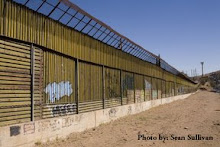
Four members of the Senate’s “Gang of Eight,” the group charged with crafting comprehensive immigration reform legislation, recently paid a visit to the border wall that separates Nogales, Arizona from Nogales, Sonora.

The trip was little more than a photo-op.  The senators did not meet with locals or hear from others who live on the border, who experience border security daily and will be directly impacted by any border security measures in the coming bill.  But their pilgrimage to the wall did send a message that their bill is likely to be heavy on enforcement, possibly including hundreds of miles of new border walls.

Senator McCain (R-AZ) led the tour, and he chose a striking location to give Senator Schumer (D-NY) his first glimpse of the border wall. 

Maybe he just wanted to show off the nearby section of wall that he used as a backdrop for his “Complete the Danged Fence” campaign ad. 


It is a safe bet that he did not take his colleagues to the spot, a few hundred yards from where they posed for the press, where last October a Border Patrol agent reached through the wall to shoot an unarmed teenager in Mexico 11 times in the back.  He probably also failed to point out the high water mark left on Mexican buildings when, in 2008, the Nogales border wall dammed floodwaters, causing millions of dollars in property damage and the drowning of two men.
 

Of course those events don’t fit the simple narrative of McCain’s “perfect plan” for border security that he outlined in his TV ad.  Better to stare into the camera and ignore inconvenient facts, then and now.

Senator Schumer likely sees more “danged fence” as the cost of immigration reform, the burden that border communities will have to bear to bring undocumented immigrants out of the shadows.  That was also the idea in 2006, when the Congressional push for immigration reform fell apart and all we were left with was the Secure Fence Act and hundreds of miles of border wall.

As the “Gang of Eight” has been horse-trading behind closed doors Customs and Border Protection has been quietly laying the groundwork for the last of the Secure Fence Act’s walls to go up in Roma, Rio Grande City, and Los Ebanos, along with neighboring farms and the Lower Rio Grande Valley National Wildlife Refuge.

Customs and Border Protection wants to build these walls in the floodplain, but over the years the International Boundary and Water Commission repeatedly rejected them, citing “substantial increases in water surface elevations and deflections of flow at several points of all three projects.”  Were the Rio Grande to flood after a hurricane or tropical depression, as it did in 2010, walls in the floodplain would deflect water into Mexican cities like Ciudad Aleman, and would stop water from draining out of communities such as Rio Grande City. 


Last year, after sustained pressure from Customs and Border Protection, the US section of the International Boundary and Water Commission reversed its decision, rejecting the Mexican section’s objections and allowing these dangerous walls to go forward.  They now officially accept the claim that the border wall will allow flood water to pass harmlessly through, even though in 2008 they forced Customs and Border Protection to build walls in Cameron County of the exact same design north of the levees so that they would be out of the floodplain. 

Homes and businesses, farms and wildlife refuges, could be washed away or inundated by floodwaters as a direct result of these walls. 

Customs and Border Protection says that everything will be fine.  Of course they also said that they would pay to mitigate the damage that previous wall construction inflicted upon the Lower Rio Grande Valley National Wildlife refuge, but after years of promises not a penny has been provided.

Just like the “Gang of Eight” on their trip to Nogales, Customs and Border Protection has made no attempt to talk to residents or local officials in the Texas communities that the new walls will tear through. 

I contacted Customs and Border Protection last week and asked for an update regarding the Starr county walls.  Daniel Tirado, with the RGV Sector Public Affairs Office, responded that, "the Office of Border Patrol identified these segments as highest operational priorities in Texas. Though construction of these segments has been delayed, Border Patrol’s requirement remains.”

The assertion that these walls, or any border walls for that matter, are a high operational priority is absurd.  Customs and Border Protection knows better than to think that border walls stop anyone. 

While the Senators were doing their press junket in Nogales they watched as a woman laid a ladder against the 18-foot wall and quickly climbed over.  Senator McCain even tweeted about it as it happened.
 

Visiting Arizona last summer I easily climbed the border wall in the San Pedro Riparian National Conservation Area.  I was wearing sandals and didn’t have a ladder, but it only took a few seconds to reach the top.  The San Pedro wall is identical to the ones planned for Roma, Rio Grande City, and Los Ebanos.
 
These new walls will go up in Representative Cuellar’s district, and his silence regarding them has been even more striking, and surprising, than Customs and Border Protection’s.  He has not held any town hall meetings to get feedback from, or provide information to, effected communities, and he has not publicly criticized Customs and Border Protection’s plans or their refusal to speak with local residents.

When I asked his office if he had taken any action on behalf of his constituents, he responded,

I initiated a formal inquiry with CBP as a follow up and update on the status of the proposed fence. CBP has advised that there are no plans for building additional fences in FY 2013 due to the lack of funding.”

Customs and Border Protection also told me that, “Construction activities will commence at such time as funds become available.”

Which sounds good.  Until Congress provides funds for border walls maybe residents can relax.  One might expect that with the sequester gutting the budgets of federal agencies and forcing furloughs from the Environmental Protection Agency to air traffic controllers money for border walls won’t come any time soon.

But tucked into the spending bill that Congress just passed to keep the government running is a provision that says, 

“For expenses for border security fencing, infrastructure, and technology, $324,099,000, to remain available until September 30, 2015.”

Existing border walls are very expensive to maintain, so not all of that money is available to build new ones.  But Customs and Border Protection condemned the land and bought the steel for these walls years ago.  All that is left is to hire the crews, gas up the bulldozers, and start tearing up the land.

And if the “Gang of Eight” includes hundreds of miles of new border walls in comprehensive immigration reform, instead of passing a clean bill that focuses strictly on immigration instead of multi-million dollar handouts to government contractors, the rest of the border landowners and wildlife refuge tracts in Congressman Cuellar’s district will likely suffer the same fate as Roma, Rio Grande City, and Los Ebanos.

Saturday, July 21, 2012

IBWC Approves New Border Walls Despite Flood Danger

By Scott Nicol
The U.S. half of the International Boundary and Water Commission (IBWC) has finally caved under pressure from Customs and Border Protection (CBP) and approved border walls in the Rio Grande floodplain adjacent to Roma, Rio Grande City, and Los Ebanos.    

Customs and Border Protection maps of the three new Rio Grande border wall sections

These three border wall sections, totaling 14 miles, were not built when other parts of the Rio Grande Valley were walled off because of the serious danger they pose to communities on both sides of the river.  On the U.S. side they could block the exit of flood water into the Rio Grande, bottling it up in towns and farm land and exacerbating the damage that they suffer.

They could also deflect flood waters towards Mexico, worsening flooding in Mexican communities.  Deflection might even cause the river to settle into a new channel farther to the south, which would effectively change the location of the border.  

In an attempt to lessen the amount of water that these walls will deflect into Mexican cities CBP designed them to channel flood waters north into the U.S. cities that they abut.  The walls will begin close to the Rio Grande, where during a flood water would be split off from the main channel.  As the river bends the mostly straight walls get farther from them, meaning that floodwater, along with all of the debris and garbage it carries, will be channeled into properties in the United States that might otherwise be spared from flooding. 

To make certain that water is channeled into the U.S. holes were planned for the middle of two of these wall sections – a 100 foot wide gap in the Roma wall, and a 275 foot wide gap in the Rio Grande City wall – explicitly intended to direct more water into these communities during a flood.

Existing border wall slicing through the Lower Rio Grande Valley National Wildlife Refuge

All three of the new border wall sections would also slice through the Lower Rio Grande Valley National Wildlife Refuge.  Established to create a wildlife corridor along the Rio Grande, the refuge provides habitat for critically endangered ocelot and jaguarundi.  Walls that have already been erected downriver repeatedly bisect and fragment the refuge, putting the future of the terrestrial species that it harbors in doubt.  The new walls would further fragment the refuge and cut off animals from the only reliable source of water in what US Fish and Wildlife has described as “some of the best habitat(s) in the U.S. along the final portion of the Rio Grande.

In a February 15, 2012 letter John Merino, Principal Engineer for the US section of the International Boundary and Water Commission gave CBP the green light, saying, “the USIBWC has no objection to the erection of the fence segments within the limits of the Rio Grande floodplain.”  Merino dismissed the possibility that walls would deflect or obstruct flood waters, and stated flatly that USIBWC did not examine potential environmental impacts.  He also failed to mention the fact that for the previous five years both the U.S. and Mexican halves of the bi-national International Boundary and Water Commission had rejected the idea of placing border walls in the floodplain. 

Throughout 2007 and 2008 CBP tried without success to come up with a wall design for these last three sections that would not impact flooding, and that the IBWC would therefore approve.  Unable to convince the IBWC that walls in the floodplain would not act like dams, a DHS briefing from October 2, 2008, said of these three, “DHS likely to drop fence segments. When CBP informed Representative Henry Cuellar a few days after the 2008 election that these border wall sections were “on hold,” Cuellar called it “a big victory” for his district.

It would have made sense for Customs and Border Protection to decide that the Roma, Rio Grande City, and Los Ebanos walls were not worth risking lives and property to build.  Or, if bureaucracy outweighed humanity in their thinking, they might have called off wall construction in order to comply with the international treaty.

They also could have based a decision to spare them on a June 2008 internal Customs and Border Protection document that stated that The Rio Grande Valley Sector Chief has determined that operational areas that contain the PF225 fence segments such as O-1 to O-2, O-12 through O-14, and O-17 through O-21 to be in “effectively controlled” level at the current time.  Segments O-1 and O-2 are the Roma and Rio Grande City walls. 

Segments O-12 through O-14 are in Cameron County, near Los Indios.  Segments O-17 through O-21 encompass all of the wall sections in the vicinity of Brownsville, from the neighborhoods near the River Bend Golf Course west of town past the Sabal Palms Audubon Sanctuary and the Loop family orchard to the east.  Those who live in these areas and had their property condemned for border walls lost their land for nothing, because the local Border Patrol had determined that the area already under effective control before any walls were built.

Border wall segment O-21 under construction with the Sabal Palms Audubon Sanctuary south of it

Of course decisions about who will get walls and who will be spared are made in Washington DC, not the Rio Grande Valley. 

That simple fact helps to explain why Customs and Border Protection continued to push for these walls, shifting tactics from trying to convince Mexico that walls would not worsen flooding south of the border to pushing the US section of IBWC to allow for “unilateral” action – building walls in the face of Mexican objections, and thereby violating the international treaty.

After hurricane Alex roared into the Rio Grande Valley in 2010, followed by a tropical depression, the flooding Rio Grande forced the mandatory evacuation of Los Ebanos and parts of Rio Grande City.  With homes underwater and the evacuation order still in place, CBP hosted a meeting for the USIBWC and the State Department in Washington DC. 

At the DC meeting Customs and Border Protection did not mention the ongoing floods that were inundating the sites of the proposed walls, or the Border Patrol sector chief’s assessment that the area was “effectively controlled.”  Instead, CBP said that the three remaining walls were “critical to our Nation’s security,” and since Mexico continued to insist that they posed a flood hazard “we need [US]IBWC and Department of State’s support for an unilateral decision to proceed with the fence construction.”

Throughout 2010 USIBWC consistently rejected unilateral action, pointing out the likelihood of “substantial increases in water surface elevations and deflections of flow at several points of all three projects.”

But in late 2011 USIBWC reversed itself.  John Merino, the US section’s Principal Engineer, wrote to his Mexican counterpart to say that US IBWC had “concluded that the project will not cause significant deflection or obstruction of the normal or flood flows of the Rio Grande. 

The Mexican section of the IBWC responded in December of 2011, saying,


Because the IBWC is a bi-national body, the rejection of one party should have brought this project to a halt.  Instead the US half of the IBWC approved the walls, allowing Customs and Border Protection to undertake the unilateral action that it had been pushing for.  This is a clear violation of the treaty that created both the IBWC and the border that Customs and Border Protection is supposed to protect.

But a treaty is just paper.  The real harm will come after the walls go up, when the next big storm roars into the Rio Grande Valley and the river floods. 

Monday, October 24, 2011

A Wall in a River is a Dam

by Scott Nicol

In this week’s Republican debate Bachmann, Cain, and Romney each fought to prove that if elected President they would build longer, taller, and more deadly walls than their opponents. In the run up to the event, Representative Bahmann vowed that the length of her wall “will be every mile, it will be every yard, it will be every foot, it will be every inch of that border.” Not to be outdone, Herman Cain said, “It’s going to be 20 feet high. It’s going to have barbed wire on the top. It’s going to be electrified. And there’s going to be a sign on the other side saying, ‘It will kill you — Warning.’

In an effort to please politicians by erecting mile after mile of border wall, Customs and Border Protection (CBP) continues to push for new walls in the floodplain between the Rio Grande and the Texas towns of Roma, Rio Grande City, and Los Ebanos. To convince the International Boundary Water Commission (IBWC) to go along, CBP has tried to paper over the risk of increased flooding with more than a million dollars worth of reports and flood models. Walls in the floodplain are likely to either deflect water into Mexican cities or bottle it up in U.S. ones, and so far IBWC has rejected CBP’s claims to the contrary.

Last June CBP paid Baker Engineering for yet another flood model, which was used over the summer to pressure IBWC to reverse its position. The Sierra Club recently received a copy as a result of a Freedom of Information Act request.

The new flood model makes it clear that no changes in the border walls themselves are being considered. The walls’ locations are the same as those mapped out in a Baker report from 2009. They are still designed to split flood waters, diverting a portion of the flow into these three communities. The only difference is that the newer model uses a different computer program, allowing for more detail.

In 2009 CBP did not know what type of border wall they would like to build, so Baker’s model imagined a solid slab. Now CBP says that they plan to use a bollard design, similar to the walls built to the north of the levees in Cameron county. But in Cameron county the levees would keep flood waters away from the border wall, whereas the new walls would be in the floodplain, where there are no levees, and would be inundated if the Rio Grande were swollen by a major flood.

For this report, Baker assumed that debris in the bollards would block no more than 10% - 25% of the water. That led to the conclusion that walls would have minimal impacts. But the assumption that between 75% and 90% of the water in a major flood would pass harmlessly through the wall seems to be based on wishful thinking at best, or a desire to rig the model’s results at worst.

Flooding rivers pick up large amounts of debris, from trash to trees, and carry it along until they encounter an obstruction. Bollards spaced a few inches apart may allow crystal clear water to pass through, but in a flood debris will pile up. As the debris accumulates it blocks more and more water, and the border wall acts more and more like a dam.

This should not be news to CBP. The border walls that they have already built in Arizona, and which they promised would have no impact on flooding, have caused tremendous flood damage.

On July 12, 2008, seasonal monsoon rains swept through northern Mexico and southern Arizona. In the sister cities of Nogales, Sonora and Nogales, Arizona the border wall acted as a dam. In addition to the wall built above ground it was later revealed that DHS had constructed a wall in a storm drain that passes beneath both cities without informing local officials or the International Boundary Water Commission. Water in the storm drain backed up and burst through the roof, adding to the flooding in the streets. Two people drowned, and millions of dollars of damage was sustained by Mexican businesses and residents.

The same storm caused flooding in Organ Pipe Cactus National Monument. CBP had stated categorically that border walls crossing washes in the monument, using a design similar to that proposed for the new South Texas sections, would be water permeable and therefore would not impact flooding. Grate openings 6 inches high and 24 inches wide that were built into the base of the wall were supposed to allow water to pass through, but they quickly became clogged with debris. The wall then acted as a dam, with water piling up behind it 2 to 7 feet deep. Backed up flood waters then traveled along the wall in search of an outlet, which was found at the Lukeville, Arizona port of entry, causing millions of dollars in damage to private and federal property.

Following this event, Baker Engineering was paid to run the length of the border wall from El Paso to San Diego and produce a report on the problems posed by the many walls that cross stream beds and washes. They documented “debris build-up which sometimes reached a height of 6 feet.” Their report concluded that, “fencing obstructs drainage flow every time a wash is crossed. With additional debris build-up, the International Boundary Water Commission’s (IBWC’s) criteria for rise in water surface elevations (set at 6” in rural areas and 3” in urban areas) can quickly be exceeded.”

Flood gates were installed, at a cost of over $24 million, in an attempt to prevent a repeat of the 2008 flooding. These gates are massive, and to work require Border Patrol agents to predict a flood, drive into a wash ahead of the water, throw a cable over a bar at the top of the wall, hook it to the top of the gate, and use their Jeep’s winch to pull the gate up. Then the agents need to get out of the wash and get to high ground. If they are not quick enough, they could be swept away or slammed into the wall by raging flood waters. If they manage to get out of the way they may be forced to wait on high ground between flooded washes until the waters recede.

Last August one of the sections of Arizona border wall that CBP had retrofitted with flood gates was knocked over and washed away by the force of flood waters after just over two inches of rain fell. Debris build-up had again turned the wall into a dam, just as it had in 2008. In this case, instead of following the wall to the nearest port of entry, the debris piled higher and higher the water poured over the top like a waterfall. The falling water tore away the wall’s foundation at the same time as the weight and pressure of the water pushed against the wall with increasing force. A forty-foot wide section of border wall fell.

Border Patrol spokesman Lloyd Easterling blamed the wall’s failure on human error, apparently because agents had not gone into washes ahead of the flash flood to open flood gates.

But the problem does not lie with patrol agents who cannot predict the weather, or don’t want to drive into a riverbed during a flood. The problem is higher up CBP’s command structure, with administrators who are so fixated on building walls, and thereby pleasing their superiors, that they overlook a basic fact:

A wall in a river is a dam.

It is time for Customs and Border Protection to face up to the fact that when they build walls in flood-prone areas, they may be able to ignore the impacts on paper, but not in the real world. The walls that they are pushing in Roma, Rio Grande City, and Los Ebanos will have a disastrous impact on the very homeland that they are supposed to protect. Customs and Border Protection needs to ignore political pressure and give up on these last sections of border wall, before they do any more damage.


The June 2011 flood model for walls in Roma, Rio Grande City, and Los Ebanos can be downloaded here: http://www.scribd.com/doc/68844504/June-2011-CBP-Hydrology-Report-for-Border-Wall-Sections-O-1-O-2-O-3

Saturday, November 8, 2008

The No Border Wall Coalition Praises DHS’ Decision to Spare 3 South Texas Communities

The No Border Wall Coalition hails the decision by the Department of Homeland Security to give the South Texas communities of Roma, Rio Grande City, and Los Ebanos a reprieve from border wall construction in 2008. It is our hope that this will be made permanent by the new administration. We believe that Cameron County and the rest of the border which is slated for wall construction before the end of Secretary Chertoff’s tenure should also be spared.

No Border Wall Coalition protest in Roma, Texas, July 2007

The border wall has already led to the condemnation of farmland and municipal property, and the walls that are currently under construction are devastating wildlife refuges and destabilizing South Texas’ flood control levees. $3 billion has been wasted on walls that the Border Patrol says only slow crossers by a few minutes. With two wars, a deepening financial crisis, and trillions of dollars of debt, our nation cannot afford to throw more money into this bottomless pit.


Levee - border wall construction on the northern border of a US Fish and Wildlife Refuge tract in South Texas October 24, 2008

We hope that the decision to spare these communities signals the beginning of a sane border policy on the part of the Department of Homeland Security and the Bush administration. The border wall is nothing more than a political prop, a backdrop for politicians who want to look tough on national security. With the election behind us, it is time to move beyond hollow symbols.

The No Border Wall coalition calls upon President-elect Obama to appoint a new Secretary of Homeland Security who will reject Michael Chertoff’s failures and refuse to play politics with the lives and property of border residents. He should enact a moratorium on further border wall construction until a non-partisan organization such as the Government Accountability Office can review both the impacts of the walls that have already been built and the foreseeable impacts of proposed walls.