Showing posts with label comprehensive immigration reform. Show all posts

Tuesday, April 1, 2014

Arresting Babies on the Border

by Scott Nicol


“They’re arresting babies.”

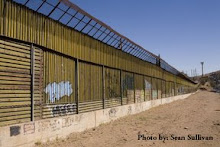
The thought struck hard, and it kept echoing.  I had come to the border wall with a correspondent from National Public Radio to see its impact on the environment.  We had also seen evidence of the apprehensions that occur there daily.  Piles of shoelaces and belts that immigrants were forced to abandon before being taken into custody, and even a pair of plastic toy helicopters, littered the ground.


The Border Patrol agent said that they had captured eighteen people.  Most sat in a line in the dirt beside the rusting wall as agents took their names and bagged their possessions.  Only three or four were adults.

Inside a Border Patrol van, escaping the heat, were two mothers, each with an infant in her arms.  On the seats beside them were a pair of toddlers.

The Border Patrol would probably prefer not to use the term “arrest,” but the children were taken into custody along with the rest of their family.  All eighteen will be included in the sector’s apprehension statistics.

In 2013 the Border Patrol apprehended 26,027 juveniles in its Rio Grande Valley sector, 21,553 of whom were unaccompanied.  Border-wide 38,833 out of the 47,238 minors who were captured were traveling without an adult.  At least these children were not on their own.

Call it an apprehension, call it an arrest, for a child too young to walk or talk the terminology does not matter.

The United States of America, through elected Representatives who are meant to express the will of its citizens, spent $18 billion last year to keep these families out.  A few years back taxpayers spent $12 million per mile to build the border wall that stood nearby, and more than $3 billion was spent to wall off 652 miles of the southern border.  From 1995 to 2003 we doubled the size of the Border Patrol, then over the last decade we doubled their ranks again.  They carry out the mission that we have given them.

We are arresting babies.

And toddlers.  And teenagers.  And adolescents.  And their parents.

We have decided that the people I saw lined up beside the wall, parents who traveled hundreds of miles from Guatemala looking for work with children in tow, threaten us.

Like most who walk or swim across the border they are not terrorists, they are not smugglers, they simply want a better life.  They are parents struggling to feed their families.  They are children hoping to escape violence, go to school, live the American Dream.  So long as that desperation and desire remains people will keep coming. 

This is not a challenge to our nation’s defenses, it is a test of our conscience.

When the Senate took up immigration reform they failed to grasp this.  They made a “border surge,” with hundreds of miles of new border wall, a further ballooning of the Border Patrol, and tens of billions of dollars of new military hardware, a “trigger” that must be completed before anyone currently in the country could start on a thirteen-year-long pathway to citizenship.  The irrational fears of middle American voters who only see the border when they watch FOX News or Border Wars on TV had to be appeased.


Even with the “surge” Republicans in the U.S. House refuse to even debate immigration reform.  They are far less concerned with the children sitting in a line on the dirt beside the wall than they are about a Tea Party challenge in the next primary election.

The Border Patrol agents called headquarters to have child car seats sent out.  Older kids shuffled back into the green and white van, now lacking belts and laces for their sneakers.

After they drove off we began to walk back along the top of the levee.  Through the border wall’s rusting bollards we could see another mother being marched out of the brush, clutching an infant to her chest.

As the sun settled into the treetops the wind carried the baby’s cries.

Wednesday, April 24, 2013

Another Round of South Texas Border Wall Condemnations is about to Begin

By Scott Nicol


If the Border Patrol knocks on your door you might want to have a lawyer present when you answer.

That is because Customs and Border Protection is gearing up for a fresh round of land condemnations to build border walls in Roma, Rio Grande City, and Los Ebanos.

According to documents obtained by the Sierra Club through a Freedom of Information Act request the new walls won’t just slice through farmland and wildlife refuges.  In Roma “up to 25 residences could be impacted.”  In Rio Grande City the wall’s route will take it through a nursing home, and “If the decision is made to buy the tract out in its entirety, the business will need to be relocated along with 64 residents, potentially up to 90 residents if at 100% capacity.  In Los Ebanos landowners who went through condemnation three years ago will be hauled into court again to have more of their property snatched away.

This new assault on border communities is the result of the US section of the International Boundary Water Commission’s (US IBWC) decision to allow border walls to go up in the Rio Grande floodplain.

When they were first proposed, along with the rest of South Texas’ border walls, US IBWC stated categorically that walls could not be erected in the floodplain because they posed an unacceptable flood risk to communities on both sides of the river.  Walls north of the river might deflect rising flood waters, worsening the damage to Mexican cities and possibly even pushing the river into a new channel, thereby changing the location of the international border.  For this reason walls in Cameron County were erected north of the flood control levees, and in Hidalgo County there were inserted into them.


The new walls will be identical to those built in Cameron County, using six inch wide steel posts that stand eighteen feet tall with four inch spaces in between.  In 2008 Baker Engineering looked at the impacts of this design placed in these locations, and estimated that during a flood the walls would clog with debris, limiting the ability of water to pass between the pillars.  In Roma they estimated an 85% blockage where the walls paralleled the river’s flow; in Rio Grande City a 67% blockage; and in Los Ebanos a 36% blockage.  Where the walls would be erected perpendicular to the flow Baker said CBP should assume that debris would cause the walls to be completely blocked.

In 2011 Customs and Border Protection paid Baker to look at the same wall design placed in the same location, and with no new evidence or explanation they came to a radically different conclusion.  Now A debris blockage of 10% was adopted where the fence is aligned parallel to the flow and 25% at locations where the fence is aligned perpendicular to the flow.”  Not surprisingly the model that this new estimate was plugged into concluded that walls in the floodplain would not deflect or dam flood water, since 75 -90% of the water would supposedly pass right through.


The US section of IBWC accepted this without question.  The Mexican section categorically rejected it. 

One would think that a bi-national organization would require agreement before permitting potentially dangerous projects.  Instead, the new border walls are going up.

In a presentation dated March 1, 2013, Customs and Border Protection laid out a timeline for the construction of these new walls:

Funds:  already received.

Achieve right of entry to survey property for wall construction:  60 days.

Initiate new acquisitions of property, through purchase or condemnation:  180 days.

So if you have property in the path of these walls, now is the time to call a lawyer.

And those lawyers are going to be very busy.  The “gang of eight” immigration bill includes $1.5 billion for new border walls. 

When Congress passed the Secure Fence Act in 2006 Customs and Border Protection walled off big portions of California, Arizona, and New Mexico.  There aren’t too many places outside of inaccessible mountains without walls up there.  What’s left is Texas. 

Unless the bill is changed and the walls are taken out Customs and Border Protection will start filling in the unwalled spaces between South Texas’ existing border walls.  The Lower Rio Grande Valley National Wildlife Refuge, and the endangered species that it protects, will be utterly decimated.  And every other landowner with property along the Rio Grande from Roma to Boca Chica will stand in turn before a federal judge, before watching construction crews wall off their land from the river. 

Some, like the 25 households in Roma or the senior citizens in Rio Grande City, may even see the their homes fall to these new border walls.

Monday, April 8, 2013

Border Residents Kept in the Dark about New Border Walls

by Scott Nicol


Four members of the Senate’s “Gang of Eight,” the group charged with crafting comprehensive immigration reform legislation, recently paid a visit to the border wall that separates Nogales, Arizona from Nogales, Sonora.

The trip was little more than a photo-op.  The senators did not meet with locals or hear from others who live on the border, who experience border security daily and will be directly impacted by any border security measures in the coming bill.  But their pilgrimage to the wall did send a message that their bill is likely to be heavy on enforcement, possibly including hundreds of miles of new border walls.

Senator McCain (R-AZ) led the tour, and he chose a striking location to give Senator Schumer (D-NY) his first glimpse of the border wall. 

Maybe he just wanted to show off the nearby section of wall that he used as a backdrop for his “Complete the Danged Fence” campaign ad. 


It is a safe bet that he did not take his colleagues to the spot, a few hundred yards from where they posed for the press, where last October a Border Patrol agent reached through the wall to shoot an unarmed teenager in Mexico 11 times in the back.  He probably also failed to point out the high water mark left on Mexican buildings when, in 2008, the Nogales border wall dammed floodwaters, causing millions of dollars in property damage and the drowning of two men.
 

Of course those events don’t fit the simple narrative of McCain’s “perfect plan” for border security that he outlined in his TV ad.  Better to stare into the camera and ignore inconvenient facts, then and now.

Senator Schumer likely sees more “danged fence” as the cost of immigration reform, the burden that border communities will have to bear to bring undocumented immigrants out of the shadows.  That was also the idea in 2006, when the Congressional push for immigration reform fell apart and all we were left with was the Secure Fence Act and hundreds of miles of border wall.

As the “Gang of Eight” has been horse-trading behind closed doors Customs and Border Protection has been quietly laying the groundwork for the last of the Secure Fence Act’s walls to go up in Roma, Rio Grande City, and Los Ebanos, along with neighboring farms and the Lower Rio Grande Valley National Wildlife Refuge.

Customs and Border Protection wants to build these walls in the floodplain, but over the years the International Boundary and Water Commission repeatedly rejected them, citing “substantial increases in water surface elevations and deflections of flow at several points of all three projects.”  Were the Rio Grande to flood after a hurricane or tropical depression, as it did in 2010, walls in the floodplain would deflect water into Mexican cities like Ciudad Aleman, and would stop water from draining out of communities such as Rio Grande City. 


Last year, after sustained pressure from Customs and Border Protection, the US section of the International Boundary and Water Commission reversed its decision, rejecting the Mexican section’s objections and allowing these dangerous walls to go forward.  They now officially accept the claim that the border wall will allow flood water to pass harmlessly through, even though in 2008 they forced Customs and Border Protection to build walls in Cameron County of the exact same design north of the levees so that they would be out of the floodplain. 

Homes and businesses, farms and wildlife refuges, could be washed away or inundated by floodwaters as a direct result of these walls. 

Customs and Border Protection says that everything will be fine.  Of course they also said that they would pay to mitigate the damage that previous wall construction inflicted upon the Lower Rio Grande Valley National Wildlife refuge, but after years of promises not a penny has been provided.

Just like the “Gang of Eight” on their trip to Nogales, Customs and Border Protection has made no attempt to talk to residents or local officials in the Texas communities that the new walls will tear through. 

I contacted Customs and Border Protection last week and asked for an update regarding the Starr county walls.  Daniel Tirado, with the RGV Sector Public Affairs Office, responded that, "the Office of Border Patrol identified these segments as highest operational priorities in Texas. Though construction of these segments has been delayed, Border Patrol’s requirement remains.”

The assertion that these walls, or any border walls for that matter, are a high operational priority is absurd.  Customs and Border Protection knows better than to think that border walls stop anyone. 

While the Senators were doing their press junket in Nogales they watched as a woman laid a ladder against the 18-foot wall and quickly climbed over.  Senator McCain even tweeted about it as it happened.
 

Visiting Arizona last summer I easily climbed the border wall in the San Pedro Riparian National Conservation Area.  I was wearing sandals and didn’t have a ladder, but it only took a few seconds to reach the top.  The San Pedro wall is identical to the ones planned for Roma, Rio Grande City, and Los Ebanos.
 
These new walls will go up in Representative Cuellar’s district, and his silence regarding them has been even more striking, and surprising, than Customs and Border Protection’s.  He has not held any town hall meetings to get feedback from, or provide information to, effected communities, and he has not publicly criticized Customs and Border Protection’s plans or their refusal to speak with local residents.

When I asked his office if he had taken any action on behalf of his constituents, he responded,

I initiated a formal inquiry with CBP as a follow up and update on the status of the proposed fence. CBP has advised that there are no plans for building additional fences in FY 2013 due to the lack of funding.”

Customs and Border Protection also told me that, “Construction activities will commence at such time as funds become available.”

Which sounds good.  Until Congress provides funds for border walls maybe residents can relax.  One might expect that with the sequester gutting the budgets of federal agencies and forcing furloughs from the Environmental Protection Agency to air traffic controllers money for border walls won’t come any time soon.

But tucked into the spending bill that Congress just passed to keep the government running is a provision that says, 

“For expenses for border security fencing, infrastructure, and technology, $324,099,000, to remain available until September 30, 2015.”

Existing border walls are very expensive to maintain, so not all of that money is available to build new ones.  But Customs and Border Protection condemned the land and bought the steel for these walls years ago.  All that is left is to hire the crews, gas up the bulldozers, and start tearing up the land.

And if the “Gang of Eight” includes hundreds of miles of new border walls in comprehensive immigration reform, instead of passing a clean bill that focuses strictly on immigration instead of multi-million dollar handouts to government contractors, the rest of the border landowners and wildlife refuge tracts in Congressman Cuellar’s district will likely suffer the same fate as Roma, Rio Grande City, and Los Ebanos.

Tuesday, February 19, 2013

Security First?

by Scott Nicol


The “gang of eight” U.S. Senators, four Democrats and four Republicans, have released a set of principles that they see as the basis for comprehensive immigration reform legislation.  The fact that they are trying to resolve this issue is a positive step, and has the potential to allow millions of people to finally live normal lives, free of fear and exploitation.  But a key component of their plan calls into question whether that promise will ever be realized.

Immigrants’ advocates have long held that a “pathway to citizenship” must be part of any immigration reform plan, allowing those currently in the United States without papers to earn U.S. citizenship. 

Conservative icon Ronald Reagan agreed with this, saying, "I believe in the idea of amnesty for those who have put down roots and lived here, even though sometime back they may have entered illegally."   Today anti-immigrant groups spit out the term “amnesty” as a curse, and many in the current crop of Republican politicians (Texas’ U.S. Senators prominent among them) use it to slander the very idea of allowing the undocumented to become citizens.

Though Cornyn and Cruz present the rejection of earned citizenship as a principled ideological stance, many conservative pundits have pointed out that Hispanics tend to vote for Democrats – 71% voted for Barack Obama – so allowing the 11 million or so mostly, but not entirely, Hispanic undocumented immigrants currently in the U.S. to vote might hurt Republicans in future elections.

Alienating Hispanic voters is costing Republicans elections now, but adding more Hispanic voters could hurt Republicans in the future.  What are they to do?

The answer lies in the “gang of eight” principles. 

The recently unveiled framework makes border security a prerequisite for the issuance of green cards to undocumented immigrants.  After that they could apply for full citizenship, going to the “back of the line.”

Of course the length of that line depends on what country they come from since each nation is assigned a quota; whether they are related by blood or marriage to U.S. citizens; and their income and skills.  For a Mexican national with no family in the United States, no money or special skills, the line that they will be going to the back of is over a century long.

But until the border is declared secure, that hundred-plus-year clock will not start ticking.

The principles released by the “gang of eight” do not define a secure border, so it is impossible to know how many years, how many new Border Patrol agents, how many more drones, how many miles of new border wall, it might take to get there. 

The Senate plan calls for a commission made up of “governors, attorneys general, and community leaders living along the Southwest border“ to determine when the border has been secured. 

Immigrants’ advocates cried foul at the notion that Texas governor Rick Perry and Arizona’s Jan Brewer could hold the citizenship of millions hostage indefinitely by refusing to declare the border secure. 

Perry manages to find money for Highway Patrol speedboats with machine guns mounted on the front to patrol the Rio Grande at the same time as he cuts $4.5 billion from Texas’ schools.  Brewer has committed Arizona’s scarce financial resources to defending SB 1070, the state law intended to make immigrants’ lives so hellish that they “self-deport.” 

Neither are particularly objective in their assessment of the border.

The gang seems to have viewed sacrificing the border to get a bill as a given, and they sold us out so quickly that it never occurred to them that making border security a prerequisite could put citizenship in permanent limbo.

Democratic gang members have responded to the criticism with assurances that the Department of Homeland Security would develop a new, workable definition of a secure border tied to concrete metrics rather than the delusions of Perry and Brewer.  They now say the commission will be strictly advisory.

Homeland Security Secretary Janet Napolitano is certainly further form the lunatic fringe than the governors of Texas and Arizona, but the Department of Homeland Security has a terrible record on the border.

Upon taking office Napolitano refused to halt the condemnation of land and construction of border walls in South Texas and elsewhere.  Early last year her underlings finally succeeded in pressuring the US section of the International Boundary and Water Commission to approve walls in the floodplain at Roma, Rio Grande City, and Los Ebanos, despite the risk to residents on both sides of the river and the damage that the Lower Rio Grande Valley National Wildlife Refuge and Roma Bluffs World Birding Center will suffer.

Last week Secretary Napolitano spoke in El Paso, ranked the safest big city in the United States for the third year running, and declared that the border is more secure than ever, and that the idea that immigration reform should be held hostage to border security “suffers from a fundamental flaw.” 

Her argument is backed by the numbers.  Border Patrol apprehensions are at a forty year low, and the Pew Research Center has found that net migration from Mexico is effectively at zero, with as many people heading south as north.

So why has her agency continued to push for border walls?  Politics, of course.

At the beginning of her tenure halting border wall construction would have opened up the newly elected President Obama to attacks in the press.  The “gang of eight” likewise assume that throwing the border under the bus is a political necessity to get a bill through Congress, so they do it without hesitation.

Immigration reform should not be held hostage to “border security”, whether it is Perry and Brewer or Napolitano who decide on what that means.  There will always be conflicting political needs that will prevent the honest assessment and agreement that would allow reform to move forward.

When the Senators draft their bill in the coming weeks border security must not be a prerequisite for anything else.  Otherwise real reform will always be just over the horizon, one more agent, one more drone, one more wall away.

Politics is an abstraction, but the actual border consists of real lives and real landscapes.  We are not a bargaining chip for politicians who have never dipped a toe in the Rio Grande, walked a trail in the LRGV National Wildlife Refuge, or looked a South Texas citrus grower in the eye. 

Monday, January 28, 2013

Don't Throw the Border Under the Bus

by Scott Nicol


Congress will soon take up Comprehensive Immigration Reform.  That could be a good thing, if it normalizes the status of millions who are now forced to live in the shadows; reduces the number of immigrants who cross, and sometimes die, in the desert; and allows some of the $18 billion that is spent annually on immigration enforcement to be used for other things. 

But if history is any guide it could also mean a ramping up of border enforcement, with billions more wasted on border walls.

In 2006, the last time Congress made a serious attempt at Comprehensive Immigration Reform, hundreds of miles of border wall were included in competing House and Senate bills.  The two bills were never reconciled and therefore never made it to the President’s desk. 

Instead the provisions calling for walls along the southern border were passed by both houses as a stand-alone bill - the Secure Fence Act.  650 miles of border wall were eventually built, tearing through communities from San Diego to Brownsville and ecosystems from the Otay Mountain Wilderness Area to the Sabal Palms Audubon Sanctuary.

The idea that walls would halt potential crossers in their tracks proved to be more fantasy than reality.  The Congressional Research Service reported that walls near San Diego had “little impact on overall apprehensions.”  Even the Border Patrol said that “The border fence is a speed bump in the desert.

While walls have not reduced the number of immigrants who enter the U.S., they have caused the number of border crossers who perish in southern deserts each year to more than double.  That is because border walls do not stop people from entering the United States, they only reroute them. 

Confronted with an 18 foot high wall near San Diego or El Paso or Brownsville desperate immigrants do not turn around and go home, they go around it.  Rather than crossing in safer urban areas thousands come through rugged mountains and deserts.  As a result more than 5,000 have died from dehydration and exposure, and it is estimated that thousands of bodies lie undiscovered.

Walls and other enforcement measures have also taken a heavy toll on the environment. 

California’s Otay Mountain Wilderness Area saw 530,000 cubic yards of rock blasted from the mountainsides tumble into the Tijuana River.  In Arizona the border walls that cross washes and streams in the Organ Pipe Cactus National Monument have caused severe erosion and flooding.  Walls built in New Mexico’s Playas Valley block the movement of one of the last wild herds of bison, whose range straddles the U.S. – Mexico border.  And in Texas the walls that slice through the Lower Rio Grande Valley National Wildlife Refuge have fragmented habitat that is critical for the survival of endangered ocelots.

Following the recent election, in which some (but unfortunately not all) of the loudest immigrant-bashers suffered defeat and more than 70% of Hispanic voters rejected Mitt Romney, many politicians have decided that it is in their best interest to pass some version of immigration reform. 

The big concern is that we could see history repeat itself.

Press reports describe the coming bill as mirroring past legislation, pairing work visas and a pathway to citizenship with more border enforcement. 

Once again the border may be sacrificed in a doomed attempt to get conservatives to accept comprehensive legislation.

The idea that members of Congress who have called for making the lives of immigrants so hellish that they “self-deport”, or who voted just last summer to waive federal laws within 100 miles of both borders for all Border Patrol activities, will now support humane immigration legislation is unrealistic.  Sticking walls in the bill will not change that.

Instead, if walls and further border enforcement are allowed in this year’s legislation we run the risk of a repeat of 2006, when hundreds of miles of border walls were the only part of the immigration bill to make it to the president’s desk.

Those of us who live on the border have already seen too much of the enforcement side of that equation.  Last year the federal government spent more on immigration enforcement than the budgets of the FBI, Secret Service, Drug Enforcement Administration, U.S. Marshal Service, and the Bureau of Alcohol, Tobacco, Firearms and Explosives combined.

Enough.

Members of Congress who were sent to DC to represent the border need to fight for their constituents, but so far they have been silent.  With much of Arizona and California already walled off, Representatives Vela, Hinojosa, Cuellar, Gallego, and O’Rourke could all see new walls tear through their districts if they don’t make sure that border walls are kept out of the bill, but none have told us what (if anything) they plan to do about it. 

This is a critically important piece of legislation for border communities, and border legislators should take the lead in writing it.  That is their job, after all.  Sitting silently in the back of the room and hoping for the best is not going to cut it this time.

Congress needs to come up with a clean bill, dealing with immigration without further militarizing the borderlands.  No new border walls, no more pork for military contractors; instead we as a nation must address our dysfunctional immigration system in a way that is both effective and humane. 

We need immigration reform that doesn’t throw the border under the bus.

Tuesday, December 15, 2009

Environmental Groups Support Provisions of Comprehensive Immigration Reform Bill

The Sierra Club, Defenders of Wildlife, and the Center for Biological Diversity have issued the following press release in support of the Comprehensive Immigration Reform for America's Security and Prosperity Act of 2009, introduced by Representative Luis Gutierrez. The bill contains key provisions intended to ensure that the Department of Homeland Security obeys all of our nation's laws when building infrastructure on the border.

Comprehensive Immigration Reform Bill Gets it Right at the Border
Bill Would Help Protect Wildlife from Damage of Border Walls

Washington, D.C, - A new immigration bill introduced today includes important provisions that will help protect wildlife, communities, and natural resources from damage wrought by border walls between the U.S. and Mexico.

The Comprehensive Immigration Reform for America's Security and Prosperity Act of 2009, introduced by Representative Luis Gutierrez, includes critical components of the Border Security and Responsibility Act of 2009 (HR 2076), introduced by Rep. Raul Grijalva in April 2009.

To date, at least 633 miles of border walls and barriers have been constructed along the U.S. – Mexico border, and the construction has proceeded quickly and almost entirely without proper consultation or compliance laws.Three dozen environmental, archaeological, religious freedom, historic preservation, cultural, and other laws were waived by former Secretary of Homeland Security Michael Chertoff for border wall construction.

The legislation would replace the border wall’s one-size-fits-all approach to border security with a strategy based on comprehensive analyses of the effectiveness and costs of various security measures. To address negative impacts from existing border infrastructure, the legislation would establish comprehensive monitoring and mitigation programs. The bill would also ensure full compliance with landmark laws like the Safe Drinking Water Act and the Endangered Species Act that were enacted to promote public health and protect our country’s wildlife and natural heritage.

“ Rep. Gutierrez and Rep. Grijalva deserve praise for recognizing the need for a responsible border security policy that minimizes harm to our precious borderlands, wildlife, and border communities,” said Sierra Club representative Michael Degnan.

“Much of this country’s rarest and most spectacular wildlife--including jaguar, ocelot, Sonoran pronghorn, and many other species--depend upon the borderlands for survival. This bill would restore crucial protections to such wildlife and help mitigate the widespread damage that has already been done to important habitat and migration corridors,” said Randy Serraglio, conservation advocate at the Center for Biological Diversity.

"Laws that protect our wildlife, our water, our air, and our right to a healthful environment should never have been circumvented by the Bush administration," said Bob Irvin, Senior Vice President for Conservation Programs at Defenders of Wildlife. "This bill will restore the rule of law along America's border."