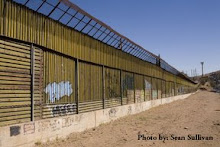
The No Border Wall Coalition strongly endorses the Border People’s March to Stop the Wall, currently underway on the Texas – Mexico border. Marchers will follow the route of the 57-mile segment of border wall that is being built from Ft. Hancock, Texas, to El Paso, Texas. Led by No Wall – Big Bend and the Border Ambassadors, they plan to highlight the tremendous human and environmental costs of the wall in west Texas and along the entire U.S. – Mexico border.
Marchers will set off from Fort Hancock today, and arrive in El Paso on Sunday, August 31. More information about the march and its route is available at the Border Ambassadors website - www.borderambassadors.com .
Of special concern along the marchers’ route is the impact of the border wall on Native American communities. Like the Tohono O’Odham farther west, the lands that the Ysleta del Sur Pueblo of the Tigua Nation calls home lie on both sides of what is now the international border. The Rio Grande is crucial not only for providing water in a harsh, dry environment, it is also integral to their religious practices. As the Rio Grande is walled off, the Tiguas have stated that they will be cut off from graves and sacred sites.
There are laws on the books, most notably the American Indian Religious Freedom Act and the Native American Graves Protection and Repatriation Act, that should prevent this assault on the Tiguas religion and culture. But section 102 of the Real ID Act allows Department of Homeland Security Secretary Chertoff to brush aside any law that might slow construction of the border wall. On April 1, 2008 he did just that, “waiving in their entirety” 36 federal laws including the American Indian Religious Freedom Act and the Native American Graves Protection and Repatriation Act.
The Tiguas are party to a challenge to the constitutionality of the Real ID Act’s waiver provision, alleging that giving an unelected administration appointee the power to waive laws passed by Congress and signed by the President for the express purpose of subverting the judiciary is a violation of the separation of powers enshrined in the U.S. Constitution. They are joined by El Paso County, the El Paso County Water Improvement District No. 1, the Hudspeth County Conservation and Reclamation District No. 1, Galeria 409, The Frontera Audubon Society, the Friends of the Wildlife Corridor, and the Friends of Laguna Atascosa National Wildlife Refuge. The wide spectrum of plaintiffs challenging the Department of Homeland Security’s suspension of laws points to the broad range of negative impacts that the wall will have in Texas, as well as the rest of our nation’s borderlands.
The same river that provides a focal point for the Tiguas’ religious ceremonies is equally important for the survival of plant, animal, and human communities. The Rio Bosque Wetlands Park has also spoken out against the wall, stating that, “A fence would limit the ability of native terrestrial species to move between such areas and the floodway. It would limit genetic exchange and would fragment populations that are currently connected.” As habitat is fragmented and access to the river is denied, animals, particularly those that are listed as federally threatened or endangered, may not survive.
With border wall construction currently under way near El Paso and elsewhere, it is critically important that we remind members of Congress that the elections that they are currently obsessed with are just the entrance exam for their jobs. Elections are meant to bring in public servants, and it is their job to serve the best interests of the American people. Building walls that will cut off the Rio Grande, that will disrupt Native American religious practices and disturb graves, that will destroy natural areas such as the Rio Bosque Wetlands Park, and will cost U.S. taxpayers billions of dollars, is unconscionable. As our public servants once again come before the American people, asking for our votes, it is important that they know that we will hold them accountable for their actions.
Showing posts with label Action Alert. Show all posts
Showing posts with label Action Alert. Show all posts
Thursday, August 28, 2008


Tuesday, September 11, 2007
Action Alert - Public Comments on the Border Wall in Buenos Aires National Wildlife Refuge
Bulldozers are already clearing vegetation to build the seven mile long section of border wall on either side of the Sasabe, Arizona port of entry (see below). The Department of Homeland Security prepared an Environmental Assessment (not to be confused with the more stringent and comprehensive Environmental Impact Statement that should be completed for a project in sensitive habitat) which, not surprisingly, found that construction of the wall would have “no significant impact.” To date Secretary Chertoff has not issued a Real ID waiver of environmental laws, so DHS cannot legally ignore the Endangered Species Act, the National Environmental Policy Act, and other relevant statutes.

Part of the Sasabe border wall will be built on the southern edge of the Buenos Aires National Wildlife Refuge. The Refuge is currently working to determine whether or not a 15 foot tall steel wall is compatible with its mission, and has opened a brief public comment period. It is important that anyone who is concerned about the environmental impacts that the border wall will have take advantage of this opportunity and write a letter.
According to the draft Compatibility Determination,
The Refuge was established on August 1, 1985 “....to conserve (A) fish or wildlife which are listed as endangered species or threatened species .... or (B) plants ....” 16 U.S.C. 1534 (Endangered Species Act of 1973) and for the “...development, advancement, management, conservation, and protection of fish and wildlife resources....” 16 U.S.C. 742f(a)(4) (Fish and Wildlife Act of 1956). Congressional records and other pertinent files show that conservation of the masked bobwhite quail was the major impetus behind establishment of the Buenos Aires NWR. Habitat restoration and the existence of a self-sustaining population of masked bobwhite quail remains a primary goal of the Refuge.
In total this portion of the border wall will clear 51 acres of habitat, and will be an impassible barrier for large terrestrial animals such as pronghorn and jaguar. In the last few years jaguar have been photographed in southern Arizona, giving hope that they may be able to move back into their former U.S. range. While according to the Border Patrol a border wall will only slow a human crosser by 5 minutes, a jaguar will find it impossible to climb over a 15 foot high steel wall.

Unfortunately, the draft Compatibility Determination finds construction of the wall to be compatible with the refuge’s mission. In many places it simply repeats assertions from the Environmental Assessment. These include the statement that “Jaguars will still be able to move through other areas of the border,” which conveniently ignores the fact that most of the Arizona border will be walled off, not just the Buenos Aires National Wildlife Refuge. It is important that this flawed argument be pointed out in public comments, along with the basic incompatibility of a wall in a wildlife refuge. The Compatibility Determination and the Environmental Assessment that it is based upon focus narrowly on the footprint of the wall, ignoring the fragmentation of habitat that extends beyond the refuge’s borders. The refuge is not an island, it is a portion of a larger ecosystem, and the ability of animals to travel through that ecosystem is vital to its continued viability.
The public comment period on the Buenos Aires National Refuge’s draft Compatibility Determination closes on September 18. It is crucial that we all take advantage of the opportunity to comment on its inadequacies and flawed determination. Comments must be sent to:
Refuge Manager
Buenos Aires NWR
P.O. Box 109
Sasabe, Arizona 85633
Part of the Sasabe border wall will be built on the southern edge of the Buenos Aires National Wildlife Refuge. The Refuge is currently working to determine whether or not a 15 foot tall steel wall is compatible with its mission, and has opened a brief public comment period. It is important that anyone who is concerned about the environmental impacts that the border wall will have take advantage of this opportunity and write a letter.
According to the draft Compatibility Determination,
The Refuge was established on August 1, 1985 “....to conserve (A) fish or wildlife which are listed as endangered species or threatened species .... or (B) plants ....” 16 U.S.C. 1534 (Endangered Species Act of 1973) and for the “...development, advancement, management, conservation, and protection of fish and wildlife resources....” 16 U.S.C. 742f(a)(4) (Fish and Wildlife Act of 1956). Congressional records and other pertinent files show that conservation of the masked bobwhite quail was the major impetus behind establishment of the Buenos Aires NWR. Habitat restoration and the existence of a self-sustaining population of masked bobwhite quail remains a primary goal of the Refuge.
In total this portion of the border wall will clear 51 acres of habitat, and will be an impassible barrier for large terrestrial animals such as pronghorn and jaguar. In the last few years jaguar have been photographed in southern Arizona, giving hope that they may be able to move back into their former U.S. range. While according to the Border Patrol a border wall will only slow a human crosser by 5 minutes, a jaguar will find it impossible to climb over a 15 foot high steel wall.
Unfortunately, the draft Compatibility Determination finds construction of the wall to be compatible with the refuge’s mission. In many places it simply repeats assertions from the Environmental Assessment. These include the statement that “Jaguars will still be able to move through other areas of the border,” which conveniently ignores the fact that most of the Arizona border will be walled off, not just the Buenos Aires National Wildlife Refuge. It is important that this flawed argument be pointed out in public comments, along with the basic incompatibility of a wall in a wildlife refuge. The Compatibility Determination and the Environmental Assessment that it is based upon focus narrowly on the footprint of the wall, ignoring the fragmentation of habitat that extends beyond the refuge’s borders. The refuge is not an island, it is a portion of a larger ecosystem, and the ability of animals to travel through that ecosystem is vital to its continued viability.
The public comment period on the Buenos Aires National Refuge’s draft Compatibility Determination closes on September 18. It is crucial that we all take advantage of the opportunity to comment on its inadequacies and flawed determination. Comments must be sent to:
Refuge Manager
Buenos Aires NWR
P.O. Box 109
Sasabe, Arizona 85633
Subscribe to:
Posts (Atom)