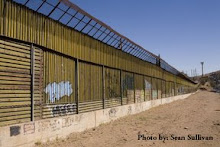
The No Border Wall Coalition strongly endorses the Border People’s March to Stop the Wall, currently underway on the Texas – Mexico border. Marchers will follow the route of the 57-mile segment of border wall that is being built from Ft. Hancock, Texas, to El Paso, Texas. Led by No Wall – Big Bend and the Border Ambassadors, they plan to highlight the tremendous human and environmental costs of the wall in west Texas and along the entire U.S. – Mexico border.
Marchers will set off from Fort Hancock today, and arrive in El Paso on Sunday, August 31. More information about the march and its route is available at the Border Ambassadors website - www.borderambassadors.com .
Of special concern along the marchers’ route is the impact of the border wall on Native American communities. Like the Tohono O’Odham farther west, the lands that the Ysleta del Sur Pueblo of the Tigua Nation calls home lie on both sides of what is now the international border. The Rio Grande is crucial not only for providing water in a harsh, dry environment, it is also integral to their religious practices. As the Rio Grande is walled off, the Tiguas have stated that they will be cut off from graves and sacred sites.
There are laws on the books, most notably the American Indian Religious Freedom Act and the Native American Graves Protection and Repatriation Act, that should prevent this assault on the Tiguas religion and culture. But section 102 of the Real ID Act allows Department of Homeland Security Secretary Chertoff to brush aside any law that might slow construction of the border wall. On April 1, 2008 he did just that, “waiving in their entirety” 36 federal laws including the American Indian Religious Freedom Act and the Native American Graves Protection and Repatriation Act.
The Tiguas are party to a challenge to the constitutionality of the Real ID Act’s waiver provision, alleging that giving an unelected administration appointee the power to waive laws passed by Congress and signed by the President for the express purpose of subverting the judiciary is a violation of the separation of powers enshrined in the U.S. Constitution. They are joined by El Paso County, the El Paso County Water Improvement District No. 1, the Hudspeth County Conservation and Reclamation District No. 1, Galeria 409, The Frontera Audubon Society, the Friends of the Wildlife Corridor, and the Friends of Laguna Atascosa National Wildlife Refuge. The wide spectrum of plaintiffs challenging the Department of Homeland Security’s suspension of laws points to the broad range of negative impacts that the wall will have in Texas, as well as the rest of our nation’s borderlands.
The same river that provides a focal point for the Tiguas’ religious ceremonies is equally important for the survival of plant, animal, and human communities. The Rio Bosque Wetlands Park has also spoken out against the wall, stating that, “A fence would limit the ability of native terrestrial species to move between such areas and the floodway. It would limit genetic exchange and would fragment populations that are currently connected.” As habitat is fragmented and access to the river is denied, animals, particularly those that are listed as federally threatened or endangered, may not survive.
With border wall construction currently under way near El Paso and elsewhere, it is critically important that we remind members of Congress that the elections that they are currently obsessed with are just the entrance exam for their jobs. Elections are meant to bring in public servants, and it is their job to serve the best interests of the American people. Building walls that will cut off the Rio Grande, that will disrupt Native American religious practices and disturb graves, that will destroy natural areas such as the Rio Bosque Wetlands Park, and will cost U.S. taxpayers billions of dollars, is unconscionable. As our public servants once again come before the American people, asking for our votes, it is important that they know that we will hold them accountable for their actions.
Showing posts with label events. Show all posts
Showing posts with label events. Show all posts
Thursday, August 28, 2008


Thursday, September 20, 2007
Brownsville NO BORDER WALL Pachanga in the Park
Everyone is invited to the Brownsville No Border Wall Pachanga in the Park on Saturday, September 29. This is the latest in a series of community rallies to oppose the building of a wall along the Texas-Mexico border sponsored by the No Border Wall coalition. It will begin at 5:00 pm at Dean Porter Park in Brownsville, Texas.
Participants hope to show the nation just what is at risk if a wall is built through the city of Brownsville and along the rest of the border. Bishop Raymundo J. Peña of the Diocese of Brownsville will be the keynote speaker. The Bishop, whose diocese operates 107 parishes and missions for the almost 800,000 Catholics who live in the Rio Grande Valley, has been outspoken against the construction of a wall along the U.S.-Mexico border. The Bishop’s opposition echoes the sentiment of the Vatican, where a top official has called the U.S. plan to build a border wall “inhuman.” Community leaders, including state representatives Eddie Lucio III and Juan Escobar, will voice the concerns of their constituents, and local experts will discuss the negative impact a wall could have on our communities, historical landmarks, farms, and natural areas. While the children fly specially-made kites and smash a wall-shaped piñata, adults can listen and dance to live South Texas music into the evening.

Building a border wall along the Rio Grande will cut a wide swath through the city of Brownsville. Maps to date have shown the proposed wall following the flood control levee that runs through the city, rather than the river itself. Parts of the downtown area, with its rich history and charming old buildings, are at risk for demolition because they lie so close to this levee. The University of Texas at Brownsville’s International Technology, Education and Commerce Campus could be cut off entirely by the wall, since it lies to the south of the levee. A border wall could also threaten the close economic and social ties between Brownsville and its sister city Matamoros. Outside the city, landowners and farmers could lose land and critical access to river water for irrigation. A double-layered wall and Border Patrol road could also cut through nearby natural areas such as the Sabal Palm Audubon Sanctuary and the Nature Conservancy’s Lennox Foundation Southmost Preserve. University of Texas at Brownsville Vice President of External Affairs Dr. Tony Zavaleta said, “In my forty odd years of studying the U.S.-Mexico border I have never seen anything suggested by either government that is so wrong headed and destructive to our communities and our people as this border wall.”
To get to Dean Porter Park, exit 6th Street from Expressway 77/83. Turn right on 6th and take another right at the first light, Ringgold Street. Turn right again onto Dean Porter Park Street. The park entrance will be on the left.
Participants hope to show the nation just what is at risk if a wall is built through the city of Brownsville and along the rest of the border. Bishop Raymundo J. Peña of the Diocese of Brownsville will be the keynote speaker. The Bishop, whose diocese operates 107 parishes and missions for the almost 800,000 Catholics who live in the Rio Grande Valley, has been outspoken against the construction of a wall along the U.S.-Mexico border. The Bishop’s opposition echoes the sentiment of the Vatican, where a top official has called the U.S. plan to build a border wall “inhuman.” Community leaders, including state representatives Eddie Lucio III and Juan Escobar, will voice the concerns of their constituents, and local experts will discuss the negative impact a wall could have on our communities, historical landmarks, farms, and natural areas. While the children fly specially-made kites and smash a wall-shaped piñata, adults can listen and dance to live South Texas music into the evening.
Building a border wall along the Rio Grande will cut a wide swath through the city of Brownsville. Maps to date have shown the proposed wall following the flood control levee that runs through the city, rather than the river itself. Parts of the downtown area, with its rich history and charming old buildings, are at risk for demolition because they lie so close to this levee. The University of Texas at Brownsville’s International Technology, Education and Commerce Campus could be cut off entirely by the wall, since it lies to the south of the levee. A border wall could also threaten the close economic and social ties between Brownsville and its sister city Matamoros. Outside the city, landowners and farmers could lose land and critical access to river water for irrigation. A double-layered wall and Border Patrol road could also cut through nearby natural areas such as the Sabal Palm Audubon Sanctuary and the Nature Conservancy’s Lennox Foundation Southmost Preserve. University of Texas at Brownsville Vice President of External Affairs Dr. Tony Zavaleta said, “In my forty odd years of studying the U.S.-Mexico border I have never seen anything suggested by either government that is so wrong headed and destructive to our communities and our people as this border wall.”
To get to Dean Porter Park, exit 6th Street from Expressway 77/83. Turn right on 6th and take another right at the first light, Ringgold Street. Turn right again onto Dean Porter Park Street. The park entrance will be on the left.
Tuesday, August 28, 2007
The La Lomita NO BORDER WALL Festival
BY STEFANIE HERWECK
MISSION, TEXAS -- From the outside, the small chapel on the banks of the Rio Grande looks like a relic of times past. The plaster has melted away in places exposing the bare adobe and stone walls underneath. The whitewash is peeling off the sturdy old wooden doors and shutters. The wood-shingled roof is weathered and bowed. A plaque beside the front door proclaims that this chapel, La Lomita, is a registered historic landmark, built in 1899 by the Oblate priesthood on land that was donated in 1861 and had originally been part of a 1767 Spanish land grant.
 Inside its walls, however, history retreats. The chapel comes to life. Candles line the altar, all glowing with a steady light. Bright silk flowers are strewn through the rafters and around the image of the Virgin of Guadalupe in an alcove above. Below the Virgin there are other images—small framed photographs of young men and women in uniform. A pink balloon tied to the edge of the dais floats in the still air: It’s a Girl! And everywhere, scattered on the altar, leaning against candles, stuck into the crevices of the woodwork, there are pieces of paper folded small or rolled into tiny scrolls, the prayers of the faithful.
 Worried about the loss of this important cultural site and the other cultural, environmental, and economic destruction that a wall might cause to their border communities, about 300 people gathered on the grounds of La Lomita Chapel for a La Lomita NO BORDER WALL Festival on August 25. Under the shade of the mesquite trees, people listened as Texas State Representatives Kino Flores and Aaron Peña spoke out against the border wall. “It would be a scar across our community. It would be something that divided our friends, our business partners, our relatives, and another country with which we have good relations,” Peña said. Aides for U.S. Congressmen Henry Cuellar and Ruben Hinojosa also relayed each congressman’s opposition to the border wall.
 After the speakers Father Roy Snipes, pastor of Our Lady of Guadalupe Church in Mission, lead the crowd in a procession from the chapel onto the levee road. Children at the front of the procession carried a retablo depicting Father Keralum, one of the Oblate priests that founded the mission at La Lomita. The marchers carried signs and the banners of the organizations represented at the festival, among them Holy Spirit Peace and Justice, Pax Christi, the Sierra Club, Frontera Audubon Society, LUPE, and the Coalition Against Immigrant Repression. They were accompanied by the music of the Our Lady of Guadalupe mariachi band on the way to the nearby Riverside Club and onto a pontoon boat docked on the river’s edge.
 At the end of the procession, the pontoon boat made several other runs to make sure that everyone had the opportunity to experience the Rio Grande. Meanwhile, children were taking turns smashing a large piñata shaped like a forbidding gray wall. Parents shouted encouragement to their children, “Break down the wall!” When the candy was distributed and the pieces of piñata picked up, the sun went down over the river to the music of Rumbo al’ Anacua, featuring Rosa and Joe Perez, musicians and educators who seek to revive and preserve traditional musical forms of the Texas-Mexico border region.
MISSION, TEXAS -- From the outside, the small chapel on the banks of the Rio Grande looks like a relic of times past. The plaster has melted away in places exposing the bare adobe and stone walls underneath. The whitewash is peeling off the sturdy old wooden doors and shutters. The wood-shingled roof is weathered and bowed. A plaque beside the front door proclaims that this chapel, La Lomita, is a registered historic landmark, built in 1899 by the Oblate priesthood on land that was donated in 1861 and had originally been part of a 1767 Spanish land grant.
 Inside its walls, however, history retreats. The chapel comes to life. Candles line the altar, all glowing with a steady light. Bright silk flowers are strewn through the rafters and around the image of the Virgin of Guadalupe in an alcove above. Below the Virgin there are other images—small framed photographs of young men and women in uniform. A pink balloon tied to the edge of the dais floats in the still air: It’s a Girl! And everywhere, scattered on the altar, leaning against candles, stuck into the crevices of the woodwork, there are pieces of paper folded small or rolled into tiny scrolls, the prayers of the faithful.
People revere the long and significant history of La Lomita Chapel by continuing to make it a vital part of their lives, praying and commemorating important life events here. But this continuity is threatened by the more than 700 miles of border fencing called for by the Secure Fence Act that was signed into law by President Bush last fall.
The Act calls for a stretch of the border wall in Texas to run from Laredo to Brownsville through this area south of Mission. La Lomita Chapel lies between the river and the flood control levee that parallels the river to the north. The Department of Homeland Security has said that in the Lower Rio Grande Valley the border wall will be erected north of the levee, rather than directly on the Rio Grande. This would wall off the little chapel, rendering it inaccessible to the community and effectively ceding the land it is situated on to Mexico.
 Worried about the loss of this important cultural site and the other cultural, environmental, and economic destruction that a wall might cause to their border communities, about 300 people gathered on the grounds of La Lomita Chapel for a La Lomita NO BORDER WALL Festival on August 25. Under the shade of the mesquite trees, people listened as Texas State Representatives Kino Flores and Aaron Peña spoke out against the border wall. “It would be a scar across our community. It would be something that divided our friends, our business partners, our relatives, and another country with which we have good relations,” Peña said. Aides for U.S. Congressmen Henry Cuellar and Ruben Hinojosa also relayed each congressman’s opposition to the border wall.
Dr. Sue Sill of the North American Butterfly Association Butterfly Park discussed the fate of the Rio Grande Valley wildlife corridor. The corridor is comprised of tracts of land, many of which are situated along the proposed path of the wall, in which the native vegetation has been painstakingly restored in order to provide viable habitats for birds, butterflies and mammals including endangered species such as the ocelot. Martha Sanchez of La Union del Pueblo Entero (LUPE) encouraged the crowd to take a stand against the border wall because of the terrible message it sends to immigrants, whose labor is so important to this country. Rey Anzaldua, a local resident and landowner whose family has lived in the area since the time of the Spanish land grants, decried the loss of homes and property that a border wall would surely bring.
 After the speakers Father Roy Snipes, pastor of Our Lady of Guadalupe Church in Mission, lead the crowd in a procession from the chapel onto the levee road. Children at the front of the procession carried a retablo depicting Father Keralum, one of the Oblate priests that founded the mission at La Lomita. The marchers carried signs and the banners of the organizations represented at the festival, among them Holy Spirit Peace and Justice, Pax Christi, the Sierra Club, Frontera Audubon Society, LUPE, and the Coalition Against Immigrant Repression. They were accompanied by the music of the Our Lady of Guadalupe mariachi band on the way to the nearby Riverside Club and onto a pontoon boat docked on the river’s edge.
The boat, festooned with a “NO BORDER WALL” banner, made a circuit up and down the Rio Grande. Upriver, the boat cruised by riverside homes and campgrounds on the banks. Downriver, the vegetation becomes denser signaling the beginning of a tract of valuable wildlife habitat. Local biologist Ken King pointed out the area, “The low-lying spots further in contain mature riparian forests of cedar elm covered in Spanish moss—it’s great habitat, and not much of it is left in the Rio Grande Valley.”
 At the end of the procession, the pontoon boat made several other runs to make sure that everyone had the opportunity to experience the Rio Grande. Meanwhile, children were taking turns smashing a large piñata shaped like a forbidding gray wall. Parents shouted encouragement to their children, “Break down the wall!” When the candy was distributed and the pieces of piñata picked up, the sun went down over the river to the music of Rumbo al’ Anacua, featuring Rosa and Joe Perez, musicians and educators who seek to revive and preserve traditional musical forms of the Texas-Mexico border region.
As people ate, drank, and danced on the banks of the Rio Grande in the evening, festival organizer Betty Perez said, “We want to show the nation how important our culture is to us, how important our river is to us. We don’t want it walled off.”
To see video of the La Lomita No Border Wall Festival, go to http://blog.rgv-life.com/ and scroll down to the August 26 entry.
Subscribe to:
Posts (Atom)