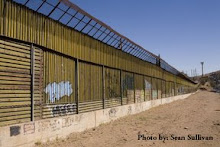
Ackerman’s civil disobedience sprang from a desire to defend the Rio Bosque Wetlands Park, a protected natural area on the Rio Grande in El Paso, Texas. Rio Bosque is situated along a stretch of the old, winding river channel in which the Rio Grande flowed before it was straightened and channelized in the 1930s. The park’s wetlands were created in 1997, and, through years of volunteer work, the native wetland habitat was painstakingly restored. Ten years later, it’s one of the few places where one can imagine what the El Paso area must have been like when the river wound freely through the mountains and desert and had ample flow to support rich wetlands and big cottonwood trees. Judy Ackerman is one of the many volunteers who made this vision possible.
But the border wall threatens this rebirth of nature. Its path will cut off Rio Bosque from the river, preventing the movement of species and severely limiting the park's value as habitat. For Ackerman and the other longtime Rio Bosque volunteers who know that the river and the wetlands are intimately and inextricably connected, the border wall is a knife through the heart.
For the simple, nonviolent action of standing her ground on the border wall construction site, Ackerman has been charged with violating the law, but the border wall itself has been placed above all of our nation’s laws. The Real ID Act gives the Secretary of Homeland Security the power to waive any federal, state, or local law that might slow down construction of the wall. No one else, not even the president, has this sweeping power. On April 1, 2008, DHS Secretary Michael Chertoff “waived in their entirety” 36 federal laws all along the southern border, including the Clean Water Act, the Endangered Species Act, and the National Environmental Policy Act. There is only one reason to waive these laws: Chertoff knows that the border wall cannot be built without violating them. His waiver is an implicit admission that constructing the border wall means breaking the law.
After her arrest, law enforcement officers brought Ackerman before a judge to be arraigned. But under the Real ID Act, neither she nor anyone else may use the courts to challenge the border wall, regardless of the damage it causes or the danger it represents. Chertoff’s waiver swept aside our legal right to demand in court that the government obey its own laws. The only jurisdiction the courts have is to determine whether or not the Real ID Act waiver provision is constitutional. El Paso County and nine other plaintiffs have claimed that it is not and are asking the Supreme Court to hear their case. In the meantime, the border wall continues to be built, devastating our border communities and natural areas, flouting our nation’s laws, and undermining our constitutionally-guaranteed right to equal protection under the law.

Some would go so far as to say that these are among the freedoms we should willingly give up in exchange for security. But this trade-off is a false one based on the twin myths that our borders are broken and that border walls will protect us.
Our borders are not broken. Well before the new walls started going up there, the El Paso Border Patrol Sector was reporting a decrease in the apprehensions of illegal crossers. From 2005 to 2007, apprehensions in the El Paso sector fell by 38 percent. Even more telling, this year El Paso has been named the nation's third-safest city among cities with populations of 500,000 or more, and it has consistently ranked in the top 3 safest large cities for a decade.
Border walls do not make the United States safer, nor do they stop undocumented immigration or smuggling. A 2007 report by the Congressional Research Service found that existing walls in San Diego “did not have a discernible impact on the influx of unauthorized aliens coming across the border.” In fact, during the same period that El Paso experienced a 38 percent drop in illegal crossings, San Diego had a 20 percent increase in crossings despite the presence of a triple-layered border wall there.
Those who say we must give up our freedom for security are in reality asking us to sacrifice one of the founding principles of our republic, the rule of law, for nothing but a false sense of security.
Judy Ackerman trespassed, disrupted border wall construction, and stood her ground. For this she was duly arrested and charged with a crime. But on the same ground where Ackerman made her stand, The Department of Homeland Security is willfully and destructively ignoring the law. One man has decided which laws apply and which do not and has single-handedly dismissed our right to sue for protection under the law. Ackerman’s trespassing charge is a misdemeanor. But the border wall construction that restarted soon after her arrest is a much more serious crime, and Chertoff’s waiver of laws is a flagrant violation of the principles upon which our nation was founded.