Showing posts with label Hidalgo. Show all posts

Tuesday, April 1, 2014

Arresting Babies on the Border

by Scott Nicol


“They’re arresting babies.”

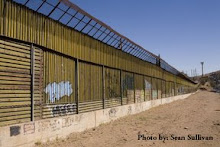
The thought struck hard, and it kept echoing.  I had come to the border wall with a correspondent from National Public Radio to see its impact on the environment.  We had also seen evidence of the apprehensions that occur there daily.  Piles of shoelaces and belts that immigrants were forced to abandon before being taken into custody, and even a pair of plastic toy helicopters, littered the ground.


The Border Patrol agent said that they had captured eighteen people.  Most sat in a line in the dirt beside the rusting wall as agents took their names and bagged their possessions.  Only three or four were adults.

Inside a Border Patrol van, escaping the heat, were two mothers, each with an infant in her arms.  On the seats beside them were a pair of toddlers.

The Border Patrol would probably prefer not to use the term “arrest,” but the children were taken into custody along with the rest of their family.  All eighteen will be included in the sector’s apprehension statistics.

In 2013 the Border Patrol apprehended 26,027 juveniles in its Rio Grande Valley sector, 21,553 of whom were unaccompanied.  Border-wide 38,833 out of the 47,238 minors who were captured were traveling without an adult.  At least these children were not on their own.

Call it an apprehension, call it an arrest, for a child too young to walk or talk the terminology does not matter.

The United States of America, through elected Representatives who are meant to express the will of its citizens, spent $18 billion last year to keep these families out.  A few years back taxpayers spent $12 million per mile to build the border wall that stood nearby, and more than $3 billion was spent to wall off 652 miles of the southern border.  From 1995 to 2003 we doubled the size of the Border Patrol, then over the last decade we doubled their ranks again.  They carry out the mission that we have given them.

We are arresting babies.

And toddlers.  And teenagers.  And adolescents.  And their parents.

We have decided that the people I saw lined up beside the wall, parents who traveled hundreds of miles from Guatemala looking for work with children in tow, threaten us.

Like most who walk or swim across the border they are not terrorists, they are not smugglers, they simply want a better life.  They are parents struggling to feed their families.  They are children hoping to escape violence, go to school, live the American Dream.  So long as that desperation and desire remains people will keep coming. 

This is not a challenge to our nation’s defenses, it is a test of our conscience.

When the Senate took up immigration reform they failed to grasp this.  They made a “border surge,” with hundreds of miles of new border wall, a further ballooning of the Border Patrol, and tens of billions of dollars of new military hardware, a “trigger” that must be completed before anyone currently in the country could start on a thirteen-year-long pathway to citizenship.  The irrational fears of middle American voters who only see the border when they watch FOX News or Border Wars on TV had to be appeased.


Even with the “surge” Republicans in the U.S. House refuse to even debate immigration reform.  They are far less concerned with the children sitting in a line on the dirt beside the wall than they are about a Tea Party challenge in the next primary election.

The Border Patrol agents called headquarters to have child car seats sent out.  Older kids shuffled back into the green and white van, now lacking belts and laces for their sneakers.

After they drove off we began to walk back along the top of the levee.  Through the border wall’s rusting bollards we could see another mother being marched out of the brush, clutching an infant to her chest.

As the sun settled into the treetops the wind carried the baby’s cries.

Friday, September 16, 2011

CBP Willing to Risk Flooding to Erect New Walls in Roma, Rio Grande City and Los Ebanos

By Scott Nicol

It was just over a year ago that the rising waters of the Rio Grande prompted the mandatory evacuation of Los Ebanos, Texas. Residents rushed to grab what they could before floodwaters cut off the town.

Before the flood, Customs and Border Protection (CBP) was pressuring the U.S. half of the International Boundary Water Commission (USIBWC) to approve the construction of border walls through Los Ebanos, as well as Rio Grande City and Roma, that could have worsened the flooding. CBP had even gone so far as to request that the US half of the International Boundary Water Commission act “unilaterally” and approve walls in the floodplain despite the objections of the Mexican half.

The plans for border walls drafted after the passage of the Secure Fence Act showed South Texas on the receiving end of 69 miles of border wall in 21 disconnected sections. The westernmost three sections, designated O-1, O-2, and O-3, were to be through the communities of Roma, Rio Grande City, and Los Ebanos.

In 2008 the US International Boundary Water Commission made it clear that any walls built along the Rio Grande must comply with US-Mexico treaties. The Real ID Act allowed the Department of Homeland Security (DHS), Customs and Border Protection’s parent agency, to waive all federal, state, and local laws, but not treaties. Walls built in the flood plain adjacent to the Rio Grande might deflect flood waters towards Mexico, causing flood damage to Mexican communities. Deflection might also cause the river to settle into a new channel farther to the south, which would effectively change the location of the US-Mexico boundary. Either of these would be a treaty violation.

In Cameron County and most of Hidalgo our treaty obligations meant that border walls could not be built between the existing flood control levees and the river, so walls were constructed on, in, or north of the levees. Those walls are, for the most part, finished. But unlike the downriver sections, Roma, Rio Grande City, and Los Ebanos do not have USIBWC flood control levees. The border walls in these three communities would therefore be in the flood plain.

Because of the wall’s likely flood impacts USIBWC rejected these three sections of border wall.

A few days after the 2008 elections CBP informed Representative Cuellar, whose district encompasses these communities, that these border wall sections were “on hold.” At the time Cuellar said, “This is a big victory.” He went on to tell the Associated Press, “We're hoping that this will allow us to work with the next president to find ... alternative methods for security."

Representative Cuellar’s constituents also hoped that that would be the last they would hear of plans to wall off their towns from the river, but in a May, 2010 report on the Secure Border Initiative (which includes both solid and “virtual” border walls) the Government Accountability Office stated, “CBP plans to construct an additional 14 miles of pedestrian fencing in the Rio Grande Valley sector.” These 14 miles are the combined Roma, Rio Grande City, and Los Ebanos sections.

Documents uncovered by the Sierra Club through a Freedom of Information Act request over the last year demonstrate that, in fact, the Department of Homeland Security and Customs and Border Protection continued to push for the construction of these walls, and were willing to disregard our treaty obligations and likely problems with flooding to do so.

A Customs and Border Protection “Fence Status Brief” dated April 27, 2009 reveals that to build the previously rejected walls CBP had decided upon a new plan. They would not change the design or location of the walls, or, better yet, give up on them entirely. Instead it says, “the new strategy involves developing a new floodplain model” and that, unlike the old model approved by USIBWC that “predicted noteworthy floodplain impacts from the fence,” “this model will demonstrate the impacts of the proposed fence will be minimal.”

The verb tense - "this model will demonstrate" - is important. It appears that CBP determined the outcome in advance, rather than commissioning an honest, unbiased model that would accurately describe the effects of structures built in the floodplain.

The “new flood plain model”, prepared by Baker Engineering, was completed in December 2009. Presented to CBP eight months after their fence status brief forecast its findings, its conclusion fit the earlier prediction precisely. The “noteworthy floodplain impacts” of building border walls in a floodplain that were predicted just a year earlier disappeared; instead, Baker now claimed that walls would have a “minimal effect on the Rio Grande floodplain.”

Baker decided this without even knowing what type of border wall design would be used. In 2008, CBP proposed a number of designs that were touted as either allowing floodwaters to pass through without being dammed up, or able to be removed before rising water reached them. USIBWC rejected all of these unrealistic schemes. In their 2009 report Baker modeled the border wall as an 18’ high, impermeable wall, with the specific design, whether concrete or steel, posts or mesh or slabs, to be determined later. Since CBP apparently told Baker what the outcome of their modeling would be before they began, it seems that such details were unimportant.

One striking conclusion of Baker’s “new flood plain model” was that in the communities of Roma, Rio Grande City, and Los Ebanos, border walls would “split” the flooding river. It states that for each wall segment, “Downstream of the flow split location, the flow continues in a north branch and a south branch on either side of the fence. The flow combines downstream of the point where the fence ends.”

This splitting is intentional. In the case of Rio Grande City, the wall was modeled with a 500 foot-wide opening in the middle specifically intended to split flood waters and send a portion of them north. Diverting water to the north of the border wall, into property on the US side of the river, means that less is deflected into Mexico. In this way CBP hopes to avoid flooding Mexican communities, and possibly pushing the Rio Grande into a new channel. Walls built in a floodplain will either deflect or divert floodwater, and the only real question is who is going to be on the receiving end.

Each of these wall sections begins upstream of a town and ends downstream of it. They begin close to the river, then the river and wall get farther apart before coming back together. So flood water that might not have reached properties where the proposed wall is farthest from the river will, with a wall in place, have “split” floodwaters channeled directly to them.

This is particularly striking for the Los Ebanos section. The community of Los Ebanos is nestled at the top of a deep bend in the river. The proposed wall would begin next to the Rio Grande at the top of this bend. While the river turns and heads due south, away from homes and the local school, the wall heads due east, directly towards them. That means that water that might have otherwise followed the river and flowed away from Los Ebanos will be split off by the wall, and be diverted into it. On the other side of town, instead of allowing the split flood waters to pour back into the Rio Grande, the wall makes a ninety degree turn, from east to north. Water that had been split off from the flooded river would therefore be bottled up in Los Ebanos.

A Customs and Border Protection Fence Status Brief dated January 20, 2010, written following the presentation of the “new flood plain model” to the Army Corps of Engineers and USIBWC, says that, “[acting USIBWC Commissioner] Ruth agreed no additional modeling is required and to ‘informally’ discuss the fence segments with the new Mexican IBWC Commissioner to determine if he will support.” The brief goes on to state that, “If it appears Mexico will continue to oppose fencing, CBP/DHS and IBWC/DOS [Department of State] to discuss potential unilateral decision to proceed with construction.”

A “unilateral decision” regarding the Rio Grande floodplain, taken by the US half of the International Boundary Water Commission in the face of opposition by the Mexican half, would be a serious treaty violation. The United States would essentially be challenging Mexico to try to stop us from building illegal walls.

On January 21, 2010, acting USIBWC Commissioner Ruth stepped aside, and Edward Drusina became the new commissioner. On his first day in office Commissioner Drusina wrote a letter to David Aguilar, the acting Commissioner of Customs and Border Protection. He stated that, after examining the model that CBP had commissioned, “the USIBWC is not in a position to approve construction of the O-1, O-2 and O-3 fence projects.”

Rather than accept the fact that walls built in the Rio Grande floodplain will have unacceptable impacts, CBP repeatedly pressed the USIBWC to reverse its decision. On February 2, 2010, Aguilar responded to Drusina, “we respectfully request that the USIBWC and Department of State reconsider your position and approve a unilateral decision to allow us to proceed with the design and construction of the O-1, O-2 and O-3 fence segments.”

On July 20, just one week after the flooding Rio Grande forced the mandatory evacuation of Los Ebanos, CBP presented a briefing to the State Department on these three border wall sections. During the briefing CBP claimed that they had already spent “+$1M in “design analysis” costs”, and said that, “we need IBWC and Department of State’s support for an unilateral decision to proceed with the fence construction.”

USIBWC stood firm, and on September 17, 2010, Comissioner Drusina again denied CBP permission to build new walls in the Rio Grande flood plain. CBP continued to push back, and a month later the new CBP Commissioner, Alan Bersin, wrote to USIBWC, asking that they reconsider and complaining about “Mexico’s recent opposition to border fencing regardless of hydraulic modeling results.”

Bersin’s October 2010 letter to USIBWC is the most recent document uncovered by the Sierra Club’s Freedom of Information Act request. The Club was told that to obtain newer documents another request would have to be filed. One has, but it may take months for us to begin receiving more documents.

We have learned through a recent conversation with representatives of the USIBWC and State Department that following the October 2010 letter Commissioners Bersin and Drusina held at least two meetings to discuss the Roma, Rio Grande City, and Los Ebanos walls. As a result of those meetings Baker Engineering was commissioned to develop yet another flood model. That model was completed last spring, and was reviewed by the Army Corps. of Engineers and USIBWC over the summer. It has not been released to the public.

While we hope that USIBWC continues to act in the best interests of the residents of these three communities and live up to its treaty obligations in the face of pressure from Customs and Border Protection, we have no guarantees. The discussions between these two agencies are being held behind closed doors, with landowners and community leaders kept out of the room. It may be months before we are able to see a copy of the latest flood model, and the only announcement that new border walls have been approved may be the arrival of construction crews.

US Representative Henry Cuellar, who represents Roma, Rio Grande City, and Los Ebanos in Washington, should ensure that his constituents are kept informed and given a seat at the table when walls that could channel flood waters into their homes and property are discussed. As the ranking member of the House Homeland Security Subcommittee on Border and Maritime Security, he has the power to demand that CBP hold open public hearings in each of these communities. Customs and Border Protection owes residents the decency of a face to face explanation, before they build new border walls that could put people’s lives and properties at risk.

Thursday, March 19, 2009

Hidalgo County's Border Wall is Nothing to Brag About

By Scott Nicol

Last March, Hidalgo County Judge JD Salinas cut a deal with Department of Homeland Security Secretary Michael Chertoff to build part of the border wall. Rather than build the wall to the north of the levee, DHS would insert it into the levees in Hidalgo County. It was estimated that this would raise the per-mile cost from $3 million to $5 million, so the county agreed to pay $44 million. When the bids came in, the low bids were $12 million per mile. As a result of Judge Salinas' capitulation Hidalgo County's border walls are nearly finished, while neighboring Starr County's wall construction has not begun, and Cameron County's is just beginning. They still have the chance to fight to halt construction, while for Hidalgo County the fight moves from stopping the wall entirely to preventing pro-wall zealots from filling in the spaces between levee-walls.


In his recent State of the County address, Judge JD Salinas made statements regarding the levee-border wall that were, to put it charitably, less than honest.

Judge Salinas said,


"The levee-barrier, which was the alternative reached by the Hidalgo County Drainage District and the U.S. Department of Homeland Security, is now 95 percent complete. This solution has saved residents and businesses from purchasing $150 million per year in mandatory flood insurance. It has prevented private land from being taken by the federal government, and the flood control structure is more environmentally-sensitive than the proposed border fence."


As to his first point regarding the money saved by residents who will not need to purchase flood insurance, the levee-border wall did not replace all of the levee sections in Hidalgo County that were deemed inadequate. In a number of instances, portions of our levees that were not in need of repair were ripped apart to insert border walls. Other sections that are still in bad shape were not touched by the levee-border wall scheme. This is because the locations of levee-border walls had nothing to do with Hidalgo County’s flood control needs. They were decided upon by the Department of Homeland Security, without consulting locals, and without regard to the condition of the flood-control levees in any given area.


Luckily for Hidalgo County property owners, the economic stimulus package contains funds to rebuild our remaining decrepit levees. It is these repairs that will keep us from having to purchase flood insurance, not the border wall. If Judge Salinas had not capitulated to the demands of the Department of Homeland Security, those funds would also have been available to repair the levees in the places that are now border walls. Unfortunately for Hidalgo County residents, there is no money in the stimulus package to reimburse us for the $44 million that Judge Salinas spent to build the levee-border wall. Congress almost never appropriates money for projects that are already finished, so it is highly unlikely that Hidalgo County taxpayers will ever be reimbursed for the levee-border wall. Rather than save us millions, as he claims, the border walls that Salinas built have cost us millions of dollars.


As for the idea that the levee-border wall is better for the environment than Homeland Security’s original border wall designs, Judge Salinas knows full well that the opposite is true. Last March the US Fish and Wildlife Service (USFW) wrote a letter to the Department of Homeland Security in response to the plan to build levee-border walls in Hidalgo County. It said,


“This combined project would eliminate wildlife passage by replacing CBP’s original “wildlife friendly” fence design with an impermeable 16 to 18 foot high wall built into a flood control levee. This new project design would effectively eliminate the wildlife passage component of the earlier design and would impair the ability of the wildlife corridor to fulfill its function. […] We would like to document that any proposed fence and/or levee segment that bisects lands within the Lower Rio Grande Valley National Wildlife Refuge cannot be found compatible with the purposes for which the Refuge was established.”


Today the levee-border walls in Hidalgo County hit 12 tracts of the Lower Rio Grande Valley National Wildlife Refuge, along with 3 tracts managed by Texas Parks and Wildlife, a World Birding Center, and property owned by the Nature Conservancy.


In contrast to Judge Salinas’ claims of environmental benefit, former Secretary of Homeland Security Michael Chertoff knew that the levee-border wall would violate numerous environmental laws. Last April he used the Real ID Act to issue 2 waivers of federal laws, one of which was specifically for the Hidalgo County levee-border wall. It brushed aside 27 laws, including the Endangered Species Act, the Migratory Bird Treaty Act, the Safe Drinking Water Act, and the National Environmental Policy Act. If the wall was in any way “environmentally-sensitive”, as Judge Salinas says, Chertoff could have left these laws in effect.


A visit to the Old Hidalgo Pumphouse World Birding Center makes the negative environmental impact of the levee-border wall painfully clear. The path that once led from the birding center into the adjacent USFW refuge tract is blocked by a concrete wall topped with rusting steel pickets. Not only are wildlife such as bobcats, or even endangered ocelots, stopped from moving freely, but birders and eco-tourists are also unable to access the 600 acre wildlife refuge tract that contains the birds and wildlife that they come to see.


The Old Hidalgo Pumphouse World Birding Center opened in April of 2007, and was the result of a joint effort of the city of Hidalgo, Hidalgo County, Texas Parks and Wildlife, and US Fish and Wildlife. Like other World Birding Centers in the Rio Grande Valley, it is meant to both preserve natural habitat and bring eco-tourists. Eco-tourism brings $125 million per year to the area, and Hidalgo hoped to attract some of those dollars. But eco-tourists come to see nature, not towering concrete and rusting steel, so the millions that have been invested to develop the birding center have been lost.


Tourists are also unlikely to visit a place that they think is a war zone. In the past few weeks the national press has been filled with sensationalistic headlines about the possibility that Mexico will become a “failed state”, and that violent “spillover” will sweep through border communities. Such stories generally fail to mention that while Juarez is being racked by violence, FBI statistics show that El Paso, just across the Rio Grande, is the third safest large city in the United States. San Diego and Brownsville are likewise far safer than the nation’s capitol, Washington, DC. Instead of refuting this misperception, Governor Perry and Senator Cornyn have reinforced it with calls for the mobilization of troops on the border. When people in Middle America hear this, and see that Hidalgo County’s Judge collaborated with the Department of Homeland Security to build the border wall, it looks like further evidence that Mexico poses a military threat to South Texas. Who in their right mind would come here on vacation?


The headlines screaming about “spillover” violence are already being used to call for a further militarization of the border. When the first walls built in California failed to slow the influx of immigrants, the response from Congress was not to try something else. Instead, two weeks ahead of the 2006 midterm election, they passed the Secure Fence Act, which called for more walls. With members of Congress trying to look hawkish on Homeland Security, there are guaranteed to be calls to build even more border walls. In the Rio Grande Valley the border wall is in 21 separate sections, ranging from nine-tenths of a mile to 6 miles long. It will be much harder to fight off calls to fill in the gaps in South Texas’ border wall with Judge Salinas’ repeatedly praising the levee-border wall. If the walls that he has already helped to build are such a blessing, why would he oppose the erection of more walls?


While on the surface his State of the County address is the run-of-the-mill self-congratulation that we expect from a politician, in fact his words have real consequences. Following his capitulation to former Secretary Chertoff, Judge Salinas went from being an opponent of the wall to the Department of Homeland Security’s poster boy. In press releases and Congressional testimony they use him to show that they are working with local stakeholders, rather than ignoring local concerns, condemning private and municipal property, and irreparably damaging border communities, economies, and ecosystems. Judge Salinas’ words provide DHS with cover as they continue to strong arm our next-door neighbors in Cameron County, as well as our friends in California.


Of course it is naïve to expect a politician to own up to his mistakes, to admit to being suckered into a bad deal that has cost his constituents millions of dollars. It is unrealistic to expect a mea culpa from Judge Salinas. But if he truly cares about the residents of Hidalgo County, the people who elected him and who he claims to serve, JD Salinas needs to stop trying to rebrand his greatest failure as a shining success. The wall is not a “solution” for any of the problems that we face. The border wall is a symbol of hatred, a blight on our communities, and a scar upon the landscape.