By Scott Nicol
Last March, Hidalgo County Judge JD Salinas cut a deal with Department of Homeland Security Secretary Michael Chertoff to build part of the border wall. Rather than build the wall to the north of the levee, DHS would insert it into the levees in Hidalgo County. It was estimated that this would raise the per-mile cost from $3 million to $5 million, so the county agreed to pay $44 million. When the bids came in, the low bids were $12 million per mile. As a result of Judge Salinas' capitulation Hidalgo County's border walls are nearly finished, while neighboring Starr County's wall construction has not begun, and Cameron County's is just beginning. They still have the chance to fight to halt construction, while for Hidalgo County the fight moves from stopping the wall entirely to preventing pro-wall zealots from filling in the spaces between levee-walls.

In his recent State of the County address, Judge JD Salinas made statements regarding the levee-border wall that were, to put it charitably, less than honest.
Judge Salinas said,
"The levee-barrier, which was the alternative reached by the Hidalgo County Drainage District and the U.S. Department of Homeland Security, is now 95 percent complete. This solution has saved residents and businesses from purchasing $150 million per year in mandatory flood insurance. It has prevented private land from being taken by the federal government, and the flood control structure is more environmentally-sensitive than the proposed border fence."
As to his first point regarding the money saved by residents who will not need to purchase flood insurance, the levee-border wall did not replace all of the levee sections in Hidalgo County that were deemed inadequate. In a number of instances, portions of our levees that were not in need of repair were ripped apart to insert border walls. Other sections that are still in bad shape were not touched by the levee-border wall scheme. This is because the locations of levee-border walls had nothing to do with Hidalgo County’s flood control needs. They were decided upon by the Department of Homeland Security, without consulting locals, and without regard to the condition of the flood-control levees in any given area.
Luckily for Hidalgo County property owners, the economic stimulus package contains funds to rebuild our remaining decrepit levees. It is these repairs that will keep us from having to purchase flood insurance, not the border wall. If Judge Salinas had not capitulated to the demands of the Department of Homeland Security, those funds would also have been available to repair the levees in the places that are now border walls. Unfortunately for Hidalgo County residents, there is no money in the stimulus package to reimburse us for the $44 million that Judge Salinas spent to build the levee-border wall. Congress almost never appropriates money for projects that are already finished, so it is highly unlikely that Hidalgo County taxpayers will ever be reimbursed for the levee-border wall. Rather than save us millions, as he claims, the border walls that Salinas built have cost us millions of dollars. 
As for the idea that the levee-border wall is better for the environment than Homeland Security’s original border wall designs, Judge Salinas knows full well that the opposite is true. Last March the US Fish and Wildlife Service (USFW) wrote a letter to the Department of Homeland Security in response to the plan to build levee-border walls in Hidalgo County. It said,
“This combined project would eliminate wildlife passage by replacing CBP’s original “wildlife friendly” fence design with an impermeable 16 to 18 foot high wall built into a flood control levee. This new project design would effectively eliminate the wildlife passage component of the earlier design and would impair the ability of the wildlife corridor to fulfill its function. […] We would like to document that any proposed fence and/or levee segment that bisects lands within the Lower Rio Grande Valley National Wildlife Refuge cannot be found compatible with the purposes for which the Refuge was established.”
Today the levee-border walls in Hidalgo County hit 12 tracts of the Lower Rio Grande Valley National Wildlife Refuge, along with 3 tracts managed by Texas Parks and Wildlife, a World Birding Center, and property owned by the Nature Conservancy.
In contrast to Judge Salinas’ claims of environmental benefit, former Secretary of Homeland Security Michael Chertoff knew that the levee-border wall would violate numerous environmental laws. Last April he used the Real ID Act to issue 2 waivers of federal laws, one of which was specifically for the Hidalgo County levee-border wall. It brushed aside 27 laws, including the Endangered Species Act, the Migratory Bird Treaty Act, the Safe Drinking Water Act, and the National Environmental Policy Act. If the wall was in any way “environmentally-sensitive”, as Judge Salinas says, Chertoff could have left these laws in effect.

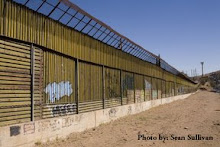
A visit to the Old Hidalgo Pumphouse World Birding Center makes the negative environmental impact of the levee-border wall painfully clear. The path that once led from the birding center into the adjacent USFW refuge tract is blocked by a concrete wall topped with rusting steel pickets. Not only are wildlife such as bobcats, or even endangered ocelots, stopped from moving freely, but birders and eco-tourists are also unable to access the 600 acre wildlife refuge tract that contains the birds and wildlife that they come to see.
The Old Hidalgo Pumphouse World Birding Center opened in April of 2007, and was the result of a joint effort of the city of Hidalgo, Hidalgo County, Texas Parks and Wildlife, and US Fish and Wildlife. Like other World Birding Centers in the Rio Grande Valley, it is meant to both preserve natural habitat and bring eco-tourists. Eco-tourism brings $125 million per year to the area, and Hidalgo hoped to attract some of those dollars. But eco-tourists come to see nature, not towering concrete and rusting steel, so the millions that have been invested to develop the birding center have been lost.

Tourists are also unlikely to visit a place that they think is a war zone. In the past few weeks the national press has been filled with sensationalistic headlines about the possibility that Mexico will become a “failed state”, and that violent “spillover” will sweep through border communities. Such stories generally fail to mention that while Juarez is being racked by violence, FBI statistics show that El Paso, just across the Rio Grande, is the third safest large city in the United States. San Diego and Brownsville are likewise far safer than the nation’s capitol, Washington, DC. Instead of refuting this misperception, Governor Perry and Senator Cornyn have reinforced it with calls for the mobilization of troops on the border. When people in Middle America hear this, and see that Hidalgo County’s Judge collaborated with the Department of Homeland Security to build the border wall, it looks like further evidence that Mexico poses a military threat to South Texas. Who in their right mind would come here on vacation?
The headlines screaming about “spillover” violence are already being used to call for a further militarization of the border. When the first walls built in California failed to slow the influx of immigrants, the response from Congress was not to try something else. Instead, two weeks ahead of the 2006 midterm election, they passed the Secure Fence Act, which called for more walls. With members of Congress trying to look hawkish on Homeland Security, there are guaranteed to be calls to build even more border walls. In the Rio Grande Valley the border wall is in 21 separate sections, ranging from nine-tenths of a mile to 6 miles long. It will be much harder to fight off calls to fill in the gaps in South Texas’ border wall with Judge Salinas’ repeatedly praising the levee-border wall. If the walls that he has already helped to build are such a blessing, why would he oppose the erection of more walls?
While on the surface his State of the County address is the run-of-the-mill self-congratulation that we expect from a politician, in fact his words have real consequences. Following his capitulation to former Secretary Chertoff, Judge Salinas went from being an opponent of the wall to the Department of Homeland Security’s poster boy. In press releases and Congressional testimony they use him to show that they are working with local stakeholders, rather than ignoring local concerns, condemning private and municipal property, and irreparably damaging border communities, economies, and ecosystems. Judge Salinas’ words provide DHS with cover as they continue to strong arm our next-door neighbors in Cameron County, as well as our friends in California.
Of course it is naïve to expect a politician to own up to his mistakes, to admit to being suckered into a bad deal that has cost his constituents millions of dollars. It is unrealistic to expect a mea culpa from Judge Salinas. But if he truly cares about the residents of Hidalgo County, the people who elected him and who he claims to serve, JD Salinas needs to stop trying to rebrand his greatest failure as a shining success. The wall is not a “solution” for any of the problems that we face. The border wall is a symbol of hatred, a blight on our communities, and a scar upon the landscape.