www.sierraclub.org/borderlands
Friday, December 14, 2012
Border Wall Imperils Southern Arizona Pronghorn Herds
www.sierraclub.org/borderlands
Monday, January 2, 2012
Frontier Injustice: Not Even the Pacific Ocean is Safe from Our Pernicious Effort to Wall Off the Border
The Department of Homeland Security (DHS) has a nasty habit of rubbing salt into wounds, fresh and old.
Just ask anyone who lives along the Rio Grande Valley, makes their home in the Sonoran Desert covering large sections of northwest Mexico and southwest Arizona, or inhabits the dense sprawl of those entwined cities, San Diego and Tijuana. Since 2006, wherever DHS has pounded down its infamous Border Wall, it has chopped up habitats human and natural, severing longstanding cultural links and environmental connections between the U.S. and Mexico. It is a haunting reminder that the post-9/11 hunt for national security has generated its own insecurities.
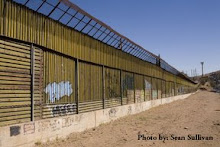
The most recent (and stinging) example of this painful paradox came in late November. That's when DHS began construction of the latest segment of the wall, dubbed the Surf Fence Project. This 18-foot-high barrier, hung on six-inch rust-proof steel piping, is being pile-driven out 300 feet into the Pacific Ocean. The goal is fortify Imperial Beach, making it impregnable redoubt, the first line of defense for San Diego.
"There is a clear operational need for this development," Michael Hance, field operation supervisor with the U.S. Border Patrol, told the BBC. "The southern side of the border is densely populated and in the past many people found an easy way into the US through these beaches. We need physical infrastructure as well as border agents in the area."
As for the urgency to thrust this wall so deep into the pounding surf, local border patrol agents point to the capture in November of several undocumented migrants attempting to swim around the current fencing.
At a cost of $4.3 million, this new wall will be a very expensive form of deterrent. But Assistant Chief Patrol Agent Bruce Parks assured the LA Times that the exorbitant price tag (amounting to $143,333.33 per foot!) is worth every penny, for this stretch of beach "still has the potential to be very dangerous, as beautiful as it is."
I'd like to think that Parks is just being silly: do we really spend this much money building a wall because of the potential that this stretch of seaside can be a dangerous gateway into the U.S.? But he's not being flippant. After five years of listening to the Border Patrol and its parent department, DHS, say similar things every time they have announced the launch of yet another segment to the 670-mile border wall, it is clear that there is a pattern to their patter.
If, as DHS asserts, the land and sea are so threatening; if the people who would cross these stretches of our sovereign territory are judged to be so unsafe, then we must militarize the first while demonizing the second. Every mile of steel pole and three-ply fencing, every searchlight, movement sensor, high-flying drone, and armed guard is a reflection of this American war on nature and the Other. A terrorism that may be as malevolent as the threat this thick bulwark is supposed to repel.
This deliberate violence against land and people is underscored in the title of a new and insightful collection of essays on the geopolitics of the borderlands: Wounded Border/Frontera-Herida. The injuries that its ten chapters probe cover a wide range: the deeply flawed law enforcement and judicial systems on both sides of the border; the inequities and humiliations that migrants face in U.S. labor markets desperate for low-wage, expendable workers (pressure that women disproportionately bear); the environmental despoliation that comes from a globalized economy that created maquiladoras in Mexico, industries whose toxic effluent damages ground and surface waters, pollutes the air, and poisons adjacent neighborhoods. The border is a fraught landscape.
No shock, this contested physical space is also a social construct. As co-editor Justin Akers Chacón argues: "Since its inception as a boundary imposed by war of expansion, the U.S.-Mexico border has functioned in a dualistic manner. It has served both as a gateway to economic opportunity and as a barrier that creates and maintains unequal power relationships." Out of this duality, he writes, flows "the identities of both people in relationship to each other," becoming a "signifier of status that sustains each population in its own form of isolation." Although the proponents of globalization like to argue that this force is flattening the distinctions between counties and cultures, the U.S. border wall stands in stark refutation, a vertical and visible barrier. Bluntly divisive.
Emblematic of the rending of the social fabric that this enforced divide can produce is Friendship Park. Its name once conveyed its binational significance: First Lady Pat Nixon was on site at its ceremonial opening in 1971, there celebrating the site that memorialized the two nation's close relationship. "There should be no more fences," she declared.
That amity turned into animosity when, as a result of the 2006 Secure Fence Act that the George W. Bush administration promulgated, DHS built a series of fences that turned the park into a penitentiary. "New rules for public access to the gathering place leave families feeling like they have entered a maximum security prison on visiting day," writes Jill Holslin at her blog At the Edges. Any who would like to enter the park today must "wait outside the border wall 150 feet away from Friendship Park, seek permission to enter a locked gate, then be escorted by a border patrol agent in a 'security zone,' a five-foot tall pedestrian barrier that confines the space of the concrete circle of Friendship Park." Detention, surveillance, enforcement: these are the markers of a "containment society."
More egregious still is the latest effort to cordon off the United States, our arrogant ambition to split the Pacific Ocean in two.
Char Miller is the Director and W.M. Keck Professor of Environmental Analysis at Pomona College, and editor of the just-published "Cities and Nature in the American West." This article originally appeared on KCET, and is reproduced with the author's permission.
Tuesday, October 4, 2011
Assault on Public Lands and Environmental Laws up for a House Vote
How does waiving the Endangered Species Act in Hawaii help secure the U.S. – Mexico border?
Simple. It doesn’t.
But that obvious fact is irrelevant to Representative Rob Bishop of Utah, author of the National Security and Federal Lands Protection Act (HR 1505). Bishop claims that the Department of Homeland Security (DHS) cannot enforce immigration laws without violating the rest of our nation’s laws, so his bill waives 36 federal laws within 100 miles of the U.S. – Mexico border, the U.S. – Canada border, and all U.S. coastlines, for anything that DHS may want to do.
Most of the laws that HR 1505 tosses aside, including the Endangered Species Act, Migratory Bird Treaty Act, and Safe Drinking Water Act, protect the environment, but it also waives laws like the Farmland Policy Protection Act and the American Indian Religious Freedom Act.
This bill is an expansion of the Real ID Act, which gave the Secretary of Homeland Security the authority to waive local, state, and federal laws to build walls along the southern border.
The existing Real ID Act waivers, which HR 1505 expands, have caused tremendous environmental damage. To build border walls 530,000 cubic yards of rock was blasted from mountainsides in the Otay Mountain Wilderness Area; walls have caused serious flooding in the Organ Pipe Cactus National Monument; and walls fragment the Lower Rio Grande Valley National Wildlife Refuge, which was established for the preservation of endangered ocelots. Without the waiver, these walls would be illegal.
Bishop’s bill would also give DHS the run of all federally owned lands, in all 50 states, with absolutely no restrictions. Has a lack of access to the Everglades, or Hawaii’s Volcanoes National Park, or the lawn around the Statue of Liberty, prevented DHS from securing the southern border?
Not according to the Border Patrol.
The irony is that the Border Patrol, which operates under DHS’ umbrella, has not asked for the power to overrule land managers or ignore environmental laws. Last spring the Government Accountability Office found that, “Most agents reported that land management laws have had no effect on Border Patrol’s overall measure of border security.”
When Rep. Bishop introduced a similar bill last year Brandon Judd of the National Border Patrol Council said, “I would definitely look and see if there are some restrictions that are too restrictive. But to get rid of all restrictions, you would destroy the land.”
Representative Bishop has a long history of attacking protected lands and environmental regulations. He is currently pushing for a repeal of the Antiquities Act and a ban on new National Monuments. HR 1505 is just more of the same.
This Wednesday the National Security and Federal Lands Protection Act will be up for a vote in the House Natural Resources Committee, which Rep. Bishop, in a bit of Orwellian irony, chairs. Packed with Tea Party darlings like Bishop, the bill is almost certain to pass and be sent on to the full House of Representatives.
This is the week to contact your representatives and tell them that HR 1505 is not about protecting our nation. It is an assault on federal lands and environmental laws using border security as a convenient cover, nothing more.
For more information, visit www.sierraclub.org/borderlands.
Monday, August 15, 2011
Our Worst Fears about the Border Wall Come True
More human beings would die alone in remote deserts. Endangered species would be pushed to the brink. These were the fears that led humanitarians, environmentalists, and border residents to object to the walls along the U.S.-Mexico border called for by the Secure Fence Act of 2006. With 650 miles built, this summer has brought news that these fears are tragically coming true.
The journey taken by migrant men, women and children who set out across the U.S.-Mexico border has always been risky. But border walls have rerouted migrants away from the safety of urban areas and forced them to walk for greater distances over treacherous mountains and through searing deserts. All too easily they can become fatigued, dehydrated, and unable to go on. In too many cases, they die alone in remote areas.
This month an Arizona Daily Star analysis found that migrants today are almost three times more likely to die on their journey than people who crossed in 2006, the year before the walls began to go up. In fact, the rate of death—the number of deaths per 100,000 Border Patrol apprehensions—continues to increase even as fewer people are making the trek across the border.
Before the walls, in 2006, there were just 46 known deaths per 100,000 Border Patrol apprehensions. By 2010 the number had jumped to 118 known deaths per 100,000 apprehensions, and so far 2011 already has a death rate of 129 per 100,000.
These human beings are also dying deeper in the desert and much further from roads than ever before. Because of the remoteness of the areas in which they die, many of the bodies discovered are just skeletal remains. Such are the real and tragic consequences of border walls.
The same walls that are pushing crossers deeper into deadly terrain slice though nature preserves that were established to protect endangered species. The Otay Mountain Wilderness Area, Organ Pipe Cactus National Monument, and Lower Rio Grande Valley National Wildlife Refuge have seen critical wildlife habitat divided by walls. Environmentalists have argued that vulnerable species like the ocelot, whose U.S. population is less than 100 individuals in South Texas, would be walled off and trapped in small fragments of habitat. Without sufficient food, water, and potential mates, the population would dwindle.
Now scientists are beginning to uncover just how extensive the wall’s impacts are likely to be on endangered species. A recent article published in the journal Diversity and Distributions found that border walls impact 23 endangered species border-wide. Some species in California are blocked from as much as 75 percent of their ranges, a circumstance that makes the isolated populations extremely vulnerable to disease or natural disasters. The study also found that in South Texas border walls impact between 60 percent and 70 percent of the habitat set aside for endangered ocelots in the Lower Rio Grande Valley National Wildlife Refuge.
In 2008 the Department of Homeland Security (DHS) recognized that the border wall had damaged wildlife refuges along the border, and Congress appropriated $50 million to mitigate the effects of the wall border-wide. Money was promised to the Lower Rio Grande Valley National Wildlife Refuge to purchase land to replace the ocelot habitat that the border walls fragmented. But after DHS withheld the money for years, Congress took back the funds. DHS has no further plans to fix any of the environmental damage that its border walls have caused.
As predicted, the border wall has exacerbated the ongoing humanitarian crisis of migrant deaths and has devastated the environment. Nevertheless, some in Congress are calling for more walls and looking to strip border communities of their environmental protections under the pretense of border security.
Dan Millis has witnessed first-hand the human tragedy and environmental devastation unfolding daily along the U.S.-Mexico border. Shortly after finding the lifeless body of a young girl along a migrant trail in Arizona, Dan was convicted of littering for leaving bottles of clean water along trails in the same area. He now works for the Sierra Club in Tucson fighting on behalf of the people and places victimized by border walls and enforcement-only politics.
Dan will visit Texas' Rio Grande Valley to share his experiences, and discuss the impacts of flawed U.S. border policy and how you can make a difference on Monday evening, August 22nd at 7:00 pm at Galeria 409 in Brownsville and on Tuesday August 23rd at 7:00 pm at St. John the Baptist Parish Hall in San Juan. For more information and directions, visit valleygreenspace.wordpress.com.
As border residents we need to educate ourselves about the terrible consequences of border walls and enforcement-only policies all along the border, and then inform our elected leaders.
Stefanie Herweck is chair of the Lower Rio Grande Valley Sierra Club.
Friday, July 29, 2011
New Amendments Threaten Protected Lands
What federal lands would be put at risk?
• All of them. This amendment decimates environmental and other protections on every single acre of federally owned lands, from areas in the southwest already at risk from Border Patrol Activities, like the Cabeza Prieta National Wildlife Refuge in Arizona, to places far from the border, including the Grand Canyon, Yellowstone National Park, and the Cape Hatteras National Seashore.
• This amendment is NOT restricted to areas near the southwest border or even to areas near all borders, as past legislation has proposed.
What laws would be overturned?
• All of them. This amendment is even more overreaching in its impact on federal lands than the controversial H.R. 1505 because it is not restricted to a long list of environmental regulations, but prevents the enforcement of any regulation, even those put in place for safety and other reasons.
• Other regulations that could be completely ignored are those that support economic development, allowing Border Patrol to interfere with grazing, mining, and drilling for oil and gas on public lands.
What Border Patrol activities would be exempted from any oversight?
• All of them. The amendment does not clearly define what “impede or obstruct” means or who would decide whether a law or regulation meets this standard and could therefore be ignored.
• The amendment is even more overreaching than past bills on the Border Patrol because it does not limit exempted activities to “operational control” – or activities specifically intended to prevent illegal entry into the country. Instead it exempts all “patrol activities” which, without definition, could mean any activity undertaken by the Border Patrol.
• This will create conflict between agencies that have begun to work very effectively together to resolve issues surrounding Border Patrol activities.
Is the amendment even needed by the Border Patrol?
• No. The amendment would override multiagency coordination that has been occurring on Federal lands since a 2006 Memorandum of Agreement between the Departments of Homeland Security, Interior, and Agriculture that has led to increased cooperation and leveraged resources.
• 22 out of 26 Border Patrol stations on the southern border with Mexico report that the border security of their area of operation has not been affected by land management laws beyond some minor delays. Instead, factors like rugged terrain—and not access delays or restrictions—have the highest impact on operational control.
• Exemptions already exist that allow Border Patrol Officers in pursuit to continue onto any federal land regardless of regulations or laws. Other exemptions have also been established administratively to ensure the Border Patrol has the access necessary to secure the border.
In addition, Rep. Gosar has also introduced amendment No. 55, another extreme attack on federal lands. Similar to amendment No. 20, this amendment would exempt the Border Patrol from any environmental review, from protecting clean air and water, from honoring and respecting the history and culture of native people, from preserving biodiversity, and more.
Who isn’t hurt by this amendment?
Representative Gosar’s friends in industries like oil and gas drilling, grazing, mining, and logging are taken off the hook in this updated version of amendment No. 20. Amendment No. 20 exempts the Border Patrol from “any regulation” meaning that rules allowing for development and resources extraction could also be trampled by any Border Patrol activities. Amendment No. 55, however, spares these special interests and instead focuses its attack on the environment, biodiversity, and native people.
What environmental and cultural laws would be overturned?
A similar list of laws to that found in H.R. 1505 is included in the amendment. These laws represent a century of bipartisan efforts to protect the environment, intelligently manage public lands, and demonstrate respect for historical and cultural sites.
The exempted laws include:
The National Environmental Policy Act of 1969 (42 U.S.C. 4321 et seq.)
The Endangered Species Act of 1973 (16 U.S.C. 1531 et seq.)
The Clean Water Act (33 U.S.C. 1251 et seq.)
The National Historic Preservation Act (16 U.S.C. 470 et seq.).
The Migratory Bird Treaty Act (16 U.S.C. 703 et seq.)
The Clean Air Act (42 U.S.C. 7401 et seq.).
The Archeological Resources Protection Act of 1979 (16 U.S.C. 18 470aa et seq.).
The Safe Drinking Water Act (42 U.S.C. 300f et seq.).
The Noise Control Act of 1972 (42 U.S.C. 4901 et seq.).
The Solid Waste Disposal Act (42 U.S.C. 6901 et seq.).
The Comprehensive Environmental Response, Compensation, and Liability Act of 1980 (42 U.S.C. 9601 et seq.)
The Archaeological and Historic Preservation Act' and the Archaeological Recovery Act (16 U.S.C. 469 et seq.).
The Antiquities Act (16 U.S.C. 431 et seq.).
The Historic Sites, Buildings, and Antiquities Act (16 U.S.C. 461 et seq.)
The Farmland Protection Policy Act (7 U.S.C. 4201 et seq.).
The Coastal Zone Management Act of 1972 (16 U.S.C. 1451 et seq.).
The Federal Land Policy and Management Act of 1976 (43 U.S.C. 1701 et seq.).
The Wilderness Act (16 U.S.C. 1131 et seq.).
The Bald Eagle Protection Act of 1940 (16 U.S.C. 668 et seq.).
The Native American Graves Protection and Repatriation Act (25 U.S.C. 3001 et seq.).
The American Indian Religious Freedom Act (42 U.S.C. 1996 et seq.).
The Religious Freedom Restoration Act of 1993 (42 U.S.C. 2000bb et seq.).
The Federal Grant and Cooperative Agreement Act of 1977 (31 U.S.C. 6303 et seq.)
What Species would be impacted?
The bill waives compliance with all provisions of the ESA on federal lands. Species throughout the nation that would be impacted include
In the Southwest
• Mexican spotted owl
• Desert tortoise
• Jaguar
• Ocelot
• Sonoran pronghorn
• Chiricahua leopard frog
Elsewhere in the country
• Florida Panther
• Canada lynx
• Polar bear
• Hawaii akepa (honeycreeper)
• Leatherback sea turtle
• West Indian manatee
Thursday, June 9, 2011
Border Skirmish: Republicans Are Using Immigrants to Bash Our Wilderness
It would be nice if Congress held executive-branch agencies accountable for their actions. Or insisted that they follow federal law. Or fulfill their fiduciary responsibilities to one another.
But the Republican-controlled House of Representatives is making a mockery of these basic rules of order and good government.
You won't be surprised that the latest bit of GOP chicanery involves its twin obsessions: the U.S-Mexico Border and national environmental regulations. Their hyperventilating defense of the former, as I've noted before, comes with blustery assaults on the latter.
Since November, Utah representative Rob Bishop, chair of the House subcommittee on public lands, along with his gal pal, Cynthia Lummis (R-WY), and a host of fellow travelers, have mounted an incessant campaign to allow the U. S. Border Patrol to ignore key provisions of the Wilderness Act, the Endangered Species Act, and other vital environmental laws.
Arguing that such legislation impedes the Border Patrol's capacity to defend the nation against undocumented migrants, they have filed amendments and riders to pending legislation, called public hearings to lambaste officials of the Department of Interior, and penned fulminating op-eds to rouse the party's extremist base.
Their most recent gambit came late last week in the form of an amendment to the Department of Homeland Security's appropriation. Rep. Lummis proposed, and a lock-step Republican vote secured, a rule prohibiting DHS from transferring funds to the Department of the Interior.
These moneys would have been used to mitigate the oft-intense environmental damage resulting from the construction of the infamous border wall across federal wildlife refuges, wildlands, and preserves, in such places as the Rio Grande Valley; Arizona's Organ Pipe Cactus National Monument; and the Otay Wilderness near San Diego. And from the spinning wheels of its high-speed patrols that can tear up wildlife habitat or damage sensitive ecosystems.
Such mitigation, required by law, is also sanctioned through longstanding practice among localities, states, and the federal government. It is also a matter of committed environmental stewardship.
Neither the precedent nor the principle matters to contemporary Republicans. In a "Dear Colleague" letter that Bishop, Rep. Doc Hastings (R-WA), chair of the Natural Resources Committee, and Rep. Peter King (R-NY), chair of the Committee on Homeland Security sent out in support of Lummis' amendment, they thrilled at its anti-environmentalism: "the amendment would strike language in the bill that allows these funds to be used by the Interior Department to purchase even more land. Additional federal land acquisition only exacerbates the problem by limiting access to even more land and further bloating the federal estate--at a time when the government cannot even afford to provide the basic care and maintenance needed for existing national parks and other lands."
(Query: why can't the government afford to take care of its treasured public lands? Answer: drastic Republican budget cuts!)
Lummis heaps just as much scorn on the legal obligations and moral responsibilities the government has for protecting our public lands: "Every day our nation's border patrol fights to protect our country against increasingly sophisticated criminal networks that produce and smuggle illegal drugs, and people, into America," she fumed. "Unfortunately, DOI policies have tied the hands of Border Patrol agents, who need access to federal lands to carry out their constitutional responsibility to secure the border."
Her allegation is bogus. The very same Government Accountability Office report that Lummis and Bishop routinely cite as evidence that environmental regulations have handcuffed the Border Patrol, in fact reached the opposite conclusion. In mid-April, for instance, the GAO found that "22 of the 26 patrol agents-in-charge reported that the overall security status of their jurisdiction had not been affected by land management laws. Instead, factors such as the remoteness and ruggedness of the terrain have had the greatest effect on their ability to achieve operational control in these areas."
The report also revealed that the four patrol agents-in-charge who had "reported that delays and restrictions had affected their ability to achieve or maintain operational control," admitted they "either had not requested resources for increased or timelier access or their requests had been denied by senior Border Patrol officials because of higher priority needs of the agency."
Moreover, the GAO investigation demonstrated that relevant agencies out in the field and inside the Beltway have developed close working relations. To argue otherwise, as Lummis and Bishop reflexively do, is to perpetuate a fraud.
Ah, but why let the facts get in your way when you can wrap yourself in the flag as protective cover? Trumpets Lummis: "our nation's security should be our top priority." Wilderness be damned.
Such a blinkered public policy, in point of fact, will lead us into damnation. That's the potent message embedded in Aldo Leopold's private correspondence and his brilliant conservation classic, Sand County Almanac (1948).
Arguing that wilderness is an irreplaceable part of our "cultural inheritance," and that even then was in precious, dwindling supply--it is a "resource that can shrink but cannot grow"--Leopold urged his fellow citizens to defend these beleaguered lands against those with a narrowly conceived notion of homeland securityhttp://www.blogger.com/img/blank.gif. "If we lose our wilderness, we have nothing left...worth fighting for."
Note, please, that Leopold was a Republican.
Char Miller is the Director and W.M. Keck Professor of Environmental Analysis at Pomona College, and editor of the just-published "Cities and Nature in the American West."
Reprinted with the author's permission, this essay was originally posted at KCET:
http://www.kcet.org/updaily/socal_focus/commentary/border-skirmish-republicans-are-using-immigrants-to-bash-our-wilderness-34146.html
Thursday, May 5, 2011
Congressional Proposals Aim to Eviscerate Environmental Laws Along U.S. Borders, Coasts
Randy Serraglio, Center for Biological Diversity
Scott Nicol, Sierra Club Borderlands Team
Jenny Neeley, Sky Island Alliance
Matt Clark, Defenders of Wildlife
Mike Quigley, The Wilderness Society
Nathan Newcomer, New Mexico Wilderness Alliance
Matt Skroch, Arizona Wilderness Coalition
Under Guise of Border Security, Bills Would Eliminate Measures
Protecting Air, Water, Endangered Species
TUCSON, Ariz.— Two bills pending in Congress would eliminate environmental laws along U.S. borderlands — including those that protect endangered species and safeguard clean air and water — under the guise of improving border security. The “National Security and Federal Lands Protection Act” (H.R. 1505), introduced by Utah Rep. Rob Bishop, would permanently exempt border-enforcement activities from 31 environmental and cultural resource laws within 100 miles of all U.S. borders and coasts.
The “Border Security Enforcement Act of 2011” (S. 803), introduced by Arizona Sens. John McCain and Jon Kyl, would effectively give the Department of Homeland Security veto power over environmental protections on public lands within 150 miles of the southwestern border. Land managers in the border region would be prevented from acting to protect the resources they manage if their actions were perceived to conflict with Department of Homeland Security activities.
“These bedrock environmental laws were put in place for a reason: to protect the air we breathe, the water we drink and the natural resources and wildlife we value,” said Randy Serraglio, a conservation advocate with the Center for Biological Diversity. “It makes no sense to turn our back on these laws to satisfy the narrow agenda of a few politicians looking to score points with their most extreme constituents.”
The authority included in these bills has not been requested. In fact, it has been deemed unnecessary by border-enforcement agencies. During an April 15 congressional hearing on border security, U.S. Border Patrol Deputy Chief Ronald Vitiello testified that his agency “enjoys a close working relationship” with public lands agencies that “allows it to fulfill its border enforcement responsibilities.” Vitiello said his agency “is fully committed to continuing our cooperative relationships with the Department of the Interior and the Department of Agriculture.”
“These bills have been introduced solely to satisfy the radical whims of a small minority of anti-environment extremists in Congress,” said Jenny Neeley, conservation policy director for Sky Island Alliance. “These proposals threaten the entire Sky Islands region we work to protect by establishing a dangerous legal precedent of permanently erasing environmental and cultural resource protections across huge swaths of the United States.”
Barrier and road construction, off-road driving, stadium lighting and other border-enforcement activities already threaten parks, refuges and other protected areas as well as many species in the border region, including endangered jaguars and ocelots in Arizona, New Mexico and Texas.
“Too much damage has been done to our borderlands already,” said Scott Nicol, Sierra Club Borderlands Team co-chair. “From massive blasting and erosion in California wilderness areas to devastating floods in Arizona and fragmented habitat for endangered species in Texas, the implementation of border enforcement with callous disregard for our nation’s environmental laws has caused one disaster after another.”
“Protections for endangered wildlife, water and clean air are not standing in the way of border security,” said Matt Clark with Defenders of Wildlife in Tucson. “All Congress has to do is look at the facts: Apprehensions of immigrants illegally crossing the border have fallen by two-thirds over the past decade. Border Patrol and land-management agencies have been effectively working together, and it’s clear that it takes teamwork to secure the border and protect the environment.”
“These efforts to discard the rule of law rest on the false premise that we can have border security or we can have functioning borderlands ecosystems, but not both. That's wrong. We can — and we should — have both,” said Mike Quigley, Arizona representative of The Wilderness Society.
“Protected areas such as wilderness and national parks along our borders provide us with essential environmental services, premier recreation opportunities and important habitat for our wildlife heritage,” said Matt Skroch, executive director of the Arizona Wilderness Coalition. “These shortsighted efforts to waive laws are penny wise and pound foolish. Border enforcement and natural resource management are not and should not be mutually exclusive.”
http://www.biologicaldiversity.org/news/press_releases/2011/border-05-04-2011.html
Tuesday, December 7, 2010
Walling Off Our Southern Deserts
Over 660 miles of border wall have been built along the U.S.-Mexico border, slicing through the deserts of California and Arizona on its route from the Pacific Ocean to the Gulf of Mexico. The wall’s path takes it through some of our nation’s most fragile and biologically diverse protected lands. Border wall construction has involved dynamiting mountains and damming rivers, the disruption of migration corridors and the destruction of endangered species habitat.
Rather than insist that Border Patrol obey our nation’s environmental laws, Congress passed the Real ID Act. Section 102 of the act was intended to overrule the objections of the California Coastal Commission and the Sierra Club by allowing the Secretary of Homeland Security to waive any law that border wall construction might otherwise violate. No one else, including the President, is granted this power. Former Homeland Secretary Chertoff used the Real ID Act five times, to set aside 36 federal laws and, “all federal, state, or other laws, regulations and legal requirements of, deriving from, or related to the subject of” those laws. The waivers encompass the broad subjects of water, air, wildlife, and the environment, leaving few, if any, environmental laws in place.

Border wall through the Otay Mountain Wilderness Area.
San Diego Sector Border Patrol spokesman Richard Kite said of the Wilderness Area, "At the mountain range, you simply don't need a fence. It's such harsh terrain it's difficult to walk, let alone drive. There's no reason to disrupt the land when the land itself is a physical barrier."
By 2008, this logic no longer held sway at DHS and, ignoring the concerns of the EPA and DOI, the Department of Homeland Security (DHS) decided to “disrupt the land” of the Otay Mountain Wilderness Area with a border wall and a patrol road. The rugged terrain necessitated the blasting of 530,000 cubic yards of rock and extensive grading and leveling. Border wall construction caused tremendous erosion, and involved cutting down more than 100 Tecate cypress trees.
Because dynamiting mountains is clearly incompatible with a wilderness designation, Secretary Chertoff used the Real ID Act to waive the Otay Mountain Wilderness Act. He also swept aside the Clean Water Act and the Endangered Species Act. The Otay Mountain Wilderness Area now suffers from a barren scar and erosion that will bleed sediment into the Tijuana River for years to come.
Border wall through the Otay Mountain Wilderness Area.Further east, Arizona’s San Pedro River is one of the last undammed, free-flowing rivers in the American Southwest. It anchors one of the most biologically diverse areas in the United States, at the convergence of four major ecosystems: the Sierra Madre and Rocky Mountains, and the Sonoran and Chihuahan Deserts. The San Pedro Riparian National Conservation Area was designated by the National Audubon Society as its first Globally Important Bird Area, and by the United Nations World Heritage Program as a World Heritage Natural Area.
When the DHS announced that it would put a wall across the San Pedro, the Sierra Club and Defenders of Wildlife sued. A federal court agreed that the federal government’s failure to fully assess the environmental impacts of the border wall violated the National Environmental Policy Act (NEPA), and ordered a temporary halt to construction. Rather than comply with NEPA, former DHS Secretary Chertoff used the Real ID Act to waive it. Border walls built in the San Pedro watershed are now causing erosion and damming that will permanently alter the riparian habitat.
The border wall’s impact on the flow of water in desert ecosystems was made clear in 2008, when the Organ Pipe Cactus National Monument received seasonal monsoon rains that resulted in the flooding of a number of washes that were blocked by the border wall. Grates built into the base of the wall to allow for the passage of water quickly choked with debris and sediment. The wall then acted as a dam, with water up to seven feet deep piling up behind it. Floodwaters then travelled laterally along the wall until they found an outlet at the Sonoyta port of entry, causing millions of dollars of damage to private businesses and government buildings there.
The border walls and patrol roads that slice through hundreds of miles of public and protected lands also fragment the habitats of a number of endangered species, including the Sonoran pronghorn, cactus ferruginous pygmy owl, and desert tortoise. Cut off from their usual range, populations may not have access to mates in other groups, a necessity for a genetically diverse, healthy population. Border walls also separate animals from food and water sources, leaving them especially vulnerable in times of drought. With the endangered species act waived, these threats to species’ survival have been largely ignored.
A mountain lion runs alongside the border wall.Border wall construction has also unearthed Tohono O’odham graves. When the Secretary of Homeland Security waived Native American Grave Protection and Repatriation Act, the regulations that ensured respect for the Tohono O’odham’s ancestral remains and culture no longer applied to border wall construction.
Speaking before a U.S. House of Representatives hearing on the border wall, Tohono O’odham Chairman Ned Norris Jr. said, “… fragments of human remains were observed in the tire tracks of heavy construction equipment. Imagine a bulldozer parking in your family graveyard, turning up bones. This is our reality.”
DHS claims that border walls are actually good for the environment because border crossers leave litter, make foot paths, and, in the states that do not have a river for a border, drive off road vehicles through sensitive habitat. This assertion is based on a pair of false premises. The first is that border walls stop crossers. They do not. The Congressional Research Service found that border walls have “no discernible impact” on the number of undocumented immigrants who enter the United States each year. Instead, walls redirect many of those who seek to enter on foot, “funneling” them into more remote areas. This often means that their environmental impacts are concentrated in fragile desert ecosystems, rather than closer to walled off border towns. “Funneling” has contributed to the deaths of more than 5,600 crossers in the harsh Arizona desert.
The second false premise is that border walls and patrol roads are less damaging to ecosystems than border crossers. The border wall’s destructive impact is made obvious by the Department of Homeland Security’s need to “waive in their entirety” our nation’s most important environmental laws. The only reason for DHS to waive laws is that border walls violate them. Litter and migrant trails can be a problem for wildlife, but the blasting, bulldozing, habitat fragmentation, and large-scale erosion caused by border walls and roads are worse by magnitudes of scale.
Ignoring the useless and destructive nature of border walls, political hopefuls from Alaska to Kansas, Utah to Rhode Island, called for more walls in the run up to the mid-term elections. This is not just empty rhetoric that can be ignored. A number of amendments requiring the erection of hundreds of miles of new wall were introduced in the last Congress, and one, authored by Jim DeMint of South Carolina, passed in the Senate before being stripped in a House/Senate conference committee.
Representative Ciro Rodriguez, whose district already has border walls, blocked DeMint’s amendment. Rep. Rodriguez lost his reelection bid, and the U.S. House lurched to the right. Key committees that oversee immigration and homeland security will soon be chaired by Representatives who have long advocated further militarizing the border. DeMint and others will likely redouble their efforts to build more border walls, and their legislation will stand a much better chance of making it onto the President’s desk.
Instead of building more border walls, Congress should focus on mitigating the damage that has already been inflicted. It is also critically important that Congress repeal the Real ID Act’s waiver provision. The Real ID Act is not only a threat to border ecosystems should Congress require more walls, it also establishes the precedent that bedrock environmental laws such as the Endangered Species Act and Clean Water Act can be swept aside when obeying them would be inconvenient. For these reasons the Sierra Club and other environmental organizations oppose further border wall construction, and call upon Congress to repeal of section 102 of the Real ID Act.
This originally appeared in the Desert Report, a quarterly publication of the Sierra Club's California / Nevada Desert Committee: http://www.desertreport.org/wp-content/uploads/2010/12/DR_Winter2010.pdf
Monday, April 26, 2010
Walling off Texas' Last Sabal Palm Forest
Kiewit construction sign in front of the South Texas border wall
Before the order granting the federal government possession of their land, the Nature Conservancy had attempted to use the courts to force DHS to provide compensation and guarantee access to its property. The Department of Homeland Security has stated that the new border wall will have gates, but they have refused to explain under what circumstances they will be opened to permit access to areas behind the wall. With no way of knowing if staff or eco-tourists will be allowed into the Southmost Preserve, it is hard to see how they can continue to operate. Faced with a similar situation, the neighboring Sabal Palms Audubon Sanctuary simply took down its sign and ceased operations.
The Southmost Preserve contains one of the last of the sabal palm forests that once enveloped the mouth of the river. Before it was called the Rio Grande in the United States and the Rio Bravo in Mexico, the river was known as the Rio de las Palmas to Spanish explorers and conquistadors, who used the palm forest at its mouth as a landmark as they sailed along the Gulf Coast. Then dense groves of sabal palms followed the river up to 80 miles inland, but today the last stands are confined to one tract of the Lower Rio Grande Valley National Wildlife Refuge, the former Sabal Palms Audubon Sanctuary, and the Nature Conservancy’s Southmost Preserve. All three are now behind the border wall.
Federally listed endangered species, including the ocelot and jaguarundi, depend upon riparian habitat along the Rio Grande for their continued survival. Naturally solitary animals, they require large territories in which to hunt, find mates, and disperse after they are weaned. But South Texas has lost roughly 95% of its historic vegetative cover to urban development and agriculture.
Habitat fragmentation, in which disconnected “islands” of habitat are separated by large areas cleared of vegetation, split by roads, or divided by other impediments to movement, poses a tremendous threat to these species’ long-term survival. Ocelot and jaguarundi trapped within too-small habitat “islands” may not have sufficient prey or access to water, and often show evidence of inbreeding. Today, the Rio Grande Valley is home to the less than 80 ocelots and 40 jaguarundi that are still believed to survive in the United States.
The Lower Rio Grande Valley National Wildlife Refuge was established to address the threat to the survival of ocelot, jaguarundi, and other wildlife posed by habitat fragmentation. Over the years 113 individual tracts of land, totaling 88,044 acres, have been acquired, with a goal of using the ribbon of riparian habitat along the Rio Grande as a wildlife corridor to link them. Though not operated by US Fish and Wildlife, the Southmost Preserve and Sabal Palms Audubon Sanctuary are critical parts of the corridor. Bound together by the river, it was hoped that they would provide sufficient resources and allow for the necessary mobility to prevent the extirpation of these endangered cats.
Mile after mile of border wall now slice through the LRGV National Wildlife Refuge; along the northern border of the Sabal Palms Audubon Sanctuary; and soon will tear through the Nature Conservancy’s Southmost Preserve, fragmenting habitat that was painstakingly pieced together over the course of many years. The walls that break apart the wildlife corridor may prove to be the final nail in the coffin for ocelots and jaguarundi.
Sabal Palms Audubon Sanctuary closed
Though the border walls called for by the Secure Fence Act are nearly finished, the threat of Congressionally mandated damage to the borderlands continues. With mid-term elections looming, many politicians hope to exploit fears of “spillover violence” and a Mexican “reconquista” in their bids to stay in office. Calling for the erection of more walls and the deployment of troops may not be sound border policy, but it is a sure-fire way to land an interview on Fox news, which is tantamount to a free campaign ad. The border environment is then either used as a scapegoat or ignored.Claiming that federal land managers are “hiding behind the law” and preventing the Border Patrol from doing their job, recently Representative Rob Bishop introduced legislation that would prevent the Department of Interior from “impeding” Homeland Security’s attempts to fulfill the Secure Fence Act’s mandate. Rep. Bishop, whose Utah district lies 800 miles north of the U.S. – Mexico border, failed to ask the Border Patrol if the Department of the Interior’s stewardship of public lands was in fact interfering with their operations. Brandon Judd, vice president of Local 2544 of the National Border Patrol Council, spoke out against Rep. Bishop’s bill, stating that without environmental regulations, “you would destroy the land.”
Last week the Senate held hearings on border security and the failure of Boeing’s multi-million dollar “virtual fence.” The Senators did not discuss the environmental impacts of the border wall, or address the underlying economic factors driving immigration, or even consider whether or not it made sense to continue “enforcement only” immigration policies. Instead Connecticut Senator Joe Lieberman, chairman of the Homeland Security and Governmental Affairs Committee, suggested that, "The best answer to this continuing crisis and continued flow of illegal immigrants into the U.S. is to go back to the old-style fences, double- and triple-tiered, and layered."
So while we may want to believe that border wall construction, and the accompanying destruction of border ecosystems, is finally coming to an end, the truth is that so long as politicians believe that militarizing the border plays well in their home districts they will continue to draft legislation calling for more border walls. To voters in Utah and Connecticut sabal palm forests along the Rio Grande are no more real than the forests in Avatar. When the palm forests are gone most won’t notice their passing.
This is why it is so important for those of us who can see the damage that is being inflicted upon the borderlands, and who will mourn the loss of sabal palms, ocelots, and the rest of our unique environment, to make certain that when these decisions are made far from the border our voices are heard. We cannot allow ecosystems that predate the founding of the United States and Mexico to be destroyed just to score points in an off-year election. As John Muir said, “God has cared for these trees, saved them from drought, disease, avalanches, and a thousand tempests and floods. But he cannot save them from fools.”
Monday, January 25, 2010
The Border Wall's Ongoing Environmental Toll
In 1996 the United States Congress called for the construction of “triple layered fencing” along the U.S.-Mexico border, beginning in the Pacific Ocean and extending 14 miles into California. This was to consist of parallel 10 to 15 foot high steel walls, with 50 feet of land in between graded and cleared of all vegetation, and the entire expanse lit by stadium floodlights. The Border Patrol also proposed filling in canyons and scalping mountains to give the new walls and road a level path. The California Coastal Commission determined in 2004 that these initial border walls would violate the Coastal Zone Management Act. Of particular concern was the damage that walls would do to the Tijuana River National Estuarine Research Reserve, the largest of the remaining California salt marshes, which harbors many endangered plant and animal species. The Sierra Club, Audubon Society, and other environmental groups also challenged the border wall in court. Construction came to a halt.
Congress responded by passing the Real ID Act of 2005, which gave the Secretary of Homeland Security the power to waive all laws that might slow construction of border walls, and also curtailed normal judicial review. President Bush’s Secretary of Homeland Security, Michael Chertoff, used this unprecedented power to “waive in their entirety” the Coastal Zone Management Act, the National Environmental Policy Act, the Endangered Species Act, the Migratory Bird Treaty Act, the Clean Water Act, the Clean Air Act, and the National Historic Preservation Act in order to resume border wall construction. The challenges brought by the California Coastal Commission and environmental organizations were thrown out when the laws that they were based upon were waived.
When Congress passed the Secure Fence Act in 2006, the power to waive laws granted by the Real ID Act carried over to all of the walls that the new law mandated. The Secure Fence Act called for over 700 hundred miles of new border wall extending from California into Arizona, New Mexico, and Texas, stopping just short of the Gulf of Mexico. Its path takes it through some of our nation’s most fragile and biologically diverse protected lands. Over the years former Homeland Secretary Chertoff issued 5 separate waivers under Real ID, setting aside 36 federal laws and, “all federal, state, or other laws, regulations and legal requirements of, deriving from, or related to the subject of” those named laws. The waivers encompass the broad subjects of water, air, wildlife, and the environment, leaving few, if any, federal, state, or other environmental laws in place. In addition to brushing aside environmental protections, laws relating to farmland, archaeological and historic sites, religious freedoms, and Native American graves were also suspended.

Construction of the massive earthen berm to fill in Smuggler’s Gulch. Border Patrol photo.
With no need to obey environmental laws, the Department of Homeland Security (DHS) filled in the canyon known as Smuggler’s Gulch, south of San Diego, with over 2 million cubic yards of earth that had been ripped from adjacent mountaintops, and planted the border wall on top of the berm. With no regulations in place and no oversight by other agencies, DHS put little effort into erosion control, and the still bare slopes of the earthen dam threaten to wash tremendous amounts of dirt into the Tijuana River National Estuarine Research Reserve, which is only 600 feet away. Burying the estuary in sediment may raise its surface level enough to disrupt the twice-daily inundation of sea water upon which its fragile ecosystem depends.
To the east of Smuggler’s Gulch, in the rugged Otay Mountain Wilderness Area, DHS has blasted mountainsides in order to create access roads and level ground upon which to build the border wall. Before construction began the Environmental Protection Agency raised concerns that the dumping of tons of rubble, and the erosion that would follow, would clog the Tijuana River and violate the Clean Water Act. The Otay Mountain Wilderness Area was established in part to preserve some of the last stands of rare tecate cypress trees, the host plant for the even rarer Thorne’s hairstreak butterfly, which are found nowhere else in the United States. But with the Real ID Act’s waiver authority in hand, DHS has ignored the EPA’s concerns and our nation’s environmental laws, including the Otay Mountain Wilderness Act and the Clean Water Act. Border wall construction caused tremendous erosion, as predicted, and also involved cutting down more than 100 tecate cypress trees.
In July of 2008 the Organ Pipe Cactus National Monument received seasonal monsoon rains which resulted in the flooding of a number of washes that are bisected by the border wall. Storms of this type normally occur every 3 – 5 years in this part of the Sonoran desert. The Army Corps of Engineers had previously stated that the border walls built across washes would "not impede the natural flow of water.” In stark contrast to these claims, the National Park Service determined that the grates built into the base of the wall to allow for the passage of water were quickly choked with debris and sediment. The border wall then acted as a dam, with floodwaters up to seven feet deep piling up behind it. The floodwaters then followed the wall in search of an outlet, which they found at the Sonoyta port of entry, causing millions of dollars of damage to private businesses and government buildings.

Flood debris backed up by the border wall in Organ Pipe Cactus National Monument. National Park Service photo.
The U.S.-Mexico border consists of hundreds of miles of public and protected lands, which is habitat for scores of species. The border wall and patrol road slicing through these areas fragments the habitats of the animals that live here. Cut off from their usual range, populations may not have access to mates in other groups, a necessity for a genetically diverse, healthy population. Border walls also block animals from food and water sources, which leaves them especially vulnerable in times of drought. As the border wall funnels migrants into rugged, remote terrain and Border Patrol vehicles pursue them, they damage fragile ecosystems and disturb sensitive wildlife, like the bighorn sheep and the desert tortoise, both of which are endangered.
Endangered jaguars, which were almost entirely extirpated in the United States, have been photographed and even captured in Southern Arizona and New Mexico in recent years. In 1997, the jaguar was placed on the endangered species list in hopes of reviving U.S. populations. While their former range extends into all four southern border states, the individual animals which have been seen in Arizona likely came into the U.S. from Mexico, where larger populations live. With routes from Mexico almost completely sealed off by the border wall, establishing a healthy breeding population of jaguar in the U.S. may no longer be possible.
South Texas is home to ocelots and jaguarundi, both of which are listed under the Endangered Species Act. Agricultural and urban development have stripped these animals of 95% of their original habitat. Because so few of each species are left in the U.S., they need access to mates in Mexico to avoid inbreeding. The Lower Rio Grande Valley National Wildlife Refuge was created to provide them with sufficient habitat to survive, as well as offer a potential route to Mexico. Over the past 20 years, more than 90 million tax dollars and thousands of volunteer hours were spent piecing together and revegetating tracts of land along the Rio Grande in order to create this wildlife corridor. The border walls in South Texas now divide some of these refuge tracts, and cut others off from the Rio Grande and from Mexico. With the Endangered Species Act waived, the Department of Homeland Security has largely ignored the way that border walls fragment the ocelot and jaguarundi’s remaining habitat and seriously diminish hope for their recovery, or even survival.
Before former Secretary Chertoff’s last Real ID Act waivers in April 2008, DHS prepared draft environmental impact statements and draft environmental assessments for the various sections of border wall, as mandated by the National Environmental Policy Act. In reviewing the draft environmental impact statement for the Rio Grande Valley, the Environmental Protection Agency found it to be “insufficient,” and recommended that DHS start the process over. The EPA reached the same conclusion, and made the same recommendation, when it reviewed the draft environmental impact statements and draft environmental assessments that DHS prepared for each the other border wall sections.
Following the waivers, which allowed DHS to disregard the National Environmental Policy Act, the agency abruptly ended the environmental assessment and environmental impact statement processes. Instead, they created a brand new category, the “environmental stewardship plan,” which was not governed by any federal legislation. These new reports recycle the bulk of the prior, “insufficient” reports, in many cases word-for-word, but have no established criteria or requirement for review from the EPA or the public. While they do include recommendations to minimize the wall’s environmental impact, most of which appeared in the earlier “insufficient” reports, there is no requirement that these be adhered to. In the instance of Smuggler’s Gulch, for example, revegetation and erosion control measures called for in DHS’ own report were not implemented.
One of DHS’ most absurd claims for the border wall is that it will actually be good for the environment because border crossers leave litter, make foot paths, and, in the states that do not have a river for a border, drive off road vehicles through sensitive habitat. This ignores the difference in scale between a dirt path that winds through the brush and an area 150 feet wide cleared of all vegetation, and 10 – 15 foot tall steel and concrete walls. The border wall’s destructive impact is made obvious by the Department of Homeland Security’s need to “waive in their entirety” our nation’s most important environmental laws. The only reason for DHS to waive laws is the knowledge that the border wall violates them. Litter can be a problem for wildlife, but the blasting, bulldozing, fragmentation, and large-scale erosion caused by border wall and Border Patrol road construction are much worse. Animals can sidestep discarded water bottles, but when their habitat is cleared of vegetation, flooded, or silted up, and blocked by an impermeable wall, they cannot survive.
Sunday, September 20, 2009
Environmental Organizations Call Upon Congress to Strip Border Walls from the DHS Appropriations Bill
Dear Conferees,
On behalf of our millions of members and supporters across the entire country, the undersigned organizations are writing to ask that you remove Sen. DeMint’s amendment #1399 from the Homeland Security Appropriations Act and continue to support efforts to monitor and mitigate negative impacts of border wall construction.
Senate amendment #1399 is the latest attempt to extend the failed policy of building more border walls along our southwest border. In addition to negatively impacting the wildlife and natural resources of the borderlands, the provision would come at great expense to our nation’s border security programs and the American taxpayer. While tying the hands of border security experts by requiring an arbitrary number of miles of wall construction, this language would drain funding from other border security programs in order to cover the growing cost of border wall construction. Taxpayers have paid approximately $2.4 billion for border wall construction to date, and according to the Government Accountability Office, one mile of border wall now costs nearly $8 million.
Nearly one-third of the 1,950 mile U.S.-Mexico border lies within military, tribal, and public lands, including Wilderness areas, National Wildlife Refuges, National Forests, National Monuments, State Parks and hundreds of miles within the National Park system. Much of this country’s most spectacular and imperiled wildlife, including two of America’s most endangered big cats, jaguars and ocelot, bighorn sheep, Sonoran pronghorn, and bison, depend upon protected public lands along the border for intact habitat and survival.
Numerous studies have highlighted the damage that border infrastructure has caused to the borderlands’ ecology and wildlife. The National Park Service issued a report in August, 2008 confirming that the border wall along the Lukeville Port of Entry has exacerbated seasonal flooding and has caused accelerated scouring and erosion on the Organ Pipe Cactus National Monument. A recent study in Conservation Biology showed that the border wall fractures the habitat connectivity that wildlife like the pygmy owl and bighorn sheep need for survival. As climate change shifts habitats and alters migration routes, establishing wildlife corridors and protecting habitat connectivity becomes even more critical.
The damage that border walls have caused to the unique natural values of the borderlands has been exacerbated by the Secretary of Homeland Security’s authority to waive any applicable laws to expedite border wall construction. This unprecedented authority has prompted the waiving of 37 environmental, historic preservation, tribal protection and other federal laws along with related state and local laws across 563 miles of the border.
In order to help address the negative impacts of border walls that have already been constructed, the House Homeland Security Appropriations bill included $40 million for border monitoring and mitigation. We strongly support keeping this language in the final bill and believe that its inclusion would mark one more step towards repairing the damage done to communities and natural resources along the border.
Again, we support the House version of the Homeland Security Appropriations Act, and as you move to conference we specifically ask that you remove Senate amendment #1399 from the final bill and continue to advance border monitoring and mitigation efforts.
Sincerely,
The Arizona Zoological Society
Center for Biological Diversity
Defenders of Wildlife
Earthjustice
Frontera Audubon
International League of Conservation Photographers
League of Conservation Voters
National Audubon Society
National Wildlife Federation
Natural Resources Defense Council
Rio Grande International Study Center
Sierra Club
Southwest Environmental Center
Valley Nature Center
Western Lands Project
The Wilderness Society
Wildlands CPR
Wildlands Network
Thursday, March 19, 2009
Hidalgo County's Border Wall is Nothing to Brag About
Last March, Hidalgo County Judge JD Salinas cut a deal with Department of Homeland Security Secretary Michael Chertoff to build part of the border wall. Rather than build the wall to the north of the levee, DHS would insert it into the levees in Hidalgo County. It was estimated that this would raise the per-mile cost from $3 million to $5 million, so the county agreed to pay $44 million. When the bids came in, the low bids were $12 million per mile. As a result of Judge Salinas' capitulation Hidalgo County's border walls are nearly finished, while neighboring Starr County's wall construction has not begun, and Cameron County's is just beginning. They still have the chance to fight to halt construction, while for Hidalgo County the fight moves from stopping the wall entirely to preventing pro-wall zealots from filling in the spaces between levee-walls.
In his recent State of the County address, Judge JD Salinas made statements regarding the levee-border wall that were, to put it charitably, less than honest.
Judge Salinas said,
"The levee-barrier, which was the alternative reached by the Hidalgo County Drainage District and the U.S. Department of Homeland Security, is now 95 percent complete. This solution has saved residents and businesses from purchasing $150 million per year in mandatory flood insurance. It has prevented private land from being taken by the federal government, and the flood control structure is more environmentally-sensitive than the proposed border fence."
As to his first point regarding the money saved by residents who will not need to purchase flood insurance, the levee-border wall did not replace all of the levee sections in Hidalgo County that were deemed inadequate. In a number of instances, portions of our levees that were not in need of repair were ripped apart to insert border walls. Other sections that are still in bad shape were not touched by the levee-border wall scheme. This is because the locations of levee-border walls had nothing to do with
Luckily for
As for the idea that the levee-border wall is better for the environment than Homeland Security’s original border wall designs, Judge Salinas knows full well that the opposite is true. Last March the US Fish and Wildlife Service (USFW) wrote a letter to the Department of Homeland Security in response to the plan to build levee-border walls in
“This combined project would eliminate wildlife passage by replacing CBP’s original “wildlife friendly” fence design with an impermeable 16 to 18 foot high wall built into a flood control levee. This new project design would effectively eliminate the wildlife passage component of the earlier design and would impair the ability of the wildlife corridor to fulfill its function. […] We would like to document that any proposed fence and/or levee segment that bisects lands within the Lower Rio Grande Valley National Wildlife Refuge cannot be found compatible with the purposes for which the Refuge was established.”
Today the levee-border walls in
In contrast to Judge Salinas’ claims of environmental benefit, former Secretary of Homeland Security Michael Chertoff knew that the levee-border wall would violate numerous environmental laws. Last April he used the Real ID Act to issue 2 waivers of federal laws, one of which was specifically for the
A visit to the
The
Tourists are also unlikely to visit a place that they think is a war zone. In the past few weeks the national press has been filled with sensationalistic headlines about the possibility that
The headlines screaming about “spillover” violence are already being used to call for a further militarization of the border. When the first walls built in
While on the surface his State of the County address is the run-of-the-mill self-congratulation that we expect from a politician, in fact his words have real consequences. Following his capitulation to former Secretary Chertoff, Judge Salinas went from being an opponent of the wall to the Department of Homeland Security’s poster boy. In press releases and Congressional testimony they use him to show that they are working with local stakeholders, rather than ignoring local concerns, condemning private and municipal property, and irreparably damaging border communities, economies, and ecosystems. Judge Salinas’ words provide DHS with cover as they continue to strong arm our next-door neighbors in
Of course it is naïve to expect a politician to own up to his mistakes, to admit to being suckered into a bad deal that has cost his constituents millions of dollars. It is unrealistic to expect a mea culpa from Judge Salinas. But if he truly cares about the residents of
Wednesday, February 11, 2009
Border Wall Threatens Endangered Ocelot Kitten in South Texas: Future Uncertain as Construction Nears Fragile Habitat
BROWNSVILLE , TEXAS —The first ocelot kitten seen in Texas in more than ten years has been photographed at Laguna Atascosa National Wildlife Refuge in Cameron County, Texas. Ocelots were listed under the Endangered Species Act in 1972, and there are believed to be less than 100 left in the United States .
The birth of an ocelot should be a hopeful sign of recovery, but it is marred by the looming onset of border wall construction along the U.S.-Mexico border in Cameron County , which puts this kitten’s future – and the future of the entire Texas ocelot population – in grave jeopardy.
“As we’ve seen with the border walls in California and Arizona , human beings can easily climb over walls with ladders or tunnel under them with a shovel,” said Jim Chapman, chair of the Lower Rio Grande Valley Sierra Club Group. “Ocelots and other wildlife are stopped dead in their tracks.”
Ocelots once lived in dense brush habitat throughout Mexico and the southern U.S., but farms, roads, fences, and housing developments have destroyed and fragmented their habitat along the Rio Grande, pushing populations in the two nations farther apart, and further isolating the Texas cats. Isolation weakens the gene pool and makes the population susceptible to catastrophic declines due to inbreeding or disease.
In 1979 a collaborative effort to bolster the ocelot population of South Texas began by piecing together and rehabilitating tracts of former farmland to create the Lower Rio Grande Valley National Wildlife Refuge. The ribbon of habitat that lines the Rio Grande acts as a wildlife corridor, connecting these refuge tracts to state lands and privately owned parks like Sabal Palm Audubon Sanctuary and The Nature Conservancy’s Lennox Foundation Southmost Preserve. Individually, none of these tracts would be large enough to support a healthy ocelot population, but with the Rio Grande corridor allowing for movement between tracts, and encouraging cross-border movements, it was hoped that their extirpation in the U.S. could be avoided.
The U.S.-Mexico border wall currently under construction will slice through the wildlife corridor, utterly undermining its purpose and decades of hard work and financial investment. The path of the wall follows the Rio Grande through prime riparian habitat, cutting some refuge tracts in two and severing others from the river, which in many places is the only source of fresh water.
Karen Chapman of the Environmental Defense Fund notes that, although the continued urban development of South Texas poses threats to the ocelot, “no other project so completely isolates habitat patches north and south, so completely renders riparian habitat inaccessible or so thoroughly eliminates the potential for future north-south habitat corridors.”
Concrete border walls topped with metal bars are already tearing through the wildlife corridor in neighboring Hidalgo County , upriver from Cameron County ’s refuge tracts. When the combination levee/border wall was proposed for Hidalgo County last year, Deputy Director Kenneth Stansell of the U.S. Fish and Wildlife Service wrote to the Customs and Border Protection agency that “any proposed fence and/or levee segment that bisects lands within the Lower Rio Grande Valley National Wildlife Refuge cannot be found compatible with the purposed for which the Refuge was established.”
With the levee/border walls nearing completion in Hidalgo County ’s refuge tracts, the preservation of the wildlife corridor that remains in Cameron County is even more critical to the ocelots’ survival.
“The last administration swept away dozens of environmental laws to fast-track the construction of an enormously expensive, ineffective border wall,” said Noah Kahn, wildlife refuge program manager for Defenders of Wildlife. “President Obama has made it very clear that he intends to restore scientific integrity to federal actions. We hope that will include steps to reverse or mitigate the damage that the border wall is inflicting on wildlife, habitat and people along our southern border.”
###