Showing posts with label Texas Border Coalition. Show all posts

Friday, May 1, 2009

The Border Wall vs. Property Rights: Texas’ Senators Support the Wrong Side

by Scott Nicol

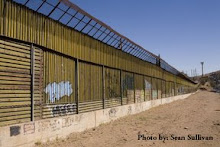
To build the border wall the federal government has brought condemnation lawsuits against more than 300 Texas landowners. Homeowners, farmers, nature preserves, and municipalities all face the imminent loss of their property for a patchwork of walls that have “no discernible impact” on the overall numbers of immigrants or smugglers who cross the border, according to the Congressional Research Service. The wall is a rhetorical point used by politicians who do not represent border communities to claim that they are working to protect the homeland. For them, the real impact of the border wall is irrelevant; all that matters is the perception among voters who will never actually see it. Members of congress who do represent Texas border residents should be fighting to defend our lands and our homes, literally the homeland that the border wall is supposed to secure. Instead, Texas’ Senators have worked to fund and build the wall that today stands in Hidalgo County and is tearing through Brownsville.

Land nearest the Rio Grande has always been prized because of the rich soil and the year-round availability of water. Many families along its banks still hold title to lands that were granted to their forefathers by the King of Spain as early as the 1740’s, decades before the United States and Mexico became sovereign nations, and more than a century before the Rio Grande became their shared border. For these owners, the land is a priceless piece of their family’s history.

Eloisa Tamez’ property has been in her family since the King of Spain issued the San Pedro Carracitos Land Grant in 1763. In 2007 DHS demanded access to her property for border wall surveys, then initiated condemnation proceedings. Dr. Tamez enlisted the Center for Human Rights and Constitutional Law and initiated a class-action lawsuit alleging that DHS has refused to negotiate with landowners before condemning their property, as the law requires. She also demanded that DHS reveal its criteria for citing the border wall, which in places runs for miles through poor and/or minority communities, then ends abruptly at the property line of wealthy property owners and resort communities. David Pagan of Customs and Border Protection responded, "We do not plan to suspend work on the construction of fence in order to hold a series of additional consultation meetings." On April 15, 2009 the court ruled against Dr. Tamez’, allowing the federal government to seize her land. Within a week the border wall had been built across her property.

Last February Eva Lambert awoke to the sound of heavy equipment erecting the border wall’s steel posts on her land. In her case, either through disregard for the law or incompetence, DHS finished construction of the wall before anyone had contacted her to negotiate a price or condemn her property. Denied her day in court as well as her property, Ms. Lambert is still waiting to find out what compensation will be offered. As she told the Brownsville Herald, "In the end, the government does what it wants."

In the low-lying river delta of South Texas, the treaty that established the Rio Grande as the border prohibits construction between the levee and the river. This is because a structure immediately adjacent to the river could deflect floodwaters and shift the river’s course, resulting in a change in the international boundary. So, to comply with the treaty, the border wall is being built into, on, or behind the flood-control levee that parallels the river rather than immediately adjacent to it. This levee is located up to two miles north of the river, leaving thousands of acres of U.S. territory, much of it privately owned, behind the border wall.

The Department of Homeland Security has offered only to pay for the exact footprint of the border wall (typically, a 60-foot wide strip) as it passes through a parcel of land. In their simplistic calculations, the agency has completely issues such as the devaluation of contiguous property, problems accessing land and homes behind the wall, impacts on livelihood, and the importance of cultural heritage. Despite the range and complexity of these issues, DHS has steadfastly refused to enter into meaningful negotiations with property owners.

The Nature Conservancy’s Southmost Preserve maintains one of the last remaining Sabal Palm forests along the banks of the Rio Grande. The border wall will bisect the preserve, cutting off more than 700 acres along with an equipment barn, office, and caretaker’s residence. The property was purchased in 1999 for $2.6 million, but DHS has only offered to pay $114,000 for the wall’s footprint, a strip of land 60 feet wide and 6,000 feet long. DHS has refused to explain how they will access the property that will be behind the wall. They claim that gates will be built, but they won’t say who will get keys or under what circumstances Conservancy staff will be able to access the property. Like Dr. Tamez, the Nature Conservancy is attempting to use the courts to save their land.

Other homes, businesses, and properties that are behind the levees will be walled off entirely, trapped between the wall and the Rio Grande. DHS has refused to grant any compensation whatsoever for properties left on the “Mexican” side of the wall. Indeed, because DHS is focused solely on the wall’s exact footprint, they have failed to even make contact with some of the landowners with property behind the wall.

The Sabal Palm Audubon Center preserves another 557 acres of Sabal Palm forest, which will also be behind the border wall. Because the wall will be built a few feet to the north of their property line, DHS has not offered Audubon any compensation whatsoever. Both Audubon and the Nature Conservancy have said that restricted access for their employees may force them to cut their operations. There is also the concern that uncertain access for emergency personnel may make it impossible to purchase the insurance that allows busloads of local school children to visit the center. With construction of the border wall imminent, Audubon announced that on May 15, 2009 they will close to the public for at least the next 6 months.

The Department of Homeland Security has repeatedly claimed that they have consulted with landowners and local officials regarding border wall construction. But when the Texas Border Coalition repeatedly invited DHS and Customs and Border Protection officials to “walk the line” and see the impacts that the border wall will have on specific communities, they responded that they would only do so if the owners of the property that they would be crossing were kept away. Apparently, their preferred method of consultation is a condemnation proceeding.

In the face of these assaults on property rights by the federal government, one would expect Texas’ conservative Senators to stand up for their constituents. Private property and small government are central tenets of both of their stated philosophies. In July of 2007 Senator Cornyn told reporters, "I assure you there will be local consultation. There will not be ... unilateral actions on the part of the Department of Homeland Security without local input."

Senator Hutchison did add an amendment to the 2008 Omnibus Appropriations Bill that gave the Secretary of Homeland Security the flexibility to decide where walls should be built, as well as to spare places where walls do not make sense. The Homeland Security Secretary was also required to, “consult with the Secretary of Interior, the Secretary of Agriculture, States, local governments, Indian tribes, and property owners in the United States to minimize the impact on the environment, culture, commerce, and quality of life for the communities and residents located near the sites at which such fencing is to be constructed.”

Following howls of outrage from right wing pundits and politicians that she had “gutted” the Secure Fence Act, Hutchison backed away from her amendment. She has yet to confront DHS on its refusal to consult with property owners, as epitomized by its demand that landowners be kept away from any DHS employees who walk the line through their property. So long as she is afraid to fight on behalf of Texas landowners, the amendment that she authored is just more empty words.

Senator Cornyn’s statements assuring that there will be local consultation have also proved to be empty. Like Senator Hutchison, he has made no concrete effort to stand up for border residents. Instead, Cornyn sponsored the “Emergency Border Security Funding Act of 2007” which called for 700 linear miles of border wall and 300 miles of vehicle barriers along the US – Mexico border, and provided $3 billion dollars to build it. Cornyn’s bill went nowhere, but even without it DHS has received $3.1 billion to build the border wall.

On April 2, 2009, the one year anniversary of former Homeland Security Secretary Chertoff’s border-wide waiver that swept aside 36 federal laws, both of Texas’ Senators voted to add a motion to the Omnibus Appropriations bill that read, “To provide for a point of order against any appropriations bill that fails [to] fully fund the construction of the Southwest border fence.” The vote fell along party lines and failed, but in voting once again in favor of the border wall Hutchison and Cornyn chose party loyalty over the interests of their constituents.

This should not come as a surprise. When Cornyn looks back at the last election, he will look to the north Dallas suburbs as important to his win, not 540 miles south of Dallas to Brownsville. When Hutchison thinks about her upcoming bid to unseat Governor Perry, she will be counting on votes in Sugarland, not El Paso. Though they claim to represent the entire state, so long as they see border communities as politically irrelevant they will not work on our behalf.

The fact that their neglect is not surprising does not make it acceptable. Our Senators, as well as our U.S. Representatives and our President, were put in office to work for all of us. They can not be allowed to play favorites. When they do we need to speak up.

Some border representatives are working to defend border communities. Representative Grijalva of Arizona has authored HR 2076, The Border Security and Responsibility Act. It would require that the Department of Homeland Security work with border communities and landowners in developing security measures, rather than treat them as the enemy. DHS would also have to obey all of our nation’s laws, instead of sweeping away those which are seen as an inconvenience. Cosponsoring this bill in the House, or introducing a companion in the Senate, would be a concrete demonstration of support for border residents.

With this bill pending and walls under construction, it is critical that our members of Congress hear from their constituents right now. Urge them to support the Border Security and Responsibility Act. Demand that they work to stop further walls from tearing through the borderlands. Though only around 50 miles of border wall remain to be built it is not too late to stop it. If you lived in a home, or owned a farm, or worked at a wildlife refuge that is in the path of one of those miles, you would see every last mile as important.

So long as we sit quietly by and watch the border wall go up, we are irrelevant in the eyes of Congress. If we do not make our voices heard, and make our elected officials listen, mile upon mile of wall will be built. And while we can rail against the politicians who sacrifice our home for political gain, if we are silent we own a portion of the blame.

Thursday, January 15, 2009

Texas Border Coalition Members Ask U.S. Supreme Court to Hear Border Wall Waiver Case

The Texas Border Coalition has written an amicus brief in support of a constitutional challenge to section 102 of the Real ID Act, which gives the Secretary of Homeland Security the unprecedened power to brush aside any law that might slow down construcion of the border wall. Section 102 said, “Notwithstanding any other provision of law, the Secretary of Homeland Security shall have the authority to waive all legal requirements such Secretary, in such Secretary’s sole discretion, determines necessary to ensure expeditious construction of the barriers and roads under this section.” The Texas Border Coalition issued the following press release regarding their support of the constitutional challenge:

EAGLE PASS, Texas (Jan. 14, 2009) – Members of the Texas Border Coalition (TBC) are asking the U.S. Supreme Court to hear an appeal by El Paso County, the city of El Paso and others challenging the constitutionality of Homeland Security Secretary Michael Chertoff’s waivers of 37 federal laws and all state, local and tribal laws. Chertoff exercised these waivers in connection with the U.S.-Mexico border wall.

In an amicus curiae brief filed today, TBC members ask the Court to address for the first time whether the waiver authority granted to Chertoff by Congress is permissible under the U.S. Constitution.

The brief noted that no appellate court has ever upheld such a broad a delegation of legislative power to the executive branch without judicial review, arguing that the waivers “bulldoze wide swaths of unidentified state and local laws” in a fashion contrary to what the framers of the Constitution intended.

Eagle Pass Mayor and TBC Chairman Foster said, “I hope the justices will seize this opportunity to restore the balance of sovereignty among federal, state and local governments that our nation’s founders guaranteed to the people and eloquently expressed in the Constitution and in the writings of James Madison.”

On April 3, 2008, Chertoff issued two waivers covering almost 500 miles of territory along the Mexican border from California to Texas in an effort to expedite construction of the 670-mile wall along the U.S.-Mexico border.Invoking his authority under Section 102(c) of the Illegal Immigration Reform and Immigrant Responsibility Act (IIRIRA), the Secretary waived 37 federal laws and all related regulations, including environmental laws, historic preservation acts, the Rivers and Harbors Act, the Federal Land Policy and Management Act, the Federal Grant and Cooperation Act, acts protecting the exercise of religious freedom, and the entire Administrative Procedures Act.

Perhaps most troubling is that Chertoff has purported to waive all state and local laws relating to the subject matter of these federal laws, but has not specified which state and local laws have been waived, for how long, or against whom.

TBC members argue that such unrestricted power granted to Chertoff raises profound, unanswered questions about sovereignty – including the local police powers – of the state of Texas and other cities and counties along the U.S.-Mexico border. They assert that the secretary has encroached on the most fundamental aspect of state and local sovereignty, and that is the power to govern by their own duly enacted laws.

“Should the Supreme Court allow these waivers to stand without so much as an argument in defense of liberty, the justices will effectively confer upon an unelected agency chief limitless and unbridled power never dreamed possible by the authors of the Constitution,” Foster said.

The justices are expected to decide this spring or summer whether to hear the case.

For a copy of the brief, please click here.

The Texas Border Coalition (TBC) is a collective voice of border mayors, county judges, economic development commissions focused on issues that affect more than 6 million people along the Texas-Mexico border region and economically disadvantaged counties from El Paso to Brownsville. TBC is working closely with the state and federal government to educate, advocate, and secure funding for transportation, immigration and ports of entry, workforce and education and health care. For more information, visit the TBC Web site at www.texasbordercoaltion.org.

Tuesday, November 11, 2008

TBC Dumbfounded by CBP `Demands for Secrecy' Over Border Fence Talks, Land Acquisitions

The Texas Border Coalition issued the following press release in response to word from U.S. Customs and Border Protection that when they "walk the line" that the border wall will take through South Texas communities, residents of those communities, including the owners of land that the wall will bisect, will be kept out.

EAGLE PASS, Texas (Nov. 10, 2008) – A coalition of Texas border mayors, county judges and economic development associations today slammed a U.S. Customs and Border Protection (CBP) agency decision to shut Rio Grande Valley landowners out of federally-required talks over the border wall in Texas.

Members of the Texas Border Coalition (TBC) also condemned a CBP decision to continue land acquisition near Roma, Rio Grande City and Los Ebanos even though the agency announced last week that it would indefinitely halt construction of moveable fencing near the communities.

"TBC is dumbfounded by CBP's continued resistance to consultation with local landowners and the community, and by CBP's unjustifiable demands for secrecy," Eagle Pass Mayor and TBC Chairman Chad Foster said in response to a letter from David Pagan, an agency official.

"Equally disturbing, CBP is continuing to pursue legal action to condemn the land of the people in Roma, Rio Grande City and Los Ebanos for a fence that the International Boundary & Water Commission won't support," Foster said. "With our nation adding $1 trillion this year to our $10 trillion national debt, this a gross waste of money at a time when the American taxpayer can least afford it."

Last week, CBP informed coalition members that construction of moveable fencing would be delayed at least until next year because the IBWC had raised concerns that the structure could increase the potential for flooding in those communities.

Meanwhile, TBC and Homeland Security officials agreed in April to participate in a series of fence site tours in the Rio Grande Valley, known as "walk the line," to help satisfy federal requirements outlined in the Consolidated Fiscal 2008 Appropriations Act.
Under the law, homeland security officials are obliged to consult with the Secretary
of the Interior, the Secretary of Agriculture, states, local governments, Indian tribes,
and property owners in communities where the wall is to be built. The point is to minimize the barrier's impact on Rio Grande Valley communities and residents from an environmental, cultural and economic standpoint.

The coalition had hoped the tour would take place before the congressionally imposed fence construction deadline of Dec. 31.

But on Nov. 4, Foster said, CBP officials told TBC that attendance would be limited to coalition members only and that individual landowners or their attorneys would not be allowed to "walk the line."

Foster said he believes CBP officials balked because they fear effective consultation
with TBC might be compromised if the agency was forced to show its hand on individual segments of fencing in the presence of opposing landowners. These fears are "inappropriately thin-skinned," he asserted.

"The idea that CBP would expressly prohibit attorneys representing landowners from walking the line when the government's legal actions threaten the rights and liberties of landowners violates the concept of the right to counsel embodied in the Bill of Rights," Foster said.

Foster said TBC will ignore the agency's demands and open its membership to affected Texas landowners who reside along the wall's 270-mile path if CBP insists on shutting them – or their attorneys – out of the consultation process.

"We will not retreat from our insistence that the government consult with our communities and landowners `to minimize the impact on the environment, culture, commerce, and quality of life' as the law requires," he added.

The Texas Border Coalition (TBC) is a collective voice of border mayors, county judges, economic development commissions focused on issues that affect more than 6 million people along the Texas-Mexico border region and economically disadvantaged counties from El Paso to Brownsville. TBC is working closely with the state and federal government to educate, advocate, and secure funding for transportation, immigration and ports of entry, workforce and education and health care. For more information, visit the coalition Web site at http://www.texasbordercoaltion.org/.

Tuesday, July 29, 2008

Hurricanes and Border Walls Don’t Mix

The Texas Border Coalition, which describes itself as a collective voice of border mayors, county judges, and economic development commissions along Texas' border with Mexico, released the following statement regarding the border wall in South Texas:

EAGLE PASS, Texas – (July 25, 2008) – As South Texans continue to repair roofs, roads and lives damaged by Hurricane Dolly, the chairman of the Texas Border Coalition (TBC) repeated his protest today that hurricanes and the border wall don’t mix.

TBC Chairman and Eagle Pass Mayor Chad Foster objected to a new plan by the Department of Homeland Security (DHS) to build 14 miles of movable wall in the U.S.-Mexico border floodplain that would have to be torn down within 24 hours of the next hurricane or other flood event.

“Hurricane season is not over with the downgrading of Dolly,” Foster said. “Not only does DHS plan to continue its piecemeal approach to protecting the lives of South Texans, now they plan a total absurdity: a movable wall.”

“If a movable wall were in place today, over 1,000 workers would be needed to tear it down within 24 hours, load it on to hundreds of trucks to take it north,” said Foster. “They would be doing so instead of battening down their homes for the storm or evacuating their families from its wrath.”

According to the latest information available about the movable wall, it would be constructed of steel bollards 18 feet above ground, filled to the 10-foot level with concrete. By TBC’s back-of-the-envelope estimations, the 14-mile movable wall would be made of nearly 90,000 steel bollards, each weighing about 1,700 pounds.

To achieve its goal of removing the wall, the DHS would have to haul away 151 million pounds of unwieldy pipe filled with concrete. Who will move it and with what equipment is unclear.

“The people of the Rio Grande Valley, having just experienced the rapid emergency work necessary to protect the people in advance of a hurricane, know that DHS’ movable wall is simply ridiculous,” Foster said.

“It is an outrage that that DHS is so arrogant, out of control and headstrong to build a wall that even Homeland Security Secretary Michael Chertoff admits won’t work – that illegal crossers will go around, over, through and under it,” Foster said. “In doing so, they are wasting $50 billion of the taxpayers’ money for a wall that everyone knows won’t work.”

Foster added, “This is the result of Secretary Chertoff’s waiver of 34 laws to build the wall. By repealing these laws, DHS has avoided scrutiny from the public and government agencies, essentially voiding our system of checks and balances. It would have made more sense, and saved taxpayers hundreds of millions of dollars, if DHS had simply consulted with border residents and border officials first. We certainly would not have suggested a 151-million-pound movable wall.”

The Texas wall is being built more than 1 mile from the border, trapping workers, families, farmers, ranchers, and retirees on the Mexican side. The wall will cede thousands of acres of U.S. land to Mexico and endanger the lives of people when they need assistance from emergency or law enforcement personnel who won’t be able to reach them.

“Illegal border crossing won’t be controlled until the U.S. has a well-run immigration system that expands avenues for legal workers and cracks down on illegal hiring,” Foster said.

When immigration is reformed, the U.S. won’t need a border wall, although the nation will continue to require beefed up Border Patrol and Customs forces to halt illegal drug smuggling. The border wall will be torn down, he added.

“We thank goodness that Hurricane Dolly jogged north of the Rio Grande river just before hitting Texas. As my friends and neighbors give thanks for being spared from what could have been the worst catastrophe of their lives, Congress and President Bush should stop the construction of an absurd movable border wall that they’ll have to tear down,” Foster said.

# # #

The Texas Border Coalition (TBC) is a collective voice of border mayors, county judges, economic development commissions focused on issues that affect more than 6 million people along the Texas-Mexico border region and economically disadvantaged counties from El Paso to Brownsville. TBC is working closely with the state and federal government to educate, advocate, and secure funding for transportation, immigration and ports of entry, workforce and education and health care. For more information, visit the coalition Web site at www.texasbordercoaltion.org.

Saturday, May 24, 2008

Presidio does the right thing in joining the Texas Border Coalition border wall lawsuit

by Adrienne Evans

On Tuesday, May 20, after input from citizens and discussion among the mayor and council, the Presidio City Council voted to join the Texas Border Coalition (TBC), a coalition of Texas border cities, counties, chambers of commerce, and economic development corporations, representing over two million border residents from El Paso to Brownsville. Presidio is scheduled by DHS for levee-wall construction this year, along with Cameron and Hidalgo Counties.

On February 19, the Presidio City Council passed a resolution that stated that they opposed “the building of a wall along the Texas/Mexico border that extends over 135 miles of border,” as well as “a wall specifically in the Big Bend Area of Texas,” in that “the building of the border wall will impact our region, through trade, tourism, and unfriendly relations within border alliances”. The Presidio County Commissioners, the City of Marfa, the City of Alpine, and the City of El Paso passed similar resolutions.

At the Border Wall Conference in Alpine on May 17, U.S. Border Patrol Deputy Chief Carry Huffman stated in reference to a border wall in Presidio, “As I mentioned earlier, Presidio is not a place that is out of control. Apprehensions in Presidio are relatively low.” After delineating examples of the existing problems in the Marfa Sector, Huffman said, “We anticipate that traffic will be moving through the Ojinaga area,” as the rationale for the border wall.

During a presentation at the Tuesday City Council meeting, Redford resident and border activist April Cotte stated, “I have spoken with five landowners who are very against this, whose land will be affected.”

Mayor Lorenzo Hernandez said, “The thing that really bothers me is those big, old lines that we have to wait in [at the port of entry]. Two Sundays ago, people were complaining about waiting three hours to pass. So if this coalition could help us out that and help the businesses in Presidio, I don’t see why we shouldn’t join. … About the relationship between Presidio and Ojinaga … how is [the border wall] going to affect the relationship with those people? And they know they need Presidio just as much as we need them. And I don’t think this wall is going to help that relationship.”

Before the council voted to join the TBC, there was a discussion about alternatives to the border wall, such as restoring the Rio Grande to its historical levels. The vote was unanimous.
During the city council meeting, Presidio City Attorney Steve Spurgin indicated that he would be in contact with the attorneys involved regarding legal action.

The TBC has recently filed a class action lawsuit against the government asserting, among other issues, that there was a lack of consultation with property owners and border communities about the construction of a border wall. The lawsuit is being brought pro bono by a team that includes lead attorney Peter Schey of the Center for Human Rights and Constitutional Law in Los Angeles.

In the legal complaint filed on May 16, 2008, it states that Secretary of Homeland Security Michael Chertoff has "failed to comply with the consultation requirement of the Consolidated Appropriations Act, 2008 … which requires consultation with private property owners and cities and other stake-holders to minimize the impact on the environment, culture, commerce, and quality of life for the communities and residents located near the sites at which activities relating to border fencing may occur.”

The chair of the TBC is Chad Foster, the mayor of Eagle Pass. In the complaint filed last week, which names as the plaintiff, TBC, and as defendants, Secretary Chertoff as well as Robert F. Janson of U.S. Customs and Border Protection, Mayor Foster is quoted about never receiving “any logical answers from defendants as to why certain areas in his city have been targeted for fencing over other areas: ‘I puzzled a while over why the fence would bypass the industrial park and go through the city park.’”

After the Presidio city council's vote, lifelong Redford resident Enrique Madrid, who attended the meeting with his wife Ruby, said, “Today, May 20, is the eleventh anniversary of the killing of Esequiel Hernandez Jr. Instead of a human form of militarization like the Marines killing Esequiel, this border wall is an engineering form of militarization, which is just as inhumane and brutal as deploying the Marines on U.S. soil in Redford was, eleven years ago."

On May 20, 1997, Esequiel Hernandez, Jr., an 18-year-old high school student, was killed by U.S. Marines near his home in Redford, Texas, which is 12 miles from Presidio. He was the first U.S. citizen to be killed by members of the U.S. Armed Forces since an incident where student demonstrators were massacred at Kent State University by members of the Ohio National Guard in 1970. The documentary, The Ballad of Esequiel Hernandez, will air on PBS on July 8. It is narrated by Tommy Lee Jones and directed by Kieran Fitzgerald.

Mr. Madrid went on to say that “it was appropriate that the City of Presidio, in its own way, commemorated the death of Esequiel Hernandez by rejecting this new manifestation of militarization on this day. It’s like there’s a light at the end of the tunnel, that there is hope, that justice will be permitted, finally. Justice is a natural right that should be freely flowing, and the City of Presidio is supporting that.”

###########

Adrienne Evans is a mother, health practitioner and community volunteer who lives in Terlingua, Texas. She is the co-founder of No Wall – Big Bend coalition. For more info, visit www.NoWallBigBend.blogspot.com.
This op-ed first appeared in the Big Bend Sentinel, the Presidio International, and the Rio Grande Guardian.