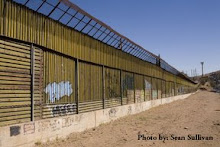
We are pleased to announce that the new No Border Wall website is up and running at
www.No-Border-Wall.com
This site is designed to be a comprehensive guide to the U.S.-Mexico border wall--its history, its ineffectiveness, types of wall designs, and the problems it has caused. There is also a geographical breakdown that details the damage walls have caused in specific regions. With loads of information and citation links to documents and newspaper articles embedded throughout, it is our hope that this site will become a point of entry into the issue for reporters, researchers, policy makers, and the general public.
The updated website comes at a particularly important time, with candidates for office as far from the border as Rhode Island running on border militarization. This often includes calls for more border walls, even double-layered walls from coast to coast, despite the tremendous financial, social, and environmental cost that this would inflict upon the United States. National policies of this magnitude must be based on facts, rather than misleading sound bites. That is why we have made every effort to ensure the accuracy of the information that is presented on the website.
Showing posts with label Obama. Show all posts
Showing posts with label Obama. Show all posts
Sunday, October 10, 2010


Friday, May 1, 2009
The Border Wall vs. Property Rights: Texas’ Senators Support the Wrong Side
by Scott Nicol
To build the border wall the federal government has brought condemnation lawsuits against more than 300Texas Texas Texas ’ Senators have worked to fund and build the wall that today stands in Hidalgo County and is tearing through Brownsville
To build the border wall the federal government has brought condemnation lawsuits against more than 300
Land nearest the
Eloisa Tamez’ property has been in her family since the King of Spain issued the San Pedro Carracitos Land Grant in 1763. In 2007 DHS demanded access to her property for border wall surveys, then initiated condemnation proceedings. Dr. Tamez enlisted the Center for Human Rights and Constitutional Law and initiated a class-action lawsuit alleging that DHS has refused to negotiate with landowners before condemning their property, as the law requires. She also demanded that DHS reveal its criteria for citing the border wall, which in places runs for miles through poor and/or minority communities, then ends abruptly at the property line of wealthy property owners and resort communities. David Pagan of Customs and Border Protection responded, "We do not plan to suspend work on the construction of fence in order to hold a series of additional consultation meetings." On April 15, 2009 the court ruled against Dr. Tamez’, allowing the federal government to seize her land. Within a week the border wall had been built across her property.
Last February Eva Lambert awoke to the sound of heavy equipment erecting the border wall’s steel posts on her land. In her case, either through disregard for the law or incompetence, DHS finished construction of the wall before anyone had contacted her to negotiate a price or condemn her property. Denied her day in court as well as her property, Ms. Lambert is still waiting to find out what compensation will be offered. As she told the Brownsville Herald, "In the end, the government does what it wants."
In the low-lying river delta of South Texas, the treaty that established the
The Department of Homeland Security has offered only to pay for the exact footprint of the border wall (typically, a 60-foot wide strip) as it passes through a parcel of land. In their simplistic calculations, the agency has completely issues such as the devaluation of contiguous property, problems accessing land and homes behind the wall, impacts on livelihood, and the importance of cultural heritage. Despite the range and complexity of these issues, DHS has steadfastly refused to enter into meaningful negotiations with property owners.
The Nature Conservancy’s Southmost Preserve maintains one of the last remaining Sabal Palm forests along the banks of the
Other homes, businesses, and properties that are behind the levees will be walled off entirely, trapped between the wall and the
The
The Department of Homeland Security has repeatedly claimed that they have consulted with landowners and local officials regarding border wall construction. But when the Texas Border Coalition repeatedly invited DHS and Customs and Border Protection officials to “walk the line” and see the impacts that the border wall will have on specific communities, they responded that they would only do so if the owners of the property that they would be crossing were kept away. Apparently, their preferred method of consultation is a condemnation proceeding.
In the face of these assaults on property rights by the federal government, one would expect
Senator Hutchison did add an amendment to the 2008 Omnibus Appropriations Bill that gave the Secretary of Homeland Security the flexibility to decide where walls should be built, as well as to spare places where walls do not make sense. The Homeland Security Secretary was also required to, “consult with the Secretary of Interior, the Secretary of Agriculture, States, local governments, Indian tribes, and property owners in the United States to minimize the impact on the environment, culture, commerce, and quality of life for the communities and residents located near the sites at which such fencing is to be constructed.”
Following howls of outrage from right wing pundits and politicians that she had “gutted” the Secure Fence Act, Hutchison backed away from her amendment. She has yet to confront DHS on its refusal to consult with property owners, as epitomized by its demand that landowners be kept away from any DHS employees who walk the line through their property. So long as she is afraid to fight on behalf of
Senator Cornyn’s statements assuring that there will be local consultation have also proved to be empty. Like Senator Hutchison, he has made no concrete effort to stand up for border residents. Instead, Cornyn sponsored the “Emergency Border Security Funding Act of 2007” which called for 700 linear miles of border wall and 300 miles of vehicle barriers along the US – Mexico border, and provided $3 billion dollars to build it. Cornyn’s bill went nowhere, but even without it DHS has received $3.1 billion to build the border wall.
On April 2, 2009, the one year anniversary of former Homeland Security Secretary Chertoff’s border-wide waiver that swept aside 36 federal laws, both of Texas’ Senators voted to add a motion to the Omnibus Appropriations bill that read, “To provide for a point of order against any appropriations bill that fails [to] fully fund the construction of the Southwest border fence.” The vote fell along party lines and failed, but in voting once again in favor of the border wall Hutchison and Cornyn chose party loyalty over the interests of their constituents.
This should not come as a surprise. When Cornyn looks back at the last election, he will look to the north
The fact that their neglect is not surprising does not make it acceptable. Our Senators, as well as our
Some border representatives are working to defend border communities. Representative Grijalva of
With this bill pending and walls under construction, it is critical that our members of Congress hear from their constituents right now. Urge them to support the Border Security and Responsibility Act. Demand that they work to stop further walls from tearing through the borderlands. Though only around 50 miles of border wall remain to be built it is not too late to stop it. If you lived in a home, or owned a farm, or worked at a wildlife refuge that is in the path of one of those miles, you would see every last mile as important.
So long as we sit quietly by and watch the border wall go up, we are irrelevant in the eyes of Congress. If we do not make our voices heard, and make our elected officials listen, mile upon mile of wall will be built. And while we can rail against the politicians who sacrifice our home for political gain, if we are silent we own a portion of the blame.
Wednesday, January 21, 2009
Texas Calls Upon DHS Secretary Napolitano to Bring an End to the Border Wall
Secretary Janet Napolitano
United States Department of Homeland SecurityWashington, D.C. 20528
January 20, 2009
Dear Secretary Napolitano,
At the same time as Barak Obama is taking the oath of office, workers are pouring concrete and welding steel to build the border wall. Today, walls slice through more than 500 miles of our borderlands. As Governor of Arizona, you are certainly aware of both the inefficacy of the wall and its tremendous financial costs. Surely you are aware of the thousands of undocumented migrants who have died in Arizona’s deserts, and the species being driven to extinction by Arizona’s border wall. Those of us who live in Texas hope that you will also take into account the wall’s tremendous toll along our border, and that you will reverse your predecessor’s policies and bring an immediate end to border wall construction.
The overwhelming majority of Texas border residents oppose the border wall, because we can see firsthand the destruction that it is causing without bringing the slightest benefit. If its impacts on the border and the nation as a whole were as positive as outgoing Secretary of Homeland Security Michael Chertoff has claimed, there would be overwhelming support for the wall. If the southern border was in fact being overrun by terrorists and smugglers who were causing us to live in a state of constant fear, and the wall was a viable solution to such a dire situation, there would be no need to pursue hundreds of land condemnation lawsuits. We would gather at the riverside with trowels and welding torches in hand to help build it.
But we know that the border wall will not save us from threats dreamed up by politicians in Washington, DC who have never seen the Rio Grande. The wall does not even stop those who enter the U.S. to find work. Del Rio, Texas, Border Patrol Chief Randy Hill said, “We're going to see steel barriers erected on the borders where U.S. and Mexican cities adjoin. These will slow down illegal crossers by minutes.” He said nothing about stopping crossers, only slowing crossers down by “minutes.” We are not willing to sacrifice homes, farms, and wildlife refuges for a speed bump.
Instead, a broad cross-section of border residents has come together in opposition to the border wall. The Texas Border Coalition, made up of mayors, judges, and elected officials all along Texas’ border with Mexico has been outspoken in its rejection of walls, and has fought in court to defend the Texas border from further construction. Numerous municipalities have passed resolutions opposing the border wall. The Lone Star Sierra Club Chapter has passed a resolution opposing the border wall, and has worked to draw attention to its tremendous environmental costs. Bishop Peña of the Catholic Diocese of Brownsville spoke at a No Border Wall rally, as have a number of mayors and Texas State Representatives.
The Cameron County Commissioners Court passed a resolution which sums up much of the sentiment along Texas’ southern border, saying in part,
"Proponents of the fence, who are not residents of the border region, have wrongly used the construction of a fence as a rhetorical device to transform the issue of immigration from an economic concern to a matter of international relations and national security, and to transfer responsibility for alleged defects in United States immigration policy and enforcement from the United States government to the government of Mexico."
Those of us who live along the border are not willing to see our land condemned, our communities divided, and our parks and wildlife refuges destroyed, for a rhetorical device.
The No Border Wall coalition has circulated a petition that reads,
We oppose the construction of a solid wall along more than 700 miles of the United States / Mexico border. A wall that tears through border communities will cause terrible economic damage, impacting agriculture, ecotourism, retail sales, and private property. It will cause grave social harm, separating families and sending a terrible message to our neighbors. The route specified by the Secure Fence Act of 2006 will take it through National Wildlife Refuges, other parks, and riparian habitat critical for the survival of migrating birds as well as threatened and endangered species. The border wall will cost billions of dollars and even the Department of Homeland Security has said that it will only slow down, not stop, people who cross the border illegally.
To date, 6,501 people have signed this petition. Most are residents of Texas border communities who will be directly impacted by the border wall. This is not an abstraction, a symbol, or a rhetorical device to us. This is our lives. Our families, our children, and our grandchildren will be forced to live in the shadow of a wall that we abhor so that politicians who will never visit our communities can give their voters a false sense of security.
Thanks to last year’s Omnibus spending bill, you will have the authority to either double the current length of the border wall or immediately halt construction. Outgoing Homeland Security Secretary Chertoff used these powers to condemn private property, decimate wildlife corridors, and build mile upon mile of useless border wall. His retirement was celebrated from Brownsville, Texas, to Tucson, Arizona.
Secretary Napolitano, Texas border communities call upon you to embody the “change” that Barak Obama campaigned on. You must have the courage to speak truthfully to the American people, to admit that we are not safer for having built hundreds of miles of border wall, and our national security will not be enhanced by building another mile or one hundred miles or even one thousand miles. You should restore the rule of law along the border by rescinding the waivers of 36 federal laws that Michael Chertoff issued in order to build border walls. We ask you to shift the Department of Homeland Security’s funds and priorities away from empty gestures and political grandstanding, and bring an end to the border wall.
United States Department of Homeland SecurityWashington, D.C. 20528
January 20, 2009
Dear Secretary Napolitano,
At the same time as Barak Obama is taking the oath of office, workers are pouring concrete and welding steel to build the border wall. Today, walls slice through more than 500 miles of our borderlands. As Governor of Arizona, you are certainly aware of both the inefficacy of the wall and its tremendous financial costs. Surely you are aware of the thousands of undocumented migrants who have died in Arizona’s deserts, and the species being driven to extinction by Arizona’s border wall. Those of us who live in Texas hope that you will also take into account the wall’s tremendous toll along our border, and that you will reverse your predecessor’s policies and bring an immediate end to border wall construction.
The overwhelming majority of Texas border residents oppose the border wall, because we can see firsthand the destruction that it is causing without bringing the slightest benefit. If its impacts on the border and the nation as a whole were as positive as outgoing Secretary of Homeland Security Michael Chertoff has claimed, there would be overwhelming support for the wall. If the southern border was in fact being overrun by terrorists and smugglers who were causing us to live in a state of constant fear, and the wall was a viable solution to such a dire situation, there would be no need to pursue hundreds of land condemnation lawsuits. We would gather at the riverside with trowels and welding torches in hand to help build it.
But we know that the border wall will not save us from threats dreamed up by politicians in Washington, DC who have never seen the Rio Grande. The wall does not even stop those who enter the U.S. to find work. Del Rio, Texas, Border Patrol Chief Randy Hill said, “We're going to see steel barriers erected on the borders where U.S. and Mexican cities adjoin. These will slow down illegal crossers by minutes.” He said nothing about stopping crossers, only slowing crossers down by “minutes.” We are not willing to sacrifice homes, farms, and wildlife refuges for a speed bump.
Instead, a broad cross-section of border residents has come together in opposition to the border wall. The Texas Border Coalition, made up of mayors, judges, and elected officials all along Texas’ border with Mexico has been outspoken in its rejection of walls, and has fought in court to defend the Texas border from further construction. Numerous municipalities have passed resolutions opposing the border wall. The Lone Star Sierra Club Chapter has passed a resolution opposing the border wall, and has worked to draw attention to its tremendous environmental costs. Bishop Peña of the Catholic Diocese of Brownsville spoke at a No Border Wall rally, as have a number of mayors and Texas State Representatives.
The Cameron County Commissioners Court passed a resolution which sums up much of the sentiment along Texas’ southern border, saying in part,
"Proponents of the fence, who are not residents of the border region, have wrongly used the construction of a fence as a rhetorical device to transform the issue of immigration from an economic concern to a matter of international relations and national security, and to transfer responsibility for alleged defects in United States immigration policy and enforcement from the United States government to the government of Mexico."
Those of us who live along the border are not willing to see our land condemned, our communities divided, and our parks and wildlife refuges destroyed, for a rhetorical device.
The No Border Wall coalition has circulated a petition that reads,
We oppose the construction of a solid wall along more than 700 miles of the United States / Mexico border. A wall that tears through border communities will cause terrible economic damage, impacting agriculture, ecotourism, retail sales, and private property. It will cause grave social harm, separating families and sending a terrible message to our neighbors. The route specified by the Secure Fence Act of 2006 will take it through National Wildlife Refuges, other parks, and riparian habitat critical for the survival of migrating birds as well as threatened and endangered species. The border wall will cost billions of dollars and even the Department of Homeland Security has said that it will only slow down, not stop, people who cross the border illegally.
To date, 6,501 people have signed this petition. Most are residents of Texas border communities who will be directly impacted by the border wall. This is not an abstraction, a symbol, or a rhetorical device to us. This is our lives. Our families, our children, and our grandchildren will be forced to live in the shadow of a wall that we abhor so that politicians who will never visit our communities can give their voters a false sense of security.
Thanks to last year’s Omnibus spending bill, you will have the authority to either double the current length of the border wall or immediately halt construction. Outgoing Homeland Security Secretary Chertoff used these powers to condemn private property, decimate wildlife corridors, and build mile upon mile of useless border wall. His retirement was celebrated from Brownsville, Texas, to Tucson, Arizona.
Secretary Napolitano, Texas border communities call upon you to embody the “change” that Barak Obama campaigned on. You must have the courage to speak truthfully to the American people, to admit that we are not safer for having built hundreds of miles of border wall, and our national security will not be enhanced by building another mile or one hundred miles or even one thousand miles. You should restore the rule of law along the border by rescinding the waivers of 36 federal laws that Michael Chertoff issued in order to build border walls. We ask you to shift the Department of Homeland Security’s funds and priorities away from empty gestures and political grandstanding, and bring an end to the border wall.
Monday, December 8, 2008
Obama needs to consign Border Wall plan to the trashcan of bad ideas
By K. Rod Summy
During the past year, numerous articles have appeared in the local and national press regarding problems associated with construction of the Border Fence or Wall along the U.S.–Mexico border.
In one recent article, I expressed my concerns that the initiation of Border Wall construction in Hidalgo County, Texas during the middle of the 2008 hurricane season was inherently dangerous and could predispose our region to massive flooding if we were impacted by a major storm while such construction was in progress.
As examples of levee disturbances caused by Border Wall construction, I included a series of images acquired in the city of Granjeno during early-September of this year which showed firstly, deep unconsolidated (loose and friable) soil on both faces of the flood-control levee, and secondly a five- to six-meter gap between an uncompleted section of the concrete Border Wall and the remnants of the destabilized levee located to the south.
 Border wall under construction in the levee in Granjeno, TX 9/21/08
I discussed the ramifications of each type of disturbance, and recommended that major construction of any type which provides a potential to disturb or destabilize flood-control levees should be curtailed or prohibited during the annual hurricane season, which extends from early-June through late-November.
In response to my article, an unknown person (hereafter referred to “Anonymous”) posted the following statement on the No Border Wall blog on Sept. 22, 2008:
“Deceiving commentary on the engineering that is going on here. First the existing levees (small molehills) are raised using fill material. That is what the author calls "unstable" and "friable." Then the flood wall is constructed in front of the raised levees on the side facing the river, with space between so as not to disturb the newly upgraded earthen levee. After the wall is complete, the space is backfilled and consolidated agatinst [sic] the back of the flood wall. Please explain how the upgraded earth levee would provide less protection during a major storm than what was originally there?? (the original earth levee is still there underneath the built up levee). This makes no sense to me and it's a deceptive way to get an audience for this site's border wall bashing.”

Levee / border wall diagram from the Marfa Sector draft Environmental Assessment
The engineering details of the Border Wall provided by “Anonymous” are informative but irrelevant. How effective the Border Wall might be as a flood-control structure once construction is complete has nothing to do with the concerns expressed in my article – the real question is how it may be expected to perform if we are impacted by a major tropical storm or hurricane while construction is in progress.
All phases of Border Wall construction were in progress by September 7, 2008, the beginning of the week in which Hurricane Ike entered the Gulf of Mexico and intensified into one of the largest and most dangerous storms in Texas Gulf Coast history.
This included extensive excavation of the south levee face, the embedding of pilings and metal panels along the top of the levee, and construction of the partially-completed concrete wall which now extended approximately 150 to 200 meters west of its original point of origin.
 Levee / border wall construction in Granjeno, TX 8/01/08
To suggest that a levee in this condition is storm-worthy and capable of withstanding the onslaught of floodwaters produced by major tropical storms and hurricanes is ludicrous. Tropical storms and hurricanes are typically associated with high winds and torrential rainfall, which generally result in deep water and strong water currents within floodways. Any engineer or hydrologist worthy of the name should recognize that strong water currents developing in this manner will almost certainly obliterate any type of obstruction (earthen or otherwise) causing abrupt changes in surface contour of levee faces.
Moreover, a competent engineer should also recognize that the five- to six-meter “gap behind the wall” provides a means to generate very powerful water currents if any type of breach were to occur in the levee behind the concrete wall, e.g., as a result of overtopping. This is a simple matter of physical principles and hydrology – if a breach in this area should occur, floodwaters under tremendous pressure will tend to flow along the “path of least resistance,” i.e., they will flow through the breach until the system stabilizes as floodwaters subside.

Levee / border wall construction in Granjeno, TX 11/27/08
Since the concrete wall is impermeable to water, it will force floodwaters to enter a restricted channel (i.e., the gap in question) and to flow with increased velocity toward the breach in a direction parallel to the face of the destabilized earthen levee. As water flows through the breach, hydraulic action (erosion caused by moving water) will tend to widen the breach, which in turn will allow more water to enter the restricted channel (gap) which in turn will tend to increase the velocity of water flowing through the channel.
Despite repeated advisories from NOAA that water temperatures in the Gulf of Mexico were highly conducive to the development of tropical storms and hurricanes, Border Wall construction proceeded at a feverish pace without interruption during the peak of the 2008 hurricane season – August and September. During the second week of September, when Hurricane Ike was on an apparent “collision course” with south Texas, one of our local officials stated somewhat arrogantly that construction of the Border Wall (referred to as “levee repairs”) might be “halted temporarily” if Hurricane Ike headed our way. As it turned out, no such delay occurred – during the latter half of the week, Hurricane Ike began to veer northward and made landfall at Galveston on Sept. 13.

Levee / border wall construction behind homes in Granjeno, TX August 1, 2008
It is important for the reader to note that officials of the Department of Homeland Security, our local county officials and their construction contractors made no apparent preparations at Granjeno and three other construction sites in Hidalgo County for the possible landfall of Hurricane Ike along the south Texas coast. On Sept. 13, the day in which Ike was devastating much of southeast Texas and western Louisiana with massive flooding, construction of the Border Wall at Granjeno and three other sites in Hidalgo County was in high gear, with fleets of cranes, backhoes and other heavy equipment gnawing away at our flood-control levees like huge metallic termites.
The determination by DHS and our county officials to meet “Bush’s deadline” at essentially any cost and/or risk was presumably based on the erroneous logic that if funding for legitimate levee repairs and upgrades is not obtained now (under the Bush administration), it will be very difficult or impossible to obtain in the future (under a new presidential administration). This urgency is somewhat understandable considering the recent findings by FEMA that many areas of the LRGV levee system are not in compliance with federal standards, and will not be recertified unless they are upgraded and brought into compliance with FEMA standards within a period of one year (an additional one-year extension was recently granted).
Regardless of what their motives may have been, however, the decision by DHS and our local officials to initiate Border Wall construction in the Lower Rio Grande Valley during middle of the 2008 hurricane season, and their failure to make adequate preparations for the possible landfall of dangerous storms such as Hurricane Ike (which at one time seemed imminent) is inexcusable and placed the properties and lives of hundreds and possibly thousands of our citizens at considerable risk. We were very fortunate that Hurricane Dolly made landfall before Border Wall construction began in earnest at Granjeno and the other three sites, and that Hurricane Ike veered northward two days before its destructive landfall at Galveston. Had Hurricane Ike maintained its westward course and impacted the LRGV region while large sections of our flood-control system were under major construction, this story would not have ended happily (for us, at least). We cannot afford to allow this to happen again – ever!
Within the next six weeks, the George Bush administration will be history and Barack Obama will be inaugurated as the 44th President of the United States. If our country reenters a period of normalcy and rational thinking, the “Great Texas Border Wall” will hopefully be committed to its rightful place in the “Historical Trashcan of Bad Ideas.” Given our staggering federal deficit – which has increased substantially following the recent $750 billion bailout of the U. S. financial industry – it is very unlikely that the federal government will continue to pour millions (or billions) of dollars into a concrete structure that has become symbolic of tyranny and is despised almost universally by residents along the U.S.–Mexico border.

Levee / border wall construction in the Lower Rio Grande Valley National Wildlife Refuge 11/27/08
Termination of the Border Wall concept would place great pressure on the U.S. Congress to develop real solutions to the problem of illegal immigration (instead of expensive and dangerous concrete placebos) and would allow available funds - including the $400 million “bailout package” for the ailing Border Wall project – to be used much more effectively for repair and upgrades of the Lower Rio Grande Valley levee system and bring it into compliance with FEMA standards for the first time in many years. Of all the options available to us right now, this comes closest to being a true “win–win” situation, and is the only one which will really protect us from disastrous flooding if and when we are impacted by some future storm similar to Hurricane Ike.
We were deprived of these basic rights during 2008 because of two federal laws – the Secure Fence Act and the Real ID Act - which were enacted by the U. S. Congress during a period of national hysteria, fear and intolerance. Collectively, these two laws allowed federal, state and local officials involved in the Border Wall project to conduct their business in a reckless and dangerous manner, and deprived the nearly two million American citizens in the Lower Rio Grande Valley of their legal rights to challenge construction of the Border Wall on any virtually any grounds, including public safety issues.
What happened in south Texas during 2008 is a prime example of what happens when too few people are given too much power without an adequate system of checks and balances. In order to ensure that this never happens again, it is imperative that all residents of our border regions with Mexico (and hopefully, all Americans in general) demand that our elected congressional representatives either amend or repeal both of these dangerous laws at the earliest opportunity. The next congressional session would be none too soon.
K. Rod Summy is an associate professor of entomology. He lives in Weslaco, Texas.
This article first appeared in the Rio Grande Guardian.
Sunday, November 30, 2008
Chertoff’s Billion Dollar Speedbump Should Be Obama’s First Budget Cut
By Scott Nicol
On the day that Barak Obama takes the oath of office workers will be pouring concrete and welding steel to extend the border wall. Today, walls slice through 378 miles of our borderlands. The Secure Fence Act calls for roughly double that amount. As president, it will be up to Obama to decide whether the costs, in terms of billions of dollars spent and homes, farms, communities, and wildlife refuges torn apart, is justified. He recently said that with two foreign wars, hundreds of billions of dollars pledged to the financial bailout, and trillions of dollars in national debt, projects that “bleed billions of dollars” without benefiting the nation will have to be cut. The border wall should top that list.
All of the imagined benefits of the border wall flow from the assumption that if walls are built they will stop illegal traffic from entering the U.S. Some politicians claim that building 700 miles of wall along our 1,933 mile long southern border, while ignoring the 3,987 mile long northern border and 12,479 miles of coastline, will somehow allow the Department of Homeland Security to realize the Secure Fence Act’s goal, to “achieve and maintain operational control over the entire international land and maritime borders of the United States.”

In fact, the Border Patrol’s own statistics show that border walls have not brought about a decrease in illegal entries. The border patrol uses the number of border crossers apprehended in a given sector to gauge the overall number of attempted crossings. Apprehensions dropped dramatically between 2005, the year before the Secure Fence Act was passed, and 2007, the year after. But the decrease did not occur in areas where border walls had been built. On the contrary, the greatest reductions in apprehensions, which according to the Border Patrol would indicate a successful strategy for stopping undocumented immigration, were seen in sectors that did not have walls. Texas’ Rio Grande Valley sector saw a 45.3% decrease in apprehensions, bringing them to a 15 year low. The Del Rio sector saw a 66.5% decrease. Neither sector had an inch of border wall before 2008. In sectors such as Tucson, which saw walls built shortly after the passage of the Secure Fence Act, the reduction in apprehensions began before any cement was poured. The areas that saw an increase in crossings were California’s San Diego and El Centro sectors, both of which have had border walls for over a decade. At the same time that the unwalled border witnessed dramatic decreases in crossings, heavily fortified San Diego saw a 20.1% increase.
Long before the Secure Fence Act was written it was clear that border walls did not reduce the number of people entering the United States. In looking at the number of crossers apprehended by the Border Patrol between 1992 and 2004, when walls were being erected in the San Diego sector, the Congressional Research Service found that there was no change. They concluded that, “While the increased enforcement in the San Diego sector has resulted in a shift in migration patterns for unauthorized aliens, it does not appear to have decreased the overall number of apprehensions made each year by USBP agents.” Would-be immigrants were not stopped by the border wall; they simply went around it.
 Two months before the passage of the Secure Fence Act, Wayne Cornelius, Director of the Center for Comparative Immigration Studies at the University of California-San Diego told the House Judiciary Committee that,
“tightened border enforcement since 1993 has not stopped nor even discouraged unauthorized migrants from entering the United States. Even if apprehended, the vast majority (92-97%) keep trying until they succeed. Neither the higher probability of being apprehended by the Border Patrol, nor the sharply increased danger of clandestine entry through deserts and mountainous terrain, has discouraged potential migrants from leaving home.”
The assertion that more walls will allow the U.S. to “secure” its southern border is therefore false. Spokespersons for the Border Patrol tend to describe them much more modestly. Del Rio, Texas, Border Patrol Chief Randy Hill said, “We're going to see steel barriers erected on the borders where U.S. and Mexican cities adjoin. These will slow down illegal crossers by minutes.” He says nothing about stopping crossers, or allowing the Border Patrol to “achieve and maintain operational control” of the border, but only slowing crossers down by “minutes.” As Border Patrol spokesperson Mike Scioli said, “The border fence is a speed bump in the desert.”

The false sense of security that the border wall brings comes with a real price tag. In 2007 the Congressional Research Service estimated that the border wall could cost as much as $49 billion to build and maintain. Since then the costs of construction have risen dramatically. Between February and October of 2008, the Army Corps of Engineers reported that the cost of building border walls had increased by 88%, from an average of $3.5 million per mile to $7.5 million per mile. The cost of building vehicle barriers on the border increased by 48%, to $2.8 million per mile. Some sections of border wall are particularly expensive: the walls that are being inserted into the levees in South Texas are averaging $12 million per mile; in California, a 3.5 mile section that involves filling a canyon with 2.5 million yards of earth torn from adjacent mountains so that the wall will not have to dip down into it will cost taxpayers $57 million. In 2008, the Department of Homeland Security asked Congress to allocate an additional $400 million for border wall construction, because the $2.7 billion already spent was not enough to finish out the year.
Arizona governor Janet Napolitano has been named as President-elect Obama’s choice for Secretary of Homeland Security. From her first day on the job she must embody the “change” that Barak Obama campaigned on. Napolitano must have the courage to speak truthfully to the American people, to admit that we are not safer for having built hundreds of miles of border wall, and our national security will not be enhanced by building another mile or one hundred miles or even one thousand miles. She should restore the rule of law on the border by rescinding the waivers of 36 federal laws that Michael Chertoff issued in order to build border walls. Thanks to last year’s Omnibus spending bill, she will have the authority to either double the current length of the border wall or immediately halt construction. Chertoff has used these powers to condemn private property, decimate wildlife corridors, and build mile upon mile of useless border wall. Napolitano should shift the Department of Homeland Security’s funds and priorities away from empty gestures and political grandstanding, and bring an end to the border wall.
On the day that Barak Obama takes the oath of office workers will be pouring concrete and welding steel to extend the border wall. Today, walls slice through 378 miles of our borderlands. The Secure Fence Act calls for roughly double that amount. As president, it will be up to Obama to decide whether the costs, in terms of billions of dollars spent and homes, farms, communities, and wildlife refuges torn apart, is justified. He recently said that with two foreign wars, hundreds of billions of dollars pledged to the financial bailout, and trillions of dollars in national debt, projects that “bleed billions of dollars” without benefiting the nation will have to be cut. The border wall should top that list.
All of the imagined benefits of the border wall flow from the assumption that if walls are built they will stop illegal traffic from entering the U.S. Some politicians claim that building 700 miles of wall along our 1,933 mile long southern border, while ignoring the 3,987 mile long northern border and 12,479 miles of coastline, will somehow allow the Department of Homeland Security to realize the Secure Fence Act’s goal, to “achieve and maintain operational control over the entire international land and maritime borders of the United States.”

In fact, the Border Patrol’s own statistics show that border walls have not brought about a decrease in illegal entries. The border patrol uses the number of border crossers apprehended in a given sector to gauge the overall number of attempted crossings. Apprehensions dropped dramatically between 2005, the year before the Secure Fence Act was passed, and 2007, the year after. But the decrease did not occur in areas where border walls had been built. On the contrary, the greatest reductions in apprehensions, which according to the Border Patrol would indicate a successful strategy for stopping undocumented immigration, were seen in sectors that did not have walls. Texas’ Rio Grande Valley sector saw a 45.3% decrease in apprehensions, bringing them to a 15 year low. The Del Rio sector saw a 66.5% decrease. Neither sector had an inch of border wall before 2008. In sectors such as Tucson, which saw walls built shortly after the passage of the Secure Fence Act, the reduction in apprehensions began before any cement was poured. The areas that saw an increase in crossings were California’s San Diego and El Centro sectors, both of which have had border walls for over a decade. At the same time that the unwalled border witnessed dramatic decreases in crossings, heavily fortified San Diego saw a 20.1% increase.
Long before the Secure Fence Act was written it was clear that border walls did not reduce the number of people entering the United States. In looking at the number of crossers apprehended by the Border Patrol between 1992 and 2004, when walls were being erected in the San Diego sector, the Congressional Research Service found that there was no change. They concluded that, “While the increased enforcement in the San Diego sector has resulted in a shift in migration patterns for unauthorized aliens, it does not appear to have decreased the overall number of apprehensions made each year by USBP agents.” Would-be immigrants were not stopped by the border wall; they simply went around it.
 Two months before the passage of the Secure Fence Act, Wayne Cornelius, Director of the Center for Comparative Immigration Studies at the University of California-San Diego told the House Judiciary Committee that,
“tightened border enforcement since 1993 has not stopped nor even discouraged unauthorized migrants from entering the United States. Even if apprehended, the vast majority (92-97%) keep trying until they succeed. Neither the higher probability of being apprehended by the Border Patrol, nor the sharply increased danger of clandestine entry through deserts and mountainous terrain, has discouraged potential migrants from leaving home.”
The assertion that more walls will allow the U.S. to “secure” its southern border is therefore false. Spokespersons for the Border Patrol tend to describe them much more modestly. Del Rio, Texas, Border Patrol Chief Randy Hill said, “We're going to see steel barriers erected on the borders where U.S. and Mexican cities adjoin. These will slow down illegal crossers by minutes.” He says nothing about stopping crossers, or allowing the Border Patrol to “achieve and maintain operational control” of the border, but only slowing crossers down by “minutes.” As Border Patrol spokesperson Mike Scioli said, “The border fence is a speed bump in the desert.”
The false sense of security that the border wall brings comes with a real price tag. In 2007 the Congressional Research Service estimated that the border wall could cost as much as $49 billion to build and maintain. Since then the costs of construction have risen dramatically. Between February and October of 2008, the Army Corps of Engineers reported that the cost of building border walls had increased by 88%, from an average of $3.5 million per mile to $7.5 million per mile. The cost of building vehicle barriers on the border increased by 48%, to $2.8 million per mile. Some sections of border wall are particularly expensive: the walls that are being inserted into the levees in South Texas are averaging $12 million per mile; in California, a 3.5 mile section that involves filling a canyon with 2.5 million yards of earth torn from adjacent mountains so that the wall will not have to dip down into it will cost taxpayers $57 million. In 2008, the Department of Homeland Security asked Congress to allocate an additional $400 million for border wall construction, because the $2.7 billion already spent was not enough to finish out the year.
Arizona governor Janet Napolitano has been named as President-elect Obama’s choice for Secretary of Homeland Security. From her first day on the job she must embody the “change” that Barak Obama campaigned on. Napolitano must have the courage to speak truthfully to the American people, to admit that we are not safer for having built hundreds of miles of border wall, and our national security will not be enhanced by building another mile or one hundred miles or even one thousand miles. She should restore the rule of law on the border by rescinding the waivers of 36 federal laws that Michael Chertoff issued in order to build border walls. Thanks to last year’s Omnibus spending bill, she will have the authority to either double the current length of the border wall or immediately halt construction. Chertoff has used these powers to condemn private property, decimate wildlife corridors, and build mile upon mile of useless border wall. Napolitano should shift the Department of Homeland Security’s funds and priorities away from empty gestures and political grandstanding, and bring an end to the border wall.
Subscribe to:
Posts (Atom)