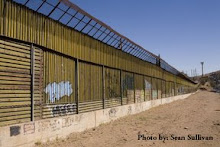
In a Congress plagued by immigration hysteria, none is more gravely afflicted than South Carolina’s Republican Senator Jim DeMint. Twice in two weeks he added border pork to Senate bills, both times calling for 300-plus miles of walls to be imposed between the U.S. and Mexico. These are the fourth and fifth times in less than two years that he has made such attempts.
Delirious and angry lawmakers like DeMint seem oblivious to the 650 miles of barriers and walls that already occupy the Southwest’s borderlands, exacting high costs on taxpayers and public lands. Another side effect these lawmakers suffer is an acute indifference to the impacts caused by their border madness.
A new study in the Diversity and Distributions journal identifies 49 species put most at risk by border walls and areas of intensive human land use along the U.S.-Mexico border. The study only considers amphibian, reptile, and non-volant (don't fly) mammal species, and identifies California, the Sky Islands, the Gulf Coast as the three regions most heavily impacted.
One unique aspect of this study is that it doesn’t just look at current impacts wrought by existing border walls and areas with a heavy human footprint. Potential future impacts from border wall expansions such as those proposed by DeMint are also taken into consideration, and the results are sobering:
This graph from the study shows a horizontal base line representing our 2,000 mile border with Mexico. The three faint vertical lines in the left half of the graph represent the state borders between California, Arizona, New Mexico, and Texas. The fatter horizontal line sitting atop the baseline shows where the taller “pedestrian” (10-25 feet tall) border walls are located along the border.
Then there is the vertical ‘species’ scale, which includes only species from the sample set that have already been listed as threatened, either binationally or by the International Union for the Conservation of Nature. The dashed line represents how many of these already-threatened species are put in grave danger by existing “pedestrian” border walls in each geographic location along the border. You’ll notice that there are few such species, which may be expected when working with such a small sample set of species to begin with.
However, the solid line is much less benign, with the number of vulnerable species spiking most dramatically here in Arizona (to the right [East] of first faint vertical line [CA-AZ border]). This line represents the number of already threatened species that would be pushed to the brink if proposals like DeMint’s were passed and border walls came to occupy even more precious habitat.
A key finding of the study states, "The REAL ID Act should be amended to reinstate environmental regulation of border security efforts." The REAL ID waiver of more than 30 vital federal protection laws along the border allowed walls to be built in violation of the Wilderness Act, the Endangered Species Act, and more.
Dan Millis is a Sierra Club Borderlands campaign organizer. To learn more about the Sierra Club's Borderlands Campaign visit http://sierraclub.org/borderlands/
I generally refrain from making New Year’s predictions, but following the mid-term elections one thing has been crystal clear: barring divine intervention or a grass-roots outcry loud enough to drown out the Tea Party, the new Congress will pass legislation requiring hundreds of miles of new border walls.
In the final days of the Congressional “lame duck” session Democrats struggled to line up votes in the Senate to pass the DREAM Act, which would have provided a path to citizenship for those who had been brought into the United States as minors, and who completed two years of college or military service. Hoping to bring Republicans on board, slots were left open for two Republican amendments, should the bill make it to the Senate floor.
Senator Jim DeMint (R-SC).
Republican Senator Jim DeMint of South Carolina took one of those slots for an amendment that would change the Secure Fence Act to require 700 miles of “pedestrian” border walls; vehicle barriers built along the border could no longer be applied to the mile count. Currently, 302 miles of vehicle barriers are included in the Department of Homeland Security’s official total of 646 miles of border wall. DeMint’s amendment would require Customs and Border Protection to build 356 miles of new “pedestrian” wall. With “pedestrian” walls averaging $7.5 million per mile, this could cost taxpayers $2,670,000,000. And with California, Arizona, and New Mexico largely walled off, most of those miles would come to Texas.
Passage of the DREAM Act should have been fairly easy, as many Republican Senators had supported it in the past. Ten years ago Republican Senator Orin Hatch actually co-wrote the DREAM Act. Before he voted against his own creation this year, his spokesperson simply said, “Times have changed.”
When Senator Graham says “we’ve done nothing on the border” he knows full well that the opposite is true. The Government Accountability Office presented a report to Congress in November of 2010 that stated,
Bollard border wall in California. Photo by Jay Johnson Castro.
The myth that borders can be made airtight through the construction of hundreds of miles of border wall or the doubling of Border Patrol agents should have been laid to rest by the fact that after these things were done the cries from politicians that the borders are broken are louder than ever.
Republicans voted in lock-step to prevent the DREAM Act from reaching the floor of the Senate. Even Senator DeMint, who planned to attach his amendment to it, voted against even debating the bill.
DeMint’s proposed amendment to the DREAM Act is identical to the one that he successfully attached to the Department of Homeland Security’s appropriation bill in 2009. Texas Senators Cornyn and Hutchison voted in favor of the 2009 amendment, as they have for every border wall bill that has come before them. But because there was not a matching amendment in the House version of the bill Representative Ciro Rodriguez (D-TX) was able to remove it in the House -Senate conference committee.
Once the new Congress is sworn in the House of Representatives will no longer act as a brake on Senator DeMint’s desire to build more border walls. Ciro Rodriguez lost his reelection bid, and, thanks in part to the success of Tea Party candidates, Republicans will control the House. In addition to new members like Ben Quayle (R-AZ) who put militarizing the border front and center in their campaigns, the next Congress will see some of the border wall’s biggest backers chairing key House committees.
Signing ceremony for the Secure Fence Act of 2006
Peter King (R-NY) will be the new chair of the House Homeland Security Committee. He wrote the Secure Fence Act, which mandated the hundreds of miles of wall that now slice through border communities, farms, and wildlife refuges. In the White House photo of the Secure Fence Act signing ceremony he can be seen looking over President Bush’s shoulder, smiling from ear to ear. Last week he told the New York Post that, “The Obama Administration continues to display an obvious lack of urgency when it comes to operational control of the border.” He went on to list border walls as an important tool for gaining control.
Iowa Republican Steve King is expected to lead the Judiciary Committee’s Immigration Subcommittee. In 2006 Rep. King assembled a model of the border wall during Congressional debate on the Secure Fence Act and suggested running electric current through it, saying, “we do this with livestock all the time.” Last month King said that as Immigration Subcommittee Chair he planned to conduct a formal review of the Obama Administration’s spending on border enforcement and push for construction of new border walls. He told the New York Times, “Build it until they stop going around the end – that would be my standard.”
Rep. Steve King (R-Iowa) builds his wall on the House floor
Rep. Smith and the two Kings, along with Senator DeMint, are so enamored with the idea of a border wall that they have not bothered to look at whether the wall actually prevents immigrants, smugglers, or terrorists from entering the United States. Even Customs and Border Protection (CBP), which Congress tasked with building walls, cannot say whether or not they do anything. The November Government Accountability Office report found that, “As of May 2010, CBP had not assessed the effect of fencing on border security.”
But that will not stop Senator DeMint from reintroducing his amendment next year. The Senate passed it in 2009, and although Democrats will still control the chamber it will be more conservative now than it was then. Senator DeMint was an early and ardent backer of Tea Party candidates, and they will be anxious to return the favor by supporting his bill. And with Republicans in charge of the House of Representatives, Ciro Rodriguez gone, and the key committees in the hands of Representatives who have long histories of supporting border walls, the DeMint amendment is all but assured of passage there as well.
Once it passes the House and Senate, it will be up to President Obama to decide whether or not more walls are built. Will he veto an entire bill (perhaps the Department of Homeland Security’s appropriation) to stop border walls? That would mean a head-on fight with Republicans over an issue that he has so far chosen to avoid. As Governor of Arizona, Janet Napolitano famously said, “You show me a 50-foot wall, and I'll show you a 51-foot ladder." But as President Obama’s Secretary of Homeland Security, she failed to bring border wall construction to a halt.
The decision will come down to politics. If Democrats in the House and Senate oppose the DeMint amendment and vote against it, President Obama might oppose it as well. If it passes with Democratic support and votes, he will sign it.
So in looking ahead do we succumb to fatalism, and accept that eventually walls will stretch unbroken from the Pacific to the Gulf of Mexico, cutting off South Texas from the river that slakes its thirst, waters its crops, and anchors its wildlife refuges? Or do we work to change the political dynamic that pushes for more and more and more border walls?
When Senator DeMint reintroduces his border wall amendment in 2011 most of the politicians who will vote for or against it represent districts that are hundreds of miles away from the border. Their votes will be based on opinion polls and political expediency, not an understanding of border security or concern for border communities. Senators Hatch and Graham voted against the DREAM Act not because they believed that it was a bad bill, but because they believed that supporting it would be bad politics. When the political winds changed, their votes changed.
The Tea Party was successful in changing the political landscape not just because they had the backing of FOX News and Koch Industries. They were also very loud. They made so much noise that their ideas, no matter how far off the deep end, became impossible to ignore. They shaped the political debate, and then they turned out to vote.
If we want to prevent the construction of more border walls we need to be just as loud, and make it clear that politicians who support more walls will be less likely to return to Washington after the next election. In the end, a politician’s vote on border walls is about job security, not border security.
All of the imagined benefits of the border wall flow from the assumption that if walls are built they will stop undocumented traffic from coming across. Politicians claim that building 700 miles of wall along our 1,933 mile long southern border, while ignoring the 3,987 mile long northern border and 12,479 miles of coastline will somehow allow the Department of Homeland Security to achieve the Secure Fence Act’s goal, to “achieve and maintain operational control over the entire international land and maritime borders of the United States.”
Crossers climbing the “triple fence” near San Diego, California. Photo by Laura Garcia.
In fact, the Border Patrol’s own statistics show that the border walls have not brought about a decrease in illegal entries. The border patrol uses the number of border crossers apprehended in a given sector to gauge the overall number of attempted crossings. Apprehensions dropped dramatically between 2005, the year before the Secure Fence Act was passed, and 2007, the year after. But the decrease did not occur in areas where border walls had been built. On the contrary, the greatest reductions in apprehensions, which according to the Border Patrol would indicate a successful strategy for stopping undocumented immigration, were seen in sectors that did not have walls. Texas’ Rio Grande Valley sector saw a 45.3% decrease in apprehensions, bringing them to a 15 year low. The Del Rio, Texas, sector saw a 66.5% decrease. Neither sector had an inch of border wall before 2008. In sectors such as Tucson, which saw walls built shortly after passage of the Secure Fence Act, the reduction in apprehensions began before any wall posts were erected. The areas that saw an increase in crossings were California’s San Diego and El Centro sectors, both of which have had border walls for over a decade. At the same time that the unwalled border witnessed dramatic decreases in crossings, heavily fortified San Diego saw a 20.1% increase.
Even before the passage of the Secure Fence Act, it was clear that border walls did not reduce the number of people entering the United States. The Congressional Research Service found that the number of border crossers apprehended nationally in 1992 was the same as the number apprehended in 2004, after walls in San Diego had been erected. They concluded that migrant traffic had simply shifted to more remote areas in Arizona and that “increased enforcement in San Diego sector has had little impact on overall apprehensions.” Migrants were not stopped by border walls; they simply went around them.
Other researchers have studied the effectiveness of the border wall and border enforcement by analyzing how successful migrants are at getting through it. The Migrant Policy Institute found that 97% of undocumented immigrants eventually succeed in entering the United States, a number that has been unchanged since the first border walls went up in 1995. Wayne Cornelius, Director of the Center for Comparative Immigration Studies at the University of California-San Diego told the House Judiciary Committee that according to his research,
Assertions by pundits and politicians that walls will allow the U.S. to “secure” its southern border are patently false. Spokespersons for the Border Patrol tend to describe it much more modestly. Del Rio, Texas, Border Patrol Chief Randy Hill said, “We're going to see steel barriers erected on the borders where U.S. and Mexican cities adjoin. These will slow down illegal crossers by minutes.” Not stop crossers, or allow the Border Patrol to “achieve and maintain operational control” of the border, but slow them down by “minutes.” As Border Patrol spokesperson Mike Scioli said, “The border fence is a speed bump in the desert.”
Border Wall in the Imperial Sand Dunes. Border Patrol photo.
Despite its “symbolic significance” and its possibly arbitrary placement, the border wall comes with a real price tag. In 2007 the Congressional Research Service estimated that the border wall could cost as much as $49 billion to build and maintain. Since then the costs of construction have risen dramatically. The Army Corps of Engineers reported that the cost of building “pedestrian fences” has increased from an average of $3.5 million per mile to $7.5 million per mile. The cost of building vehicle barriers on the border is now $2.8 million per mile. Some sections of border wall are particularly expensive: the walls that have been inserted into the levees in south Texas averaged $12 million per mile; in California, a 3.5 mile section that involved filling in canyons cost taxpayers $57 million. In 2008, the Department of Homeland Security asked Congress to allocate an additional $400 million for border wall construction, because the $2.7 billion already spent was not enough to finish out the year.
Why would members of Congress vote to spend billions of taxpayer dollars on border walls that do not work?
Simply put, for members of Congress who do not live beside the border, and do not count on the votes of those who do, the border wall is an abstraction. The reality that the border wall has little or no impact on border crossings is irrelevant. The reality that more than 400 property owners have had their property condemned is irrelevant. The reality that federally designated wilderness areas and wildlife refuges have been severely impacted is irrelevant. The politicians who voted for border walls were voting for a symbol, something that could be used to give voters a false sense of security during election cycles, and nothing more.
In 2006, both the House and Senate passed Comprehensive Immigration Reform bills. Each contained hundreds of miles of border wall, inserted as a bone to lure conservative support. The bills differed on a number of points, including the number of miles of wall to be built. When a conference committee convened to craft a final bill they were unable to work out their differences, and immigration reform died in committee. From its ashes Congress pulled the one thing that they could agree on: 700 miles of border wall.
The stated goal of the Secure Fence Act was to “achieve and maintain operational control over the entire international land and maritime borders of the United States.” Nearly 3 years later, most of the border walls that it mandated are complete. Time to dust off the “MISSION ACCOMPLISHED” banner and hang it on the border?
Apparently not. This month Senator Jim DeMint, whose home state of South Carolina is closer to Canada than Mexico, inserted an amendment into the Senate’s bill funding the Department of Homeland Security (DHS). It changes the Secure Fence Act to say that, “Fencing that does not effectively restrain pedestrian traffic (such as vehicle barriers and virtual fencing) may not be used to meet the 700-mile fence requirement.”
As of July 17, DHS claims to have completed 331 miles of “pedestrian fencing” and 302 miles of vehicle barriers. If DeMint’s amendment makes it through the House/Senate Conference Committee and is signed into law, the border wall will suddenly be 369 miles short of its new mandate. DHS will probably replace many of the 302 miles of vehicle barriers with “pedestrian fence,” inflicting tremendous environmental damage in the process. That leaves at least 67 miles of brand new border wall to be built in places that are currently unwalled. With California, Arizona, and New Mexico largely walled off, those new border walls will most likely be built in Texas.
So far, Congress has given the Department of Homeland Security $3.1 billion for border wall construction. The Army Corps of Engineers reported that between February and October of 2008 the cost of building walls increased by 88%, from an average of $3.5 million per mile to $7.5 million per mile. Some sections of border wall are particularly expensive: the levee-border wall combination in South Texas averaged $12 million per mile; in California, a 3.5 mile section that involved filling in canyons cost taxpayers $57 million.
If the Secure Fence Act succeeded in achieving “operational control” of the border, why should we spend no less than (and quite possibly a lot more than) $2,767,500,000.00 to build 369 miles of new border wall?
First and foremost, the border wall has failed to stop either immigrants or smugglers from entering the United States. The majority enter through ports of entry, rather than crossing the desert on foot or the Rio Grande on an inner tube, so walls erected between the ports have no effect on them. And according to the Border Patrol, even those who find the wall directly in their path are only slowed down by around 5 minutes. As Border Patrol spokesperson Mike Scioli said, “The border fence is a speed bump in the desert.”
Professor Wayne Cornelius, with the University of California at San Diego, has spent more than a decade interviewing immigrants before and after they cross the border. His research has revealed that, even with border walls,
So why would Senators, ranging from alleged fiscal conservatives such as Texas Republican John Cornyn to New York Democrat Charles Schumer, vote to spend nearly $3 billion on more border walls when those already erected do not work?
Simply put, for those politicians who do not live beside the border, and do not count on the votes of those who do, the border wall is an abstraction. The reality that the border wall has little or no impact on border crossers is irrelevant. The reality that more than 300 property owners have had their property condemned is irrelevant. The reality that federally designated wilderness areas and wildlife refuges have been severely impacted is irrelevant. The Senators who voted for more border walls were voting for a symbol, nothing more.
Senator Schumer seems to think that by voting for more walls, and more than likely including border walls in his Comprehensive Immigration Reform bill, he can appease conservatives like Cornyn and gain their votes. If so, he is deluded. No matter how much of the borderlands the bill sacrifices for the sake of empty gestures, immigration reform will not woo conservatives. It is far more likely that Schumer will instead see a repeat of 2006, in which the only part of Comprehensive Immigration Reform that makes it to the President’s desk is hundreds of miles of border wall.