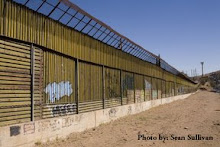
by Char Miller
It would be nice if Congress held executive-branch agencies accountable for their actions. Or insisted that they follow federal law. Or fulfill their fiduciary responsibilities to one another.
But the Republican-controlled House of Representatives is making a mockery of these basic rules of order and good government.
You won't be surprised that the latest bit of GOP chicanery involves its twin obsessions: the U.S-Mexico Border and national environmental regulations. Their hyperventilating defense of the former, as I've noted before, comes with blustery assaults on the latter.
Since November, Utah representative Rob Bishop, chair of the House subcommittee on public lands, along with his gal pal, Cynthia Lummis (R-WY), and a host of fellow travelers, have mounted an incessant campaign to allow the U. S. Border Patrol to ignore key provisions of the Wilderness Act, the Endangered Species Act, and other vital environmental laws.
Arguing that such legislation impedes the Border Patrol's capacity to defend the nation against undocumented migrants, they have filed amendments and riders to pending legislation, called public hearings to lambaste officials of the Department of Interior, and penned fulminating op-eds to rouse the party's extremist base.
Their most recent gambit came late last week in the form of an amendment to the Department of Homeland Security's appropriation. Rep. Lummis proposed, and a lock-step Republican vote secured, a rule prohibiting DHS from transferring funds to the Department of the Interior.
These moneys would have been used to mitigate the oft-intense environmental damage resulting from the construction of the infamous border wall across federal wildlife refuges, wildlands, and preserves, in such places as the Rio Grande Valley; Arizona's Organ Pipe Cactus National Monument; and the Otay Wilderness near San Diego. And from the spinning wheels of its high-speed patrols that can tear up wildlife habitat or damage sensitive ecosystems.
Such mitigation, required by law, is also sanctioned through longstanding practice among localities, states, and the federal government. It is also a matter of committed environmental stewardship.
Neither the precedent nor the principle matters to contemporary Republicans. In a "Dear Colleague" letter that Bishop, Rep. Doc Hastings (R-WA), chair of the Natural Resources Committee, and Rep. Peter King (R-NY), chair of the Committee on Homeland Security sent out in support of Lummis' amendment, they thrilled at its anti-environmentalism: "the amendment would strike language in the bill that allows these funds to be used by the Interior Department to purchase even more land. Additional federal land acquisition only exacerbates the problem by limiting access to even more land and further bloating the federal estate--at a time when the government cannot even afford to provide the basic care and maintenance needed for existing national parks and other lands."
(Query: why can't the government afford to take care of its treasured public lands? Answer: drastic Republican budget cuts!)
Lummis heaps just as much scorn on the legal obligations and moral responsibilities the government has for protecting our public lands: "Every day our nation's border patrol fights to protect our country against increasingly sophisticated criminal networks that produce and smuggle illegal drugs, and people, into America," she fumed. "Unfortunately, DOI policies have tied the hands of Border Patrol agents, who need access to federal lands to carry out their constitutional responsibility to secure the border."
Her allegation is bogus. The very same Government Accountability Office report that Lummis and Bishop routinely cite as evidence that environmental regulations have handcuffed the Border Patrol, in fact reached the opposite conclusion. In mid-April, for instance, the GAO found that "22 of the 26 patrol agents-in-charge reported that the overall security status of their jurisdiction had not been affected by land management laws. Instead, factors such as the remoteness and ruggedness of the terrain have had the greatest effect on their ability to achieve operational control in these areas."
The report also revealed that the four patrol agents-in-charge who had "reported that delays and restrictions had affected their ability to achieve or maintain operational control," admitted they "either had not requested resources for increased or timelier access or their requests had been denied by senior Border Patrol officials because of higher priority needs of the agency."
Moreover, the GAO investigation demonstrated that relevant agencies out in the field and inside the Beltway have developed close working relations. To argue otherwise, as Lummis and Bishop reflexively do, is to perpetuate a fraud.
Ah, but why let the facts get in your way when you can wrap yourself in the flag as protective cover? Trumpets Lummis: "our nation's security should be our top priority." Wilderness be damned.
Such a blinkered public policy, in point of fact, will lead us into damnation. That's the potent message embedded in Aldo Leopold's private correspondence and his brilliant conservation classic, Sand County Almanac (1948).
Arguing that wilderness is an irreplaceable part of our "cultural inheritance," and that even then was in precious, dwindling supply--it is a "resource that can shrink but cannot grow"--Leopold urged his fellow citizens to defend these beleaguered lands against those with a narrowly conceived notion of homeland securityhttp://www.blogger.com/img/blank.gif. "If we lose our wilderness, we have nothing left...worth fighting for."
Note, please, that Leopold was a Republican.
Char Miller is the Director and W.M. Keck Professor of Environmental Analysis at Pomona College, and editor of the just-published "Cities and Nature in the American West."
Reprinted with the author's permission, this essay was originally posted at KCET:
http://www.kcet.org/updaily/socal_focus/commentary/border-skirmish-republicans-are-using-immigrants-to-bash-our-wilderness-34146.html
Showing posts with label GAO. Show all posts
Showing posts with label GAO. Show all posts
Thursday, June 9, 2011


Tuesday, February 23, 2010
Border Walls are Ineffective Speed Bumps in the Desert
By Scott Nicol
All of the imagined benefits of the border wall flow from the assumption that if walls are built they will stop undocumented traffic from coming across. Politicians claim that building 700 miles of wall along our 1,933 mile long southern border, while ignoring the 3,987 mile long northern border and 12,479 miles of coastline will somehow allow the Department of Homeland Security to achieve the Secure Fence Act’s goal, to “achieve and maintain operational control over the entire international land and maritime borders of the United States.”

Crossers climbing the “triple fence” near San Diego, California. Photo by Laura Garcia.
In fact, the Border Patrol’s own statistics show that the border walls have not brought about a decrease in illegal entries. The border patrol uses the number of border crossers apprehended in a given sector to gauge the overall number of attempted crossings. Apprehensions dropped dramatically between 2005, the year before the Secure Fence Act was passed, and 2007, the year after. But the decrease did not occur in areas where border walls had been built. On the contrary, the greatest reductions in apprehensions, which according to the Border Patrol would indicate a successful strategy for stopping undocumented immigration, were seen in sectors that did not have walls. Texas’ Rio Grande Valley sector saw a 45.3% decrease in apprehensions, bringing them to a 15 year low. The Del Rio, Texas, sector saw a 66.5% decrease. Neither sector had an inch of border wall before 2008. In sectors such as Tucson, which saw walls built shortly after passage of the Secure Fence Act, the reduction in apprehensions began before any wall posts were erected. The areas that saw an increase in crossings were California’s San Diego and El Centro sectors, both of which have had border walls for over a decade. At the same time that the unwalled border witnessed dramatic decreases in crossings, heavily fortified San Diego saw a 20.1% increase.
Even before the passage of the Secure Fence Act, it was clear that border walls did not reduce the number of people entering the United States. The Congressional Research Service found that the number of border crossers apprehended nationally in 1992 was the same as the number apprehended in 2004, after walls in San Diego had been erected. They concluded that migrant traffic had simply shifted to more remote areas in Arizona and that “increased enforcement in San Diego sector has had little impact on overall apprehensions.” Migrants were not stopped by border walls; they simply went around them.
Other researchers have studied the effectiveness of the border wall and border enforcement by analyzing how successful migrants are at getting through it. The Migrant Policy Institute found that 97% of undocumented immigrants eventually succeed in entering the United States, a number that has been unchanged since the first border walls went up in 1995. Wayne Cornelius, Director of the Center for Comparative Immigration Studies at the University of California-San Diego told the House Judiciary Committee that according to his research,
Tightened border enforcement since 1993 has not stopped nor even discouraged unauthorized migrants from entering the United States. Even if apprehended, the vast majority (92-97%) keep trying until they succeed. Neither the higher probability of being apprehended by the Border Patrol, nor the sharply increased danger of clandestine entry through deserts and mountainous terrain, has discouraged potential migrants from leaving home.
Assertions by pundits and politicians that walls will allow the U.S. to “secure” its southern border are patently false. Spokespersons for the Border Patrol tend to describe it much more modestly. Del Rio, Texas, Border Patrol Chief Randy Hill said, “We're going to see steel barriers erected on the borders where U.S. and Mexican cities adjoin. These will slow down illegal crossers by minutes.” Not stop crossers, or allow the Border Patrol to “achieve and maintain operational control” of the border, but slow them down by “minutes.” As Border Patrol spokesperson Mike Scioli said, “The border fence is a speed bump in the desert.”
Even Bush administration Secretary of Homeland Security Michael Chertoff said in 2007, “I think the fence has come to assume a certain kind of symbolic significance which should not obscure the fact that it is a much more complicated problem than putting up a fence which someone can climb over with a ladder or tunnel under with a shovel.”
Mile upon mile of border wall have been built, with no apparent thought given to efficacy, because the Secure Fence Act only mandated a mile count. There is no requirement that border walls have any measurable impact on immigration or smuggling, and in 2009 the Government Accountability Office found that the Department of Homeland Security had made no effort to determine whether or not walls were having any effect. Even the Border Patrol has questioned whether walls are being built in some locations for political, rather than operational, reasons. In a 2007 email obtained by the Center for Responsibility and Ethics in Washington (CREW) through a Freedom of Information Act request, the Assistant Chief Patrol Agent for the Yuma sector asks, “will we be getting fence where we don’t need it in our sector for the sake of putting up the required mileage?” The miles of unnecessary border wall that he referred to have since been built through the Imperial Sand Dunes of Southern California.

Border Wall in the Imperial Sand Dunes. Border Patrol photo.
Despite its “symbolic significance” and its possibly arbitrary placement, the border wall comes with a real price tag. In 2007 the Congressional Research Service estimated that the border wall could cost as much as $49 billion to build and maintain. Since then the costs of construction have risen dramatically. The Army Corps of Engineers reported that the cost of building “pedestrian fences” has increased from an average of $3.5 million per mile to $7.5 million per mile. The cost of building vehicle barriers on the border is now $2.8 million per mile. Some sections of border wall are particularly expensive: the walls that have been inserted into the levees in south Texas averaged $12 million per mile; in California, a 3.5 mile section that involved filling in canyons cost taxpayers $57 million. In 2008, the Department of Homeland Security asked Congress to allocate an additional $400 million for border wall construction, because the $2.7 billion already spent was not enough to finish out the year.
Why would members of Congress vote to spend billions of taxpayer dollars on border walls that do not work?
Simply put, for members of Congress who do not live beside the border, and do not count on the votes of those who do, the border wall is an abstraction. The reality that the border wall has little or no impact on border crossings is irrelevant. The reality that more than 400 property owners have had their property condemned is irrelevant. The reality that federally designated wilderness areas and wildlife refuges have been severely impacted is irrelevant. The politicians who voted for border walls were voting for a symbol, something that could be used to give voters a false sense of security during election cycles, and nothing more.
All of the imagined benefits of the border wall flow from the assumption that if walls are built they will stop undocumented traffic from coming across. Politicians claim that building 700 miles of wall along our 1,933 mile long southern border, while ignoring the 3,987 mile long northern border and 12,479 miles of coastline will somehow allow the Department of Homeland Security to achieve the Secure Fence Act’s goal, to “achieve and maintain operational control over the entire international land and maritime borders of the United States.”
Crossers climbing the “triple fence” near San Diego, California. Photo by Laura Garcia.
In fact, the Border Patrol’s own statistics show that the border walls have not brought about a decrease in illegal entries. The border patrol uses the number of border crossers apprehended in a given sector to gauge the overall number of attempted crossings. Apprehensions dropped dramatically between 2005, the year before the Secure Fence Act was passed, and 2007, the year after. But the decrease did not occur in areas where border walls had been built. On the contrary, the greatest reductions in apprehensions, which according to the Border Patrol would indicate a successful strategy for stopping undocumented immigration, were seen in sectors that did not have walls. Texas’ Rio Grande Valley sector saw a 45.3% decrease in apprehensions, bringing them to a 15 year low. The Del Rio, Texas, sector saw a 66.5% decrease. Neither sector had an inch of border wall before 2008. In sectors such as Tucson, which saw walls built shortly after passage of the Secure Fence Act, the reduction in apprehensions began before any wall posts were erected. The areas that saw an increase in crossings were California’s San Diego and El Centro sectors, both of which have had border walls for over a decade. At the same time that the unwalled border witnessed dramatic decreases in crossings, heavily fortified San Diego saw a 20.1% increase.
Even before the passage of the Secure Fence Act, it was clear that border walls did not reduce the number of people entering the United States. The Congressional Research Service found that the number of border crossers apprehended nationally in 1992 was the same as the number apprehended in 2004, after walls in San Diego had been erected. They concluded that migrant traffic had simply shifted to more remote areas in Arizona and that “increased enforcement in San Diego sector has had little impact on overall apprehensions.” Migrants were not stopped by border walls; they simply went around them.
Other researchers have studied the effectiveness of the border wall and border enforcement by analyzing how successful migrants are at getting through it. The Migrant Policy Institute found that 97% of undocumented immigrants eventually succeed in entering the United States, a number that has been unchanged since the first border walls went up in 1995. Wayne Cornelius, Director of the Center for Comparative Immigration Studies at the University of California-San Diego told the House Judiciary Committee that according to his research,
Tightened border enforcement since 1993 has not stopped nor even discouraged unauthorized migrants from entering the United States. Even if apprehended, the vast majority (92-97%) keep trying until they succeed. Neither the higher probability of being apprehended by the Border Patrol, nor the sharply increased danger of clandestine entry through deserts and mountainous terrain, has discouraged potential migrants from leaving home.
Assertions by pundits and politicians that walls will allow the U.S. to “secure” its southern border are patently false. Spokespersons for the Border Patrol tend to describe it much more modestly. Del Rio, Texas, Border Patrol Chief Randy Hill said, “We're going to see steel barriers erected on the borders where U.S. and Mexican cities adjoin. These will slow down illegal crossers by minutes.” Not stop crossers, or allow the Border Patrol to “achieve and maintain operational control” of the border, but slow them down by “minutes.” As Border Patrol spokesperson Mike Scioli said, “The border fence is a speed bump in the desert.”
Even Bush administration Secretary of Homeland Security Michael Chertoff said in 2007, “I think the fence has come to assume a certain kind of symbolic significance which should not obscure the fact that it is a much more complicated problem than putting up a fence which someone can climb over with a ladder or tunnel under with a shovel.”
Mile upon mile of border wall have been built, with no apparent thought given to efficacy, because the Secure Fence Act only mandated a mile count. There is no requirement that border walls have any measurable impact on immigration or smuggling, and in 2009 the Government Accountability Office found that the Department of Homeland Security had made no effort to determine whether or not walls were having any effect. Even the Border Patrol has questioned whether walls are being built in some locations for political, rather than operational, reasons. In a 2007 email obtained by the Center for Responsibility and Ethics in Washington (CREW) through a Freedom of Information Act request, the Assistant Chief Patrol Agent for the Yuma sector asks, “will we be getting fence where we don’t need it in our sector for the sake of putting up the required mileage?” The miles of unnecessary border wall that he referred to have since been built through the Imperial Sand Dunes of Southern California.
Border Wall in the Imperial Sand Dunes. Border Patrol photo.
Despite its “symbolic significance” and its possibly arbitrary placement, the border wall comes with a real price tag. In 2007 the Congressional Research Service estimated that the border wall could cost as much as $49 billion to build and maintain. Since then the costs of construction have risen dramatically. The Army Corps of Engineers reported that the cost of building “pedestrian fences” has increased from an average of $3.5 million per mile to $7.5 million per mile. The cost of building vehicle barriers on the border is now $2.8 million per mile. Some sections of border wall are particularly expensive: the walls that have been inserted into the levees in south Texas averaged $12 million per mile; in California, a 3.5 mile section that involved filling in canyons cost taxpayers $57 million. In 2008, the Department of Homeland Security asked Congress to allocate an additional $400 million for border wall construction, because the $2.7 billion already spent was not enough to finish out the year.
Why would members of Congress vote to spend billions of taxpayer dollars on border walls that do not work?
Simply put, for members of Congress who do not live beside the border, and do not count on the votes of those who do, the border wall is an abstraction. The reality that the border wall has little or no impact on border crossings is irrelevant. The reality that more than 400 property owners have had their property condemned is irrelevant. The reality that federally designated wilderness areas and wildlife refuges have been severely impacted is irrelevant. The politicians who voted for border walls were voting for a symbol, something that could be used to give voters a false sense of security during election cycles, and nothing more.
Sunday, September 27, 2009
Border War Rhetoric Has Real Consequences for the Borderlands
By Stefanie Herweck
This week Texas Lieutenant Governor David Dewhurst addressed an assembly of border residents and community leaders in Harlingen, Texas, less than 15 miles from the Rio Grande, and proclaimed that there was a war going on along the border. His assessment of the border was extreme: “We have two wars everyone talks about going on, one is in Iraq and one is in Afghanistan. We’ve got a third going on and that’s the border.”
Dewhurst made this announcement in the keynote speech for State Senator Eddie Lucio’s State of the District Address. With Senator Lucio looking on, Dewhurst went on to make his case for war on the border, speaking in vague terms about “transnational gangs,” “drug lords killing Americans,” and “border violence,” but providing little in the way of concrete details. He urged that more law enforcement be deployed in order to “close down this border.”
Dewhurst’s comparison of the U.S.-Mexico border region to war-torn Iraq and Afghanistan is offensive and absurd. His characterization of a border at war is based on ignorant hysteria instead of reality. And his portrayal of the border region as the dangerous fount of criminal activity for the rest of the state and the country is categorically false.
When pressed in an interview after the speech to provide the details that would support his claims, Dewhurst said, “We’ve seen incidence of gangs, drive by shootings, in Wichita Falls, which is a long way from the border.” The Lieutenant Governor is right about one thing here: 600 miles between Wichita Falls and the Texas-Mexico border is a long way. But declaring war on the border in order to fight crime in Wichita Falls is ludicrous.
Especially because most Texas border cities are actually safer than Wichita Falls. Although Wichita Falls has 30,000 fewer people than the border city of McAllen, its crime rate in 2008 was higher than McAllen’s. According to FBI statistics, Wichita Falls had 557 incidences of violent crime in 2008, while McAllen only had 371. El Paso was ranked as the third safest large city in the United States in the same year. And all of these cities saw a decrease in violent crime from 2007 to 2008, as did the nation as a whole. Dewhurst’s perverse fantasy of a chaotic crime-ridden border simply does not match the relatively peaceful day-to-day border reality.
In his speech, Dewhurst also cited briefings he has received from the Department of Public Safety and other law enforcement. When asked to elaborate on these briefings after his speech, he cited no official reports or criminological studies, but said “Virtually every city I go into I talk to the DPS and I talk to the local police and they have all seen a pick up of gang activity that they feel is related to drug cartels in Mexico.” While the views of law enforcement officers around the state are valuable, it is irresponsible to make policy recommendations based on their “feelings” rather than hard facts.
Furthermore, Dewhurst has apparently failed to consult with law enforcement officials in the border region. When interviewed by NPR this spring, Brownsville Police Chief Carlos Garcia noted that there had only been 3 homicides in his city in 2008, and that none of them were related to drug cartels. In the same article McAllen Police Chief Victor Rodriguez provided some perceptive analysis that Dewhurst should heed: “The sky is not falling,” he said, refuting unfounded statements by pundits and politicians that cartel violence was spilling over at the border. "What's happening right now is we've got rhetoric that's driving the policy."
When it was pointed out after his speech that his talk of war might not be welcome at the border, Dewhurst quickly wrote it off as just a rhetorical strategy: “I use the word 'war' only in the sense to get people’s attention to understand that there’s a serious problem along our porous southern and northern border.”
Unfortunately, as Chief Rodriguez well understands, rhetoric drives policy. Dewhurst’s declaration of war on the border may be intended as nothing more than a metaphor, but it is likely to have real consequences for the residents of the Texas border.
In his own speech, Dewhurst called for more actual boots on the ground to deal with the war scenario that he later claimed was purely rhetorical. This same border war rhetoric is driving Governor Perry’s call for troops to patrol the border and military predator aircraft to fly up and down the Rio Grande. This month he stationed a specialized team of the Texas Rangers that will reportedly be patrolling the border region carrying automatic weapons, and wearing camouflage, helmets, and bullet-proof vests.
The governor’s action comes despite his own admission that crime along the border has been falling in recent years. And it has been deemed unnecessary by border law enforcement. Hidalgo County Sheriff Lupe Treviño said, “We don't need the Texas Rangers to come to the border to quell any imaginary disturbance.”
Although sending the Texas Rangers or the National Guard to fight an imaginary war at the border might make for good sound bites in the rest of the state, it sends a shiver down the spine of border residents. Community and business leaders fear that their efforts to develop the border region will be undermined by the false perception of a dangerous, militarized border. Residents know that staging a war in their communities, parks, and farmlands only puts them more at risk.
Border war rhetoric like Dewhurst’s drives policy on the national stage as well. Senator Jim DeMint of South Carolina introduced an amendment to the 2010 DHS Appropriations Bill calling for more than 300 miles of new border wall. If the amendment passes, hundreds of those miles could be built in Texas. These walls are being proposed despite the fact that the hundreds of miles of border walls already built have not stopped people from crossing the border. Wayne Cornelius, Director Emeritus of the Center for Comparative Immigration Studies at the University of California at San Diego, say that despite the walls at the border, between 92% and 98% of all those attempting to cross the U.S.-Mexico border illegally eventually get through. This month, a report by the Government Accountability Office faulted the Department of Homeland Security for having no effective way to gauge the impacts that border walls are having on illegal entry.
But the myth of a border war trumps the reality that walls don’t work. In the press release about his amendment, DeMint says that more border walls are urgently needed because “our southern border has become a battleground.”
Too many walls already blight the Texas borderlands. Texas citizens have had their private property stripped away to make way for walls. Texas cities have seen their landscape forever marred by them. Texas natural areas, wildlife refuges and parks have been irreparably damaged by them. All of this destruction is rooted in the myth of the border war.
Dewhurst’s inflammatory war rhetoric may have been intended only to “get people’s attention,” but the consequences for his constituents along the border are very real. When our borderlands are decreed a war zone, politicians in Austin and Washington forget that it is a place that millions of people call home. They jump on the border war bandwagon, hoping to score political points and to burnish their law-and-order credentials. Like Lt. Gov. Dewhurst, they make the border a scapegoat for crime in the rest of the Texas and the United States. Like Gov. Perry and Sen. DeMint, they dream up absurd, and ultimately destructive, schemes to fight an imaginary war.
Border residents desperately need leaders who will reject the border war scenario, who will refuse to bear false witness against the borderlands and who will work tirelessly to represent the reality of border life at the state and national level. We need uncompromising leaders who will not be complicit in the border war myth, who will actively oppose the schemes based on this myth, and who will not sit silently by as the border region that they were elected to represent is mischaracterized, maligned and damaged.
This week Texas Lieutenant Governor David Dewhurst addressed an assembly of border residents and community leaders in Harlingen, Texas, less than 15 miles from the Rio Grande, and proclaimed that there was a war going on along the border. His assessment of the border was extreme: “We have two wars everyone talks about going on, one is in Iraq and one is in Afghanistan. We’ve got a third going on and that’s the border.”
Dewhurst made this announcement in the keynote speech for State Senator Eddie Lucio’s State of the District Address. With Senator Lucio looking on, Dewhurst went on to make his case for war on the border, speaking in vague terms about “transnational gangs,” “drug lords killing Americans,” and “border violence,” but providing little in the way of concrete details. He urged that more law enforcement be deployed in order to “close down this border.”
Dewhurst’s comparison of the U.S.-Mexico border region to war-torn Iraq and Afghanistan is offensive and absurd. His characterization of a border at war is based on ignorant hysteria instead of reality. And his portrayal of the border region as the dangerous fount of criminal activity for the rest of the state and the country is categorically false.
When pressed in an interview after the speech to provide the details that would support his claims, Dewhurst said, “We’ve seen incidence of gangs, drive by shootings, in Wichita Falls, which is a long way from the border.” The Lieutenant Governor is right about one thing here: 600 miles between Wichita Falls and the Texas-Mexico border is a long way. But declaring war on the border in order to fight crime in Wichita Falls is ludicrous.
Especially because most Texas border cities are actually safer than Wichita Falls. Although Wichita Falls has 30,000 fewer people than the border city of McAllen, its crime rate in 2008 was higher than McAllen’s. According to FBI statistics, Wichita Falls had 557 incidences of violent crime in 2008, while McAllen only had 371. El Paso was ranked as the third safest large city in the United States in the same year. And all of these cities saw a decrease in violent crime from 2007 to 2008, as did the nation as a whole. Dewhurst’s perverse fantasy of a chaotic crime-ridden border simply does not match the relatively peaceful day-to-day border reality.
In his speech, Dewhurst also cited briefings he has received from the Department of Public Safety and other law enforcement. When asked to elaborate on these briefings after his speech, he cited no official reports or criminological studies, but said “Virtually every city I go into I talk to the DPS and I talk to the local police and they have all seen a pick up of gang activity that they feel is related to drug cartels in Mexico.” While the views of law enforcement officers around the state are valuable, it is irresponsible to make policy recommendations based on their “feelings” rather than hard facts.
Furthermore, Dewhurst has apparently failed to consult with law enforcement officials in the border region. When interviewed by NPR this spring, Brownsville Police Chief Carlos Garcia noted that there had only been 3 homicides in his city in 2008, and that none of them were related to drug cartels. In the same article McAllen Police Chief Victor Rodriguez provided some perceptive analysis that Dewhurst should heed: “The sky is not falling,” he said, refuting unfounded statements by pundits and politicians that cartel violence was spilling over at the border. "What's happening right now is we've got rhetoric that's driving the policy."
When it was pointed out after his speech that his talk of war might not be welcome at the border, Dewhurst quickly wrote it off as just a rhetorical strategy: “I use the word 'war' only in the sense to get people’s attention to understand that there’s a serious problem along our porous southern and northern border.”
Unfortunately, as Chief Rodriguez well understands, rhetoric drives policy. Dewhurst’s declaration of war on the border may be intended as nothing more than a metaphor, but it is likely to have real consequences for the residents of the Texas border.
In his own speech, Dewhurst called for more actual boots on the ground to deal with the war scenario that he later claimed was purely rhetorical. This same border war rhetoric is driving Governor Perry’s call for troops to patrol the border and military predator aircraft to fly up and down the Rio Grande. This month he stationed a specialized team of the Texas Rangers that will reportedly be patrolling the border region carrying automatic weapons, and wearing camouflage, helmets, and bullet-proof vests.
The governor’s action comes despite his own admission that crime along the border has been falling in recent years. And it has been deemed unnecessary by border law enforcement. Hidalgo County Sheriff Lupe Treviño said, “We don't need the Texas Rangers to come to the border to quell any imaginary disturbance.”
Although sending the Texas Rangers or the National Guard to fight an imaginary war at the border might make for good sound bites in the rest of the state, it sends a shiver down the spine of border residents. Community and business leaders fear that their efforts to develop the border region will be undermined by the false perception of a dangerous, militarized border. Residents know that staging a war in their communities, parks, and farmlands only puts them more at risk.
Border war rhetoric like Dewhurst’s drives policy on the national stage as well. Senator Jim DeMint of South Carolina introduced an amendment to the 2010 DHS Appropriations Bill calling for more than 300 miles of new border wall. If the amendment passes, hundreds of those miles could be built in Texas. These walls are being proposed despite the fact that the hundreds of miles of border walls already built have not stopped people from crossing the border. Wayne Cornelius, Director Emeritus of the Center for Comparative Immigration Studies at the University of California at San Diego, say that despite the walls at the border, between 92% and 98% of all those attempting to cross the U.S.-Mexico border illegally eventually get through. This month, a report by the Government Accountability Office faulted the Department of Homeland Security for having no effective way to gauge the impacts that border walls are having on illegal entry.
But the myth of a border war trumps the reality that walls don’t work. In the press release about his amendment, DeMint says that more border walls are urgently needed because “our southern border has become a battleground.”
Too many walls already blight the Texas borderlands. Texas citizens have had their private property stripped away to make way for walls. Texas cities have seen their landscape forever marred by them. Texas natural areas, wildlife refuges and parks have been irreparably damaged by them. All of this destruction is rooted in the myth of the border war.
Dewhurst’s inflammatory war rhetoric may have been intended only to “get people’s attention,” but the consequences for his constituents along the border are very real. When our borderlands are decreed a war zone, politicians in Austin and Washington forget that it is a place that millions of people call home. They jump on the border war bandwagon, hoping to score political points and to burnish their law-and-order credentials. Like Lt. Gov. Dewhurst, they make the border a scapegoat for crime in the rest of the Texas and the United States. Like Gov. Perry and Sen. DeMint, they dream up absurd, and ultimately destructive, schemes to fight an imaginary war.
Border residents desperately need leaders who will reject the border war scenario, who will refuse to bear false witness against the borderlands and who will work tirelessly to represent the reality of border life at the state and national level. We need uncompromising leaders who will not be complicit in the border war myth, who will actively oppose the schemes based on this myth, and who will not sit silently by as the border region that they were elected to represent is mischaracterized, maligned and damaged.
Friday, September 18, 2009
Taxpayers for Common Sense Blasts the Border Wall
Taxpayers for Common Sense has voiced their opposition to the border wall, tossing it into their Weekly Wastebasket. They describe themselves in this way,
"Taxpayers for Common Sense is an independent and non-partisan voice for taxpayers working to increase transparency and expose and eliminate wasteful and corrupt subsidies, earmarks, and corporate welfare."
Border Waste Reruns
Volume XIV No. 38: September 18, 2009
Jimmy Buffet could have testified at this week’s hearing about ongoing federal border protection initiatives. As you watched the same old song and dance about Department of Homeland Security (DHS) spending commence before lawmakers, you could almost hear him sing: “Wasting away again on the border wall. Searching for the lost section of fence. Some people say that Boeing’s to blame, but I know – it’s our own damn fault.”
With the benefit of updated numbers and dates, the House Homeland Security Committee learned that seven years and more than $4 billion in, DHS’s Secure Border Initiative (SBI) is (still) broken. SBI is comprised of a system of cameras and sensors known as SBINet and a steel “pedestrian” fence erected on more than 600 miles of the southwestern U.S. border.
Lawmakers heard an all too familiar tale of waste and woe. The average cost of pedestrian fencing has jumped from $3.5 to $6.5 million per mile, and costs for vehicle fencing have doubled. The Government Accountability Office (GAO) testified that the sensors used in the SBINet system still suffer from too many false detections and are vulnerable to bad weather despite the fact that the military has effectively used camera and sensor technology to track enemy movements for years at a much lower cost. But it didn’t stop there, the sad song continued:
· Full deployment of SBINet is now projected for 2016—seven years after the original contract with Boeing was scheduled to end;
· The pedestrian fence has been breached more than 3,000 times so far, with each repair costing at least $1,300;
· A long-overdue DHS study estimates the costs of maintaining the fence over a 20-year period at $6.5 billion— which is likely a low ball.
Sadly, even the new price tag may not tell the whole story. As our analysis of fence costs points out, maintenance estimates by the Congressional Budget Office and U.S. Army Corps of Engineers put that figure at $8 billion years ago, before the same labor and materials price hikes that have bumped up the cost of fence construction.
Problems with SBINet are due in large part to a contract that even a Boeing spokesman admitted was “awkward.” That’s a bit of an understatement: The delays and cost overruns have made the project a poster child for problems with “lead systems integrator” contracting strategy, where one company acts as a “system integrator” that tries to cobble together several different projects completed at different times and with different subcontractors. Incredibly, DHS just renewed Boeing’s contract for another year, despite a string of failures that has dogged the contract almost since its 2006 inception.
The fundamental question, of course, is whether the fence actually works. The unfortunate answers range between “no” and “not sure”. Because the SBINet technology still isn’t functional, border patrol agents are forced to work with outdated and ineffective technology, decreasing the border’s effectiveness. And the border patrol hasn’t yet created a way to quantitatively measure whether or not the pedestrian fence is actually keeping people out. The number of people caught trying to cross the border actually declined in several sectors before the fence went up, showing only that those numbers are influenced by factors other than the existence of a 14-foot steel wall.
Like too many expensive national security projects, Congressional commitments to the border fence were made in a fiscal vacuum. Yet Senators exacerbated irresponsible spending by inserting a requirement that would add another 300 miles of pedestrian fence at a cost of some $40 billion. Even though they’ve seen this one before, maybe lawmakers should review the hearing transcript: When asked whether the American taxpayer had benefitted from spending on SBI, the GAO analyst replied with an unequivocal “No.”
"Taxpayers for Common Sense is an independent and non-partisan voice for taxpayers working to increase transparency and expose and eliminate wasteful and corrupt subsidies, earmarks, and corporate welfare."
Border Waste Reruns
Volume XIV No. 38: September 18, 2009
Jimmy Buffet could have testified at this week’s hearing about ongoing federal border protection initiatives. As you watched the same old song and dance about Department of Homeland Security (DHS) spending commence before lawmakers, you could almost hear him sing: “Wasting away again on the border wall. Searching for the lost section of fence. Some people say that Boeing’s to blame, but I know – it’s our own damn fault.”
With the benefit of updated numbers and dates, the House Homeland Security Committee learned that seven years and more than $4 billion in, DHS’s Secure Border Initiative (SBI) is (still) broken. SBI is comprised of a system of cameras and sensors known as SBINet and a steel “pedestrian” fence erected on more than 600 miles of the southwestern U.S. border.
Lawmakers heard an all too familiar tale of waste and woe. The average cost of pedestrian fencing has jumped from $3.5 to $6.5 million per mile, and costs for vehicle fencing have doubled. The Government Accountability Office (GAO) testified that the sensors used in the SBINet system still suffer from too many false detections and are vulnerable to bad weather despite the fact that the military has effectively used camera and sensor technology to track enemy movements for years at a much lower cost. But it didn’t stop there, the sad song continued:
· Full deployment of SBINet is now projected for 2016—seven years after the original contract with Boeing was scheduled to end;
· The pedestrian fence has been breached more than 3,000 times so far, with each repair costing at least $1,300;
· A long-overdue DHS study estimates the costs of maintaining the fence over a 20-year period at $6.5 billion— which is likely a low ball.
Sadly, even the new price tag may not tell the whole story. As our analysis of fence costs points out, maintenance estimates by the Congressional Budget Office and U.S. Army Corps of Engineers put that figure at $8 billion years ago, before the same labor and materials price hikes that have bumped up the cost of fence construction.
Problems with SBINet are due in large part to a contract that even a Boeing spokesman admitted was “awkward.” That’s a bit of an understatement: The delays and cost overruns have made the project a poster child for problems with “lead systems integrator” contracting strategy, where one company acts as a “system integrator” that tries to cobble together several different projects completed at different times and with different subcontractors. Incredibly, DHS just renewed Boeing’s contract for another year, despite a string of failures that has dogged the contract almost since its 2006 inception.
The fundamental question, of course, is whether the fence actually works. The unfortunate answers range between “no” and “not sure”. Because the SBINet technology still isn’t functional, border patrol agents are forced to work with outdated and ineffective technology, decreasing the border’s effectiveness. And the border patrol hasn’t yet created a way to quantitatively measure whether or not the pedestrian fence is actually keeping people out. The number of people caught trying to cross the border actually declined in several sectors before the fence went up, showing only that those numbers are influenced by factors other than the existence of a 14-foot steel wall.
Like too many expensive national security projects, Congressional commitments to the border fence were made in a fiscal vacuum. Yet Senators exacerbated irresponsible spending by inserting a requirement that would add another 300 miles of pedestrian fence at a cost of some $40 billion. Even though they’ve seen this one before, maybe lawmakers should review the hearing transcript: When asked whether the American taxpayer had benefitted from spending on SBI, the GAO analyst replied with an unequivocal “No.”
Subscribe to:
Posts (Atom)