Showing posts with label Bishop. Show all posts

Sunday, May 20, 2012

The Grand Old Party Pushes for a Lawless Border

By Scott Nicol


Last month, the Pew Hispanic Center reported that net migration from Mexico into the United States has dropped to zero, with roughly the same number of Mexican citizens heading south across the border as north.

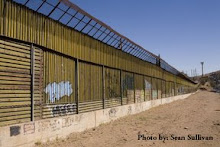
Just a few days earlier, HR 1505, the misnamed National Security and Federal Lands Protection Act, was introduced onto the floor of the U.S. House of Representatives by Representative Rob Bishop (R-Utah).  Aimed at stopping the flood of immigrants that Pew found are, in fact, not pouring over our borders, this bill waives 36 laws on all federal lands within 100 miles of both the northern and southern U.S. borders for any Border Patrol activity.  Forward operating bases, roads, and even more border walls could tear through national parks from Glacier to Olympic to Big Bend, as well as national forests, national monuments, wildlife refuges, and wilderness areas with no concern for the laws that protect natural ecosystems or human communities.


HR 1505 is a dramatic expansion of the Real ID Act, which gave the Secretary of Homeland Security the power to waive laws to build border walls and roads.  In 2008 former DHS Secretary Chertoff waived these same laws, which include the Endangered Species Act, Farmland Policy Protection Act, and the Native American Graves Protection and Repatriation Act to build walls that would otherwise have been illegal. 

The resulting damage has been tremendous.   Walls now carve up the Lower Rio Grande Valley National Wildlife Refuge, fragmenting habitat set aside for endangered ocelot and jaguarundi.  Up and down the Rio Grande, farmers and ranchers, some of whose families have held title to their land since the 1760’s, have had their property condemned.  And during border wall construction ancestral remains were unearthed and left exposed by bulldozers in the Tohono O’Odham reservation.

Now Representative Bishop, whose Utah district is hundreds of miles away from either border, wants to see this brutalizing of our borderlands expanded to cover lands that are nowhere near the border.  He has yet to explain why he believes that the Border Patrol is incapable of enforcing immigration laws without violating every other law.

For their part, the Border Patrol has not asked for the power to ignore our nation’s laws, and they have told Congressional researchers that “land management laws have had no effect on Border Patrol’s overall measure of border security.”  The current Secretary of Homeland Security, former Arizona governor Janet Napolitano, recently called HR 1505 “unnecessary” and “bad policy. 

One would assume that those who represent border communities would stand up for the borderlands.  Yet  Representative Francisco Canseco, whose district already contains more miles of border wall than any other in Texas, is one of HR 1505’s cosponsors.  The city of Eagle Pass, whose residents are Rep. Canseco’s constituents, was on the receiving end of the very first border wall condemnation.  Big Bend National Park is also in his district, and HR 1505 would sweep aside all of the environmental laws that currently protect and maintain it.

Some of Texas’ other border Representatives have taken the opposite position, asserting that all of our nation’s laws should be enforced on the border, not just those that pertain to immigration.  Representative Ruben Hinojosa, for example, whose district includes the Lower Rio Grande Valley National Wildlife Refuge, criticized HR 1505, saying, I think we can allow the Border Patrol to do its work and at the same time protect our environment and our rare animals such as the jaguarundi, the ocelot and our migrating birds in deep South Texas.


It may be that the difference between the two Representatives’ positions comes down to experience:  Hinojosa saw first-hand the harm inflicted upon the border by the waiving of laws, while Canseco did not come to office until the Tea Party’s surge in 2010.  Or perhaps it is a matter of party affiliation, as Conseco’s Grand Old Party tries to use immigrant bashing and charges that President Obama has not done enough to secure the border as a wedge issue in the upcoming election, ignoring the Pew findings and facts on the ground.

Representative Bishop is currently working hard to convince Democrats, particularly those whose districts are as far from the borders has his own and who he assumes know as little about the borders as him, to support HR 1505.  Bipartisan support would increase the bill’s chances in the Senate, and make a Presidential veto unlikely.

Whether he comes to his decision out of ignorance or politics, Representative Canseco needs to think about the on-the-ground impacts of the National Security and Federal Lands Protection Act on his constituents and the lands they cherish.  He and other members of Congress need to decide whether they stand for partisan politics or stand up for the people who put them in office.  And when the next election comes around border residents need to think seriously about which side their Representatives in Washington are on.


Tuesday, October 4, 2011

Assault on Public Lands and Environmental Laws up for a House Vote

By Scott Nicol

How does waiving the Endangered Species Act in Hawaii help secure the U.S. – Mexico border?

Simple. It doesn’t.

But that obvious fact is irrelevant to Representative Rob Bishop of Utah, author of the National Security and Federal Lands Protection Act (HR 1505). Bishop claims that the Department of Homeland Security (DHS) cannot enforce immigration laws without violating the rest of our nation’s laws, so his bill waives 36 federal laws within 100 miles of the U.S. – Mexico border, the U.S. – Canada border, and all U.S. coastlines, for anything that DHS may want to do.

Most of the laws that HR 1505 tosses aside, including the Endangered Species Act, Migratory Bird Treaty Act, and Safe Drinking Water Act, protect the environment, but it also waives laws like the Farmland Policy Protection Act and the American Indian Religious Freedom Act.

This bill is an expansion of the Real ID Act, which gave the Secretary of Homeland Security the authority to waive local, state, and federal laws to build walls along the southern border.

The existing Real ID Act waivers, which HR 1505 expands, have caused tremendous environmental damage. To build border walls 530,000 cubic yards of rock was blasted from mountainsides in the Otay Mountain Wilderness Area; walls have caused serious flooding in the Organ Pipe Cactus National Monument; and walls fragment the Lower Rio Grande Valley National Wildlife Refuge, which was established for the preservation of endangered ocelots. Without the waiver, these walls would be illegal.

Bishop’s bill would also give DHS the run of all federally owned lands, in all 50 states, with absolutely no restrictions. Has a lack of access to the Everglades, or Hawaii’s Volcanoes National Park, or the lawn around the Statue of Liberty, prevented DHS from securing the southern border?

Not according to the Border Patrol.

The irony is that the Border Patrol, which operates under DHS’ umbrella, has not asked for the power to overrule land managers or ignore environmental laws. Last spring the Government Accountability Office found that, “Most agents reported that land management laws have had no effect on Border Patrol’s overall measure of border security.”

When Rep. Bishop introduced a similar bill last year Brandon Judd of the National Border Patrol Council said, “I would definitely look and see if there are some restrictions that are too restrictive. But to get rid of all restrictions, you would destroy the land.”

Representative Bishop has a long history of attacking protected lands and environmental regulations. He is currently pushing for a repeal of the Antiquities Act and a ban on new National Monuments. HR 1505 is just more of the same.

This Wednesday the National Security and Federal Lands Protection Act will be up for a vote in the House Natural Resources Committee, which Rep. Bishop, in a bit of Orwellian irony, chairs. Packed with Tea Party darlings like Bishop, the bill is almost certain to pass and be sent on to the full House of Representatives.

This is the week to contact your representatives and tell them that HR 1505 is not about protecting our nation. It is an assault on federal lands and environmental laws using border security as a convenient cover, nothing more.


For more information, visit www.sierraclub.org/borderlands.

Thursday, June 9, 2011

Border Skirmish: Republicans Are Using Immigrants to Bash Our Wilderness

by Char Miller

It would be nice if Congress held executive-branch agencies accountable for their actions. Or insisted that they follow federal law. Or fulfill their fiduciary responsibilities to one another.

But the Republican-controlled House of Representatives is making a mockery of these basic rules of order and good government.

You won't be surprised that the latest bit of GOP chicanery involves its twin obsessions: the U.S-Mexico Border and national environmental regulations. Their hyperventilating defense of the former, as I've noted before, comes with blustery assaults on the latter.

Since November, Utah representative Rob Bishop, chair of the House subcommittee on public lands, along with his gal pal, Cynthia Lummis (R-WY), and a host of fellow travelers, have mounted an incessant campaign to allow the U. S. Border Patrol to ignore key provisions of the Wilderness Act, the Endangered Species Act, and other vital environmental laws.

Arguing that such legislation impedes the Border Patrol's capacity to defend the nation against undocumented migrants, they have filed amendments and riders to pending legislation, called public hearings to lambaste officials of the Department of Interior, and penned fulminating op-eds to rouse the party's extremist base.

Their most recent gambit came late last week in the form of an amendment to the Department of Homeland Security's appropriation. Rep. Lummis proposed, and a lock-step Republican vote secured, a rule prohibiting DHS from transferring funds to the Department of the Interior.

These moneys would have been used to mitigate the oft-intense environmental damage resulting from the construction of the infamous border wall across federal wildlife refuges, wildlands, and preserves, in such places as the Rio Grande Valley; Arizona's Organ Pipe Cactus National Monument; and the Otay Wilderness near San Diego. And from the spinning wheels of its high-speed patrols that can tear up wildlife habitat or damage sensitive ecosystems.

Such mitigation, required by law, is also sanctioned through longstanding practice among localities, states, and the federal government. It is also a matter of committed environmental stewardship.

Neither the precedent nor the principle matters to contemporary Republicans. In a "Dear Colleague" letter that Bishop, Rep. Doc Hastings (R-WA), chair of the Natural Resources Committee, and Rep. Peter King (R-NY), chair of the Committee on Homeland Security sent out in support of Lummis' amendment, they thrilled at its anti-environmentalism: "the amendment would strike language in the bill that allows these funds to be used by the Interior Department to purchase even more land. Additional federal land acquisition only exacerbates the problem by limiting access to even more land and further bloating the federal estate--at a time when the government cannot even afford to provide the basic care and maintenance needed for existing national parks and other lands."

(Query: why can't the government afford to take care of its treasured public lands? Answer: drastic Republican budget cuts!)

Lummis heaps just as much scorn on the legal obligations and moral responsibilities the government has for protecting our public lands: "Every day our nation's border patrol fights to protect our country against increasingly sophisticated criminal networks that produce and smuggle illegal drugs, and people, into America," she fumed. "Unfortunately, DOI policies have tied the hands of Border Patrol agents, who need access to federal lands to carry out their constitutional responsibility to secure the border."

Her allegation is bogus. The very same Government Accountability Office report that Lummis and Bishop routinely cite as evidence that environmental regulations have handcuffed the Border Patrol, in fact reached the opposite conclusion. In mid-April, for instance, the GAO found that "22 of the 26 patrol agents-in-charge reported that the overall security status of their jurisdiction had not been affected by land management laws. Instead, factors such as the remoteness and ruggedness of the terrain have had the greatest effect on their ability to achieve operational control in these areas."

The report also revealed that the four patrol agents-in-charge who had "reported that delays and restrictions had affected their ability to achieve or maintain operational control," admitted they "either had not requested resources for increased or timelier access or their requests had been denied by senior Border Patrol officials because of higher priority needs of the agency."

Moreover, the GAO investigation demonstrated that relevant agencies out in the field and inside the Beltway have developed close working relations. To argue otherwise, as Lummis and Bishop reflexively do, is to perpetuate a fraud.

Ah, but why let the facts get in your way when you can wrap yourself in the flag as protective cover? Trumpets Lummis: "our nation's security should be our top priority." Wilderness be damned.

Such a blinkered public policy, in point of fact, will lead us into damnation. That's the potent message embedded in Aldo Leopold's private correspondence and his brilliant conservation classic, Sand County Almanac (1948).

Arguing that wilderness is an irreplaceable part of our "cultural inheritance," and that even then was in precious, dwindling supply--it is a "resource that can shrink but cannot grow"--Leopold urged his fellow citizens to defend these beleaguered lands against those with a narrowly conceived notion of homeland securityhttp://www.blogger.com/img/blank.gif. "If we lose our wilderness, we have nothing left...worth fighting for."

Note, please, that Leopold was a Republican.

Char Miller is the Director and W.M. Keck Professor of Environmental Analysis at Pomona College, and editor of the just-published "Cities and Nature in the American West."

Reprinted with the author's permission, this essay was originally posted at KCET:

http://www.kcet.org/updaily/socal_focus/commentary/border-skirmish-republicans-are-using-immigrants-to-bash-our-wilderness-34146.html

Friday, May 20, 2011

Congressional Nightmares Fuel a New Assault on our Borderlands

By Scott Nicol

In his recent speech in El Paso President Obama pointed to the buildup of border security personnel and infrastructure, and declining crime rates in border communities, to justify a renewed effort to enact immigration reform. This will be a tough sell in the current Congress.

Just three weeks earlier the difficulty of his task was on display in Washington DC when Representative Jason Chaffetz (R-UT) displayed photos of headless corpses while shouting at Ron Vitiello, Deputy Chief of the US Border Patrol, during a committee hearing. Vitiello had enraged Representative Chaffetz by calmly asserting that, “While there is still work to be done, every key measure shows we are making significant progress along the Southwest border.”

The horrific pictures were not taken within U.S. borders, and so were outside of the Border Patrol’s jurisdiction, despite Chaffetz’ cries that “This is the kind of thing that we’re sending our agents to deal with on a daily basis!”

Chaffetz’ anger boiled over because Deputy Chief Vitiello was not following the Congressman’s script. The facts, that border communities are safe and apprehensions are down, were not welcome.

The Congressional hearing was intended to paint a picture of the U.S. southern border as a war zone, awash in blood and the mutilated bodies of innocents. In this telling, the Border Patrol fights valiantly to achieve “operational control” and quell the violence, but it is hamstrung by environmental laws and federal land managers who care more about endangered species than human life.

It was meant to promote HR 1505, the misnamed “National Security and Federal Lands Protection Act.” Starting with the premise that the Border Patrol has been prevented from entering federal wildlife refuges, wilderness areas, and national monuments along the southern border, it gives the Border Patrol carte blanche on federal lands.

Like the photos of headless bodies, this provision is based on a false impression of our southern border. The Border Patrol and federal land management agencies signed a cooperative agreement in 2006 allowing access to protected lands that Vitiello said works well. Rugged terrain and remote locations are the real problems reported by agents in the field, not restrictions imposed by land managers.

The bill goes on to exempt the Border Patrol from obeying dozens of environmental laws.

Its precursor, the Real ID Act, was used in 2008 to waive 36 laws along the southern border to erect border walls. The Endangered Species Act, Clean Water Act, and National Environmental Policy Act were among those brushed aside to allow for construction that otherwise would have violated them. This resulted in severe environmental damage.

HR 1505 extends the 2008 waivers to cover all of the U.S. – Mexico border, the Canadian border, all maritime borders, and every square inch of terrain within 100 miles of them.

The waiver covers some of our nation’s most important protected areas, from Glacier National Park and the Boundary Waters to Redwood National Park and the Cape Cod National Seashore. Two-thirds of the population of the United States would also fall under the waiver.

Instead of thanking the Congressmen for freeing the Border Patrol from these legal burdens, Deputy Chief Vitiello undermined HR 1505’s premise. He confirmed the Government Accountability Office finding that “Most agents reported that land management laws have had no effect on Border Patrol’s overall measure of border security.”

The photos of headless bodies were displayed in an effort to discredit the Border Patrol’s testimony, and to burn a brutal image into viewers’ minds that would overwhelm the facts that Vitiello presented.

The angry tirades aimed at the Border Patrol made it clear that the “National Security and Federal Lands Protection Act” really has nothing to do with national security. It does not help the Border Patrol, and they did not ask for it. It is nothing more than an assault on our nation’s public lands and environmental laws.

Speaking within sight of the border, President Obama said that “despite a lot of breathless reports that have tagged places like El Paso as dangerous… El Paso and other cities and towns along this border are consistently among the safest in the nation.”

America cannot develop rational policies that protect border residents and ecosystems by picking and choosing facts any more than we can support the rule of law by cherry picking which laws to obey and waiving the rest. With members of congress choosing fear over facts, ungrounded nightmares instead of FBI statistics, the reform that the president spoke of remains a distant dream.


Here is part one of the April 15 hearing on HR 1505


Here is part two. Rep. Chaffetz brandishes the photos of corpses around a half-hour into this clip.

Thursday, May 5, 2011

Congressional Proposals Aim to Eviscerate Environmental Laws Along U.S. Borders, Coasts

Press Release from:

Randy Serraglio, Center for Biological Diversity
Scott Nicol, Sierra Club Borderlands Team
Jenny Neeley, Sky Island Alliance
Matt Clark, Defenders of Wildlife
Mike Quigley, The Wilderness Society
Nathan Newcomer, New Mexico Wilderness Alliance
Matt Skroch, Arizona Wilderness Coalition

Under Guise of Border Security, Bills Would Eliminate Measures
Protecting Air, Water, Endangered Species


TUCSON, Ariz.— Two bills pending in Congress would eliminate environmental laws along U.S. borderlands — including those that protect endangered species and safeguard clean air and water — under the guise of improving border security. The “National Security and Federal Lands Protection Act” (H.R. 1505), introduced by Utah Rep. Rob Bishop, would permanently exempt border-enforcement activities from 31 environmental and cultural resource laws within 100 miles of all U.S. borders and coasts.

The “Border Security Enforcement Act of 2011” (S. 803), introduced by Arizona Sens. John McCain and Jon Kyl, would effectively give the Department of Homeland Security veto power over environmental protections on public lands within 150 miles of the southwestern border. Land managers in the border region would be prevented from acting to protect the resources they manage if their actions were perceived to conflict with Department of Homeland Security activities.

“These bedrock environmental laws were put in place for a reason: to protect the air we breathe, the water we drink and the natural resources and wildlife we value,” said Randy Serraglio, a conservation advocate with the Center for Biological Diversity. “It makes no sense to turn our back on these laws to satisfy the narrow agenda of a few politicians looking to score points with their most extreme constituents.”

The authority included in these bills has not been requested. In fact, it has been deemed unnecessary by border-enforcement agencies. During an April 15 congressional hearing on border security, U.S. Border Patrol Deputy Chief Ronald Vitiello testified that his agency “enjoys a close working relationship” with public lands agencies that “allows it to fulfill its border enforcement responsibilities.” Vitiello said his agency “is fully committed to continuing our cooperative relationships with the Department of the Interior and the Department of Agriculture.”

“These bills have been introduced solely to satisfy the radical whims of a small minority of anti-environment extremists in Congress,” said Jenny Neeley, conservation policy director for Sky Island Alliance. “These proposals threaten the entire Sky Islands region we work to protect by establishing a dangerous legal precedent of permanently erasing environmental and cultural resource protections across huge swaths of the United States.”

Barrier and road construction, off-road driving, stadium lighting and other border-enforcement activities already threaten parks, refuges and other protected areas as well as many species in the border region, including endangered jaguars and ocelots in Arizona, New Mexico and Texas.

“Too much damage has been done to our borderlands already,” said Scott Nicol, Sierra Club Borderlands Team co-chair. “From massive blasting and erosion in California wilderness areas to devastating floods in Arizona and fragmented habitat for endangered species in Texas, the implementation of border enforcement with callous disregard for our nation’s environmental laws has caused one disaster after another.”

“Protections for endangered wildlife, water and clean air are not standing in the way of border security,” said Matt Clark with Defenders of Wildlife in Tucson. “All Congress has to do is look at the facts: Apprehensions of immigrants illegally crossing the border have fallen by two-thirds over the past decade. Border Patrol and land-management agencies have been effectively working together, and it’s clear that it takes teamwork to secure the border and protect the environment.”

“These efforts to discard the rule of law rest on the false premise that we can have border security or we can have functioning borderlands ecosystems, but not both. That's wrong. We can — and we should — have both,” said Mike Quigley, Arizona representative of The Wilderness Society.

“Protected areas such as wilderness and national parks along our borders provide us with essential environmental services, premier recreation opportunities and important habitat for our wildlife heritage,” said Matt Skroch, executive director of the Arizona Wilderness Coalition. “These shortsighted efforts to waive laws are penny wise and pound foolish. Border enforcement and natural resource management are not and should not be mutually exclusive.”

http://www.biologicaldiversity.org/news/press_releases/2011/border-05-04-2011.html