Sunday, January 13, 2013
Broken Promises and Border Walls Push Jaguarundi to the Brink
Sunday, May 20, 2012
The Grand Old Party Pushes for a Lawless Border
Some of Texas’ other border Representatives have taken the opposite position, asserting that all of our nation’s laws should be enforced on the border, not just those that pertain to immigration. Representative Ruben Hinojosa, for example, whose district includes the Lower Rio Grande Valley National Wildlife Refuge, criticized HR 1505, saying, “I think we can allow the Border Patrol to do its work and at the same time protect our environment and our rare animals such as the jaguarundi, the ocelot and our migrating birds in deep South Texas.”
It may be that the difference between the two Representatives’ positions comes down to experience: Hinojosa saw first-hand the harm inflicted upon the border by the waiving of laws, while Canseco did not come to office until the Tea Party’s surge in 2010. Or perhaps it is a matter of party affiliation, as Conseco’s Grand Old Party tries to use immigrant bashing and charges that President Obama has not done enough to secure the border as a wedge issue in the upcoming election, ignoring the Pew findings and facts on the ground.
Monday, August 15, 2011
Our Worst Fears about the Border Wall Come True
More human beings would die alone in remote deserts. Endangered species would be pushed to the brink. These were the fears that led humanitarians, environmentalists, and border residents to object to the walls along the U.S.-Mexico border called for by the Secure Fence Act of 2006. With 650 miles built, this summer has brought news that these fears are tragically coming true.
The journey taken by migrant men, women and children who set out across the U.S.-Mexico border has always been risky. But border walls have rerouted migrants away from the safety of urban areas and forced them to walk for greater distances over treacherous mountains and through searing deserts. All too easily they can become fatigued, dehydrated, and unable to go on. In too many cases, they die alone in remote areas.
This month an Arizona Daily Star analysis found that migrants today are almost three times more likely to die on their journey than people who crossed in 2006, the year before the walls began to go up. In fact, the rate of death—the number of deaths per 100,000 Border Patrol apprehensions—continues to increase even as fewer people are making the trek across the border.
Before the walls, in 2006, there were just 46 known deaths per 100,000 Border Patrol apprehensions. By 2010 the number had jumped to 118 known deaths per 100,000 apprehensions, and so far 2011 already has a death rate of 129 per 100,000.
These human beings are also dying deeper in the desert and much further from roads than ever before. Because of the remoteness of the areas in which they die, many of the bodies discovered are just skeletal remains. Such are the real and tragic consequences of border walls.
The same walls that are pushing crossers deeper into deadly terrain slice though nature preserves that were established to protect endangered species. The Otay Mountain Wilderness Area, Organ Pipe Cactus National Monument, and Lower Rio Grande Valley National Wildlife Refuge have seen critical wildlife habitat divided by walls. Environmentalists have argued that vulnerable species like the ocelot, whose U.S. population is less than 100 individuals in South Texas, would be walled off and trapped in small fragments of habitat. Without sufficient food, water, and potential mates, the population would dwindle.
Now scientists are beginning to uncover just how extensive the wall’s impacts are likely to be on endangered species. A recent article published in the journal Diversity and Distributions found that border walls impact 23 endangered species border-wide. Some species in California are blocked from as much as 75 percent of their ranges, a circumstance that makes the isolated populations extremely vulnerable to disease or natural disasters. The study also found that in South Texas border walls impact between 60 percent and 70 percent of the habitat set aside for endangered ocelots in the Lower Rio Grande Valley National Wildlife Refuge.
In 2008 the Department of Homeland Security (DHS) recognized that the border wall had damaged wildlife refuges along the border, and Congress appropriated $50 million to mitigate the effects of the wall border-wide. Money was promised to the Lower Rio Grande Valley National Wildlife Refuge to purchase land to replace the ocelot habitat that the border walls fragmented. But after DHS withheld the money for years, Congress took back the funds. DHS has no further plans to fix any of the environmental damage that its border walls have caused.
As predicted, the border wall has exacerbated the ongoing humanitarian crisis of migrant deaths and has devastated the environment. Nevertheless, some in Congress are calling for more walls and looking to strip border communities of their environmental protections under the pretense of border security.
Dan Millis has witnessed first-hand the human tragedy and environmental devastation unfolding daily along the U.S.-Mexico border. Shortly after finding the lifeless body of a young girl along a migrant trail in Arizona, Dan was convicted of littering for leaving bottles of clean water along trails in the same area. He now works for the Sierra Club in Tucson fighting on behalf of the people and places victimized by border walls and enforcement-only politics.
Dan will visit Texas' Rio Grande Valley to share his experiences, and discuss the impacts of flawed U.S. border policy and how you can make a difference on Monday evening, August 22nd at 7:00 pm at Galeria 409 in Brownsville and on Tuesday August 23rd at 7:00 pm at St. John the Baptist Parish Hall in San Juan. For more information and directions, visit valleygreenspace.wordpress.com.
As border residents we need to educate ourselves about the terrible consequences of border walls and enforcement-only policies all along the border, and then inform our elected leaders.
Stefanie Herweck is chair of the Lower Rio Grande Valley Sierra Club.
Thursday, August 5, 2010
Destroying the Borderlands to Secure the Border
Time to call in the troops and wall off the border.
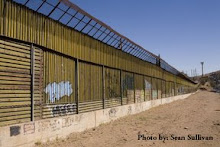
The first 14 miles of border wall, extending from the Pacific Ocean inland, were built of rusting steel helicopter landing mats left over from the Vietnam War crudely welded together. A second layer, 15-feet tall and made of steel mesh, was later added north of the first wall. In the no-man’s-land between these two walls was a graded road for Border Patrol vehicles, with towers for surveillance cameras and stadium lights.
The landing mat border wall entering the ocean between San Diego and Tijuana.
In 2004 the California Coastal Commission and environmental groups, including the Sierra Club, sued to stop the Border Patrol’s plan to plug several canyons in order to create a level path for the border wall. The court found that the Border Patrol was in violation of federal environmental laws and that such a fill project would have a devastating impact on the Tijuana Estuary. The judge ordered that construction be halted.
In order to override the court’s decision, a provision was inserted into the Real ID Act of 2005 giving the unprecedented power to the US Attorney General (later transferred to the Secretary of Homeland Security) to waive all federal, state, and local laws, environmental and otherwise, to build border walls. Former Secretary of Homeland Security Michael Chertoff used the Real ID Act to brush aside the laws that had stopped the border wall, and resumed construction. In waiving those laws he was admitting that border wall construction would violate them.
A few hundred feet from the border wall’s starting point in the Pacific, the Tijuana River Estuary spills into the sea. It is the largest of Southern California’s remaining salt marshes, where over 90% of wetland habitat has been lost to development. The combined Tijuana River Slough National Wildlife Refuge, Tijuana River National Estuarine Research Reserve and Border Field State Park protect sand dunes and beaches, vernal pools, tidal channels, mudflats and coastal sage scrub. During the wet winter season, water drains into the marsh from the Tijuana River and surrounding creeks and canyons, infusing the marsh with fresh water and creating a delicate balance on which its many highly sensitive habitats depend. The site is a key stopover point on the Pacific Flyway, and provides over 370 species of migratory and native birds, including six endangered species, with essential breeding, feeding and nesting grounds.
Following the passage of the Real ID Act the canyon known as Smuggler’s Gulch, south of San Diego, was filled in with over 2 million cubic yards of earth that had been ripped from adjacent mountaintops. A border wall was then perched on top. With no regulations in place and no oversight by other agencies, the Department of Homeland Security (DHS) put little effort into erosion control, and the still bare slopes of the earthen dam threaten to wash tremendous amounts of dirt into the Tijuana River National Estuarine Research Reserve, which is only 600 feet away. In addition to smothering vegetation, burying the estuary in sediment may raise its surface level enough to disrupt the twice-daily inundation of sea water upon which its fragile ecosystem depends.
A few miles up the Tijuana River, the Otay Mountain region is home to the last surviving stands of Tecate cypress, an ice age tree that survives by absorbing coastal moisture from the air. This tree in turn is the host plant for the rare Thorne’s hairstreak butterfly. In an attempt to protect these and other rare and endangered species that inhabit this unique ecosystem, 18,500 acres of the Otay Mountain region were designated a National Wilderness Area.

Border wall in the Otay Mountain Wilderness Area, California
When the Environmental Protection Agency reviewed the plan to build this section of border wall, they expressed concern that plans to fill in canyons and waterways that feed into the Tijuana River would violate the Clean Water Act. The Department of the Interior warned that 6 endangered species would also be harmed by the wall.San Diego Sector Border Patrol spokesman Richard Kite said in 2006, "At the mountain range, you simply don't need a fence. It's such harsh terrain it's difficult to walk, let alone drive. There's no reason to disrupt the land when the land itself is a physical barrier."
Ignoring his observation, DHS decided to “disrupt the land” of the Otay Mountain Wilderness Area with a border wall and an access road. The rugged terrain of the Wilderness Area necessitated the blasting and removal of 530,000 cubic yards of rock and extensive grading and leveling. The Otay Mountain Wilderness Area is so steep that the goal of blasting was to achieve an elevation grade of 15%, even though the Secure Fence Act states that if the elevation grade of an area exceeds 10% walls do not need to be constructed there. Border wall construction caused tremendous erosion, and involved cutting down more than 100 Tecate cypress trees.
Because this is clearly incompatible with a wilderness designation, the goal of which was to limit human activity and protect fragile ecosystems, the Otay Mountain Wilderness Act was among the 36 laws that former Homeland Security Secretary Chertoff suspended using the Real ID Act. He also swept aside the Clean Water Act and the Endangered Species Act, rather than listen to the concerns of the Environmental Protection Agency and the Department of the Interior. With the wilderness no longer protected by law, DHS blasted through it and built the border wall. The Otay Mountain Wilderness Area now suffers from a barren scar and erosion that will bleed sediment into the Tijuana River for years to come.
Unchecked by environmental protections, the walls that began in California’s borderlands now extend over 600 miles, inflicting tremendous damage upon many sensitive ecosystems. In Arizona the border walls that cross washes and streams in the Organ Pipe Cactus National Monument have caused severe erosion and flooding. Border walls built in New Mexico’s Playas Valley block the movement of one of the last wild herds of bison, whose range straddles the U.S. – Mexico border. In Texas the walls that slice through the Lower Rio Grande Valley National Wildlife Refuge have fragmented habitat that is critical for the survival of endangered ocelots.
Border wall in the Lower Rio Grande Valley National Wildlife Refuge in Texas.
Environmental organizations, including the Sierra Club, Defenders of Wildlife, and many others, have attempted to protect fragile border ecosystems from DHS’ lawless actions. They have challenged the constitutionality for the Real ID Act’s waiver provision in court, and have worked to educate Congress and the public about the wall’s environmental impacts. The Sierra Club has also produced a short documentary, Wild vs. Wall, that gives an overview of the border wall’s environmental impacts from the Pacific to the Gulf of Mexico.
Even the Department of Homeland Security admits that border walls have negative impacts on border ecosystems, though they consistently underestimate the extent of the damage. In Environmental Stewardship Plans prepared ahead of construction, DHS identified the purchase of equivalent replacement lands as the most practical way to make up for the many thousands of acres of land that walls would tear through. Setting aside the question of where one would find replacement land comparable to a mountainous wilderness area, Congress allocated some of the necessary funds in 2008 and 2009. The Department of Homeland Security has yet to provide the Department of the Interior with those funds, and not a single acre of replacement land has been bought.
The Department of Homeland Security’s dismissive attitude towards environmental laws and border ecosystems is a direct reflection of that of some politicians, who whip up hysteria about “broken borders” and are openly hostile towards environmental protections. Chief among them has been Utah Representative Rob Bishop, who has repeatedly called the idea that DHS should pay to fix some small portion of the damage that it has done “extortion”, and has worked to keep mitigation funds from reaching the Department of the Interior.
Bishop recently said, "If wilderness designation gets in the way of a secure southern border, I want the designation changed. If it means you lose a couple of acres of wilderness, I don't think God will blame us at the judgment bar for doing that."
In 1968 an unnamed Army major justified the bombing of the Vietnamese provincial capital of Ben Tre by stating coldly, “It became necessary to destroy the town to save it.” The same Orwellian logic seems to animate Representative Bishop, and some of his colleagues, when they look at the U.S.-Mexico border. Blinded by the myth that the border is a war zone, they ignore inconvenient facts like the low crime rates in the border cities of San Diego, El Paso, and Brownsville, and call for a scorched earth campaign to stop the imagined invasion. They fail to see the hypocrisy in setting aside all of our nation’s laws to stop those whom they call “illegals”. They are destroying the borderlands to “secure” the border.
The Sierra Club documentary Wild vs. Wall can be viewed at sierraclub.org/borderlands .
Monday, April 26, 2010
Walling off Texas' Last Sabal Palm Forest
Kiewit construction sign in front of the South Texas border wall
Before the order granting the federal government possession of their land, the Nature Conservancy had attempted to use the courts to force DHS to provide compensation and guarantee access to its property. The Department of Homeland Security has stated that the new border wall will have gates, but they have refused to explain under what circumstances they will be opened to permit access to areas behind the wall. With no way of knowing if staff or eco-tourists will be allowed into the Southmost Preserve, it is hard to see how they can continue to operate. Faced with a similar situation, the neighboring Sabal Palms Audubon Sanctuary simply took down its sign and ceased operations.
The Southmost Preserve contains one of the last of the sabal palm forests that once enveloped the mouth of the river. Before it was called the Rio Grande in the United States and the Rio Bravo in Mexico, the river was known as the Rio de las Palmas to Spanish explorers and conquistadors, who used the palm forest at its mouth as a landmark as they sailed along the Gulf Coast. Then dense groves of sabal palms followed the river up to 80 miles inland, but today the last stands are confined to one tract of the Lower Rio Grande Valley National Wildlife Refuge, the former Sabal Palms Audubon Sanctuary, and the Nature Conservancy’s Southmost Preserve. All three are now behind the border wall.
Federally listed endangered species, including the ocelot and jaguarundi, depend upon riparian habitat along the Rio Grande for their continued survival. Naturally solitary animals, they require large territories in which to hunt, find mates, and disperse after they are weaned. But South Texas has lost roughly 95% of its historic vegetative cover to urban development and agriculture.
Habitat fragmentation, in which disconnected “islands” of habitat are separated by large areas cleared of vegetation, split by roads, or divided by other impediments to movement, poses a tremendous threat to these species’ long-term survival. Ocelot and jaguarundi trapped within too-small habitat “islands” may not have sufficient prey or access to water, and often show evidence of inbreeding. Today, the Rio Grande Valley is home to the less than 80 ocelots and 40 jaguarundi that are still believed to survive in the United States.
The Lower Rio Grande Valley National Wildlife Refuge was established to address the threat to the survival of ocelot, jaguarundi, and other wildlife posed by habitat fragmentation. Over the years 113 individual tracts of land, totaling 88,044 acres, have been acquired, with a goal of using the ribbon of riparian habitat along the Rio Grande as a wildlife corridor to link them. Though not operated by US Fish and Wildlife, the Southmost Preserve and Sabal Palms Audubon Sanctuary are critical parts of the corridor. Bound together by the river, it was hoped that they would provide sufficient resources and allow for the necessary mobility to prevent the extirpation of these endangered cats.
Mile after mile of border wall now slice through the LRGV National Wildlife Refuge; along the northern border of the Sabal Palms Audubon Sanctuary; and soon will tear through the Nature Conservancy’s Southmost Preserve, fragmenting habitat that was painstakingly pieced together over the course of many years. The walls that break apart the wildlife corridor may prove to be the final nail in the coffin for ocelots and jaguarundi.
Sabal Palms Audubon Sanctuary closed
Though the border walls called for by the Secure Fence Act are nearly finished, the threat of Congressionally mandated damage to the borderlands continues. With mid-term elections looming, many politicians hope to exploit fears of “spillover violence” and a Mexican “reconquista” in their bids to stay in office. Calling for the erection of more walls and the deployment of troops may not be sound border policy, but it is a sure-fire way to land an interview on Fox news, which is tantamount to a free campaign ad. The border environment is then either used as a scapegoat or ignored.Claiming that federal land managers are “hiding behind the law” and preventing the Border Patrol from doing their job, recently Representative Rob Bishop introduced legislation that would prevent the Department of Interior from “impeding” Homeland Security’s attempts to fulfill the Secure Fence Act’s mandate. Rep. Bishop, whose Utah district lies 800 miles north of the U.S. – Mexico border, failed to ask the Border Patrol if the Department of the Interior’s stewardship of public lands was in fact interfering with their operations. Brandon Judd, vice president of Local 2544 of the National Border Patrol Council, spoke out against Rep. Bishop’s bill, stating that without environmental regulations, “you would destroy the land.”
Last week the Senate held hearings on border security and the failure of Boeing’s multi-million dollar “virtual fence.” The Senators did not discuss the environmental impacts of the border wall, or address the underlying economic factors driving immigration, or even consider whether or not it made sense to continue “enforcement only” immigration policies. Instead Connecticut Senator Joe Lieberman, chairman of the Homeland Security and Governmental Affairs Committee, suggested that, "The best answer to this continuing crisis and continued flow of illegal immigrants into the U.S. is to go back to the old-style fences, double- and triple-tiered, and layered."
So while we may want to believe that border wall construction, and the accompanying destruction of border ecosystems, is finally coming to an end, the truth is that so long as politicians believe that militarizing the border plays well in their home districts they will continue to draft legislation calling for more border walls. To voters in Utah and Connecticut sabal palm forests along the Rio Grande are no more real than the forests in Avatar. When the palm forests are gone most won’t notice their passing.
This is why it is so important for those of us who can see the damage that is being inflicted upon the borderlands, and who will mourn the loss of sabal palms, ocelots, and the rest of our unique environment, to make certain that when these decisions are made far from the border our voices are heard. We cannot allow ecosystems that predate the founding of the United States and Mexico to be destroyed just to score points in an off-year election. As John Muir said, “God has cared for these trees, saved them from drought, disease, avalanches, and a thousand tempests and floods. But he cannot save them from fools.”
Monday, January 25, 2010
The Border Wall's Ongoing Environmental Toll
In 1996 the United States Congress called for the construction of “triple layered fencing” along the U.S.-Mexico border, beginning in the Pacific Ocean and extending 14 miles into California. This was to consist of parallel 10 to 15 foot high steel walls, with 50 feet of land in between graded and cleared of all vegetation, and the entire expanse lit by stadium floodlights. The Border Patrol also proposed filling in canyons and scalping mountains to give the new walls and road a level path. The California Coastal Commission determined in 2004 that these initial border walls would violate the Coastal Zone Management Act. Of particular concern was the damage that walls would do to the Tijuana River National Estuarine Research Reserve, the largest of the remaining California salt marshes, which harbors many endangered plant and animal species. The Sierra Club, Audubon Society, and other environmental groups also challenged the border wall in court. Construction came to a halt.
Congress responded by passing the Real ID Act of 2005, which gave the Secretary of Homeland Security the power to waive all laws that might slow construction of border walls, and also curtailed normal judicial review. President Bush’s Secretary of Homeland Security, Michael Chertoff, used this unprecedented power to “waive in their entirety” the Coastal Zone Management Act, the National Environmental Policy Act, the Endangered Species Act, the Migratory Bird Treaty Act, the Clean Water Act, the Clean Air Act, and the National Historic Preservation Act in order to resume border wall construction. The challenges brought by the California Coastal Commission and environmental organizations were thrown out when the laws that they were based upon were waived.
When Congress passed the Secure Fence Act in 2006, the power to waive laws granted by the Real ID Act carried over to all of the walls that the new law mandated. The Secure Fence Act called for over 700 hundred miles of new border wall extending from California into Arizona, New Mexico, and Texas, stopping just short of the Gulf of Mexico. Its path takes it through some of our nation’s most fragile and biologically diverse protected lands. Over the years former Homeland Secretary Chertoff issued 5 separate waivers under Real ID, setting aside 36 federal laws and, “all federal, state, or other laws, regulations and legal requirements of, deriving from, or related to the subject of” those named laws. The waivers encompass the broad subjects of water, air, wildlife, and the environment, leaving few, if any, federal, state, or other environmental laws in place. In addition to brushing aside environmental protections, laws relating to farmland, archaeological and historic sites, religious freedoms, and Native American graves were also suspended.

Construction of the massive earthen berm to fill in Smuggler’s Gulch. Border Patrol photo.
With no need to obey environmental laws, the Department of Homeland Security (DHS) filled in the canyon known as Smuggler’s Gulch, south of San Diego, with over 2 million cubic yards of earth that had been ripped from adjacent mountaintops, and planted the border wall on top of the berm. With no regulations in place and no oversight by other agencies, DHS put little effort into erosion control, and the still bare slopes of the earthen dam threaten to wash tremendous amounts of dirt into the Tijuana River National Estuarine Research Reserve, which is only 600 feet away. Burying the estuary in sediment may raise its surface level enough to disrupt the twice-daily inundation of sea water upon which its fragile ecosystem depends.
To the east of Smuggler’s Gulch, in the rugged Otay Mountain Wilderness Area, DHS has blasted mountainsides in order to create access roads and level ground upon which to build the border wall. Before construction began the Environmental Protection Agency raised concerns that the dumping of tons of rubble, and the erosion that would follow, would clog the Tijuana River and violate the Clean Water Act. The Otay Mountain Wilderness Area was established in part to preserve some of the last stands of rare tecate cypress trees, the host plant for the even rarer Thorne’s hairstreak butterfly, which are found nowhere else in the United States. But with the Real ID Act’s waiver authority in hand, DHS has ignored the EPA’s concerns and our nation’s environmental laws, including the Otay Mountain Wilderness Act and the Clean Water Act. Border wall construction caused tremendous erosion, as predicted, and also involved cutting down more than 100 tecate cypress trees.
In July of 2008 the Organ Pipe Cactus National Monument received seasonal monsoon rains which resulted in the flooding of a number of washes that are bisected by the border wall. Storms of this type normally occur every 3 – 5 years in this part of the Sonoran desert. The Army Corps of Engineers had previously stated that the border walls built across washes would "not impede the natural flow of water.” In stark contrast to these claims, the National Park Service determined that the grates built into the base of the wall to allow for the passage of water were quickly choked with debris and sediment. The border wall then acted as a dam, with floodwaters up to seven feet deep piling up behind it. The floodwaters then followed the wall in search of an outlet, which they found at the Sonoyta port of entry, causing millions of dollars of damage to private businesses and government buildings.

Flood debris backed up by the border wall in Organ Pipe Cactus National Monument. National Park Service photo.
The U.S.-Mexico border consists of hundreds of miles of public and protected lands, which is habitat for scores of species. The border wall and patrol road slicing through these areas fragments the habitats of the animals that live here. Cut off from their usual range, populations may not have access to mates in other groups, a necessity for a genetically diverse, healthy population. Border walls also block animals from food and water sources, which leaves them especially vulnerable in times of drought. As the border wall funnels migrants into rugged, remote terrain and Border Patrol vehicles pursue them, they damage fragile ecosystems and disturb sensitive wildlife, like the bighorn sheep and the desert tortoise, both of which are endangered.
Endangered jaguars, which were almost entirely extirpated in the United States, have been photographed and even captured in Southern Arizona and New Mexico in recent years. In 1997, the jaguar was placed on the endangered species list in hopes of reviving U.S. populations. While their former range extends into all four southern border states, the individual animals which have been seen in Arizona likely came into the U.S. from Mexico, where larger populations live. With routes from Mexico almost completely sealed off by the border wall, establishing a healthy breeding population of jaguar in the U.S. may no longer be possible.
South Texas is home to ocelots and jaguarundi, both of which are listed under the Endangered Species Act. Agricultural and urban development have stripped these animals of 95% of their original habitat. Because so few of each species are left in the U.S., they need access to mates in Mexico to avoid inbreeding. The Lower Rio Grande Valley National Wildlife Refuge was created to provide them with sufficient habitat to survive, as well as offer a potential route to Mexico. Over the past 20 years, more than 90 million tax dollars and thousands of volunteer hours were spent piecing together and revegetating tracts of land along the Rio Grande in order to create this wildlife corridor. The border walls in South Texas now divide some of these refuge tracts, and cut others off from the Rio Grande and from Mexico. With the Endangered Species Act waived, the Department of Homeland Security has largely ignored the way that border walls fragment the ocelot and jaguarundi’s remaining habitat and seriously diminish hope for their recovery, or even survival.
Before former Secretary Chertoff’s last Real ID Act waivers in April 2008, DHS prepared draft environmental impact statements and draft environmental assessments for the various sections of border wall, as mandated by the National Environmental Policy Act. In reviewing the draft environmental impact statement for the Rio Grande Valley, the Environmental Protection Agency found it to be “insufficient,” and recommended that DHS start the process over. The EPA reached the same conclusion, and made the same recommendation, when it reviewed the draft environmental impact statements and draft environmental assessments that DHS prepared for each the other border wall sections.
Following the waivers, which allowed DHS to disregard the National Environmental Policy Act, the agency abruptly ended the environmental assessment and environmental impact statement processes. Instead, they created a brand new category, the “environmental stewardship plan,” which was not governed by any federal legislation. These new reports recycle the bulk of the prior, “insufficient” reports, in many cases word-for-word, but have no established criteria or requirement for review from the EPA or the public. While they do include recommendations to minimize the wall’s environmental impact, most of which appeared in the earlier “insufficient” reports, there is no requirement that these be adhered to. In the instance of Smuggler’s Gulch, for example, revegetation and erosion control measures called for in DHS’ own report were not implemented.
One of DHS’ most absurd claims for the border wall is that it will actually be good for the environment because border crossers leave litter, make foot paths, and, in the states that do not have a river for a border, drive off road vehicles through sensitive habitat. This ignores the difference in scale between a dirt path that winds through the brush and an area 150 feet wide cleared of all vegetation, and 10 – 15 foot tall steel and concrete walls. The border wall’s destructive impact is made obvious by the Department of Homeland Security’s need to “waive in their entirety” our nation’s most important environmental laws. The only reason for DHS to waive laws is the knowledge that the border wall violates them. Litter can be a problem for wildlife, but the blasting, bulldozing, fragmentation, and large-scale erosion caused by border wall and Border Patrol road construction are much worse. Animals can sidestep discarded water bottles, but when their habitat is cleared of vegetation, flooded, or silted up, and blocked by an impermeable wall, they cannot survive.