Showing posts with label El Paso. Show all posts

Monday, December 2, 2013

A New Wall Through El Paso’s Historic Heart


By Scott Nicol

The condemnation suit has been filed and construction crews are staging.  Another section of border wall will soon stand beside the Rio Grande. 

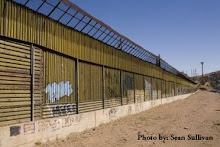
El Paso’s new border wall will tear through the city’s historic heart.  It will stand upon the exact spot where Don Juan de Oñate first crossed the Rio Grande in 1598, and New Spain established a road from Mexico City to Santa Fe long before the founding of either Mexico or the United States.  Oñate’s crossing was called “El Paso del Rio de Norte,” the Pass Across the River of the North, and over time it grew into the city of El Paso.

The new El Paso wall will be added to the patchwork of barriers called for by the Secure Fence Act.  Those walls have proved to be largely ineffective at stopping either drug smugglers or migrants looking for work.  Customs and Border Protection spends millions of dollars repairing thousands of breaches each year, and if a crosser forgets to pack a saw the border wall takes less than a minute to climb. 

But efficacy is not the point, and never has been.  Border walls are nothing more than symbols, props for politicians to use as a backdrop in political ads.  Whether or not they actually stop anyone is irrelevant –appearance is all that matters. 

So far as Customs and Border Protection is concerned the actual damage that will be inflicted on a site of tremendous historical significance such as the Oñate crossing is also irrelevant.  Because the Bush administration used the REAL ID Act to waive 36 laws construction can move quickly, with no need to protect historic or archaeological features.  The Antiquities Act, National Historic Preservation Act, Archaeological Resources Protection Act, and other laws that might safeguard our cultural heritage have been swept aside, along with laws that protect our environment and human health.

Thanks to the waiver other border walls have caused severe erosion in the Otay Mountain Wilderness Area, flooding in the Organ Pipe Cactus National Monument, and the fragmentation of endangered species habitat in the Lower Rio Grande Valley National Wildlife Refuge. 

There is no reason to think that this time Customs and Border Protection will act responsibly.

The stated intent of the REAL ID Act’s waiver provision was to allow for the “expeditious construction” of border walls and patrol roads that might otherwise be slowed down by compliance with laws.  But it has been 7 years since the Secure Fence Act was passed.  Construction was not delayed by lawsuits; Customs and Border Protection simply did not think that this section was a priority.  Now that they have gotten around to building it there is no rush, they just don’t want to be bothered with obeying our nation’s laws.

No agency should be above the rule of law, and it is beyond ridiculous to allow a law enforcement agency to violate laws with impunity. 

El Paso’s U.S. Representative, Democrat Beto O’rourke, and Republican U.S. Senator John Cornyn have called upon Customs and Border Protection to rethink this section of wall, to reach out to El Paso residents and listen to the opinions of those on the ground as to whether this wall will be of benefit to the community or if instead it will be, as Brownsville’s Bishop Flores described Texas’ border walls, another “scar” disfiguring border communities.  Customs and Border Protection has refused to listen to border residents, likely because they know that those who will live with this scar through the heart of their community would reject it.

Having been given such tremendous power when Senator Cornyn and his fellow members of Congress voted for the REAL ID Act (in 2005 O’rourke was not yet a member of Congress, so could neither support nor oppose the bill), Customs and Border Protection can ignore the law and lawmakers.  They have a long track record of condemning the property of local landowners and municipalities and erecting walls in the face of local protests. 

Customs and Border Protection should commit to upholding all of our nation’s laws, not just those that it finds convenient.  If it is impossible to erect border walls without violating 36 federal laws those walls should not be built. 


This article originally ran in the Rio Grande Guardian on November 30, 2013.
www.riograndeguardian.com

Sunday, September 27, 2009

Border War Rhetoric Has Real Consequences for the Borderlands

By Stefanie Herweck

This week Texas Lieutenant Governor David Dewhurst addressed an assembly of border residents and community leaders in Harlingen, Texas, less than 15 miles from the Rio Grande, and proclaimed that there was a war going on along the border. His assessment of the border was extreme: “We have two wars everyone talks about going on, one is in Iraq and one is in Afghanistan. We’ve got a third going on and that’s the border.”

Dewhurst made this announcement in the keynote speech for State Senator Eddie Lucio’s State of the District Address. With Senator Lucio looking on, Dewhurst went on to make his case for war on the border, speaking in vague terms about “transnational gangs,” “drug lords killing Americans,” and “border violence,” but providing little in the way of concrete details. He urged that more law enforcement be deployed in order to “close down this border.”

Dewhurst’s comparison of the U.S.-Mexico border region to war-torn Iraq and Afghanistan is offensive and absurd. His characterization of a border at war is based on ignorant hysteria instead of reality. And his portrayal of the border region as the dangerous fount of criminal activity for the rest of the state and the country is categorically false.

When pressed in an interview after the speech to provide the details that would support his claims, Dewhurst said, “We’ve seen incidence of gangs, drive by shootings, in Wichita Falls, which is a long way from the border.” The Lieutenant Governor is right about one thing here: 600 miles between Wichita Falls and the Texas-Mexico border is a long way. But declaring war on the border in order to fight crime in Wichita Falls is ludicrous.

Especially because most Texas border cities are actually safer than Wichita Falls. Although Wichita Falls has 30,000 fewer people than the border city of McAllen, its crime rate in 2008 was higher than McAllen’s. According to FBI statistics, Wichita Falls had 557 incidences of violent crime in 2008, while McAllen only had 371. El Paso was ranked as the third safest large city in the United States in the same year. And all of these cities saw a decrease in violent crime from 2007 to 2008, as did the nation as a whole. Dewhurst’s perverse fantasy of a chaotic crime-ridden border simply does not match the relatively peaceful day-to-day border reality.

In his speech, Dewhurst also cited briefings he has received from the Department of Public Safety and other law enforcement. When asked to elaborate on these briefings after his speech, he cited no official reports or criminological studies, but said “Virtually every city I go into I talk to the DPS and I talk to the local police and they have all seen a pick up of gang activity that they feel is related to drug cartels in Mexico.” While the views of law enforcement officers around the state are valuable, it is irresponsible to make policy recommendations based on their “feelings” rather than hard facts.

Furthermore, Dewhurst has apparently failed to consult with law enforcement officials in the border region. When interviewed by NPR this spring, Brownsville Police Chief Carlos Garcia noted that there had only been 3 homicides in his city in 2008, and that none of them were related to drug cartels. In the same article McAllen Police Chief Victor Rodriguez provided some perceptive analysis that Dewhurst should heed: “The sky is not falling,” he said, refuting unfounded statements by pundits and politicians that cartel violence was spilling over at the border. "What's happening right now is we've got rhetoric that's driving the policy."

When it was pointed out after his speech that his talk of war might not be welcome at the border, Dewhurst quickly wrote it off as just a rhetorical strategy: “I use the word 'war' only in the sense to get people’s attention to understand that there’s a serious problem along our porous southern and northern border.”

Unfortunately, as Chief Rodriguez well understands, rhetoric drives policy. Dewhurst’s declaration of war on the border may be intended as nothing more than a metaphor, but it is likely to have real consequences for the residents of the Texas border.

In his own speech, Dewhurst called for more actual boots on the ground to deal with the war scenario that he later claimed was purely rhetorical. This same border war rhetoric is driving Governor Perry’s call for troops to patrol the border and military predator aircraft to fly up and down the Rio Grande. This month he stationed a specialized team of the Texas Rangers that will reportedly be patrolling the border region carrying automatic weapons, and wearing camouflage, helmets, and bullet-proof vests.

The governor’s action comes despite his own admission that crime along the border has been falling in recent years. And it has been deemed unnecessary by border law enforcement. Hidalgo County Sheriff Lupe Treviño said, “We don't need the Texas Rangers to come to the border to quell any imaginary disturbance.”

Although sending the Texas Rangers or the National Guard to fight an imaginary war at the border might make for good sound bites in the rest of the state, it sends a shiver down the spine of border residents. Community and business leaders fear that their efforts to develop the border region will be undermined by the false perception of a dangerous, militarized border. Residents know that staging a war in their communities, parks, and farmlands only puts them more at risk.

Border war rhetoric like Dewhurst’s drives policy on the national stage as well. Senator Jim DeMint of South Carolina introduced an amendment to the 2010 DHS Appropriations Bill calling for more than 300 miles of new border wall. If the amendment passes, hundreds of those miles could be built in Texas. These walls are being proposed despite the fact that the hundreds of miles of border walls already built have not stopped people from crossing the border. Wayne Cornelius, Director Emeritus of the Center for Comparative Immigration Studies at the University of California at San Diego, say that despite the walls at the border, between 92% and 98% of all those attempting to cross the U.S.-Mexico border illegally eventually get through. This month, a report by the Government Accountability Office faulted the Department of Homeland Security for having no effective way to gauge the impacts that border walls are having on illegal entry.

But the myth of a border war trumps the reality that walls don’t work. In the press release about his amendment, DeMint says that more border walls are urgently needed because “our southern border has become a battleground.”

Too many walls already blight the Texas borderlands. Texas citizens have had their private property stripped away to make way for walls. Texas cities have seen their landscape forever marred by them. Texas natural areas, wildlife refuges and parks have been irreparably damaged by them. All of this destruction is rooted in the myth of the border war.

Dewhurst’s inflammatory war rhetoric may have been intended only to “get people’s attention,” but the consequences for his constituents along the border are very real. When our borderlands are decreed a war zone, politicians in Austin and Washington forget that it is a place that millions of people call home. They jump on the border war bandwagon, hoping to score political points and to burnish their law-and-order credentials. Like Lt. Gov. Dewhurst, they make the border a scapegoat for crime in the rest of the Texas and the United States. Like Gov. Perry and Sen. DeMint, they dream up absurd, and ultimately destructive, schemes to fight an imaginary war.

Border residents desperately need leaders who will reject the border war scenario, who will refuse to bear false witness against the borderlands and who will work tirelessly to represent the reality of border life at the state and national level. We need uncompromising leaders who will not be complicit in the border war myth, who will actively oppose the schemes based on this myth, and who will not sit silently by as the border region that they were elected to represent is mischaracterized, maligned and damaged.

Friday, December 19, 2008

Civil Disobedience and the Border Wall

After successfully blocking construction of the US-Mexico border wall for 7 hours on December 17, Judy Ackerman was handcuffed and led away from the construction site. She had been on the site since 6:30 that morning, cheered on by a group of enthusiastic supporters while idle workers leaned against their silent equipment.


Ackerman’s civil disobedience sprang from a desire to defend the Rio Bosque Wetlands Park, a protected natural area on the Rio Grande in El Paso, Texas. Rio Bosque is situated along a stretch of the old, winding river channel in which the Rio Grande flowed before it was straightened and channelized in the 1930s. The park’s wetlands were created in 1997, and, through years of volunteer work, the native wetland habitat was painstakingly restored. Ten years later, it’s one of the few places where one can imagine what the El Paso area must have been like when the river wound freely through the mountains and desert and had ample flow to support rich wetlands and big cottonwood trees. Judy Ackerman is one of the many volunteers who made this vision possible.

But the border wall threatens this rebirth of nature. Its path will cut off Rio Bosque from the river, preventing the movement of species and severely limiting the park's value as habitat. For Ackerman and the other longtime Rio Bosque volunteers who know that the river and the wetlands are intimately and inextricably connected, the border wall is a knife through the heart.


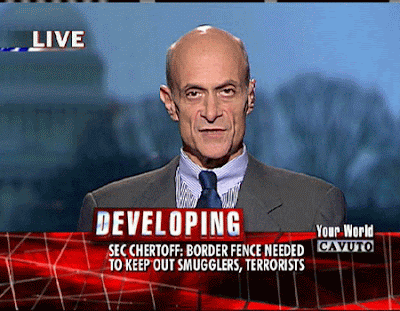
For the simple, nonviolent action of standing her ground on the border wall construction site, Ackerman has been charged with violating the law, but the border wall itself has been placed above all of our nation’s laws. The Real ID Act gives the Secretary of Homeland Security the power to waive any federal, state, or local law that might slow down construction of the wall. No one else, not even the president, has this sweeping power. On April 1, 2008, DHS Secretary Michael Chertoff “waived in their entirety” 36 federal laws all along the southern border, including the Clean Water Act, the Endangered Species Act, and the National Environmental Policy Act. There is only one reason to waive these laws: Chertoff knows that the border wall cannot be built without violating them. His waiver is an implicit admission that constructing the border wall means breaking the law.

After her arrest, law enforcement officers brought Ackerman before a judge to be arraigned. But under the Real ID Act, neither she nor anyone else may use the courts to challenge the border wall, regardless of the damage it causes or the danger it represents. Chertoff’s waiver swept aside our legal right to demand in court that the government obey its own laws. The only jurisdiction the courts have is to determine whether or not the Real ID Act waiver provision is constitutional. El Paso County and nine other plaintiffs have claimed that it is not and are asking the Supreme Court to hear their case. In the meantime, the border wall continues to be built, devastating our border communities and natural areas, flouting our nation’s laws, and undermining our constitutionally-guaranteed right to equal protection under the law.


Some would go so far as to say that these are among the freedoms we should willingly give up in exchange for security. But this trade-off is a false one based on the twin myths that our borders are broken and that border walls will protect us.

Our borders are not broken. Well before the new walls started going up there, the El Paso Border Patrol Sector was reporting a decrease in the apprehensions of illegal crossers. From 2005 to 2007, apprehensions in the El Paso sector fell by 38 percent. Even more telling, this year El Paso has been named the nation's third-safest city among cities with populations of 500,000 or more, and it has consistently ranked in the top 3 safest large cities for a decade.

Border walls do not make the United States safer, nor do they stop undocumented immigration or smuggling. A 2007 report by the Congressional Research Service found that existing walls in San Diego “did not have a discernible impact on the influx of unauthorized aliens coming across the border.” In fact, during the same period that El Paso experienced a 38 percent drop in illegal crossings, San Diego had a 20 percent increase in crossings despite the presence of a triple-layered border wall there.


Those who say we must give up our freedom for security are in reality asking us to sacrifice one of the founding principles of our republic, the rule of law, for nothing but a false sense of security.

Judy Ackerman trespassed, disrupted border wall construction, and stood her ground. For this she was duly arrested and charged with a crime. But on the same ground where Ackerman made her stand, The Department of Homeland Security is willfully and destructively ignoring the law. One man has decided which laws apply and which do not and has single-handedly dismissed our right to sue for protection under the law. Ackerman’s trespassing charge is a misdemeanor. But the border wall construction that restarted soon after her arrest is a much more serious crime, and Chertoff’s waiver of laws is a flagrant violation of the principles upon which our nation was founded.

Tuesday, September 9, 2008

Fly on the Wall

By Adrienne Evans

TERLINGUA, September 4 - I arrived late for the August 24-28, 2008 Peace and Unity March against the border wall. I got there on Sunday, the last day.

The march that had started on Wednesday and gone 57 miles along the future route of the border wall in far west Texas. Being that late, and having not been that close to the actual border wall before, I was feeling almost like a "fly on the wall," having almost an out-of-body experience and getting a physical, psychological, and spiritual shock at the sight of the ugly wall. It's one thing to see a picture of it; it's another to see it up close, to touch it.

I parked hurriedly, spotting the rally in progress a hundred yards up the mountain in Sunland Park at the border wall there. I started up the hill, joining a journalist as we walked to join the group of 200 people present on both sides of the wall, most kneeling in the dust of the Border Patrol's road alongside the American side of the wall, in the shadow of the camera towers. It was a somber scene, full of the intensity of those who had marched, and the silent recognition by the rest of us of their effort.

Smudge pots by Native American elders burning, most heads bowed, blue, yellow and white butterflies flying up and hitting the wall and falling back over and over, the tired marchers standing a bit apart from the rest of us, the Mexican people gazing through the heavy mesh of the fence as the prayer ended at our sad faces and our signs that proclaimed our friendship and the injustice of a border wall, the indigenous drum beat THRUM-THRUM-THRUM, the sudden, loud call of the Native American woman as the priest said Amen, the Farm Workers Union leader then speaking of the travesty of this wall, hearts heavy on both sides, the priest asking us all to come up to the wall and touch a "brother and a sister's hand." Which we did, tears flowing on both sides.

Some brave few crested the steep hill where the border wall disappeared into the sky. They waved and shouted before heading back down; an elderly Hispanic man picked up tiny pieces of litter off the ground offering the tired marchers a ride to the parking lot in his truck; others trudging back down, arm in arm, to listen to more speeches as marchers on the U.S. side handed food, clothing and camping equipment over the top of the wall to a small crowd of children. Children as young as four were easily able to reach the top of the wall by standing on each other's shoulders.

We hugged and waved goodbye to our sisters and brothers on both sides of the wall.

That day, the wall was a bridge, not a divider. You could touch someone's fingertips through the mesh. You could look into their eyes. You could walk alongside them and speak. You could pray together. The road alongside the border wall was not a military road Sunday -- it was a church, a holy place; it was a place to kneel and pray. It was a place that the indigenous people could call from to the Great Spirit. The wall became a bridge for those few moments -- but as we looked back, its hideous shape reasserted, a physical reminder of our nation's insecurity, its hatreds, its racism, in the form of a wall that was easily breached, even by children.

Yet the butterflies reminded us how solid the wall was, how impenetrable to the helpless animals. The children, not helpless, calling to us, reminded us that our fancy cars and clothes meant we had something to give that they needed. The march’s leaders and activists on both sides of the wall reminded us of the social injustice of border walls, and that the "March had just begun." The priests reminded us that our brethren on the Mexican side of the wall were no different than we were in the sight of God. Indeed.

The sight of the border wall reminded us of the reality of a wall, how grotesque it really is. How useless, really. While the wall stands, we have a chance to wake up to our own fears and the horrible result of these fears. So go see the wall, and symbolically write your own fears, your own hatred, your own racism, upon its surface, as I did last Sunday. Release your fears and be done with them. Lay flowers there. Pray. Watch the butterflies smack against it. Watch the children, laughingly, climb it in five seconds.

The day the wall comes down, we will recognize those fears fully as being exposed and dealt with. We will have overcome them.

Adrienne Evans is a mother, health practitioner and community volunteer who lives in Terlingua, Texas. She is the co-founder of No Wall – Big Bend coalition. For more info, visit http://www.nowallbigbend.blogspot.com/.