Monday, August 4, 2008

Border Wall Causes Flood in Nogales, Sonora

By Sean Sullivan

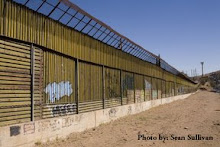
On July 12, monsoons washed through the Nogales, Sonora area and caused major flooding on the Mexican side of the border. In some places five feet of water was pooled up along the border wall and there were reports of cars floating away. What caused this flood?

As reported in the AZ Daily Star, Mexican officials blame an illegally built wall for the devastating flood. The Border Patrol built a 5 foot wall within a drainage tunnel near a port of entry without notifying the International Boundary and Water Commission (IBWC).

The IBWC is comprised of officials from Mexico and the U.S. They are charged with seeking solutions to issues pertaining to sanitation, water quality, and flood control in the border region. The 5 foot wall was built by Border Patrol in January of this year. Traditionally, the IBWC is consulted when projects built on either side of the border will have an impact on stormwater runoff. However, Border Patrol never contacted the IBWC.

Mexican officials with the IBWC have submitted a formal complaint claiming that the wall reduced water flows within the drainage tunnel. As a result, concrete drainage structures failed and released torrents of water into the streets of the Nogales, Sonora. U.S. officials are still investigating the matter.

Complete disregard for the law and respect for other agencies and communities within the border region is now rampant within the Department for Homeland Security (DHS). This year DHS waived over 30 federal laws in order to construct hundreds of miles of border walls. Now the Border Patrol has failed to consult with the organization responsible for bi-national flood control and has endangered the residents of Nogales.

We know that border infrastructure is having devastating impacts on wildlife and ecosystems. The Nogales flood shows us that border communities also face environmental injustices. The flood caused millions of dollars in damages and destroyed many businesses in a low income community. Floods such as this can soil drinking water, spread hazardous materials, and create breeding grounds for various types of mold that can pose a health risk to people.


The infrastructure being utilized by DHS along the U.S./Mexico border continues to result in devastating impacts not only to the natural environment, but to communities as well. The Nogales flood could very well be a portent of what could occur along the lower Rio Grande Valley. There are many communities in the vicinity of the walls being constructed along that stretch of the border. This incident is yet another tarnished example of how U.S. border policy fails and instead places people and the environment at risk.

Sean Sullivan is the Co-Chair for the Sierra Club's Rincon Group in southern Arizona.

Tuesday, July 29, 2008

Hurricanes and Border Walls Don’t Mix

The Texas Border Coalition, which describes itself as a collective voice of border mayors, county judges, and economic development commissions along Texas' border with Mexico, released the following statement regarding the border wall in South Texas:

EAGLE PASS, Texas – (July 25, 2008) – As South Texans continue to repair roofs, roads and lives damaged by Hurricane Dolly, the chairman of the Texas Border Coalition (TBC) repeated his protest today that hurricanes and the border wall don’t mix.

TBC Chairman and Eagle Pass Mayor Chad Foster objected to a new plan by the Department of Homeland Security (DHS) to build 14 miles of movable wall in the U.S.-Mexico border floodplain that would have to be torn down within 24 hours of the next hurricane or other flood event.

“Hurricane season is not over with the downgrading of Dolly,” Foster said. “Not only does DHS plan to continue its piecemeal approach to protecting the lives of South Texans, now they plan a total absurdity: a movable wall.”

“If a movable wall were in place today, over 1,000 workers would be needed to tear it down within 24 hours, load it on to hundreds of trucks to take it north,” said Foster. “They would be doing so instead of battening down their homes for the storm or evacuating their families from its wrath.”

According to the latest information available about the movable wall, it would be constructed of steel bollards 18 feet above ground, filled to the 10-foot level with concrete. By TBC’s back-of-the-envelope estimations, the 14-mile movable wall would be made of nearly 90,000 steel bollards, each weighing about 1,700 pounds.

To achieve its goal of removing the wall, the DHS would have to haul away 151 million pounds of unwieldy pipe filled with concrete. Who will move it and with what equipment is unclear.

“The people of the Rio Grande Valley, having just experienced the rapid emergency work necessary to protect the people in advance of a hurricane, know that DHS’ movable wall is simply ridiculous,” Foster said.

“It is an outrage that that DHS is so arrogant, out of control and headstrong to build a wall that even Homeland Security Secretary Michael Chertoff admits won’t work – that illegal crossers will go around, over, through and under it,” Foster said. “In doing so, they are wasting $50 billion of the taxpayers’ money for a wall that everyone knows won’t work.”

Foster added, “This is the result of Secretary Chertoff’s waiver of 34 laws to build the wall. By repealing these laws, DHS has avoided scrutiny from the public and government agencies, essentially voiding our system of checks and balances. It would have made more sense, and saved taxpayers hundreds of millions of dollars, if DHS had simply consulted with border residents and border officials first. We certainly would not have suggested a 151-million-pound movable wall.”

The Texas wall is being built more than 1 mile from the border, trapping workers, families, farmers, ranchers, and retirees on the Mexican side. The wall will cede thousands of acres of U.S. land to Mexico and endanger the lives of people when they need assistance from emergency or law enforcement personnel who won’t be able to reach them.

“Illegal border crossing won’t be controlled until the U.S. has a well-run immigration system that expands avenues for legal workers and cracks down on illegal hiring,” Foster said.

When immigration is reformed, the U.S. won’t need a border wall, although the nation will continue to require beefed up Border Patrol and Customs forces to halt illegal drug smuggling. The border wall will be torn down, he added.

“We thank goodness that Hurricane Dolly jogged north of the Rio Grande river just before hitting Texas. As my friends and neighbors give thanks for being spared from what could have been the worst catastrophe of their lives, Congress and President Bush should stop the construction of an absurd movable border wall that they’ll have to tear down,” Foster said.

# # #

The Texas Border Coalition (TBC) is a collective voice of border mayors, county judges, economic development commissions focused on issues that affect more than 6 million people along the Texas-Mexico border region and economically disadvantaged counties from El Paso to Brownsville. TBC is working closely with the state and federal government to educate, advocate, and secure funding for transportation, immigration and ports of entry, workforce and education and health care. For more information, visit the coalition Web site at www.texasbordercoaltion.org.

Thursday, July 10, 2008

CALL TO ACTION BY THE TOHONO O'ODHAM INDIGENOUS PEOPLE AGAINST THE US-MEXICO BORDER WALL

The Traditional Tohono O'odham Indigenous People Demand a Halt to the Construction of the US-Mexico Border Wall and the Destruction of Indigenous Nations.

The following press release was issued by the O'odham Solidarity Project:

The Tohono O'odham Nation has the second largest reservation recognized by the United States, with territory and members on both sides of the US-Mexico political boundary in the states of Arizona, US and Sonora, Mexico. As original people of the territory, the Tohono O'odham have lived on and cared for that land long before such a boundary even existed; before there was a US or a Mexico. Now, however, the construction of the border wall along the entire US – Mexican border is splitting border communities and Indigenous nations alike, including the Tohono O'odham.

The construction of this wall will destroy the Tohono O'odham way of life (their traditions and religious practices), not to mention the many rights sworn to the O'odham people that are being violated. Tohono O'odham elders and traditionalists maintain their legacy through oral history, conducting natural ceremonies that include offerings to the land and sea. They also use manyplants and environmental resources of the region as a source of food and medicine. But, many of these sacred ceremonies take place in Mexico.

"This Wall and the construction of this Wall has destroyed our communities, our burial sites, and ancient O'odham routes throughout our lands. The entire International border has divided and displaced our people," says Ofelia Rivas, a representative of the traditional Tohono O'odham in Washington D.C. “The Wall is also severely affecting the animals. We now see mountain lions going into areas where people live because of the Wall.”

The right of the O'odham to travel freely and safely via these traditional routes in their territory has previously been guaranteed under United States, Mexican, and International Law. The US government's American Indian Religious Freedom Act of 1978 acknowledges rights for the O'odham people that the construction of the US-Mexico Border Wall directly violates. By restricting the mobility of the O'odham people, the Wall prevents the free practice of their religion and their cultural traditions. Further, rights granted by the United Nations universalDeclaration of Human Rights, the Declaration of Human Rights for Indigenous Peoples, and the American Declaration of the Rights and Duties of Man are also being ignored due to a waiver issued by the US Department of Homeland Security. Under this document, the President claims the power to waive any and all environmental and Federal Indian laws in order to build the Wall in the name of national security.

The US-Mexican border policies and the Wall have also increased the military presence within the O'odham lands, further affecting their lives and communities.

"This Wall has militarized our entire lands," states Ofelia Rivas, "We, as original people, are now required to answer to United States armed forces as to our nationality on our own lands." Ofelia Rivas, herself, was once asked, at gunpoint, to produce identification to establish her right to be on lands that she was born on and her ancestors lived on since before Columbus.

Ironically, the increase in militarization of the US-Mexican Border has coincided with the rise of the North American Free Trade Agreement (NAFTA) that went into effect in 1994. Supporters at the time said NAFTA would decrease immigration and bring good paying jobs to Mexico but the exact opposite has happened.

“Many of the people crossing from Mexico into the United States are indigenous people and families,” says Ofelia Rivas. “They tell me that under these free trade agreements they can no longer farm and make a living.”

Under NAFTA it has become easier for commercial goods to cross the border than people, especially the Tohono O'odham. This is illustrated by a striking example told by Mrs. Rivas:"An O'odham elder and her daughter were interrogated and watched by United States Border Patrol guards as they collected traditional O'odham food in the desert."

Ofelia Rivas is in Washington, D.C. today with members of many different Indigenous nations and allies who have walked from San Francisco, California across the continent to Washington, D.C. This group calls their march “The People’s Walk” not only for the sovereignty of Indigenous nations but also for the protection of sacred sites, plants, and animals.

Thus, ordinary O'odham people and elders and their allies are issuing a call to action against the construction of the US-Mexico Border Wall. "As original peoples of these lands,” says Ofelia Rivas, “we protest the violation of the thirty seven federal laws by the April 1, 2008 Waiver by Secretary Chertoff."

For More Information Contact:
O'odham VOICE Against the Wall and O'odham Rights Cultural and Environmental
Justice Coalition: Ofelia Rivas (520) 471-3398, uyarivas@hotmail.com,
http://www.tiamatpublications.com/odham_solidarity_project.html
The People’s Walk: peoplejune13@yahoo.com
Earthpeoples: Rebecca Sommer: (718) 302-1949, http://www.earthpeoples.org/

Tuesday, July 8, 2008

WAIVED ON THE BORDER: THE ADMINISTRATIVE PROCEDURE ACT OF 1946

By Nat Stone

Wary of New Deal-era government expansion, and after costly brushes with fascism under Nazi Germany and Imperial Japan, in 1946 Congress passed the Administrative Procedure Act to protect United States citizens from abuses by federal agencies.

As President Roosevelt had observed during the decade-long process of negotiating the APA, to entrust federal agencies with legislative, executive, and judicial powers was also to risk corrupting these powers, and "to develop a fourth branch of government for which there is no sanction in the Constitution."

The Administrative Procedure Act authorizes and standardizes the procedures of 55 federal agencies responsible for implementing and enforcing federal laws. A manual for governance, APA requires transparency in agency rulemaking, opportunity for citizen participation, and protection of individual privacy.

Further buttressing the foundation of American civil rights, these among many provisions of the Administrative Procedure Act require that:

Agencies shall "give interested persons an opportunity to participate in the rule making…"

Agencies shall "maintain no record describing how any individual exercises rights guaranteed by the First Amendment unless expressly authorized."

Agencies shall "establish appropriate administrative, technical, and physical safeguards to insure the security and confidentiality of records…"

Whenever any agency fails to comply…in such a way as to have an adverse effect on an individual, the individual may bring a civil action against the agency…"

A person compelled to appear in person before an agency or representative thereof is entitled to be accompanied, represented, and advised by counsel…"

Under authority of Section 102 of the 2005 REAL ID Act, The Administrative Procedure Act is one of 36 federal laws now waived, without explanation, by the Department of Homeland Security for border wall construction.

Left unchecked, the unprecedented vagueness of Section 102 waiver authority, and the unjustified muting of the Administrative Procedure Act, may be repeated for other federal projects elsewhere in the nation.

For true collaboration between DHS and local agencies for appropriate border management, and to check Section 102 waiver authority, please support HR 2593, The Borderlands Conservation and Security Act.

The full text of HR 2593 can be found here:
http://www.govtrack.us/congress/billtext.xpd?bill=h110-2593.

Here is the complete list of laws that Department of Homeland Security Secretary Chertoff waived using his Real ID Act authority on April 1, 2008:

National Environmental Policy Act
Endangered Species Act
Federal Water Pollution Control Act (commonly referred to as the Clean Water Act)
National Historic Preservation Act
Migratory Bird Treaty Act
Clean Air Act
Archeological Resources Protection Act
Safe Drinking Water Act
Noise Control Act
Solid Waste Disposal Act
Comprehensive Environmental Response, Compensation, and Liability Act
Archaeological and Historic Preservation Act
Antiquities Act
Historic Sites, Buildings, and Antiquities Act
Wild and Scenic Rivers Act
Farmland Protection Policy Act
Coastal Zone Management Act
Wilderness Act
Federal Land Policy and Management Act
National Wildlife Refuge System Administration Act
Fish and Wildlife Act of 1956
Fish and Wildlife Coordination Act
Administrative Procedure Act
Otay Mountain Wilderness Act of 1999
Sections 102(29) and 103 of Title I of the California Desert Protection Act
National Park Service Organic Act
National Park Service General Authorities Act
Sections 401(7), 403, and 404 of the National Parks and Recreation Act of 1978
Sections 301(a)-(f) of the Arizona Desert Wilderness Act
Rivers and Harbors Act of 1899
Eagle Protection Act
Native American Graves Protection and Repatriation Act
American Indian Religious Freedom Act
Religious Freedom Restoration Act
National Forest Management Act of 1976
Multiple Use and Sustained Yield Act of 1960

Wednesday, July 2, 2008

The Border Wall's Environmental Impacts were Largely Ignored According to the Environmental Protection Agency

Before Chertoff waived 36 federal laws to build the border wall, the Department of Homeland Security went through the motions of preparing Draft Environmental Impact Statements for the Rio Grande Valley of Texas and for a portion of the border wall south of San Diego. Their contractor, E2m, also prepared Draft Environmental Assessments for many of the other Border Patrol sectors which are scheduled to see border wall construction in 2008. DHS claimed that these were in compliance with the National Environmental Policy Act, which requires that when the government goes forward with major projects it first must study the impacts that will be felt by the human and natural environments, so that stakeholders and decisionmakers can decide whether the project justifies the damage that it will do, and if that damage can be lessened in any way. When Secretary Chertoff issued the Real ID Act waiver in April, the National Environmental Policy Act topped the list of suspended laws. Chertoff quickly announced that Final Environmental Impact Statements and Environmetal Assessments would not be issued.

The Environmental Protection Agency is tasked with evaluating Environmental Impact Statements and Environmental Assessments, and determining whether the have been properly prepared. In the case of the documents prepared by the Department of Homeland Security's contractor, they found in every case that the reports were inadequate.

Today the Lone Star Chapter of the Sierra Club issued the following press release about the EPA's findings:

(Austin) -- The Environmental Protection Agency (EPA) expressed serious concerns about the impacts of the border wall that were ignored, according to newly disclosed public comments from late 2007.

The EPA's environmental and economic concerns echoed those raised by hundreds of residents, environmental organizations, and local institutions and public officials, all of which were negated by the Bush Administration's April 1 waiver of 36 federal laws to expedite construction of the border wall.

The ignored comments were submitted by EPA to the Department of Homeland Security (DHS) as part of the draft Environmental Impact Study (DEIS) on the planned border fences in the Lower Rio Grande Valley, as well as similar plans in the Presidio and El Paso areas of the Texas-Mexico border.

"These comments show that the EPA felt that the border wall represents a major threat to the habitat and endangered species found along the Texas-Mexico border," said Cyrus Reed, Conservation Director of the Lone Star Chapter of the Sierra Club. "Rather than trying to rewrite or reconsider the hastily drawn plans of a massive border wall, the Bush Administration felt it was above the law and chose to waive dozens of environmental and other federal laws."

The EPA comments characterized the proposed border walls and fences to be environmentally and economically disruptive due to their size and location, often slated for construction in natural wildlife areas or cutting through agriculturally productive land. For example, in its comments submitted on the proposed fences in the Lower Rio Grande Valley, John Blevins, Director of Compliance Assurance and Enforcement Definitions rates the project as "EC-2, Environmental Concerns-Insufficient Information," and explains: "The DEIS contains insufficient information for an adequate review. Of particular concern to EPA is the potential for long-term adverse environmental and ecological habitat impacts in the study area."

Among the chief concerns and insufficiencies highlighted by the agency are:

There is no text, studies, etc. that provide support for the purpose and need.

It does not appear that the alternatives are equally analyzed. There is also text that implies that the "No Action Alternative" is not a viable alternative.

There is no mention of how the wall would impact water quality.

The majority of this section uses relative terms like "minor, major, perceptible, short-term, and long-term." There are qualitative descriptions of these terms, but there is no quantitative description or attempt to quantify these impacts.

There is also no mention of US-Mexico treaties and whether they will be impacted.

There is no discussion of the fence's potential impact on migratory species or impact to their home range, in particular, large mammal species (e.g., deer or carnivores) or birds.

There is no discussion of the U. S. Fish and Wildlife Service (FWS) initiative to purchase land to connect units of the Lower Rio Grande Valley National Wildlife Refuge (LRGVNWR) (p. 3-30 line 4-10) or the potential impacts of the fence to this large scale effort to increase connectivity and reduce habitat fragmentation.

Related to the location of the fence and property of individuals, the maps created by DHS show that the fence could run straight through houses and backyards. Many families have lived at these locations for decades, some even centuries, and have strong emotional ties to the family land and homes.

The fence could also cut off farmers from prime farmland close to the water.

"These comments show the DHS never conducted a proper assessment of the sites, and also show that they would have a hard time convincing EPA to give a thumbs up to the proposed border wall," Reed stated. "Rather than getting a black eye from their fellow agency, they chose to waive environmental laws and ignore the comments of EPA and the public."

Several civil lawsuits that could impact the construction of the border wall are ongoing.

Find more information on the Lone Star Chapter Sierra Club's website at http://www.texas.sierraclub.org/press/newsreleases/20080702.asp.

Contact: Donna Hoffman, Lone Star Chapter, Sierra Club, 512-477-1729 or 512-299-5776

Friday, June 27, 2008

Assaults on Private Property to Build the Border Wall Challenged in Court

Texas RioGrande Legal Aid has been working to defend the rights of landowners who live in the path of the border wall. Their legal defense of private property rights in south Texas comes as the Department of Homeland Security, led by Secretary Chertoff, is accused of repeatedly violating laws and court orders in their aggressive attmempts to condemn land to build the wall. DHS even went so far as to initiate condemnation proceedings against one of the few south Texas landowners who wanted the border wall, and who had already agreed to sell his land. The Texas Border Coalition continues to challenge the coercive tactics that DHS has employed as it attempts to take over private and municipal property. The University of Texas at Brownsville has announced that they will bring suit to force DHS to comply with a court order requiring that they explore others alternatives to a wall that would slice through their campus. And altough the Supreme Court refused to hear the constitutional challenge to the Real ID Act's waiver privision brought by the Sierra Club and Defenders of Wildlife, there is another constitutional challenge pending, brought by El Paso County, the El Paso County Water Improvement District No. 1, the Hudspeth County Conservation and Reclamation District No. 1, the Ysleta Del Sur Pueblo of the Tigua Nation, Frontera Audubon Society, the Friends of the Wildlife Corridor, and the Friends of Laguna Atascosa National Wildlife Refuge, and Brownsville’s Galeria 409.

The following press release was sent out by Texas RioGrande Legal Aid regarding their ongoing efforts on behalf of private landowners threatened by the border wall:

LOS EBANOS, Texas – Two Rio Grande Valley families will be taking their legal fight against the federal government regarding the construction of the border wall to New Orleans, Louisiana.

Represented by Texas RioGrande Legal Aid (TRLA), the largest provider of legal aid in Texas, the families of Hilaria and Baldomero Muniz and Pamela Rivas are fighting the government’s efforts to take their land to build a wall along the Texas – Mexico border. The legal battle will continue in the Fifth Circuit Court of Appeals in New Orleans on July 8th. The Court will convene at 9 am.

The legal battle began when the Department of Homeland Security (DHS) filed lawsuits against the families to gain access to their land to begin planning the border wall. The families have argued that DHS did not follow the legal steps required before initiating the condemnation proceedings. DHS has sued more than fifty Rio Grande Valley landowners in the border wall process.

According to TRLA attorney Jerome Wesevich,“The government is required to negotiate a reasonable price for the property with these families before they use the court system. The government’s reasonable price was nothing.”

Both the Muniz and Rivas families have owned property in Los Ebanos for several decades. Baldomero and Hilaria Muniz worked as migrant farmworkers to save the money to build their house along the Rio Grande River. They have raised five children in that house and currently use the land to raise goats that they depend on to survive.

“Zero dollars is not a reasonable price for these families’ livelihoods,” added Wesevich. “The government needs to comply with its own laws. Right now, its failure to do so is at the expense of hardworking border landowners.”

Established in 1970, Texas RioGrande Legal Aid, Inc. (TRLA) is a nonprofit organization that provides free civil legal services to low-income and disadvantaged clients in a 68-county service area. TRLA’s mission is to promote the dignity, self-sufficiency, safety and stability of low-income Texas residents by providing high-quality legal assistance and related educational services.

Contact: Jerome Wesevich, Attorney
915.241.0534
jwesevich@trla.org

Cynthia Martinez, Communications Director
512.374.2764
cmartinez@trla.org

Friday, June 20, 2008

The Border Wall’s Lawless History

By Scott Nicol

The border wall, which has already done tremendous damage to the environment of our borderlands, will in coming weeks plug a canyon south of San Diego. More than 2 million cubic yards of earth will be torn from adjacent hills and dumped into a canyon called Smuggler’s Gulch to create a massive earthen berm. The wall will then be built on top of this berm, rather than following the canyon’s natural contours. The Keiwit Corporation will be paid $48.6 million to fill the canyon and build 3.5 miles of border wall, doing irreparable damage the Tijuana River estuary in the process. In Keiwit’s home state of Nebraska, or any other part of the country, federal laws would limit the destruction that such a reckless project could do, but on the border the Department of Homeland Security is no longer bound by our nation’s laws.

In 1996 Congress passed the Illegal Immigration Reform and Immigrant Responsibility Act, which called for the construction of walls along the U.S.-Mexico border. Beginning in the Pacific Ocean and extending inland for 14 miles, the wall would slice through protected lands, Smuggler’s Gulch, and the Tijuana River. It would consist of parallel concrete and steel walls with a graded road between them, lights, cameras, and sensors, and 50 feet on either side cleared of all vegetation.

California’s Coastal Commission determined that the border wall would violate the federal Coastal Zone Management Act. Of particular concern was the damage that would be done to the Tijuana River National Estuarine Research Reserve and other lands that had been set aside for protection, Smuggler’s Gulch in particular, as well as impacts on threatened and endangered species. The Sierra Club and other environmental groups challenged the border wall in court, alleging that it violated the National Environmental Policy Act. The judge agreed, and construction was halted.In 2005 the Real ID Act was attached as a rider on an appropriations bill funding the wars in Iraq and Afghanistan after it failed to pass on its own merits. It contained a provision intended to overrule the objections of the California Coastal Commission and anyone else who might oppose the construction of border walls. It said, “Notwithstanding any other provision of law, the Secretary of Homeland Security shall have the authority to waive all legal requirements such Secretary, in such Secretary’s sole discretion, determines necessary to ensure expeditious construction of the barriers and roads under this section.”

Department of Homeland Security Secretary Michael Chertoff used his unprecedented new power to “waive in their entirety” the Coastal Zone Management Act, the National Environmental Policy Act, the Endangered Species Act, the Migratory Bird Treaty Act, the Clean Water Act, and other vital federal laws to build the San Diego border wall. The challenges brought by the California Coastal Commission and the Sierra Club were thrown out when the laws that they were based upon were waived.

The Real ID Act amended the Illegal Immigration Reform and Immigrant Responsibility Act, with the phrase “under this section” referring to its 14 miles of California border wall. When the Secure Fence Act was passed two weeks before the 2006 mid-term election, it further amended the Illegal Immigration Reform and Immigrant Responsibility Act, replacing the 14 miles originally called for by the act with over 700 miles of border wall. Because these new walls were now “under this section” Secretary Chertoff had the power under Real ID to “waive all legal requirements” to build them as well.

In 2007 the California pattern was repeated in Arizona. The Sierra Club and Defenders of Wildlife challenged the construction of the border wall in the San Pedro Riparian National Conservation Area. The San Pedro was recognized by the National Audubon Society as its first Globally Important Bird Area, and designated as a world heritage natural area by the United Nations World Heritage Program. The court agreed that the Department of Homeland Security had ignored the requirements of the National Environmental Policy Act when they began building the wall through Arizona’s last free-flowing river, and an injunction temporarily halting construction was handed down. Rather than comply with the law, Secretary Chertoff waived it, once again suspending the laws that were the basis of a successful suit, along with 18 others. Within days of the waiver DHS restarted construction. This case is currently pending before the Supreme Court.

Apparently hoping to head off further court challenges to the border wall, last April Secretary Chertoff issued two waivers. One waived 27 federal laws to allow for the insertion of border walls into the existing flood control levees in Hidalgo County. This followed the determination by the US Fish and Wildlife Service that, “any proposed fence and/or levee segment that bisects lands within the Lower Rio Grande National Wildlife Refuge cannot be found compatible with the purposes for which the refuge was established,” and would therefore be in violation of the National Wildlife Refuge Administration Act. It also brought an abrupt end to the Environmental Impact Statement process mandated by the National Environmental Policy Act.

The second waiver covered every other section of border wall that will be built in 2008 from San Diego, California to Brownsville, Texas. This mega-waiver suspended 36 federal laws. Along with the environmental laws set aside in earlier waivers, Chertoff waived the Farmland Protection Policy Act, the National Historic Preservation Act, the Religious Freedom Restoration Act, the Clean Water Act, the Clean Air Act, the Endangered Species Act, and a host of others. It appears that in his rush to build the border wall, Chertoff was setting aside not only the laws that the wall was certain to violate, but any law that might in any way be relevant.

Predictably, this abuse of power invited court challenge rather than curtailing it. A diverse group of plaintiffs - El Paso County, the El Paso County Water Improvement District No. 1, the Hudspeth County Conservation and Reclamation District No. 1, the Ysleta Del Sur Pueblo of the Tigua Nation, Frontera Audubon Society, the Friends of the Wildlife Corridor, the Friends of Laguna Atascosa National Wildlife Refuge, and Brownsville’s Galeria 409 - have challenged the constitutionality of the Real ID Act’s waiver provision. They allege that giving an Administration appointee the power to overrule acts of Congress that were signed by the President for the express purpose of short-circuiting the functioning of the Judiciary is a violation of the Constitutionally mandated separation of powers.

This is not just an academic question; these plaintiffs will be directly impacted by the suspension of these laws. The waiving of the American Indian Religious Freedom Act means that the wall can be built without consideration of the sites on the Rio Grande that are important to the religious practices of the Tigua Nation. The El Paso and Hudspeth County water districts are charged with providing their counties with drinking and irrigation water. Not only has Chertoff waived the Clean Water Act and the Safe Drinking Water Act, but, “all federal, state, or other laws, regulations and legal requirements of, deriving from, or related to the subject of” the laws listed in the waiver. Apparently, no laws related to water are in force, leaving water districts with no way of knowing what rules still apply.

Long after the remains of the border wall share museum space with the broken concrete of the Berlin Wall, Smuggler’s Gulch will still be filled in, and the Tijuana River estuary that it flows into silted up. Secretary Chertoff, however, is so fixated on building the border wall that he is willing to ignore the consequences of his actions. Serious violations of federal law, resulting in irreparable damage to our nation’s natural and cultural heritage; to homes and farms and businesses; and to the continuation of Native American religious practices that predate the founding of the United States, are all acceptable costs according to this narrow mindset. Chertoff has admitted that, “Yes, you can get over it; yes, you can get under it,” but in his mind an ineffectual border wall is still worth sacrificing the fundamental principles enshrined in the U.S. Constitution.