by Char Miller
The Department of Homeland Security (DHS) has a nasty habit of rubbing salt into wounds, fresh and old.
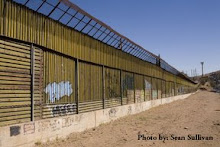
Just ask anyone who lives along the Rio Grande Valley, makes their home in the Sonoran Desert covering large sections of northwest Mexico and southwest Arizona, or inhabits the dense sprawl of those entwined cities, San Diego and Tijuana. Since 2006, wherever DHS has pounded down its infamous Border Wall, it has chopped up habitats human and natural, severing longstanding cultural links and environmental connections between the U.S. and Mexico. It is a haunting reminder that the post-9/11 hunt for national security has generated its own insecurities.
The most recent (and stinging) example of this painful paradox came in late November. That's when DHS began construction of the latest segment of the wall, dubbed the Surf Fence Project. This 18-foot-high barrier, hung on six-inch rust-proof steel piping, is being pile-driven out 300 feet into the Pacific Ocean. The goal is fortify Imperial Beach, making it impregnable redoubt, the first line of defense for San Diego.
"There is a clear operational need for this development," Michael Hance, field operation supervisor with the U.S. Border Patrol, told the BBC. "The southern side of the border is densely populated and in the past many people found an easy way into the US through these beaches. We need physical infrastructure as well as border agents in the area."
As for the urgency to thrust this wall so deep into the pounding surf, local border patrol agents point to the capture in November of several undocumented migrants attempting to swim around the current fencing.
At a cost of $4.3 million, this new wall will be a very expensive form of deterrent. But Assistant Chief Patrol Agent Bruce Parks assured the LA Times that the exorbitant price tag (amounting to $143,333.33 per foot!) is worth every penny, for this stretch of beach "still has the potential to be very dangerous, as beautiful as it is."
I'd like to think that Parks is just being silly: do we really spend this much money building a wall because of the potential that this stretch of seaside can be a dangerous gateway into the U.S.? But he's not being flippant. After five years of listening to the Border Patrol and its parent department, DHS, say similar things every time they have announced the launch of yet another segment to the 670-mile border wall, it is clear that there is a pattern to their patter.
If, as DHS asserts, the land and sea are so threatening; if the people who would cross these stretches of our sovereign territory are judged to be so unsafe, then we must militarize the first while demonizing the second. Every mile of steel pole and three-ply fencing, every searchlight, movement sensor, high-flying drone, and armed guard is a reflection of this American war on nature and the Other. A terrorism that may be as malevolent as the threat this thick bulwark is supposed to repel.
This deliberate violence against land and people is underscored in the title of a new and insightful collection of essays on the geopolitics of the borderlands: Wounded Border/Frontera-Herida. The injuries that its ten chapters probe cover a wide range: the deeply flawed law enforcement and judicial systems on both sides of the border; the inequities and humiliations that migrants face in U.S. labor markets desperate for low-wage, expendable workers (pressure that women disproportionately bear); the environmental despoliation that comes from a globalized economy that created maquiladoras in Mexico, industries whose toxic effluent damages ground and surface waters, pollutes the air, and poisons adjacent neighborhoods. The border is a fraught landscape.
No shock, this contested physical space is also a social construct. As co-editor Justin Akers Chacón argues: "Since its inception as a boundary imposed by war of expansion, the U.S.-Mexico border has functioned in a dualistic manner. It has served both as a gateway to economic opportunity and as a barrier that creates and maintains unequal power relationships." Out of this duality, he writes, flows "the identities of both people in relationship to each other," becoming a "signifier of status that sustains each population in its own form of isolation." Although the proponents of globalization like to argue that this force is flattening the distinctions between counties and cultures, the U.S. border wall stands in stark refutation, a vertical and visible barrier. Bluntly divisive.
Emblematic of the rending of the social fabric that this enforced divide can produce is Friendship Park. Its name once conveyed its binational significance: First Lady Pat Nixon was on site at its ceremonial opening in 1971, there celebrating the site that memorialized the two nation's close relationship. "There should be no more fences," she declared.
That amity turned into animosity when, as a result of the 2006 Secure Fence Act that the George W. Bush administration promulgated, DHS built a series of fences that turned the park into a penitentiary. "New rules for public access to the gathering place leave families feeling like they have entered a maximum security prison on visiting day," writes Jill Holslin at her blog At the Edges. Any who would like to enter the park today must "wait outside the border wall 150 feet away from Friendship Park, seek permission to enter a locked gate, then be escorted by a border patrol agent in a 'security zone,' a five-foot tall pedestrian barrier that confines the space of the concrete circle of Friendship Park." Detention, surveillance, enforcement: these are the markers of a "containment society."
More egregious still is the latest effort to cordon off the United States, our arrogant ambition to split the Pacific Ocean in two.
Char Miller is the Director and W.M. Keck Professor of Environmental Analysis at Pomona College, and editor of the just-published "Cities and Nature in the American West." This article originally appeared on KCET, and is reproduced with the author's permission.
Showing posts with label California. Show all posts
Showing posts with label California. Show all posts
Monday, January 2, 2012


Tuesday, December 7, 2010
Walling Off Our Southern Deserts
by Scott Nicol
Over 660 miles of border wall have been built along the U.S.-Mexico border, slicing through the deserts of California and Arizona on its route from the Pacific Ocean to the Gulf of Mexico. The wall’s path takes it through some of our nation’s most fragile and biologically diverse protected lands. Border wall construction has involved dynamiting mountains and damming rivers, the disruption of migration corridors and the destruction of endangered species habitat.
Over 660 miles of border wall have been built along the U.S.-Mexico border, slicing through the deserts of California and Arizona on its route from the Pacific Ocean to the Gulf of Mexico. The wall’s path takes it through some of our nation’s most fragile and biologically diverse protected lands. Border wall construction has involved dynamiting mountains and damming rivers, the disruption of migration corridors and the destruction of endangered species habitat.
 Border wall on the beach between San Diego and Tijuana.
In 2004 the California Coastal Commission determined that border walls south of San Diego would have a devastating impact on the Tijuana Estuary, in violation of the Coastal Zone Management Act. Environmental groups, including the Sierra Club, sued to stop the Border Patrol’s plan to plug several canyons in order to create a level path for the border wall. The court found that the Border Patrol was in violation of federal environmental laws, and construction ground to a halt.
Rather than insist that Border Patrol obey our nation’s environmental laws, Congress passed the Real ID Act. Section 102 of the act was intended to overrule the objections of the California Coastal Commission and the Sierra Club by allowing the Secretary of Homeland Security to waive any law that border wall construction might otherwise violate. No one else, including the President, is granted this power. Former Homeland Secretary Chertoff used the Real ID Act five times, to set aside 36 federal laws and, “all federal, state, or other laws, regulations and legal requirements of, deriving from, or related to the subject of” those laws. The waivers encompass the broad subjects of water, air, wildlife, and the environment, leaving few, if any, environmental laws in place.
Rather than insist that Border Patrol obey our nation’s environmental laws, Congress passed the Real ID Act. Section 102 of the act was intended to overrule the objections of the California Coastal Commission and the Sierra Club by allowing the Secretary of Homeland Security to waive any law that border wall construction might otherwise violate. No one else, including the President, is granted this power. Former Homeland Secretary Chertoff used the Real ID Act five times, to set aside 36 federal laws and, “all federal, state, or other laws, regulations and legal requirements of, deriving from, or related to the subject of” those laws. The waivers encompass the broad subjects of water, air, wildlife, and the environment, leaving few, if any, environmental laws in place.

Border wall through the Otay Mountain Wilderness Area.
A few miles east of the border wall’s start in the Pacific Ocean, the Otay Mountain Wilderness Area protects the last surviving stands of Tecate cypress, an ice age tree that survives by absorbing coastal moisture from the air. This tree in turn is the host plant for the rare Thorne’s hairstreak butterfly. When the Environmental Protection Agency (EPA) reviewed the plan to build border walls through the Otay Mountain Wilderness Area, they expressed concern that filling in canyons and waterways that feed the Tijuana River would violate the Clean Water Act. The Department of the Interior (DOI) warned that 6 endangered species would also be harmed by the wall.
San Diego Sector Border Patrol spokesman Richard Kite said of the Wilderness Area, "At the mountain range, you simply don't need a fence. It's such harsh terrain it's difficult to walk, let alone drive. There's no reason to disrupt the land when the land itself is a physical barrier."
By 2008, this logic no longer held sway at DHS and, ignoring the concerns of the EPA and DOI, the Department of Homeland Security (DHS) decided to “disrupt the land” of the Otay Mountain Wilderness Area with a border wall and a patrol road. The rugged terrain necessitated the blasting of 530,000 cubic yards of rock and extensive grading and leveling. Border wall construction caused tremendous erosion, and involved cutting down more than 100 Tecate cypress trees.
Because dynamiting mountains is clearly incompatible with a wilderness designation, Secretary Chertoff used the Real ID Act to waive the Otay Mountain Wilderness Act. He also swept aside the Clean Water Act and the Endangered Species Act. The Otay Mountain Wilderness Area now suffers from a barren scar and erosion that will bleed sediment into the Tijuana River for years to come.
San Diego Sector Border Patrol spokesman Richard Kite said of the Wilderness Area, "At the mountain range, you simply don't need a fence. It's such harsh terrain it's difficult to walk, let alone drive. There's no reason to disrupt the land when the land itself is a physical barrier."
By 2008, this logic no longer held sway at DHS and, ignoring the concerns of the EPA and DOI, the Department of Homeland Security (DHS) decided to “disrupt the land” of the Otay Mountain Wilderness Area with a border wall and a patrol road. The rugged terrain necessitated the blasting of 530,000 cubic yards of rock and extensive grading and leveling. Border wall construction caused tremendous erosion, and involved cutting down more than 100 Tecate cypress trees.
Because dynamiting mountains is clearly incompatible with a wilderness designation, Secretary Chertoff used the Real ID Act to waive the Otay Mountain Wilderness Act. He also swept aside the Clean Water Act and the Endangered Species Act. The Otay Mountain Wilderness Area now suffers from a barren scar and erosion that will bleed sediment into the Tijuana River for years to come.
 Border wall through the Otay Mountain Wilderness Area.
Further east, Arizona’s San Pedro River is one of the last undammed, free-flowing rivers in the American Southwest. It anchors one of the most biologically diverse areas in the United States, at the convergence of four major ecosystems: the Sierra Madre and Rocky Mountains, and the Sonoran and Chihuahan Deserts. The San Pedro Riparian National Conservation Area was designated by the National Audubon Society as its first Globally Important Bird Area, and by the United Nations World Heritage Program as a World Heritage Natural Area.
When the DHS announced that it would put a wall across the San Pedro, the Sierra Club and Defenders of Wildlife sued. A federal court agreed that the federal government’s failure to fully assess the environmental impacts of the border wall violated the National Environmental Policy Act (NEPA), and ordered a temporary halt to construction. Rather than comply with NEPA, former DHS Secretary Chertoff used the Real ID Act to waive it. Border walls built in the San Pedro watershed are now causing erosion and damming that will permanently alter the riparian habitat.
The border wall’s impact on the flow of water in desert ecosystems was made clear in 2008, when the Organ Pipe Cactus National Monument received seasonal monsoon rains that resulted in the flooding of a number of washes that were blocked by the border wall. Grates built into the base of the wall to allow for the passage of water quickly choked with debris and sediment. The wall then acted as a dam, with water up to seven feet deep piling up behind it. Floodwaters then travelled laterally along the wall until they found an outlet at the Sonoyta port of entry, causing millions of dollars of damage to private businesses and government buildings there.
The border walls and patrol roads that slice through hundreds of miles of public and protected lands also fragment the habitats of a number of endangered species, including the Sonoran pronghorn, cactus ferruginous pygmy owl, and desert tortoise. Cut off from their usual range, populations may not have access to mates in other groups, a necessity for a genetically diverse, healthy population. Border walls also separate animals from food and water sources, leaving them especially vulnerable in times of drought. With the endangered species act waived, these threats to species’ survival have been largely ignored.
 A mountain lion runs alongside the border wall.
The lands of the Tohono O'odham, whose name means “the desert people,” were once vast, extending from what is now Central Arizona down into Sonora, Mexico, and from the Gulf of California east to the San Pedro River. The international border splits their land, and the erection of the border wall has restricted their ability to visit family and sacred sites and to collect traditional foods and other materials.
Border wall construction has also unearthed Tohono O’odham graves. When the Secretary of Homeland Security waived Native American Grave Protection and Repatriation Act, the regulations that ensured respect for the Tohono O’odham’s ancestral remains and culture no longer applied to border wall construction.
Speaking before a U.S. House of Representatives hearing on the border wall, Tohono O’odham Chairman Ned Norris Jr. said, “… fragments of human remains were observed in the tire tracks of heavy construction equipment. Imagine a bulldozer parking in your family graveyard, turning up bones. This is our reality.”
DHS claims that border walls are actually good for the environment because border crossers leave litter, make foot paths, and, in the states that do not have a river for a border, drive off road vehicles through sensitive habitat. This assertion is based on a pair of false premises. The first is that border walls stop crossers. They do not. The Congressional Research Service found that border walls have “no discernible impact” on the number of undocumented immigrants who enter the United States each year. Instead, walls redirect many of those who seek to enter on foot, “funneling” them into more remote areas. This often means that their environmental impacts are concentrated in fragile desert ecosystems, rather than closer to walled off border towns. “Funneling” has contributed to the deaths of more than 5,600 crossers in the harsh Arizona desert.
The second false premise is that border walls and patrol roads are less damaging to ecosystems than border crossers. The border wall’s destructive impact is made obvious by the Department of Homeland Security’s need to “waive in their entirety” our nation’s most important environmental laws. The only reason for DHS to waive laws is that border walls violate them. Litter and migrant trails can be a problem for wildlife, but the blasting, bulldozing, habitat fragmentation, and large-scale erosion caused by border walls and roads are worse by magnitudes of scale.
Ignoring the useless and destructive nature of border walls, political hopefuls from Alaska to Kansas, Utah to Rhode Island, called for more walls in the run up to the mid-term elections. This is not just empty rhetoric that can be ignored. A number of amendments requiring the erection of hundreds of miles of new wall were introduced in the last Congress, and one, authored by Jim DeMint of South Carolina, passed in the Senate before being stripped in a House/Senate conference committee.
Representative Ciro Rodriguez, whose district already has border walls, blocked DeMint’s amendment. Rep. Rodriguez lost his reelection bid, and the U.S. House lurched to the right. Key committees that oversee immigration and homeland security will soon be chaired by Representatives who have long advocated further militarizing the border. DeMint and others will likely redouble their efforts to build more border walls, and their legislation will stand a much better chance of making it onto the President’s desk.
Instead of building more border walls, Congress should focus on mitigating the damage that has already been inflicted. It is also critically important that Congress repeal the Real ID Act’s waiver provision. The Real ID Act is not only a threat to border ecosystems should Congress require more walls, it also establishes the precedent that bedrock environmental laws such as the Endangered Species Act and Clean Water Act can be swept aside when obeying them would be inconvenient. For these reasons the Sierra Club and other environmental organizations oppose further border wall construction, and call upon Congress to repeal of section 102 of the Real ID Act.
This originally appeared in the Desert Report, a quarterly publication of the Sierra Club's California / Nevada Desert Committee: http://www.desertreport.org/wp-content/uploads/2010/12/DR_Winter2010.pdf
Border wall construction has also unearthed Tohono O’odham graves. When the Secretary of Homeland Security waived Native American Grave Protection and Repatriation Act, the regulations that ensured respect for the Tohono O’odham’s ancestral remains and culture no longer applied to border wall construction.
Speaking before a U.S. House of Representatives hearing on the border wall, Tohono O’odham Chairman Ned Norris Jr. said, “… fragments of human remains were observed in the tire tracks of heavy construction equipment. Imagine a bulldozer parking in your family graveyard, turning up bones. This is our reality.”
DHS claims that border walls are actually good for the environment because border crossers leave litter, make foot paths, and, in the states that do not have a river for a border, drive off road vehicles through sensitive habitat. This assertion is based on a pair of false premises. The first is that border walls stop crossers. They do not. The Congressional Research Service found that border walls have “no discernible impact” on the number of undocumented immigrants who enter the United States each year. Instead, walls redirect many of those who seek to enter on foot, “funneling” them into more remote areas. This often means that their environmental impacts are concentrated in fragile desert ecosystems, rather than closer to walled off border towns. “Funneling” has contributed to the deaths of more than 5,600 crossers in the harsh Arizona desert.
The second false premise is that border walls and patrol roads are less damaging to ecosystems than border crossers. The border wall’s destructive impact is made obvious by the Department of Homeland Security’s need to “waive in their entirety” our nation’s most important environmental laws. The only reason for DHS to waive laws is that border walls violate them. Litter and migrant trails can be a problem for wildlife, but the blasting, bulldozing, habitat fragmentation, and large-scale erosion caused by border walls and roads are worse by magnitudes of scale.
Ignoring the useless and destructive nature of border walls, political hopefuls from Alaska to Kansas, Utah to Rhode Island, called for more walls in the run up to the mid-term elections. This is not just empty rhetoric that can be ignored. A number of amendments requiring the erection of hundreds of miles of new wall were introduced in the last Congress, and one, authored by Jim DeMint of South Carolina, passed in the Senate before being stripped in a House/Senate conference committee.
Representative Ciro Rodriguez, whose district already has border walls, blocked DeMint’s amendment. Rep. Rodriguez lost his reelection bid, and the U.S. House lurched to the right. Key committees that oversee immigration and homeland security will soon be chaired by Representatives who have long advocated further militarizing the border. DeMint and others will likely redouble their efforts to build more border walls, and their legislation will stand a much better chance of making it onto the President’s desk.
Instead of building more border walls, Congress should focus on mitigating the damage that has already been inflicted. It is also critically important that Congress repeal the Real ID Act’s waiver provision. The Real ID Act is not only a threat to border ecosystems should Congress require more walls, it also establishes the precedent that bedrock environmental laws such as the Endangered Species Act and Clean Water Act can be swept aside when obeying them would be inconvenient. For these reasons the Sierra Club and other environmental organizations oppose further border wall construction, and call upon Congress to repeal of section 102 of the Real ID Act.
This originally appeared in the Desert Report, a quarterly publication of the Sierra Club's California / Nevada Desert Committee: http://www.desertreport.org/wp-content/uploads/2010/12/DR_Winter2010.pdf
Thursday, August 5, 2010
Destroying the Borderlands to Secure the Border
By Scott Nicol
In the 1990’s politicians trying to explain away all of America’s ills, without blaming American voters or accepting their own fair share of blame, turned their attention towards the southern border. The ebb and flow of migrants across the border, which had been occurring since the Treaty of Guadalupe Hidalgo established it at its present location, was recast as an invasion. The invaders (who were, conveniently, ineligible to vote) were blamed for rising crime and failing schools, unemployment and overstretched social services. Clearly, the invasion must be stopped before the nation was overwhelmed.
Time to call in the troops and wall off the border.
The first 14 miles of border wall, extending from the Pacific Ocean inland, were built of rusting steel helicopter landing mats left over from the Vietnam War crudely welded together. A second layer, 15-feet tall and made of steel mesh, was later added north of the first wall. In the no-man’s-land between these two walls was a graded road for Border Patrol vehicles, with towers for surveillance cameras and stadium lights.
Time to call in the troops and wall off the border.
The first 14 miles of border wall, extending from the Pacific Ocean inland, were built of rusting steel helicopter landing mats left over from the Vietnam War crudely welded together. A second layer, 15-feet tall and made of steel mesh, was later added north of the first wall. In the no-man’s-land between these two walls was a graded road for Border Patrol vehicles, with towers for surveillance cameras and stadium lights.

The landing mat border wall entering the ocean between San Diego and Tijuana.
In 2004 the California Coastal Commission and environmental groups, including the Sierra Club, sued to stop the Border Patrol’s plan to plug several canyons in order to create a level path for the border wall. The court found that the Border Patrol was in violation of federal environmental laws and that such a fill project would have a devastating impact on the Tijuana Estuary. The judge ordered that construction be halted.
In order to override the court’s decision, a provision was inserted into the Real ID Act of 2005 giving the unprecedented power to the US Attorney General (later transferred to the Secretary of Homeland Security) to waive all federal, state, and local laws, environmental and otherwise, to build border walls. Former Secretary of Homeland Security Michael Chertoff used the Real ID Act to brush aside the laws that had stopped the border wall, and resumed construction. In waiving those laws he was admitting that border wall construction would violate them.
A few hundred feet from the border wall’s starting point in the Pacific, the Tijuana River Estuary spills into the sea. It is the largest of Southern California’s remaining salt marshes, where over 90% of wetland habitat has been lost to development. The combined Tijuana River Slough National Wildlife Refuge, Tijuana River National Estuarine Research Reserve and Border Field State Park protect sand dunes and beaches, vernal pools, tidal channels, mudflats and coastal sage scrub. During the wet winter season, water drains into the marsh from the Tijuana River and surrounding creeks and canyons, infusing the marsh with fresh water and creating a delicate balance on which its many highly sensitive habitats depend. The site is a key stopover point on the Pacific Flyway, and provides over 370 species of migratory and native birds, including six endangered species, with essential breeding, feeding and nesting grounds.

Smuggler's Gulch filled in to make way for the border wall.
Following the passage of the Real ID Act the canyon known as Smuggler’s Gulch, south of San Diego, was filled in with over 2 million cubic yards of earth that had been ripped from adjacent mountaintops. A border wall was then perched on top. With no regulations in place and no oversight by other agencies, the Department of Homeland Security (DHS) put little effort into erosion control, and the still bare slopes of the earthen dam threaten to wash tremendous amounts of dirt into the Tijuana River National Estuarine Research Reserve, which is only 600 feet away. In addition to smothering vegetation, burying the estuary in sediment may raise its surface level enough to disrupt the twice-daily inundation of sea water upon which its fragile ecosystem depends.
A few miles up the Tijuana River, the Otay Mountain region is home to the last surviving stands of Tecate cypress, an ice age tree that survives by absorbing coastal moisture from the air. This tree in turn is the host plant for the rare Thorne’s hairstreak butterfly. In an attempt to protect these and other rare and endangered species that inhabit this unique ecosystem, 18,500 acres of the Otay Mountain region were designated a National Wilderness Area.

Border wall in the Otay Mountain Wilderness Area, California
When the Environmental Protection Agency reviewed the plan to build this section of border wall, they expressed concern that plans to fill in canyons and waterways that feed into the Tijuana River would violate the Clean Water Act. The Department of the Interior warned that 6 endangered species would also be harmed by the wall.San Diego Sector Border Patrol spokesman Richard Kite said in 2006, "At the mountain range, you simply don't need a fence. It's such harsh terrain it's difficult to walk, let alone drive. There's no reason to disrupt the land when the land itself is a physical barrier."
Ignoring his observation, DHS decided to “disrupt the land” of the Otay Mountain Wilderness Area with a border wall and an access road. The rugged terrain of the Wilderness Area necessitated the blasting and removal of 530,000 cubic yards of rock and extensive grading and leveling. The Otay Mountain Wilderness Area is so steep that the goal of blasting was to achieve an elevation grade of 15%, even though the Secure Fence Act states that if the elevation grade of an area exceeds 10% walls do not need to be constructed there. Border wall construction caused tremendous erosion, and involved cutting down more than 100 Tecate cypress trees.
Because this is clearly incompatible with a wilderness designation, the goal of which was to limit human activity and protect fragile ecosystems, the Otay Mountain Wilderness Act was among the 36 laws that former Homeland Security Secretary Chertoff suspended using the Real ID Act. He also swept aside the Clean Water Act and the Endangered Species Act, rather than listen to the concerns of the Environmental Protection Agency and the Department of the Interior. With the wilderness no longer protected by law, DHS blasted through it and built the border wall. The Otay Mountain Wilderness Area now suffers from a barren scar and erosion that will bleed sediment into the Tijuana River for years to come.
Unchecked by environmental protections, the walls that began in California’s borderlands now extend over 600 miles, inflicting tremendous damage upon many sensitive ecosystems. In Arizona the border walls that cross washes and streams in the Organ Pipe Cactus National Monument have caused severe erosion and flooding. Border walls built in New Mexico’s Playas Valley block the movement of one of the last wild herds of bison, whose range straddles the U.S. – Mexico border. In Texas the walls that slice through the Lower Rio Grande Valley National Wildlife Refuge have fragmented habitat that is critical for the survival of endangered ocelots.

Border wall in the Lower Rio Grande Valley National Wildlife Refuge in Texas.
Environmental organizations, including the Sierra Club, Defenders of Wildlife, and many others, have attempted to protect fragile border ecosystems from DHS’ lawless actions. They have challenged the constitutionality for the Real ID Act’s waiver provision in court, and have worked to educate Congress and the public about the wall’s environmental impacts. The Sierra Club has also produced a short documentary, Wild vs. Wall, that gives an overview of the border wall’s environmental impacts from the Pacific to the Gulf of Mexico.
Even the Department of Homeland Security admits that border walls have negative impacts on border ecosystems, though they consistently underestimate the extent of the damage. In Environmental Stewardship Plans prepared ahead of construction, DHS identified the purchase of equivalent replacement lands as the most practical way to make up for the many thousands of acres of land that walls would tear through. Setting aside the question of where one would find replacement land comparable to a mountainous wilderness area, Congress allocated some of the necessary funds in 2008 and 2009. The Department of Homeland Security has yet to provide the Department of the Interior with those funds, and not a single acre of replacement land has been bought.
The Department of Homeland Security’s dismissive attitude towards environmental laws and border ecosystems is a direct reflection of that of some politicians, who whip up hysteria about “broken borders” and are openly hostile towards environmental protections. Chief among them has been Utah Representative Rob Bishop, who has repeatedly called the idea that DHS should pay to fix some small portion of the damage that it has done “extortion”, and has worked to keep mitigation funds from reaching the Department of the Interior.
Bishop recently said, "If wilderness designation gets in the way of a secure southern border, I want the designation changed. If it means you lose a couple of acres of wilderness, I don't think God will blame us at the judgment bar for doing that."
In 1968 an unnamed Army major justified the bombing of the Vietnamese provincial capital of Ben Tre by stating coldly, “It became necessary to destroy the town to save it.” The same Orwellian logic seems to animate Representative Bishop, and some of his colleagues, when they look at the U.S.-Mexico border. Blinded by the myth that the border is a war zone, they ignore inconvenient facts like the low crime rates in the border cities of San Diego, El Paso, and Brownsville, and call for a scorched earth campaign to stop the imagined invasion. They fail to see the hypocrisy in setting aside all of our nation’s laws to stop those whom they call “illegals”. They are destroying the borderlands to “secure” the border.
The Sierra Club documentary Wild vs. Wall can be viewed at sierraclub.org/borderlands .
Monday, January 25, 2010
The Border Wall's Ongoing Environmental Toll
By Scott Nicol
In 1996 the United States Congress called for the construction of “triple layered fencing” along the U.S.-Mexico border, beginning in the Pacific Ocean and extending 14 miles into California. This was to consist of parallel 10 to 15 foot high steel walls, with 50 feet of land in between graded and cleared of all vegetation, and the entire expanse lit by stadium floodlights. The Border Patrol also proposed filling in canyons and scalping mountains to give the new walls and road a level path. The California Coastal Commission determined in 2004 that these initial border walls would violate the Coastal Zone Management Act. Of particular concern was the damage that walls would do to the Tijuana River National Estuarine Research Reserve, the largest of the remaining California salt marshes, which harbors many endangered plant and animal species. The Sierra Club, Audubon Society, and other environmental groups also challenged the border wall in court. Construction came to a halt.
Congress responded by passing the Real ID Act of 2005, which gave the Secretary of Homeland Security the power to waive all laws that might slow construction of border walls, and also curtailed normal judicial review. President Bush’s Secretary of Homeland Security, Michael Chertoff, used this unprecedented power to “waive in their entirety” the Coastal Zone Management Act, the National Environmental Policy Act, the Endangered Species Act, the Migratory Bird Treaty Act, the Clean Water Act, the Clean Air Act, and the National Historic Preservation Act in order to resume border wall construction. The challenges brought by the California Coastal Commission and environmental organizations were thrown out when the laws that they were based upon were waived.
When Congress passed the Secure Fence Act in 2006, the power to waive laws granted by the Real ID Act carried over to all of the walls that the new law mandated. The Secure Fence Act called for over 700 hundred miles of new border wall extending from California into Arizona, New Mexico, and Texas, stopping just short of the Gulf of Mexico. Its path takes it through some of our nation’s most fragile and biologically diverse protected lands. Over the years former Homeland Secretary Chertoff issued 5 separate waivers under Real ID, setting aside 36 federal laws and, “all federal, state, or other laws, regulations and legal requirements of, deriving from, or related to the subject of” those named laws. The waivers encompass the broad subjects of water, air, wildlife, and the environment, leaving few, if any, federal, state, or other environmental laws in place. In addition to brushing aside environmental protections, laws relating to farmland, archaeological and historic sites, religious freedoms, and Native American graves were also suspended.

Construction of the massive earthen berm to fill in Smuggler’s Gulch. Border Patrol photo.
With no need to obey environmental laws, the Department of Homeland Security (DHS) filled in the canyon known as Smuggler’s Gulch, south of San Diego, with over 2 million cubic yards of earth that had been ripped from adjacent mountaintops, and planted the border wall on top of the berm. With no regulations in place and no oversight by other agencies, DHS put little effort into erosion control, and the still bare slopes of the earthen dam threaten to wash tremendous amounts of dirt into the Tijuana River National Estuarine Research Reserve, which is only 600 feet away. Burying the estuary in sediment may raise its surface level enough to disrupt the twice-daily inundation of sea water upon which its fragile ecosystem depends.
To the east of Smuggler’s Gulch, in the rugged Otay Mountain Wilderness Area, DHS has blasted mountainsides in order to create access roads and level ground upon which to build the border wall. Before construction began the Environmental Protection Agency raised concerns that the dumping of tons of rubble, and the erosion that would follow, would clog the Tijuana River and violate the Clean Water Act. The Otay Mountain Wilderness Area was established in part to preserve some of the last stands of rare tecate cypress trees, the host plant for the even rarer Thorne’s hairstreak butterfly, which are found nowhere else in the United States. But with the Real ID Act’s waiver authority in hand, DHS has ignored the EPA’s concerns and our nation’s environmental laws, including the Otay Mountain Wilderness Act and the Clean Water Act. Border wall construction caused tremendous erosion, as predicted, and also involved cutting down more than 100 tecate cypress trees.
In July of 2008 the Organ Pipe Cactus National Monument received seasonal monsoon rains which resulted in the flooding of a number of washes that are bisected by the border wall. Storms of this type normally occur every 3 – 5 years in this part of the Sonoran desert. The Army Corps of Engineers had previously stated that the border walls built across washes would "not impede the natural flow of water.” In stark contrast to these claims, the National Park Service determined that the grates built into the base of the wall to allow for the passage of water were quickly choked with debris and sediment. The border wall then acted as a dam, with floodwaters up to seven feet deep piling up behind it. The floodwaters then followed the wall in search of an outlet, which they found at the Sonoyta port of entry, causing millions of dollars of damage to private businesses and government buildings.

Flood debris backed up by the border wall in Organ Pipe Cactus National Monument. National Park Service photo.
The U.S.-Mexico border consists of hundreds of miles of public and protected lands, which is habitat for scores of species. The border wall and patrol road slicing through these areas fragments the habitats of the animals that live here. Cut off from their usual range, populations may not have access to mates in other groups, a necessity for a genetically diverse, healthy population. Border walls also block animals from food and water sources, which leaves them especially vulnerable in times of drought. As the border wall funnels migrants into rugged, remote terrain and Border Patrol vehicles pursue them, they damage fragile ecosystems and disturb sensitive wildlife, like the bighorn sheep and the desert tortoise, both of which are endangered.
Endangered jaguars, which were almost entirely extirpated in the United States, have been photographed and even captured in Southern Arizona and New Mexico in recent years. In 1997, the jaguar was placed on the endangered species list in hopes of reviving U.S. populations. While their former range extends into all four southern border states, the individual animals which have been seen in Arizona likely came into the U.S. from Mexico, where larger populations live. With routes from Mexico almost completely sealed off by the border wall, establishing a healthy breeding population of jaguar in the U.S. may no longer be possible.
South Texas is home to ocelots and jaguarundi, both of which are listed under the Endangered Species Act. Agricultural and urban development have stripped these animals of 95% of their original habitat. Because so few of each species are left in the U.S., they need access to mates in Mexico to avoid inbreeding. The Lower Rio Grande Valley National Wildlife Refuge was created to provide them with sufficient habitat to survive, as well as offer a potential route to Mexico. Over the past 20 years, more than 90 million tax dollars and thousands of volunteer hours were spent piecing together and revegetating tracts of land along the Rio Grande in order to create this wildlife corridor. The border walls in South Texas now divide some of these refuge tracts, and cut others off from the Rio Grande and from Mexico. With the Endangered Species Act waived, the Department of Homeland Security has largely ignored the way that border walls fragment the ocelot and jaguarundi’s remaining habitat and seriously diminish hope for their recovery, or even survival.
 Levee-border wall through the Lower Rio Grande Valley National Wildlife Refuge in Texas. Photo by Scott Nicol.
Before former Secretary Chertoff’s last Real ID Act waivers in April 2008, DHS prepared draft environmental impact statements and draft environmental assessments for the various sections of border wall, as mandated by the National Environmental Policy Act. In reviewing the draft environmental impact statement for the Rio Grande Valley, the Environmental Protection Agency found it to be “insufficient,” and recommended that DHS start the process over. The EPA reached the same conclusion, and made the same recommendation, when it reviewed the draft environmental impact statements and draft environmental assessments that DHS prepared for each the other border wall sections.
Following the waivers, which allowed DHS to disregard the National Environmental Policy Act, the agency abruptly ended the environmental assessment and environmental impact statement processes. Instead, they created a brand new category, the “environmental stewardship plan,” which was not governed by any federal legislation. These new reports recycle the bulk of the prior, “insufficient” reports, in many cases word-for-word, but have no established criteria or requirement for review from the EPA or the public. While they do include recommendations to minimize the wall’s environmental impact, most of which appeared in the earlier “insufficient” reports, there is no requirement that these be adhered to. In the instance of Smuggler’s Gulch, for example, revegetation and erosion control measures called for in DHS’ own report were not implemented.
One of DHS’ most absurd claims for the border wall is that it will actually be good for the environment because border crossers leave litter, make foot paths, and, in the states that do not have a river for a border, drive off road vehicles through sensitive habitat. This ignores the difference in scale between a dirt path that winds through the brush and an area 150 feet wide cleared of all vegetation, and 10 – 15 foot tall steel and concrete walls. The border wall’s destructive impact is made obvious by the Department of Homeland Security’s need to “waive in their entirety” our nation’s most important environmental laws. The only reason for DHS to waive laws is the knowledge that the border wall violates them. Litter can be a problem for wildlife, but the blasting, bulldozing, fragmentation, and large-scale erosion caused by border wall and Border Patrol road construction are much worse. Animals can sidestep discarded water bottles, but when their habitat is cleared of vegetation, flooded, or silted up, and blocked by an impermeable wall, they cannot survive.
In 1996 the United States Congress called for the construction of “triple layered fencing” along the U.S.-Mexico border, beginning in the Pacific Ocean and extending 14 miles into California. This was to consist of parallel 10 to 15 foot high steel walls, with 50 feet of land in between graded and cleared of all vegetation, and the entire expanse lit by stadium floodlights. The Border Patrol also proposed filling in canyons and scalping mountains to give the new walls and road a level path. The California Coastal Commission determined in 2004 that these initial border walls would violate the Coastal Zone Management Act. Of particular concern was the damage that walls would do to the Tijuana River National Estuarine Research Reserve, the largest of the remaining California salt marshes, which harbors many endangered plant and animal species. The Sierra Club, Audubon Society, and other environmental groups also challenged the border wall in court. Construction came to a halt.
Congress responded by passing the Real ID Act of 2005, which gave the Secretary of Homeland Security the power to waive all laws that might slow construction of border walls, and also curtailed normal judicial review. President Bush’s Secretary of Homeland Security, Michael Chertoff, used this unprecedented power to “waive in their entirety” the Coastal Zone Management Act, the National Environmental Policy Act, the Endangered Species Act, the Migratory Bird Treaty Act, the Clean Water Act, the Clean Air Act, and the National Historic Preservation Act in order to resume border wall construction. The challenges brought by the California Coastal Commission and environmental organizations were thrown out when the laws that they were based upon were waived.
When Congress passed the Secure Fence Act in 2006, the power to waive laws granted by the Real ID Act carried over to all of the walls that the new law mandated. The Secure Fence Act called for over 700 hundred miles of new border wall extending from California into Arizona, New Mexico, and Texas, stopping just short of the Gulf of Mexico. Its path takes it through some of our nation’s most fragile and biologically diverse protected lands. Over the years former Homeland Secretary Chertoff issued 5 separate waivers under Real ID, setting aside 36 federal laws and, “all federal, state, or other laws, regulations and legal requirements of, deriving from, or related to the subject of” those named laws. The waivers encompass the broad subjects of water, air, wildlife, and the environment, leaving few, if any, federal, state, or other environmental laws in place. In addition to brushing aside environmental protections, laws relating to farmland, archaeological and historic sites, religious freedoms, and Native American graves were also suspended.
Construction of the massive earthen berm to fill in Smuggler’s Gulch. Border Patrol photo.
With no need to obey environmental laws, the Department of Homeland Security (DHS) filled in the canyon known as Smuggler’s Gulch, south of San Diego, with over 2 million cubic yards of earth that had been ripped from adjacent mountaintops, and planted the border wall on top of the berm. With no regulations in place and no oversight by other agencies, DHS put little effort into erosion control, and the still bare slopes of the earthen dam threaten to wash tremendous amounts of dirt into the Tijuana River National Estuarine Research Reserve, which is only 600 feet away. Burying the estuary in sediment may raise its surface level enough to disrupt the twice-daily inundation of sea water upon which its fragile ecosystem depends.
To the east of Smuggler’s Gulch, in the rugged Otay Mountain Wilderness Area, DHS has blasted mountainsides in order to create access roads and level ground upon which to build the border wall. Before construction began the Environmental Protection Agency raised concerns that the dumping of tons of rubble, and the erosion that would follow, would clog the Tijuana River and violate the Clean Water Act. The Otay Mountain Wilderness Area was established in part to preserve some of the last stands of rare tecate cypress trees, the host plant for the even rarer Thorne’s hairstreak butterfly, which are found nowhere else in the United States. But with the Real ID Act’s waiver authority in hand, DHS has ignored the EPA’s concerns and our nation’s environmental laws, including the Otay Mountain Wilderness Act and the Clean Water Act. Border wall construction caused tremendous erosion, as predicted, and also involved cutting down more than 100 tecate cypress trees.
In July of 2008 the Organ Pipe Cactus National Monument received seasonal monsoon rains which resulted in the flooding of a number of washes that are bisected by the border wall. Storms of this type normally occur every 3 – 5 years in this part of the Sonoran desert. The Army Corps of Engineers had previously stated that the border walls built across washes would "not impede the natural flow of water.” In stark contrast to these claims, the National Park Service determined that the grates built into the base of the wall to allow for the passage of water were quickly choked with debris and sediment. The border wall then acted as a dam, with floodwaters up to seven feet deep piling up behind it. The floodwaters then followed the wall in search of an outlet, which they found at the Sonoyta port of entry, causing millions of dollars of damage to private businesses and government buildings.
Flood debris backed up by the border wall in Organ Pipe Cactus National Monument. National Park Service photo.
The U.S.-Mexico border consists of hundreds of miles of public and protected lands, which is habitat for scores of species. The border wall and patrol road slicing through these areas fragments the habitats of the animals that live here. Cut off from their usual range, populations may not have access to mates in other groups, a necessity for a genetically diverse, healthy population. Border walls also block animals from food and water sources, which leaves them especially vulnerable in times of drought. As the border wall funnels migrants into rugged, remote terrain and Border Patrol vehicles pursue them, they damage fragile ecosystems and disturb sensitive wildlife, like the bighorn sheep and the desert tortoise, both of which are endangered.
Endangered jaguars, which were almost entirely extirpated in the United States, have been photographed and even captured in Southern Arizona and New Mexico in recent years. In 1997, the jaguar was placed on the endangered species list in hopes of reviving U.S. populations. While their former range extends into all four southern border states, the individual animals which have been seen in Arizona likely came into the U.S. from Mexico, where larger populations live. With routes from Mexico almost completely sealed off by the border wall, establishing a healthy breeding population of jaguar in the U.S. may no longer be possible.
South Texas is home to ocelots and jaguarundi, both of which are listed under the Endangered Species Act. Agricultural and urban development have stripped these animals of 95% of their original habitat. Because so few of each species are left in the U.S., they need access to mates in Mexico to avoid inbreeding. The Lower Rio Grande Valley National Wildlife Refuge was created to provide them with sufficient habitat to survive, as well as offer a potential route to Mexico. Over the past 20 years, more than 90 million tax dollars and thousands of volunteer hours were spent piecing together and revegetating tracts of land along the Rio Grande in order to create this wildlife corridor. The border walls in South Texas now divide some of these refuge tracts, and cut others off from the Rio Grande and from Mexico. With the Endangered Species Act waived, the Department of Homeland Security has largely ignored the way that border walls fragment the ocelot and jaguarundi’s remaining habitat and seriously diminish hope for their recovery, or even survival.
Levee-border wall through the Lower Rio Grande Valley National Wildlife Refuge in Texas. Photo by Scott Nicol.Before former Secretary Chertoff’s last Real ID Act waivers in April 2008, DHS prepared draft environmental impact statements and draft environmental assessments for the various sections of border wall, as mandated by the National Environmental Policy Act. In reviewing the draft environmental impact statement for the Rio Grande Valley, the Environmental Protection Agency found it to be “insufficient,” and recommended that DHS start the process over. The EPA reached the same conclusion, and made the same recommendation, when it reviewed the draft environmental impact statements and draft environmental assessments that DHS prepared for each the other border wall sections.
Following the waivers, which allowed DHS to disregard the National Environmental Policy Act, the agency abruptly ended the environmental assessment and environmental impact statement processes. Instead, they created a brand new category, the “environmental stewardship plan,” which was not governed by any federal legislation. These new reports recycle the bulk of the prior, “insufficient” reports, in many cases word-for-word, but have no established criteria or requirement for review from the EPA or the public. While they do include recommendations to minimize the wall’s environmental impact, most of which appeared in the earlier “insufficient” reports, there is no requirement that these be adhered to. In the instance of Smuggler’s Gulch, for example, revegetation and erosion control measures called for in DHS’ own report were not implemented.
One of DHS’ most absurd claims for the border wall is that it will actually be good for the environment because border crossers leave litter, make foot paths, and, in the states that do not have a river for a border, drive off road vehicles through sensitive habitat. This ignores the difference in scale between a dirt path that winds through the brush and an area 150 feet wide cleared of all vegetation, and 10 – 15 foot tall steel and concrete walls. The border wall’s destructive impact is made obvious by the Department of Homeland Security’s need to “waive in their entirety” our nation’s most important environmental laws. The only reason for DHS to waive laws is the knowledge that the border wall violates them. Litter can be a problem for wildlife, but the blasting, bulldozing, fragmentation, and large-scale erosion caused by border wall and Border Patrol road construction are much worse. Animals can sidestep discarded water bottles, but when their habitat is cleared of vegetation, flooded, or silted up, and blocked by an impermeable wall, they cannot survive.
Thursday, February 26, 2009
The Border Patrol Halts Communion at Friendship Park as Border Wall Construction Looms
By John Fanestil
On Saturday I was almost arrested for committing assault with a tortilla. Or was it my communion cup that Customs and Border Protection agents perceived to be a threat?

The setting was Friendship Park, a historic venue on the U.S.-Mexico border, overlooking the Pacific Ocean. For generations people from the two nations have met at this location to visit with friends and family through the border fence.
As part of its commitment to build 670 miles of double and triple barriers along the U.S.-Mexico border, the Department of Homeland Security is building a second wall across Friendship Park. On December 23, 2008, Customs and Border Protection declared the site a construction zone. On January 6, 2009 CBP released final design plans for the park and announced that these plans would eliminate permanently all public access to this unique site.
We, who are aficionados of the park, were stunned by the announcement. We knew DHS had decided to build a wall across the park, and we knew Customs and Border Protection agents had concerns about drug-smuggling and illegal border-crossings at the location. Still, we had assumed that the totality of law enforcement strategy for Friendship Park would not be predicated on the illegal conduct of a few. After all, drugs and criminal activity are problems in thousands of parks across the United States, and law enforcement agencies don’t respond by simply shutting them down.
We had assumed that some accommodation would be made for the vast majority of visitors to the park, who respect and honor the park’s intended purpose. Locals don’t call it “Friendship Park” for nothing, after all. Surely, we thought, there must be some room for friendship in the complex formula of U.S. border policy.

As the news of our government’s plans to close the park sunk in, we began to wonder when CBP would begin to enforce the ban on public access. The answer, it turns out, was this past Saturday, February 21. And I guess I have the ignominious distinction of being the first U.S. citizen to be forcibly prevented from approaching the border fence at Friendship Park.
For the past eight months I have gone to Friendship Park each Sunday afternoon and served communion to people on both sides of the border fence. I have done so out of solidarity with the many people who meet their loved ones there – and as a protest against DHS plans to decimate the park. People have been breaking bread at this location for a long, long time. It seemed to me only fitting that Friendship Park should host the sacrament of communion, too.
This past week, we moved our communion celebration to Saturday. The reason for this was something that any pastor can understand: we wanted to make the choir happy. A fabulous choir, composed of singers from both countries, wanted to perform at Friendship Park. Most of the singers have standing obligations on Sunday, so they asked for the event to be held on Saturday. We were quick to oblige.
As we approached the border on Saturday, we were met by a wall of CBP officers, who told us we could go no further than about 45 feet from the border fence. The choir set up shop and sang the Faure Requiem, the music blasting from a sound system set up by our friends in Tijuana. The choir performed admirably, despite having to compete with whistles, shouts and bullhorn blasts from a small group of anti-immigrant protestors who tried to hi-jack the gathering. Their inimitable combination of ignorance, hatred and incivility was no match for the choir, which included a stunning soprano solo – the Pie Jesu, “at the feet of Jesus” – sung from a distance in Tijuana.
After the requiem and a few prayers, I shared a brief message with the congregation. I recalled the gospel story in which Jesus goes to a mountaintop with his closest disciples. After Jesus is transfigured in dazzling light, Peter proposes that they erect tents atop the mountain and simply stay put. I drew the analogy to the love that so many of us feel for the United States, the land our forebears called “a shining city on a hill.” But can a city on a hill still truly shine if it has walls built around it? This is the great temptation of patriotism – the love of country is so quickly turned into hostility toward “the other.” The desire to protect our own wealth and privilege from the intrusion of foreigners is akin to Peter’s desire to stay up on the mountaintop with Jesus. As the Bible story makes clear, God has other things in mind for Jesus and those who find in him a kindred spirit. Jesus came down off the mountaintop and set out on his journey to Jerusalem, resisting at every step along the way all human efforts to build walls between God and God’s people.
Having concluded my brief sermon, I then offered communion to the 150 or so who had gathered in the United States. I then turned to the south, intending to serve the many people who were assembled in Tijuana for this same purpose.
My way was blocked by a Border Patrol agent, who was determined to make an impression. “You don’t want to do this,” he shouted at me, unsnapping several compartments on his uniform – to handcuffs, I presume, or perhaps mace.
I told him that all I wanted to do was serve communion, and another agent nearby shouted, “Go to Tijuana if you want to serve communion. You’re supposed to be a man of God. Then obey the law!”
I decided that this was not the time to conduct a teach-in on the historic Christian practice of civil disobedience, and instead tried to step forward. “I just want to serve communion,” I said.
The lead agent stepped in front of me, holding out his hand. “If you bump into me,” he shouted, “you’ll be charged with assaulting an officer.”
I’ve since learned from a lawyer that my actions did not come anywhere near the threshold for constituting assault, but in the moment I didn’t know that this was the case.
“So if I try to walk past you, and I bump into you, I’ll be charged with assault?” I asked.
“That’s right,” he said.
“OK,” I replied, “then I guess you’ll have to arrest me, because I’m going to serve communion.”
“OK, I will,” he said. “Turn around and put your hands behind your back.”
I did as I was told – this may have been a tactical mistake on my part – and the lead agent then instructed a colleague to remove me from the premises. “Take him out of the park,” he said, “but don’t arrest him.”
In retrospect I should have asked if I was being detained, but it seemed an almost silly question. After all I was being dragged away by a man in uniform, wearing a gun.
As we climbed the hillside that overlooks the beach at Friendship Park, the agent and I began to exchange pleasantries. “If it weren’t for all this mess, it really would be a beautiful day, wouldn’t it?” I said.
“Yeah,” he replied. “What did you have to go and do all that for?”
“I didn’t mean any disrespect to you or your colleagues,” I explained. “Our problem isn’t with you guys, we know you are just following orders. Our problem is with the policy, with the decision by your higher-ups to shut down the park.”
“The ones who ruin it,” the agent replied, “are the bad guys who pass all kinds of crap through the fence.”
“I understand that,” I said, “but this is exactly the problem with all our border policies. We’ve got to figure out a better way to distinguish between the bad guys and the good guys.”
The agent shrugged.
We sat atop the mesa, the agent and I, looking down on the beach. Later I learned that another of my friends, Dan Watman, was also removed from the beach by Border Patrol. After that the CBP agents put up a solid wall in front of our group and threatened them with assault charges if they stepped forward. The leaders of our group decided to stand down.
I am pleased with the way we all held up under such difficult circumstances on Saturday – but two days later I am left with a bad taste in my mouth. I find it unpalatable that I was not permitted to serve communion. There is a young homeless man, Adrian, who lives on the beach right there in Tijuana. He is there every Sunday and I saw him this last Saturday, too. Was he less worthy of communion that day than I was? What about Oscar, who was deported eight months ago and is separated from his wife and children, still living in the United States? He was there, too, just looking for a little human contact. Had I been allowed to offer him a piece of tortilla and a swig of juice, would that have compromised our national security, or our nation’s nobler principles?
Questions like these point to a larger one: What is to become of our nation’s southern border? Is this strip of land – over 1,850 miles long – to be turned over to the Department of Homeland Security and converted into nothing more than a “zone of enforcement,” straddled by walls?
I cannot abide it. I cannot abide it because I know the border can be an altogether different place than this. Like millions of others whose lives and relationships straddle the international boundary, I know the border can be a place where human beings meet, a place of friendship, a place of communion.
And that’s why I’ll be going back to Friendship Park next Sunday afternoon, to try once more to serve communion.
You are welcome to join me. The particulars are below my signature.
Adelante.
John Fanestil
DATE: Sunday, March 1, 2009
TIME: 2:30 meetup at entrance to Border Field State Park
PROGRAM: 30 minute hike to Friendship Park, communion
DIRECTIONS: Take Hwy 5 South, exit Dairy Mart Road, turn right (west) and follow the winding road to the entrance to the park.
INSTRUCTIONS: Bring documents verifying U.S. residence. Wear hiking boots.
In case you missed it, you can see the coverage in the Union-Tribune at this link. You can also keep up to date by joining the Friends of Friendship Park on Facebook. For Scott Bennett’s photos from the San Diego side, click here. For Alondra Almendra’s photos taken in Tijuana, click here.
Wednesday, February 25, 2009
MINISTER DETAINED WHILE ATTEMPTING TO SERVE COMMUNION AT U.S.-MEXICO BORDER WALL
The following release was issued by the San Diego-based Foundation for Change. Every Sunday since last summer, John Fanestil, the Foundation's Executive Director, has been offering communion to people on both sides of the wall at Friendship Park. To learn more about the Foundation for Change, visit their website here.
SAN DIEGO, CA – On Saturday, February 21, United States Border Patrol (USBP) agents forcibly denied U.S. citizens access to Friendship Park, an historic plaza overlooking the Pacific Ocean on the U.S.-Mexico border. The Department of Homeland Security (DHS) has announced their intent to impose a permanent ban on all public access to the historic location.
At noon on Saturday a group of 150 park patrons – local church choir members, university students, human rights advocates and environmentalists – gathered at Friendship Park to hold a peaceful, ecumenical service and concert. They were joined by friends from Tijuana, including members of the Tijuana Opera, who were waiting to participate on the other side of the fence. Upon their arrival, Border Patrol agents with rubber-bullet guns and tear-gas canisters at the ready forcibly pushed the group back and threatened to arrest any who would approach the fence.
The group then performed the Faure Requiem Mass in harmony with the Mexican singers and musicians. Rev. John Fanestil – a United Methodist Pastor and Executive Director of the San Diego-based Foundation for Change – then celebrated communion with a crowd of over 150 on the U.S. side of the border. When he attempted to distribute the communion elements to the crowd in Tijuana, Fanestil’s movements were blocked by a Border Patrol agent and he was told that one more step forward would result in his being charged with assault. Fanestil, communion elements in hand, was then told to turn around and place his hands behind his back. He was then forcibly removed from the area and later released without charge.
Also detained at Saturday’s event was Daniel Watman, organizer of the community-based organization Border Meetup. For years Watman’s group has hosted social events at Friendship Park, ranging from yoga classes and salsa dancing lessons to beach clean-ups in coalition with environmental organizations from San Diego and Tijuana like San Diego Coastkeeper and Proyecto Fronterizo de Educación del Medio Ambiente. As part of Saturday’s program, Watman and other participants had intended to join with counterparts from Grupo Ecologista de Tijuana in restoring Friendship Park’s bi-national garden, which has been uprooted on the U.S.
side by Border Patrol.
"Saturday, we followed in the footsteps of thousands over the decades who have visited Friendship Park for its intended purpose, international friendship," said the Rev. Fanestil. "Now, U.S. citizens are being walled off from a part of their own country and the building of friendships with our Mexican neighbors is being criminalized."
Dedicated on August 18, 1971, by First Lady Pat Nixon, Friendship Park is an historic, binational plaza that encircles a marble monument marking the initial boundary point separating the U.S. and Mexico since 1848. The plaza is within California’s Border Field State Park and a part of a larger ecological habitat, the Tijuana River National Estuarine Research Reserve. After planting a tree to inaugurate the plaza in 1971, Mrs. Nixon ordered her security guards to cut the barbed wire separating her from a cheering crowd in Mexico and stated, "I hate to see a fence anywhere."
On December 23, 2008, Customs and Border Protection (CBP) declared Friendship Park a construction zone and announced a ban on all public access. On January 6, 2009 CBP released final design plans for the park and revealed their plans to prohibit permanently all public access to this unique site.
DHS plans for Friendship Park are part of a larger project which saw the Bush Administration waive dozens of environmental laws and regulations in order to facilitate the accelerated construction of double and triple barriers along the length of the 1850-mile U.S.-Mexico border. To date, over 600 miles of supplemental border wall have been completed, in some locations as far as two miles north of the first fence marking the international boundary. DHS officials have made known their desire to claim the lands along the border as a “zone of enforcement,” in effect creating a “no man’s land” that cuts across private property, public lands, national parks, sensitive wildlife refuges, sacred lands and historic cultural sites.
The San Diego-based coalition, “Friends of Friendship Park, includes over 30 community organizations dedicated to preserving the park. Local efforts have been supported by legislators ranging from Lieutenant Governor John Garamendi to San Diego City Council members. On February 4, members of Congress Susan Davis and Bob Filner, along with State Senators Christine Kehoe and Denise Ducheny, and State Assemblymembers Mary Salas and Lori Saldaña, sent a joint letter to Department of Homeland Security Secretary Janet Napolitano asking her to halt to construction at the site pending further review.
The effort to save Friendship Park is a part of a larger movement being led by citizens and legislators from Brownsville, Texas, through New Mexico and Arizona to San Diego, California advocating a moratorium on border wall construction, pending further review. On February 10, eight members of Congress from border districts sent a letter to President Obama requesting a halt to construction on the border.
"In an era of advanced technologies, the border fence is an antiquated structure that has torn our communities apart and damaged our cross-border relationships,” the legislators wrote.
SAN DIEGO, CA – On Saturday, February 21, United States Border Patrol (USBP) agents forcibly denied U.S. citizens access to Friendship Park, an historic plaza overlooking the Pacific Ocean on the U.S.-Mexico border. The Department of Homeland Security (DHS) has announced their intent to impose a permanent ban on all public access to the historic location.
At noon on Saturday a group of 150 park patrons – local church choir members, university students, human rights advocates and environmentalists – gathered at Friendship Park to hold a peaceful, ecumenical service and concert. They were joined by friends from Tijuana, including members of the Tijuana Opera, who were waiting to participate on the other side of the fence. Upon their arrival, Border Patrol agents with rubber-bullet guns and tear-gas canisters at the ready forcibly pushed the group back and threatened to arrest any who would approach the fence.
The group then performed the Faure Requiem Mass in harmony with the Mexican singers and musicians. Rev. John Fanestil – a United Methodist Pastor and Executive Director of the San Diego-based Foundation for Change – then celebrated communion with a crowd of over 150 on the U.S. side of the border. When he attempted to distribute the communion elements to the crowd in Tijuana, Fanestil’s movements were blocked by a Border Patrol agent and he was told that one more step forward would result in his being charged with assault. Fanestil, communion elements in hand, was then told to turn around and place his hands behind his back. He was then forcibly removed from the area and later released without charge.
Also detained at Saturday’s event was Daniel Watman, organizer of the community-based organization Border Meetup. For years Watman’s group has hosted social events at Friendship Park, ranging from yoga classes and salsa dancing lessons to beach clean-ups in coalition with environmental organizations from San Diego and Tijuana like San Diego Coastkeeper and Proyecto Fronterizo de Educación del Medio Ambiente. As part of Saturday’s program, Watman and other participants had intended to join with counterparts from Grupo Ecologista de Tijuana in restoring Friendship Park’s bi-national garden, which has been uprooted on the U.S.
side by Border Patrol.
"Saturday, we followed in the footsteps of thousands over the decades who have visited Friendship Park for its intended purpose, international friendship," said the Rev. Fanestil. "Now, U.S. citizens are being walled off from a part of their own country and the building of friendships with our Mexican neighbors is being criminalized."
Dedicated on August 18, 1971, by First Lady Pat Nixon, Friendship Park is an historic, binational plaza that encircles a marble monument marking the initial boundary point separating the U.S. and Mexico since 1848. The plaza is within California’s Border Field State Park and a part of a larger ecological habitat, the Tijuana River National Estuarine Research Reserve. After planting a tree to inaugurate the plaza in 1971, Mrs. Nixon ordered her security guards to cut the barbed wire separating her from a cheering crowd in Mexico and stated, "I hate to see a fence anywhere."
On December 23, 2008, Customs and Border Protection (CBP) declared Friendship Park a construction zone and announced a ban on all public access. On January 6, 2009 CBP released final design plans for the park and revealed their plans to prohibit permanently all public access to this unique site.
DHS plans for Friendship Park are part of a larger project which saw the Bush Administration waive dozens of environmental laws and regulations in order to facilitate the accelerated construction of double and triple barriers along the length of the 1850-mile U.S.-Mexico border. To date, over 600 miles of supplemental border wall have been completed, in some locations as far as two miles north of the first fence marking the international boundary. DHS officials have made known their desire to claim the lands along the border as a “zone of enforcement,” in effect creating a “no man’s land” that cuts across private property, public lands, national parks, sensitive wildlife refuges, sacred lands and historic cultural sites.
The San Diego-based coalition, “Friends of Friendship Park, includes over 30 community organizations dedicated to preserving the park. Local efforts have been supported by legislators ranging from Lieutenant Governor John Garamendi to San Diego City Council members. On February 4, members of Congress Susan Davis and Bob Filner, along with State Senators Christine Kehoe and Denise Ducheny, and State Assemblymembers Mary Salas and Lori Saldaña, sent a joint letter to Department of Homeland Security Secretary Janet Napolitano asking her to halt to construction at the site pending further review.
The effort to save Friendship Park is a part of a larger movement being led by citizens and legislators from Brownsville, Texas, through New Mexico and Arizona to San Diego, California advocating a moratorium on border wall construction, pending further review. On February 10, eight members of Congress from border districts sent a letter to President Obama requesting a halt to construction on the border.
"In an era of advanced technologies, the border fence is an antiquated structure that has torn our communities apart and damaged our cross-border relationships,” the legislators wrote.
Tuesday, January 13, 2009
Friendship Park: A Place of Communion or a Zone of Enforcement?
By John Fanestil

As we approached, a Border Patrol officer checked in with us. It was clear that he had been briefed about our presence and was courteous and professional. He asked that we gather at the fence on the beach, but not congregate with the crowds down at the water’s edge as that would make it difficult for them to monitor border crossings. We sent some of our group ahead to talk with the folks on the beach, not wanting our celebration of communion to be confused for an event that invited crossings.
We also told the agent that we intended to serve communion on Monument Mesa, and this clearly surprised him. The mesa was closed, he told us, because it was a construction zone and was unsafe. We told him we were aware of this and that we intended to go to the top of the mesa anyway, as our people had been gathering there for years, in fact for generations. He told us that he would have to check in with his supervisor about this and we agreed that this would be good for him to do. We kept walking.
After waiting a while for the supervisor to weigh in, we decided to begin our celebrations on the beach. Many hundreds of people gathered on the Tijuana side of the fence. I shared with the crowd my belief that what is happening at Friendship Park is of historic proportions. Just as in 1849 the members of the first US-Mexico boundary commission gathered at this site to create the border out of nothing, we are once again at this location trying to decide exactly what the border will be.

At present the US Government is trying to impose a vision of the border that is characterized by fear and hostility and mistrust. They envision a “zone of enforcement” that will run the entire length of the border, and to which no one will be allowed access, from either the south or the north. This is why they have chosen to declare that all public access at Friendship Park will soon be eliminated – because they are trying to set a precedent that they hope someday to enforce along the entire length of the border.
We, by contrast, had gathered to celebrate a different vision of the future. We had gathered to celebrate the border we have come to know and love – a place of profound human encounter, a place of friendship, a place of communion.
After consecrating the elements and serving the crowd on both sides of the wall, a small number of us prepared to climb the slope of Monument Mesa. We had been warned that we would be cited for trespassing by officers from CA Fish & Wildlife, but we had prepared for there to be some consequence and we were committed to make it to the monument. We climbed up on to the mesa, stepped over the plastic meshing that now surrounds the plaza, and began to prepare to share communion. Another Border Patrol agent approached us, told us the Mesa was closed, again citing reasons of safety in a construction zone as the reason for its closure. We told him we understood that, but that we were going to stay and serve communion. He returned to his vehicle, and we shared communion with a small group of people who greeted us on the Mexican side of the monument.

We arrived Sunday as planned at 2:30 pm at the entrance to Border Field State Park . We hiked out the horse trail as we did last week and headed south on the beach. It was a stunningly beautiful day – the hike is about a mile and a half.
No two days are alike at Friendship Park , and two things stood out. First, there were a lot of people at the park – far more than usual for a winter weekend. Clearly, the word was out about this past Tuesday’s meeting – the one at which Customs and Border Patrol announced that the designs for Friendship Park had been finalized and that these designs would allow no public access of any kind to either Monument Mesa or to the border wall on the beach.
Second, the tide was extraordinarily low, and from a distance we could see that hundreds of people had gathered on the beach at Playas de Tijuana. Of these at least a hundred were standing down by the water’s edge, beyond the reach of the border wall (see photo).
No two days are alike at Friendship Park , and two things stood out. First, there were a lot of people at the park – far more than usual for a winter weekend. Clearly, the word was out about this past Tuesday’s meeting – the one at which Customs and Border Patrol announced that the designs for Friendship Park had been finalized and that these designs would allow no public access of any kind to either Monument Mesa or to the border wall on the beach.
Second, the tide was extraordinarily low, and from a distance we could see that hundreds of people had gathered on the beach at Playas de Tijuana. Of these at least a hundred were standing down by the water’s edge, beyond the reach of the border wall (see photo).
As we approached, a Border Patrol officer checked in with us. It was clear that he had been briefed about our presence and was courteous and professional. He asked that we gather at the fence on the beach, but not congregate with the crowds down at the water’s edge as that would make it difficult for them to monitor border crossings. We sent some of our group ahead to talk with the folks on the beach, not wanting our celebration of communion to be confused for an event that invited crossings.
We also told the agent that we intended to serve communion on Monument Mesa, and this clearly surprised him. The mesa was closed, he told us, because it was a construction zone and was unsafe. We told him we were aware of this and that we intended to go to the top of the mesa anyway, as our people had been gathering there for years, in fact for generations. He told us that he would have to check in with his supervisor about this and we agreed that this would be good for him to do. We kept walking.
After waiting a while for the supervisor to weigh in, we decided to begin our celebrations on the beach. Many hundreds of people gathered on the Tijuana side of the fence. I shared with the crowd my belief that what is happening at Friendship Park is of historic proportions. Just as in 1849 the members of the first US-Mexico boundary commission gathered at this site to create the border out of nothing, we are once again at this location trying to decide exactly what the border will be.
At present the US Government is trying to impose a vision of the border that is characterized by fear and hostility and mistrust. They envision a “zone of enforcement” that will run the entire length of the border, and to which no one will be allowed access, from either the south or the north. This is why they have chosen to declare that all public access at Friendship Park will soon be eliminated – because they are trying to set a precedent that they hope someday to enforce along the entire length of the border.
We, by contrast, had gathered to celebrate a different vision of the future. We had gathered to celebrate the border we have come to know and love – a place of profound human encounter, a place of friendship, a place of communion.
After consecrating the elements and serving the crowd on both sides of the wall, a small number of us prepared to climb the slope of Monument Mesa. We had been warned that we would be cited for trespassing by officers from CA Fish & Wildlife, but we had prepared for there to be some consequence and we were committed to make it to the monument. We climbed up on to the mesa, stepped over the plastic meshing that now surrounds the plaza, and began to prepare to share communion. Another Border Patrol agent approached us, told us the Mesa was closed, again citing reasons of safety in a construction zone as the reason for its closure. We told him we understood that, but that we were going to stay and serve communion. He returned to his vehicle, and we shared communion with a small group of people who greeted us on the Mexican side of the monument.
When we returned to the beach below, one of our friends told us he heard a Border Patrol agent call in on his radio, “There are about eight of them (who went up on to Monument Mesa) and I’m not going to detain anybody with all these cameras around.”
We look forward to celebrating communion at Friendship Park next Sunday, January 18. We will meet at the entrance to the park at 2:30 p.m.
Adelante.
We look forward to celebrating communion at Friendship Park next Sunday, January 18. We will meet at the entrance to the park at 2:30 p.m.
Adelante.
John Fanestil is the Executive Director of the Foundation for Change.
Subscribe to:
Posts (Atom)