Showing posts with label Otay Mountain. Show all posts

Tuesday, December 7, 2010

Walling Off Our Southern Deserts

by Scott Nicol

Over 660 miles of border wall have been built along the U.S.-Mexico border, slicing through the deserts of California and Arizona on its route from the Pacific Ocean to the Gulf of Mexico. The wall’s path takes it through some of our nation’s most fragile and biologically diverse protected lands. Border wall construction has involved dynamiting mountains and damming rivers, the disruption of migration corridors and the destruction of endangered species habitat.
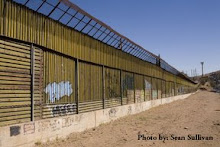
Border wall on the beach between San Diego and Tijuana.

In 2004 the California Coastal Commission determined that border walls south of San Diego would have a devastating impact on the Tijuana Estuary, in violation of the Coastal Zone Management Act. Environmental groups, including the Sierra Club, sued to stop the Border Patrol’s plan to plug several canyons in order to create a level path for the border wall. The court found that the Border Patrol was in violation of federal environmental laws, and construction ground to a halt.

Rather than insist that Border Patrol obey our nation’s environmental laws, Congress passed the Real ID Act. Section 102 of the act was intended to overrule the objections of the California Coastal Commission and the Sierra Club by allowing the Secretary of Homeland Security to waive any law that border wall construction might otherwise violate. No one else, including the President, is granted this power. Former Homeland Secretary Chertoff used the Real ID Act five times, to set aside 36 federal laws and, “all federal, state, or other laws, regulations and legal requirements of, deriving from, or related to the subject of” those laws. The waivers encompass the broad subjects of water, air, wildlife, and the environment, leaving few, if any, environmental laws in place.


Border wall through the Otay Mountain Wilderness Area.

A few miles east of the border wall’s start in the Pacific Ocean, the Otay Mountain Wilderness Area protects the last surviving stands of Tecate cypress, an ice age tree that survives by absorbing coastal moisture from the air. This tree in turn is the host plant for the rare Thorne’s hairstreak butterfly. When the Environmental Protection Agency (EPA) reviewed the plan to build border walls through the Otay Mountain Wilderness Area, they expressed concern that filling in canyons and waterways that feed the Tijuana River would violate the Clean Water Act. The Department of the Interior (DOI) warned that 6 endangered species would also be harmed by the wall.

San Diego Sector Border Patrol spokesman Richard Kite said of the Wilderness Area, "At the mountain range, you simply don't need a fence. It's such harsh terrain it's difficult to walk, let alone drive. There's no reason to disrupt the land when the land itself is a physical barrier."

By 2008, this logic no longer held sway at DHS and, ignoring the concerns of the EPA and DOI, the Department of Homeland Security (DHS) decided to “disrupt the land” of the Otay Mountain Wilderness Area with a border wall and a patrol road. The rugged terrain necessitated the blasting of 530,000 cubic yards of rock and extensive grading and leveling. Border wall construction caused tremendous erosion, and involved cutting down more than 100 Tecate cypress trees.

Because dynamiting mountains is clearly incompatible with a wilderness designation, Secretary Chertoff used the Real ID Act to waive the Otay Mountain Wilderness Act. He also swept aside the Clean Water Act and the Endangered Species Act. The Otay Mountain Wilderness Area now suffers from a barren scar and erosion that will bleed sediment into the Tijuana River for years to come.

Border wall through the Otay Mountain Wilderness Area.

Further east, Arizona’s San Pedro River is one of the last undammed, free-flowing rivers in the American Southwest. It anchors one of the most biologically diverse areas in the United States, at the convergence of four major ecosystems: the Sierra Madre and Rocky Mountains, and the Sonoran and Chihuahan Deserts. The San Pedro Riparian National Conservation Area was designated by the National Audubon Society as its first Globally Important Bird Area, and by the United Nations World Heritage Program as a World Heritage Natural Area.

When the DHS announced that it would put a wall across the San Pedro, the Sierra Club and Defenders of Wildlife sued. A federal court agreed that the federal government’s failure to fully assess the environmental impacts of the border wall violated the National Environmental Policy Act (NEPA), and ordered a temporary halt to construction. Rather than comply with NEPA, former DHS Secretary Chertoff used the Real ID Act to waive it. Border walls built in the San Pedro watershed are now causing erosion and damming that will permanently alter the riparian habitat.

The border wall’s impact on the flow of water in desert ecosystems was made clear in 2008, when the Organ Pipe Cactus National Monument received seasonal monsoon rains that resulted in the flooding of a number of washes that were blocked by the border wall. Grates built into the base of the wall to allow for the passage of water quickly choked with debris and sediment. The wall then acted as a dam, with water up to seven feet deep piling up behind it. Floodwaters then travelled laterally along the wall until they found an outlet at the Sonoyta port of entry, causing millions of dollars of damage to private businesses and government buildings there.

The border walls and patrol roads that slice through hundreds of miles of public and protected lands also fragment the habitats of a number of endangered species, including the Sonoran pronghorn, cactus ferruginous pygmy owl, and desert tortoise. Cut off from their usual range, populations may not have access to mates in other groups, a necessity for a genetically diverse, healthy population. Border walls also separate animals from food and water sources, leaving them especially vulnerable in times of drought. With the endangered species act waived, these threats to species’ survival have been largely ignored.

A mountain lion runs alongside the border wall.

The lands of the Tohono O'odham, whose name means “the desert people,” were once vast, extending from what is now Central Arizona down into Sonora, Mexico, and from the Gulf of California east to the San Pedro River. The international border splits their land, and the erection of the border wall has restricted their ability to visit family and sacred sites and to collect traditional foods and other materials.

Border wall construction has also unearthed Tohono O’odham graves. When the Secretary of Homeland Security waived Native American Grave Protection and Repatriation Act, the regulations that ensured respect for the Tohono O’odham’s ancestral remains and culture no longer applied to border wall construction.

Speaking before a U.S. House of Representatives hearing on the border wall, Tohono O’odham Chairman Ned Norris Jr. said, “… fragments of human remains were observed in the tire tracks of heavy construction equipment. Imagine a bulldozer parking in your family graveyard, turning up bones. This is our reality.”

DHS claims that border walls are actually good for the environment because border crossers leave litter, make foot paths, and, in the states that do not have a river for a border, drive off road vehicles through sensitive habitat. This assertion is based on a pair of false premises. The first is that border walls stop crossers. They do not. The Congressional Research Service found that border walls have “no discernible impact” on the number of undocumented immigrants who enter the United States each year. Instead, walls redirect many of those who seek to enter on foot, “funneling” them into more remote areas. This often means that their environmental impacts are concentrated in fragile desert ecosystems, rather than closer to walled off border towns. “Funneling” has contributed to the deaths of more than 5,600 crossers in the harsh Arizona desert.

The second false premise is that border walls and patrol roads are less damaging to ecosystems than border crossers. The border wall’s destructive impact is made obvious by the Department of Homeland Security’s need to “waive in their entirety” our nation’s most important environmental laws. The only reason for DHS to waive laws is that border walls violate them. Litter and migrant trails can be a problem for wildlife, but the blasting, bulldozing, habitat fragmentation, and large-scale erosion caused by border walls and roads are worse by magnitudes of scale.

Ignoring the useless and destructive nature of border walls, political hopefuls from Alaska to Kansas, Utah to Rhode Island, called for more walls in the run up to the mid-term elections. This is not just empty rhetoric that can be ignored. A number of amendments requiring the erection of hundreds of miles of new wall were introduced in the last Congress, and one, authored by Jim DeMint of South Carolina, passed in the Senate before being stripped in a House/Senate conference committee.

Representative Ciro Rodriguez, whose district already has border walls, blocked DeMint’s amendment. Rep. Rodriguez lost his reelection bid, and the U.S. House lurched to the right. Key committees that oversee immigration and homeland security will soon be chaired by Representatives who have long advocated further militarizing the border. DeMint and others will likely redouble their efforts to build more border walls, and their legislation will stand a much better chance of making it onto the President’s desk.

Instead of building more border walls, Congress should focus on mitigating the damage that has already been inflicted. It is also critically important that Congress repeal the Real ID Act’s waiver provision. The Real ID Act is not only a threat to border ecosystems should Congress require more walls, it also establishes the precedent that bedrock environmental laws such as the Endangered Species Act and Clean Water Act can be swept aside when obeying them would be inconvenient. For these reasons the Sierra Club and other environmental organizations oppose further border wall construction, and call upon Congress to repeal of section 102 of the Real ID Act.


This originally appeared in the Desert Report, a quarterly publication of the Sierra Club's California / Nevada Desert Committee: http://www.desertreport.org/wp-content/uploads/2010/12/DR_Winter2010.pdf

Thursday, August 5, 2010

Destroying the Borderlands to Secure the Border

By Scott Nicol


In the 1990’s politicians trying to explain away all of America’s ills, without blaming American voters or accepting their own fair share of blame, turned their attention towards the southern border. The ebb and flow of migrants across the border, which had been occurring since the Treaty of Guadalupe Hidalgo established it at its present location, was recast as an invasion. The invaders (who were, conveniently, ineligible to vote) were blamed for rising crime and failing schools, unemployment and overstretched social services. Clearly, the invasion must be stopped before the nation was overwhelmed.

Time to call in the troops and wall off the border.

The first 14 miles of border wall, extending from the Pacific Ocean inland, were built of rusting steel helicopter landing mats left over from the Vietnam War crudely welded together. A second layer, 15-feet tall and made of steel mesh, was later added north of the first wall. In the no-man’s-land between these two walls was a graded road for Border Patrol vehicles, with towers for surveillance cameras and stadium lights.


The landing mat border wall entering the ocean between San Diego and Tijuana.


In 2004 the California Coastal Commission and environmental groups, including the Sierra Club, sued to stop the Border Patrol’s plan to plug several canyons in order to create a level path for the border wall. The court found that the Border Patrol was in violation of federal environmental laws and that such a fill project would have a devastating impact on the Tijuana Estuary. The judge ordered that construction be halted.

In order to override the court’s decision, a provision was inserted into the Real ID Act of 2005 giving the unprecedented power to the US Attorney General (later transferred to the Secretary of Homeland Security) to waive all federal, state, and local laws, environmental and otherwise, to build border walls. Former Secretary of Homeland Security Michael Chertoff used the Real ID Act to brush aside the laws that had stopped the border wall, and resumed construction. In waiving those laws he was admitting that border wall construction would violate them.

A few hundred feet from the border wall’s starting point in the Pacific, the Tijuana River Estuary spills into the sea. It is the largest of Southern California’s remaining salt marshes, where over 90% of wetland habitat has been lost to development. The combined Tijuana River Slough National Wildlife Refuge, Tijuana River National Estuarine Research Reserve and Border Field State Park protect sand dunes and beaches, vernal pools, tidal channels, mudflats and coastal sage scrub. During the wet winter season, water drains into the marsh from the Tijuana River and surrounding creeks and canyons, infusing the marsh with fresh water and creating a delicate balance on which its many highly sensitive habitats depend. The site is a key stopover point on the Pacific Flyway, and provides over 370 species of migratory and native birds, including six endangered species, with essential breeding, feeding and nesting grounds.


Smuggler's Gulch filled in to make way for the border wall.


Following the passage of the Real ID Act the canyon known as Smuggler’s Gulch, south of San Diego, was filled in with over 2 million cubic yards of earth that had been ripped from adjacent mountaintops. A border wall was then perched on top. With no regulations in place and no oversight by other agencies, the Department of Homeland Security (DHS) put little effort into erosion control, and the still bare slopes of the earthen dam threaten to wash tremendous amounts of dirt into the Tijuana River National Estuarine Research Reserve, which is only 600 feet away. In addition to smothering vegetation, burying the estuary in sediment may raise its surface level enough to disrupt the twice-daily inundation of sea water upon which its fragile ecosystem depends.

A few miles up the Tijuana River, the Otay Mountain region is home to the last surviving stands of Tecate cypress, an ice age tree that survives by absorbing coastal moisture from the air. This tree in turn is the host plant for the rare Thorne’s hairstreak butterfly. In an attempt to protect these and other rare and endangered species that inhabit this unique ecosystem, 18,500 acres of the Otay Mountain region were designated a National Wilderness Area.


Border wall in the Otay Mountain Wilderness Area, California

When the Environmental Protection Agency reviewed the plan to build this section of border wall, they expressed concern that plans to fill in canyons and waterways that feed into the Tijuana River would violate the Clean Water Act. The Department of the Interior warned that 6 endangered species would also be harmed by the wall.

San Diego Sector Border Patrol spokesman Richard Kite said in 2006, "At the mountain range, you simply don't need a fence. It's such harsh terrain it's difficult to walk, let alone drive. There's no reason to disrupt the land when the land itself is a physical barrier."

Ignoring his observation, DHS decided to “disrupt the land” of the Otay Mountain Wilderness Area with a border wall and an access road. The rugged terrain of the Wilderness Area necessitated the blasting and removal of 530,000 cubic yards of rock and extensive grading and leveling. The Otay Mountain Wilderness Area is so steep that the goal of blasting was to achieve an elevation grade of 15%, even though the Secure Fence Act states that if the elevation grade of an area exceeds 10% walls do not need to be constructed there. Border wall construction caused tremendous erosion, and involved cutting down more than 100 Tecate cypress trees.

Because this is clearly incompatible with a wilderness designation, the goal of which was to limit human activity and protect fragile ecosystems, the Otay Mountain Wilderness Act was among the 36 laws that former Homeland Security Secretary Chertoff suspended using the Real ID Act. He also swept aside the Clean Water Act and the Endangered Species Act, rather than listen to the concerns of the Environmental Protection Agency and the Department of the Interior. With the wilderness no longer protected by law, DHS blasted through it and built the border wall. The Otay Mountain Wilderness Area now suffers from a barren scar and erosion that will bleed sediment into the Tijuana River for years to come.

Unchecked by environmental protections, the walls that began in California’s borderlands now extend over 600 miles, inflicting tremendous damage upon many sensitive ecosystems. In Arizona the border walls that cross washes and streams in the Organ Pipe Cactus National Monument have caused severe erosion and flooding. Border walls built in New Mexico’s Playas Valley block the movement of one of the last wild herds of bison, whose range straddles the U.S. – Mexico border. In Texas the walls that slice through the Lower Rio Grande Valley National Wildlife Refuge have fragmented habitat that is critical for the survival of endangered ocelots.


Border wall in the Lower Rio Grande Valley National Wildlife Refuge in Texas.


Environmental organizations, including the Sierra Club, Defenders of Wildlife, and many others, have attempted to protect fragile border ecosystems from DHS’ lawless actions. They have challenged the constitutionality for the Real ID Act’s waiver provision in court, and have worked to educate Congress and the public about the wall’s environmental impacts. The Sierra Club has also produced a short documentary, Wild vs. Wall, that gives an overview of the border wall’s environmental impacts from the Pacific to the Gulf of Mexico.

Even the Department of Homeland Security admits that border walls have negative impacts on border ecosystems, though they consistently underestimate the extent of the damage. In Environmental Stewardship Plans prepared ahead of construction, DHS identified the purchase of equivalent replacement lands as the most practical way to make up for the many thousands of acres of land that walls would tear through. Setting aside the question of where one would find replacement land comparable to a mountainous wilderness area, Congress allocated some of the necessary funds in 2008 and 2009. The Department of Homeland Security has yet to provide the Department of the Interior with those funds, and not a single acre of replacement land has been bought.

The Department of Homeland Security’s dismissive attitude towards environmental laws and border ecosystems is a direct reflection of that of some politicians, who whip up hysteria about “broken borders” and are openly hostile towards environmental protections. Chief among them has been Utah Representative Rob Bishop, who has repeatedly called the idea that DHS should pay to fix some small portion of the damage that it has done “extortion”, and has worked to keep mitigation funds from reaching the Department of the Interior.

Bishop recently said, "If wilderness designation gets in the way of a secure southern border, I want the designation changed. If it means you lose a couple of acres of wilderness, I don't think God will blame us at the judgment bar for doing that."

In 1968 an unnamed Army major justified the bombing of the Vietnamese provincial capital of Ben Tre by stating coldly, “It became necessary to destroy the town to save it.” The same Orwellian logic seems to animate Representative Bishop, and some of his colleagues, when they look at the U.S.-Mexico border. Blinded by the myth that the border is a war zone, they ignore inconvenient facts like the low crime rates in the border cities of San Diego, El Paso, and Brownsville, and call for a scorched earth campaign to stop the imagined invasion. They fail to see the hypocrisy in setting aside all of our nation’s laws to stop those whom they call “illegals”. They are destroying the borderlands to “secure” the border.

The Sierra Club documentary Wild vs. Wall can be viewed at sierraclub.org/borderlands .

Monday, January 25, 2010

The Border Wall's Ongoing Environmental Toll

By Scott Nicol

In 1996 the United States Congress called for the construction of “triple layered fencing” along the U.S.-Mexico border, beginning in the Pacific Ocean and extending 14 miles into California. This was to consist of parallel 10 to 15 foot high steel walls, with 50 feet of land in between graded and cleared of all vegetation, and the entire expanse lit by stadium floodlights. The Border Patrol also proposed filling in canyons and scalping mountains to give the new walls and road a level path. The California Coastal Commission determined in 2004 that these initial border walls would violate the Coastal Zone Management Act. Of particular concern was the damage that walls would do to the Tijuana River National Estuarine Research Reserve, the largest of the remaining California salt marshes, which harbors many endangered plant and animal species. The Sierra Club, Audubon Society, and other environmental groups also challenged the border wall in court. Construction came to a halt.

Congress responded by passing the Real ID Act of 2005, which gave the Secretary of Homeland Security the power to waive all laws that might slow construction of border walls, and also curtailed normal judicial review. President Bush’s Secretary of Homeland Security, Michael Chertoff, used this unprecedented power to “waive in their entirety” the Coastal Zone Management Act, the National Environmental Policy Act, the Endangered Species Act, the Migratory Bird Treaty Act, the Clean Water Act, the Clean Air Act, and the National Historic Preservation Act in order to resume border wall construction. The challenges brought by the California Coastal Commission and environmental organizations were thrown out when the laws that they were based upon were waived.

When Congress passed the Secure Fence Act in 2006, the power to waive laws granted by the Real ID Act carried over to all of the walls that the new law mandated. The Secure Fence Act called for over 700 hundred miles of new border wall extending from California into Arizona, New Mexico, and Texas, stopping just short of the Gulf of Mexico. Its path takes it through some of our nation’s most fragile and biologically diverse protected lands. Over the years former Homeland Secretary Chertoff issued 5 separate waivers under Real ID, setting aside 36 federal laws and, “all federal, state, or other laws, regulations and legal requirements of, deriving from, or related to the subject of” those named laws. The waivers encompass the broad subjects of water, air, wildlife, and the environment, leaving few, if any, federal, state, or other environmental laws in place. In addition to brushing aside environmental protections, laws relating to farmland, archaeological and historic sites, religious freedoms, and Native American graves were also suspended.


Construction of the massive earthen berm to fill in Smuggler’s Gulch. Border Patrol photo.

With no need to obey environmental laws, the Department of Homeland Security (DHS) filled in the canyon known as Smuggler’s Gulch, south of San Diego, with over 2 million cubic yards of earth that had been ripped from adjacent mountaintops, and planted the border wall on top of the berm. With no regulations in place and no oversight by other agencies, DHS put little effort into erosion control, and the still bare slopes of the earthen dam threaten to wash tremendous amounts of dirt into the Tijuana River National Estuarine Research Reserve, which is only 600 feet away. Burying the estuary in sediment may raise its surface level enough to disrupt the twice-daily inundation of sea water upon which its fragile ecosystem depends.

To the east of Smuggler’s Gulch, in the rugged Otay Mountain Wilderness Area, DHS has blasted mountainsides in order to create access roads and level ground upon which to build the border wall. Before construction began the Environmental Protection Agency raised concerns that the dumping of tons of rubble, and the erosion that would follow, would clog the Tijuana River and violate the Clean Water Act. The Otay Mountain Wilderness Area was established in part to preserve some of the last stands of rare tecate cypress trees, the host plant for the even rarer Thorne’s hairstreak butterfly, which are found nowhere else in the United States. But with the Real ID Act’s waiver authority in hand, DHS has ignored the EPA’s concerns and our nation’s environmental laws, including the Otay Mountain Wilderness Act and the Clean Water Act. Border wall construction caused tremendous erosion, as predicted, and also involved cutting down more than 100 tecate cypress trees.

In July of 2008 the Organ Pipe Cactus National Monument received seasonal monsoon rains which resulted in the flooding of a number of washes that are bisected by the border wall. Storms of this type normally occur every 3 – 5 years in this part of the Sonoran desert. The Army Corps of Engineers had previously stated that the border walls built across washes would "not impede the natural flow of water.” In stark contrast to these claims, the National Park Service determined that the grates built into the base of the wall to allow for the passage of water were quickly choked with debris and sediment. The border wall then acted as a dam, with floodwaters up to seven feet deep piling up behind it. The floodwaters then followed the wall in search of an outlet, which they found at the Sonoyta port of entry, causing millions of dollars of damage to private businesses and government buildings.


Flood debris backed up by the border wall in Organ Pipe Cactus National Monument. National Park Service photo.

The U.S.-Mexico border consists of hundreds of miles of public and protected lands, which is habitat for scores of species. The border wall and patrol road slicing through these areas fragments the habitats of the animals that live here. Cut off from their usual range, populations may not have access to mates in other groups, a necessity for a genetically diverse, healthy population. Border walls also block animals from food and water sources, which leaves them especially vulnerable in times of drought. As the border wall funnels migrants into rugged, remote terrain and Border Patrol vehicles pursue them, they damage fragile ecosystems and disturb sensitive wildlife, like the bighorn sheep and the desert tortoise, both of which are endangered.

Endangered jaguars, which were almost entirely extirpated in the United States, have been photographed and even captured in Southern Arizona and New Mexico in recent years. In 1997, the jaguar was placed on the endangered species list in hopes of reviving U.S. populations. While their former range extends into all four southern border states, the individual animals which have been seen in Arizona likely came into the U.S. from Mexico, where larger populations live. With routes from Mexico almost completely sealed off by the border wall, establishing a healthy breeding population of jaguar in the U.S. may no longer be possible.

South Texas is home to ocelots and jaguarundi, both of which are listed under the Endangered Species Act. Agricultural and urban development have stripped these animals of 95% of their original habitat. Because so few of each species are left in the U.S., they need access to mates in Mexico to avoid inbreeding. The Lower Rio Grande Valley National Wildlife Refuge was created to provide them with sufficient habitat to survive, as well as offer a potential route to Mexico. Over the past 20 years, more than 90 million tax dollars and thousands of volunteer hours were spent piecing together and revegetating tracts of land along the Rio Grande in order to create this wildlife corridor. The border walls in South Texas now divide some of these refuge tracts, and cut others off from the Rio Grande and from Mexico. With the Endangered Species Act waived, the Department of Homeland Security has largely ignored the way that border walls fragment the ocelot and jaguarundi’s remaining habitat and seriously diminish hope for their recovery, or even survival.


Levee-border wall through the Lower Rio Grande Valley National Wildlife Refuge in Texas. Photo by Scott Nicol.

Before former Secretary Chertoff’s last Real ID Act waivers in April 2008, DHS prepared draft environmental impact statements and draft environmental assessments for the various sections of border wall, as mandated by the National Environmental Policy Act. In reviewing the draft environmental impact statement for the Rio Grande Valley, the Environmental Protection Agency found it to be “insufficient,” and recommended that DHS start the process over. The EPA reached the same conclusion, and made the same recommendation, when it reviewed the draft environmental impact statements and draft environmental assessments that DHS prepared for each the other border wall sections.

Following the waivers, which allowed DHS to disregard the National Environmental Policy Act, the agency abruptly ended the environmental assessment and environmental impact statement processes. Instead, they created a brand new category, the “environmental stewardship plan,” which was not governed by any federal legislation. These new reports recycle the bulk of the prior, “insufficient” reports, in many cases word-for-word, but have no established criteria or requirement for review from the EPA or the public. While they do include recommendations to minimize the wall’s environmental impact, most of which appeared in the earlier “insufficient” reports, there is no requirement that these be adhered to. In the instance of Smuggler’s Gulch, for example, revegetation and erosion control measures called for in DHS’ own report were not implemented.

One of DHS’ most absurd claims for the border wall is that it will actually be good for the environment because border crossers leave litter, make foot paths, and, in the states that do not have a river for a border, drive off road vehicles through sensitive habitat. This ignores the difference in scale between a dirt path that winds through the brush and an area 150 feet wide cleared of all vegetation, and 10 – 15 foot tall steel and concrete walls. The border wall’s destructive impact is made obvious by the Department of Homeland Security’s need to “waive in their entirety” our nation’s most important environmental laws. The only reason for DHS to waive laws is the knowledge that the border wall violates them. Litter can be a problem for wildlife, but the blasting, bulldozing, fragmentation, and large-scale erosion caused by border wall and Border Patrol road construction are much worse. Animals can sidestep discarded water bottles, but when their habitat is cleared of vegetation, flooded, or silted up, and blocked by an impermeable wall, they cannot survive.

Sunday, September 20, 2009

Environmental Organizations Call Upon Congress to Strip Border Walls from the DHS Appropriations Bill

The following letter, signed by 18 environmental organizations including the Sierra Club, Defenders of Wildlife, and Audubon, was sent to members of the House / Senate conference committee that will be debating the DHS appropriations bill. Currently, the Senate version of the bill contains an amendment requiring hundreds of miles of new border wall. The House version does not require more walls.


Dear Conferees,

On behalf of our millions of members and supporters across the entire country, the undersigned organizations are writing to ask that you remove Sen. DeMint’s amendment #1399 from the Homeland Security Appropriations Act and continue to support efforts to monitor and mitigate negative impacts of border wall construction.

Senate amendment #1399 is the latest attempt to extend the failed policy of building more border walls along our southwest border. In addition to negatively impacting the wildlife and natural resources of the borderlands, the provision would come at great expense to our nation’s border security programs and the American taxpayer. While tying the hands of border security experts by requiring an arbitrary number of miles of wall construction, this language would drain funding from other border security programs in order to cover the growing cost of border wall construction. Taxpayers have paid approximately $2.4 billion for border wall construction to date, and according to the Government Accountability Office, one mile of border wall now costs nearly $8 million.

Nearly one-third of the 1,950 mile U.S.-Mexico border lies within military, tribal, and public lands, including Wilderness areas, National Wildlife Refuges, National Forests, National Monuments, State Parks and hundreds of miles within the National Park system. Much of this country’s most spectacular and imperiled wildlife, including two of America’s most endangered big cats, jaguars and ocelot, bighorn sheep, Sonoran pronghorn, and bison, depend upon protected public lands along the border for intact habitat and survival.

Numerous studies have highlighted the damage that border infrastructure has caused to the borderlands’ ecology and wildlife. The National Park Service issued a report in August, 2008 confirming that the border wall along the Lukeville Port of Entry has exacerbated seasonal flooding and has caused accelerated scouring and erosion on the Organ Pipe Cactus National Monument. A recent study in Conservation Biology showed that the border wall fractures the habitat connectivity that wildlife like the pygmy owl and bighorn sheep need for survival. As climate change shifts habitats and alters migration routes, establishing wildlife corridors and protecting habitat connectivity becomes even more critical.

The damage that border walls have caused to the unique natural values of the borderlands has been exacerbated by the Secretary of Homeland Security’s authority to waive any applicable laws to expedite border wall construction. This unprecedented authority has prompted the waiving of 37 environmental, historic preservation, tribal protection and other federal laws along with related state and local laws across 563 miles of the border.

In order to help address the negative impacts of border walls that have already been constructed, the House Homeland Security Appropriations bill included $40 million for border monitoring and mitigation. We strongly support keeping this language in the final bill and believe that its inclusion would mark one more step towards repairing the damage done to communities and natural resources along the border.

Again, we support the House version of the Homeland Security Appropriations Act, and as you move to conference we specifically ask that you remove Senate amendment #1399 from the final bill and continue to advance border monitoring and mitigation efforts.

Sincerely,

The Arizona Zoological Society
Center for Biological Diversity
Defenders of Wildlife
Earthjustice
Frontera Audubon
International League of Conservation Photographers
League of Conservation Voters
National Audubon Society
National Wildlife Federation
Natural Resources Defense Council
Rio Grande International Study Center
Sierra Club
Southwest Environmental Center
Valley Nature Center
Western Lands Project
The Wilderness Society
Wildlands CPR
Wildlands Network

Thursday, September 17, 2009

No Border Wall Calls on Congress to Strip the DeMint Border Wall Mandate from the DHS Appropriations Bill

The No Border Wall Coalition sent the following letter to the members of the House / Senate conference committee that will be deciding on the final language of the Department of Homeland Security appropriations bill. While the House version does not include more border walls, the Seante's version includes the DeMint amendment, calling for 700 miles of pedestrian walls. After the letter was sent a new report from the Government Accountability Office on the Secure Border Initiative, which includes border walls, was released. It found,

"A life cycle cost study has been completed which estimates deployment, operations, and future maintenance for the tactical infrastructure will total $6.5 billion. Despite the investment in tactical infrastructure, its impact on securing the border has not been measured because DHS has not assessed the impact of the tactical infrastructure on gains or losses in the level of effective control."

The life cycle cost estimate is on top of construction costs, and does not include the cost of the construction called for by the DeMint amendment.

Here is the text of our letter to the committee members, explaining our opposition to the construction of more border walls:

The No Border Wall Coalition urges you to remove the DeMint amendment (1399), which calls for hundreds of miles of new border wall, from the Department of Homeland Security appropriations bill. Further border wall construction will do tremendous damage to private and municipal property, severely impact critical wildlife habitat, and cost our nation billions of dollars. But like the walls that have already been built, the new border walls will have no impact on immigration.

The DeMint amendment changes the Secure Fence Act to require 700 miles of “pedestrian” border walls; vehicle barriers built along the border could no longer be applied to the mile count. As of July, DHS has completed 331 miles of “pedestrian fencing” and 302 miles of vehicle barriers. If DeMint’s amendment is accepted by the House/Senate Conference Committee and is signed into law, the border wall will suddenly be 369 miles short of its new mandate.

To build border walls the federal government has initiated condemnation suits against more than 400 landowners, of which 255 are still unresolved. Landowners and local elected officials have been denied basic information, including how they will access properties and water intake pumps that are walled off. If the DeMint amendment is not removed, hundreds more farmers, ranchers, nature preserves, and municipalities will be hauled into federal court to have their lands taken from them.

Border walls currently slice through National Monuments, National Wildlife Refuges, and preserves owned by the Nature Conservancy and Audubon. Habitats that are critical for the survival of federally endangered ocelots and Sonoran pronghorn have been fragmented, cutting animals off from the resources that they need to survive. Blocked watersheds have led to flood damage in Organ Pipe Cactus National Monument, and ongoing blasting in the Otay Mountain Wilderness Area is filling the Tijuana River with boulders and debris. If more border walls are built, more border ecosystems will be degraded or destroyed.

To date, $3.1 billion has been spent on border wall construction. Last year the Army Corps of Engineers reported that the average cost of building walls had increased to $7.5 million per mile. Some sections of border wall are particularly expensive: walls in South Texas averaged $12 million per mile; in California, a 3.5 mile section that involved filling in canyons cost taxpayers $57 million.

If the DeMint amendment remains in the DHS appropriations bill, we will spend no less than (and quite possibly a lot more than) $2,767,500,000.00 to build 369 miles of new border walls.

Border walls have utterly failed to stop either immigrants or smugglers from entering the United States. The majority enter through ports of entry, so walls erected between the ports have no effect on them. And according to the Border Patrol, even those who find the wall directly in their path are only slowed down by around 5 minutes.

Professor Wayne Cornelius of the University of California at San Diego has spent more than a decade researching undocumented immigration. His work has revealed that, even with border walls,

“all but a tiny minority eventually get through – between 92 and 98 percent, depending on the community of origin. … [T]he eventual success rate is virtually the same for migrants whose most recent crossing occurred before 1995, when the border was largely unfortified, and those crossing in the most recent period. In other words, the border enforcement build-up seems to have made no appreciable difference in terms of migrants’ ability to enter the United States clandestinely.”

The Department of Homeland Security recognizes this fact. After DeMint’s amendment was adopted, DHS spokesman Matt Chandler told the Wall Street Journal that it is, “designed to prevent real progress on immigration enforcement and [is] a reflection of the old administration's strategy: all show, no substance."

Rather than spend billions more on walls that will do tremendous damage to border communities and ecosystems, and which the Department of Homeland Security says will not help them to do their job, the membership of the No Border Wall Coalition urges you to adopt the House version of the DHS appropriations bill. For many of us, the border is our home, and as walls have been erected our needs, concerns, and voices have been ignored. We ask that you listen to us now. Strip the DeMint amendment from the bill, and refrain from building more border walls.

Friday, January 9, 2009

A Border Wall in the Otay Mountain Wilderness Area Will Be an Environmental Disaster

Four prominent national environmental organizations - the Sierra Club, Defenders of Wildlife, Wilderness Society, and Wildlands Network - issued the following press release in response to recently announced plans to punch the border wall and its associated roads through the Otay Mountain Wilderness Area. The Secure Fence Act itself states that if the elevation grade of an area exceeds 10%, walls do not need to be constructed there. Otay Mountain is so steep and rugged that the goal of blasting is to achieve an elevation grade of 15%, greater than the 10% limit in the Secure Fence Act. When the Environmental Protection Agency reviewed the plan to build this section of border wall, they expressed concern that plans to fill in canyons and waterways that feed into the Tijuana River would violate the Clean Water Act. The Department of the Interior expressed concern for 6 endangered species that would be impacted by the wall. Secretary Chertoff's response was to waive the Clean Water Act, Endangered Species Act, National Environmental Policy Act, the Otay Mountain Wildeerness Act, and 32 other federal laws, and now their contractor, Sukut, is quite literally breaking ground.


Conservation Groups call for Halt to
Road-Building in Borderlands Wilderness Area

Project is first use of Real ID Act waiver allowing
construction in designated wilderness

Otay Mesa, CA –With little advance notice, the Department of Homeland Security (DHS) has begun bulldozing a road inside a federally-designated wilderness area on the U.S.-Mexico border. Apparently not wishing to attract national attention to the controversial project, DHS made the construction start-up announcement through its contractor on Christmas Eve. According to DHS, the road-building project is necessary to build a border wall within and immediately to the south of the 18,500-acre Otay Mountain Wilderness Area on the U.S.-Mexico border east of San Diego.

The rugged terrain of the wilderness area will require blasting and removal of 530,000 cubic yards of rock, and extensive grading and leveling in order to build the wall and the accompanying road, says Sukut Construction, the contractor doing the work. Plans for the project note that much of the five-mile patrol road and approximately 1,300 feet of the primary pedestrian fence would extend into the Otay Mountain Wilderness.

Because motorized equipment, new roads and permanent human structures are not permitted within a federally-designated wilderness area, the Wilderness Act was among the 36 laws waived by Homeland Security Secretary Chertoff in April 2008 in order to expedite border wall construction. The controversial waiver was authorized under the Real ID Act, which allows the Secretary to exempt DHS from any and all laws that might interfere with construction of the border wall and associated access roads.

“Wilderness areas are designated by Congress specifically to protect sensitive places from projects like this road construction,” said Carl Pope, Executive Director of the Sierra Club. “This road sets terrible precedent and clearly demonstrates the dangers of granting the Secretary of Homeland Security authority to waive any law in order to build walls along our international borders.”

The project now moves forward despite DHS documentation that “Construction of the fence, staging areas, and patrol road…will result in a barrier to movement for large non-flying animals and general loss of wildlife habitat.” According to Matt Clark, Southwest representative for Defenders of Wildlife, “Such harmful impacts to wilderness characteristics and values are clearly inconsistent with the Congressional intent of the law that established the Otay Mountain Wilderness Area in 1999. The waiver and the wall are an affront to our nation’s laws and natural heritage.”

When Congress passed the Secure Fence Act (SFA) in 2006, mandating that 670 miles of border fence be constructed by the end of 2008, San Diego Sector Border Patrol spokesman, Richard Kite, said, "…at the (Otay) mountain range, you simply don't need a fence. It's such harsh terrain it's difficult to walk, let alone drive. There's no reason to disrupt the land when the land itself is a physical barrier." Kite’s experience and reasoning, along with the language of the SFA itself, which does not require walls on slopes with more than a 10% grade (such as most of those in the project area), has apparently been ignored by DHS as it now attempts to speed up border wall construction.

“The frantic pace of wall building along the U.S.-Mexico border completely ignores the project’s serious environmental consequences to wildlife, wildlands and the general ecology of the borderlands region,” says Kim Vacariu, Western Director for the Wildlands Network, a conservation group working to protect cross-border wildlife corridors. “The waiving of the bedrock environmental laws that protect our nation’s natural resources is unconscionable. Construction in the Otay Mountain Wilderness should cease pending immediate and thorough environmental review,” he notes.

William H. Meadows, president of The Wilderness Society, agreed. “We are very concerned about the impacts this wall will cause to wilderness values at Otay,” Meadows said. “Wilderness areas are among the last places in the United States that are untrammeled by humans, and we believe they should stay that way.”


Contacts: Kim Vacariu, Wildlands Network 575-557-0155
Matt Clark, Defenders of Wildlife 520-623-9653
Oliver Bernstein, Sierra Club 512-477-2152
Paul Spitler, The Wilderness Society 202-429-2672