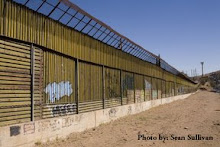
US Representative Raul Grijalva has introduced legislation which would reverse some of the worst abuses of the Department of Homeland Security's implementation of the Secure Fence Act and the Real ID Act. Below is the press release issued by his office.
Washington, D.C. – Today, Congressman Raúl M. Grijalva introduced legislation that will help secure and conserve public and tribal lands along the international land borders of the United States.
The Border Security and Responsibility Act of 2009 will secure and conserve federal public lands along the international land borders of the U.S. and provide the highest protection possible while ensuring that all operations necessary to achieve border security are undertaken.
The legislation will also help mitigate damage to federal and tribal lands from illegal border activity and border enforcement efforts by increasing coordination and planning between the Department of Homeland Security (DHS), federal land management agencies and local, state and tribal governments.
The legislation will also correct existing policies and allow flexibility for a local approach to border security, instead of mandating an unrealistic and harmful wall.
“Current policy has driven crossing activity to remote isolated areas along the border which, in Southern Arizona, represent significant public and tribal lands,” said Grijalva. “Many of these lands have suffered extensive environmental degradation as a result of unauthorized activity and border security efforts. This bill is the first step in preserving our unique natural heritage while we protect our borders.”
The Border Security and Responsibility Act of 2009 will:
1. Require the Department of Homeland Security to consult with federal land managers and state, local, and tribal governments in creating a Border Protection Strategy that supports border security efforts while also protecting federal and tribal lands.
2. Provide for flexibility, rather than a “one size fits all” approach, to border security by allowing experts at DHS to decide upon best strategies for border security.
3. Allow land managers, local officials, and local communities to have a say in border security decisions, requiring full public notice and participation.
4. Ensure that laws intended to protect air, water, wildlife, culture, and health and safety are fully upheld.
Under the Bush Administration, the passage and implementation of the Secure Fence Act and REAL ID ignored environmental, health and safety laws that had been in place for decades. The Border Security and Responsibility Act amends the current law, which pursues a “one fence fits all” solution. The legislation ensures that local experts are part of the planning and evaluation of security measures that would be more effective and have a lower impact on the border environment.
“This multi-disciplinary approach is the correct path for addressing a growing crisis in a rapidly changing geopolitical reality,” stated Grijalva. “The Border Security and Responsibility Act will strengthen border security, protect the environment and uphold the health of the border community by allowing all agencies to work together cooperatively.”
Thursday, April 23, 2009


Sunday, April 5, 2009
Secretary Napolitano Must End DHS’ Abuse of Texas Border Communities
By Stefanie Herweck
Over the past two years, the Department of Homeland Security (DHS) and the organizations that it manages, Customs and Border Protection (CBP) and the Border Patrol, have shown a deep-seated indifference to the welfare of those of us living on the Texas-Mexico border. These agencies have treated our elected leaders with disrespect, they have assumed an adversarial relationship with the public, and they have shown disdain for border communities, culture, and the environment. These actions have seriously undermined DHS’s credibility along the
The border wall is the clearest example of this. The border wall project has been propelled by a blind determination to build as many miles of wall as possible regardless of cost, safety, effectiveness, and environmental damage. It has been shrouded in secrecy, and DHS has purposely obfuscated time and time again, as though border residents have no right to know what is happening in their communities and even on their own property.

Levee-border wall in Hidalgo County, Texas February 22, 2009
In June 2007, they started with a lie to the Texas Border Coalition.
DHS lied again in order to comply with legislation that requires local consultation. When ask to submit proof of the “18 town hall meetings” that they claimed to have held, they listed random phone calls and lunch meetings with single individuals, but no actual town hall meetings.
Then, in the ultimate act of negligence, DHS decided that border residents should not be protected by the laws that govern the rest of the country, and Bush Administration Secretary Chertoff waived 36 federal laws in order to slam the border wall through the 
Border wall "pickets" in front of the wall in El Calaboz, Texas March 14, 2009
Yet another DHS policy revealed this same disregard for public safety. Shortly before hurricane season last year, the news broke that in the event of a hurricane making landfall in the
Worried that this policy would cause a bottleneck at the checkpoints and the unjustified arrests of citizens fleeing in haste without documents, border leaders and residents decried the practice. Advocates for colonias complained that it unfairly risked the safety of the poor, elderly, and those with limited English who would be afraid to evacuate. Since many people would be unwilling to leave their undocumented family members, this policy could mean many thousands of people left in the path of a deadly storm.
In the face of criticism that DHS was willing to put so many human lives in jeopardy, and the perception that they might even be taking advantage of a natural disaster to make more arrests, Secretary Chertoff downplayed the policy and said that the Border Patrol would not impede evacuations. However, when Hurricane Dolly bore down on the
Although there has been a change in administration, the agency is still primarily staffed by the same officials that crafted and implemented DHS's stance during the last administration. Among them is the CBP employee who in February gave the Brownsville City Commissioners an arbitrary deadline to accept a border wall deal. The deadline was later repudiated by Secretary Napolitano, who had not been informed of it, after U.S. Representative Ortiz intervened on
Under the Obama administration, DHS has also maintained its indifference toward the landowners whose properties are being directly affected by the construction of the border wall. Having long refused to provide landowners and their elected officials with a detailed border wall plans, they sabotaged yet another opportunity to explain where and how the wall will be built when they refused to “walk the line” with the Texas Border Coalition in February. DHS said that they were willing to visit a very few of the properties where the border wall would be built with TBC, but the property owners must be kept away.

Border wall behind a home in Cameron County, Texas March 14, 2009
In perhaps the ultimate act of disrespect to landowners, as well as evidence of sheer incompetence and unprofessionalism, last week brought news that DHS usurped one
Given this track record, it is no surprise that
This behavior reinforces the widespread notion in
Secretary Napolitano must begin immediately to mend the broken relationship between DHS and border residents. This will require an attitude shift across the entire agency: DHS must recognize that for millions of people, the borderlands are the homeland. Instead of viewing the border as the frontline in a war zone, Secretary Napolitano needs to instill in her agency the understanding that the people who live on the border are entitled to the same rights and privileges, and due the same protections, as those who live in any other part of the
Secretary Napolitano will have little success in reversing the Department’s abusive practices until she replaces the ideologues that her predecessor hired. Even as she speaks to Congress and in the press about bringing change to DHS, holdovers from the last administration tell Congress and the press that there will be no change. So long as they are willing to go so far as to issue ultimatums on behalf of the Department of Homeland Security without bothering to inform its new leadership, any positive changes that she wishes to make will dissipate before they make it from Washington, D.C. to border communities.
Tremendous damage to the Texas borderlands has already been done by former Secretary Chertoff, but in a few places it is not too late to stop border wall construction and thereby signal that change is real and profound, rather than just a campaign slogan. Where the wall has not yet been built because condemnation lawsuits are still in court, DHS should drop its court case and enter into meaningful negotiations.
Finally, if Secretary Napolitano truly sees the defense of our nation’s laws as a fundamental part of her new job she should rescind former Secretary Chertoff’s Real ID Act waivers and restore the rule of law to the
The new Administration has a tremendous opportunity to reverse the Bush administration’s abuses, and to begin to repair the damage that was done. But they must act immediately. Right now, landowners are facing condemnation proceedings. Right now, construction crews from South Texas to
Friday, April 3, 2009
Sabal Palms Audubon Sanctuary Will Close to the Public Thanks in part to the Border Wall
The Audubon Society issued the following press release today, announcing that thanks in part to the impending construction of the border wall they will be forced to curtail public access to the Sabal Palms Audubon Sanctuary. The Sanctuary is just downriver from Brownsville, Texas. The entire refuge lies between the Rio Grande and the flood control levee. DHS' current plan is to construct the border wall on the levee, completely cutting off the refuge. Because the wall is in front of the refuge, but does not touch it, Audubon has not been offered any compensation.
FOR IMMEDIATE RELEASE:
Audubon Texas will reduce hours of operation at the Sabal Palm Audubon Center and Sanctuary effective May 15, 2009. Combined impacts of the declining economy and continued uncertainty over the proposed border fence are forcing Audubon to curtail public programs and access at the center outside Brownsville, Texas, in order to continue its primary conservation mission there.
The sanctuary's original mission of preserving one of the nation's last oases of healthy sabal palm habitat had been augmented in recent years by nature education efforts that expanded its role to that of a community nature center. Regrettably, donors buffeted by the recession have significantly cut back support and there is uncertainty about the Homeland Security border fence that threatens to cut off the facility from the community, effectively decimating the sanctuary's operating budget.
"Funding must go first and foremost to maintaining the sanctuary and protecting the habitat, "said Audubon Texas Executive Director, Bob Benson. "Our first priority is to keep the habitat healthy for native wildlife and to ensure that its natural wonders remain intact for the inspiration, sustenance and education of future human generations.
Contact: Bob Benson, Executive Director, 512-469-7891 or bbenson@audubon.org
FOR IMMEDIATE RELEASE:
Audubon Texas will reduce hours of operation at the Sabal Palm Audubon Center and Sanctuary effective May 15, 2009. Combined impacts of the declining economy and continued uncertainty over the proposed border fence are forcing Audubon to curtail public programs and access at the center outside Brownsville, Texas, in order to continue its primary conservation mission there.
The sanctuary's original mission of preserving one of the nation's last oases of healthy sabal palm habitat had been augmented in recent years by nature education efforts that expanded its role to that of a community nature center. Regrettably, donors buffeted by the recession have significantly cut back support and there is uncertainty about the Homeland Security border fence that threatens to cut off the facility from the community, effectively decimating the sanctuary's operating budget.
"Funding must go first and foremost to maintaining the sanctuary and protecting the habitat, "said Audubon Texas Executive Director, Bob Benson. "Our first priority is to keep the habitat healthy for native wildlife and to ensure that its natural wonders remain intact for the inspiration, sustenance and education of future human generations.
The 557-acre property, owned by The National Audubon Society, is home to the last remaining largest stand of native sabal palms in the nation; and is among the most biologically diverse regions in the Lone Star state. Aside from being a birder's paradise, rare plants and animals are seen here in this unique sub-tropical habitat.
Audubon will focus its resources on protecting and managing the sanctuary through a new schedule that includes months with limited access to the public. The following schedule will be in effect until further notice:
May 15 – Oct. 15 CLOSED TO THE PUBLIC
Oct. 15 – Dec. 15 OPEN WEEKENDS ONLY (Saturday & Sunday)
Dec. 15 – May 15 OPEN Tues – Sunday, 9 a.m. to 5 p.m.
The sanctuary will still offer scheduled group tours for $10/person during the closed season; they can be arranged through the sanctuary manager. Individual admission during the open season will be $6.00 per person.
"It's unfortunate that we won't be able to maintain the current operation schedule," added Benson, "but Audubon will continue its vital work with the conservation community to protect the last vestiges of the sabal palm forest for future generations to enjoy. That's the mission that brought Audubon to the area, and it's a mission we will accomplish."
Contact: Bob Benson, Executive Director, 512-469-7891 or bbenson@audubon.
Thursday, March 19, 2009
Hidalgo County's Border Wall is Nothing to Brag About
By Scott Nicol
Last March, Hidalgo County Judge JD Salinas cut a deal with Department of Homeland Security Secretary Michael Chertoff to build part of the border wall. Rather than build the wall to the north of the levee, DHS would insert it into the levees in Hidalgo County. It was estimated that this would raise the per-mile cost from $3 million to $5 million, so the county agreed to pay $44 million. When the bids came in, the low bids were $12 million per mile. As a result of Judge Salinas' capitulation Hidalgo County's border walls are nearly finished, while neighboring Starr County's wall construction has not begun, and Cameron County's is just beginning. They still have the chance to fight to halt construction, while for Hidalgo County the fight moves from stopping the wall entirely to preventing pro-wall zealots from filling in the spaces between levee-walls.
Last March, Hidalgo County Judge JD Salinas cut a deal with Department of Homeland Security Secretary Michael Chertoff to build part of the border wall. Rather than build the wall to the north of the levee, DHS would insert it into the levees in Hidalgo County. It was estimated that this would raise the per-mile cost from $3 million to $5 million, so the county agreed to pay $44 million. When the bids came in, the low bids were $12 million per mile. As a result of Judge Salinas' capitulation Hidalgo County's border walls are nearly finished, while neighboring Starr County's wall construction has not begun, and Cameron County's is just beginning. They still have the chance to fight to halt construction, while for Hidalgo County the fight moves from stopping the wall entirely to preventing pro-wall zealots from filling in the spaces between levee-walls.

In his recent State of the County address, Judge JD Salinas made statements regarding the levee-border wall that were, to put it charitably, less than honest.
Judge Salinas said,
"The levee-barrier, which was the alternative reached by the Hidalgo County Drainage District and the U.S. Department of Homeland Security, is now 95 percent complete. This solution has saved residents and businesses from purchasing $150 million per year in mandatory flood insurance. It has prevented private land from being taken by the federal government, and the flood control structure is more environmentally-sensitive than the proposed border fence."
As to his first point regarding the money saved by residents who will not need to purchase flood insurance, the levee-border wall did not replace all of the levee sections in Hidalgo County that were deemed inadequate. In a number of instances, portions of our levees that were not in need of repair were ripped apart to insert border walls. Other sections that are still in bad shape were not touched by the levee-border wall scheme. This is because the locations of levee-border walls had nothing to do with
Luckily for 
As for the idea that the levee-border wall is better for the environment than Homeland Security’s original border wall designs, Judge Salinas knows full well that the opposite is true. Last March the US Fish and Wildlife Service (USFW) wrote a letter to the Department of Homeland Security in response to the plan to build levee-border walls in
“This combined project would eliminate wildlife passage by replacing CBP’s original “wildlife friendly” fence design with an impermeable 16 to 18 foot high wall built into a flood control levee. This new project design would effectively eliminate the wildlife passage component of the earlier design and would impair the ability of the wildlife corridor to fulfill its function. […] We would like to document that any proposed fence and/or levee segment that bisects lands within the Lower Rio Grande Valley National Wildlife Refuge cannot be found compatible with the purposes for which the Refuge was established.”
Today the levee-border walls in
In contrast to Judge Salinas’ claims of environmental benefit, former Secretary of Homeland Security Michael Chertoff knew that the levee-border wall would violate numerous environmental laws. Last April he used the Real ID Act to issue 2 waivers of federal laws, one of which was specifically for the

A visit to the
The

Tourists are also unlikely to visit a place that they think is a war zone. In the past few weeks the national press has been filled with sensationalistic headlines about the possibility that
The headlines screaming about “spillover” violence are already being used to call for a further militarization of the border. When the first walls built in
While on the surface his State of the County address is the run-of-the-mill self-congratulation that we expect from a politician, in fact his words have real consequences. Following his capitulation to former Secretary Chertoff, Judge Salinas went from being an opponent of the wall to the Department of Homeland Security’s poster boy. In press releases and Congressional testimony they use him to show that they are working with local stakeholders, rather than ignoring local concerns, condemning private and municipal property, and irreparably damaging border communities, economies, and ecosystems. Judge Salinas’ words provide DHS with cover as they continue to strong arm our next-door neighbors in
Of course it is naïve to expect a politician to own up to his mistakes, to admit to being suckered into a bad deal that has cost his constituents millions of dollars. It is unrealistic to expect a mea culpa from Judge Salinas. But if he truly cares about the residents of
Thursday, February 26, 2009
The Border Patrol Halts Communion at Friendship Park as Border Wall Construction Looms
By John Fanestil
On Saturday I was almost arrested for committing assault with a tortilla. Or was it my communion cup that Customs and Border Protection agents perceived to be a threat?

The setting was Friendship Park, a historic venue on the U.S.-Mexico border, overlooking the Pacific Ocean. For generations people from the two nations have met at this location to visit with friends and family through the border fence.
As part of its commitment to build 670 miles of double and triple barriers along the U.S.-Mexico border, the Department of Homeland Security is building a second wall across Friendship Park. On December 23, 2008, Customs and Border Protection declared the site a construction zone. On January 6, 2009 CBP released final design plans for the park and announced that these plans would eliminate permanently all public access to this unique site.
We, who are aficionados of the park, were stunned by the announcement. We knew DHS had decided to build a wall across the park, and we knew Customs and Border Protection agents had concerns about drug-smuggling and illegal border-crossings at the location. Still, we had assumed that the totality of law enforcement strategy for Friendship Park would not be predicated on the illegal conduct of a few. After all, drugs and criminal activity are problems in thousands of parks across the United States, and law enforcement agencies don’t respond by simply shutting them down.
We had assumed that some accommodation would be made for the vast majority of visitors to the park, who respect and honor the park’s intended purpose. Locals don’t call it “Friendship Park” for nothing, after all. Surely, we thought, there must be some room for friendship in the complex formula of U.S. border policy.

As the news of our government’s plans to close the park sunk in, we began to wonder when CBP would begin to enforce the ban on public access. The answer, it turns out, was this past Saturday, February 21. And I guess I have the ignominious distinction of being the first U.S. citizen to be forcibly prevented from approaching the border fence at Friendship Park.
For the past eight months I have gone to Friendship Park each Sunday afternoon and served communion to people on both sides of the border fence. I have done so out of solidarity with the many people who meet their loved ones there – and as a protest against DHS plans to decimate the park. People have been breaking bread at this location for a long, long time. It seemed to me only fitting that Friendship Park should host the sacrament of communion, too.
This past week, we moved our communion celebration to Saturday. The reason for this was something that any pastor can understand: we wanted to make the choir happy. A fabulous choir, composed of singers from both countries, wanted to perform at Friendship Park. Most of the singers have standing obligations on Sunday, so they asked for the event to be held on Saturday. We were quick to oblige.
As we approached the border on Saturday, we were met by a wall of CBP officers, who told us we could go no further than about 45 feet from the border fence. The choir set up shop and sang the Faure Requiem, the music blasting from a sound system set up by our friends in Tijuana. The choir performed admirably, despite having to compete with whistles, shouts and bullhorn blasts from a small group of anti-immigrant protestors who tried to hi-jack the gathering. Their inimitable combination of ignorance, hatred and incivility was no match for the choir, which included a stunning soprano solo – the Pie Jesu, “at the feet of Jesus” – sung from a distance in Tijuana.
After the requiem and a few prayers, I shared a brief message with the congregation. I recalled the gospel story in which Jesus goes to a mountaintop with his closest disciples. After Jesus is transfigured in dazzling light, Peter proposes that they erect tents atop the mountain and simply stay put. I drew the analogy to the love that so many of us feel for the United States, the land our forebears called “a shining city on a hill.” But can a city on a hill still truly shine if it has walls built around it? This is the great temptation of patriotism – the love of country is so quickly turned into hostility toward “the other.” The desire to protect our own wealth and privilege from the intrusion of foreigners is akin to Peter’s desire to stay up on the mountaintop with Jesus. As the Bible story makes clear, God has other things in mind for Jesus and those who find in him a kindred spirit. Jesus came down off the mountaintop and set out on his journey to Jerusalem, resisting at every step along the way all human efforts to build walls between God and God’s people.
Having concluded my brief sermon, I then offered communion to the 150 or so who had gathered in the United States. I then turned to the south, intending to serve the many people who were assembled in Tijuana for this same purpose.
My way was blocked by a Border Patrol agent, who was determined to make an impression. “You don’t want to do this,” he shouted at me, unsnapping several compartments on his uniform – to handcuffs, I presume, or perhaps mace.
I told him that all I wanted to do was serve communion, and another agent nearby shouted, “Go to Tijuana if you want to serve communion. You’re supposed to be a man of God. Then obey the law!”
I decided that this was not the time to conduct a teach-in on the historic Christian practice of civil disobedience, and instead tried to step forward. “I just want to serve communion,” I said.
The lead agent stepped in front of me, holding out his hand. “If you bump into me,” he shouted, “you’ll be charged with assaulting an officer.”
I’ve since learned from a lawyer that my actions did not come anywhere near the threshold for constituting assault, but in the moment I didn’t know that this was the case.
“So if I try to walk past you, and I bump into you, I’ll be charged with assault?” I asked.
“That’s right,” he said.
“OK,” I replied, “then I guess you’ll have to arrest me, because I’m going to serve communion.”
“OK, I will,” he said. “Turn around and put your hands behind your back.”
I did as I was told – this may have been a tactical mistake on my part – and the lead agent then instructed a colleague to remove me from the premises. “Take him out of the park,” he said, “but don’t arrest him.”
In retrospect I should have asked if I was being detained, but it seemed an almost silly question. After all I was being dragged away by a man in uniform, wearing a gun.
As we climbed the hillside that overlooks the beach at Friendship Park, the agent and I began to exchange pleasantries. “If it weren’t for all this mess, it really would be a beautiful day, wouldn’t it?” I said.
“Yeah,” he replied. “What did you have to go and do all that for?”
“I didn’t mean any disrespect to you or your colleagues,” I explained. “Our problem isn’t with you guys, we know you are just following orders. Our problem is with the policy, with the decision by your higher-ups to shut down the park.”
“The ones who ruin it,” the agent replied, “are the bad guys who pass all kinds of crap through the fence.”
“I understand that,” I said, “but this is exactly the problem with all our border policies. We’ve got to figure out a better way to distinguish between the bad guys and the good guys.”
The agent shrugged.
We sat atop the mesa, the agent and I, looking down on the beach. Later I learned that another of my friends, Dan Watman, was also removed from the beach by Border Patrol. After that the CBP agents put up a solid wall in front of our group and threatened them with assault charges if they stepped forward. The leaders of our group decided to stand down.
I am pleased with the way we all held up under such difficult circumstances on Saturday – but two days later I am left with a bad taste in my mouth. I find it unpalatable that I was not permitted to serve communion. There is a young homeless man, Adrian, who lives on the beach right there in Tijuana. He is there every Sunday and I saw him this last Saturday, too. Was he less worthy of communion that day than I was? What about Oscar, who was deported eight months ago and is separated from his wife and children, still living in the United States? He was there, too, just looking for a little human contact. Had I been allowed to offer him a piece of tortilla and a swig of juice, would that have compromised our national security, or our nation’s nobler principles?
Questions like these point to a larger one: What is to become of our nation’s southern border? Is this strip of land – over 1,850 miles long – to be turned over to the Department of Homeland Security and converted into nothing more than a “zone of enforcement,” straddled by walls?
I cannot abide it. I cannot abide it because I know the border can be an altogether different place than this. Like millions of others whose lives and relationships straddle the international boundary, I know the border can be a place where human beings meet, a place of friendship, a place of communion.
And that’s why I’ll be going back to Friendship Park next Sunday afternoon, to try once more to serve communion.
You are welcome to join me. The particulars are below my signature.
Adelante.
John Fanestil
DATE: Sunday, March 1, 2009
TIME: 2:30 meetup at entrance to Border Field State Park
PROGRAM: 30 minute hike to Friendship Park, communion
DIRECTIONS: Take Hwy 5 South, exit Dairy Mart Road, turn right (west) and follow the winding road to the entrance to the park.
INSTRUCTIONS: Bring documents verifying U.S. residence. Wear hiking boots.
In case you missed it, you can see the coverage in the Union-Tribune at this link. You can also keep up to date by joining the Friends of Friendship Park on Facebook. For Scott Bennett’s photos from the San Diego side, click here. For Alondra Almendra’s photos taken in Tijuana, click here.
Wednesday, February 25, 2009
MINISTER DETAINED WHILE ATTEMPTING TO SERVE COMMUNION AT U.S.-MEXICO BORDER WALL
The following release was issued by the San Diego-based Foundation for Change. Every Sunday since last summer, John Fanestil, the Foundation's Executive Director, has been offering communion to people on both sides of the wall at Friendship Park. To learn more about the Foundation for Change, visit their website here.
SAN DIEGO, CA – On Saturday, February 21, United States Border Patrol (USBP) agents forcibly denied U.S. citizens access to Friendship Park, an historic plaza overlooking the Pacific Ocean on the U.S.-Mexico border. The Department of Homeland Security (DHS) has announced their intent to impose a permanent ban on all public access to the historic location.
At noon on Saturday a group of 150 park patrons – local church choir members, university students, human rights advocates and environmentalists – gathered at Friendship Park to hold a peaceful, ecumenical service and concert. They were joined by friends from Tijuana, including members of the Tijuana Opera, who were waiting to participate on the other side of the fence. Upon their arrival, Border Patrol agents with rubber-bullet guns and tear-gas canisters at the ready forcibly pushed the group back and threatened to arrest any who would approach the fence.
The group then performed the Faure Requiem Mass in harmony with the Mexican singers and musicians. Rev. John Fanestil – a United Methodist Pastor and Executive Director of the San Diego-based Foundation for Change – then celebrated communion with a crowd of over 150 on the U.S. side of the border. When he attempted to distribute the communion elements to the crowd in Tijuana, Fanestil’s movements were blocked by a Border Patrol agent and he was told that one more step forward would result in his being charged with assault. Fanestil, communion elements in hand, was then told to turn around and place his hands behind his back. He was then forcibly removed from the area and later released without charge.
Also detained at Saturday’s event was Daniel Watman, organizer of the community-based organization Border Meetup. For years Watman’s group has hosted social events at Friendship Park, ranging from yoga classes and salsa dancing lessons to beach clean-ups in coalition with environmental organizations from San Diego and Tijuana like San Diego Coastkeeper and Proyecto Fronterizo de Educación del Medio Ambiente. As part of Saturday’s program, Watman and other participants had intended to join with counterparts from Grupo Ecologista de Tijuana in restoring Friendship Park’s bi-national garden, which has been uprooted on the U.S.
side by Border Patrol.
"Saturday, we followed in the footsteps of thousands over the decades who have visited Friendship Park for its intended purpose, international friendship," said the Rev. Fanestil. "Now, U.S. citizens are being walled off from a part of their own country and the building of friendships with our Mexican neighbors is being criminalized."
Dedicated on August 18, 1971, by First Lady Pat Nixon, Friendship Park is an historic, binational plaza that encircles a marble monument marking the initial boundary point separating the U.S. and Mexico since 1848. The plaza is within California’s Border Field State Park and a part of a larger ecological habitat, the Tijuana River National Estuarine Research Reserve. After planting a tree to inaugurate the plaza in 1971, Mrs. Nixon ordered her security guards to cut the barbed wire separating her from a cheering crowd in Mexico and stated, "I hate to see a fence anywhere."
On December 23, 2008, Customs and Border Protection (CBP) declared Friendship Park a construction zone and announced a ban on all public access. On January 6, 2009 CBP released final design plans for the park and revealed their plans to prohibit permanently all public access to this unique site.
DHS plans for Friendship Park are part of a larger project which saw the Bush Administration waive dozens of environmental laws and regulations in order to facilitate the accelerated construction of double and triple barriers along the length of the 1850-mile U.S.-Mexico border. To date, over 600 miles of supplemental border wall have been completed, in some locations as far as two miles north of the first fence marking the international boundary. DHS officials have made known their desire to claim the lands along the border as a “zone of enforcement,” in effect creating a “no man’s land” that cuts across private property, public lands, national parks, sensitive wildlife refuges, sacred lands and historic cultural sites.
The San Diego-based coalition, “Friends of Friendship Park, includes over 30 community organizations dedicated to preserving the park. Local efforts have been supported by legislators ranging from Lieutenant Governor John Garamendi to San Diego City Council members. On February 4, members of Congress Susan Davis and Bob Filner, along with State Senators Christine Kehoe and Denise Ducheny, and State Assemblymembers Mary Salas and Lori Saldaña, sent a joint letter to Department of Homeland Security Secretary Janet Napolitano asking her to halt to construction at the site pending further review.
The effort to save Friendship Park is a part of a larger movement being led by citizens and legislators from Brownsville, Texas, through New Mexico and Arizona to San Diego, California advocating a moratorium on border wall construction, pending further review. On February 10, eight members of Congress from border districts sent a letter to President Obama requesting a halt to construction on the border.
"In an era of advanced technologies, the border fence is an antiquated structure that has torn our communities apart and damaged our cross-border relationships,” the legislators wrote.
SAN DIEGO, CA – On Saturday, February 21, United States Border Patrol (USBP) agents forcibly denied U.S. citizens access to Friendship Park, an historic plaza overlooking the Pacific Ocean on the U.S.-Mexico border. The Department of Homeland Security (DHS) has announced their intent to impose a permanent ban on all public access to the historic location.
At noon on Saturday a group of 150 park patrons – local church choir members, university students, human rights advocates and environmentalists – gathered at Friendship Park to hold a peaceful, ecumenical service and concert. They were joined by friends from Tijuana, including members of the Tijuana Opera, who were waiting to participate on the other side of the fence. Upon their arrival, Border Patrol agents with rubber-bullet guns and tear-gas canisters at the ready forcibly pushed the group back and threatened to arrest any who would approach the fence.
The group then performed the Faure Requiem Mass in harmony with the Mexican singers and musicians. Rev. John Fanestil – a United Methodist Pastor and Executive Director of the San Diego-based Foundation for Change – then celebrated communion with a crowd of over 150 on the U.S. side of the border. When he attempted to distribute the communion elements to the crowd in Tijuana, Fanestil’s movements were blocked by a Border Patrol agent and he was told that one more step forward would result in his being charged with assault. Fanestil, communion elements in hand, was then told to turn around and place his hands behind his back. He was then forcibly removed from the area and later released without charge.
Also detained at Saturday’s event was Daniel Watman, organizer of the community-based organization Border Meetup. For years Watman’s group has hosted social events at Friendship Park, ranging from yoga classes and salsa dancing lessons to beach clean-ups in coalition with environmental organizations from San Diego and Tijuana like San Diego Coastkeeper and Proyecto Fronterizo de Educación del Medio Ambiente. As part of Saturday’s program, Watman and other participants had intended to join with counterparts from Grupo Ecologista de Tijuana in restoring Friendship Park’s bi-national garden, which has been uprooted on the U.S.
side by Border Patrol.
"Saturday, we followed in the footsteps of thousands over the decades who have visited Friendship Park for its intended purpose, international friendship," said the Rev. Fanestil. "Now, U.S. citizens are being walled off from a part of their own country and the building of friendships with our Mexican neighbors is being criminalized."
Dedicated on August 18, 1971, by First Lady Pat Nixon, Friendship Park is an historic, binational plaza that encircles a marble monument marking the initial boundary point separating the U.S. and Mexico since 1848. The plaza is within California’s Border Field State Park and a part of a larger ecological habitat, the Tijuana River National Estuarine Research Reserve. After planting a tree to inaugurate the plaza in 1971, Mrs. Nixon ordered her security guards to cut the barbed wire separating her from a cheering crowd in Mexico and stated, "I hate to see a fence anywhere."
On December 23, 2008, Customs and Border Protection (CBP) declared Friendship Park a construction zone and announced a ban on all public access. On January 6, 2009 CBP released final design plans for the park and revealed their plans to prohibit permanently all public access to this unique site.
DHS plans for Friendship Park are part of a larger project which saw the Bush Administration waive dozens of environmental laws and regulations in order to facilitate the accelerated construction of double and triple barriers along the length of the 1850-mile U.S.-Mexico border. To date, over 600 miles of supplemental border wall have been completed, in some locations as far as two miles north of the first fence marking the international boundary. DHS officials have made known their desire to claim the lands along the border as a “zone of enforcement,” in effect creating a “no man’s land” that cuts across private property, public lands, national parks, sensitive wildlife refuges, sacred lands and historic cultural sites.
The San Diego-based coalition, “Friends of Friendship Park, includes over 30 community organizations dedicated to preserving the park. Local efforts have been supported by legislators ranging from Lieutenant Governor John Garamendi to San Diego City Council members. On February 4, members of Congress Susan Davis and Bob Filner, along with State Senators Christine Kehoe and Denise Ducheny, and State Assemblymembers Mary Salas and Lori Saldaña, sent a joint letter to Department of Homeland Security Secretary Janet Napolitano asking her to halt to construction at the site pending further review.
The effort to save Friendship Park is a part of a larger movement being led by citizens and legislators from Brownsville, Texas, through New Mexico and Arizona to San Diego, California advocating a moratorium on border wall construction, pending further review. On February 10, eight members of Congress from border districts sent a letter to President Obama requesting a halt to construction on the border.
"In an era of advanced technologies, the border fence is an antiquated structure that has torn our communities apart and damaged our cross-border relationships,” the legislators wrote.
Wednesday, February 11, 2009
Border Wall Threatens Endangered Ocelot Kitten in South Texas: Future Uncertain as Construction Nears Fragile Habitat
Three of the nation's most respected environmental organizations - the Sierra Club, Defenders of Wildlife, and the Environmental Defense Fund - have issued the following press release condemning the tremendous environmental damage that the border wall will have on the endangered ocelot:
BROWNSVILLE , TEXAS —The first ocelot kitten seen in Texas in more than ten years has been photographed at Laguna Atascosa National Wildlife Refuge in Cameron County, Texas. Ocelots were listed under the Endangered Species Act in 1972, and there are believed to be less than 100 left in the United States .
The birth of an ocelot should be a hopeful sign of recovery, but it is marred by the looming onset of border wall construction along the U.S.-Mexico border in Cameron County , which puts this kitten’s future – and the future of the entire Texas ocelot population – in grave jeopardy.
“As we’ve seen with the border walls in California and Arizona , human beings can easily climb over walls with ladders or tunnel under them with a shovel,” said Jim Chapman, chair of the Lower Rio Grande Valley Sierra Club Group. “Ocelots and other wildlife are stopped dead in their tracks.”
Ocelots once lived in dense brush habitat throughout Mexico and the southern U.S., but farms, roads, fences, and housing developments have destroyed and fragmented their habitat along the Rio Grande, pushing populations in the two nations farther apart, and further isolating the Texas cats. Isolation weakens the gene pool and makes the population susceptible to catastrophic declines due to inbreeding or disease.
In 1979 a collaborative effort to bolster the ocelot population of South Texas began by piecing together and rehabilitating tracts of former farmland to create the Lower Rio Grande Valley National Wildlife Refuge. The ribbon of habitat that lines the Rio Grande acts as a wildlife corridor, connecting these refuge tracts to state lands and privately owned parks like Sabal Palm Audubon Sanctuary and The Nature Conservancy’s Lennox Foundation Southmost Preserve. Individually, none of these tracts would be large enough to support a healthy ocelot population, but with the Rio Grande corridor allowing for movement between tracts, and encouraging cross-border movements, it was hoped that their extirpation in the U.S. could be avoided.
The U.S.-Mexico border wall currently under construction will slice through the wildlife corridor, utterly undermining its purpose and decades of hard work and financial investment. The path of the wall follows the Rio Grande through prime riparian habitat, cutting some refuge tracts in two and severing others from the river, which in many places is the only source of fresh water.
Karen Chapman of the Environmental Defense Fund notes that, although the continued urban development of South Texas poses threats to the ocelot, “no other project so completely isolates habitat patches north and south, so completely renders riparian habitat inaccessible or so thoroughly eliminates the potential for future north-south habitat corridors.”
Concrete border walls topped with metal bars are already tearing through the wildlife corridor in neighboring Hidalgo County , upriver from Cameron County ’s refuge tracts. When the combination levee/border wall was proposed for Hidalgo County last year, Deputy Director Kenneth Stansell of the U.S. Fish and Wildlife Service wrote to the Customs and Border Protection agency that “any proposed fence and/or levee segment that bisects lands within the Lower Rio Grande Valley National Wildlife Refuge cannot be found compatible with the purposed for which the Refuge was established.”
With the levee/border walls nearing completion in Hidalgo County ’s refuge tracts, the preservation of the wildlife corridor that remains in Cameron County is even more critical to the ocelots’ survival.
“The last administration swept away dozens of environmental laws to fast-track the construction of an enormously expensive, ineffective border wall,” said Noah Kahn, wildlife refuge program manager for Defenders of Wildlife. “President Obama has made it very clear that he intends to restore scientific integrity to federal actions. We hope that will include steps to reverse or mitigate the damage that the border wall is inflicting on wildlife, habitat and people along our southern border.”
###
Subscribe to:
Posts (Atom)