Tuesday, September 16, 2008

Chertoff Pays the Price of the Border Wall in Human Lives

By Scott Nicol

In 2007 a U.S. district court ordered a halt to construction of the border wall through the San Pedro Riparian National Conservation Area. Homeland Security Secretary Michael Chertoff responded to the ruling, “I have to say to myself, ‘Yes, I don’t want to disturb the habitat of a lizard, but am I prepared to pay human lives to do that?’” He then waived 19 federal laws, using the unprecedented power granted him by the Real ID Act to override the judge’s order, and immediately resumed construction of the border wall through the last free-flowing river in southern Arizona. This past April he issued another Real Id Act waiver, which swept aside 36 federal laws to enable the construction of walls called for by the Secure Fence Act along the southern border.


Secretary Chertoff’s statement was intended to mislead the American people into believing that the environmental damage caused by border walls is the necessary cost of protecting U.S. citizens. When confronted with a “lizards vs. humans” choice, anyone with warm blood will defend the latter. Establishing this false dichotomy is therefore a great way to marshal support for the border wall by demonizing border wall opponents as wanting to sacrifice human safety and national security to protect animals. But it is a lie, and Chertoff knows it.

While the walls built along the U.S./Mexico border since the 1990s have done tremendous environmental damage, they have not saved any human lives. Chertoff cannot point to a single terrorist who has attempted to cross the U.S./Mexico border, much less one turned back by a section of border wall. It has not even reduced the number of undocumented immigrants who enter the country each year seeking work. Four months before Chertoff claimed that if we do not build walls we must be “prepared to pay human lives,” the Congressional Research Service issued a report which found that the border wall “did not have a discernible impact on the influx of unauthorized aliens coming across the border.”

The border wall has instead caused thousands of deaths. In 2006 the U.S. Government Accountability Office (GAO) looked at the border wall’s human toll since the erection of the first California sections in the mid 1990s. They found that, though the number of border-crossing deaths had been declining in the 1980s and early 1990s,

“Since 1995, the number of border-crossing deaths increased and by 2005 had more than doubled. […] This increase in deaths occurred despite the fact that, according to published estimates, there was not a corresponding increase in the number of illegal entries. Further, GAO’s analysis also shows that more than three-fourths of the doubling in deaths along the southwest border since 1995 can be attributed to increases in deaths occurring in the Arizona desert.”


This increase in deaths occurred because the border walls did not stop people from entering the United States, they only rerouted them. Confronted with an 18 foot high wall near San Diego, desperate immigrants did not turn around and go home. They went around it. Rather than crossing in safer urban areas, thousands instead came in through the desert. As a result, more than 5,000 have died from dehydration and exposure, and it is estimated that thousands of bodies lie undiscovered.

The GAO report revealed that funneling immigrants into the desert was not accidental, but intentional. “The strategy assumed that as the urban areas were controlled, the migrant traffic would shift to more remote areas where the Border Patrol would be able to more easily detect and apprehend migrants entering illegally. The strategy also assumed that natural barriers including rivers, such as the Rio Grande in Texas, the mountains east of San Diego, and the desert in Arizona would act as deterrents to illegal entry.”

The GAO concluded, “The increase in deaths due to heat exposure over the last 15 years is consistent with our previous report that found evidence that migrant traffic shifted from urban areas like San Diego and El Paso into the desert following the implementation of the Southwest Border Strategy in 1994.”


These findings were presented to Secretary Chertoff long before he lied to the American people to justify his Real ID Act waiver. Fully aware that existing border walls have caused thousands of deaths, he has decided to erect more walls.

And the decision is entirely his to make. Last year’s supplemental appropriations bill contained a provision which gives Secretary Chertoff absolute discretion as to whether or not to build walls along the border. It changes the Secure Fence Act’s text to read, “nothing in this paragraph shall require the Secretary of Homeland Security to install fencing, physical barriers, roads, lighting, cameras, and sensors in a particular location along an international border of the United States, if the Secretary determines that the use or placement of such resources is not the most appropriate means to achieve and maintain operational control over the international border at such location.'' With ample evidence that the border wall is causing thousands of deaths without slowing the influx of undocumented immigrants or enhancing national security, it should be easy to make that determination.

The border wall does not present the United States with a choice of either saving the environment or saving human lives. The wall takes a terrible toll on both. The real choice is whether or not to build more walls, knowing that if more walls are constructed they will do irreparable environmental damage and cause thousands more to die.

Until Congress acts to amend or repeal the Secure Fence Act and the Real ID Act, only Secretary Chertoff has the power to make this decision. The language in the Omnibus bill gives Secretary Chertoff the power to decide whether or not more border walls are built. The Real ID Act gives him the power to suspend our nation’s laws to build walls that would otherwise be illegal. Numerous reports have spelled out how many people have died, and how many more are likely to die, as a direct result of the border wall. In the face of all of this, Secretary Chertoff continues to build walls. In legal terms, this is a premeditated act, because he knows what the result will be. Department of Homeland Security Secretary Michael Chertoff has decided that to build the border wall he is in fact “prepared to pay human lives.”

Friday, September 12, 2008

Texas Politicians Ignoring the Danger that the Border Wall Poses to South Texas' Levees

An Open Letter to Texas Politicians:

During the past year, many of us have submitted letters to our elected representatives expressing our concerns regarding the manner in which the Border Wall or Fence is being constructed in the Lower Rio Grande Valley (LRGV). Most of our letters of concern have gone unanswered although we have received a few vague responses which appear to be standard form letters which have little or no relevance to the concerns we expressed. This indicates to us that our letters are not getting past your staffers, so we are expressing these concerns again by way of this Open Letter to Texas Politicians, which includes all of our Senators and Representatives in the U. S. Congress, the Governor of Texas, and our local County officials involved in the Border Wall project.

One of the primary concerns expressed in our previous letters relates to the fact that construction of the Border Wall in Hidalgo County was originally scheduled to begin on 25 July 2008 – a date which lies in the middle of our annual hurricane season. Less than one week after letters requesting a congressional investigation or reevaluation of the Border Wall project in south Texas were sent to Mr. Richard Stana of the Government Accountability Office in Washington (with copies to both Texas Senators), the LRGV region was impacted by Hurricane Dolly, a category 2 storm which made landfall on 23 July and caused extensive flooding in most of Cameron County and within large areas of central Hidalgo County. Approximately two days after the landfall of Hurricane Dolly, and while Dolly’s floodwaters were still rising in most areas of the LRGV region, DHS contractors began excavating the flood-control levees at Granjeno for implantation of the concrete Border Wall. Since that time, additional large-scale construction projects have been initiated along levee systems located east of Santa Ana NWR near Alamo and south of Donna and Weslaco. It does not seem to have dawned on any of the decision-makers in the Border Wall project that we are still in the middle of our annual hurricane season, and they seem to be oblivious to the fact that NOAA has warned that 2008 will probably be an unusually active hurricane season.

To appreciate why we are so concerned about this situation, please note the images of the flood-control levees at Granjeno (located four miles south of Mission) which were acquired on 1 September 2008 – the same day that Hurricane Gustav made landfall on the Louisiana coast. The first two images were taken from the back yard of a local resident and show the north face of a levee under construction – notice how loose and friable the soil on this side of the levee appears to be, which suggests that it has been destabilized to a considerable extent as a result of construction activities.

North face of flood-control levee at Granjeno, Texas – 1 September 2008.

When this same section of the Granjeno levee system is viewed from the floodway located to the south, several disturbing observations are evident. First, the extent of Border Wall construction which has occurred in this area during the past six weeks – i.e., since 27 July - is substantial, although the concrete Border Wall itself appears to be far from complete (upper). More importantly, a huge gap exists between the concrete Border Wall and the south face of the original (now excavated) levee which shows the same evidence of destabilization (loose and friable texture) as the north side discussed previously (lower). After viewing these images, try to visualize how a “flood-control” levee in this destabilized condition might perform if we are impacted by another hurricane this year and areas such Granjeno are subjected to torrential rainfall and the floodway to the south becomes submerged in deep water exhibiting strong currents and eddies. By doing so, you will probably begin to understand why we are so concerned about this situation and why we are making so much noise about it.


South Side of the Granjeno levees – 1 September 2008.

In a meeting held in Edinburg during early-June of this year, our local Hidalgo County officials assured us that construction of the Border Wall will not destabilize our flood-control levees in any manner - they even stated that levees under construction would be checked and certified as being stable (at least 15 of our members were present at this meeting and can verify that these statements were made). Ladies and Gentlemen – Senators, Representatives, Governor, and Locals - it does not take a rocket scientist or a hydrologist or a civil engineer to figure out that the “flood-control” levees shown in the above images are in a highly destabilized condition as a result of Border Wall construction and will probably not hold up to runoff produced by a heavy afternoon thundershower, much less to floodwaters produced by a major tropical storm or hurricane. This is a very dangerous situation – we have already been impacted by one hurricane this season and recent NOAA satellite images of the Atlantic, Caribbean and Gulf of Mexico resemble an “assembly line” of tropical storms and hurricanes, any one of which could head our way. If this occurs, we will have a week at most to prepare for it, and we see no way that destabilized “Humpty-Dumpty” levees such as those that now occur at Granjeno and other areas can be “put back together again” in time to avert major flooding.

In all of our previous correspondence, we have simply asked that one or more of our elected public officials take the initiative to address this problem before a genuine disaster occurs here. The solution to this problem is simple – use your influence and power or introduce legislation to postpone any further construction of the Border Wall in the LRGV region until the 2008 hurricane season ends in November. If this is not done, we are facing the distinct possibility of having 30+ miles of our flood-control levees in Hidalgo County disrupted to the extent of those at Granjeno during the most dangerous time of the year (the hurricane season peaks during mid-September). And while you are at it, you might want to assess the ramifications of the recent decision by DHS officials to construct a traditional metal Border Fence (in lieu of a concrete Border Wall) in neighboring Cameron County in order to reduce costs. What everyone involved had better be aware of is that the metal Border Fence has caused at least three major floods this year in cities located in Arizona and/or adjacent areas of Mexico - e.g., the failure of runoff from a 2-inch rain to flow under the Border Fence in Nogales, Arizona resulted in floodwaters up to 8 feet deep in neighboring Nogales, Mexico during July, 2008. If DHS mandates the construction of the less-expensive fence in Cameron County, then it is essentially mandating the construction of a structure known to be dangerous through an entire Texas county without the approval of local citizens. If things go wrong, and a lot of property is damaged and/or lives are lost because of this structure, the U. S. government will face a public relations meltdown and the local officials and contractors who constructed the fence will very probably spend their retirement years in poverty and possibly in jail.

We support efforts to secure the international border with Mexico, but we also expect and demand that government programs in our area be conducted in a manner that does not place our homes and lives at undue risk.

Thank you.

K. Rod Summy, Ph.D.
Resident and Concerned Citizen
Weslaco, Texas

Tuesday, September 9, 2008

Fly on the Wall

By Adrienne Evans

TERLINGUA, September 4 - I arrived late for the August 24-28, 2008 Peace and Unity March against the border wall. I got there on Sunday, the last day.

The march that had started on Wednesday and gone 57 miles along the future route of the border wall in far west Texas. Being that late, and having not been that close to the actual border wall before, I was feeling almost like a "fly on the wall," having almost an out-of-body experience and getting a physical, psychological, and spiritual shock at the sight of the ugly wall. It's one thing to see a picture of it; it's another to see it up close, to touch it.

I parked hurriedly, spotting the rally in progress a hundred yards up the mountain in Sunland Park at the border wall there. I started up the hill, joining a journalist as we walked to join the group of 200 people present on both sides of the wall, most kneeling in the dust of the Border Patrol's road alongside the American side of the wall, in the shadow of the camera towers. It was a somber scene, full of the intensity of those who had marched, and the silent recognition by the rest of us of their effort.

Smudge pots by Native American elders burning, most heads bowed, blue, yellow and white butterflies flying up and hitting the wall and falling back over and over, the tired marchers standing a bit apart from the rest of us, the Mexican people gazing through the heavy mesh of the fence as the prayer ended at our sad faces and our signs that proclaimed our friendship and the injustice of a border wall, the indigenous drum beat THRUM-THRUM-THRUM, the sudden, loud call of the Native American woman as the priest said Amen, the Farm Workers Union leader then speaking of the travesty of this wall, hearts heavy on both sides, the priest asking us all to come up to the wall and touch a "brother and a sister's hand." Which we did, tears flowing on both sides.

Some brave few crested the steep hill where the border wall disappeared into the sky. They waved and shouted before heading back down; an elderly Hispanic man picked up tiny pieces of litter off the ground offering the tired marchers a ride to the parking lot in his truck; others trudging back down, arm in arm, to listen to more speeches as marchers on the U.S. side handed food, clothing and camping equipment over the top of the wall to a small crowd of children. Children as young as four were easily able to reach the top of the wall by standing on each other's shoulders.

We hugged and waved goodbye to our sisters and brothers on both sides of the wall.

That day, the wall was a bridge, not a divider. You could touch someone's fingertips through the mesh. You could look into their eyes. You could walk alongside them and speak. You could pray together. The road alongside the border wall was not a military road Sunday -- it was a church, a holy place; it was a place to kneel and pray. It was a place that the indigenous people could call from to the Great Spirit. The wall became a bridge for those few moments -- but as we looked back, its hideous shape reasserted, a physical reminder of our nation's insecurity, its hatreds, its racism, in the form of a wall that was easily breached, even by children.

Yet the butterflies reminded us how solid the wall was, how impenetrable to the helpless animals. The children, not helpless, calling to us, reminded us that our fancy cars and clothes meant we had something to give that they needed. The march’s leaders and activists on both sides of the wall reminded us of the social injustice of border walls, and that the "March had just begun." The priests reminded us that our brethren on the Mexican side of the wall were no different than we were in the sight of God. Indeed.

The sight of the border wall reminded us of the reality of a wall, how grotesque it really is. How useless, really. While the wall stands, we have a chance to wake up to our own fears and the horrible result of these fears. So go see the wall, and symbolically write your own fears, your own hatred, your own racism, upon its surface, as I did last Sunday. Release your fears and be done with them. Lay flowers there. Pray. Watch the butterflies smack against it. Watch the children, laughingly, climb it in five seconds.

The day the wall comes down, we will recognize those fears fully as being exposed and dealt with. We will have overcome them.

Adrienne Evans is a mother, health practitioner and community volunteer who lives in Terlingua, Texas. She is the co-founder of No Wall – Big Bend coalition. For more info, visit http://www.nowallbigbend.blogspot.com/.

Monday, September 1, 2008

Rapoport Center Alleges that the Border Wall Violates Human Rights

A multi-disciplinary working group of faculty and students affiliated with the Rapoport Center for Human Rights and Justice at The University of Texas at Austin alleges that human rights are being violated by the United States through construction of the border wall. The working group submitted a series of briefing papers to the Inter-American Commission on Human Rights, an inter-governmental body of the Organization of American States composed of seven independent experts. The Commission’s mandate is to examine and monitor compliance by member States of the OAS, including the United States, with human rights obligations established in international law. Below is the full text of their letter. Their report on the human rights violations associated with the border wall is available at: http://www.utexas.edu/law/academics/centers/humanrights/publications/

August 27, 2008

Santiago A. Canton
Executive Secretary
Inter-American Commission on Human Rights
1889 "F" Street, N.W.
Washington, DC 20006
VIA FACSIMILE: (202) 458-3992

RE: Request for General Hearing on the Texas/Mexico Border Wall

Dear Secretary Canton:

I am writing to respectfully request that you schedule, during the 133rd period of sessions of the Inter-American Commission on Human Rights (the "Commission"), a general hearing on the human rights violations implicated in the construction by the United States of a border wall on the Texas/Mexico border. I am making this request in the name of the University of Texas Working Group on Human Rights and the Border Wall, a multi-disciplinary collective of faculty and students at the University of Texas at Austin, which has collaborated with individuals and communities affected by the border wall and Environmental Sciences faculty at the University of Texas at Brownsville, to highlight the human rights violations committed by the United States through planned construction of the wall. A list of working group members is attached to this request. The working group submitted a series of briefing papers to the Inter-American Commission on Human Rights in June 2008. Those papers can also be found at:
http://www.utexas.edu/law/academics/centers/humanrights/publications/

The working group now requests that the Commission urgently consider the matter of the Texas/Mexico border wall in a general hearing. Violations of human rights are already occurring as preparations are made for construction of the wall, and further serious violations are imminent as construction moves forward.

The United States Congress mandated construction of 670 miles of wall along the border between the United States and Mexico in the Secure Fence Act of 2006 and the Consolidated Appropriations Act for FY 2008 and further mandated that 370 miles of that wall be constructed by December 31, 2008. The Department of Homeland Security plans to fulfill this mandate by constructing hundreds of miles of wall along the Texas/Mexico border before the end of 2008.

The United States' plans for the wall have generated significant opposition and clamor for further consultation and deliberation, coming from within the United States and internationally. Many small landowners living along the river, who would see their properties divided in two by the wall, have struggled to defend themselves against the United States government's condemnation proceedings. A number of municipalities along the Texas/Mexico border have joined a class action suit against the United States government asserting that the United States failed to properly consult with individuals and communities affected by the wall or to negotiate fairly regarding the taking of land. Mexico has adopted a formal position against the wall as an affront to the climate of cooperation and joint responsibility that it believes should exist with the United States and has received support for this position from other Latin American countries. In 2006, the Mexican government presented a declaration against the wall at the Organization of American States that received the support of 27 other countries. Mexico also obtained a resolution at the Summit of the Americas urging the United States to reconsider its decision to build a wall. Other State entities, such as the Senate of Chile, have condemned the wall as well. Yet, the United States has not modified its plans to move forward with the wall, making this situation urgent.

The violations of human rights resulting from the border wall plans, which will be presented at the general hearing if granted, include:

Articles II and XXIII of the American Declaration on the Rights and Duties of Man ("American Declaration") guaranteeing equality before the law without distinction as to race, sex, language, creed or any other factor and guaranteeing the right to private property.

To build the wall, the United States is taking property that has been held by families for generations, in some cases dating back to Spanish and Mexican land grants from the 1700s and 1800s. Yet, the State is taking this property in an arbitrary and unjustified manner without properly considering other alternatives for controlling the border. The United States government has not explained why it is necessary to take property to build a border wall to meet the goals of impeding immigration and protecting national security. U.S. officials agree that the border wall will stop intending immigrants only for a matter of minutes and cannot point to national security breaches on the southern border of the United States. Nor has the U. S. government explained the rationale behind the placement of an intermittent fence in particular areas and not in others. The United States therefore cannot assert that the border wall, which violates property rights, is proportional and necessary to the goals it is said to meet.

In addition, the United States is treating property owners on the border unequally. Numerous small landowners will lose property to the wall while more lucrative developed properties and resorts are not included in the wall's path. A statistical analysis conducted by Professor Jeff Wilson of the working group demonstrates that the property owners impacted by the wall are poorer, more often Latino and less educated than those not impacted who also live along the border.

The wall will also negatively impact Native American communities, including individual landowners who are Lipan Apache and the federally recognized Kickapoo and Ysleta del Sur tribes that live and practice their traditional cultures and religions along the Texas/Mexico border. The InterAmerican system has repeatedly recognized the unique and vitally important rights to property and equal protection guaranteed to members of indigenous communities. Yet, the United States has not adequately considered the impact of the wall on indigenous communities in its construction plans.

Article IV of the American Declaration guaranteeing the right to freedom of investigation, opinion, expression and dissemination.

The United States has not acted with transparency regarding its plans to build the border wall. The United States has failed to provide specific information regarding the exact locations for the wall or to explain the rationale for those locations. It has been extremely difficult for anybody outside the United States government to determine even how much and what type ofwall is planned in which regions. In April 2008, the working group at the University of Texas filed requests under the Freedom of Information Act for documents and maps that would show the planned locations for the border wall and for records that might explain why the United States had decided to place the wall in certain areas rather than others as well as any information reflecting consideration given to the impact ofthe wall on Native American communities. As of this date, the United States government has failed to provide a single document or record, although federal law requires U.S. agencies to release information in response to a request under the Freedom of Information Act in a period of 20 days. The lack of transparency violates the right to freedom of investigation and dissemination. The paucity of information also makes it much more difficult to define the exact contours of other violations of rights, such as the right to property, since it is not even possible to identify all victims and impacts of the wall.

The lack of information also negatively affects the right of impacted individuals to be consulted and to express an opinion about the border wall. The "consultations" carried out by the United States have been characterized by this lack of transparency regarding critical information as well as by a lack of possibility for discussion of the relevant issues. Attendees at the handful of public meetings organized by United States government officials have consistently reported that private citizens had no opportunity to enter into any sort of dialogue or question-and-answer discussion with government officials regarding the border wall. Rather, participants listened to prepared statements by officials, which lacked detail, and then were told to record their comments in writing or online.

The lack of transparency and dialogue violates Article IV and has also made it impossible for the United States to comply with its obligation under the American Convention to ensure that no less restrictive alternatives to the wall exist and its obligation under International Labor Organization Convention No. 169 to consult with affected indigenous communities.

Articles V and XIII of the American Declaration protecting the right to private and family life and to culture.

The construction of a wall will irreparably damage a centuries-old culture in which families live and work on both sides of the Rio Grande River, which now constitutes the border between Texas and Mexico. The wall necessarily makes a powerful statement of separation of a community that has traditionally treated the border as a meeting point rather than a dividing line. The communities along the border have also always treated the Rio Grande River dividing Mexico and Texas and its wildlife as an important part of their culture. According to experts, the wall will cause severe environmental degradation of these cultural treasures.

In addition, the wall impacts indigenous culture in violation of the norms guaranteeing special protections to the traditions of Native Americans. For example, the United States government's own analyses recognize that the wall will impinge upon traditional ceremonies conducted by the Ysleta del Sur tribe along the banks of the Rio Grande River.

Article XVIII of the American Declaration guaranteeing the right to
judicial protection.

The possibilities for a court challenge to the taking of property and construction of the border wall are extremely limited. For example, federal law gives the Secretary of the Department of Homeland Security ("DHS") the authority to invoke the importance of border wall construction to overlook a long list of federal statutes that would normally apply to protect indigenous rights and the environment. DHS Secretary Michael Chertoff has exercised this authority and has waived all applicable environmental laws and several laws guaranteeing indigenous rights, such as the Native American Graves Protection and Repatriation Act (NAGPRA). Thus far, the Supreme Court of the United States has declined requests to analyze the constitutionality of the broad grant of authority to the Secretary of DHS to issue these waivers. The United States has thus stripped away, in relation to the border wall, judicial protection that it otherwise provides.

Similarly, the Consolidated Appropriations Act for FY 2008 requires consultation with property owners, Indian tribes and local governments regarding the impact of the wall. However, the same provision clarifies that the consultation mandate creates no enforceable rights. Property owners and members of indigenous communities affected by the wall face a blatant lack of judicial protection against actions of the United States affecting their land and culture. In addition, through its waivers of environmental laws, the United States has failed in its obligation to consider environmental harm and to take measures to limit likely damage. See IIA Comm. H.R., Report N° 40104, Case 12.053, Maya Indigenous Community (Belize), Annual Report of the Inter-American Commission on Human Rights 2004, para. 147.

Finally, the U.S. government is violating the right of indigenous communities to enforce treaties and agreements, as supported by Article 37 of the United Nations Declaration of the Rights of Indigenous Peoples.

The Native American tribes of Texas affected by the border wall are parties to various treaties, which guarantee protection of their civil and human rights. Yet, these rights have not been respected. In addition, by agreement with the United States government, at least one indigenous tribe in Texas -the Kickapoo-has been guaranteed the right to cross freely back and forth from Texas to Mexico, a right which will almost certainly be derogated or limited by the construction of a border wall.

If this hearing is granted, a member of the working group at the University of Texas will testify regarding our findings on the human rights impacts of the Texas/Mexico border wall as well as the difficulties the group has faced in obtaining information from the United States. In addition, we will present a detailed analysis of the equal protection violations revealed in the statistical study of the properties to be affected by the wall. We also expect to present to the Commission the testimony of an affected property owner of indigenous Lipan Apache heritage whose land along the Texas/Mexico border has been held in the family for several hundred years. If possible, we will present testimony from additional impacted individuals. Finally, we hope to also provide information regarding human rights analyses conducted from within Mexico regarding the effects of the border wall. We respectfully request that the Commission invite the United States to be represented at the hearing.

Thank you for your kind attention to this request for a hearing on the Texas/Mexico
border wall during the 133rd period of sessions of the Commission. Please do not hesitate to contact me if I may provide you with any further information regarding this request for a hearing or any other matter.

Thursday, August 28, 2008

No Border Wall Endorses the People’s March to Stop the Wall

The No Border Wall Coalition strongly endorses the Border People’s March to Stop the Wall, currently underway on the Texas – Mexico border. Marchers will follow the route of the 57-mile segment of border wall that is being built from Ft. Hancock, Texas, to El Paso, Texas. Led by No Wall – Big Bend and the Border Ambassadors, they plan to highlight the tremendous human and environmental costs of the wall in west Texas and along the entire U.S. – Mexico border.

Marchers will set off from Fort Hancock today, and arrive in El Paso on Sunday, August 31. More information about the march and its route is available at the Border Ambassadors website - www.borderambassadors.com .

Of special concern along the marchers’ route is the impact of the border wall on Native American communities. Like the Tohono O’Odham farther west, the lands that the Ysleta del Sur Pueblo of the Tigua Nation calls home lie on both sides of what is now the international border. The Rio Grande is crucial not only for providing water in a harsh, dry environment, it is also integral to their religious practices. As the Rio Grande is walled off, the Tiguas have stated that they will be cut off from graves and sacred sites.

There are laws on the books, most notably the American Indian Religious Freedom Act and the Native American Graves Protection and Repatriation Act, that should prevent this assault on the Tiguas religion and culture. But section 102 of the Real ID Act allows Department of Homeland Security Secretary Chertoff to brush aside any law that might slow construction of the border wall. On April 1, 2008 he did just that, “waiving in their entirety” 36 federal laws including the American Indian Religious Freedom Act and the Native American Graves Protection and Repatriation Act.

The Tiguas are party to a challenge to the constitutionality of the Real ID Act’s waiver provision, alleging that giving an unelected administration appointee the power to waive laws passed by Congress and signed by the President for the express purpose of subverting the judiciary is a violation of the separation of powers enshrined in the U.S. Constitution. They are joined by El Paso County, the El Paso County Water Improvement District No. 1, the Hudspeth County Conservation and Reclamation District No. 1, Galeria 409, The Frontera Audubon Society, the Friends of the Wildlife Corridor, and the Friends of Laguna Atascosa National Wildlife Refuge. The wide spectrum of plaintiffs challenging the Department of Homeland Security’s suspension of laws points to the broad range of negative impacts that the wall will have in Texas, as well as the rest of our nation’s borderlands.

The same river that provides a focal point for the Tiguas’ religious ceremonies is equally important for the survival of plant, animal, and human communities. The Rio Bosque Wetlands Park has also spoken out against the wall, stating that, “A fence would limit the ability of native terrestrial species to move between such areas and the floodway. It would limit genetic exchange and would fragment populations that are currently connected.” As habitat is fragmented and access to the river is denied, animals, particularly those that are listed as federally threatened or endangered, may not survive.

With border wall construction currently under way near El Paso and elsewhere, it is critically important that we remind members of Congress that the elections that they are currently obsessed with are just the entrance exam for their jobs. Elections are meant to bring in public servants, and it is their job to serve the best interests of the American people. Building walls that will cut off the Rio Grande, that will disrupt Native American religious practices and disturb graves, that will destroy natural areas such as the Rio Bosque Wetlands Park, and will cost U.S. taxpayers billions of dollars, is unconscionable. As our public servants once again come before the American people, asking for our votes, it is important that they know that we will hold them accountable for their actions.

Monday, August 18, 2008

Organ Pipe Cactus National Monument Damaged by Border Wall Flood Obstruction

New Park Service Report Details Environmental, Infrastructure Damage Caused by Predictable Border Wall Flood Problems.

The following press release comes from the Center for Biological Diversity, regarding the impact of the border wall on flooding in Organ Pipe National Monument on July 12. The same storm system that caused flooding in Nogales, Sonora, Mexico, which was dramatically worsened by the presence of the border wall that runs through the sister cities of Nogales as well as an illegally built wall in the storm sewer beneath the cities, was responsible for the flooding of the washes in Organ Pipe. This is a regular occurrence that the Department of Homeland Security had been warned of, but apparently Chertoff did not heed those warnings.

PHOENIX— A newly obtained National Park Service report details ecological and infrastructure damage in Organ Pipe Cactus National Monument caused by flood obstruction and debris accumulation along recently constructed portions of the border wall. Damage includes severe erosion, infrastructure damage, and movement of floodwaters and drainages behind debris obstructions into adjacent deserts and, in one case, through a border-crossing station.

An environmental analysis conducted by the Department of Homeland Security in 2007 concluded that the fence would “…not impede the natural flow of water.” It would be “…designed and constructed to ensure proper conveyance of floodwaters and to eliminate the potential to cause backwater flooding on either side of the U.S.-Mexico border.” Further, Customs and Border Protection would “…remove debris from the fence within washes/arroyos immediately after rain events to ensure that no backwater flooding occurs.” Homeland Security Secretary Michael Chertoff has since exempted the border wall from all environmental laws.

“The callousness displayed by Homeland Security in ignoring warnings to damage a national treasure is mind-boggling,” said Robin Silver of the Center for Biological Diversity. “The border wall does not stop humans, but it will stop jaguars and other wildlife. It is already wreaking havoc on the southern part of Organ Pipe National Monument.”

“The contrast between the report findings and the environmental assessment displays the Bush administration’s wholly meaningless approach to environmental analysis,” said Silver. “The administration essentially did no analysis at all.”

The Park Service report shows several instances in which debris collected in flash floods in south-flowing drainages caused natural resource and infrastructure damage and states that National Monument resources and infrastructure will continue to be impacted, as well as resources and infrastructure on neighboring lands in the United States and Mexico. The report anticipates the following short- and long-term impacts:

Accelerated scour below the pedestrian fence will damage the structural integrity of the vehicle barrier along the U.S./Mexico boundary unless continued maintenance occurs.

Floodwaters will flow laterally along the pedestrian fence and on the patrol road. These flows will result in erosion and scour above and below the foundation wall of the fence, including areas hundreds of feet outside existing drainage channels. As a consequence, the need for routine maintenance and repairs of the patrol road and vehicle barrier will increase.

The patrol road associated with the pedestrian fence will change vegetation in Organ Pipe by changing rainfall retention or runoff along the northern road edge.

Riparian vegetation will change in response to increased sedimentation.

Channel morphology and floodplain function will change over time.

Channelized waters will begin a gullying process that has the potential to transform land surfaces in the affected watersheds.

“While the Bush administration may claim it’s taking environmental impacts of the border wall into consideration, building wire mesh fences across washes prone to debris-laden floods is fundamentally flawed,” said Silver. “It’s time for Homeland Security to lift its embargo on environmental laws. The border fence does not stop humans. Now we have more proof of the wall’s destruction of our national treasures."

www.BiologicalDiversity.org
Contact: Robin Silver, (602) 799-3275

Monday, August 4, 2008

Border Wall Causes Flood in Nogales, Sonora

By Sean Sullivan

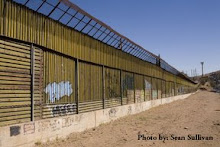
On July 12, monsoons washed through the Nogales, Sonora area and caused major flooding on the Mexican side of the border. In some places five feet of water was pooled up along the border wall and there were reports of cars floating away. What caused this flood?

As reported in the AZ Daily Star, Mexican officials blame an illegally built wall for the devastating flood. The Border Patrol built a 5 foot wall within a drainage tunnel near a port of entry without notifying the International Boundary and Water Commission (IBWC).

The IBWC is comprised of officials from Mexico and the U.S. They are charged with seeking solutions to issues pertaining to sanitation, water quality, and flood control in the border region. The 5 foot wall was built by Border Patrol in January of this year. Traditionally, the IBWC is consulted when projects built on either side of the border will have an impact on stormwater runoff. However, Border Patrol never contacted the IBWC.

Mexican officials with the IBWC have submitted a formal complaint claiming that the wall reduced water flows within the drainage tunnel. As a result, concrete drainage structures failed and released torrents of water into the streets of the Nogales, Sonora. U.S. officials are still investigating the matter.

Complete disregard for the law and respect for other agencies and communities within the border region is now rampant within the Department for Homeland Security (DHS). This year DHS waived over 30 federal laws in order to construct hundreds of miles of border walls. Now the Border Patrol has failed to consult with the organization responsible for bi-national flood control and has endangered the residents of Nogales.

We know that border infrastructure is having devastating impacts on wildlife and ecosystems. The Nogales flood shows us that border communities also face environmental injustices. The flood caused millions of dollars in damages and destroyed many businesses in a low income community. Floods such as this can soil drinking water, spread hazardous materials, and create breeding grounds for various types of mold that can pose a health risk to people.


The infrastructure being utilized by DHS along the U.S./Mexico border continues to result in devastating impacts not only to the natural environment, but to communities as well. The Nogales flood could very well be a portent of what could occur along the lower Rio Grande Valley. There are many communities in the vicinity of the walls being constructed along that stretch of the border. This incident is yet another tarnished example of how U.S. border policy fails and instead places people and the environment at risk.

Sean Sullivan is the Co-Chair for the Sierra Club's Rincon Group in southern Arizona.