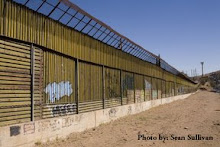
The Texas Border Coalition has written an amicus brief in support of a constitutional challenge to section 102 of the Real ID Act, which gives the Secretary of Homeland Security the unprecedened power to brush aside any law that might slow down construcion of the border wall. Section 102 said, “Notwithstanding any other provision of law, the Secretary of Homeland Security shall have the authority to waive all legal requirements such Secretary, in such Secretary’s sole discretion, determines necessary to ensure expeditious construction of the barriers and roads under this section.” The Texas Border Coalition issued the following press release regarding their support of the constitutional challenge:
EAGLE PASS, Texas (Jan. 14, 2009) – Members of the Texas Border Coalition (TBC) are asking the U.S. Supreme Court to hear an appeal by El Paso County, the city of El Paso and others challenging the constitutionality of Homeland Security Secretary Michael Chertoff’s waivers of 37 federal laws and all state, local and tribal laws. Chertoff exercised these waivers in connection with the U.S.-Mexico border wall.
In an amicus curiae brief filed today, TBC members ask the Court to address for the first time whether the waiver authority granted to Chertoff by Congress is permissible under the U.S. Constitution.
The brief noted that no appellate court has ever upheld such a broad a delegation of legislative power to the executive branch without judicial review, arguing that the waivers “bulldoze wide swaths of unidentified state and local laws” in a fashion contrary to what the framers of the Constitution intended.
Eagle Pass Mayor and TBC Chairman Foster said, “I hope the justices will seize this opportunity to restore the balance of sovereignty among federal, state and local governments that our nation’s founders guaranteed to the people and eloquently expressed in the Constitution and in the writings of James Madison.”
On April 3, 2008, Chertoff issued two waivers covering almost 500 miles of territory along the Mexican border from California to Texas in an effort to expedite construction of the 670-mile wall along the U.S.-Mexico border.Invoking his authority under Section 102(c) of the Illegal Immigration Reform and Immigrant Responsibility Act (IIRIRA), the Secretary waived 37 federal laws and all related regulations, including environmental laws, historic preservation acts, the Rivers and Harbors Act, the Federal Land Policy and Management Act, the Federal Grant and Cooperation Act, acts protecting the exercise of religious freedom, and the entire Administrative Procedures Act.
Perhaps most troubling is that Chertoff has purported to waive all state and local laws relating to the subject matter of these federal laws, but has not specified which state and local laws have been waived, for how long, or against whom.
TBC members argue that such unrestricted power granted to Chertoff raises profound, unanswered questions about sovereignty – including the local police powers – of the state of Texas and other cities and counties along the U.S.-Mexico border. They assert that the secretary has encroached on the most fundamental aspect of state and local sovereignty, and that is the power to govern by their own duly enacted laws.
“Should the Supreme Court allow these waivers to stand without so much as an argument in defense of liberty, the justices will effectively confer upon an unelected agency chief limitless and unbridled power never dreamed possible by the authors of the Constitution,” Foster said.
The justices are expected to decide this spring or summer whether to hear the case.
For a copy of the brief, please click here.
The Texas Border Coalition (TBC) is a collective voice of border mayors, county judges, economic development commissions focused on issues that affect more than 6 million people along the Texas-Mexico border region and economically disadvantaged counties from El Paso to Brownsville. TBC is working closely with the state and federal government to educate, advocate, and secure funding for transportation, immigration and ports of entry, workforce and education and health care. For more information, visit the TBC Web site at www.texasbordercoaltion.org.
Thursday, January 15, 2009


Tuesday, January 13, 2009
Friendship Park: A Place of Communion or a Zone of Enforcement?
By John Fanestil

As we approached, a Border Patrol officer checked in with us. It was clear that he had been briefed about our presence and was courteous and professional. He asked that we gather at the fence on the beach, but not congregate with the crowds down at the water’s edge as that would make it difficult for them to monitor border crossings. We sent some of our group ahead to talk with the folks on the beach, not wanting our celebration of communion to be confused for an event that invited crossings.
We also told the agent that we intended to serve communion on Monument Mesa, and this clearly surprised him. The mesa was closed, he told us, because it was a construction zone and was unsafe. We told him we were aware of this and that we intended to go to the top of the mesa anyway, as our people had been gathering there for years, in fact for generations. He told us that he would have to check in with his supervisor about this and we agreed that this would be good for him to do. We kept walking.
After waiting a while for the supervisor to weigh in, we decided to begin our celebrations on the beach. Many hundreds of people gathered on the Tijuana side of the fence. I shared with the crowd my belief that what is happening at Friendship Park is of historic proportions. Just as in 1849 the members of the first US-Mexico boundary commission gathered at this site to create the border out of nothing, we are once again at this location trying to decide exactly what the border will be.

At present the US Government is trying to impose a vision of the border that is characterized by fear and hostility and mistrust. They envision a “zone of enforcement” that will run the entire length of the border, and to which no one will be allowed access, from either the south or the north. This is why they have chosen to declare that all public access at Friendship Park will soon be eliminated – because they are trying to set a precedent that they hope someday to enforce along the entire length of the border.
We, by contrast, had gathered to celebrate a different vision of the future. We had gathered to celebrate the border we have come to know and love – a place of profound human encounter, a place of friendship, a place of communion.
After consecrating the elements and serving the crowd on both sides of the wall, a small number of us prepared to climb the slope of Monument Mesa. We had been warned that we would be cited for trespassing by officers from CA Fish & Wildlife, but we had prepared for there to be some consequence and we were committed to make it to the monument. We climbed up on to the mesa, stepped over the plastic meshing that now surrounds the plaza, and began to prepare to share communion. Another Border Patrol agent approached us, told us the Mesa was closed, again citing reasons of safety in a construction zone as the reason for its closure. We told him we understood that, but that we were going to stay and serve communion. He returned to his vehicle, and we shared communion with a small group of people who greeted us on the Mexican side of the monument.

We arrived Sunday as planned at 2:30 pm at the entrance to Border Field State Park . We hiked out the horse trail as we did last week and headed south on the beach. It was a stunningly beautiful day – the hike is about a mile and a half.
No two days are alike at Friendship Park , and two things stood out. First, there were a lot of people at the park – far more than usual for a winter weekend. Clearly, the word was out about this past Tuesday’s meeting – the one at which Customs and Border Patrol announced that the designs for Friendship Park had been finalized and that these designs would allow no public access of any kind to either Monument Mesa or to the border wall on the beach.
Second, the tide was extraordinarily low, and from a distance we could see that hundreds of people had gathered on the beach at Playas de Tijuana. Of these at least a hundred were standing down by the water’s edge, beyond the reach of the border wall (see photo).
No two days are alike at Friendship Park , and two things stood out. First, there were a lot of people at the park – far more than usual for a winter weekend. Clearly, the word was out about this past Tuesday’s meeting – the one at which Customs and Border Patrol announced that the designs for Friendship Park had been finalized and that these designs would allow no public access of any kind to either Monument Mesa or to the border wall on the beach.
Second, the tide was extraordinarily low, and from a distance we could see that hundreds of people had gathered on the beach at Playas de Tijuana. Of these at least a hundred were standing down by the water’s edge, beyond the reach of the border wall (see photo).
As we approached, a Border Patrol officer checked in with us. It was clear that he had been briefed about our presence and was courteous and professional. He asked that we gather at the fence on the beach, but not congregate with the crowds down at the water’s edge as that would make it difficult for them to monitor border crossings. We sent some of our group ahead to talk with the folks on the beach, not wanting our celebration of communion to be confused for an event that invited crossings.
We also told the agent that we intended to serve communion on Monument Mesa, and this clearly surprised him. The mesa was closed, he told us, because it was a construction zone and was unsafe. We told him we were aware of this and that we intended to go to the top of the mesa anyway, as our people had been gathering there for years, in fact for generations. He told us that he would have to check in with his supervisor about this and we agreed that this would be good for him to do. We kept walking.
After waiting a while for the supervisor to weigh in, we decided to begin our celebrations on the beach. Many hundreds of people gathered on the Tijuana side of the fence. I shared with the crowd my belief that what is happening at Friendship Park is of historic proportions. Just as in 1849 the members of the first US-Mexico boundary commission gathered at this site to create the border out of nothing, we are once again at this location trying to decide exactly what the border will be.
At present the US Government is trying to impose a vision of the border that is characterized by fear and hostility and mistrust. They envision a “zone of enforcement” that will run the entire length of the border, and to which no one will be allowed access, from either the south or the north. This is why they have chosen to declare that all public access at Friendship Park will soon be eliminated – because they are trying to set a precedent that they hope someday to enforce along the entire length of the border.
We, by contrast, had gathered to celebrate a different vision of the future. We had gathered to celebrate the border we have come to know and love – a place of profound human encounter, a place of friendship, a place of communion.
After consecrating the elements and serving the crowd on both sides of the wall, a small number of us prepared to climb the slope of Monument Mesa. We had been warned that we would be cited for trespassing by officers from CA Fish & Wildlife, but we had prepared for there to be some consequence and we were committed to make it to the monument. We climbed up on to the mesa, stepped over the plastic meshing that now surrounds the plaza, and began to prepare to share communion. Another Border Patrol agent approached us, told us the Mesa was closed, again citing reasons of safety in a construction zone as the reason for its closure. We told him we understood that, but that we were going to stay and serve communion. He returned to his vehicle, and we shared communion with a small group of people who greeted us on the Mexican side of the monument.
When we returned to the beach below, one of our friends told us he heard a Border Patrol agent call in on his radio, “There are about eight of them (who went up on to Monument Mesa) and I’m not going to detain anybody with all these cameras around.”
We look forward to celebrating communion at Friendship Park next Sunday, January 18. We will meet at the entrance to the park at 2:30 p.m.
Adelante.
We look forward to celebrating communion at Friendship Park next Sunday, January 18. We will meet at the entrance to the park at 2:30 p.m.
Adelante.
John Fanestil is the Executive Director of the Foundation for Change.
Friday, January 9, 2009
A Border Wall in the Otay Mountain Wilderness Area Will Be an Environmental Disaster
Four prominent national environmental organizations - the Sierra Club, Defenders of Wildlife, Wilderness Society, and Wildlands Network - issued the following press release in response to recently announced plans to punch the border wall and its associated roads through the Otay Mountain Wilderness Area. The Secure Fence Act itself states that if the elevation grade of an area exceeds 10%, walls do not need to be constructed there. Otay Mountain is so steep and rugged that the goal of blasting is to achieve an elevation grade of 15%, greater than the 10% limit in the Secure Fence Act. When the Environmental Protection Agency reviewed the plan to build this section of border wall, they expressed concern that plans to fill in canyons and waterways that feed into the Tijuana River would violate the Clean Water Act. The Department of the Interior expressed concern for 6 endangered species that would be impacted by the wall. Secretary Chertoff's response was to waive the Clean Water Act, Endangered Species Act, National Environmental Policy Act, the Otay Mountain Wildeerness Act, and 32 other federal laws, and now their contractor, Sukut, is quite literally breaking ground.

Contacts: Kim Vacariu, Wildlands Network 575-557-0155
Matt Clark, Defenders of Wildlife 520-623-9653
Oliver Bernstein, Sierra Club 512-477-2152
Paul Spitler, The Wilderness Society 202-429-2672
Conservation Groups call for Halt to
Road-Building in Borderlands Wilderness Area
Project is first use of Real ID Act waiver allowing
construction in designated wilderness
Otay Mesa, CA –With little advance notice, the Department of Homeland Security (DHS) has begun bulldozing a road inside a federally-designated wilderness area on the U.S.-Mexico border. Apparently not wishing to attract national attention to the controversial project, DHS made the construction start-up announcement through its contractor on Christmas Eve. According to DHS, the road-building project is necessary to build a border wall within and immediately to the south of the 18,500-acre Otay Mountain Wilderness Area on the U.S.-Mexico border east of San Diego.
The rugged terrain of the wilderness area will require blasting and removal of 530,000 cubic yards of rock, and extensive grading and leveling in order to build the wall and the accompanying road, says Sukut Construction, the contractor doing the work. Plans for the project note that much of the five-mile patrol road and approximately 1,300 feet of the primary pedestrian fence would extend into the Otay Mountain Wilderness.
Because motorized equipment, new roads and permanent human structures are not permitted within a federally-designated wilderness area, the Wilderness Act was among the 36 laws waived by Homeland Security Secretary Chertoff in April 2008 in order to expedite border wall construction. The controversial waiver was authorized under the Real ID Act, which allows the Secretary to exempt DHS from any and all laws that might interfere with construction of the border wall and associated access roads.
“Wilderness areas are designated by Congress specifically to protect sensitive places from projects like this road construction,” said Carl Pope, Executive Director of the Sierra Club. “This road sets terrible precedent and clearly demonstrates the dangers of granting the Secretary of Homeland Security authority to waive any law in order to build walls along our international borders.”
The project now moves forward despite DHS documentation that “Construction of the fence, staging areas, and patrol road…will result in a barrier to movement for large non-flying animals and general loss of wildlife habitat.” According to Matt Clark, Southwest representative for Defenders of Wildlife, “Such harmful impacts to wilderness characteristics and values are clearly inconsistent with the Congressional intent of the law that established the Otay Mountain Wilderness Area in 1999. The waiver and the wall are an affront to our nation’s laws and natural heritage.”
When Congress passed the Secure Fence Act (SFA) in 2006, mandating that 670 miles of border fence be constructed by the end of 2008, San Diego Sector Border Patrol spokesman, Richard Kite, said, "…at the (Otay) mountain range, you simply don't need a fence. It's such harsh terrain it's difficult to walk, let alone drive. There's no reason to disrupt the land when the land itself is a physical barrier." Kite’s experience and reasoning, along with the language of the SFA itself, which does not require walls on slopes with more than a 10% grade (such as most of those in the project area), has apparently been ignored by DHS as it now attempts to speed up border wall construction.
“The frantic pace of wall building along the U.S.-Mexico border completely ignores the project’s serious environmental consequences to wildlife, wildlands and the general ecology of the borderlands region,” says Kim Vacariu, Western Director for the Wildlands Network, a conservation group working to protect cross-border wildlife corridors. “The waiving of the bedrock environmental laws that protect our nation’s natural resources is unconscionable. Construction in the Otay Mountain Wilderness should cease pending immediate and thorough environmental review,” he notes.
William H. Meadows, president of The Wilderness Society, agreed. “We are very concerned about the impacts this wall will cause to wilderness values at Otay,” Meadows said. “Wilderness areas are among the last places in the United States that are untrammeled by humans, and we believe they should stay that way.”
Road-Building in Borderlands Wilderness Area
Project is first use of Real ID Act waiver allowing
construction in designated wilderness
Otay Mesa, CA –With little advance notice, the Department of Homeland Security (DHS) has begun bulldozing a road inside a federally-designated wilderness area on the U.S.-Mexico border. Apparently not wishing to attract national attention to the controversial project, DHS made the construction start-up announcement through its contractor on Christmas Eve. According to DHS, the road-building project is necessary to build a border wall within and immediately to the south of the 18,500-acre Otay Mountain Wilderness Area on the U.S.-Mexico border east of San Diego.
The rugged terrain of the wilderness area will require blasting and removal of 530,000 cubic yards of rock, and extensive grading and leveling in order to build the wall and the accompanying road, says Sukut Construction, the contractor doing the work. Plans for the project note that much of the five-mile patrol road and approximately 1,300 feet of the primary pedestrian fence would extend into the Otay Mountain Wilderness.
Because motorized equipment, new roads and permanent human structures are not permitted within a federally-designated wilderness area, the Wilderness Act was among the 36 laws waived by Homeland Security Secretary Chertoff in April 2008 in order to expedite border wall construction. The controversial waiver was authorized under the Real ID Act, which allows the Secretary to exempt DHS from any and all laws that might interfere with construction of the border wall and associated access roads.
“Wilderness areas are designated by Congress specifically to protect sensitive places from projects like this road construction,” said Carl Pope, Executive Director of the Sierra Club. “This road sets terrible precedent and clearly demonstrates the dangers of granting the Secretary of Homeland Security authority to waive any law in order to build walls along our international borders.”
The project now moves forward despite DHS documentation that “Construction of the fence, staging areas, and patrol road…will result in a barrier to movement for large non-flying animals and general loss of wildlife habitat.” According to Matt Clark, Southwest representative for Defenders of Wildlife, “Such harmful impacts to wilderness characteristics and values are clearly inconsistent with the Congressional intent of the law that established the Otay Mountain Wilderness Area in 1999. The waiver and the wall are an affront to our nation’s laws and natural heritage.”
When Congress passed the Secure Fence Act (SFA) in 2006, mandating that 670 miles of border fence be constructed by the end of 2008, San Diego Sector Border Patrol spokesman, Richard Kite, said, "…at the (Otay) mountain range, you simply don't need a fence. It's such harsh terrain it's difficult to walk, let alone drive. There's no reason to disrupt the land when the land itself is a physical barrier." Kite’s experience and reasoning, along with the language of the SFA itself, which does not require walls on slopes with more than a 10% grade (such as most of those in the project area), has apparently been ignored by DHS as it now attempts to speed up border wall construction.
“The frantic pace of wall building along the U.S.-Mexico border completely ignores the project’s serious environmental consequences to wildlife, wildlands and the general ecology of the borderlands region,” says Kim Vacariu, Western Director for the Wildlands Network, a conservation group working to protect cross-border wildlife corridors. “The waiving of the bedrock environmental laws that protect our nation’s natural resources is unconscionable. Construction in the Otay Mountain Wilderness should cease pending immediate and thorough environmental review,” he notes.
William H. Meadows, president of The Wilderness Society, agreed. “We are very concerned about the impacts this wall will cause to wilderness values at Otay,” Meadows said. “Wilderness areas are among the last places in the United States that are untrammeled by humans, and we believe they should stay that way.”
Contacts: Kim Vacariu, Wildlands Network 575-557-0155
Matt Clark, Defenders of Wildlife 520-623-9653
Oliver Bernstein, Sierra Club 512-477-2152
Paul Spitler, The Wilderness Society 202-429-2672
Tuesday, January 6, 2009
Communion through the border wall at Friendship Park
By Jason Evans
Every Sunday afternoon, I head down I-5 towards the San Ysidro border crossing. I get off the freeway and head towards Border Field State Park. Within the park, at the most southwest point of San Diego county is Friendship Park, a monument to the friendly relationship between the U.S. and Mexico. When I come up to the monument I am met by familiar faces on both sides of the fence. Mexican men, deported from the U.S., women selling their handmade goods, and families separated from each other by the border, using this unique space as a place to meet, squeezing their fingers through the fence to touch each other; wipe away tears from each others faces. And there are clergy and activists too. We are gathered to celebrate communion. We are gathered to celebrate our unity through the work of Jesus Christ that surpasses fences and walls built by the State.

The Department of Homeland Security has elected to build a new border fence that will run through this special place. 35 laws and regulations have been waived in order to do this. Millions of dollars will go into this project. Several months ago, I went to the meeting with the Army Corps. of Engineers to see how San Diego contractors could get a piece of this work. I may disagree with most of the contractors present on this fence, but they aren’t dumb. Everyone quickly realized that the meeting was a simply a “dog and pony show.” There wasn’t any real work for San Diego contractors. No significant amount of that large amount of money was going back into our economy.
So, as I walk towards that fence every week, looking to the east and seeing the new fence encroaching on this peacable place, I am aware of the undemocratic manner in which it has been erected. I am aware of how unhelpful this is to our local economy. I am aware of the irreprable ecological damage it reeks on God’s creation in this place. I am aware that it will give coyote’s reason to raise prices for human smuggling, making a violent, inhumane industry even more so. I am aware that this means even more people will die in the eastern rural segment of our county, trying to cross in areas manned by fewer Border Patrol agents. I am saddened by this but I feel that our symbolic work every Sunday helps us imagine another world, a world that we continue to work towards establishing even in the face of this large challenge.
During winter months, the park is closed to vehicles. The roads often flood. Instead, my colleagues and I park outside the park gate and hike through the sticky mud, down to the beach and then south towards the monument. Altogether about a mile and a half walk in sand and mud. Not a big ordeal when considering the celebratory moment we are about to participate in. The Friendship Park monument segment in Mexico is part of urban Tijuana. People easily walk up to the Mexican side to meet us, eating cob corn on a stick as they meet with their loved one’s that have not been deported.
 A plastic mesh fence was put around the monument the week before Christmas this year. The park was still open to pedestrians and no one has prohibited us from serving communion. So, this week we continued with our usual plan. We turned off the muddy horse path and on to the beach beginning our southward walk. About halfway from the horse path to the monument we were met by two Border Patrol jeeps. We were told that we would be given a citation by State Parks if we went any further. We asked why this wasn’t on their website. The agent did not have a helpful response. This was also curious as the Department of Homeland Security has declared this federal property. Why would the Parks give us a citation and not Border Patrol? We told the young agent that we had people waiting for us at the fence. We needed to get there. He told us he would have to “intervene” if we did that. He would not clarify what this meant. We asked to speak to a supervisor.
About this time, a Border Patrol helicopter flew over us a couple times. A curious show of force. A photo journalist from the LA Times was with us this Sunday. He decided to risk driving up to the monument and was stopped by the State Parks and cited. About the time that it was realized that he was a photo journalist, we were told we could approach the fence near the ocean to do communion, and the “man from the LA Times” would be driven out to meet us if we agreed to stay away from the monument. It seemed clear that they were willing to compromise with us as long as it didn’t mean a scene would be made for the photo journalist to report.
Communion was beautiful this week. It was cold enough to keep the orders of rotting fish, trash and kelp at our feet at bay. At the water, the fence has wider openings. The chalice was able to fit through the fence so that people did not have to squeeze their small bit of tortilla through the opening. I was able to fully grasp my friend Martin’s hand as we prayed. An honor to do with a man who–along with his family–has been through so much. The initial behavior of the Border Patrol ignited a fervor in my fellow clergy, Rev. John Fanestil who brought tears to eyes during his introduction to communion, smoothly moving between Spanish and English.

After saying goodbye to our friends, cleaning up and getting ready to start our walk back, we noticed a couple that had met us at the fence from the San Diego side walking back north. Around 10 people had started the walk back before them, several yards north of them. Two Border Patrol jeeps stormed down the beach cutting off these 2 specific pedestrians. The couple and their young son were brown-skinned Hispanic Americans. No one else had been stopped who had begun walking home. None of the rest of us were brown-skinned as they were… But the Border Patrol will say they do not conduct racial profiling.
It has become even more important for the tight-lipped posture of the agencies in charge of this project and area to be more transparent. At a minimum, it seems realistic to ask for plans for the park to be made public. To date, their has been nearly zero consistency between information released by State Parks and Border Patrol. It’s disconcerting and unlike the democratic society this country claims to be to not involve the public and it’s elected officials in the process of something that so drastically impacts part of the place we call home. We are a long way from Washington D.C. We should be allowed to have a voice in this project.
Even more deeply important to me, is that as a follower of the Great Liberator, Jesus Christ, I do not feel I can stand idly by while powers do not listen to their people, act inhumanely to people based on the color of their skin or place of origin, recklessly destroy God’s creation and line the pockets of corporations who have no intent on benefiting the people who live in the region effected by their work–further gouging the divide between the have’s and have-not’s in a variety of ways. Last night, I asked my faith community to pray for discernment, courage and wisdom as I work with my colleagues in determining how we will continue to respond to this situation. I ask those of you that pray to do the same. I also invite those physically able to join me next Sunday for communion at the border. It is uncertain how much longer we will be able to do this. You may even want to spend the day in Tijuana and meet us on Mexican side. We meet at the fence on Sundays at 3:00 p.m. It would be really great to see a large turn out. It would make a great statement to the people and powers of Tijuana and San Diego. Feel free to contact us for information.
Jason Evans is a co-founder of the Ecclesia Collective and a member of the Hawthorn House.
His essay was originally posted at the Ecclesia Collective's website: http://ecclesiacollective.org/borderland/continued-border-activity
To see the results from the LA Times photojournalist who accompanied him, go to:
http://www.latimes.com/news/columnists/la-me-tobar6-2009jan06,0,2887120.column
Every Sunday afternoon, I head down I-5 towards the San Ysidro border crossing. I get off the freeway and head towards Border Field State Park. Within the park, at the most southwest point of San Diego county is Friendship Park, a monument to the friendly relationship between the U.S. and Mexico. When I come up to the monument I am met by familiar faces on both sides of the fence. Mexican men, deported from the U.S., women selling their handmade goods, and families separated from each other by the border, using this unique space as a place to meet, squeezing their fingers through the fence to touch each other; wipe away tears from each others faces. And there are clergy and activists too. We are gathered to celebrate communion. We are gathered to celebrate our unity through the work of Jesus Christ that surpasses fences and walls built by the State.
The Department of Homeland Security has elected to build a new border fence that will run through this special place. 35 laws and regulations have been waived in order to do this. Millions of dollars will go into this project. Several months ago, I went to the meeting with the Army Corps. of Engineers to see how San Diego contractors could get a piece of this work. I may disagree with most of the contractors present on this fence, but they aren’t dumb. Everyone quickly realized that the meeting was a simply a “dog and pony show.” There wasn’t any real work for San Diego contractors. No significant amount of that large amount of money was going back into our economy.
So, as I walk towards that fence every week, looking to the east and seeing the new fence encroaching on this peacable place, I am aware of the undemocratic manner in which it has been erected. I am aware of how unhelpful this is to our local economy. I am aware of the irreprable ecological damage it reeks on God’s creation in this place. I am aware that it will give coyote’s reason to raise prices for human smuggling, making a violent, inhumane industry even more so. I am aware that this means even more people will die in the eastern rural segment of our county, trying to cross in areas manned by fewer Border Patrol agents. I am saddened by this but I feel that our symbolic work every Sunday helps us imagine another world, a world that we continue to work towards establishing even in the face of this large challenge.
During winter months, the park is closed to vehicles. The roads often flood. Instead, my colleagues and I park outside the park gate and hike through the sticky mud, down to the beach and then south towards the monument. Altogether about a mile and a half walk in sand and mud. Not a big ordeal when considering the celebratory moment we are about to participate in. The Friendship Park monument segment in Mexico is part of urban Tijuana. People easily walk up to the Mexican side to meet us, eating cob corn on a stick as they meet with their loved one’s that have not been deported.
A plastic mesh fence was put around the monument the week before Christmas this year. The park was still open to pedestrians and no one has prohibited us from serving communion. So, this week we continued with our usual plan. We turned off the muddy horse path and on to the beach beginning our southward walk. About halfway from the horse path to the monument we were met by two Border Patrol jeeps. We were told that we would be given a citation by State Parks if we went any further. We asked why this wasn’t on their website. The agent did not have a helpful response. This was also curious as the Department of Homeland Security has declared this federal property. Why would the Parks give us a citation and not Border Patrol? We told the young agent that we had people waiting for us at the fence. We needed to get there. He told us he would have to “intervene” if we did that. He would not clarify what this meant. We asked to speak to a supervisor.About this time, a Border Patrol helicopter flew over us a couple times. A curious show of force. A photo journalist from the LA Times was with us this Sunday. He decided to risk driving up to the monument and was stopped by the State Parks and cited. About the time that it was realized that he was a photo journalist, we were told we could approach the fence near the ocean to do communion, and the “man from the LA Times” would be driven out to meet us if we agreed to stay away from the monument. It seemed clear that they were willing to compromise with us as long as it didn’t mean a scene would be made for the photo journalist to report.
Communion was beautiful this week. It was cold enough to keep the orders of rotting fish, trash and kelp at our feet at bay. At the water, the fence has wider openings. The chalice was able to fit through the fence so that people did not have to squeeze their small bit of tortilla through the opening. I was able to fully grasp my friend Martin’s hand as we prayed. An honor to do with a man who–along with his family–has been through so much. The initial behavior of the Border Patrol ignited a fervor in my fellow clergy, Rev. John Fanestil who brought tears to eyes during his introduction to communion, smoothly moving between Spanish and English.
After saying goodbye to our friends, cleaning up and getting ready to start our walk back, we noticed a couple that had met us at the fence from the San Diego side walking back north. Around 10 people had started the walk back before them, several yards north of them. Two Border Patrol jeeps stormed down the beach cutting off these 2 specific pedestrians. The couple and their young son were brown-skinned Hispanic Americans. No one else had been stopped who had begun walking home. None of the rest of us were brown-skinned as they were… But the Border Patrol will say they do not conduct racial profiling.
It has become even more important for the tight-lipped posture of the agencies in charge of this project and area to be more transparent. At a minimum, it seems realistic to ask for plans for the park to be made public. To date, their has been nearly zero consistency between information released by State Parks and Border Patrol. It’s disconcerting and unlike the democratic society this country claims to be to not involve the public and it’s elected officials in the process of something that so drastically impacts part of the place we call home. We are a long way from Washington D.C. We should be allowed to have a voice in this project.
Even more deeply important to me, is that as a follower of the Great Liberator, Jesus Christ, I do not feel I can stand idly by while powers do not listen to their people, act inhumanely to people based on the color of their skin or place of origin, recklessly destroy God’s creation and line the pockets of corporations who have no intent on benefiting the people who live in the region effected by their work–further gouging the divide between the have’s and have-not’s in a variety of ways. Last night, I asked my faith community to pray for discernment, courage and wisdom as I work with my colleagues in determining how we will continue to respond to this situation. I ask those of you that pray to do the same. I also invite those physically able to join me next Sunday for communion at the border. It is uncertain how much longer we will be able to do this. You may even want to spend the day in Tijuana and meet us on Mexican side. We meet at the fence on Sundays at 3:00 p.m. It would be really great to see a large turn out. It would make a great statement to the people and powers of Tijuana and San Diego. Feel free to contact us for information.
Jason Evans is a co-founder of the Ecclesia Collective and a member of the Hawthorn House.
His essay was originally posted at the Ecclesia Collective's website: http://ecclesiacollective.org/borderland/continued-border-activity
To see the results from the LA Times photojournalist who accompanied him, go to:
http://www.latimes.com/news/columnists/la-me-tobar6-2009jan06,0,2887120.column
Friday, December 19, 2008
Civil Disobedience and the Border Wall
After successfully blocking construction of the US-Mexico border wall for 7 hours on December 17, Judy Ackerman was handcuffed and led away from the construction site. She had been on the site since 6:30 that morning, cheered on by a group of enthusiastic supporters while idle workers leaned against their silent equipment.

Ackerman’s civil disobedience sprang from a desire to defend the Rio Bosque Wetlands Park, a protected natural area on the Rio Grande in El Paso, Texas. Rio Bosque is situated along a stretch of the old, winding river channel in which the Rio Grande flowed before it was straightened and channelized in the 1930s. The park’s wetlands were created in 1997, and, through years of volunteer work, the native wetland habitat was painstakingly restored. Ten years later, it’s one of the few places where one can imagine what the El Paso area must have been like when the river wound freely through the mountains and desert and had ample flow to support rich wetlands and big cottonwood trees. Judy Ackerman is one of the many volunteers who made this vision possible.
But the border wall threatens this rebirth of nature. Its path will cut off Rio Bosque from the river, preventing the movement of species and severely limiting the park's value as habitat. For Ackerman and the other longtime Rio Bosque volunteers who know that the river and the wetlands are intimately and inextricably connected, the border wall is a knife through the heart.
For the simple, nonviolent action of standing her ground on the border wall construction site, Ackerman has been charged with violating the law, but the border wall itself has been placed above all of our nation’s laws. The Real ID Act gives the Secretary of Homeland Security the power to waive any federal, state, or local law that might slow down construction of the wall. No one else, not even the president, has this sweeping power. On April 1, 2008, DHS Secretary Michael Chertoff “waived in their entirety” 36 federal laws all along the southern border, including the Clean Water Act, the Endangered Species Act, and the National Environmental Policy Act. There is only one reason to waive these laws: Chertoff knows that the border wall cannot be built without violating them. His waiver is an implicit admission that constructing the border wall means breaking the law.
After her arrest, law enforcement officers brought Ackerman before a judge to be arraigned. But under the Real ID Act, neither she nor anyone else may use the courts to challenge the border wall, regardless of the damage it causes or the danger it represents. Chertoff’s waiver swept aside our legal right to demand in court that the government obey its own laws. The only jurisdiction the courts have is to determine whether or not the Real ID Act waiver provision is constitutional. El Paso County and nine other plaintiffs have claimed that it is not and are asking the Supreme Court to hear their case. In the meantime, the border wall continues to be built, devastating our border communities and natural areas, flouting our nation’s laws, and undermining our constitutionally-guaranteed right to equal protection under the law.

Some would go so far as to say that these are among the freedoms we should willingly give up in exchange for security. But this trade-off is a false one based on the twin myths that our borders are broken and that border walls will protect us.
Our borders are not broken. Well before the new walls started going up there, the El Paso Border Patrol Sector was reporting a decrease in the apprehensions of illegal crossers. From 2005 to 2007, apprehensions in the El Paso sector fell by 38 percent. Even more telling, this year El Paso has been named the nation's third-safest city among cities with populations of 500,000 or more, and it has consistently ranked in the top 3 safest large cities for a decade.
Border walls do not make the United States safer, nor do they stop undocumented immigration or smuggling. A 2007 report by the Congressional Research Service found that existing walls in San Diego “did not have a discernible impact on the influx of unauthorized aliens coming across the border.” In fact, during the same period that El Paso experienced a 38 percent drop in illegal crossings, San Diego had a 20 percent increase in crossings despite the presence of a triple-layered border wall there.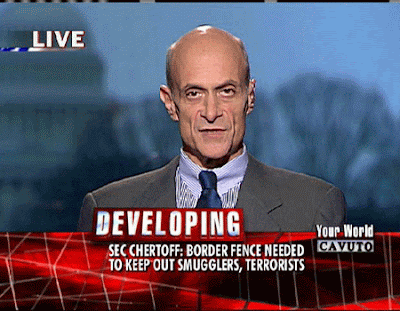
Those who say we must give up our freedom for security are in reality asking us to sacrifice one of the founding principles of our republic, the rule of law, for nothing but a false sense of security.
Judy Ackerman trespassed, disrupted border wall construction, and stood her ground. For this she was duly arrested and charged with a crime. But on the same ground where Ackerman made her stand, The Department of Homeland Security is willfully and destructively ignoring the law. One man has decided which laws apply and which do not and has single-handedly dismissed our right to sue for protection under the law. Ackerman’s trespassing charge is a misdemeanor. But the border wall construction that restarted soon after her arrest is a much more serious crime, and Chertoff’s waiver of laws is a flagrant violation of the principles upon which our nation was founded.
Saturday, December 13, 2008
Border Wall Harms Wildlife
By Matt Clark
The border wall is a classic example of habitat fragmentation – one of the leading causes of species extinction. As human-created barriers such as highways and walls bisect the land, once intact wildlife habitat patches become fragmented, and less permeable to wildlife movements. One of the insidious consequences of habitat fragmentation is that it creates smaller, more isolated habitat patches and wildlife populations – the negative effects of which may not become apparent for decades. Isolated wildlife populations are prone to more dramatic fluctuations from year to year, are less resilient to natural disturbances, have a higher probability of local extinction, and are robbed of the crucial genetic interchange that keeps wildlife populations healthy. Fragmentation may also preclude access to water sources, seasonally-available food resources, and new territories. The importance of maintaining and/or restoring habitat connectivity is a fundamental principle that has emerged from wildlife conservation sciences in the past two decades.
The border wall is causing habitat destruction, degradation and fragmentation at a regional scale for a wide array of wildlife – creatures that do not recognize arbitrary political boundaries. Numerous cross-border wildlife linkages have already been severed by the wall, and the wall itself is redirecting traffic into adjacent habitats. Clearly, more scientific research is needed to quantify these impacts.
On-the-ground examples:
· 1.9 million tons of dirt is being used to fill Smuggler’s Gulch in southern California in order to construct a wall across this steep canyon. This threatens to increase sediment flows into the ecologically-sensitive Tijuana River Estuary, which provides habitat for four federally-listed endangered birds: the light-footed clapper rail, the California least tern, the least Bell's vireo and the California brown pelican.

· Both deer and javelina have been documented along the wall in the vicinity of the San Pedro Riparian National Conservation Area, apparently unable to cross the border because of the wall.
· A Compatiblility Determination for the then-proposed border wall on the Buenos Aires National Wildlife Refuge concluded the wall was not compatible with the refuge’s mission and regulations, stating: “The barrier would fragment habitat on the refuge, thereby adversely affecting the ecological integrity of the refuge's natural resources…The barrier would adversely affect endangered species (jaguar), migratory birds (pygmy-owls), and important habitats (Arivaca Creek) on the refuge, thereby conflicting with stated management goals for the refuge...” A controversial land swap was orchestrated and the wall was built anyway. Border Patrol recently documented an aggravated mountain lion on the refuge unsuccessfully attempting to get through the border wall to the Mexican side of its habitat.
 Buenos Aires National Wildlife Refuge and the Border Wall. Photo courtesy Matt Clark.
· A recent Biological Opinion from the U.S. Fish and Wildlife Service states, “Shifting IA [illegal alien] activity has already occurred in Arizona and California as a result of fence construction or increased CBP [Customs and Border Protection] staffing”. The wall continues to funnel traffic and disturbance into remote, rugged, and ecologically sensitive areas. The Biological Opinion provides 8 documented examples of this phenomenon, some of which are anticipated to negatively impact threatened and endangered species such as the Sonoran pronghorn, jaguar, Mexican spotted owl and Chiricahua leopard frog.
Matt Clark is the Southwest Representative for Defenders of Wildlife.
The border wall is a classic example of habitat fragmentation – one of the leading causes of species extinction. As human-created barriers such as highways and walls bisect the land, once intact wildlife habitat patches become fragmented, and less permeable to wildlife movements. One of the insidious consequences of habitat fragmentation is that it creates smaller, more isolated habitat patches and wildlife populations – the negative effects of which may not become apparent for decades. Isolated wildlife populations are prone to more dramatic fluctuations from year to year, are less resilient to natural disturbances, have a higher probability of local extinction, and are robbed of the crucial genetic interchange that keeps wildlife populations healthy. Fragmentation may also preclude access to water sources, seasonally-available food resources, and new territories. The importance of maintaining and/or restoring habitat connectivity is a fundamental principle that has emerged from wildlife conservation sciences in the past two decades.
The border wall is causing habitat destruction, degradation and fragmentation at a regional scale for a wide array of wildlife – creatures that do not recognize arbitrary political boundaries. Numerous cross-border wildlife linkages have already been severed by the wall, and the wall itself is redirecting traffic into adjacent habitats. Clearly, more scientific research is needed to quantify these impacts.
On-the-ground examples:
· 1.9 million tons of dirt is being used to fill Smuggler’s Gulch in southern California in order to construct a wall across this steep canyon. This threatens to increase sediment flows into the ecologically-sensitive Tijuana River Estuary, which provides habitat for four federally-listed endangered birds: the light-footed clapper rail, the California least tern, the least Bell's vireo and the California brown pelican.
· Both deer and javelina have been documented along the wall in the vicinity of the San Pedro Riparian National Conservation Area, apparently unable to cross the border because of the wall.
· A Compatiblility Determination for the then-proposed border wall on the Buenos Aires National Wildlife Refuge concluded the wall was not compatible with the refuge’s mission and regulations, stating: “The barrier would fragment habitat on the refuge, thereby adversely affecting the ecological integrity of the refuge's natural resources…The barrier would adversely affect endangered species (jaguar), migratory birds (pygmy-owls), and important habitats (Arivaca Creek) on the refuge, thereby conflicting with stated management goals for the refuge...” A controversial land swap was orchestrated and the wall was built anyway. Border Patrol recently documented an aggravated mountain lion on the refuge unsuccessfully attempting to get through the border wall to the Mexican side of its habitat.
Buenos Aires National Wildlife Refuge and the Border Wall. Photo courtesy Matt Clark.· A recent Biological Opinion from the U.S. Fish and Wildlife Service states, “Shifting IA [illegal alien] activity has already occurred in Arizona and California as a result of fence construction or increased CBP [Customs and Border Protection] staffing”. The wall continues to funnel traffic and disturbance into remote, rugged, and ecologically sensitive areas. The Biological Opinion provides 8 documented examples of this phenomenon, some of which are anticipated to negatively impact threatened and endangered species such as the Sonoran pronghorn, jaguar, Mexican spotted owl and Chiricahua leopard frog.
Matt Clark is the Southwest Representative for Defenders of Wildlife.
Monday, December 8, 2008
Obama needs to consign Border Wall plan to the trashcan of bad ideas
By K. Rod Summy
During the past year, numerous articles have appeared in the local and national press regarding problems associated with construction of the Border Fence or Wall along the U.S.–Mexico border.
In one recent article, I expressed my concerns that the initiation of Border Wall construction in Hidalgo County, Texas during the middle of the 2008 hurricane season was inherently dangerous and could predispose our region to massive flooding if we were impacted by a major storm while such construction was in progress.
As examples of levee disturbances caused by Border Wall construction, I included a series of images acquired in the city of Granjeno during early-September of this year which showed firstly, deep unconsolidated (loose and friable) soil on both faces of the flood-control levee, and secondly a five- to six-meter gap between an uncompleted section of the concrete Border Wall and the remnants of the destabilized levee located to the south.
 Border wall under construction in the levee in Granjeno, TX 9/21/08
I discussed the ramifications of each type of disturbance, and recommended that major construction of any type which provides a potential to disturb or destabilize flood-control levees should be curtailed or prohibited during the annual hurricane season, which extends from early-June through late-November.
In response to my article, an unknown person (hereafter referred to “Anonymous”) posted the following statement on the No Border Wall blog on Sept. 22, 2008:
“Deceiving commentary on the engineering that is going on here. First the existing levees (small molehills) are raised using fill material. That is what the author calls "unstable" and "friable." Then the flood wall is constructed in front of the raised levees on the side facing the river, with space between so as not to disturb the newly upgraded earthen levee. After the wall is complete, the space is backfilled and consolidated agatinst [sic] the back of the flood wall. Please explain how the upgraded earth levee would provide less protection during a major storm than what was originally there?? (the original earth levee is still there underneath the built up levee). This makes no sense to me and it's a deceptive way to get an audience for this site's border wall bashing.”

Levee / border wall diagram from the Marfa Sector draft Environmental Assessment
The engineering details of the Border Wall provided by “Anonymous” are informative but irrelevant. How effective the Border Wall might be as a flood-control structure once construction is complete has nothing to do with the concerns expressed in my article – the real question is how it may be expected to perform if we are impacted by a major tropical storm or hurricane while construction is in progress.
All phases of Border Wall construction were in progress by September 7, 2008, the beginning of the week in which Hurricane Ike entered the Gulf of Mexico and intensified into one of the largest and most dangerous storms in Texas Gulf Coast history.
This included extensive excavation of the south levee face, the embedding of pilings and metal panels along the top of the levee, and construction of the partially-completed concrete wall which now extended approximately 150 to 200 meters west of its original point of origin.
 Levee / border wall construction in Granjeno, TX 8/01/08
To suggest that a levee in this condition is storm-worthy and capable of withstanding the onslaught of floodwaters produced by major tropical storms and hurricanes is ludicrous. Tropical storms and hurricanes are typically associated with high winds and torrential rainfall, which generally result in deep water and strong water currents within floodways. Any engineer or hydrologist worthy of the name should recognize that strong water currents developing in this manner will almost certainly obliterate any type of obstruction (earthen or otherwise) causing abrupt changes in surface contour of levee faces.
Moreover, a competent engineer should also recognize that the five- to six-meter “gap behind the wall” provides a means to generate very powerful water currents if any type of breach were to occur in the levee behind the concrete wall, e.g., as a result of overtopping. This is a simple matter of physical principles and hydrology – if a breach in this area should occur, floodwaters under tremendous pressure will tend to flow along the “path of least resistance,” i.e., they will flow through the breach until the system stabilizes as floodwaters subside.

Levee / border wall construction in Granjeno, TX 11/27/08
Since the concrete wall is impermeable to water, it will force floodwaters to enter a restricted channel (i.e., the gap in question) and to flow with increased velocity toward the breach in a direction parallel to the face of the destabilized earthen levee. As water flows through the breach, hydraulic action (erosion caused by moving water) will tend to widen the breach, which in turn will allow more water to enter the restricted channel (gap) which in turn will tend to increase the velocity of water flowing through the channel.
Despite repeated advisories from NOAA that water temperatures in the Gulf of Mexico were highly conducive to the development of tropical storms and hurricanes, Border Wall construction proceeded at a feverish pace without interruption during the peak of the 2008 hurricane season – August and September. During the second week of September, when Hurricane Ike was on an apparent “collision course” with south Texas, one of our local officials stated somewhat arrogantly that construction of the Border Wall (referred to as “levee repairs”) might be “halted temporarily” if Hurricane Ike headed our way. As it turned out, no such delay occurred – during the latter half of the week, Hurricane Ike began to veer northward and made landfall at Galveston on Sept. 13.

Levee / border wall construction behind homes in Granjeno, TX August 1, 2008
It is important for the reader to note that officials of the Department of Homeland Security, our local county officials and their construction contractors made no apparent preparations at Granjeno and three other construction sites in Hidalgo County for the possible landfall of Hurricane Ike along the south Texas coast. On Sept. 13, the day in which Ike was devastating much of southeast Texas and western Louisiana with massive flooding, construction of the Border Wall at Granjeno and three other sites in Hidalgo County was in high gear, with fleets of cranes, backhoes and other heavy equipment gnawing away at our flood-control levees like huge metallic termites.
The determination by DHS and our county officials to meet “Bush’s deadline” at essentially any cost and/or risk was presumably based on the erroneous logic that if funding for legitimate levee repairs and upgrades is not obtained now (under the Bush administration), it will be very difficult or impossible to obtain in the future (under a new presidential administration). This urgency is somewhat understandable considering the recent findings by FEMA that many areas of the LRGV levee system are not in compliance with federal standards, and will not be recertified unless they are upgraded and brought into compliance with FEMA standards within a period of one year (an additional one-year extension was recently granted).
Regardless of what their motives may have been, however, the decision by DHS and our local officials to initiate Border Wall construction in the Lower Rio Grande Valley during middle of the 2008 hurricane season, and their failure to make adequate preparations for the possible landfall of dangerous storms such as Hurricane Ike (which at one time seemed imminent) is inexcusable and placed the properties and lives of hundreds and possibly thousands of our citizens at considerable risk. We were very fortunate that Hurricane Dolly made landfall before Border Wall construction began in earnest at Granjeno and the other three sites, and that Hurricane Ike veered northward two days before its destructive landfall at Galveston. Had Hurricane Ike maintained its westward course and impacted the LRGV region while large sections of our flood-control system were under major construction, this story would not have ended happily (for us, at least). We cannot afford to allow this to happen again – ever!
Within the next six weeks, the George Bush administration will be history and Barack Obama will be inaugurated as the 44th President of the United States. If our country reenters a period of normalcy and rational thinking, the “Great Texas Border Wall” will hopefully be committed to its rightful place in the “Historical Trashcan of Bad Ideas.” Given our staggering federal deficit – which has increased substantially following the recent $750 billion bailout of the U. S. financial industry – it is very unlikely that the federal government will continue to pour millions (or billions) of dollars into a concrete structure that has become symbolic of tyranny and is despised almost universally by residents along the U.S.–Mexico border.

Levee / border wall construction in the Lower Rio Grande Valley National Wildlife Refuge 11/27/08
Termination of the Border Wall concept would place great pressure on the U.S. Congress to develop real solutions to the problem of illegal immigration (instead of expensive and dangerous concrete placebos) and would allow available funds - including the $400 million “bailout package” for the ailing Border Wall project – to be used much more effectively for repair and upgrades of the Lower Rio Grande Valley levee system and bring it into compliance with FEMA standards for the first time in many years. Of all the options available to us right now, this comes closest to being a true “win–win” situation, and is the only one which will really protect us from disastrous flooding if and when we are impacted by some future storm similar to Hurricane Ike.
We were deprived of these basic rights during 2008 because of two federal laws – the Secure Fence Act and the Real ID Act - which were enacted by the U. S. Congress during a period of national hysteria, fear and intolerance. Collectively, these two laws allowed federal, state and local officials involved in the Border Wall project to conduct their business in a reckless and dangerous manner, and deprived the nearly two million American citizens in the Lower Rio Grande Valley of their legal rights to challenge construction of the Border Wall on any virtually any grounds, including public safety issues.
What happened in south Texas during 2008 is a prime example of what happens when too few people are given too much power without an adequate system of checks and balances. In order to ensure that this never happens again, it is imperative that all residents of our border regions with Mexico (and hopefully, all Americans in general) demand that our elected congressional representatives either amend or repeal both of these dangerous laws at the earliest opportunity. The next congressional session would be none too soon.
K. Rod Summy is an associate professor of entomology. He lives in Weslaco, Texas.
This article first appeared in the Rio Grande Guardian.
Subscribe to:
Posts (Atom)