Monday, January 28, 2013

Don't Throw the Border Under the Bus

by Scott Nicol


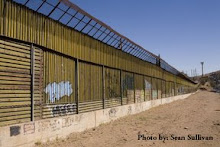
Congress will soon take up Comprehensive Immigration Reform.  That could be a good thing, if it normalizes the status of millions who are now forced to live in the shadows; reduces the number of immigrants who cross, and sometimes die, in the desert; and allows some of the $18 billion that is spent annually on immigration enforcement to be used for other things. 

But if history is any guide it could also mean a ramping up of border enforcement, with billions more wasted on border walls.

In 2006, the last time Congress made a serious attempt at Comprehensive Immigration Reform, hundreds of miles of border wall were included in competing House and Senate bills.  The two bills were never reconciled and therefore never made it to the President’s desk. 

Instead the provisions calling for walls along the southern border were passed by both houses as a stand-alone bill - the Secure Fence Act.  650 miles of border wall were eventually built, tearing through communities from San Diego to Brownsville and ecosystems from the Otay Mountain Wilderness Area to the Sabal Palms Audubon Sanctuary.

The idea that walls would halt potential crossers in their tracks proved to be more fantasy than reality.  The Congressional Research Service reported that walls near San Diego had “little impact on overall apprehensions.”  Even the Border Patrol said that “The border fence is a speed bump in the desert.

While walls have not reduced the number of immigrants who enter the U.S., they have caused the number of border crossers who perish in southern deserts each year to more than double.  That is because border walls do not stop people from entering the United States, they only reroute them. 

Confronted with an 18 foot high wall near San Diego or El Paso or Brownsville desperate immigrants do not turn around and go home, they go around it.  Rather than crossing in safer urban areas thousands come through rugged mountains and deserts.  As a result more than 5,000 have died from dehydration and exposure, and it is estimated that thousands of bodies lie undiscovered.

Walls and other enforcement measures have also taken a heavy toll on the environment. 

California’s Otay Mountain Wilderness Area saw 530,000 cubic yards of rock blasted from the mountainsides tumble into the Tijuana River.  In Arizona the border walls that cross washes and streams in the Organ Pipe Cactus National Monument have caused severe erosion and flooding.  Walls built in New Mexico’s Playas Valley block the movement of one of the last wild herds of bison, whose range straddles the U.S. – Mexico border.  And in Texas the walls that slice through the Lower Rio Grande Valley National Wildlife Refuge have fragmented habitat that is critical for the survival of endangered ocelots.

Following the recent election, in which some (but unfortunately not all) of the loudest immigrant-bashers suffered defeat and more than 70% of Hispanic voters rejected Mitt Romney, many politicians have decided that it is in their best interest to pass some version of immigration reform. 

The big concern is that we could see history repeat itself.

Press reports describe the coming bill as mirroring past legislation, pairing work visas and a pathway to citizenship with more border enforcement. 

Once again the border may be sacrificed in a doomed attempt to get conservatives to accept comprehensive legislation.

The idea that members of Congress who have called for making the lives of immigrants so hellish that they “self-deport”, or who voted just last summer to waive federal laws within 100 miles of both borders for all Border Patrol activities, will now support humane immigration legislation is unrealistic.  Sticking walls in the bill will not change that.

Instead, if walls and further border enforcement are allowed in this year’s legislation we run the risk of a repeat of 2006, when hundreds of miles of border walls were the only part of the immigration bill to make it to the president’s desk.

Those of us who live on the border have already seen too much of the enforcement side of that equation.  Last year the federal government spent more on immigration enforcement than the budgets of the FBI, Secret Service, Drug Enforcement Administration, U.S. Marshal Service, and the Bureau of Alcohol, Tobacco, Firearms and Explosives combined.

Enough.

Members of Congress who were sent to DC to represent the border need to fight for their constituents, but so far they have been silent.  With much of Arizona and California already walled off, Representatives Vela, Hinojosa, Cuellar, Gallego, and O’Rourke could all see new walls tear through their districts if they don’t make sure that border walls are kept out of the bill, but none have told us what (if anything) they plan to do about it. 

This is a critically important piece of legislation for border communities, and border legislators should take the lead in writing it.  That is their job, after all.  Sitting silently in the back of the room and hoping for the best is not going to cut it this time.

Congress needs to come up with a clean bill, dealing with immigration without further militarizing the borderlands.  No new border walls, no more pork for military contractors; instead we as a nation must address our dysfunctional immigration system in a way that is both effective and humane. 

We need immigration reform that doesn’t throw the border under the bus.

Sunday, January 13, 2013

Broken Promises and Border Walls Push Jaguarundi to the Brink


by Scott Nicol
 
The long, low body moves in a permanent crouch as the lithe cat glides through the shaded underbrush.  Not much larger than a house cat, but with a lean, dark body more closely resembling a weasel’s than a tabby’s, the jaguarundi stalks small prey, birds and rodents mostly, in the thornscrub where the Gulf Coast meets the Rio Grande.

 
Even before farms, towns, and homes devoured 95% of the Lower Rio Grande Valley’s native habitat the jaguarundi’s secretive habits meant it was rarely seen.  Now there is scant evidence as to how many cats remain, though they are occasionally spotted.   In 2009 there were two sightings by Texas Parks and Wildlife game wardens, though they were officially classified as unconfirmed in the absence of a photograph or carcass.

Loss of habitat and the fragmentation of what forested areas remain is the biggest obstacle to jaguarundi maintaining a healthy population, according to a draft recovery plan recently prepared by the U.S. Fish and Wildlife Service.  If a patch of forest is too small, it may not contain enough food, and if patches are too far apart or split by roads or other barriers jaguarundi may not have sufficient territory to survive.  Isolated animals may also be cut off from potential mates, which can lead to inbreeding within a small population.

Ocelots, a slightly larger wild cat whose markings resemble a jaguar’s, inhabit the same South Texas territory and face the same problems as the jaguarundi.  Ocelots are better studied, with radio collared individuals in Laguna Atascosa National Wildlife Refuge.  They regularly pause in front of motion-activated cameras there and in the nearby Lower Rio Grande Valley National Wildlife Refuge.  Their total population in the United States is certainly less than 100, and possibly much lower.  Even fewer jaguarundi remain, which has led to both being listed under the Endangered Species Act.

The best way to save both species, according to U.S. Fish and Wildlife, is to provide them with enough habitat to forage and find mates.  The draft recovery plan calls for the purchase of land to replace and reconnect the native forest that they need, creating the wildlife corridor that the river-hugging refuge was originally meant to be.  But with the never-ending “fiscal cliff” crisis and calls to butcher the budgets of federal agencies like U.S. Fish and Wildlife they will be hard pressed to find the necessary funds.

When border walls were erected in South Texas, they repeatedly sliced through the Lower Rio Grande Valley National Wildlife refuge, fragmenting habitat that had been purchased specifically for ocelots and jaguarundi.  Humans have had no problem climbing border walls, with or without a homemade ladder, but for a small cat that has not evolved thumbs an 18 foot high steel wall is insurmountable. 


In 2008, after the Department of Homeland Security waived the Endangered Species Act and more than thirty other laws so that Customs and Border Protection could build border walls they prepared a so-called “Environmental Stewardship Plan” meant, they said, to demonstrate their continued commitment to the environment.  To address the fragmentation of the Lower Rio Grande National Wildlife Refuge and the loss of endangered species habitat the plan stated that Customs and Border Protection would provide U.S. Fish and Wildlife with the means to purchase 4,600 acres of land to reconnect sections of the refuge that were separated by walls.  These properties would be purchased from willing sellers, because the South Texas refuge complex refuses to condemn land and earn the enmity of its neighbors, in contrast to Customs and Border Protection, who ultimately carried out more than 400 condemnations to build border walls.

In the nearly five years since Customs and Border Protection made that promise how much have they delivered? 

None. 

Not one acre, not one foot, not one inch.

It is not as though Customs and Border Protection is strapped for cash.  A report issued this month found that the federal government throws more money at immigration enforcement than it provides to the FBI, Secret Service, Drug Enforcement Administration, U.S. Marshal Service, and the Bureau of Alcohol, Tobacco, Firearms, and Explosives combined.  Somewhere in the $18 billion pot of cash that immigration enforcement agencies, Customs and Border Protection prominent among them, were swimming in in 2012 surely they could find a few dollars to buy a few acres and fulfill their overdue commitment.

Now Customs and Border Protection wants to build more miles of border wall in South Texas, tearing through Roma, Rio Grande City and Los Ebanos as well as further stretches of the Lower Rio Grande Valley National Wildlife Refuge.  In addition to the further fragmentation of ocelot and jaguarundi habitat that this would bring, these walls would stand in the Rio Grande floodplain, putting communities on both sides of the river at risk from dammed or deflected water during a major flood.

Last summer they assured landowners and mayors that the new border walls would not pose a flood hazard, and that despite the obvious fact that a wall in a river is by definition a dam these walls would be just fine.

But as their unmet commitment to be good environmental stewards has shown, a Customs and Border Protection promise is not worth the paper it is written on.  

Friday, December 14, 2012

Border Wall Imperils Southern Arizona Pronghorn Herds

Statement from the Sierra Club's Borderlands Team
www.sierraclub.org/borderlands


TUCSON, AZ – Arizona Game and Fish is planning to relocate pronghorn from central Arizona to replenish herds in southeastern Arizona where the number of animals has been decimated by recently-constructed walls along the U.S.-Mexico border.

Arizona Public Media and the Arizona Daily Star report that these drastic measures are intended to avoid a total die-off of pronghorn herds in the vicinity of Sonoita and the San Rafael Valley.  The Sonoita herd has only about 18 animals remaining, and the 7 animals of the San Rafael herd rely on only one buck who is too old to breed.

These two herds are victims of habitat fragmentation caused by environmentally reckless border policies.  Hundreds of miles of border barriers and roads were hastily built in Arizona from 2006 to 2009, many of them without regard for vital environmental safeguards and federal protections such as the Endangered Species Act and National Environmental Policy Act.  These laws, and dozens more, were waived along most of Arizona’s border with Mexico by the Bush Administration.

"Habitat fragmentation, whether caused by urban sprawl, highways, or, in this case, border walls, cuts species off from the terrain they need to find food, water and mates,” says Dan Millis of Sierra Club Borderlands in Tucson. “People climb the wall all the time. Instead of serving its intended purpose – to deter people, the wall is stopping wildlife and endangering their survival, as is the case with these pronghorn.”

“It is going to cost a lot of money to capture and relocate pronghorn from central Arizona and move them in with the struggling herds,” continues Millis. “The federal government wasted billions on useless border walls to the detriment of the border environment, and now Arizonans are stuck with the costs of cleaning up the mess.”

 
#####


The Sierra Club is America's oldest, largest and most influential grassroots environmental organization. More information on borderlands protection can be found at www.sierraclub.org/borderlands

Sunday, September 9, 2012

Will Walls Worsen Rio Grande Flooding? U.S. IBWC Can’t Give a Straight Answer


By Scott Nicol

The United States section of the International Boundary and Water Commission (US IBWC) recently hosted a meeting in Rio Grande City to explain their decision to allow Customs and Border Protection to build new border walls in the Rio Grande floodplain.  While they should be commended for reaching out to local residents, they seemed completely unprepared, unable to answer the most basic questions about their decision or the new walls.

When, for example, landowners asked whether there had been any on-the-ground surveys, and what the wall would mean for access and impacts to their property, they got no response. 

The manager for Rio Grande City’s international bridge and port of entry asked how they would be able to access the riverbank to carry out ongoing erosion control efforts.  US IBWC did not know. 

Residents asked whether walls crossing the washes that feed into the Rio Grande might become blocked with debris, preventing normal drainage and causing flooding.  At that point US IBWC admitted that even though they approved these new walls months ago, Customs and Border Protection still has not provided them with the walls’ design specifications, so they could not answer that question either.

2007 Bureau of Land Management photo of debris in the Arizona wall
 

US IBWC was also unable, or unwilling, to answer a key question about the flood model that they are using to justify their approval of border walls in the floodplain. 

Using the Freedom of Information Act the Sierra Club has gotten a copy of the flood model, as well as a number of related documents.

In 2011 Customs and Border Protection paid Baker Engineering to produce a model that claimed that flood water would pass harmlessly through the 4-inch wide spaces between the border wall’s six-inch wide bollard posts.  Baker’s accompanying report stated that, “A debris blockage of 10% was adopted where the fence is aligned parallel to the flow and 25% at locations where the fence is aligned perpendicular to the flow.”

The model’s computer program cannot add to this number, cannot decide that it is too low and that in reality more debris will clog the spaces between bollards.  By telling the computer that 75% to 90% of floodwater will pass through the wall, Baker effectively predetermined the model’s end result.    

At the meeting in Rio Grande City, surrounded by residents whose lands and lives will depend on whether or not these walls will actually let water pass through or will dam it up, US IBWC could not explain where the suspiciously round and suspiciously low estimate of 10% - 25% debris blockage came from.

In earlier reports Baker Engineering came to a very different conclusion about how much debris border walls were likely to catch.

After border walls in Arizona became clogged with debris and acted as dams in 2008, inflicting millions of dollars of damage on both sides of the border and causing two deaths, Baker Engineering was hired to follow the wall from El Paso to San Diego and report back to Customs and Border Protection.  Baker found that, PF 225 fencing obstructs drainage flow every time a wash is crossed. With additional debris build-up, the International Boundary Water Commission’s (IBWC’s) criteria for rise in water surface elevations (set at 6” in rural areas and 3” in urban areas) can quickly be exceeded.” The report included photographs of bollard-style walls nearly identical to those planned for the Rio Grande floodplain filled with debris, and documented “debris build-up which sometimes reached a height of 6 feet.

 Photo from the 2009 Baker report showing debris in the Arizona border wall

In examining on-the-ground evidence of debris clogging border walls, it bolstered a 2008 Baker Engineering white paper that looked at the likely impacts of the walls planned for Roma, Rio Grande City, and Los Ebanos.  In discussing the wall’s transfer capacity - the ability of water to pass between the bollards - it stated that,


Map of the three new border walls from the 2011 Baker flood model
 

So how did Baker’s estimates of clogging drop from 85%, 67%, and 36% down to 10% where the wall is parallel to the Rio Grande, and from 100% down to 25% where it is perpendicular?

The US IBWC has yet to give the public an answer to that question.

The new flood model, with its low debris estimate, is cited by the US section of the International Boundary and Water Commission as the basis for its decision to allow these border walls.  The Mexican section has rejected the model’s assumptions, countering in late 2011 that these walls would likely obstruct 60% - 70% of flood flows even before the clogging effect of debris is factored in. 

On February 9, 2012 the two sections of the bi-national organization met to discuss their disagreement.  Meeting notes written by the same US IBWC engineer who was unable to answer questions about the model’s assumptions at the Rio Grande City public meeting say that,


So even when they met with their Mexican counterparts, US IBWC gave no concrete evidence that the lower estimate was more accurate than the earlier, much higher one.  The nice, round, low number was \simply “felt to be reasonable”, despite conflicting with empirical evidence from Arizona, and was adopted because it matched up with the Department of Homeland Security’s desire for a model showing a “minimum debris blockage.”

Not only was Mexico’s estimate ignored, they were not even invited to participate in the 2011 modeling methodology meeting.  And six days after the 2012 meeting the US section, flouting its treaty obligations, unilaterally approved Customs and Border Protection’s request to build walls in the floodplain.


Customs and Border Protection photo of debris backed up behind the border wall

Customs and Border Protection (CBP) has not hosted a public meeting on border walls in South Texas since 2007, but they did send a representative to the recent Rio Grande City meeting.  He declined to present any information, and remained silent unless he was asked a direct question. 

When asked when CBP would begin construction he said that at this time they do not have the funds to build these walls.  He failed to mention that CBP bought the steel years ago and currently has it in storage.  More importantly, he failed to mention that the new fiscal year for federal agencies begins on October 1, at which time their bank accounts will be refilled. 

If border residents want answers, we need to demand them now. 

Representative Cuellar and Senators Hutchison and Cornyn need to pressure the US IBWC to reverse its bad decision, and direct Customs and Border Protection to finally give up on these dangerous walls.  They need to take concrete action, and they need to do it now.

But of course they won’t, unless we, their constituents and voters, tell them to.

October is only three weeks away.  The clock is ticking.

Saturday, July 21, 2012

IBWC Approves New Border Walls Despite Flood Danger

By Scott Nicol
The U.S. half of the International Boundary and Water Commission (IBWC) has finally caved under pressure from Customs and Border Protection (CBP) and approved border walls in the Rio Grande floodplain adjacent to Roma, Rio Grande City, and Los Ebanos.    

Customs and Border Protection maps of the three new Rio Grande border wall sections

These three border wall sections, totaling 14 miles, were not built when other parts of the Rio Grande Valley were walled off because of the serious danger they pose to communities on both sides of the river.  On the U.S. side they could block the exit of flood water into the Rio Grande, bottling it up in towns and farm land and exacerbating the damage that they suffer.

They could also deflect flood waters towards Mexico, worsening flooding in Mexican communities.  Deflection might even cause the river to settle into a new channel farther to the south, which would effectively change the location of the border.  

In an attempt to lessen the amount of water that these walls will deflect into Mexican cities CBP designed them to channel flood waters north into the U.S. cities that they abut.  The walls will begin close to the Rio Grande, where during a flood water would be split off from the main channel.  As the river bends the mostly straight walls get farther from them, meaning that floodwater, along with all of the debris and garbage it carries, will be channeled into properties in the United States that might otherwise be spared from flooding. 

To make certain that water is channeled into the U.S. holes were planned for the middle of two of these wall sections – a 100 foot wide gap in the Roma wall, and a 275 foot wide gap in the Rio Grande City wall – explicitly intended to direct more water into these communities during a flood.

Existing border wall slicing through the Lower Rio Grande Valley National Wildlife Refuge

All three of the new border wall sections would also slice through the Lower Rio Grande Valley National Wildlife Refuge.  Established to create a wildlife corridor along the Rio Grande, the refuge provides habitat for critically endangered ocelot and jaguarundi.  Walls that have already been erected downriver repeatedly bisect and fragment the refuge, putting the future of the terrestrial species that it harbors in doubt.  The new walls would further fragment the refuge and cut off animals from the only reliable source of water in what US Fish and Wildlife has described as “some of the best habitat(s) in the U.S. along the final portion of the Rio Grande.

In a February 15, 2012 letter John Merino, Principal Engineer for the US section of the International Boundary and Water Commission gave CBP the green light, saying, “the USIBWC has no objection to the erection of the fence segments within the limits of the Rio Grande floodplain.”  Merino dismissed the possibility that walls would deflect or obstruct flood waters, and stated flatly that USIBWC did not examine potential environmental impacts.  He also failed to mention the fact that for the previous five years both the U.S. and Mexican halves of the bi-national International Boundary and Water Commission had rejected the idea of placing border walls in the floodplain. 

Throughout 2007 and 2008 CBP tried without success to come up with a wall design for these last three sections that would not impact flooding, and that the IBWC would therefore approve.  Unable to convince the IBWC that walls in the floodplain would not act like dams, a DHS briefing from October 2, 2008, said of these three, “DHS likely to drop fence segments. When CBP informed Representative Henry Cuellar a few days after the 2008 election that these border wall sections were “on hold,” Cuellar called it “a big victory” for his district.

It would have made sense for Customs and Border Protection to decide that the Roma, Rio Grande City, and Los Ebanos walls were not worth risking lives and property to build.  Or, if bureaucracy outweighed humanity in their thinking, they might have called off wall construction in order to comply with the international treaty.

They also could have based a decision to spare them on a June 2008 internal Customs and Border Protection document that stated that The Rio Grande Valley Sector Chief has determined that operational areas that contain the PF225 fence segments such as O-1 to O-2, O-12 through O-14, and O-17 through O-21 to be in “effectively controlled” level at the current time.  Segments O-1 and O-2 are the Roma and Rio Grande City walls. 

Segments O-12 through O-14 are in Cameron County, near Los Indios.  Segments O-17 through O-21 encompass all of the wall sections in the vicinity of Brownsville, from the neighborhoods near the River Bend Golf Course west of town past the Sabal Palms Audubon Sanctuary and the Loop family orchard to the east.  Those who live in these areas and had their property condemned for border walls lost their land for nothing, because the local Border Patrol had determined that the area already under effective control before any walls were built.

Border wall segment O-21 under construction with the Sabal Palms Audubon Sanctuary south of it

Of course decisions about who will get walls and who will be spared are made in Washington DC, not the Rio Grande Valley. 

That simple fact helps to explain why Customs and Border Protection continued to push for these walls, shifting tactics from trying to convince Mexico that walls would not worsen flooding south of the border to pushing the US section of IBWC to allow for “unilateral” action – building walls in the face of Mexican objections, and thereby violating the international treaty.

After hurricane Alex roared into the Rio Grande Valley in 2010, followed by a tropical depression, the flooding Rio Grande forced the mandatory evacuation of Los Ebanos and parts of Rio Grande City.  With homes underwater and the evacuation order still in place, CBP hosted a meeting for the USIBWC and the State Department in Washington DC. 

At the DC meeting Customs and Border Protection did not mention the ongoing floods that were inundating the sites of the proposed walls, or the Border Patrol sector chief’s assessment that the area was “effectively controlled.”  Instead, CBP said that the three remaining walls were “critical to our Nation’s security,” and since Mexico continued to insist that they posed a flood hazard “we need [US]IBWC and Department of State’s support for an unilateral decision to proceed with the fence construction.”

Throughout 2010 USIBWC consistently rejected unilateral action, pointing out the likelihood of “substantial increases in water surface elevations and deflections of flow at several points of all three projects.”

But in late 2011 USIBWC reversed itself.  John Merino, the US section’s Principal Engineer, wrote to his Mexican counterpart to say that US IBWC had “concluded that the project will not cause significant deflection or obstruction of the normal or flood flows of the Rio Grande. 

The Mexican section of the IBWC responded in December of 2011, saying,


Because the IBWC is a bi-national body, the rejection of one party should have brought this project to a halt.  Instead the US half of the IBWC approved the walls, allowing Customs and Border Protection to undertake the unilateral action that it had been pushing for.  This is a clear violation of the treaty that created both the IBWC and the border that Customs and Border Protection is supposed to protect.

But a treaty is just paper.  The real harm will come after the walls go up, when the next big storm roars into the Rio Grande Valley and the river floods. 

Sunday, May 20, 2012

The Grand Old Party Pushes for a Lawless Border

By Scott Nicol


Last month, the Pew Hispanic Center reported that net migration from Mexico into the United States has dropped to zero, with roughly the same number of Mexican citizens heading south across the border as north.

Just a few days earlier, HR 1505, the misnamed National Security and Federal Lands Protection Act, was introduced onto the floor of the U.S. House of Representatives by Representative Rob Bishop (R-Utah).  Aimed at stopping the flood of immigrants that Pew found are, in fact, not pouring over our borders, this bill waives 36 laws on all federal lands within 100 miles of both the northern and southern U.S. borders for any Border Patrol activity.  Forward operating bases, roads, and even more border walls could tear through national parks from Glacier to Olympic to Big Bend, as well as national forests, national monuments, wildlife refuges, and wilderness areas with no concern for the laws that protect natural ecosystems or human communities.


HR 1505 is a dramatic expansion of the Real ID Act, which gave the Secretary of Homeland Security the power to waive laws to build border walls and roads.  In 2008 former DHS Secretary Chertoff waived these same laws, which include the Endangered Species Act, Farmland Policy Protection Act, and the Native American Graves Protection and Repatriation Act to build walls that would otherwise have been illegal. 

The resulting damage has been tremendous.   Walls now carve up the Lower Rio Grande Valley National Wildlife Refuge, fragmenting habitat set aside for endangered ocelot and jaguarundi.  Up and down the Rio Grande, farmers and ranchers, some of whose families have held title to their land since the 1760’s, have had their property condemned.  And during border wall construction ancestral remains were unearthed and left exposed by bulldozers in the Tohono O’Odham reservation.

Now Representative Bishop, whose Utah district is hundreds of miles away from either border, wants to see this brutalizing of our borderlands expanded to cover lands that are nowhere near the border.  He has yet to explain why he believes that the Border Patrol is incapable of enforcing immigration laws without violating every other law.

For their part, the Border Patrol has not asked for the power to ignore our nation’s laws, and they have told Congressional researchers that “land management laws have had no effect on Border Patrol’s overall measure of border security.”  The current Secretary of Homeland Security, former Arizona governor Janet Napolitano, recently called HR 1505 “unnecessary” and “bad policy. 

One would assume that those who represent border communities would stand up for the borderlands.  Yet  Representative Francisco Canseco, whose district already contains more miles of border wall than any other in Texas, is one of HR 1505’s cosponsors.  The city of Eagle Pass, whose residents are Rep. Canseco’s constituents, was on the receiving end of the very first border wall condemnation.  Big Bend National Park is also in his district, and HR 1505 would sweep aside all of the environmental laws that currently protect and maintain it.

Some of Texas’ other border Representatives have taken the opposite position, asserting that all of our nation’s laws should be enforced on the border, not just those that pertain to immigration.  Representative Ruben Hinojosa, for example, whose district includes the Lower Rio Grande Valley National Wildlife Refuge, criticized HR 1505, saying, I think we can allow the Border Patrol to do its work and at the same time protect our environment and our rare animals such as the jaguarundi, the ocelot and our migrating birds in deep South Texas.


It may be that the difference between the two Representatives’ positions comes down to experience:  Hinojosa saw first-hand the harm inflicted upon the border by the waiving of laws, while Canseco did not come to office until the Tea Party’s surge in 2010.  Or perhaps it is a matter of party affiliation, as Conseco’s Grand Old Party tries to use immigrant bashing and charges that President Obama has not done enough to secure the border as a wedge issue in the upcoming election, ignoring the Pew findings and facts on the ground.

Representative Bishop is currently working hard to convince Democrats, particularly those whose districts are as far from the borders has his own and who he assumes know as little about the borders as him, to support HR 1505.  Bipartisan support would increase the bill’s chances in the Senate, and make a Presidential veto unlikely.

Whether he comes to his decision out of ignorance or politics, Representative Canseco needs to think about the on-the-ground impacts of the National Security and Federal Lands Protection Act on his constituents and the lands they cherish.  He and other members of Congress need to decide whether they stand for partisan politics or stand up for the people who put them in office.  And when the next election comes around border residents need to think seriously about which side their Representatives in Washington are on.


Wednesday, April 18, 2012

National Park Service Retirees Oppose HR 1505

Yesterday HR 1505, authored by Representative Rob Bishop (R-UT), made it onto the floor of the US House of Representatives. HR 1505 would expand the Real ID Act waiver that former Homeland Security Secretary Chertoff issued in 2008, which allowed for the construction of hundreds of miles of border walls by waiving 36 federal laws that the walls would have otherwise violated. Bishop's bill waives the same laws for any activity undertaken by the Border Patrol on all federal lands within 100 miles of both the northern and southern borders.

The Coalition of National Park Service Retirees immediately issued a press release, stating their opposition to a bill that would do tremendous harm to national parks and other protected lands:

NPS RETIREES: 54 NATIONAL PARK AREAS JEOPARDIZED UNDER BOGUS “NATIONAL SECURITY” BILL ADVANCING IN U.S. HOUSE

Among National Parks Threatened With Unrestricted Construction and Road Building: Olympic, Glacier, Voyageurs, Isle Royale, Big Bend, Joshua Tree, Acadia and Saguaro; Sites in AK, AZ, CA, ME, MI, MN, MT, NM, ND, OH, TX and WA Seen As At Risk.

WASHINGTON, D.C. – April 18, 2012 -- Legislation pending in the U.S. House of Representatives that is being falsely touted as improving U.S. border security would instead “have the potential to devastate 54 of America’s national parks, historic sites, national monuments and other popular park icons and negatively impact the nation’s economy,” according to a warning issued today by the Coalition of National Park Service Retirees (CNPSR). H.R. 1505, the mistitled “National Security and Federal Lands Protection Act,” would gut a century’s worth of proven federal lands protection, potentially opening up millions of pristine acres of national parks to off-road vehicle use, road construction, air strips and helipads, fencing, base installations, and other disruptions.

This radical legislation introduced by Rep. Rob Bishop (R-UT) would suspend the enforcement of almost all the nation’s environmental laws on all lands under the jurisdiction of the Departments of the Interior and Agriculture within 100 miles of the northern border with Canada and the southern border with Mexico. It would change the targeted national park and other federal areas into security zones and leave priceless resources unprotected. Such dramatic changes to the integrity of our national parks and forests would almost certainly damage local economies, which have evolved to depend on the tourism, jobs, and related economic benefits generated by these national assets. Why would families seeking the natural and cultural wonders and transformative outdoor experiences of our national parks choose to visit such Border Patrol-controlled areas criss-crossed by new roads, penetrated by noisy all-terrain vehicles, and dominated by tactical infrastructure?

Among the National Park Service areas that fall within H.R. 1505’s proposed 100-mile zone of potential devastation are Acadia, Big Bend, Carlsbad Caverns, Cuyahoga Valley, Glacier, Glacier Bay National Park and Preserve, Guadalupe Mountains, Isle Royale, Joshua Tree, North Cascades, Olympic, Saguaro, Theodore Roosevelt, Voyageurs, and Wrangell-St. Elias National Park and Preserve. The combined total acreage of these 15 parks is 21,657,399, nearly 25 percent of the overall footprint U.S. National Park System. They are located within the states of Alaska, Arizona, California, Maine, Michigan, Minnesota, Montana, New Mexico, North Dakota, Ohio, Texas, and Washington.

CNPSR Chair Maureen Finnerty said: “This legislative proposal is perhaps the most direct assault on national parks ever to be advanced at any level in any Congress in U.S. history. It threatens to literally stop all enforcement of several landmark environmental and conservation laws that NPS uses to manage and protect the National Park System and to serve millions of park visitors. The outrage here is that national parks and other U.S. crown jewels could end up being trashed in the name of achieving national security gains that are fictitious.”

Among the 36 laws that would be expressly suspended within 100 miles of the borders with Canada and Mexico are virtually all environmental, historic preservation, wildlife, pollution, and tribal protection laws, including the National Park Service Organic Act, 1916 (the act that requires park areas to be managed for conservation and enjoyment so as to leave them unimpaired); the Wilderness Act, 1964; the National Environmental Policy Act, 1969; the National Historic Preservation Act, 1966; the Endangered Species Act, 1973; the Clean Water and Clean Air Acts; the Archeological Resources Protection Act, 1979. All these laws are critically important to maintaining the integrity of America’s national parks.

H.R. 1505’s remaining provisions are no less extreme. For example, the bill independently provides “immediate access” to U.S. Customs and Border Patrol for road, equipment, and infrastructure construction and motorized vehicle use on national parks and all the other lands under the jurisdiction of both the Secretary of Agriculture, home of the U.S. Forest Service, and the Secretary of the Interior, home of the National Park Service, the U.S. Fish and Wildlife Service, and the Bureau of Land Management. In addition, the bill prohibits these Secretaries from “impeding, prohibiting or restricting activities of the U.S. Customs and Border Patrol” on national parks or any of the other lands. Thus, even without the cynical waiver of virtually all environmental laws within 100 miles of the northern and southern borders, this bill achieves essentially the same result, and applies throughout the entire United States, through its remaining provisions.

Furthermore, in light of the interagency collaboration and achievements made under existing authorities, this harmful legislation is not needed. Homeland Security Secretary Janet Napolitano testified on March 8, 2012, that the bill “is unnecessary, and it’s bad policy.” And officials from the U.S. Border Patrol testified against the bill in Congress on July 8, 2011, explaining that “U.S. Customs and Border Protection (CBP) enjoys a close working relationship with the Department of Interior (DOI) and Department of Agriculture (USDA) that allows us to fulfill our border enforcement responsibilities while respecting and enhancing the environment. We respect the missions of these agencies, and we recognize the importance of preserving the American landscape. Our agencies have formed a number of agreements that allow us to carry out both of these missions. CBP believes that efforts to reduce the number of illegal aliens crossing the border have lessened environmental degradation and have assisted with recovery of damaged resources, and we are fully committed to continuing our cooperative relationships with DOI and USDA to further this good work.” See the testimony online at http://www.dhs.gov/ynews/testimony/20110708-cbp-national-security-federal-lands-protection-act.shtm.

H.R. 1505 is only one of several pending bills that similarly threaten national parks and other park, refuge, and wilderness lands under the jurisdiction of the Secretaries of the Interior and Agriculture in the name of border security. For example, Senators McCain (R-AZ) and Kyl (R-AZ) and Representative Quayle (R-AZ) are sponsoring amendments to the authorization legislation for the Department of Homeland Security that would have also have devastating impacts on national parks and other Federally protected lands and are unwarranted for national security.

CNPSR’s Finnerty pointed out that “while the other bills do not have the express waiver of virtually all environmental laws like H.R. 1505, they accomplish essentially the same result by allowing the Border Patrol to make decisions on activities like motorized patrol and construction of roads and infrastructure in national park and other conservation areas. It may be that these bills are too radical for Congress to pass or the President to sign as stand-alone bills, thus making it the far greater danger that Congress will tack the park-wrecking provisions onto another must-sign piece of legislation, like an appropriations bill. All these bills are terrible policy, unnecessary for national security, and must be stopped.”

ABOUT CNPSR

The more than 800 members of the Coalition of National Park Service Retirees are all former employees of the National Park Service with a combined over 24,000 years of stewardship of America’ most precious natural and cultural resources. In their personal lives, CNPSR members reflect the broad spectrum of political affiliations. CNPSR members now strive to apply their credibility and integrity as they speak out for national park solutions that uphold law and apply sound science. The Coalition counts among its members: former National Park Service leaders at the national, regional, and park levels, park rangers, and other career professionals who devoted an average of nearly 30 years each to protecting and interpreting America’s national parks on behalf of the public. For more information, visit the CNPSR Web site at http://www.npsretirees.org.