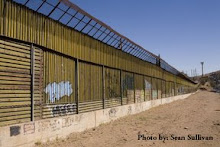
The Center for Biological Diversity has issued the following press release. No Border Wall is in complete agreement, and urges rational members of Congress to reject McCain's amendment to the DHS appropriations bill, along with similar measures in the House, most notably HR 1505.
TUCSON, Ariz.— Under the guise of border security, Sen. John McCain (R-Ariz.) offered an amendment to the Department of Homeland Security appropriations bill today that would grant border-enforcement agencies free rein on federal lands within 300 miles of the U.S.-Mexico border. After criticism from colleagues in his own party that the 300-mile limit went far beyond the scope of border-enforcement activities, McCain scaled it back to 100 miles, and the amendment was added to the bill.
“Politicians are playing games with important border-security legislation at the expense of laws that protect clean air, water and endangered species,” said Randy Serraglio, a conservation advocate at the Center for Biological Diversity. “This amendment is unnecessary, unwanted and threatens significant harm to the wildlife, natural landscapes and people of the border region.”
The McCain amendment introduced today, similar to a bill proposed earlier this year by McCain and Sen. Jon Kyl (R-Ariz.), does not specifically name any laws, but its guarantee of unfettered access for border-enforcement agencies on federal lands effectively neutralizes protections afforded by the Endangered Species Act, Clean Air Act and Clean Water Act. Existing law permits essential border-security activities even in designated wilderness areas, and an existing memorandum of understanding between Homeland Security and the Department of the Interior provides for cooperation between land managers and border agencies.
“Despite repeated statements and congressional testimony from border-security agencies that they neither want nor need the authority granted in this amendment, radical anti-environment forces in Congress continue to push this hoax on the American people,” said Serraglio. “The losers in this game will be jaguars, ocelots, Sonoran pronghorn and residents of border communities that will no longer benefit from fundamental protections that allow them to live and thrive in a healthy environment.”
The nonpartisan Government Accountability Office concluded in a recent report that access to federal lands has not been limited in 22 of 26 sectors along the border, and that the only problems that have occurred in other sectors have been “minor delays.” Meanwhile, between 8,000 and 20,000 miles of wildcat roads have been blazed through a wilderness area in southern Arizona’s Cabeza Prieta National Wildlife Refuge, a majority of which, in recent years, has been caused by enforcement activities, according to a July report by the U.S. Fish and Wildlife Service.
“This amendment pretends to address a problem that does not exist,” said Serraglio. “Clearly, access to federal lands for border-security personnel is not a significant issue in achieving operational control of the border. At best, the McCain amendment is a case of political grandstanding.”
“The false premise inherent in this proposal is that border security and a healthy environment are somehow mutually exclusive,” said Serraglio. “The truth is just the opposite. It has been shown time and again that collaboration between land managers and security agencies enhances both border security and protection of the diverse and vibrant landscapes of the borderlands.”
http://www.biologicaldiversity.org/news/press_releases/2011/border-security-09-14-2011.html
Wednesday, September 14, 2011


Monday, August 29, 2011
New Study: Border Hysteria Imperils Wildlife
by Dan Millis
In a Congress plagued by immigration hysteria, none is more gravely afflicted than South Carolina’s Republican Senator Jim DeMint. Twice in two weeks he added border pork to Senate bills, both times calling for 300-plus miles of walls to be imposed between the U.S. and Mexico. These are the fourth and fifth times in less than two years that he has made such attempts.
Delirious and angry lawmakers like DeMint seem oblivious to the 650 miles of barriers and walls that already occupy the Southwest’s borderlands, exacting high costs on taxpayers and public lands. Another side effect these lawmakers suffer is an acute indifference to the impacts caused by their border madness.
A new study in the Diversity and Distributions journal identifies 49 species put most at risk by border walls and areas of intensive human land use along the U.S.-Mexico border. The study only considers amphibian, reptile, and non-volant (don't fly) mammal species, and identifies California, the Sky Islands, the Gulf Coast as the three regions most heavily impacted.
One unique aspect of this study is that it doesn’t just look at current impacts wrought by existing border walls and areas with a heavy human footprint. Potential future impacts from border wall expansions such as those proposed by DeMint are also taken into consideration, and the results are sobering:

This graph from the study shows a horizontal base line representing our 2,000 mile border with Mexico. The three faint vertical lines in the left half of the graph represent the state borders between California, Arizona, New Mexico, and Texas. The fatter horizontal line sitting atop the baseline shows where the taller “pedestrian” (10-25 feet tall) border walls are located along the border.
Then there is the vertical ‘species’ scale, which includes only species from the sample set that have already been listed as threatened, either binationally or by the International Union for the Conservation of Nature. The dashed line represents how many of these already-threatened species are put in grave danger by existing “pedestrian” border walls in each geographic location along the border. You’ll notice that there are few such species, which may be expected when working with such a small sample set of species to begin with.
However, the solid line is much less benign, with the number of vulnerable species spiking most dramatically here in Arizona (to the right [East] of first faint vertical line [CA-AZ border]). This line represents the number of already threatened species that would be pushed to the brink if proposals like DeMint’s were passed and border walls came to occupy even more precious habitat.

A key finding of the study states, "The REAL ID Act should be amended to reinstate environmental regulation of border security efforts." The REAL ID waiver of more than 30 vital federal protection laws along the border allowed walls to be built in violation of the Wilderness Act, the Endangered Species Act, and more.
Dan Millis is a Sierra Club Borderlands campaign organizer. To learn more about the Sierra Club's Borderlands Campaign visit http://sierraclub.org/borderlands/
Monday, August 15, 2011
Our Worst Fears about the Border Wall Come True
By Stefanie Herweck
More human beings would die alone in remote deserts. Endangered species would be pushed to the brink. These were the fears that led humanitarians, environmentalists, and border residents to object to the walls along the U.S.-Mexico border called for by the Secure Fence Act of 2006. With 650 miles built, this summer has brought news that these fears are tragically coming true.
The journey taken by migrant men, women and children who set out across the U.S.-Mexico border has always been risky. But border walls have rerouted migrants away from the safety of urban areas and forced them to walk for greater distances over treacherous mountains and through searing deserts. All too easily they can become fatigued, dehydrated, and unable to go on. In too many cases, they die alone in remote areas.
This month an Arizona Daily Star analysis found that migrants today are almost three times more likely to die on their journey than people who crossed in 2006, the year before the walls began to go up. In fact, the rate of death—the number of deaths per 100,000 Border Patrol apprehensions—continues to increase even as fewer people are making the trek across the border.
Before the walls, in 2006, there were just 46 known deaths per 100,000 Border Patrol apprehensions. By 2010 the number had jumped to 118 known deaths per 100,000 apprehensions, and so far 2011 already has a death rate of 129 per 100,000.
These human beings are also dying deeper in the desert and much further from roads than ever before. Because of the remoteness of the areas in which they die, many of the bodies discovered are just skeletal remains. Such are the real and tragic consequences of border walls.
The same walls that are pushing crossers deeper into deadly terrain slice though nature preserves that were established to protect endangered species. The Otay Mountain Wilderness Area, Organ Pipe Cactus National Monument, and Lower Rio Grande Valley National Wildlife Refuge have seen critical wildlife habitat divided by walls. Environmentalists have argued that vulnerable species like the ocelot, whose U.S. population is less than 100 individuals in South Texas, would be walled off and trapped in small fragments of habitat. Without sufficient food, water, and potential mates, the population would dwindle.
Now scientists are beginning to uncover just how extensive the wall’s impacts are likely to be on endangered species. A recent article published in the journal Diversity and Distributions found that border walls impact 23 endangered species border-wide. Some species in California are blocked from as much as 75 percent of their ranges, a circumstance that makes the isolated populations extremely vulnerable to disease or natural disasters. The study also found that in South Texas border walls impact between 60 percent and 70 percent of the habitat set aside for endangered ocelots in the Lower Rio Grande Valley National Wildlife Refuge.
In 2008 the Department of Homeland Security (DHS) recognized that the border wall had damaged wildlife refuges along the border, and Congress appropriated $50 million to mitigate the effects of the wall border-wide. Money was promised to the Lower Rio Grande Valley National Wildlife Refuge to purchase land to replace the ocelot habitat that the border walls fragmented. But after DHS withheld the money for years, Congress took back the funds. DHS has no further plans to fix any of the environmental damage that its border walls have caused.
As predicted, the border wall has exacerbated the ongoing humanitarian crisis of migrant deaths and has devastated the environment. Nevertheless, some in Congress are calling for more walls and looking to strip border communities of their environmental protections under the pretense of border security.
Dan Millis has witnessed first-hand the human tragedy and environmental devastation unfolding daily along the U.S.-Mexico border. Shortly after finding the lifeless body of a young girl along a migrant trail in Arizona, Dan was convicted of littering for leaving bottles of clean water along trails in the same area. He now works for the Sierra Club in Tucson fighting on behalf of the people and places victimized by border walls and enforcement-only politics.
Dan will visit Texas' Rio Grande Valley to share his experiences, and discuss the impacts of flawed U.S. border policy and how you can make a difference on Monday evening, August 22nd at 7:00 pm at Galeria 409 in Brownsville and on Tuesday August 23rd at 7:00 pm at St. John the Baptist Parish Hall in San Juan. For more information and directions, visit valleygreenspace.wordpress.com.
As border residents we need to educate ourselves about the terrible consequences of border walls and enforcement-only policies all along the border, and then inform our elected leaders.
Stefanie Herweck is chair of the Lower Rio Grande Valley Sierra Club.
More human beings would die alone in remote deserts. Endangered species would be pushed to the brink. These were the fears that led humanitarians, environmentalists, and border residents to object to the walls along the U.S.-Mexico border called for by the Secure Fence Act of 2006. With 650 miles built, this summer has brought news that these fears are tragically coming true.
The journey taken by migrant men, women and children who set out across the U.S.-Mexico border has always been risky. But border walls have rerouted migrants away from the safety of urban areas and forced them to walk for greater distances over treacherous mountains and through searing deserts. All too easily they can become fatigued, dehydrated, and unable to go on. In too many cases, they die alone in remote areas.
This month an Arizona Daily Star analysis found that migrants today are almost three times more likely to die on their journey than people who crossed in 2006, the year before the walls began to go up. In fact, the rate of death—the number of deaths per 100,000 Border Patrol apprehensions—continues to increase even as fewer people are making the trek across the border.
Before the walls, in 2006, there were just 46 known deaths per 100,000 Border Patrol apprehensions. By 2010 the number had jumped to 118 known deaths per 100,000 apprehensions, and so far 2011 already has a death rate of 129 per 100,000.
These human beings are also dying deeper in the desert and much further from roads than ever before. Because of the remoteness of the areas in which they die, many of the bodies discovered are just skeletal remains. Such are the real and tragic consequences of border walls.
The same walls that are pushing crossers deeper into deadly terrain slice though nature preserves that were established to protect endangered species. The Otay Mountain Wilderness Area, Organ Pipe Cactus National Monument, and Lower Rio Grande Valley National Wildlife Refuge have seen critical wildlife habitat divided by walls. Environmentalists have argued that vulnerable species like the ocelot, whose U.S. population is less than 100 individuals in South Texas, would be walled off and trapped in small fragments of habitat. Without sufficient food, water, and potential mates, the population would dwindle.
Now scientists are beginning to uncover just how extensive the wall’s impacts are likely to be on endangered species. A recent article published in the journal Diversity and Distributions found that border walls impact 23 endangered species border-wide. Some species in California are blocked from as much as 75 percent of their ranges, a circumstance that makes the isolated populations extremely vulnerable to disease or natural disasters. The study also found that in South Texas border walls impact between 60 percent and 70 percent of the habitat set aside for endangered ocelots in the Lower Rio Grande Valley National Wildlife Refuge.
In 2008 the Department of Homeland Security (DHS) recognized that the border wall had damaged wildlife refuges along the border, and Congress appropriated $50 million to mitigate the effects of the wall border-wide. Money was promised to the Lower Rio Grande Valley National Wildlife Refuge to purchase land to replace the ocelot habitat that the border walls fragmented. But after DHS withheld the money for years, Congress took back the funds. DHS has no further plans to fix any of the environmental damage that its border walls have caused.
As predicted, the border wall has exacerbated the ongoing humanitarian crisis of migrant deaths and has devastated the environment. Nevertheless, some in Congress are calling for more walls and looking to strip border communities of their environmental protections under the pretense of border security.
Dan Millis has witnessed first-hand the human tragedy and environmental devastation unfolding daily along the U.S.-Mexico border. Shortly after finding the lifeless body of a young girl along a migrant trail in Arizona, Dan was convicted of littering for leaving bottles of clean water along trails in the same area. He now works for the Sierra Club in Tucson fighting on behalf of the people and places victimized by border walls and enforcement-only politics.
Dan will visit Texas' Rio Grande Valley to share his experiences, and discuss the impacts of flawed U.S. border policy and how you can make a difference on Monday evening, August 22nd at 7:00 pm at Galeria 409 in Brownsville and on Tuesday August 23rd at 7:00 pm at St. John the Baptist Parish Hall in San Juan. For more information and directions, visit valleygreenspace.wordpress.com.
As border residents we need to educate ourselves about the terrible consequences of border walls and enforcement-only policies all along the border, and then inform our elected leaders.
Stefanie Herweck is chair of the Lower Rio Grande Valley Sierra Club.
Friday, July 29, 2011
New Amendments Threaten Protected Lands
US representative Gosar has introduced two amendments (no. 20 and 55) to the Department of the Interior's annual appropriations bill that would do tremendous damage to our nation's protected federal lands. Representative Gosar’s (R-AZ) amendment No. 20 is an extreme attack on public lands even more overreaching than recent controversial legislation (H.R. 1505). Under this amendment the U.S. Border Patrol would be exempted from any regulation that would “impede or obstruct” patrol activities on every acre of federal land throughout the United States, putting national treasures at risk and throwing away a century of laws designed to protect our natural resources.
What federal lands would be put at risk?
• All of them. This amendment decimates environmental and other protections on every single acre of federally owned lands, from areas in the southwest already at risk from Border Patrol Activities, like the Cabeza Prieta National Wildlife Refuge in Arizona, to places far from the border, including the Grand Canyon, Yellowstone National Park, and the Cape Hatteras National Seashore.
• This amendment is NOT restricted to areas near the southwest border or even to areas near all borders, as past legislation has proposed.
What laws would be overturned?
• All of them. This amendment is even more overreaching in its impact on federal lands than the controversial H.R. 1505 because it is not restricted to a long list of environmental regulations, but prevents the enforcement of any regulation, even those put in place for safety and other reasons.
• Other regulations that could be completely ignored are those that support economic development, allowing Border Patrol to interfere with grazing, mining, and drilling for oil and gas on public lands.
What Border Patrol activities would be exempted from any oversight?
• All of them. The amendment does not clearly define what “impede or obstruct” means or who would decide whether a law or regulation meets this standard and could therefore be ignored.
• The amendment is even more overreaching than past bills on the Border Patrol because it does not limit exempted activities to “operational control” – or activities specifically intended to prevent illegal entry into the country. Instead it exempts all “patrol activities” which, without definition, could mean any activity undertaken by the Border Patrol.
• This will create conflict between agencies that have begun to work very effectively together to resolve issues surrounding Border Patrol activities.
Is the amendment even needed by the Border Patrol?
• No. The amendment would override multiagency coordination that has been occurring on Federal lands since a 2006 Memorandum of Agreement between the Departments of Homeland Security, Interior, and Agriculture that has led to increased cooperation and leveraged resources.
• 22 out of 26 Border Patrol stations on the southern border with Mexico report that the border security of their area of operation has not been affected by land management laws beyond some minor delays. Instead, factors like rugged terrain—and not access delays or restrictions—have the highest impact on operational control.
• Exemptions already exist that allow Border Patrol Officers in pursuit to continue onto any federal land regardless of regulations or laws. Other exemptions have also been established administratively to ensure the Border Patrol has the access necessary to secure the border.
In addition, Rep. Gosar has also introduced amendment No. 55, another extreme attack on federal lands. Similar to amendment No. 20, this amendment would exempt the Border Patrol from any environmental review, from protecting clean air and water, from honoring and respecting the history and culture of native people, from preserving biodiversity, and more.
Who isn’t hurt by this amendment?
Representative Gosar’s friends in industries like oil and gas drilling, grazing, mining, and logging are taken off the hook in this updated version of amendment No. 20. Amendment No. 20 exempts the Border Patrol from “any regulation” meaning that rules allowing for development and resources extraction could also be trampled by any Border Patrol activities. Amendment No. 55, however, spares these special interests and instead focuses its attack on the environment, biodiversity, and native people.
What environmental and cultural laws would be overturned?
A similar list of laws to that found in H.R. 1505 is included in the amendment. These laws represent a century of bipartisan efforts to protect the environment, intelligently manage public lands, and demonstrate respect for historical and cultural sites.
The exempted laws include:
The National Environmental Policy Act of 1969 (42 U.S.C. 4321 et seq.)
The Endangered Species Act of 1973 (16 U.S.C. 1531 et seq.)
The Clean Water Act (33 U.S.C. 1251 et seq.)
The National Historic Preservation Act (16 U.S.C. 470 et seq.).
The Migratory Bird Treaty Act (16 U.S.C. 703 et seq.)
The Clean Air Act (42 U.S.C. 7401 et seq.).
The Archeological Resources Protection Act of 1979 (16 U.S.C. 18 470aa et seq.).
The Safe Drinking Water Act (42 U.S.C. 300f et seq.).
The Noise Control Act of 1972 (42 U.S.C. 4901 et seq.).
The Solid Waste Disposal Act (42 U.S.C. 6901 et seq.).
The Comprehensive Environmental Response, Compensation, and Liability Act of 1980 (42 U.S.C. 9601 et seq.)
The Archaeological and Historic Preservation Act' and the Archaeological Recovery Act (16 U.S.C. 469 et seq.).
The Antiquities Act (16 U.S.C. 431 et seq.).
The Historic Sites, Buildings, and Antiquities Act (16 U.S.C. 461 et seq.)
The Farmland Protection Policy Act (7 U.S.C. 4201 et seq.).
The Coastal Zone Management Act of 1972 (16 U.S.C. 1451 et seq.).
The Federal Land Policy and Management Act of 1976 (43 U.S.C. 1701 et seq.).
The Wilderness Act (16 U.S.C. 1131 et seq.).
The Bald Eagle Protection Act of 1940 (16 U.S.C. 668 et seq.).
The Native American Graves Protection and Repatriation Act (25 U.S.C. 3001 et seq.).
The American Indian Religious Freedom Act (42 U.S.C. 1996 et seq.).
The Religious Freedom Restoration Act of 1993 (42 U.S.C. 2000bb et seq.).
The Federal Grant and Cooperative Agreement Act of 1977 (31 U.S.C. 6303 et seq.)
What Species would be impacted?
The bill waives compliance with all provisions of the ESA on federal lands. Species throughout the nation that would be impacted include
In the Southwest
• Mexican spotted owl
• Desert tortoise
• Jaguar
• Ocelot
• Sonoran pronghorn
• Chiricahua leopard frog
Elsewhere in the country
• Florida Panther
• Canada lynx
• Polar bear
• Hawaii akepa (honeycreeper)
• Leatherback sea turtle
• West Indian manatee
What federal lands would be put at risk?
• All of them. This amendment decimates environmental and other protections on every single acre of federally owned lands, from areas in the southwest already at risk from Border Patrol Activities, like the Cabeza Prieta National Wildlife Refuge in Arizona, to places far from the border, including the Grand Canyon, Yellowstone National Park, and the Cape Hatteras National Seashore.
• This amendment is NOT restricted to areas near the southwest border or even to areas near all borders, as past legislation has proposed.
What laws would be overturned?
• All of them. This amendment is even more overreaching in its impact on federal lands than the controversial H.R. 1505 because it is not restricted to a long list of environmental regulations, but prevents the enforcement of any regulation, even those put in place for safety and other reasons.
• Other regulations that could be completely ignored are those that support economic development, allowing Border Patrol to interfere with grazing, mining, and drilling for oil and gas on public lands.
What Border Patrol activities would be exempted from any oversight?
• All of them. The amendment does not clearly define what “impede or obstruct” means or who would decide whether a law or regulation meets this standard and could therefore be ignored.
• The amendment is even more overreaching than past bills on the Border Patrol because it does not limit exempted activities to “operational control” – or activities specifically intended to prevent illegal entry into the country. Instead it exempts all “patrol activities” which, without definition, could mean any activity undertaken by the Border Patrol.
• This will create conflict between agencies that have begun to work very effectively together to resolve issues surrounding Border Patrol activities.
Is the amendment even needed by the Border Patrol?
• No. The amendment would override multiagency coordination that has been occurring on Federal lands since a 2006 Memorandum of Agreement between the Departments of Homeland Security, Interior, and Agriculture that has led to increased cooperation and leveraged resources.
• 22 out of 26 Border Patrol stations on the southern border with Mexico report that the border security of their area of operation has not been affected by land management laws beyond some minor delays. Instead, factors like rugged terrain—and not access delays or restrictions—have the highest impact on operational control.
• Exemptions already exist that allow Border Patrol Officers in pursuit to continue onto any federal land regardless of regulations or laws. Other exemptions have also been established administratively to ensure the Border Patrol has the access necessary to secure the border.
In addition, Rep. Gosar has also introduced amendment No. 55, another extreme attack on federal lands. Similar to amendment No. 20, this amendment would exempt the Border Patrol from any environmental review, from protecting clean air and water, from honoring and respecting the history and culture of native people, from preserving biodiversity, and more.
Who isn’t hurt by this amendment?
Representative Gosar’s friends in industries like oil and gas drilling, grazing, mining, and logging are taken off the hook in this updated version of amendment No. 20. Amendment No. 20 exempts the Border Patrol from “any regulation” meaning that rules allowing for development and resources extraction could also be trampled by any Border Patrol activities. Amendment No. 55, however, spares these special interests and instead focuses its attack on the environment, biodiversity, and native people.
What environmental and cultural laws would be overturned?
A similar list of laws to that found in H.R. 1505 is included in the amendment. These laws represent a century of bipartisan efforts to protect the environment, intelligently manage public lands, and demonstrate respect for historical and cultural sites.
The exempted laws include:
The National Environmental Policy Act of 1969 (42 U.S.C. 4321 et seq.)
The Endangered Species Act of 1973 (16 U.S.C. 1531 et seq.)
The Clean Water Act (33 U.S.C. 1251 et seq.)
The National Historic Preservation Act (16 U.S.C. 470 et seq.).
The Migratory Bird Treaty Act (16 U.S.C. 703 et seq.)
The Clean Air Act (42 U.S.C. 7401 et seq.).
The Archeological Resources Protection Act of 1979 (16 U.S.C. 18 470aa et seq.).
The Safe Drinking Water Act (42 U.S.C. 300f et seq.).
The Noise Control Act of 1972 (42 U.S.C. 4901 et seq.).
The Solid Waste Disposal Act (42 U.S.C. 6901 et seq.).
The Comprehensive Environmental Response, Compensation, and Liability Act of 1980 (42 U.S.C. 9601 et seq.)
The Archaeological and Historic Preservation Act' and the Archaeological Recovery Act (16 U.S.C. 469 et seq.).
The Antiquities Act (16 U.S.C. 431 et seq.).
The Historic Sites, Buildings, and Antiquities Act (16 U.S.C. 461 et seq.)
The Farmland Protection Policy Act (7 U.S.C. 4201 et seq.).
The Coastal Zone Management Act of 1972 (16 U.S.C. 1451 et seq.).
The Federal Land Policy and Management Act of 1976 (43 U.S.C. 1701 et seq.).
The Wilderness Act (16 U.S.C. 1131 et seq.).
The Bald Eagle Protection Act of 1940 (16 U.S.C. 668 et seq.).
The Native American Graves Protection and Repatriation Act (25 U.S.C. 3001 et seq.).
The American Indian Religious Freedom Act (42 U.S.C. 1996 et seq.).
The Religious Freedom Restoration Act of 1993 (42 U.S.C. 2000bb et seq.).
The Federal Grant and Cooperative Agreement Act of 1977 (31 U.S.C. 6303 et seq.)
What Species would be impacted?
The bill waives compliance with all provisions of the ESA on federal lands. Species throughout the nation that would be impacted include
In the Southwest
• Mexican spotted owl
• Desert tortoise
• Jaguar
• Ocelot
• Sonoran pronghorn
• Chiricahua leopard frog
Elsewhere in the country
• Florida Panther
• Canada lynx
• Polar bear
• Hawaii akepa (honeycreeper)
• Leatherback sea turtle
• West Indian manatee
Thursday, July 7, 2011
How much do border walls cost? Just the facts:
There is a wide cost range for the construction of pedestrian border walls, resulting from factors which include labor (some sections were built by members of the National Guard, while others were built by private contractors); topography; remote vs. urban locations; land purchases and condemnations; materials (wall sections built in the 1990’s used scrap metal, obtained from the military for free, while more recent sections have required the purchase of concrete, steel, etc.); and the design that is being utilized.
In October 2008 the Houston Chronicle reported that “The Army Corps of Engineers estimated that the amount spent for pedestrian fencing has jumped 88 percent since February to $7.5 million per mile. The costs for vehicle barriers have increased 40 percent to $2.8 million per mile, according to the GAO.”
“As border fence lags, costs, controversy rise” by Stewart Powell, Houston Chronicle, October 10, 2008
http://www.chron.com/disp/story.mpl/metropolitan/6052544.html
In January, 2009, the Government Accountability Office (GAO) reported that costs for sections built up to that point ranged from $400,000 to $15.1 million. They also noted that these cost estimates were not independently verified and, “An Independent Auditor's Report on DHS's Fiscal Year 2008 Financial Statements found that CBP did not have adequate policies and procedures in place to properly account for steel purchases and construction of the U.S. border fence in an accurate and timely manner. As a result, for several months throughout the year, CBP’s financial statements did not accurately reflect the construction activity.”
Secure Border Initiative Fence Construction Costs, United States Government Accountability Office, January 29, 2009
http://www.gao.gov/new.items/d09244r.pdf
The GAO’s January 2009 report only included border wall sections that had been completed, not those which were under construction or in various stages of planning.
Sections that were later constructed included the 3.6 miles of pedestrian border wall built through the Otay Mountain Wilderness Area, at a cost of $57.7 million, averaging just over $16 million per mile.
“$57.7-million fence added to an already grueling illegal immigration route” by Richard Marosi, Los Angeles Times, February 15, 2010
http://articles.latimes.com/2010/feb/15/local/la-me-fence15-2010feb15
Also unfinished at the time were the border wall and earthen berm blocking Smuggler’s Gulch, near San Diego, which cost $59 million for 3.5 miles, averaging $16.8 million per mile.
“A Barren Promise at the Border” by Rob Davis, Voice of San Diego, October 22, 2009http://www.voiceofsandiego.org/environment/article_13330282-1245-5e49-bd68-5a10237c9f44.html
According to the GAO it will cost an estimated $75 million per year to maintain border walls. As of mid-May 2009, the fence had been breached more than 3,300 times, with costs to repair each breach averaging $1,300.
Secure Border Initiative: Technology Deployment Delays Persist and the Impact of Border Fencing Has Not Been Assessed, Government Accountability Office, September 2009
http://www.gao.gov/new.items/d09896.pdf
In 2011 the GAO stated that “CBP estimated that the border fencing had a life cycle of 20 years and over these years, a total estimated cost of about $6.5 billion to deploy, operate, and maintain the fencing and other infrastructure. According to CBP, during fiscal year 2010, there were 4,037 documented and repaired breaches of the fencing and CBP spent at least $7.2 million to repair the breaches, or an average of about $1,800 per breach.”
BORDER SECURITY: DHS Progress and Challenges in Securing the U.S. Southwest and Northern Borders, United States Government Accountability Office, March 30, 2011
http://www.gao.gov/new.items/d11508t.pdf
In the spring and summer of 2011, CBP replaced 2.77 miles of existing “landing mat” fence in Nogales, which had suffered numerous breaches, with “bollard” fencing, at a cost of $11.6 million.
“Barrier Rebuilt” by Margaret Regan, Tucson Weekly, June 23, 2011
http://www.tucsonweekly.com/tucson/barrier-rebuilt/Content?oid=3028495
In 2010 the GAO reported that “Since fiscal year 2006, DHS has received about $4.4 billion in appropriations for SBI, including about $2.5 billion for physical fencing and related infrastructure, about $1.5 billion for virtual fencing (e.g., surveillance systems) and related infrastructure (e.g., towers), and about $300 million for program management.”
SECURE BORDER INITIATIVE: DHS Needs to Strengthen Management and Oversight of Its Prime Contractor, United States Government Accountability Office, October, 2010
http://www.gao.gov/new.items/d116.pdf
In October 2008 the Houston Chronicle reported that “The Army Corps of Engineers estimated that the amount spent for pedestrian fencing has jumped 88 percent since February to $7.5 million per mile. The costs for vehicle barriers have increased 40 percent to $2.8 million per mile, according to the GAO.”
“As border fence lags, costs, controversy rise” by Stewart Powell, Houston Chronicle, October 10, 2008
http://www.chron.com/disp/story.mpl/metropolitan/6052544.html
In January, 2009, the Government Accountability Office (GAO) reported that costs for sections built up to that point ranged from $400,000 to $15.1 million. They also noted that these cost estimates were not independently verified and, “An Independent Auditor's Report on DHS's Fiscal Year 2008 Financial Statements found that CBP did not have adequate policies and procedures in place to properly account for steel purchases and construction of the U.S. border fence in an accurate and timely manner. As a result, for several months throughout the year, CBP’s financial statements did not accurately reflect the construction activity.”
Secure Border Initiative Fence Construction Costs, United States Government Accountability Office, January 29, 2009
http://www.gao.gov/new.items/d09244r.pdf
The GAO’s January 2009 report only included border wall sections that had been completed, not those which were under construction or in various stages of planning.
Sections that were later constructed included the 3.6 miles of pedestrian border wall built through the Otay Mountain Wilderness Area, at a cost of $57.7 million, averaging just over $16 million per mile.
“$57.7-million fence added to an already grueling illegal immigration route” by Richard Marosi, Los Angeles Times, February 15, 2010
http://articles.latimes.com/2010/feb/15/local/la-me-fence15-2010feb15
Also unfinished at the time were the border wall and earthen berm blocking Smuggler’s Gulch, near San Diego, which cost $59 million for 3.5 miles, averaging $16.8 million per mile.
“A Barren Promise at the Border” by Rob Davis, Voice of San Diego, October 22, 2009http://www.voiceofsandiego.org/environment/article_13330282-1245-5e49-bd68-5a10237c9f44.html
According to the GAO it will cost an estimated $75 million per year to maintain border walls. As of mid-May 2009, the fence had been breached more than 3,300 times, with costs to repair each breach averaging $1,300.
Secure Border Initiative: Technology Deployment Delays Persist and the Impact of Border Fencing Has Not Been Assessed, Government Accountability Office, September 2009
http://www.gao.gov/new.items/d09896.pdf
In 2011 the GAO stated that “CBP estimated that the border fencing had a life cycle of 20 years and over these years, a total estimated cost of about $6.5 billion to deploy, operate, and maintain the fencing and other infrastructure. According to CBP, during fiscal year 2010, there were 4,037 documented and repaired breaches of the fencing and CBP spent at least $7.2 million to repair the breaches, or an average of about $1,800 per breach.”
BORDER SECURITY: DHS Progress and Challenges in Securing the U.S. Southwest and Northern Borders, United States Government Accountability Office, March 30, 2011
http://www.gao.gov/new.items/d11508t.pdf
In the spring and summer of 2011, CBP replaced 2.77 miles of existing “landing mat” fence in Nogales, which had suffered numerous breaches, with “bollard” fencing, at a cost of $11.6 million.
“Barrier Rebuilt” by Margaret Regan, Tucson Weekly, June 23, 2011
http://www.tucsonweekly.com/tucson/barrier-rebuilt/Content?oid=3028495
In 2010 the GAO reported that “Since fiscal year 2006, DHS has received about $4.4 billion in appropriations for SBI, including about $2.5 billion for physical fencing and related infrastructure, about $1.5 billion for virtual fencing (e.g., surveillance systems) and related infrastructure (e.g., towers), and about $300 million for program management.”
SECURE BORDER INITIATIVE: DHS Needs to Strengthen Management and Oversight of Its Prime Contractor, United States Government Accountability Office, October, 2010
http://www.gao.gov/new.items/d116.pdf
Thursday, June 9, 2011
Border Skirmish: Republicans Are Using Immigrants to Bash Our Wilderness
by Char Miller
It would be nice if Congress held executive-branch agencies accountable for their actions. Or insisted that they follow federal law. Or fulfill their fiduciary responsibilities to one another.
But the Republican-controlled House of Representatives is making a mockery of these basic rules of order and good government.
You won't be surprised that the latest bit of GOP chicanery involves its twin obsessions: the U.S-Mexico Border and national environmental regulations. Their hyperventilating defense of the former, as I've noted before, comes with blustery assaults on the latter.
Since November, Utah representative Rob Bishop, chair of the House subcommittee on public lands, along with his gal pal, Cynthia Lummis (R-WY), and a host of fellow travelers, have mounted an incessant campaign to allow the U. S. Border Patrol to ignore key provisions of the Wilderness Act, the Endangered Species Act, and other vital environmental laws.
Arguing that such legislation impedes the Border Patrol's capacity to defend the nation against undocumented migrants, they have filed amendments and riders to pending legislation, called public hearings to lambaste officials of the Department of Interior, and penned fulminating op-eds to rouse the party's extremist base.
Their most recent gambit came late last week in the form of an amendment to the Department of Homeland Security's appropriation. Rep. Lummis proposed, and a lock-step Republican vote secured, a rule prohibiting DHS from transferring funds to the Department of the Interior.
These moneys would have been used to mitigate the oft-intense environmental damage resulting from the construction of the infamous border wall across federal wildlife refuges, wildlands, and preserves, in such places as the Rio Grande Valley; Arizona's Organ Pipe Cactus National Monument; and the Otay Wilderness near San Diego. And from the spinning wheels of its high-speed patrols that can tear up wildlife habitat or damage sensitive ecosystems.
Such mitigation, required by law, is also sanctioned through longstanding practice among localities, states, and the federal government. It is also a matter of committed environmental stewardship.
Neither the precedent nor the principle matters to contemporary Republicans. In a "Dear Colleague" letter that Bishop, Rep. Doc Hastings (R-WA), chair of the Natural Resources Committee, and Rep. Peter King (R-NY), chair of the Committee on Homeland Security sent out in support of Lummis' amendment, they thrilled at its anti-environmentalism: "the amendment would strike language in the bill that allows these funds to be used by the Interior Department to purchase even more land. Additional federal land acquisition only exacerbates the problem by limiting access to even more land and further bloating the federal estate--at a time when the government cannot even afford to provide the basic care and maintenance needed for existing national parks and other lands."
(Query: why can't the government afford to take care of its treasured public lands? Answer: drastic Republican budget cuts!)
Lummis heaps just as much scorn on the legal obligations and moral responsibilities the government has for protecting our public lands: "Every day our nation's border patrol fights to protect our country against increasingly sophisticated criminal networks that produce and smuggle illegal drugs, and people, into America," she fumed. "Unfortunately, DOI policies have tied the hands of Border Patrol agents, who need access to federal lands to carry out their constitutional responsibility to secure the border."
Her allegation is bogus. The very same Government Accountability Office report that Lummis and Bishop routinely cite as evidence that environmental regulations have handcuffed the Border Patrol, in fact reached the opposite conclusion. In mid-April, for instance, the GAO found that "22 of the 26 patrol agents-in-charge reported that the overall security status of their jurisdiction had not been affected by land management laws. Instead, factors such as the remoteness and ruggedness of the terrain have had the greatest effect on their ability to achieve operational control in these areas."
The report also revealed that the four patrol agents-in-charge who had "reported that delays and restrictions had affected their ability to achieve or maintain operational control," admitted they "either had not requested resources for increased or timelier access or their requests had been denied by senior Border Patrol officials because of higher priority needs of the agency."
Moreover, the GAO investigation demonstrated that relevant agencies out in the field and inside the Beltway have developed close working relations. To argue otherwise, as Lummis and Bishop reflexively do, is to perpetuate a fraud.
Ah, but why let the facts get in your way when you can wrap yourself in the flag as protective cover? Trumpets Lummis: "our nation's security should be our top priority." Wilderness be damned.
Such a blinkered public policy, in point of fact, will lead us into damnation. That's the potent message embedded in Aldo Leopold's private correspondence and his brilliant conservation classic, Sand County Almanac (1948).
Arguing that wilderness is an irreplaceable part of our "cultural inheritance," and that even then was in precious, dwindling supply--it is a "resource that can shrink but cannot grow"--Leopold urged his fellow citizens to defend these beleaguered lands against those with a narrowly conceived notion of homeland securityhttp://www.blogger.com/img/blank.gif. "If we lose our wilderness, we have nothing left...worth fighting for."
Note, please, that Leopold was a Republican.
Char Miller is the Director and W.M. Keck Professor of Environmental Analysis at Pomona College, and editor of the just-published "Cities and Nature in the American West."
Reprinted with the author's permission, this essay was originally posted at KCET:
http://www.kcet.org/updaily/socal_focus/commentary/border-skirmish-republicans-are-using-immigrants-to-bash-our-wilderness-34146.html
It would be nice if Congress held executive-branch agencies accountable for their actions. Or insisted that they follow federal law. Or fulfill their fiduciary responsibilities to one another.
But the Republican-controlled House of Representatives is making a mockery of these basic rules of order and good government.
You won't be surprised that the latest bit of GOP chicanery involves its twin obsessions: the U.S-Mexico Border and national environmental regulations. Their hyperventilating defense of the former, as I've noted before, comes with blustery assaults on the latter.
Since November, Utah representative Rob Bishop, chair of the House subcommittee on public lands, along with his gal pal, Cynthia Lummis (R-WY), and a host of fellow travelers, have mounted an incessant campaign to allow the U. S. Border Patrol to ignore key provisions of the Wilderness Act, the Endangered Species Act, and other vital environmental laws.
Arguing that such legislation impedes the Border Patrol's capacity to defend the nation against undocumented migrants, they have filed amendments and riders to pending legislation, called public hearings to lambaste officials of the Department of Interior, and penned fulminating op-eds to rouse the party's extremist base.
Their most recent gambit came late last week in the form of an amendment to the Department of Homeland Security's appropriation. Rep. Lummis proposed, and a lock-step Republican vote secured, a rule prohibiting DHS from transferring funds to the Department of the Interior.
These moneys would have been used to mitigate the oft-intense environmental damage resulting from the construction of the infamous border wall across federal wildlife refuges, wildlands, and preserves, in such places as the Rio Grande Valley; Arizona's Organ Pipe Cactus National Monument; and the Otay Wilderness near San Diego. And from the spinning wheels of its high-speed patrols that can tear up wildlife habitat or damage sensitive ecosystems.
Such mitigation, required by law, is also sanctioned through longstanding practice among localities, states, and the federal government. It is also a matter of committed environmental stewardship.
Neither the precedent nor the principle matters to contemporary Republicans. In a "Dear Colleague" letter that Bishop, Rep. Doc Hastings (R-WA), chair of the Natural Resources Committee, and Rep. Peter King (R-NY), chair of the Committee on Homeland Security sent out in support of Lummis' amendment, they thrilled at its anti-environmentalism: "the amendment would strike language in the bill that allows these funds to be used by the Interior Department to purchase even more land. Additional federal land acquisition only exacerbates the problem by limiting access to even more land and further bloating the federal estate--at a time when the government cannot even afford to provide the basic care and maintenance needed for existing national parks and other lands."
(Query: why can't the government afford to take care of its treasured public lands? Answer: drastic Republican budget cuts!)
Lummis heaps just as much scorn on the legal obligations and moral responsibilities the government has for protecting our public lands: "Every day our nation's border patrol fights to protect our country against increasingly sophisticated criminal networks that produce and smuggle illegal drugs, and people, into America," she fumed. "Unfortunately, DOI policies have tied the hands of Border Patrol agents, who need access to federal lands to carry out their constitutional responsibility to secure the border."
Her allegation is bogus. The very same Government Accountability Office report that Lummis and Bishop routinely cite as evidence that environmental regulations have handcuffed the Border Patrol, in fact reached the opposite conclusion. In mid-April, for instance, the GAO found that "22 of the 26 patrol agents-in-charge reported that the overall security status of their jurisdiction had not been affected by land management laws. Instead, factors such as the remoteness and ruggedness of the terrain have had the greatest effect on their ability to achieve operational control in these areas."
The report also revealed that the four patrol agents-in-charge who had "reported that delays and restrictions had affected their ability to achieve or maintain operational control," admitted they "either had not requested resources for increased or timelier access or their requests had been denied by senior Border Patrol officials because of higher priority needs of the agency."
Moreover, the GAO investigation demonstrated that relevant agencies out in the field and inside the Beltway have developed close working relations. To argue otherwise, as Lummis and Bishop reflexively do, is to perpetuate a fraud.
Ah, but why let the facts get in your way when you can wrap yourself in the flag as protective cover? Trumpets Lummis: "our nation's security should be our top priority." Wilderness be damned.
Such a blinkered public policy, in point of fact, will lead us into damnation. That's the potent message embedded in Aldo Leopold's private correspondence and his brilliant conservation classic, Sand County Almanac (1948).
Arguing that wilderness is an irreplaceable part of our "cultural inheritance," and that even then was in precious, dwindling supply--it is a "resource that can shrink but cannot grow"--Leopold urged his fellow citizens to defend these beleaguered lands against those with a narrowly conceived notion of homeland securityhttp://www.blogger.com/img/blank.gif. "If we lose our wilderness, we have nothing left...worth fighting for."
Note, please, that Leopold was a Republican.
Char Miller is the Director and W.M. Keck Professor of Environmental Analysis at Pomona College, and editor of the just-published "Cities and Nature in the American West."
Reprinted with the author's permission, this essay was originally posted at KCET:
http://www.kcet.org/updaily/socal_focus/commentary/border-skirmish-republicans-are-using-immigrants-to-bash-our-wilderness-34146.html
Friday, May 20, 2011
Congressional Nightmares Fuel a New Assault on our Borderlands
By Scott Nicol
In his recent speech in El Paso President Obama pointed to the buildup of border security personnel and infrastructure, and declining crime rates in border communities, to justify a renewed effort to enact immigration reform. This will be a tough sell in the current Congress.
Just three weeks earlier the difficulty of his task was on display in Washington DC when Representative Jason Chaffetz (R-UT) displayed photos of headless corpses while shouting at Ron Vitiello, Deputy Chief of the US Border Patrol, during a committee hearing. Vitiello had enraged Representative Chaffetz by calmly asserting that, “While there is still work to be done, every key measure shows we are making significant progress along the Southwest border.”
The horrific pictures were not taken within U.S. borders, and so were outside of the Border Patrol’s jurisdiction, despite Chaffetz’ cries that “This is the kind of thing that we’re sending our agents to deal with on a daily basis!”
Chaffetz’ anger boiled over because Deputy Chief Vitiello was not following the Congressman’s script. The facts, that border communities are safe and apprehensions are down, were not welcome.
The Congressional hearing was intended to paint a picture of the U.S. southern border as a war zone, awash in blood and the mutilated bodies of innocents. In this telling, the Border Patrol fights valiantly to achieve “operational control” and quell the violence, but it is hamstrung by environmental laws and federal land managers who care more about endangered species than human life.
It was meant to promote HR 1505, the misnamed “National Security and Federal Lands Protection Act.” Starting with the premise that the Border Patrol has been prevented from entering federal wildlife refuges, wilderness areas, and national monuments along the southern border, it gives the Border Patrol carte blanche on federal lands.
Like the photos of headless bodies, this provision is based on a false impression of our southern border. The Border Patrol and federal land management agencies signed a cooperative agreement in 2006 allowing access to protected lands that Vitiello said works well. Rugged terrain and remote locations are the real problems reported by agents in the field, not restrictions imposed by land managers.
The bill goes on to exempt the Border Patrol from obeying dozens of environmental laws.
Its precursor, the Real ID Act, was used in 2008 to waive 36 laws along the southern border to erect border walls. The Endangered Species Act, Clean Water Act, and National Environmental Policy Act were among those brushed aside to allow for construction that otherwise would have violated them. This resulted in severe environmental damage.
HR 1505 extends the 2008 waivers to cover all of the U.S. – Mexico border, the Canadian border, all maritime borders, and every square inch of terrain within 100 miles of them.
The waiver covers some of our nation’s most important protected areas, from Glacier National Park and the Boundary Waters to Redwood National Park and the Cape Cod National Seashore. Two-thirds of the population of the United States would also fall under the waiver.
Instead of thanking the Congressmen for freeing the Border Patrol from these legal burdens, Deputy Chief Vitiello undermined HR 1505’s premise. He confirmed the Government Accountability Office finding that “Most agents reported that land management laws have had no effect on Border Patrol’s overall measure of border security.”
The photos of headless bodies were displayed in an effort to discredit the Border Patrol’s testimony, and to burn a brutal image into viewers’ minds that would overwhelm the facts that Vitiello presented.
The angry tirades aimed at the Border Patrol made it clear that the “National Security and Federal Lands Protection Act” really has nothing to do with national security. It does not help the Border Patrol, and they did not ask for it. It is nothing more than an assault on our nation’s public lands and environmental laws.
Speaking within sight of the border, President Obama said that “despite a lot of breathless reports that have tagged places like El Paso as dangerous… El Paso and other cities and towns along this border are consistently among the safest in the nation.”
America cannot develop rational policies that protect border residents and ecosystems by picking and choosing facts any more than we can support the rule of law by cherry picking which laws to obey and waiving the rest. With members of congress choosing fear over facts, ungrounded nightmares instead of FBI statistics, the reform that the president spoke of remains a distant dream.
Here is part one of the April 15 hearing on HR 1505
Here is part two. Rep. Chaffetz brandishes the photos of corpses around a half-hour into this clip.
In his recent speech in El Paso President Obama pointed to the buildup of border security personnel and infrastructure, and declining crime rates in border communities, to justify a renewed effort to enact immigration reform. This will be a tough sell in the current Congress.
Just three weeks earlier the difficulty of his task was on display in Washington DC when Representative Jason Chaffetz (R-UT) displayed photos of headless corpses while shouting at Ron Vitiello, Deputy Chief of the US Border Patrol, during a committee hearing. Vitiello had enraged Representative Chaffetz by calmly asserting that, “While there is still work to be done, every key measure shows we are making significant progress along the Southwest border.”
The horrific pictures were not taken within U.S. borders, and so were outside of the Border Patrol’s jurisdiction, despite Chaffetz’ cries that “This is the kind of thing that we’re sending our agents to deal with on a daily basis!”
Chaffetz’ anger boiled over because Deputy Chief Vitiello was not following the Congressman’s script. The facts, that border communities are safe and apprehensions are down, were not welcome.
The Congressional hearing was intended to paint a picture of the U.S. southern border as a war zone, awash in blood and the mutilated bodies of innocents. In this telling, the Border Patrol fights valiantly to achieve “operational control” and quell the violence, but it is hamstrung by environmental laws and federal land managers who care more about endangered species than human life.
It was meant to promote HR 1505, the misnamed “National Security and Federal Lands Protection Act.” Starting with the premise that the Border Patrol has been prevented from entering federal wildlife refuges, wilderness areas, and national monuments along the southern border, it gives the Border Patrol carte blanche on federal lands.
Like the photos of headless bodies, this provision is based on a false impression of our southern border. The Border Patrol and federal land management agencies signed a cooperative agreement in 2006 allowing access to protected lands that Vitiello said works well. Rugged terrain and remote locations are the real problems reported by agents in the field, not restrictions imposed by land managers.
The bill goes on to exempt the Border Patrol from obeying dozens of environmental laws.
Its precursor, the Real ID Act, was used in 2008 to waive 36 laws along the southern border to erect border walls. The Endangered Species Act, Clean Water Act, and National Environmental Policy Act were among those brushed aside to allow for construction that otherwise would have violated them. This resulted in severe environmental damage.
HR 1505 extends the 2008 waivers to cover all of the U.S. – Mexico border, the Canadian border, all maritime borders, and every square inch of terrain within 100 miles of them.
The waiver covers some of our nation’s most important protected areas, from Glacier National Park and the Boundary Waters to Redwood National Park and the Cape Cod National Seashore. Two-thirds of the population of the United States would also fall under the waiver.
Instead of thanking the Congressmen for freeing the Border Patrol from these legal burdens, Deputy Chief Vitiello undermined HR 1505’s premise. He confirmed the Government Accountability Office finding that “Most agents reported that land management laws have had no effect on Border Patrol’s overall measure of border security.”
The photos of headless bodies were displayed in an effort to discredit the Border Patrol’s testimony, and to burn a brutal image into viewers’ minds that would overwhelm the facts that Vitiello presented.
The angry tirades aimed at the Border Patrol made it clear that the “National Security and Federal Lands Protection Act” really has nothing to do with national security. It does not help the Border Patrol, and they did not ask for it. It is nothing more than an assault on our nation’s public lands and environmental laws.
Speaking within sight of the border, President Obama said that “despite a lot of breathless reports that have tagged places like El Paso as dangerous… El Paso and other cities and towns along this border are consistently among the safest in the nation.”
America cannot develop rational policies that protect border residents and ecosystems by picking and choosing facts any more than we can support the rule of law by cherry picking which laws to obey and waiving the rest. With members of congress choosing fear over facts, ungrounded nightmares instead of FBI statistics, the reform that the president spoke of remains a distant dream.
Here is part one of the April 15 hearing on HR 1505
Here is part two. Rep. Chaffetz brandishes the photos of corpses around a half-hour into this clip.
Subscribe to:
Posts (Atom)