Saturday, July 21, 2012

IBWC Approves New Border Walls Despite Flood Danger

By Scott Nicol
The U.S. half of the International Boundary and Water Commission (IBWC) has finally caved under pressure from Customs and Border Protection (CBP) and approved border walls in the Rio Grande floodplain adjacent to Roma, Rio Grande City, and Los Ebanos.    

Customs and Border Protection maps of the three new Rio Grande border wall sections

These three border wall sections, totaling 14 miles, were not built when other parts of the Rio Grande Valley were walled off because of the serious danger they pose to communities on both sides of the river.  On the U.S. side they could block the exit of flood water into the Rio Grande, bottling it up in towns and farm land and exacerbating the damage that they suffer.

They could also deflect flood waters towards Mexico, worsening flooding in Mexican communities.  Deflection might even cause the river to settle into a new channel farther to the south, which would effectively change the location of the border.  

In an attempt to lessen the amount of water that these walls will deflect into Mexican cities CBP designed them to channel flood waters north into the U.S. cities that they abut.  The walls will begin close to the Rio Grande, where during a flood water would be split off from the main channel.  As the river bends the mostly straight walls get farther from them, meaning that floodwater, along with all of the debris and garbage it carries, will be channeled into properties in the United States that might otherwise be spared from flooding. 

To make certain that water is channeled into the U.S. holes were planned for the middle of two of these wall sections – a 100 foot wide gap in the Roma wall, and a 275 foot wide gap in the Rio Grande City wall – explicitly intended to direct more water into these communities during a flood.

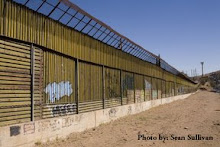
Existing border wall slicing through the Lower Rio Grande Valley National Wildlife Refuge

All three of the new border wall sections would also slice through the Lower Rio Grande Valley National Wildlife Refuge.  Established to create a wildlife corridor along the Rio Grande, the refuge provides habitat for critically endangered ocelot and jaguarundi.  Walls that have already been erected downriver repeatedly bisect and fragment the refuge, putting the future of the terrestrial species that it harbors in doubt.  The new walls would further fragment the refuge and cut off animals from the only reliable source of water in what US Fish and Wildlife has described as “some of the best habitat(s) in the U.S. along the final portion of the Rio Grande.”

In a February 15, 2012 letter John Merino, Principal Engineer for the US section of the International Boundary and Water Commission gave CBP the green light, saying, “the USIBWC has no objection to the erection of the fence segments within the limits of the Rio Grande floodplain.”  Merino dismissed the possibility that walls would deflect or obstruct flood waters, and stated flatly that USIBWC did not examine potential environmental impacts.  He also failed to mention the fact that for the previous five years both the U.S. and Mexican halves of the bi-national International Boundary and Water Commission had rejected the idea of placing border walls in the floodplain. 

Throughout 2007 and 2008 CBP tried without success to come up with a wall design for these last three sections that would not impact flooding, and that the IBWC would therefore approve.  Unable to convince the IBWC that walls in the floodplain would not act like dams, a DHS briefing from October 2, 2008, said of these three, “DHS likely to drop fence segments.”  When CBP informed Representative Henry Cuellar a few days after the 2008 election that these border wall sections were “on hold,” Cuellar called it “a big victory” for his district.

It would have made sense for Customs and Border Protection to decide that the Roma, Rio Grande City, and Los Ebanos walls were not worth risking lives and property to build.  Or, if bureaucracy outweighed humanity in their thinking, they might have called off wall construction in order to comply with the international treaty.

They also could have based a decision to spare them on a June 2008 internal Customs and Border Protection document that stated that “The Rio Grande Valley Sector Chief has determined that operational areas that contain the PF225 fence segments such as O-1 to O-2, O-12 through O-14, and O-17 through O-21 to be in “effectively controlled” level at the current time.”  Segments O-1 and O-2 are the Roma and Rio Grande City walls. 

Segments O-12 through O-14 are in Cameron County, near Los Indios.  Segments O-17 through O-21 encompass all of the wall sections in the vicinity of Brownsville, from the neighborhoods near the River Bend Golf Course west of town past the Sabal Palms Audubon Sanctuary and the Loop family orchard to the east.  Those who live in these areas and had their property condemned for border walls lost their land for nothing, because the local Border Patrol had determined that the area already under effective control before any walls were built.

Border wall segment O-21 under construction with the Sabal Palms Audubon Sanctuary south of it

Of course decisions about who will get walls and who will be spared are made in Washington DC, not the Rio Grande Valley. 

That simple fact helps to explain why Customs and Border Protection continued to push for these walls, shifting tactics from trying to convince Mexico that walls would not worsen flooding south of the border to pushing the US section of IBWC to allow for “unilateral” action – building walls in the face of Mexican objections, and thereby violating the international treaty.

After hurricane Alex roared into the Rio Grande Valley in 2010, followed by a tropical depression, the flooding Rio Grande forced the mandatory evacuation of Los Ebanos and parts of Rio Grande City.  With homes underwater and the evacuation order still in place, CBP hosted a meeting for the USIBWC and the State Department in Washington DC. 

At the DC meeting Customs and Border Protection did not mention the ongoing floods that were inundating the sites of the proposed walls, or the Border Patrol sector chief’s assessment that the area was “effectively controlled.”  Instead, CBP said that the three remaining walls were “critical to our Nation’s security,” and since Mexico continued to insist that they posed a flood hazard “we need [US]IBWC and Department of State’s support for an unilateral decision to proceed with the fence construction.”

Throughout 2010 USIBWC consistently rejected unilateral action, pointing out the likelihood of “substantial increases in water surface elevations and deflections of flow at several points of all three projects.”

But in late 2011 USIBWC reversed itself.  John Merino, the US section’s Principal Engineer, wrote to his Mexican counterpart to say that US IBWC had “concluded that the project will not cause significant deflection or obstruction of the normal or flood flows of the Rio Grande.” 

The Mexican section of the IBWC responded in December of 2011, saying,


Because the IBWC is a bi-national body, the rejection of one party should have brought this project to a halt.  Instead the US half of the IBWC approved the walls, allowing Customs and Border Protection to undertake the unilateral action that it had been pushing for.  This is a clear violation of the treaty that created both the IBWC and the border that Customs and Border Protection is supposed to protect.

But a treaty is just paper.  The real harm will come after the walls go up, when the next big storm roars into the Rio Grande Valley and the river floods. 

Sunday, May 20, 2012

The Grand Old Party Pushes for a Lawless Border

By Scott Nicol


Last month, the Pew Hispanic Center reported that net migration from Mexico into the United States has dropped to zero, with roughly the same number of Mexican citizens heading south across the border as north.

Just a few days earlier, HR 1505, the misnamed National Security and Federal Lands Protection Act, was introduced onto the floor of the U.S. House of Representatives by Representative Rob Bishop (R-Utah).  Aimed at stopping the flood of immigrants that Pew found are, in fact, not pouring over our borders, this bill waives 36 laws on all federal lands within 100 miles of both the northern and southern U.S. borders for any Border Patrol activity.  Forward operating bases, roads, and even more border walls could tear through national parks from Glacier to Olympic to Big Bend, as well as national forests, national monuments, wildlife refuges, and wilderness areas with no concern for the laws that protect natural ecosystems or human communities.


HR 1505 is a dramatic expansion of the Real ID Act, which gave the Secretary of Homeland Security the power to waive laws to build border walls and roads.  In 2008 former DHS Secretary Chertoff waived these same laws, which include the Endangered Species Act, Farmland Policy Protection Act, and the Native American Graves Protection and Repatriation Act to build walls that would otherwise have been illegal. 

The resulting damage has been tremendous.   Walls now carve up the Lower Rio Grande Valley National Wildlife Refuge, fragmenting habitat set aside for endangered ocelot and jaguarundi.  Up and down the Rio Grande, farmers and ranchers, some of whose families have held title to their land since the 1760’s, have had their property condemned.  And during border wall construction ancestral remains were unearthed and left exposed by bulldozers in the Tohono O’Odham reservation.

Now Representative Bishop, whose Utah district is hundreds of miles away from either border, wants to see this brutalizing of our borderlands expanded to cover lands that are nowhere near the border.  He has yet to explain why he believes that the Border Patrol is incapable of enforcing immigration laws without violating every other law.

For their part, the Border Patrol has not asked for the power to ignore our nation’s laws, and they have told Congressional researchers that “land management laws have had no effect on Border Patrol’s overall measure of border security.”  The current Secretary of Homeland Security, former Arizona governor Janet Napolitano, recently called HR 1505 “unnecessary” and “bad policy.” 

One would assume that those who represent border communities would stand up for the borderlands.  Yet  Representative Francisco Canseco, whose district already contains more miles of border wall than any other in Texas, is one of HR 1505’s cosponsors.  The city of Eagle Pass, whose residents are Rep. Canseco’s constituents, was on the receiving end of the very first border wall condemnation.  Big Bend National Park is also in his district, and HR 1505 would sweep aside all of the environmental laws that currently protect and maintain it.

Some of Texas’ other border Representatives have taken the opposite position, asserting that all of our nation’s laws should be enforced on the border, not just those that pertain to immigration.  Representative Ruben Hinojosa, for example, whose district includes the Lower Rio Grande Valley National Wildlife Refuge, criticized HR 1505, saying, “I think we can allow the Border Patrol to do its work and at the same time protect our environment and our rare animals such as the jaguarundi, the ocelot and our migrating birds in deep South Texas.”


It may be that the difference between the two Representatives’ positions comes down to experience:  Hinojosa saw first-hand the harm inflicted upon the border by the waiving of laws, while Canseco did not come to office until the Tea Party’s surge in 2010.  Or perhaps it is a matter of party affiliation, as Conseco’s Grand Old Party tries to use immigrant bashing and charges that President Obama has not done enough to secure the border as a wedge issue in the upcoming election, ignoring the Pew findings and facts on the ground.

Representative Bishop is currently working hard to convince Democrats, particularly those whose districts are as far from the borders has his own and who he assumes know as little about the borders as him, to support HR 1505.  Bipartisan support would increase the bill’s chances in the Senate, and make a Presidential veto unlikely.

Whether he comes to his decision out of ignorance or politics, Representative Canseco needs to think about the on-the-ground impacts of the National Security and Federal Lands Protection Act on his constituents and the lands they cherish.  He and other members of Congress need to decide whether they stand for partisan politics or stand up for the people who put them in office.  And when the next election comes around border residents need to think seriously about which side their Representatives in Washington are on.


Wednesday, April 18, 2012

National Park Service Retirees Oppose HR 1505

Yesterday HR 1505, authored by Representative Rob Bishop (R-UT), made it onto the floor of the US House of Representatives. HR 1505 would expand the Real ID Act waiver that former Homeland Security Secretary Chertoff issued in 2008, which allowed for the construction of hundreds of miles of border walls by waiving 36 federal laws that the walls would have otherwise violated. Bishop's bill waives the same laws for any activity undertaken by the Border Patrol on all federal lands within 100 miles of both the northern and southern borders.

The Coalition of National Park Service Retirees immediately issued a press release, stating their opposition to a bill that would do tremendous harm to national parks and other protected lands:

NPS RETIREES: 54 NATIONAL PARK AREAS JEOPARDIZED UNDER BOGUS “NATIONAL SECURITY” BILL ADVANCING IN U.S. HOUSE

Among National Parks Threatened With Unrestricted Construction and Road Building: Olympic, Glacier, Voyageurs, Isle Royale, Big Bend, Joshua Tree, Acadia and Saguaro; Sites in AK, AZ, CA, ME, MI, MN, MT, NM, ND, OH, TX and WA Seen As At Risk.

WASHINGTON, D.C. – April 18, 2012 -- Legislation pending in the U.S. House of Representatives that is being falsely touted as improving U.S. border security would instead “have the potential to devastate 54 of America’s national parks, historic sites, national monuments and other popular park icons and negatively impact the nation’s economy,” according to a warning issued today by the Coalition of National Park Service Retirees (CNPSR). H.R. 1505, the mistitled “National Security and Federal Lands Protection Act,” would gut a century’s worth of proven federal lands protection, potentially opening up millions of pristine acres of national parks to off-road vehicle use, road construction, air strips and helipads, fencing, base installations, and other disruptions.

This radical legislation introduced by Rep. Rob Bishop (R-UT) would suspend the enforcement of almost all the nation’s environmental laws on all lands under the jurisdiction of the Departments of the Interior and Agriculture within 100 miles of the northern border with Canada and the southern border with Mexico. It would change the targeted national park and other federal areas into security zones and leave priceless resources unprotected. Such dramatic changes to the integrity of our national parks and forests would almost certainly damage local economies, which have evolved to depend on the tourism, jobs, and related economic benefits generated by these national assets. Why would families seeking the natural and cultural wonders and transformative outdoor experiences of our national parks choose to visit such Border Patrol-controlled areas criss-crossed by new roads, penetrated by noisy all-terrain vehicles, and dominated by tactical infrastructure?

Among the National Park Service areas that fall within H.R. 1505’s proposed 100-mile zone of potential devastation are Acadia, Big Bend, Carlsbad Caverns, Cuyahoga Valley, Glacier, Glacier Bay National Park and Preserve, Guadalupe Mountains, Isle Royale, Joshua Tree, North Cascades, Olympic, Saguaro, Theodore Roosevelt, Voyageurs, and Wrangell-St. Elias National Park and Preserve. The combined total acreage of these 15 parks is 21,657,399, nearly 25 percent of the overall footprint U.S. National Park System. They are located within the states of Alaska, Arizona, California, Maine, Michigan, Minnesota, Montana, New Mexico, North Dakota, Ohio, Texas, and Washington.

CNPSR Chair Maureen Finnerty said: “This legislative proposal is perhaps the most direct assault on national parks ever to be advanced at any level in any Congress in U.S. history. It threatens to literally stop all enforcement of several landmark environmental and conservation laws that NPS uses to manage and protect the National Park System and to serve millions of park visitors. The outrage here is that national parks and other U.S. crown jewels could end up being trashed in the name of achieving national security gains that are fictitious.”

Among the 36 laws that would be expressly suspended within 100 miles of the borders with Canada and Mexico are virtually all environmental, historic preservation, wildlife, pollution, and tribal protection laws, including the National Park Service Organic Act, 1916 (the act that requires park areas to be managed for conservation and enjoyment so as to leave them unimpaired); the Wilderness Act, 1964; the National Environmental Policy Act, 1969; the National Historic Preservation Act, 1966; the Endangered Species Act, 1973; the Clean Water and Clean Air Acts; the Archeological Resources Protection Act, 1979. All these laws are critically important to maintaining the integrity of America’s national parks.

H.R. 1505’s remaining provisions are no less extreme. For example, the bill independently provides “immediate access” to U.S. Customs and Border Patrol for road, equipment, and infrastructure construction and motorized vehicle use on national parks and all the other lands under the jurisdiction of both the Secretary of Agriculture, home of the U.S. Forest Service, and the Secretary of the Interior, home of the National Park Service, the U.S. Fish and Wildlife Service, and the Bureau of Land Management. In addition, the bill prohibits these Secretaries from “impeding, prohibiting or restricting activities of the U.S. Customs and Border Patrol” on national parks or any of the other lands. Thus, even without the cynical waiver of virtually all environmental laws within 100 miles of the northern and southern borders, this bill achieves essentially the same result, and applies throughout the entire United States, through its remaining provisions.

Furthermore, in light of the interagency collaboration and achievements made under existing authorities, this harmful legislation is not needed. Homeland Security Secretary Janet Napolitano testified on March 8, 2012, that the bill “is unnecessary, and it’s bad policy.” And officials from the U.S. Border Patrol testified against the bill in Congress on July 8, 2011, explaining that “U.S. Customs and Border Protection (CBP) enjoys a close working relationship with the Department of Interior (DOI) and Department of Agriculture (USDA) that allows us to fulfill our border enforcement responsibilities while respecting and enhancing the environment. We respect the missions of these agencies, and we recognize the importance of preserving the American landscape. Our agencies have formed a number of agreements that allow us to carry out both of these missions. CBP believes that efforts to reduce the number of illegal aliens crossing the border have lessened environmental degradation and have assisted with recovery of damaged resources, and we are fully committed to continuing our cooperative relationships with DOI and USDA to further this good work.” See the testimony online at http://www.dhs.gov/ynews/testimony/20110708-cbp-national-security-federal-lands-protection-act.shtm.

H.R. 1505 is only one of several pending bills that similarly threaten national parks and other park, refuge, and wilderness lands under the jurisdiction of the Secretaries of the Interior and Agriculture in the name of border security. For example, Senators McCain (R-AZ) and Kyl (R-AZ) and Representative Quayle (R-AZ) are sponsoring amendments to the authorization legislation for the Department of Homeland Security that would have also have devastating impacts on national parks and other Federally protected lands and are unwarranted for national security.

CNPSR’s Finnerty pointed out that “while the other bills do not have the express waiver of virtually all environmental laws like H.R. 1505, they accomplish essentially the same result by allowing the Border Patrol to make decisions on activities like motorized patrol and construction of roads and infrastructure in national park and other conservation areas. It may be that these bills are too radical for Congress to pass or the President to sign as stand-alone bills, thus making it the far greater danger that Congress will tack the park-wrecking provisions onto another must-sign piece of legislation, like an appropriations bill. All these bills are terrible policy, unnecessary for national security, and must be stopped.”

ABOUT CNPSR

The more than 800 members of the Coalition of National Park Service Retirees are all former employees of the National Park Service with a combined over 24,000 years of stewardship of America’ most precious natural and cultural resources. In their personal lives, CNPSR members reflect the broad spectrum of political affiliations. CNPSR members now strive to apply their credibility and integrity as they speak out for national park solutions that uphold law and apply sound science. The Coalition counts among its members: former National Park Service leaders at the national, regional, and park levels, park rangers, and other career professionals who devoted an average of nearly 30 years each to protecting and interpreting America’s national parks on behalf of the public. For more information, visit the CNPSR Web site at http://www.npsretirees.org.

Monday, January 30, 2012

Newt Promises New Walls

By Scott Nicol

Newt Gingrich surged ahead of the pack in the South Carolina primary, soundly defeating his Republican rivals as the “anybody-but-Romney” contingent of the party appeared, for the moment, to have settled on him.

Hoping to show that he is serious about border enforcement, and to attract the voting bloc that abandoned Perry when they found out that he favored allowing undocumented students to pay in-state tuition, last fall Newt followed Michelle Bachmann’s lead and signed a pledge to line the southern border with double-layered border walls by 2013.

The pledge was written by Americans for Securing the Border, whose national chairman is the former chairman of the South Carolina Republican Party, Van D. Hipp Jr. Mr. Hipp’s push for enforcement of immigration laws is ironic, considering his own legal status. He is a convicted felon, who in 1997 pled guilty to accepting illegal campaign contributions. The Herald-Journal of Spartanburg, South Carolina, reported that, “In return for the guilty plea, the government dismissed a 14-count fraud and money laundering indictment stemming from operation of a phone sex business.”

Having lost his job with the Republican Party, Van D. Hipp is now a lobbyist and consultant for defense contractors who want to get work from the Department of Homeland Security. If Newt is elected and follows through on his promise it could mean a lot more business for Hipp’s clients.

To date, close to $3 billion has been spent on border walls. A mile of wall averages $ 7.5 million to build, though some cost much more. Levee-walls in Hidalgo County, Texas, cost $12 million a mile, with the Hidalgo County Drainage District ponying up $44 million, roughly a third of the cost. Walls through the rugged Otay Mountain Wilderness area cost $16 million per mile, and right now in San Diego $4.3 million is being spent to replace a section that runs for just 300 feet across the beach before plunging into the ocean.

650 miles, or around 1/3 of the southern border, already has either single-layered pedestrian walls or vehicle barriers. Adding another layer to the existing walls, replacing vehicle barriers with pedestrian walls, and building 1,300 miles of new wall would cost tens, and possibly hundreds, of billions more, at a time when Congress is trying to cut trillions from existing programs.

President Bush’s Secretary of Homeland Security, Michael Chertoff, oversaw the construction of most of the walls that now line the southern border. From that vantage he also saw the huge amounts of money that went into them. It is no surprise then that shortly after he left the Department of Homeland Security he founded the Chertoff Group, which helps big defense companies land Department of Homeland Security contracts. Many other top officials have quit DHS to join the Chertoff Group and cash in on their Homeland Security connections.

When the “underwear bomber” attempted to blow up a passenger plane a few months after he left DHS, former Secretary Chertoff granted dozens of interviews in which he gave advice on how the U.S. could prevent similar assaults. Again and again he said that full body scanners were the best solution. The Transportation Safety Administration, which falls under the umbrella of the Department of Homeland Security, subsequently required that airports install body scanners. Chertoff failed to mention in the first round of interviews that the company that made the body scanners was a client of the Chertoff Group. It is safe to assume that they were pleased with the return on their investment.

Hipp apparently hopes to emulate Chertoff and get his slice of the Homeland Security pie. Anything he can do to make that pie fatter, such as convincing the next president to commit to building more border walls, improves his odds of getting a piece. The hundreds of private landowners, and mile after mile of wildlife refuges, that the new walls would harm are of no more concern to Hipp than the 400 landowners whose property has already been taken or the damage walls have already inflicted on the Lower Rio Grande Valley National Wildlife Refuge were to Chertoff. In their eyes condemnations and habitat destruction are just the cost of doing business.
Of course those are costs paid by someone else; Chertoff and Hipp only reap the profits.

For Gingrich, signing Hipp’s border wall pledge is just good politics. On the one hand, it helps him look tough on immigration and border security. And following the Supreme Court’s Citizens United ruling, allowing corporations masquerading as people to spend unlimited sums on elections, cozying up to contractors who have made millions off of border security, and might like to see more contracts come their way, could prove to be quite lucrative.

Border walls are all about money and politics, not immigration or drug control. Kiewit does not have to refund the millions it was paid to build walls, even though those walls only take a couple of minutes to climb. Boeing gets to keep the huge sums that it received to build virtual fences that never worked. Like the phone sex business in the nineties, Homeland Security contracts are a sure-fire way for the unscrupulous to rake in big money, and Newt has pledged that if he is elected president the cash will keep on coming.

Monday, January 2, 2012

Frontier Injustice: Not Even the Pacific Ocean is Safe from Our Pernicious Effort to Wall Off the Border

by Char Miller


The Department of Homeland Security (DHS) has a nasty habit of rubbing salt into wounds, fresh and old.

Just ask anyone who lives along the Rio Grande Valley, makes their home in the Sonoran Desert covering large sections of northwest Mexico and southwest Arizona, or inhabits the dense sprawl of those entwined cities, San Diego and Tijuana. Since 2006, wherever DHS has pounded down its infamous Border Wall, it has chopped up habitats human and natural, severing longstanding cultural links and environmental connections between the U.S. and Mexico. It is a haunting reminder that the post-9/11 hunt for national security has generated its own insecurities.


The most recent (and stinging) example of this painful paradox came in late November. That's when DHS began construction of the latest segment of the wall, dubbed the Surf Fence Project. This 18-foot-high barrier, hung on six-inch rust-proof steel piping, is being pile-driven out 300 feet into the Pacific Ocean. The goal is fortify Imperial Beach, making it impregnable redoubt, the first line of defense for San Diego.

"There is a clear operational need for this development," Michael Hance, field operation supervisor with the U.S. Border Patrol, told the BBC. "The southern side of the border is densely populated and in the past many people found an easy way into the US through these beaches. We need physical infrastructure as well as border agents in the area."

As for the urgency to thrust this wall so deep into the pounding surf, local border patrol agents point to the capture in November of several undocumented migrants attempting to swim around the current fencing.

At a cost of $4.3 million, this new wall will be a very expensive form of deterrent. But Assistant Chief Patrol Agent Bruce Parks assured the LA Times that the exorbitant price tag (amounting to $143,333.33 per foot!) is worth every penny, for this stretch of beach "still has the potential to be very dangerous, as beautiful as it is."

I'd like to think that Parks is just being silly: do we really spend this much money building a wall because of the potential that this stretch of seaside can be a dangerous gateway into the U.S.? But he's not being flippant. After five years of listening to the Border Patrol and its parent department, DHS, say similar things every time they have announced the launch of yet another segment to the 670-mile border wall, it is clear that there is a pattern to their patter.

If, as DHS asserts, the land and sea are so threatening; if the people who would cross these stretches of our sovereign territory are judged to be so unsafe, then we must militarize the first while demonizing the second. Every mile of steel pole and three-ply fencing, every searchlight, movement sensor, high-flying drone, and armed guard is a reflection of this American war on nature and the Other. A terrorism that may be as malevolent as the threat this thick bulwark is supposed to repel.

This deliberate violence against land and people is underscored in the title of a new and insightful collection of essays on the geopolitics of the borderlands: Wounded Border/Frontera-Herida. The injuries that its ten chapters probe cover a wide range: the deeply flawed law enforcement and judicial systems on both sides of the border; the inequities and humiliations that migrants face in U.S. labor markets desperate for low-wage, expendable workers (pressure that women disproportionately bear); the environmental despoliation that comes from a globalized economy that created maquiladoras in Mexico, industries whose toxic effluent damages ground and surface waters, pollutes the air, and poisons adjacent neighborhoods. The border is a fraught landscape.

No shock, this contested physical space is also a social construct. As co-editor Justin Akers Chacón argues: "Since its inception as a boundary imposed by war of expansion, the U.S.-Mexico border has functioned in a dualistic manner. It has served both as a gateway to economic opportunity and as a barrier that creates and maintains unequal power relationships." Out of this duality, he writes, flows "the identities of both people in relationship to each other," becoming a "signifier of status that sustains each population in its own form of isolation." Although the proponents of globalization like to argue that this force is flattening the distinctions between counties and cultures, the U.S. border wall stands in stark refutation, a vertical and visible barrier. Bluntly divisive.

Emblematic of the rending of the social fabric that this enforced divide can produce is Friendship Park. Its name once conveyed its binational significance: First Lady Pat Nixon was on site at its ceremonial opening in 1971, there celebrating the site that memorialized the two nation's close relationship. "There should be no more fences," she declared.

That amity turned into animosity when, as a result of the 2006 Secure Fence Act that the George W. Bush administration promulgated, DHS built a series of fences that turned the park into a penitentiary. "New rules for public access to the gathering place leave families feeling like they have entered a maximum security prison on visiting day," writes Jill Holslin at her blog At the Edges. Any who would like to enter the park today must "wait outside the border wall 150 feet away from Friendship Park, seek permission to enter a locked gate, then be escorted by a border patrol agent in a 'security zone,' a five-foot tall pedestrian barrier that confines the space of the concrete circle of Friendship Park." Detention, surveillance, enforcement: these are the markers of a "containment society."

More egregious still is the latest effort to cordon off the United States, our arrogant ambition to split the Pacific Ocean in two.


Char Miller is the Director and W.M. Keck Professor of Environmental Analysis at Pomona College, and editor of the just-published "Cities and Nature in the American West." This article originally appeared on KCET, and is reproduced with the author's permission.

Monday, October 24, 2011

A Wall in a River is a Dam

by Scott Nicol

In this week’s Republican debate Bachmann, Cain, and Romney each fought to prove that if elected President they would build longer, taller, and more deadly walls than their opponents. In the run up to the event, Representative Bahmann vowed that the length of her wall “will be every mile, it will be every yard, it will be every foot, it will be every inch of that border.” Not to be outdone, Herman Cain said, “It’s going to be 20 feet high. It’s going to have barbed wire on the top. It’s going to be electrified. And there’s going to be a sign on the other side saying, ‘It will kill you — Warning.’”

In an effort to please politicians by erecting mile after mile of border wall, Customs and Border Protection (CBP) continues to push for new walls in the floodplain between the Rio Grande and the Texas towns of Roma, Rio Grande City, and Los Ebanos. To convince the International Boundary Water Commission (IBWC) to go along, CBP has tried to paper over the risk of increased flooding with more than a million dollars worth of reports and flood models. Walls in the floodplain are likely to either deflect water into Mexican cities or bottle it up in U.S. ones, and so far IBWC has rejected CBP’s claims to the contrary.

Last June CBP paid Baker Engineering for yet another flood model, which was used over the summer to pressure IBWC to reverse its position. The Sierra Club recently received a copy as a result of a Freedom of Information Act request.

The new flood model makes it clear that no changes in the border walls themselves are being considered. The walls’ locations are the same as those mapped out in a Baker report from 2009. They are still designed to split flood waters, diverting a portion of the flow into these three communities. The only difference is that the newer model uses a different computer program, allowing for more detail.

In 2009 CBP did not know what type of border wall they would like to build, so Baker’s model imagined a solid slab. Now CBP says that they plan to use a bollard design, similar to the walls built to the north of the levees in Cameron county. But in Cameron county the levees would keep flood waters away from the border wall, whereas the new walls would be in the floodplain, where there are no levees, and would be inundated if the Rio Grande were swollen by a major flood.

For this report, Baker assumed that debris in the bollards would block no more than 10% - 25% of the water. That led to the conclusion that walls would have minimal impacts. But the assumption that between 75% and 90% of the water in a major flood would pass harmlessly through the wall seems to be based on wishful thinking at best, or a desire to rig the model’s results at worst.

Flooding rivers pick up large amounts of debris, from trash to trees, and carry it along until they encounter an obstruction. Bollards spaced a few inches apart may allow crystal clear water to pass through, but in a flood debris will pile up. As the debris accumulates it blocks more and more water, and the border wall acts more and more like a dam.

This should not be news to CBP. The border walls that they have already built in Arizona, and which they promised would have no impact on flooding, have caused tremendous flood damage.

On July 12, 2008, seasonal monsoon rains swept through northern Mexico and southern Arizona. In the sister cities of Nogales, Sonora and Nogales, Arizona the border wall acted as a dam. In addition to the wall built above ground it was later revealed that DHS had constructed a wall in a storm drain that passes beneath both cities without informing local officials or the International Boundary Water Commission. Water in the storm drain backed up and burst through the roof, adding to the flooding in the streets. Two people drowned, and millions of dollars of damage was sustained by Mexican businesses and residents.

The same storm caused flooding in Organ Pipe Cactus National Monument. CBP had stated categorically that border walls crossing washes in the monument, using a design similar to that proposed for the new South Texas sections, would be water permeable and therefore would not impact flooding. Grate openings 6 inches high and 24 inches wide that were built into the base of the wall were supposed to allow water to pass through, but they quickly became clogged with debris. The wall then acted as a dam, with water piling up behind it 2 to 7 feet deep. Backed up flood waters then traveled along the wall in search of an outlet, which was found at the Lukeville, Arizona port of entry, causing millions of dollars in damage to private and federal property.

Following this event, Baker Engineering was paid to run the length of the border wall from El Paso to San Diego and produce a report on the problems posed by the many walls that cross stream beds and washes. They documented “debris build-up which sometimes reached a height of 6 feet.” Their report concluded that, “fencing obstructs drainage flow every time a wash is crossed. With additional debris build-up, the International Boundary Water Commission’s (IBWC’s) criteria for rise in water surface elevations (set at 6” in rural areas and 3” in urban areas) can quickly be exceeded.”

Flood gates were installed, at a cost of over $24 million, in an attempt to prevent a repeat of the 2008 flooding. These gates are massive, and to work require Border Patrol agents to predict a flood, drive into a wash ahead of the water, throw a cable over a bar at the top of the wall, hook it to the top of the gate, and use their Jeep’s winch to pull the gate up. Then the agents need to get out of the wash and get to high ground. If they are not quick enough, they could be swept away or slammed into the wall by raging flood waters. If they manage to get out of the way they may be forced to wait on high ground between flooded washes until the waters recede.

Last August one of the sections of Arizona border wall that CBP had retrofitted with flood gates was knocked over and washed away by the force of flood waters after just over two inches of rain fell. Debris build-up had again turned the wall into a dam, just as it had in 2008. In this case, instead of following the wall to the nearest port of entry, the debris piled higher and higher the water poured over the top like a waterfall. The falling water tore away the wall’s foundation at the same time as the weight and pressure of the water pushed against the wall with increasing force. A forty-foot wide section of border wall fell.

Border Patrol spokesman Lloyd Easterling blamed the wall’s failure on human error, apparently because agents had not gone into washes ahead of the flash flood to open flood gates.

But the problem does not lie with patrol agents who cannot predict the weather, or don’t want to drive into a riverbed during a flood. The problem is higher up CBP’s command structure, with administrators who are so fixated on building walls, and thereby pleasing their superiors, that they overlook a basic fact:

A wall in a river is a dam.

It is time for Customs and Border Protection to face up to the fact that when they build walls in flood-prone areas, they may be able to ignore the impacts on paper, but not in the real world. The walls that they are pushing in Roma, Rio Grande City, and Los Ebanos will have a disastrous impact on the very homeland that they are supposed to protect. Customs and Border Protection needs to ignore political pressure and give up on these last sections of border wall, before they do any more damage.


The June 2011 flood model for walls in Roma, Rio Grande City, and Los Ebanos can be downloaded here: http://www.scribd.com/doc/68844504/June-2011-CBP-Hydrology-Report-for-Border-Wall-Sections-O-1-O-2-O-3

Tuesday, October 4, 2011

Assault on Public Lands and Environmental Laws up for a House Vote

By Scott Nicol

How does waiving the Endangered Species Act in Hawaii help secure the U.S. – Mexico border?

Simple. It doesn’t.

But that obvious fact is irrelevant to Representative Rob Bishop of Utah, author of the National Security and Federal Lands Protection Act (HR 1505). Bishop claims that the Department of Homeland Security (DHS) cannot enforce immigration laws without violating the rest of our nation’s laws, so his bill waives 36 federal laws within 100 miles of the U.S. – Mexico border, the U.S. – Canada border, and all U.S. coastlines, for anything that DHS may want to do.

Most of the laws that HR 1505 tosses aside, including the Endangered Species Act, Migratory Bird Treaty Act, and Safe Drinking Water Act, protect the environment, but it also waives laws like the Farmland Policy Protection Act and the American Indian Religious Freedom Act.

This bill is an expansion of the Real ID Act, which gave the Secretary of Homeland Security the authority to waive local, state, and federal laws to build walls along the southern border.

The existing Real ID Act waivers, which HR 1505 expands, have caused tremendous environmental damage. To build border walls 530,000 cubic yards of rock was blasted from mountainsides in the Otay Mountain Wilderness Area; walls have caused serious flooding in the Organ Pipe Cactus National Monument; and walls fragment the Lower Rio Grande Valley National Wildlife Refuge, which was established for the preservation of endangered ocelots. Without the waiver, these walls would be illegal.

Bishop’s bill would also give DHS the run of all federally owned lands, in all 50 states, with absolutely no restrictions. Has a lack of access to the Everglades, or Hawaii’s Volcanoes National Park, or the lawn around the Statue of Liberty, prevented DHS from securing the southern border?

Not according to the Border Patrol.

The irony is that the Border Patrol, which operates under DHS’ umbrella, has not asked for the power to overrule land managers or ignore environmental laws. Last spring the Government Accountability Office found that, “Most agents reported that land management laws have had no effect on Border Patrol’s overall measure of border security.”

When Rep. Bishop introduced a similar bill last year Brandon Judd of the National Border Patrol Council said, “I would definitely look and see if there are some restrictions that are too restrictive. But to get rid of all restrictions, you would destroy the land.”

Representative Bishop has a long history of attacking protected lands and environmental regulations. He is currently pushing for a repeal of the Antiquities Act and a ban on new National Monuments. HR 1505 is just more of the same.

This Wednesday the National Security and Federal Lands Protection Act will be up for a vote in the House Natural Resources Committee, which Rep. Bishop, in a bit of Orwellian irony, chairs. Packed with Tea Party darlings like Bishop, the bill is almost certain to pass and be sent on to the full House of Representatives.

This is the week to contact your representatives and tell them that HR 1505 is not about protecting our nation. It is an assault on federal lands and environmental laws using border security as a convenient cover, nothing more.


For more information, visit www.sierraclub.org/borderlands.